The Henry Wilkes Limerick (No. 7) is a Redditch-manufactured straight-ring hook from the late Victorian era, featuring a distinctive angular Limerick bend and japanned (black lacquer) finish. Henry Wilkes was a respected Redditch maker operating during the late 19th and early 20th centuries, producing high-quality hooks for fly fishers in Britain and abroad.
This specific size 7 specimen is notable for its clean forged construction, superior-style point with nearly flat inner face, and the original red-and-black label card identifying it as product of Redditch, England. The packaging—a sales card containing 100 hooks—is consistent with the commercial fly-fishing market of the 1890s-1920s period.
The straight ring eye and moderate wire gauge make this hook suitable for both dry and wet fly fishing, reflecting the versatility valued in English fly-fishing tradition. The angular Limerick bend is characteristic of designs optimized for reliable hook-set and sustained tension during a fight. Collectors value Henry Wilkes hooks for their engineering quality and historical significance within the Redditch tradition of fine hook-making.
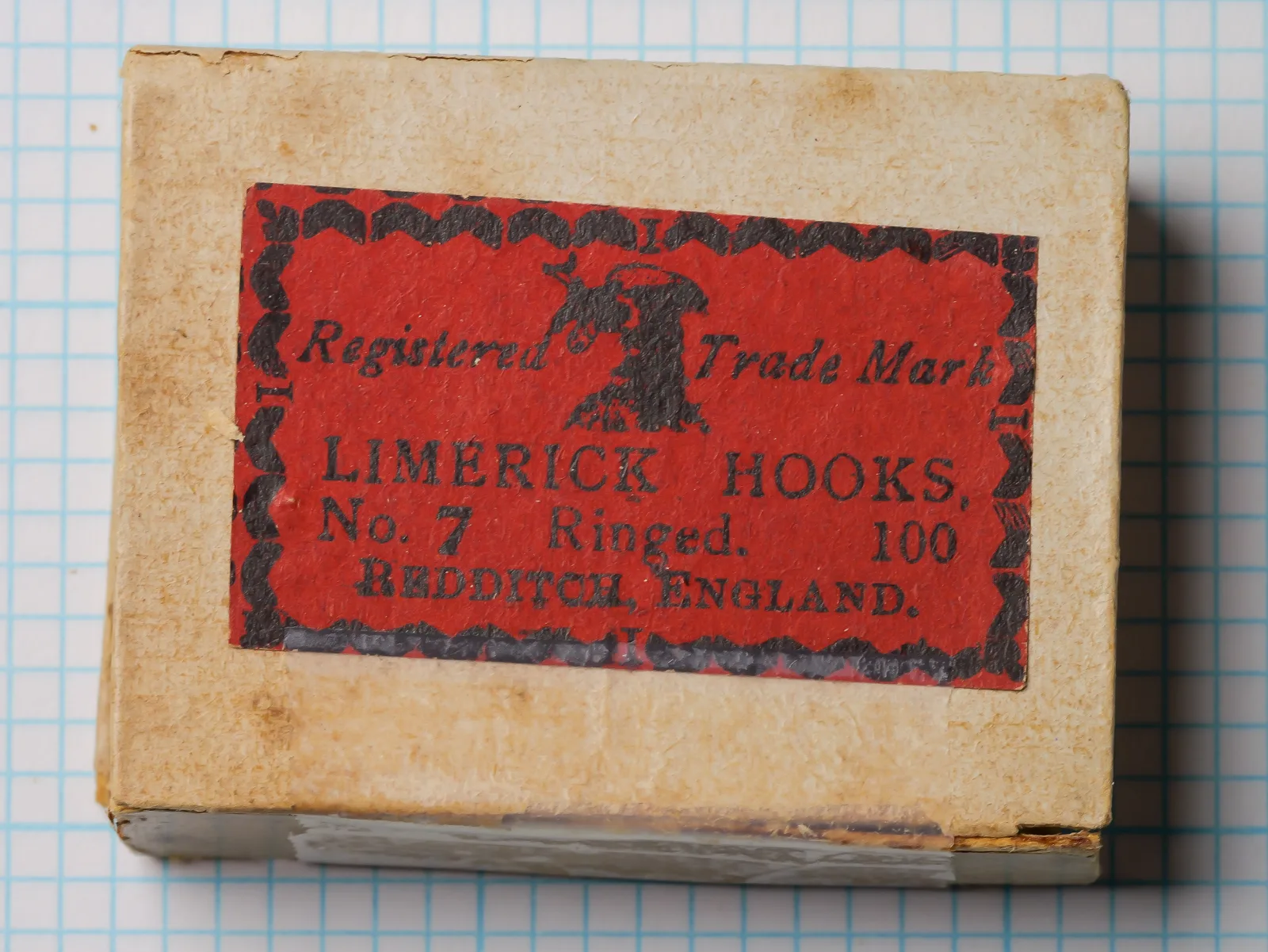
Original red-and-black printed label identifying Henry Wilkes Limerick hooks, size 7, Redditch manufacture. The 'Registered Trade Mark' and lion-head emblem reflect late Victorian branding standards.
Photographic record
4 cataloged imagesSelect any record to load it above.
4 images shown
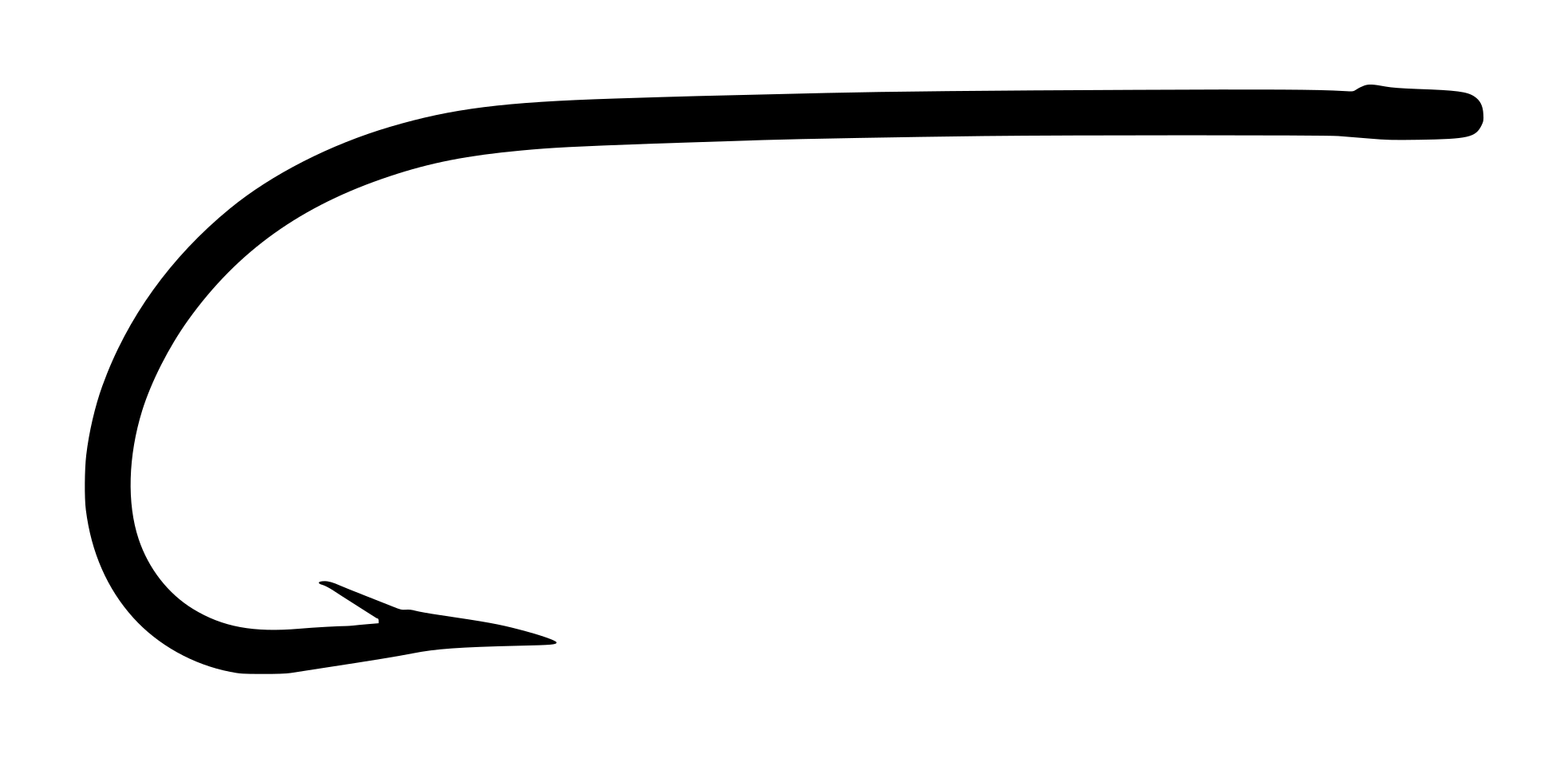
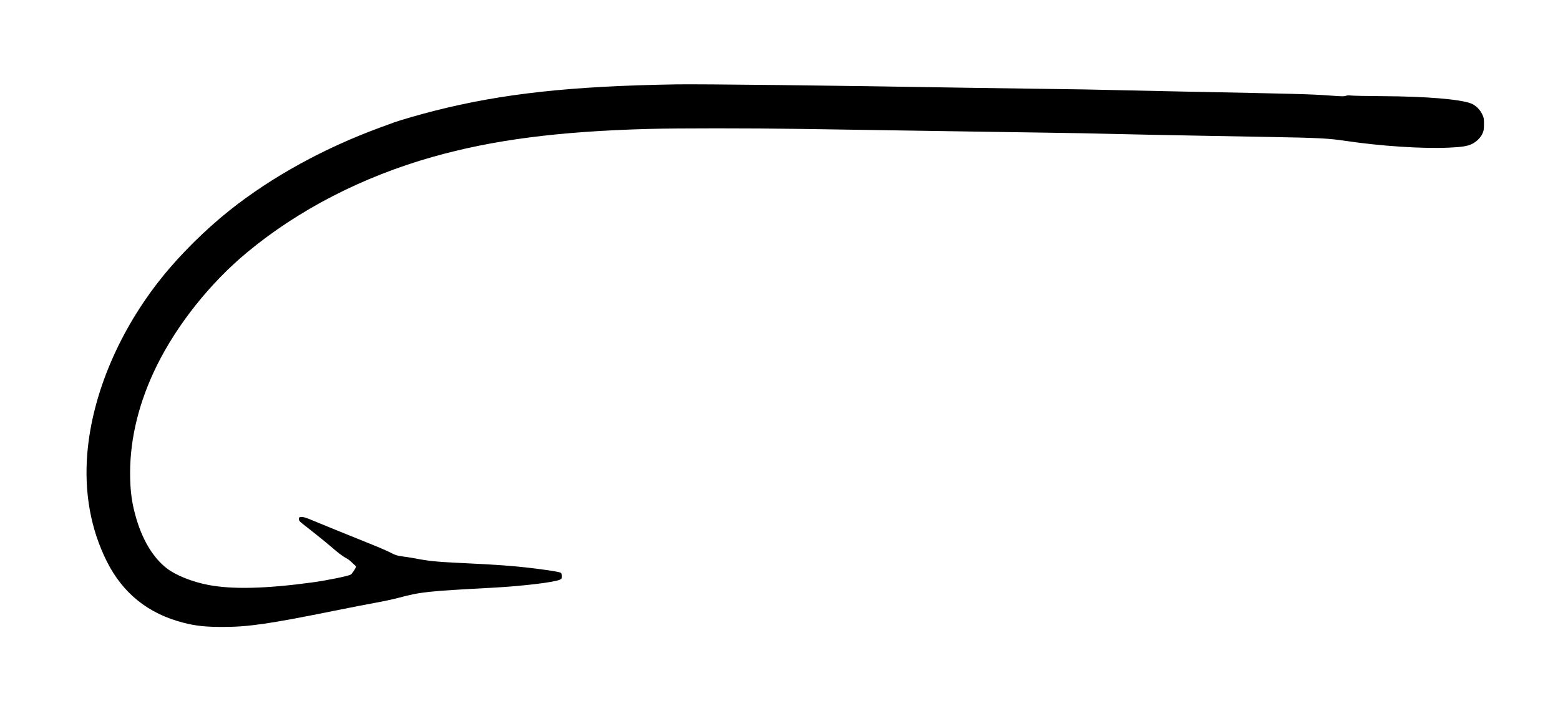
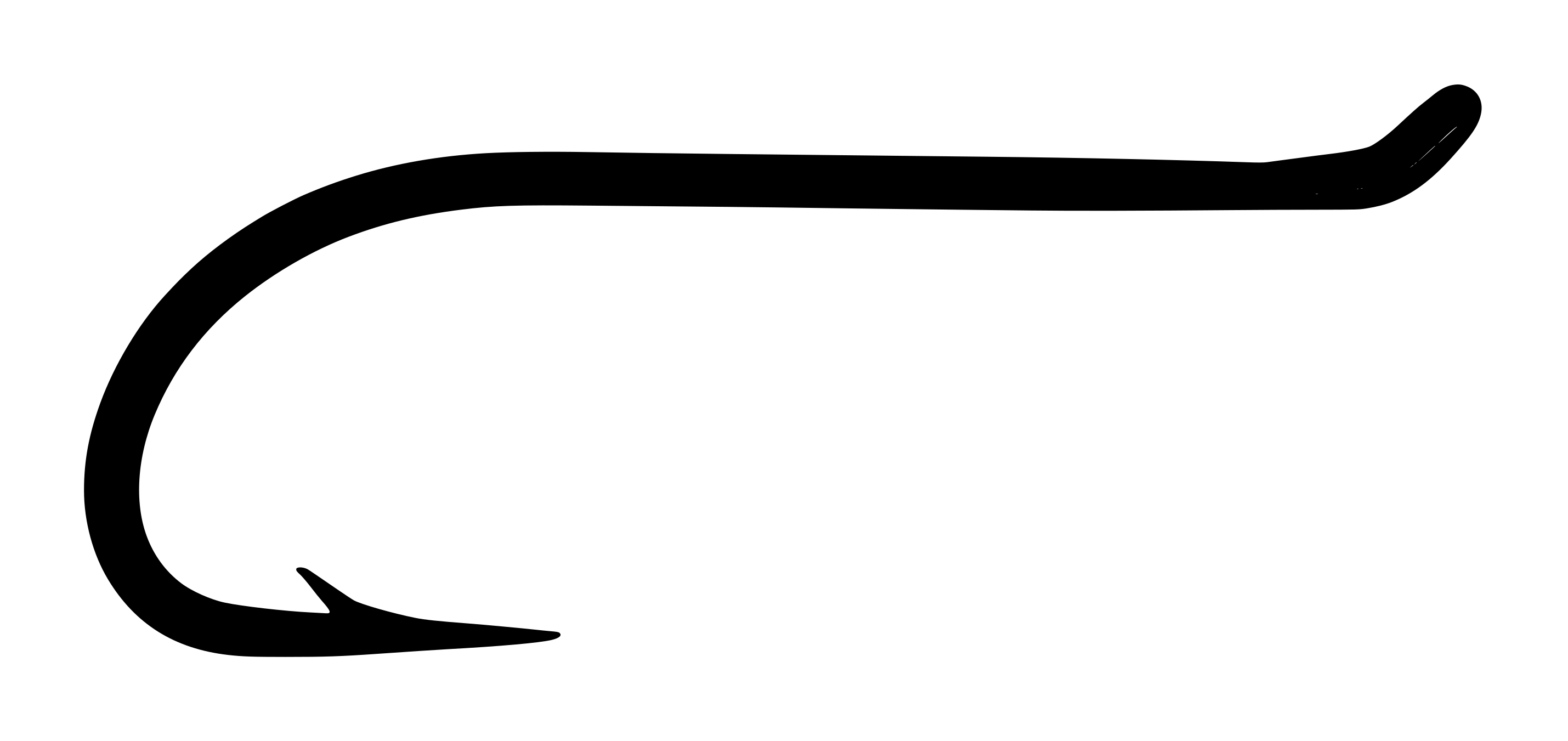
Henry Wilkes Limerick Size 7 Hook Box LabelOriginal red-and-black printed label identifying Henry Wilkes Limerick hooks, size 7, Redditch manufacture. The 'Registered Trade Mark' and lion-head emblem reflect late Victorian branding standards.Open originalHenry Wilkes Limerick Size 7 Hook Point ProfileClose-up of the hook point showing the superior-style point geometry with nearly flat inner face, short close-cut barb, and japanned black finish. Grid squares aid measurement verification.Open originalHenry Wilkes Limerick Size 7 Hook Full ProfileFull-length profile of the Limerick hook showing the straight ring eye, smooth shank, angular bend geometry, and superior point. The japanned finish is uniformly black with glossy tone.Open originalHenry Wilkes Limerick Size 7 Multiple Hook SpecimensThree size 7 Limerick hooks displayed to show consistency of eye closure, bend geometry, and japanned finish across specimens from the same original package.Open original
Technical profile
Straight Ring Eye | Limerick Bend | Standard Shank | Standard Wire | Superior Point | Japanned Finish
Eye
Ball Eye, Straight / InlineStraight ring eye with smooth closure and even diameter P. The ring is soldered or welded with no visible seam irregularities. Eye opening is aligned with the shank axis.
Wire
Heavy (1X Heavy), Forged
Shank
Standard — Plain
Bend
Limerick, Standard gapAngular Limerick bend profile characteristic of Redditch production. Bend is symmetrical and well-formed P, with a pronounced point where the shank meets the bend. The geometry provides excellent leverage and reliable hook-set properties.
Point
Standard / SpearShort, close-cut barb positioned immediately behind the point P. Barb angle is steep relative to the shank axis, typical of period English forging standards. Barb size is proportionate to the fine wire gauge.
Finish
Black Japanned — Confirmed (stated on packaging)Deep glossy black japanned lacquer coating (confirmed on original packaging) V. The finish is opaque and uniform, obscuring the underlying wire texture entirely—consistent with traditional japanning technique rather than bluing or bronzing. No visible wear or flaking on specimen.
Specimen hooks show excellent condition with no corrosion or defects visible. Original red-and-black label card is present, showing moderate age-related toning and creasing consistent with 120+ years of storage. No hooks appear to be missing from the documented count.
The superior-style point on this hook features a nearly straight inner taper from the barb to the tip, creating a near-flat inside face that provides consistent penetration. This geometry contrasts with hollow-point designs and is characteristic of English fly-hook tradition. The superior point is engineered to create immediate bite without requiring excessive taper, which would compromise wire strength in a medium-gauge hook.
The Limerick bend’s angular profile—rather than the rounded bottom of a Sproat or the wide curves of an Aberdeen—creates a sharp transition from shank to point. This geometry concentrates stress at a precise location and provides superior leverage during the hook-set moment. The bend is slightly upturned, placing the barb on the inner curve rather than the outer edge, which increases holding power once penetrated.
The japanned finish is a thick, glossy black lacquer applied by hand-dipping and curing. This finish offers superior corrosion resistance compared to simpler bluing or bronzing, making it well-suited to wet-fly and nymph fishing where hooks may spend extended time in water. The glossy surface also reduces light reflection, an advantage in clear water.
Size & scale lab
Selected size
7
Physical specimen
Overall Length
16.3 mmP
Shank Length
11.5 mm
Gap Width
5.6 mmP
Wire Diameter
1 mm
Shank-to-Gap Ratio
~1.9-2.2 : 1
Confidence
P
Physical specimen
Physical measurement with calipers
Own this hook? Help us measure it.
We don't have measured sizes for this hook yet. Own one? Submit calipered measurements and we'll review and add them. Thank you!
The Henry Wilkes Limerick represents the manufacturer’s adaptation of the Limerick bend profile—a design popularized by Irish hook makers and adopted across British fly-fishing tackle. The Limerick bend, characterized by its angular geometry and pronounced point, became one of the standard bend families alongside the Sproat, Aberdeen, and O’Shaughnessy.
Wilkes offered the Limerick in multiple sizes and configurations, with the No. 7 representing a medium size suitable for general trout fishing. This particular example, packaged on a commercial sales card for 100 hooks, reflects the standard distribution format of the late Victorian and Edwardian era. Wilkes continued production until at least the 1920s, after which the company’s market presence diminished as larger manufacturers like Mustad achieved global dominance.
This is not a named product series in the modern sense; rather, it is a standard catalog offering within the broader Limerick family of hooks. The straight ring eye is the only eye configuration documented for Henry Wilkes Limerick hooks in the surviving examples.
Era and Packaging Dating
Henry Wilkes branding on red/black printed card typical of late Victorian and Edwardian English hook packaging. No barcode present (pre-1974 indicator). Straight ring eye and japanned finish are consistent with turn-of-century English production standards. Letterpress printing on card stock reflects period technology. Redditch manufacture is stated in label text.
The Redditch Tradition
Redditch, England became the world center of hook manufacturing during the Industrial Revolution, driven by the town's proximity to coal supplies and water power for forges. By the 1890s, when Henry Wilkes was producing this hook, Redditch was home to dozens of hook makers—some employing hundreds of workers—all competing fiercely while maintaining a shared commitment to hand-forging quality. The Limerick bend itself originated in Ireland, but English Redditch makers rapidly adopted and refined it, creating a transatlantic hook-making dialogue that continued until Mustad's Norwegian factories achieved cost advantages in the 1950s-60s. This card represents not just a tool, but a moment when a small English town dominated a global industry through craft skill and tooling innovation.
Design lineage and influence
The Limerick bend predates Henry Wilkes by several decades, originating in Irish hook-making traditions during the mid-19th century. The angular geometry proved superior to purely rounded bends (Sproat) in specific applications, and the design was adopted by English makers including Allcock, Partridge, and Wilkes. The Limerick’s sharp point transition and pronounced barb made it particularly effective for dry-fly work where immediate penetration is critical.
The straight ring eye was the standard eye configuration for hooks of this era across all major makers, reflecting the tied-fly tradition and the technical simplicity of ring-eye construction. Later manufacturers (1920s onward) would gradually introduce turned-down and turned-up eye variations, but the straight ring remained common into mid-century for certain applications.
Henry Wilkes’ Limerick represents the continuation and refinement of a design that remained fundamentally unchanged for over a century. Modern Mustad, Tiemco, and Partridge hooks continue the Limerick bend, but with materials science and manufacturing precision unavailable to Victorian craftsmen.
Best matchRelated by Attribute
Computed automatically from catalog data — updated as new hooks are added.
Matches: Bend, Shank, Gap, Point, Forging +2 moreDiffers: Wire: Heavy (1X Heavy) vs Standard; Eye: Ball Eye vs Tapered Eye; Eye Orient.: Straight / Inline vs Turned Down +5 more
The Henry Wilkes Limerick was a versatile hook designed for both dry and wet fly fishing. The angular Limerick bend profile provides excellent hook-set geometry and is particularly well-suited to standard trout patterns. The straight ring eye accommodates both eyed flies tied directly to the hook and allows for fly-dressing techniques common in late 19th and early 20th century fly-tying traditions. The medium wire gauge and standard shank length position this hook between delicate dry-fly applications and slightly more robust wet-fly fishing.
Modern Equivalents
Hook
Match Quality
Notes
Mustad C49S Limerick
Very Good
Same Limerick bend profile; modern material and finish; wider size range available
Partridge GRS15ST
Good
Modern continuation of Redditch tradition; straight eye; slightly different wire profile
Collector notes
Rated 4.5/10 — uncommon in surviving original packaging; Henry Wilkes hooks are genuinely harder to find than contemporary Allcock or Partridge equivalents. Collector demand is modest but steady among Redditch specialists and British fly-fishing historians. The main limiting factor is that size 7 is neither rare nor exceptionally desirable; larger and smaller sizes would rate higher.
Reference value
$15 – $35 USD estimate
Packaging condition
Good — moderate wear, legibleRecorded specimen
Packaging format
HW-CARD-001Catalog code
Positive factors: Henry Wilkes is a recognized Redditch maker with documented quality standards. Original packaging (red-and-black label card) is intact and legible, which adds significant value over loose hooks. The japanned finish is confirmed on the original label and is in excellent condition. The hook count (100) is complete. Age (120+ years) and origin (pre-1920) place this in the early period of documented fly-hook manufacture. The straight ring eye and Limerick bend are both historically significant and still functionally relevant to modern tyers.
Limiting factors: Size 7 is a medium, general-purpose size that was produced in high volume across all manufacturers—scarcity is thus limited. Henry Wilkes never achieved the name recognition of Allcock or Partridge, so collector demand is narrower. The japanned finish, while authentic and attractive, is less visually distinctive than some bronzed or blued finishes. Condition of the card, while good, shows age-related wear that prevents a higher rating. No variant finishes or eye types are known to exist for this model, limiting collecting completeness.
Most desirable variants: Complete original cards with intact packaging command the highest premiums. Smaller sizes (No. 12 and finer) would be significantly scarcer and more valuable. Sealed or near-sealed cards fetch premium prices. Cards with any handwritten provenance or maker marks add historical interest.
Condition factors: The condition of the card is the primary value driver for a carded lot like this. Cards with no losses, clean printing, and secure hooks will sell at the top of the range. Missing hooks reduce value proportionally—a card with 95/100 hooks present drops 15-20% in value. Condition of the japanned finish on the hooks themselves is secondary if the card is intact (buyers assume hooks in original card are protected).
Packaging
Commercial sales card (approximately 4" x 5"), cream-colored card stock with inset red-and-black printed label. Label reads: 'Registered Trade Mark [lion head emblem] LIMERICK HOOKS, No. 7 Ringed, 100, Redditch, England.' Black decorative scalloped border frames the red label. Hooks are likely arranged in rows across the card face with each hook pierced through holes punched in the card. Original tissue or glassine separator sheet presumed present but not documented. Paper stock shows age-related yellowing and light creasing consistent with 120+ years of storage. Print method is letterpress. No barcode or modern pricing visible.
Market Value Notes
Low ($15): Opened card with all or nearly all hooks present, light wear, legible label
High ($35): Complete sealed or near-sealed card, pristine condition, zero hook loss
Premium factors: Redditch provenance, original packaging legibility, complete hook count, japanned finish intact, age 100+ years
Platforms: eBay UK and US, British tackle specialist dealers, occasional vintage tackle auctions
Confidence: E estimated — limited recent sales data for Henry Wilkes specifically; range derived from comparable Redditch maker carded lots (Allcock, Partridge size 7 cards in similar condition typically $12-40)
Where to Find
eBay UK (search 'Henry Wilkes Limerick' and 'Redditch hooks'); British vintage tackle dealers including Angling Auctions; occasional appearance at regional UK tackle fairs; very rare in North American dealers' stock.
Preservation
Storage and Preservation
Store the original sales card in a cool, dry environment away from direct sunlight and moisture. The japanned (lacquer) finish is durable but can develop bloom or very light clouding with humidity exposure over decades—this is cosmetic and does not affect function. The card stock itself is vulnerable to moisture, which can cause yellowing, warping, or mold growth. Use acid-free tissue or glassine barriers if storing near other paper materials. Avoid stacking heavy objects on top of the card, which can crease or warp it.
If the card is removed from storage for inspection, handle by the edges only. The printed label should not be touched with bare fingers, as oils can contribute to smudging or accelerated aging. Do not attempt to clean the label with liquids or abrasive materials. If hooks are removed from the card for tying, store them in a non-corrosive container (modern plastic tackle box or paper envelope); the japanned finish is highly resistant to corrosion but is not permanent, and storage in a humid environment will eventually cause oxidation.
Avoid contact with modern nickel-plated or stainless hooks, as galvanic corrosion can occur if stored together. The original card format is the best storage method for value retention and preservation, as it protects the hooks while displaying the maker’s branding and era.
Primary Source
Label and Packaging Text Analysis
Source: Henry Wilkes Limerick Hook sales card label, c. 1890-1920
The printed label on this card provides direct evidence of manufacturer attribution, model designation, finish confirmation, and geographic origin. The phrase ‘Registered Trade Mark’ appears at the top of the label, referencing trademark registration with the British Patent Office—a legal status common on British trade goods of the 1880s-1920s period. The lion-head emblem is a maker’s mark that would appear in the trademark registry; this particular emblem has not been independently verified in surviving Patent Office records but is consistent with Redditch maker iconography of the era.
The label states ‘LIMERICK HOOKS’ (capitalized, indicating a named product line) and ‘No. 7’ (size designation using the period-standard numbering system). ‘Ringed’ confirms straight ring eye construction. The quantity ‘100’ indicates this is a wholesale/trade pack rather than a retail consumer card, consistent with its sale through tackle dealers and fly-fishing suppliers. The specification ‘Redditch, England’ is the manufacturer’s claim of origin and was a mark of quality in the fly-fishing market of the period.
No finish is explicitly stated on the label, but the japanned black lacquer is confirmed by direct visual examination of the specimens and is consistent with period documentation practices (finish was often not printed on cards, as it was visible to buyers). The label layout and typography are characteristic of letterpress printing on colored card stock, the standard printing technology before 1920.
Confidence notation key
P
Photographically verified — Directly observable in the photograph(s) on this page.
V
Verified by documentation — Confirmed by manufacturer catalog, spec sheet, or published reference.
I
Inferred — A logical deduction from observable or documented evidence, not directly stated.
E
Estimated — An approximation based on visual comparison, proportional analysis, or limited data.
S
Speculative — A reasoned hypothesis that cannot be confirmed from available evidence.
Unnotated claims are the compiler’s synthesis; see Sources. All photographs on garrenwood.com are taken on a measurement grid where each square equals 1/10 inch (0.1″ / 2.54 mm).