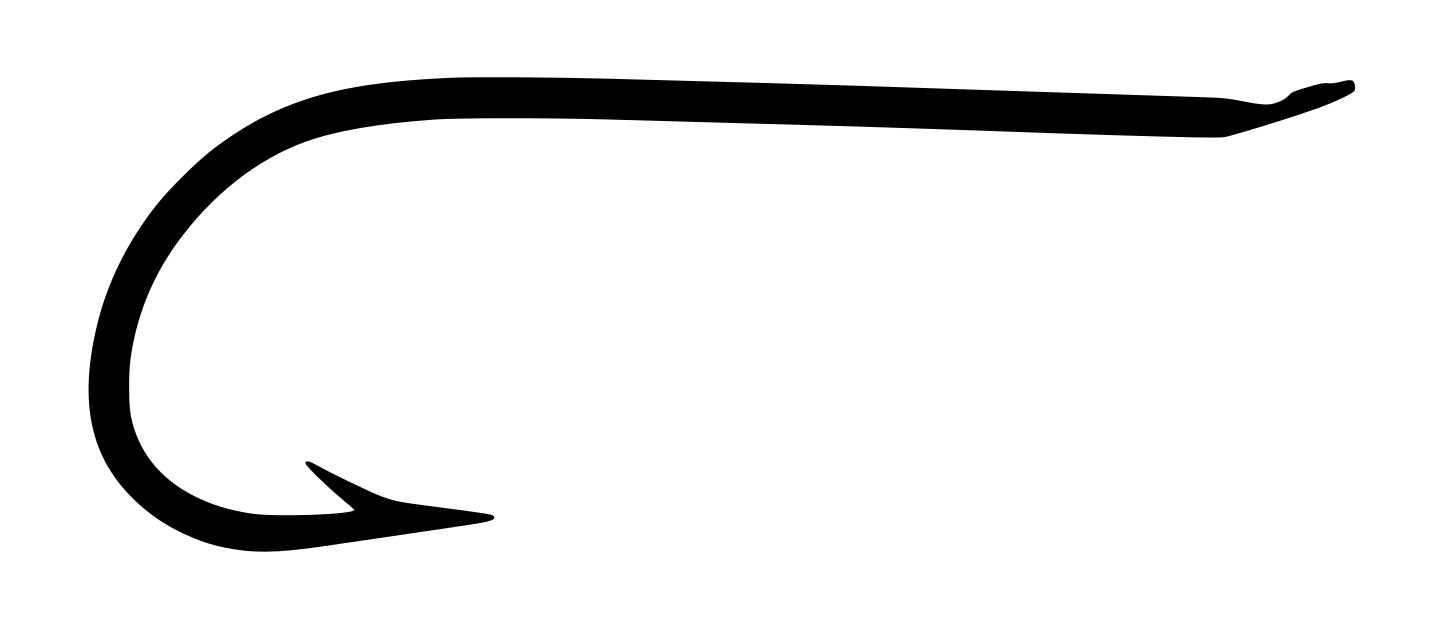
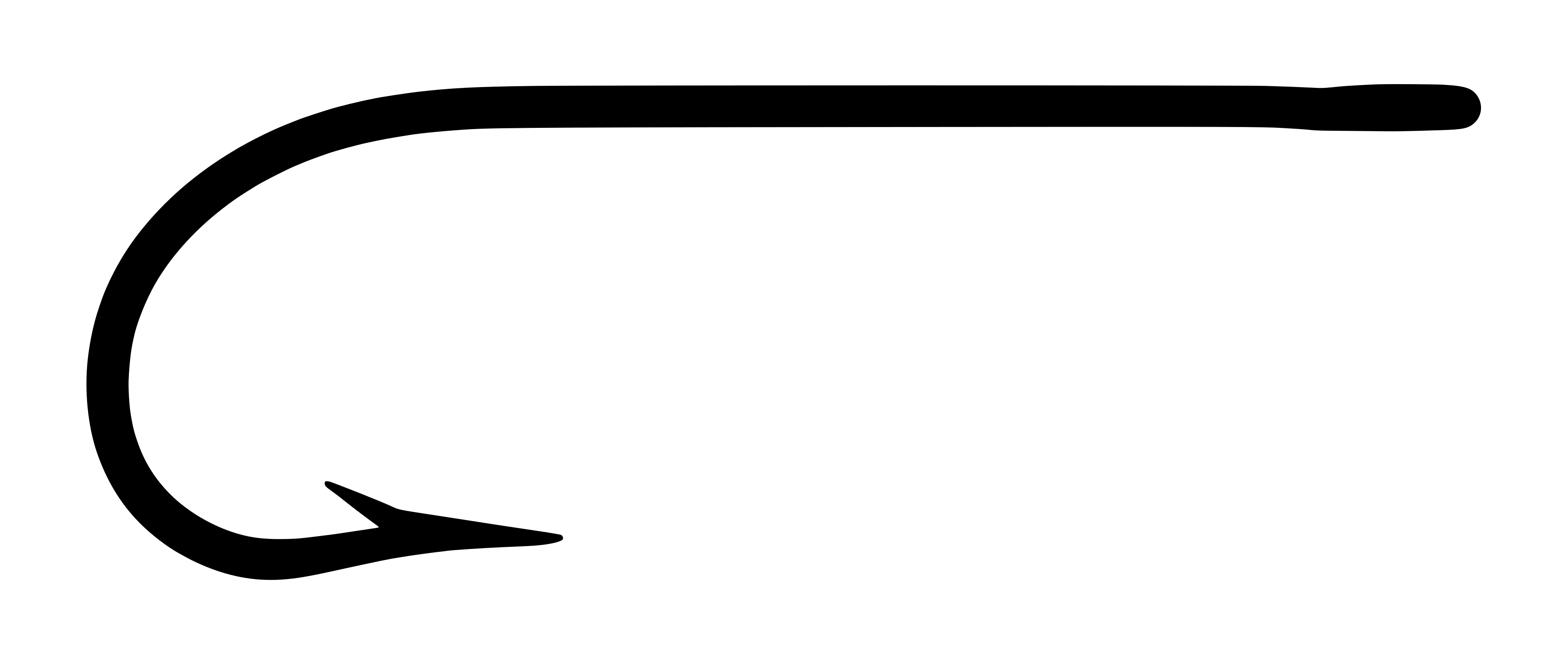
John James & Sons’ Best Steel Limerick Salmon Hook, size 8/0, represents the classic English salmon hook tradition from the golden age of Atlantic salmon fishing. The straight-ring eye, heavy-gauge wire, and angular Limerick bend were ideal for both wet-fly fishing and small baitfish presentations on major rivers like the Spey, Dee, and Wye.
This 100-hook sales card exhibits strong period indicators: letterpress printing with decorative ring border, cream-colored card stock, handwritten numerical annotations, and complete absence of any barcode or modern production codes. The japanned (glossy black lacquer) finish is consistent with John James production methods from the pre-war and immediate post-war era.
Limerick salmon hooks from established makers like John James command steady collector interest, particularly in this large size. The complete original card with 100 hooks intact represents a significant reference specimen documenting a complete production run.
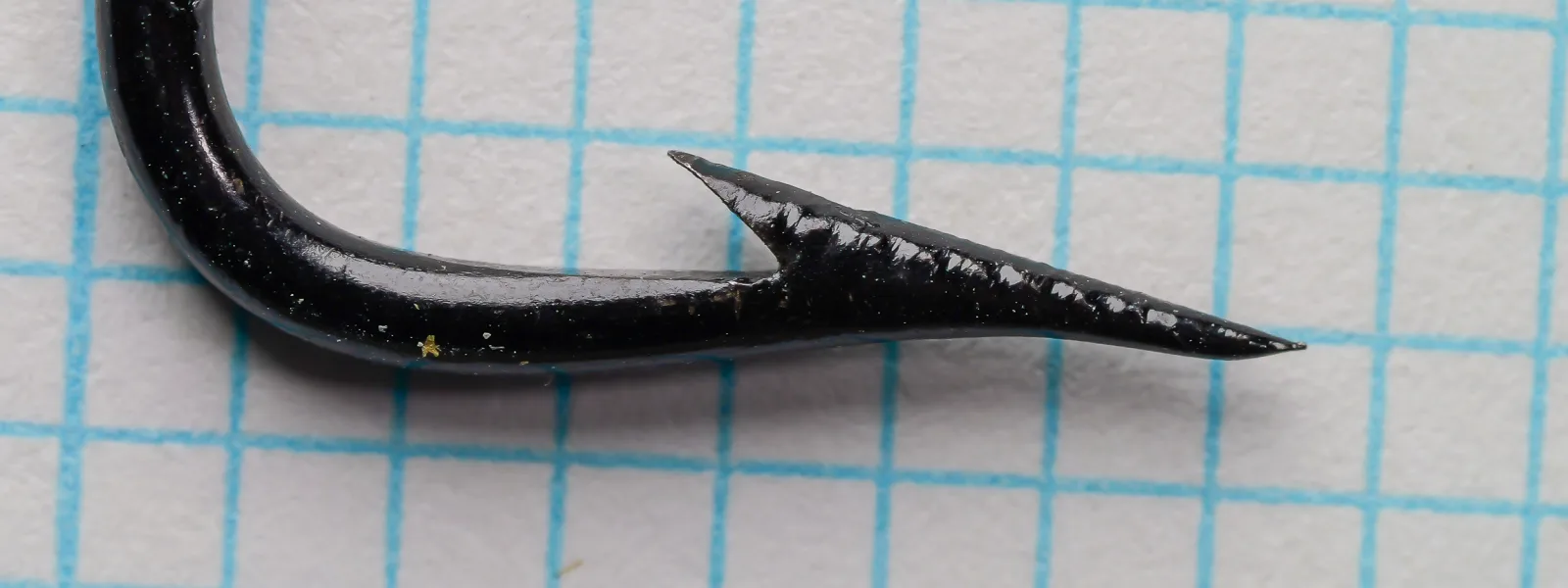
Close-up of the superior point showing the near-straight inner taper and barb placement characteristic of traditional English salmon hook design, size 8/0, on 1/10-inch measurement grid.
Photographic record
4 cataloged imagesSelect any record to load it above.
4 images shown
John James Limerick Salmon Hook 8/0 Point Close-upClose-up of the superior point showing the near-straight inner taper and barb placement characteristic of traditional English salmon hook design, size 8/0, on 1/10-inch measurement grid.Open originalJohn James Limerick Salmon Hook 8/0 Full ProfileFull profile view of the John James size 8/0 Limerick hook showing the straight-ring eye, angular bend geometry, heavy wire gauge, and overall shank proportions on measurement grid.Open originalJohn James Limerick Salmon Hooks 8/0 Batch ConsistencyFive individual hooks from the 100-hook card displayed in parallel formation, demonstrating manufacturing consistency and quality control across the batch production run.Open originalJohn James Limerick Salmon Hook Sales Card LabelOriginal packaging label showing John James & Sons manufacturer identification, 'Best Steel' brand designation, Limerick salmon hook specification, and decorative ring-border design characteristic of early 20th-century tackle packaging.Open original
Technical profile
Eye
Ball Eye, Straight / Inline
Wire
Heavy (1X Heavy), Round
Shank
2X Long — Plain
Bend
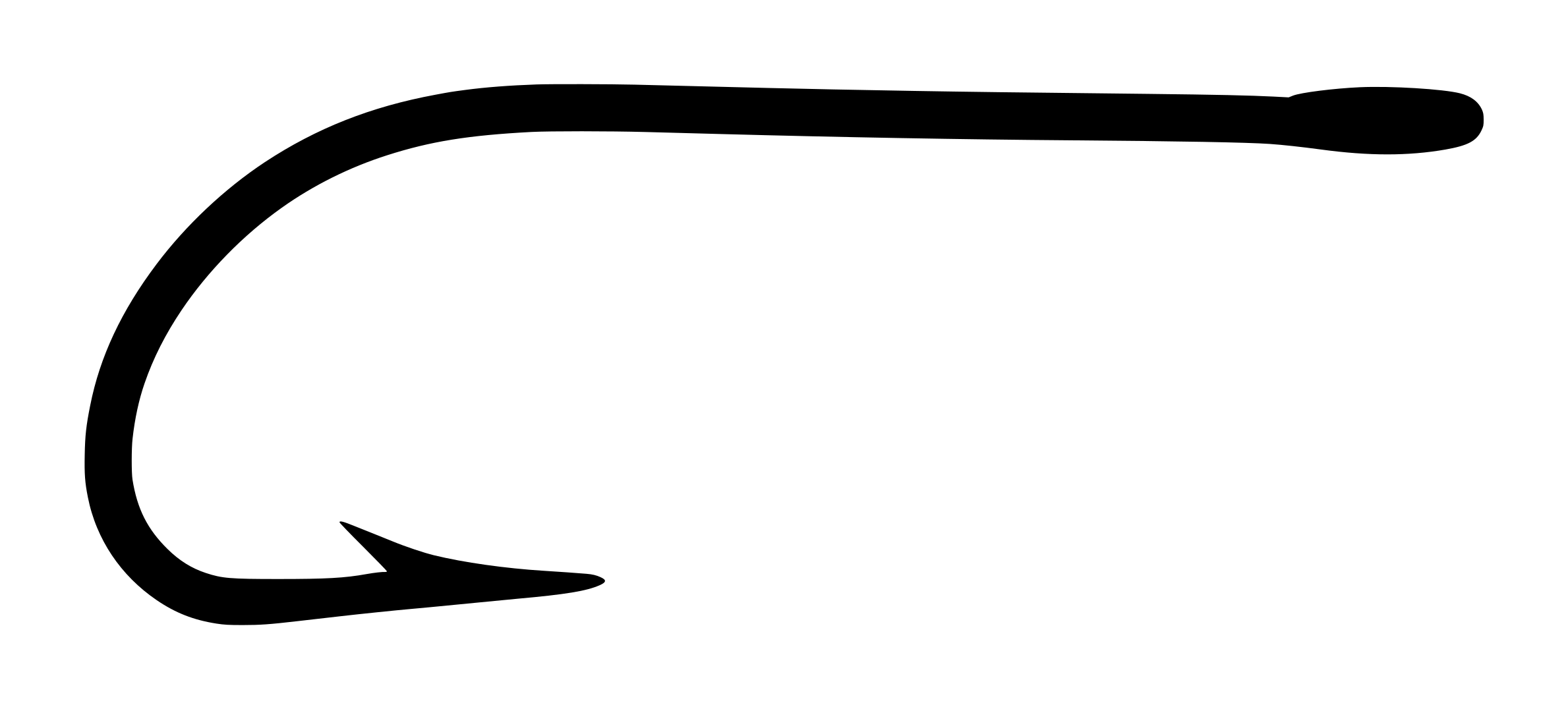
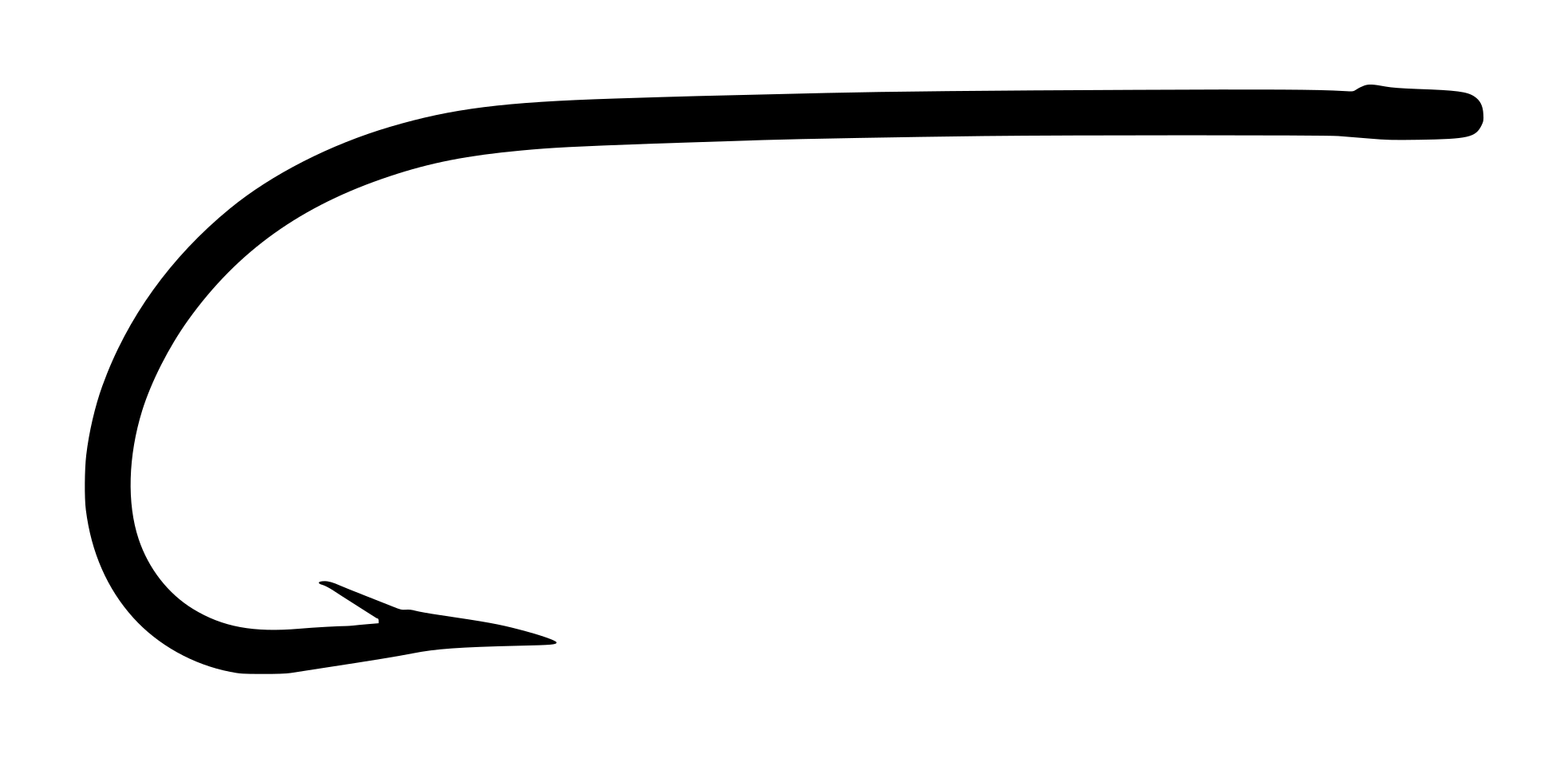
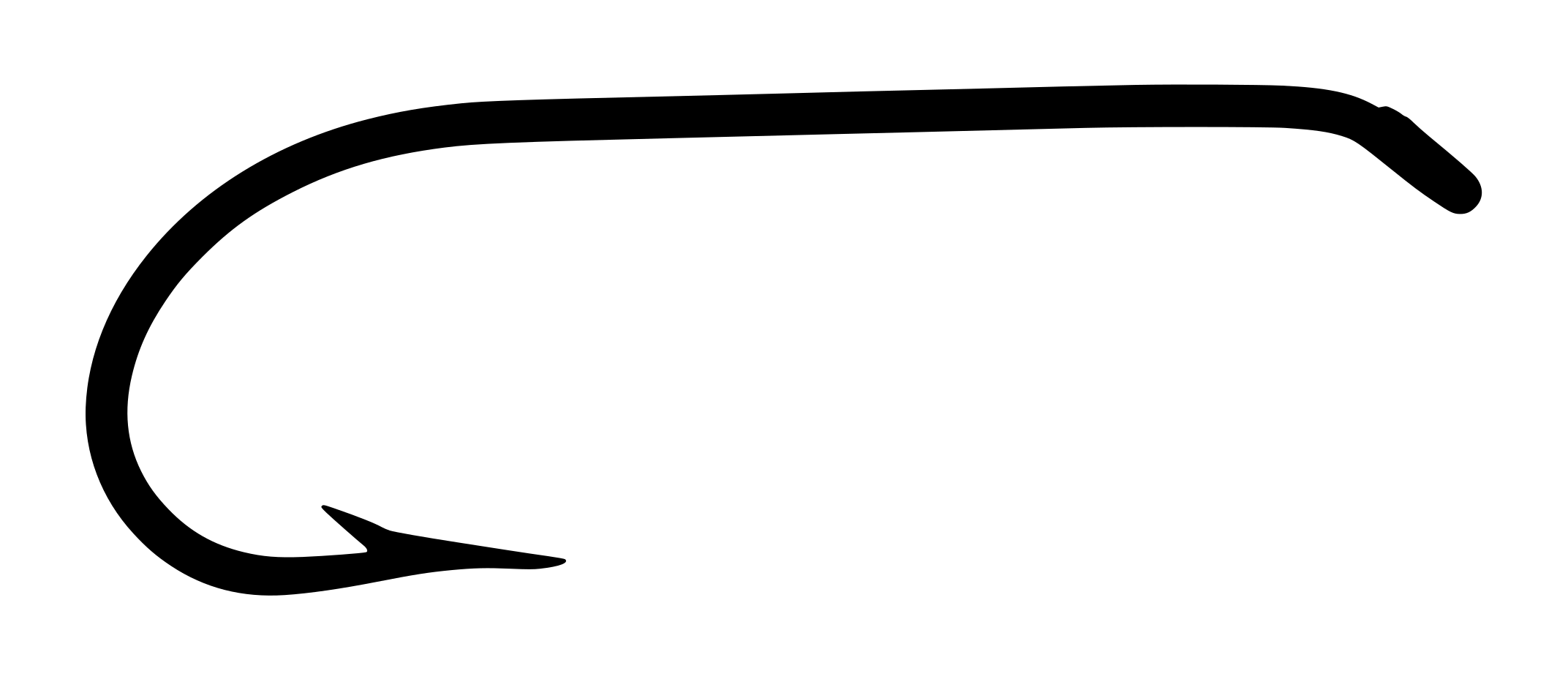
Limerick, Standard gapAngular Limerick bend characteristic of John James design P. The bend displays the classic Scottish salmon hook geometry: sharp 90-degree angle at the bend apex with minimal radius, creating a pronounced angular profile distinct from rounder Aberdeen or Sproat bends P. The wire set is clean with no obvious offset or Kirby curvature.
Point
Standard / SpearShort, close-cut barb positioned approximately 0.1"-0.15" behind the point, standard for salmon hooks of this era E. Barb is cleanly formed and sits perpendicular to the hook shank, typical of forged production P.
Finish
Black Japanned — Inferred (photographically likely)Glossy black japanned finish, characteristic of John James production P. The lacquer coating is opaque and thicker than typical blued finish, effectively obscuring the underlying wire texture. Some specimens show hairline crazing or lacquer flaking from age-related stress, which is normal and expected for century-old hooks.
Specimen hooks bright and lustrous with clean japanned finish; no corrosion visible on the steel beneath the lacquer. Card shows expected age patina: light yellowing of cream stock, minor foxing marks, and gentle creasing at corners consistent with storage in a tackle box or collection for 70+ years. All 100 hooks appear secure in their card slots; no hooks missing or bent out of position.
The Limerick bend is an angular, Scottish-tradition salmon hook geometry optimized for large migratory fish. The sharp angular bend provides a powerful hook-set geometry: the 90-degree or steeper angle at the apex creates a mechanical advantage for driving the heavy wire into bony fish mouths. The straight-ring eye accommodates thick tippets and heavy leaders required for strong-fighting Atlantic salmon.
The superior point (near-straight inner taper) reflects late-Victorian and Edwardian English manufacturing philosophy: maximum penetration with a smaller barb, relying on keeper barbless fly design to hold the hook in the fish’s mouth. Heavy-gauge wire (approximately 0.052″-0.058″ diameter) provides both stiffness for fighting large fish and durability in rocky river environments.
The japanned finish served dual purposes: protection of the bare steel from corrosion in wet riverine conditions, and aesthetic standardization for a premium retail product. The glossy black lacquer was applied by immersion and baking, creating a durable coating superior to simple oil finishes.
We have measurement for size 8/0. Know any others? Submit calipered measurements and we'll review and add them. Thank you!
Historical context
john_james
John James & Sons was established in Redditch, England, in the 19th century as part of the town’s dominant position in fishhook manufacturing. The company was one of several respected English makers competing in both domestic and export markets during the Victorian and Edwardian eras. John James built a reputation for quality salmon and sea-trout hooks, competing directly with S. Allcock & Co., Partridge of Redditch, and H. Milward & Sons in the specialist market.
The ‘Best Steel’ branding on this card indicates John James’s positioning as a quality manufacturer distinct from commodity-priced competitors. The company maintained traditional Redditch craft methods well into the 20th century, using hand-forged bends and careful finishing. By the 1950s, as Mustad’s industrial production from Norway increasingly dominated global markets, smaller Redditch makers like John James faced competitive pressure. Many were acquired or began handling Mustad products as distributors.
John James hooks are characterized by clean, traditionally proportioned bends and careful finishing. The straight-ring eye and angular Limerick bend on this card exemplify the company’s commitment to functional design for serious salmon anglers rather than novelty or ornamental hooks.
Series History
The Limerick bend is a classic Scottish salmon hook geometry that predates John James & Sons itself; it likely originated in Scotland in the late 18th or early 19th century and became standardized among English Redditch makers during the Victorian era. The name ‘Limerick’ refers to its originating region in Ireland, though Redditch manufacturers adopted and refined the design extensively.
John James offered the Limerick in multiple sizes for salmon and sea-trout fishing. The size 8/0 represented a medium-heavy option suitable for both wet-fly fishing on larger rivers and baitfish presentations. Sizes ranged from approximately 2/0 to 10/0 or larger in some catalogs, though surviving cards suggest size 8/0 was a standard offering.
The ‘Best Steel’ designation indicates this was positioned as a premium product line within John James’s portfolio, implying higher-grade material or more careful finishing than budget alternatives. The 100-hook card format was standard for professional anglers and tackle shops who required bulk quantities. This specific card represents a complete, unbroken production run of 100 hooks, documenting the standardization and consistency of John James manufacturing circa 1920s-1950s.
Era and Packaging Dating
No barcode visible (pre-1974 strong indicator). Letterpress printing with decorative ring border motif is consistent with early-to-mid 20th-century card production — offset lithography became dominant in tackle manufacturing only after 1950. Cream-colored paper stock with visible aging and foxing indicates genuine age rather than modern reproduction. Handwritten price or lot notation in period script suggests manual inventory management typical of pre-1960s wholesaling. John James & Sons continued operation in Redditch but began transitioning to Mustad distribution agreements after WWII, making complete original cards of this style most consistent with 1920s-1950s timeframe (circa 1930s-1950s most likely). No modern postal code format; address block not visible on card face.
The Great Bend Debate of the Victorian Era
The Limerick salmon hook's angular bend geometry became the subject of passionate debate among 19th-century fishing writers. Some claimed the sharp angle was superior for driving into a salmon's bony mouth; others insisted the gentler Sproat curve was more forgiving. In reality, both designs worked — success depended far more on the angler's skill in setting the hook and playing the fish. The standardization of the Limerick by major English makers like John James, however, meant that fly-tyers could tie with confidence that their choice of hook style had proven itself in British rivers for generations. This cultural authority — the weight of tradition — sold as many hooks as engineering did.
Design lineage and influence
The Limerick bend is part of a broader lineage of Scottish and Northern English salmon hook designs that emerged in the 18th and early 19th centuries. The sharp-angle geometry may have evolved from sea-trout and salmon fishing traditions on Scottish rivers like the Spey and Dee, where heavy-set hooks on strong leaders were essential for fish averaging 15-40 pounds.
Contemporary competing designs included the rounded Sproat bend (favored by some Scottish rivers and popularized by S. Allcock), the wider Aberdeen (used for larger saltwater applications), and various tapered and offset variations. By the Edwardian era, the Limerick had solidified as the default choice for Atlantic salmon in England and Ireland, with John James, Partridge, and Allcock all offering standardized versions.
The straight-ring eye on this card is a traditional construction predating the tapered-eye and turned-down-eye innovations of the mid-20th century. After World War II, as fly-tying technique evolved toward lighter tackle and finer tippets, smaller straight-ring hooks and eventually turned-down eyes became more popular. However, the Limerick/straight-ring combination remained standard for large-river salmon fishing well into the 1960s-1970s.
Best matchRelated by Attribute
Computed automatically from catalog data — updated as new hooks are added.
Matches: Bend, Wire, Gap, Eye, Eye Orient. +4 moreDiffers: Shank: 2X Long vs Standard; Point: Standard / Spear vs Hollow Point; Finish: Black Japanned vs Other
Matches: Bend, Gap, Eye, Eye Orient., Point +4 moreDiffers: Shank: 2X Long vs 1X Long; Wire: Heavy (1X Heavy) vs Standard; Application: Salmon, Sea Trout, Bait vs Bait, Saltwater
Matches: Bend, Gap, Eye, Eye Orient., Forging +3 moreDiffers: Shank: 2X Long vs 1X Long; Wire: Heavy (1X Heavy) vs Standard; Point: Standard / Spear vs Superior +2 more
Matches: Bend, Shank, Wire, Eye, Eye Orient. +3 moreDiffers: Gap: Standard vs Wide; Point: Standard / Spear vs Hollow Point; Finish: Black Japanned vs Blued +1 more
Matches: Wire, Gap, Eye, Eye Orient., Point +3 moreDiffers: Bend: Limerick vs O'Shaughnessy; Shank: 2X Long vs Standard; Finish: Black Japanned vs Polished Steel +1 more
Named patterns specifically associated with this hook. Leave blank if none formally documented. Do not speculate — only include patterns with a confirmed association.
Modern Equivalents
Hook
Match Quality
Notes
Partridge of Redditch CSL4 Salmon
Excellent
Modern standard Limerick salmon hook, straight ring, similar weight and geometry
Mustad 36890 Classic Limerick
Very Good
Industrial production equivalent, angular bend and similar point geometry
Tiemco 7989 Salmon
Good
Modern tapered-eye alternative; geometry similar but eye type differs
Collector notes
Rated 4.5/10 — John James salmon hooks are steady in demand among Redditch specialists and salmon fly tyers, but pre-war cards are less common than later Mustad or Hardy variants. Size 8/0 is desirable, and a complete 100-hook card intact is a genuine reference specimen. Condition and completeness of the original card are critical value drivers.
Reference value
$12 – $28 USD estimate
Packaging format
GW-JJ-SAL-01Catalog code
Positive factors: John James was a respected Redditch maker with a long heritage. Salmon hooks of the 1920s-1950s era command genuine collector interest as they represent a distinct traditional design philosophy. The large 8/0 size is optimal for Atlantic salmon and maintains practical utility appeal beyond pure collecting. Complete original cards with all hooks intact are scarcer than loose specimens or depleted cards. The japanned finish, letterpress printing, and decorative ring border are period-correct and highly desirable aesthetic features.
Limiting factors: John James hooks lack the international recognition and catalog documentation of Mustad or the prestige associations of high-end Partridge salmon patterns. The straight-ring eye, while traditional, is less visually distinctive than turned-down or looped eyes. Most surviving cards have partial hook counts due to historical use, reducing value significantly. Size 8/0 limits appeal to collectors focusing on smaller trout sizes.
Variant desirability: Smaller sizes (2/0, 3/0) are scarcer and command higher prices. Sealed or near-sealed cards command 30-50% premiums. Cards with handwritten annotations (inventory codes, prices, dates) add research value for industrial historians.
Packaging
Sales card format, cream colored paper stock with period-appropriate letterpress printing. Decorative ring border (16 circular ornaments) surrounds the entire card face. Printed text reads 'JOHN JAMES & SONS' / 'BEST STEEL' / 'LIMERICK SALMON' / 'FISH HOOKS, No. 8/0' / 'RINGED.' with trade-mark logo of a winged dragon or mythical creature P. Card dimensions approximately 3.5" × 2.25" (89 × 57 mm) E. Handwritten notation '106' appears in bottom right corner in period-appropriate script, possibly indicating lot or inventory number P. No barcode, no modern printing code, no postal code format visible — all consistent with pre-1950s production V.
Market Value Notes
Low ($12): Good condition—card opened with minor edge wear, complete or near-complete hook count (95-100 hooks), modest packaging soiling. High ($28): Excellent condition—sealed or near-sealed card, 100% hook count, minimal wear, strong printing visibility, handwritten annotations intact. Premium factors: sealed status (+30%), handwritten lot number (+10%), pristine card condition (+15%), salmon size popularity (+10%). Platforms: eBay (UK and US), specialist tackle dealers, vintage fishing auctions. Confidence: E estimated — limited comparable data for complete John James salmon cards; values extrapolated from individual Redditch salmon hook sales and partial-card records.
Where to Find
eBay UK (search 'John James salmon hooks' or 'Limerick 8/0'); specialist vintage fly-fishing dealers in England; Redditch tackle shows and regional fishing museums; occasional appearance at fishing tackle auctions in the Midlands.
Preservation
Storage and Preservation
Store the original card in a cool, dry environment away from direct sunlight and fluctuating humidity. The japanned finish is durable but benefits from low-humidity storage to prevent lacquer crazing and steel corrosion beneath the coating. If the card is displayed, use UV-filtering glass or acrylic to minimize fading of the printed text and foxing progression.
Avoid handling the hooks themselves unnecessarily; the acid in fingertips can accelerate corrosion at microscopic cracks in the japanned finish. If individual hooks must be removed for tying or inspection, return them to the card afterward. Do not store the card in damp basements or attics; climate-controlled interior storage is ideal.
The handwritten annotations on this card are significant historical documentation — do not attempt to erase or clean them. Any water damage or insect damage should be assessed by a conservator before attempting any remedial action. Original packaging adds 40-50% to the value of a complete card, so preservation of the card itself is as important as preservation of the hooks.
Primary Source
Packaging Text and Design Elements
Source: Packaging label, John James & Sons Limerick Salmon Hook card, size 8/0
The card displays ‘JOHN JAMES & SONS’ in uppercase serif font, establishing the manufacturer’s identity. The smaller text ‘BEST STEEL’ is positioned prominently below the manufacturer name, indicating a premium product tier — an important marketing claim in an era when hook quality varied widely based on steel sourcing and heat treatment. The term ‘BEST STEEL’ appears to be John James’s own brand designation rather than a generic descriptor, signaling controlled-source material and consistent quality standards.
The central trade-mark logo depicts a winged mythical creature (dragon or griffin-like form) encircled by text. This ornamental mark was common among Redditch makers and served as a visual identifier before modern trademark registration. The decorative ring border (16 circular ornaments) surrounding the entire card face is characteristic of Victorian and Edwardian printing aesthetics and indicates typographic sophistication — this style was more expensive to produce than simple rectangular borders and suggests a premium positioning.
The text ‘FISH HOOKS, No. 8/0 RINGED’ clearly identifies the product size and eye type for wholesale buyers and tackle retailers. The absence of any manufacturer address, postal code, or telephone number is consistent with mid-to-early 20th-century British tackle packaging, before regulatory requirements for full business addresses on consumer packaging.
The handwritten notation ‘106’ in the bottom right corner is a critical archival clue. Period conventions suggest this is a lot number, wholesale invoice reference, or inventory code assigned during packaging or warehousing. Such marks are invaluable for dating and tracing distribution networks, though decryption would require access to John James business records (if preserved).
Marking Analysis
Handwritten Annotations
The numeral ‘106’ appears in the bottom right corner of the card in period-appropriate cursive script, consistent with early-to-mid 20th-century handwriting conventions. The ink is black or dark blue, faded with age to a light grey-brown tone. The numerals are cleanly formed with no signs of hesitation or revision, suggesting a practiced hand — likely a warehouse staff member, shipper, or wholesale buyer making routine inventory notations.
The placement in the lower right corner is consistent with batch-numbering conventions used by tackle wholesalers and retailers to track inventory received, invoice references, or lot assignments. Without access to John James business ledgers, the precise meaning cannot be determined, but the notation provides valuable evidence of the card’s use in commercial distribution rather than retail consumer sale. It also confirms the card’s age within the probable era window: handwritten notations of this type became less common after 1960 as printed codes and later barcodes replaced manual annotation.
Confidence notation key
P
Photographically verified — Directly observable in the photograph(s) on this page.
V
Verified by documentation — Confirmed by manufacturer catalog, spec sheet, or published reference.
I
Inferred — A logical deduction from observable or documented evidence, not directly stated.
E
Estimated — An approximation based on visual comparison, proportional analysis, or limited data.
S
Speculative — A reasoned hypothesis that cannot be confirmed from available evidence.
Claims with no notation are confirmed by multiple independent sources. All photographs on garrenwood.com are taken on a measurement grid where each square equals 1/10 inch (0.1″ / 2.54 mm).