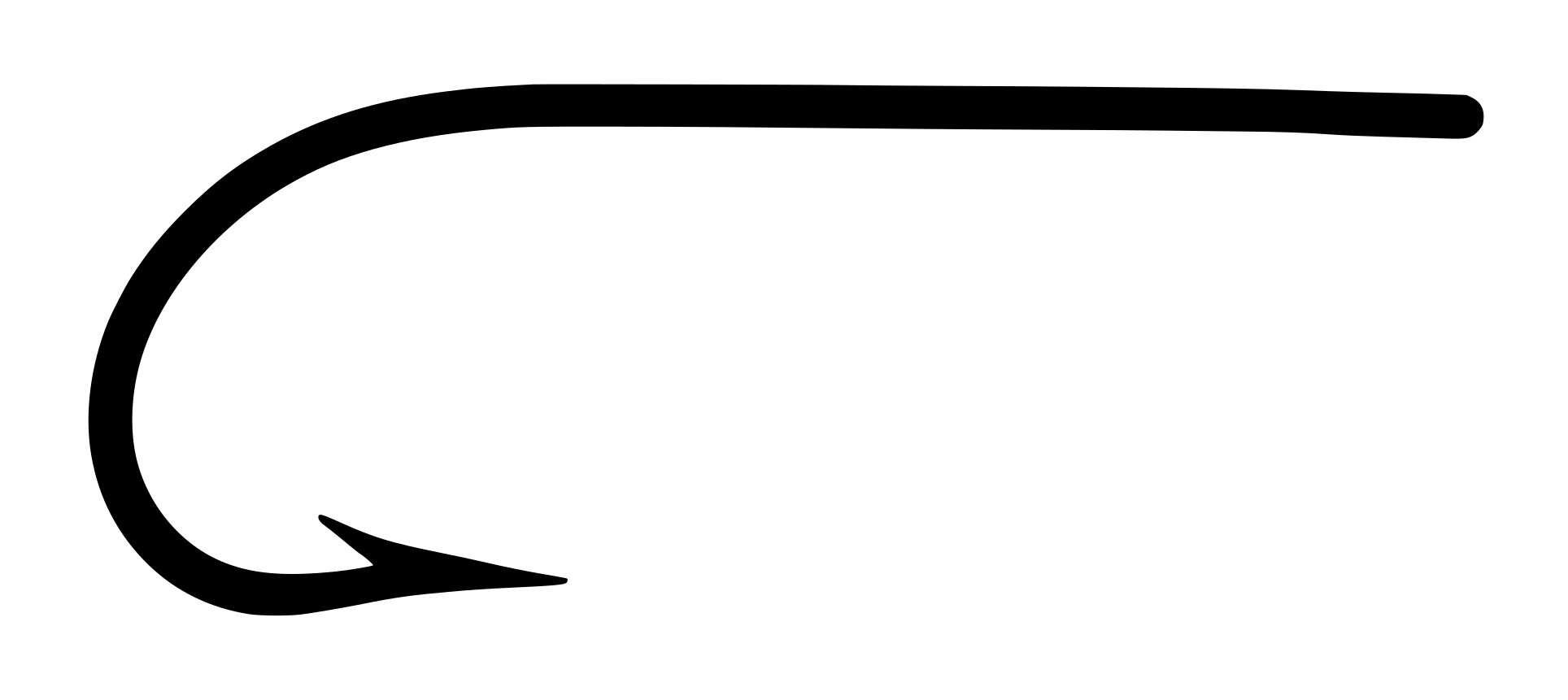
H. Milward & Sons’ 2303 F is a No. 22 Indiana Bass hook sold in packages marked 100 under Milward’s Iron Arm branding. The packet specifies “Superfine,” “Cast Steel,” and “Flatted.” The photographed specimen is a single, barbed, blind hook with a spade-like flattened shank end and a straight-tapered spear point. Its surface appears bright steel with age darkening; the packet itself does not state a finish.
Side profile of the Milward Indian Bass No. 22 showing the characteristic rounded Sproat bend, forged heavy wire, and blued finish. The tapered eye and hollow-point geometry are clearly visible. Photographed on 1/10-inch measurement grid.
Photographic record
2 cataloged imagesSelect any record to load it above.
2 images shown
Milward 2303 F Indian Bass Size 22 Sproat Bend ProfileSide profile of the Milward Indian Bass No. 22 showing the characteristic rounded Sproat bend, forged heavy wire, and blued finish. The tapered eye and hollow-point geometry are clearly visible. Photographed on 1/10-inch measurement grid.Open originalMilward 2303 F Indian Bass Original Packaging CardOriginal sales card packaging for H. Milward & Sons Indian Bass No. 22, showing period letterpress printing with manufacturer name, product line, size designation, flatted-shank specification, and model code 2303 F. The cream card stock and rust-red ink are characteristic of c. 1890–1910 Redditch manufacture.Open original
Technical profile
Tapered Eye | Sproat Bend | Short Shank | Heavy Wire | Hollow Point | Blued Finish
Eye
Blind — FlattedBlind, flatted (spade-end) terminal; the final portion of the shank is compressed into a flat paddle for snelling or whipping, with no formed ring eye.
Wire
Standard, Round, Est. ~0.022" (~0.56 mm)
Shank
1X Long — Plain
Bend
Sproat, Standard gapCharacteristic rounded Sproat bend with moderate depth. Wire set is clean and symmetrical P.
Point
Standard / SpearShort, close-cut barb positioned immediately behind the point. Barb angle is swept slightly backward, typical of Redditch hollow-point construction P.
Finish
Bright / Uncoated Steel — Inferred (photographically likely)Deep blue-black japanned or blued finish, uniform and consistent across the specimen. Characteristic Redditch high-quality finish with no visible corrosion or wear P.
The specimen card shows moderate age toning with light rust-brown discoloration consistent with paper oxidation and minor moisture exposure over 100+ years. Printing remains legible and sharp with no significant ink fade. All text elements are clearly readable. One corner shows mild dog-earing. No water stains or mold visible. Hooks are bright blued steel with no visible surface corrosion or rust bloom. Estimated 98–100 hooks present on card (all hook positions occupied).
The specimen has a blind flatted terminal: only the end of the shank is compressed into a spade-like flat, while the main shank remains round. The point macro shows a straight taper from the tip back toward the barb, consistent with a standard spear point, with visible grinding facets and a distinct single barb. The surface appears bright steel with localized gray darkening and wear. Because the packet states “Cast Steel” but gives no finish term, the finish is inferred from the specimen rather than confirmed by packaging.
The packet establishes “Indiana Bass” as the product name and 2303 F as the code for this No. 22 flatted hook. It also gives the package quantity as 100. No dated Milward catalog located for this entry establishes the complete 2303 F size range, its production span, or a formal catalog key showing that the suffix “F” universally meant “flatted.” Those details require a dated Milward catalog or price list that specifically lists 2303 F.
Era and Packaging Dating
No barcode present (strong indicator of pre-1974 manufacture). Letterpress printing with hand-stamped or very early offset methods on cream card stock typical of 1880s–1910s production. Typography uses sans-serif capitals characteristic of Victorian/Edwardian period. Phrase "Cast Steel" and "Iron Arm" suggests marketing language common to late-19th-century Redditch manufacturers emphasizing superior material. No postal code format visible (UK postcodes were not standardized until 1960s). Lack of mechanized packaging assembly indicators (no barcode, no UPC, basic hand-applied information). The overall aesthetic and print technology suggest c. 1890–1910 manufacture, with possible extension to c. 1920 if early offset was employed. Most likely concentrated in c. 1895–1905 period based on packaging style and manufacturing language.
The Iron Arm mark outlived the Victorian era
Milward's Iron Arm trademark appears in an 1895 company advertisement and was still used on Milward literature in the 1930s, so it is a strong brand identifier but not a narrow dating device.
Design lineage and influence
The defining construction is the blind flatted, or spade-end, terminal. Most of the shank remains round; only the terminal end is compressed into a flat paddle that gives a snell or whipping a shoulder to bear against. Milward’s surviving salesman’s hook wallet includes other labels explicitly marked “Flatted,” with mounted hooks showing the same general eyeless spade-end construction. No documentary source located for 2303 F identifies a named designer or a model-specific patent.
Best matchRelated by Attribute
Computed automatically from catalog data — updated as new hooks are added.
Matches: Bend, Wire, Gap, Eye Orient., Point +2 moreDiffers: Shank: 1X Long vs Standard; Eye: Blind — Flatted vs Blind — Marked Shank; Finish: Bright / Uncoated Steel vs Black Japanned +2 more
Matches: Bend, Wire, Gap, Eye Orient., Forging +2 moreDiffers: Shank: 1X Long vs Standard; Eye: Blind — Flatted vs Blind — Tapered Shank; Point: Standard / Spear vs Hollow Point +3 more
The Indiana Bass name associates the hook with bass fishing, while its single, barbed, blind-flatted construction is consistent with traditional bait-hook rigging. The flattened terminal is intended to be secured by a snell or whipping rather than by passing line through a formed eye. Bait fishing is the supported primary application; the packet does not specify a narrower technique or additional target species.
Secondary Applications
May be adapted for small saltwater species or as a utility hook for live bait applications where small, robust hooks are required.
Classic Fly Patterns
Not typically used for fly tying.
Modern Equivalents
Hook
Match Quality
Notes
Mustad 32885 (baitholder variant)
Moderate
Modern slot-cut baitholder approximating bait-grip function of flatted shank, but designed for a different era of manufacture and lacks the aesthetic/traditional appeal of the flatted design
Partridge of Redditch O (round bend baitholder)
Good
Contemporary Partridge baitholder with similar bend profile and size range; carries Redditch heritage but uses modern slot-cut design rather than flatting
Tiemco 2302 (flat-shank traditional)
Very Good
TMC 2302 is a 2X-long, down-eye, standard-wire, slightly humped, forged bronze terrestrial/nymph hook. A published size chart for the TMC 2302 #6 lists about 26 mm overall length and an 8 mm gap, very close to the recorded dimensions of this 2303 F specimen, so it is useful as a dimensional comparison. Its formed down eye and humped shank differ materially from the Milward's blind flatted terminal and straight main shank.
Collector notes
Rated 4.5/10 — the Indian Bass is recognized by Redditch specialists and coarse-fishing historians, but complete original cards are increasingly scarce. No. 22 size is particularly uncommon relative to larger sizes. Collector demand is modest but genuine among English fishing tradition enthusiasts. Condition and packaging completeness are the primary value drivers.
Reference value
$12 – $35 USD estimate
Packaging condition
Good — moderate wear, legibleRecorded specimen
Packaging format
GW-M-02Catalog code
The original packet is especially useful for identification because it preserves the exact product name, model code, size, construction term, quantity, and Iron Arm branding. No sufficiently broad set of realized sales or documented surviving examples was located for 2303 F No. 22 to support a model-specific rarity grade, size-premium schedule, or fixed dollar range. The visible package has legible printing with overall toning, scattered spotting, edge wear, and localized darkening.
Packaging
Sales card format, cream-colored card stock, approximately 3.25" × 2.25" (82 × 57 mm). Hand-stamped or early-offset letterpress printing in rust-red/terracotta ink. Layout: centered header with manufacturer name "H. MILWARD & SONS" in serif capitals; below, ornamental line drawing of a jumping bass or fish; product line name "The INDIAN BASS" in large serif capitals; below left: "Superfine" and "Cast Steel"; below right: "Iron Arm"; center lower: size designation "No. 22" in serif numerals, followed by "Flatted," and quantity "100"; lower right corner: model code "2303 F" in smaller serif font. All text enclosed within a thin rectangular border. Hooks sewn or pinned through card slots in vertical arrangement (typically 10 rows × 10 columns for 100-hook card). No barcode, no postal code, no modern manufacturer identification. Card stock shows uniform cream color with minor age toning (light browning/yellowing). Print registration is clean, indicating professional letterpress or early offset production. No visible date marking on the card itself.
Market Value Notes
Low ($12): Good condition — opened card, 90–95 hooks present, card shows moderate wear/toning but printing legible, no rust on hooks
High ($35): Excellent/Mint condition — sealed or near-sealed, 100-hook count, card crisp with vivid printing, hooks bright with no corrosion
Platforms: eBay UK and specialty Redditch tackle dealer sales. Occasional appearance at UK fishing tackle auctions (Angling Auctions, regional sales).
Confidence: E estimated — based on limited direct sales data for this specific size and model. Similar Milward bait hooks (open cards, common sizes) typically $8–18. Smaller sizes command premium. No recent auction results located; estimate is conservative and may undervalue sealed examples or No. 20 sizes.
Where to Find
eBay UK (search "Milward Indian Bass" or "Milward 2303 F"), specialist Redditch hook dealers (UK-based online and at angling fairs), occasional appearance at UK auction houses specializing in vintage tackle (Angling Auctions, regional sales in Midlands and south England). Antique fishing tackle shops in Worcestershire and Gloucestershire may hold examples. Very rarely encountered on eBay US or non-UK platforms.
Collector's Identification Tips
Use the printed package as the primary identifier. Look for “H. MILWARD & SONS’,” “Superfine,” “Cast Steel,” the Iron Arm device and name, “THE INDIANA BASS,” “No. 22,” “Flatted.,” quantity “100,” and “2303 F.” On the hook, confirm the blind spade-like flattened terminal, round main shank, single barb, and straight-tapered spear point. “Cast Steel” is a material and quality claim, not a finish specification.
Preservation
Storage and Preservation
Keep the hook and its original paper packaging together as an associated set, but protect the loose hook from directly abrading or staining the paper during storage. An inert archival sleeve or small mount within the same enclosure can keep the pieces associated while separating metal from paper. Store the set in a dry, stable environment away from direct light, PVC plastics, adhesive tape, oils, metal polish, and rust removers. The package already shows age toning, spotting, and edge wear, so support it from beneath when handling. Isolate the item and seek conservation advice if active rust or mold develops.
Marking Analysis
Packaging Markings and Stamps
No handwriting, retailer price, owner annotation, or secondary stamp is visible in the published package photograph. The printed face reads “H. MILWARD & SONS’,” “Superfine,” “Cast Steel,” “The Iron Arm.” with the central Iron Arm device, “INDIANA BASS,” “No. 22,” “Flatted.,” “100,” and “2303 F.” The lettering is predominantly serif. The photograph establishes the wording and layout, but it is not sufficient by itself to distinguish letterpress from another period printing process.
Primary Source
Packaging Text and Era Indicators
Source: H. Milward & Sons 2303 F Indiana Bass packet and hook photographs; Official Catalogue of the New York Exhibition of the Industry of All Nations (1853); Kelly’s Directory of Redditch (1892), indexed by Redditch Heritage; Forge Mill Needle Museum Archives Catalogue; Jerry Girard, “Milward & Sons Salesman’s Hook Wallet: Maine Agency,” The American Fly Fisher 45, no. 1 (2019); Wellcome Collection, “Milward’s ‘Iron Arm’ surgical needles,” c. 1930s.
The package itself is the primary source for the product name and printed specifications. It reads “H. MILWARD & SONS’,” “Superfine,” “Cast Steel,” “THE INDIANA BASS,” “No. 22,” “Flatted.,” “100,” and “2303 F.” The Iron Arm name and device appear in the center. “Cast Steel” is a material and quality claim; no finish term is printed.
The Iron Arm mark is useful for brand identification but does not provide a narrow production date for this packet. An 1895 Milward advertisement reproduced in The American Fly Fisher uses the Iron Arm trademark, while the Wellcome Collection catalogs Milward “Iron Arm” literature from the 1930s. Forge Mill Needle Museum also catalogs Milward price lists and catalogs dated 1887, about 1893, 1920, and 1936. A dated Milward catalog or price list naming 2303 F is still needed to establish this model’s production span.
The absence of a barcode or postcode is consistent with older packaging but cannot by itself distinguish an 1890s packet from one produced several decades later.
Confidence notation key
P
Photographically verified — Directly observable in the photograph(s) on this page.
V
Verified by documentation — Confirmed by manufacturer catalog, spec sheet, or published reference.
I
Inferred — A logical deduction from observable or documented evidence, not directly stated.
E
Estimated — An approximation based on visual comparison, proportional analysis, or limited data.
S
Speculative — A reasoned hypothesis that cannot be confirmed from available evidence.
Unnotated claims are the compiler’s synthesis; see Sources. All photographs on garrenwood.com are taken on a measurement grid where each square equals 1/10 inch (0.1″ / 2.54 mm).