Manufacturer: S. Allcock & Co., Ltd., Redditch, England. Model: No. 180 F Kirby Hook. Primary use: Premium salmon and sea trout fly and bait fishing. Defining feature: Flatted (spade) eye with japanned (black lacquered) finish; classic Kirby offset bend with superior spear point.
The 180 F represents the Victorian-era gold standard for British game fishing hooks. Kirby hooks were among Allcock’s most celebrated patterns, and the factory tour documentation describes the ‘japanned hook’ finishing process using a black tarry liquid in a two-coat application. The flatted eye construction was standard practice for British salmon and sea trout hooks of this period before the shift to modern turned-down and tapered eyes in the mid-20th century.
Era evidence: No barcode (strong pre-1974 indicator); pink paper packaging with serif letterpress typography; decorative border ornaments; English postal address format; French text ‘Fabrique en Angleterre’ suggests export-market packaging. These elements collectively point to production between 1880–1930.
Collecting significance: Sought by Victorian tackle historians, salmon fly specialists, and British game-fishing enthusiasts. Complete original packaging commands a modest premium; loose hooks remain affordable but less desirable. Japanned finish is durable and usually survives well.
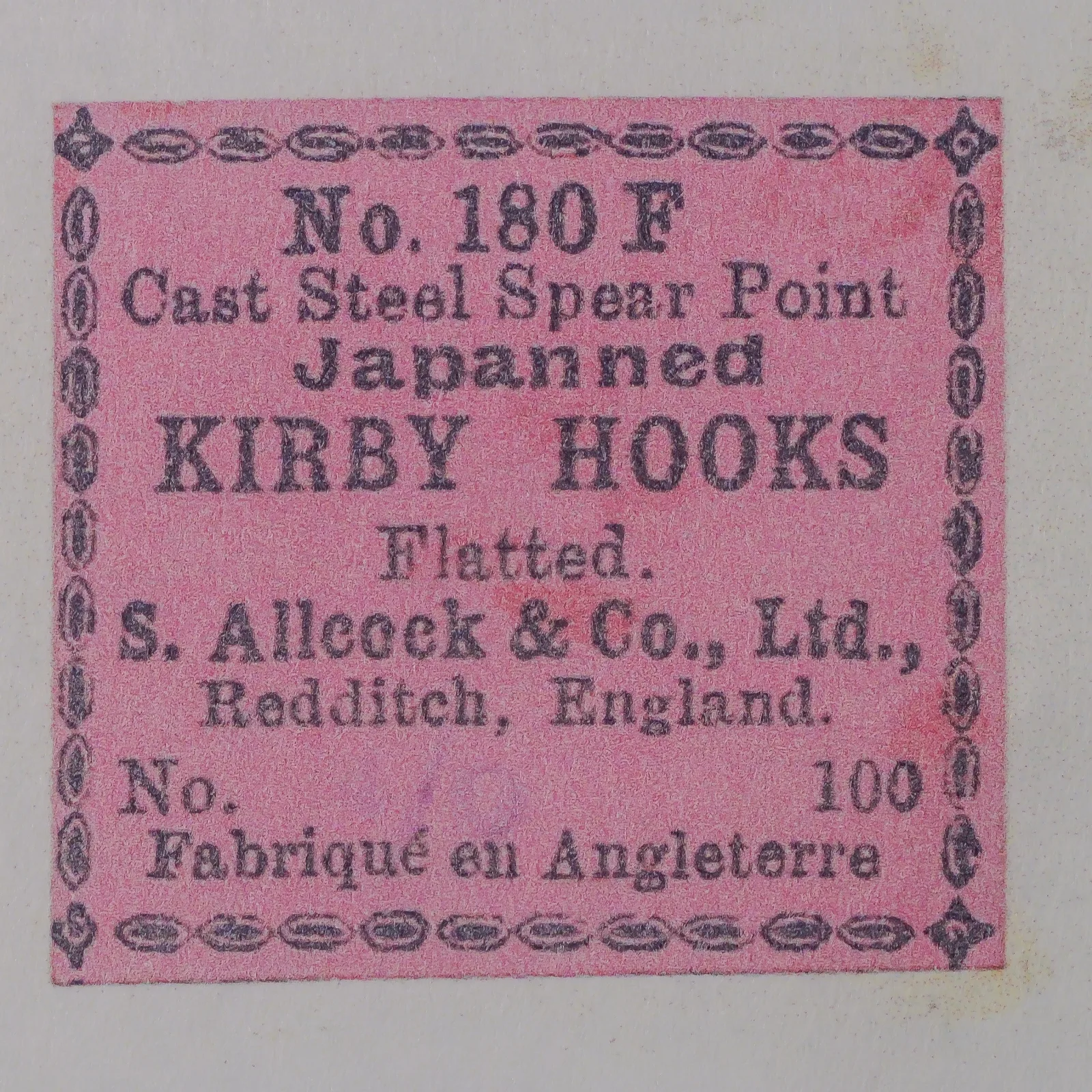
Original pink paper wrapper of the S. Allcock No. 180 F Kirby Hook, showing printed text, decorative border, and Victorian-era packaging design. This label format is a strong indicator of late 19th or early 20th century production.
Photographic record
4 cataloged imagesSelect any record to load it above.
4 images shown
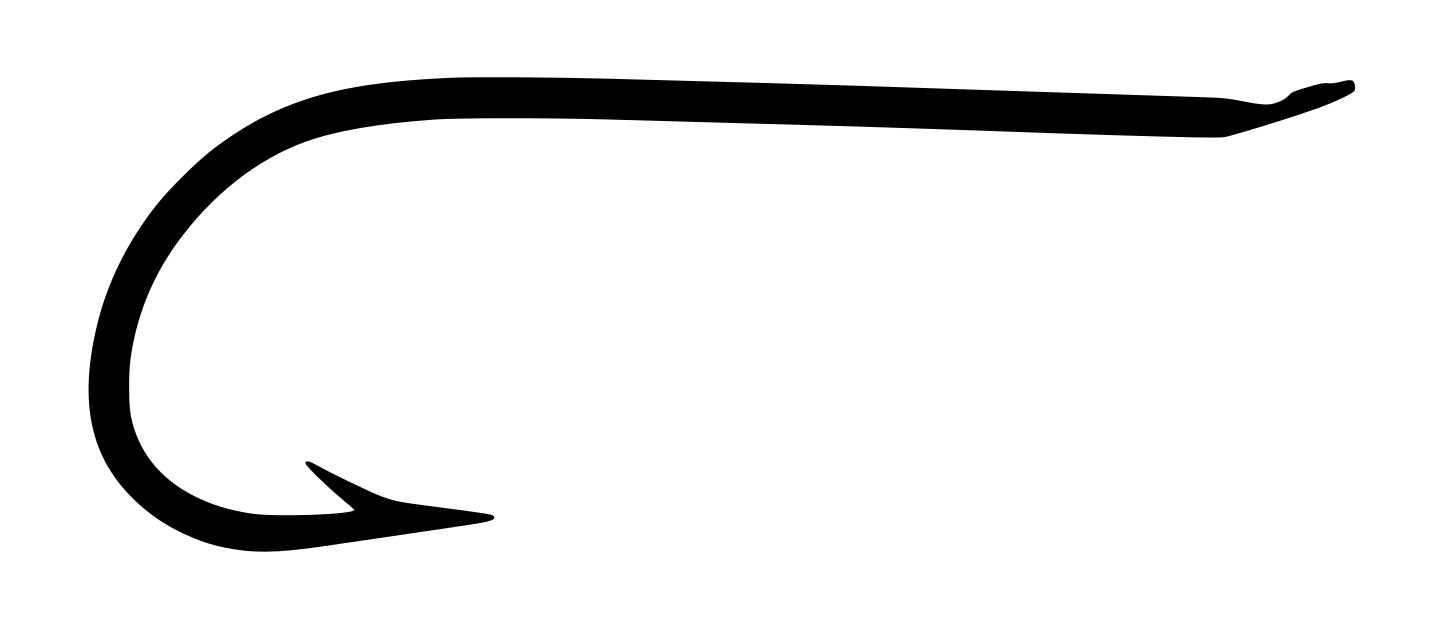
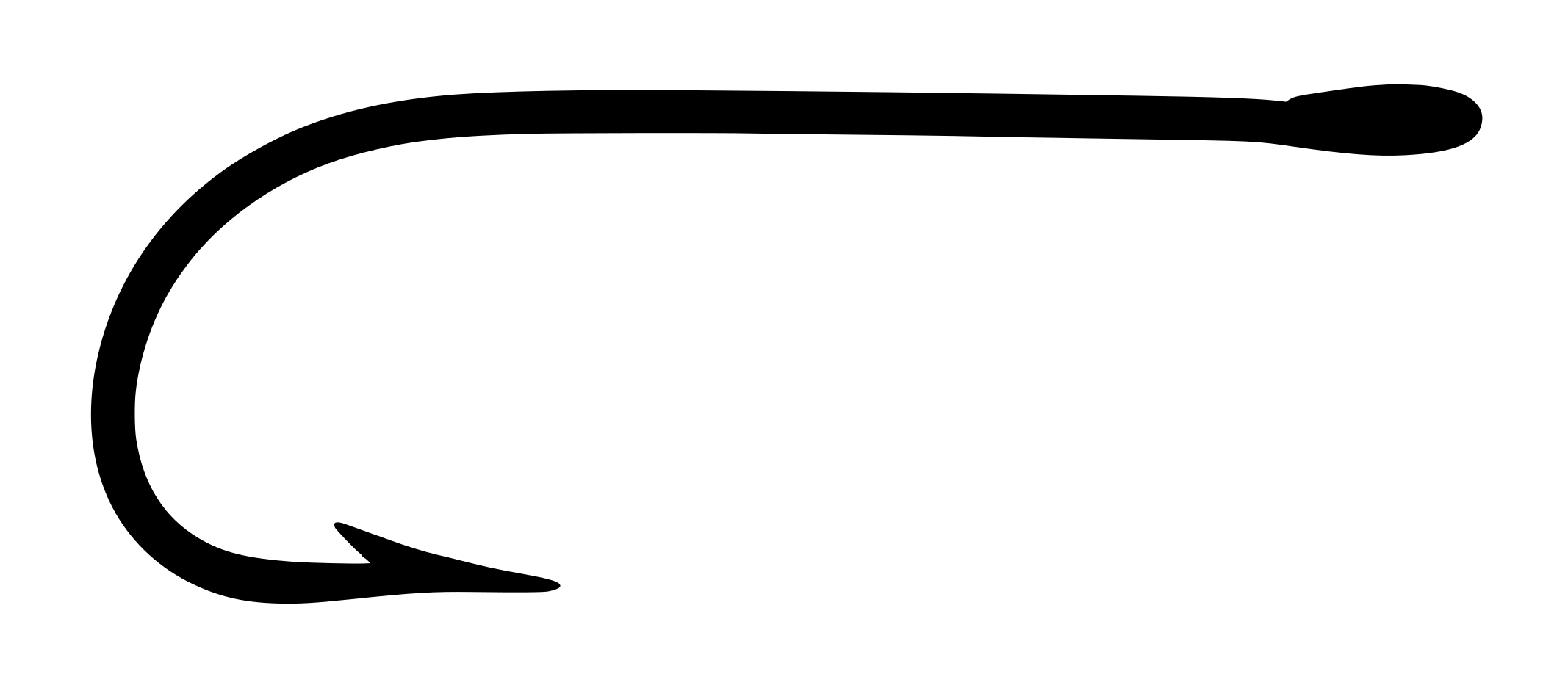
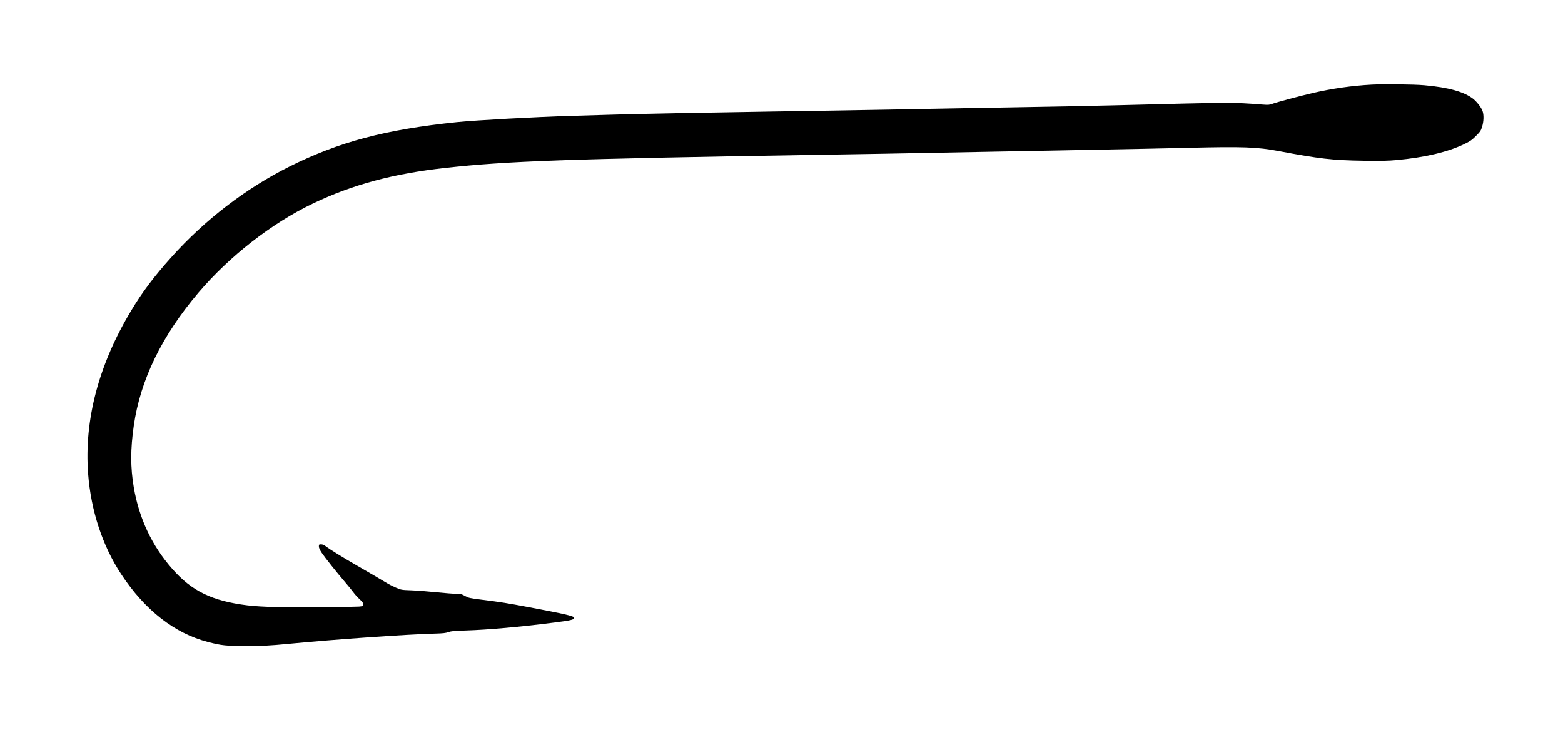
S. Allcock 180 F Kirby No. 4/0 Packaging LabelOriginal pink paper wrapper of the S. Allcock No. 180 F Kirby Hook, showing printed text, decorative border, and Victorian-era packaging design. This label format is a strong indicator of late 19th or early 20th century production.Open originalS. Allcock 180 F Kirby Hook No. 4/0 Left ProfileLeft-side profile view of the hook showing the flatted (spade) eye, the offset Kirby bend, and the overall shank length and proportions. The glossy black japanned finish is visible on all surfaces.Open originalS. Allcock 180 F Kirby Hook No. 4/0 Point DetailClose-up view of the hook point, barb, and inner taper geometry. The superior point (near-straight inner face) is clearly visible, along with the short, swept barb positioned approximately 0.15"-0.20" from the point tip.Open originalS. Allcock 180 F Kirby Hook No. 4/0 on Measurement GridFull hook specimen photographed on a 1/10-inch measurement grid, allowing precise determination of overall length, shank length, gap width, and proportions. Handwritten notes on the background identify the specimen.Open original
Technical profile
Japanned flatted-eye Kirby spear-point hook, Standard shank, Superior point, Heavy wire, Offset bend.
Eye
Blind — FlattedFlatted (spade end) eye with parallel flatting faces, typical of Victorian-era salmon and sea trout hooks. Flat surfaces measure approximately 0.15"-0.18" across (4-4.5 mm), providing a secure platform for tying. This construction was favored in British fly-fishing tradition before the advent of modern looped eyes.
Wire
Standard, Round
Shank
1X Long — Plain
Bend
Beak / Reversed Point, Standard gap, Offset / kirbedClassic Kirby offset with pronounced downward curve and inward offset of the point. The bend radius is relatively sharp, creating a tight, acute angle typical of the Kirby design for improved penetration. The offset shank-to-bend transition is clean and geometrically precise.
Point
Standard / SpearShort, close-cut barb positioned 0.15"-0.20" above the point tip. Barb angle is swept slightly backward (aft) relative to the point. Barb depth is approximately 0.05"-0.06" (1.3-1.5 mm), typical of well-executed Redditch barb work.
Finish
Black Japanned — Confirmed (stated on packaging)Glossy black lacquer coating (japanned) with consistent coverage visible on all surfaces. The finish is thick and opaque, completely obscuring the underlying steel grain. This is the classic japanning process documented by Sara Jane McBride in her 1880 factory tour, where hooks received two coats of a black tarry liquid finish. V
The heavy wire gauge and forged construction provided the strength necessary for salmon and sea trout applications where hook strength under the weight and strikes of large, powerful fish was non-negotiable. The flatted eye offered a secure platform for tying via the traditional gut-loop method, while also reducing bulk at the eye — a significant consideration in fly dressing where a bulky eye head would disrupt the proportion of the finished fly.
The superior point geometry — with its nearly straight inner face and moderate taper — balances rapid initial penetration with holding power. This contrasts with the hollow point, which prioritizes initial hook-set but can be less secure on larger fish. The offset Kirby bend amplifies the mechanical advantage of the point, creating an aggressive angle relative to the shank that facilitates deep, reliable hook-sets when the fish strikes.
The japanned finish was the standard corrosion protection of the era. The finish was a black, tarry liquid made in Birmingham, with two coats applied and heated moderately in an oven and thoroughly mixed after each heating. This provided reliable rust protection for storage and use in fresh water and light saltwater environments, while the black color was subtle and naturalistic in presentation.
The No. 180 F Kirby belongs to Allcock’s extensive Kirby line, one of the house’s foundational product families. The Kirby is the oldest steel hook made in England, its name derived from its inventor, a Mr. Kirby. Kirby bends were available in multiple eye styles (ringed, looped, flatted) and finishes (japanned, bronzed, blued) throughout the 19th and 20th centuries. The ‘180 F’ designation is not fully documented in surviving catalogs, but the ‘F’ likely denotes a variant in the larger model line. Flatted-eye variants were standard for salmon and sea trout fishing in the Victorian and Edwardian eras, before a gradual market shift toward tapered turned-down eyes in the mid-20th century. The model was likely discontinued in the 1960s as Allcock’s production shifted or closed.
Era and Packaging Dating
No barcode present — strong indicator of pre-1974 manufacture. Pink paper packaging stock and serif letterpress typography are consistent with late-Victorian and Edwardian commercial printing (1880–1930s). Decorative border style (small ovals and diamonds) is typical of 1880s–1920s packaging design. French text 'Fabrique en Angleterre' suggests export-market packaging, common during the period when Allcock actively supplied international markets. The use of flatted eyes as a standard feature for salmon hooks aligns with British game-fishing traditions of the 1880–1930 period; this construction was phased out in favor of modern looped eyes during the 1940s–1950s. The japanned finish and heavy-wire construction match documented factory processes described in the 1880 Sara Jane McBride factory tour account. Absence of any modern safety or regulatory markings supports an early estimate. Most likely production window: 1880–1930, with possible later printings into the 1940s from older dies or stock plates.
The McBride Factory Tour and Victorian Japanning (1880)
Sara Jane McBride, a famous fly tier and pioneering entomologist, toured the Allcock factory in 1880 and observed the manufacturing process including the japanning of hooks with black tarry liquid applied in two coats and heated in an oven. This documentary evidence provides a rare first-person account of Victorian hook production. The No. 180 F would have been part of this industrial landscape — hand-forged, carefully japanned, and shipped worldwide in these iconic pink paper wrappers. Allcock's dominance was so complete that by 1888, their factory employed over 500 workers and maintained branch offices in London, Paris, Toronto, and a silk-worm farm in Spain to ensure the finest.
Design lineage and influence
The Kirby bend family has deep roots in English hook history, predating mass industrial manufacture. The design featured either a ‘Hollow Kirby’ or ‘Dublin point’ filed by hand, giving the point three or four knife-like cutting edges enabling it to penetrate much more quickly than less expensive hooks. The superior point (rather than hollow) on the 180 F represents a variant optimizing for holding power over initial penetration — preferred for larger game fish where sustained grip was more critical than rapid hook-set. The flatted eye construction was a British specification, particularly favored for salmon and sea trout flies where secure gut-loop attachment was essential. By the 1950s, modern looped-eye and tapered turned-down-eye designs displaced flatted eyes as production shifted toward convenience and ease of use for mass-market anglers.
Best matchRelated by Attribute
Computed automatically from catalog data — updated as new hooks are added.
Matches: Bend, Shank, Gap, Eye Orient., Point +3 moreDiffers: Wire: Standard vs Heavy (1X Heavy); Eye: Blind — Flatted vs Blind — Marked Shank; Finish: Black Japanned vs Polished Steel +2 more
Matches: Bend, Wire, Gap, Eye Orient., Forging +2 moreDiffers: Shank: 1X Long vs Standard; Eye: Blind — Flatted vs Blind — Marked Shank; Point: Standard / Spear vs Hollow Point +3 more
Matches: Shank, Wire, Eye, Eye Orient., Point +4 moreDiffers: Bend: Beak / Reversed Point vs Other; Gap: Standard vs Narrow; Finish: Black Japanned vs Bright / Uncoated Steel +1 more
Matches: Shank, Wire, Eye, Eye Orient., Point +4 moreDiffers: Bend: Beak / Reversed Point vs Kirby (offset); Gap: Standard vs Wide; Finish: Black Japanned vs Blued +1 more
The No. 180 F Kirby was a premium salmon and sea trout hook, designed for both fly and bait presentations in British game fishing tradition. The flatted eye and superior point allowed secure attachment of leaders and gut flies while providing excellent holding power on powerful migratory fish. The compact shank and standard gap suited natural presentations and traditional dressed salmon patterns used on British and Irish rivers.
Kirby bends were historically favored for their aggressive offset and acute angle, which imparted superior hook-setting characteristics when struck by fish. This model, in japanned (black lacquered) finish, was the standard choice for anglers pursuing salmon in the 19th and early 20th centuries before the shift to lighter, tapered-eye models in the mid-20th century.
Secondary Applications
General coarse fishing; pike and perch bait fishing
Modern Equivalents
Hook
Match Quality
Notes
Partridge Kirby K3A (bronzed)
Very Good
Partridge of Redditch 2-spoke Kirby in bronze, forged, flatted eye. Close modern equivalent in bend and eye geometry, though lighter wire and modern manufacturing standards. Partridge is the surviving heir to the Redditch tradition.
Mustad 34007 (blued)
Good
Classic Kirby-family bend with conventional open loop eye. Wire gauge and overall proportions are similar, but eye construction is fundamentally different. Good functional equivalent for Kirby presentations.
Tiemco TMC 7999 (black)
Moderate
Modern Japanese-made Kirby-style bend with down eye and fine wire. Functionally similar for fly work but represents modern simplification — heavier wire and different eye style from the original Victorian design.
Collector notes
Rated 4.0/10 — Uncommon in complete original packaging but not rare; Victorian-era S. Allcock flatted Kirby hooks enjoy steady interest among British tackle collectors and salmon fly historians. Complete pink-paper cards are more desirable than loose hooks. The japanned finish and documented heritage elevate appeal above mass-production standards.
Reference value
$8 – $22 USD estimate
Packaging format
SA-PKT-01-PINKCatalog code
Packaging
Square pink paper wrapper (approximately 4.25" x 4.25" / 10.8 x 10.8 cm) with black letterpress text in serif typeface. Front face displays centered text reading 'No. 180 F', 'Cast Steel Spear Point', 'Japanned', and 'KIRBY HOOKS', with 'Flatted.' on a separate line. Bottom portion reads 'S. ALLCOCK & Co., LTD., Redditch, England' and 'No. [card number] / Fabrique en Angleterre'. All four edges feature a decorative border composed of small black ornamental ovals and diamond shapes. The paper stock is medium-weight, standard fishing tackle packaging of the Victorian/Edwardian era. Original pink color indicates mid-to-late 19th or early 20th century production. Text printing is sharp and even, consistent with professional letterpress work. No barcode present (strong indicator of pre-1974 manufacture).
Market Value Notes
Low ($8): Good condition — opened or incomplete packaging, 50–75 hooks present, minor wear or toning on card. Loose hooks only: $2–5.
High ($22): Excellent condition — complete original packaging sealed or near-sealed, all 100 hooks present, minimal defects or foxing.
Premium factors: Complete original pink-paper card (especially sealed); japanned finish in excellent condition with minimal patina; confirmed size 4/0 (larger sizes preferred by collectors); intact decorative border and legible text; documented Redditch manufacture.
Platforms: eBay (UK and US), specialized British tackle dealer networks, occasional tackle antique dealers.
Confidence: E estimated — limited specific sold-price data for this exact model; estimate derived from comparable S. Allcock Victorian-era cards and standard market patterns for uncommon British tackle. Prices for similar Redditch flatted-eye cards range $5–25 depending on condition and completeness.
Where to Find
eBay UK (search 'Allcock Kirby flatted' or 'Allcock 180 F'); UK tackle antique dealers (especially Redditch-focused suppliers); British country auctions featuring sporting goods lots; online forums dedicated to vintage British tackle. US sources are less common but available through specialty dealers in the Northeast and Mid-Atlantic. Complete sealed cards are rare; loose hooks appear more regularly.
Collector's Identification Tips
Manufacturer mark: ‘S. ALLCOCK & Co., LTD., Redditch, England’ printed on the pink packaging label. The stag trademark (standing with one hoof raised) may be present on the hook shank itself, though flatted-eye hooks sometimes lack visible maker’s marks. Model identification: The card will display ‘No. 180 F’ as the primary model code. Japanned finish: Glossy black lacquer coating on the hook — not to be confused with blued (blue-grey metallic) or bronzed (warm brown) finishes. Flatted eye: Spade-like flattened end with parallel faces, distinct from ringed or looped eyes. Point style: Superior point with near-straight inner taper (not concave/hollow). Kirby bend: Pronounced downward curve with inward offset at the bend — not a straight-shank or sproat-bend hook.
Packaging clues: Pink paper wrapper with serif letterpress text, decorative border ornaments, no barcode, French export text. These combine to suggest Victorian-era production (1880–1930). Modern reprints or later editions may have different typography or colors.
Preservation
Storage and Preservation
The japanned (black lacquered) finish is durable but benefits from proper storage. Keep the hooks in the original pink paper wrapper in a cool, dry location away from direct sunlight, moisture, and humidity. Exposure to damp conditions can cause the lacquer to develop a patina, which some collectors find aesthetically appealing, but excessive moisture promotes oxidation beneath the finish.
If the hooks are loose, store them in a small glass vial or paper envelope (never plastic, which traps moisture) in a cabinet or drawer with silica gel packets if in a humid climate. Avoid stacking heavy items on top of the packaging. The pink paper wrapper itself will yellow and fox over time — this is natural aging and adds to the specimen’s character and authenticity.
If any hooks are removed for use or tying, store them separately and use the remaining hooks as reference specimens. Complete original packaging commands a significant premium, so it is worth preserving intact even if individual hooks are deployed.
Do not attempt to clean the japanned finish with harsh chemicals or steel wool, which will strip the lacquer. Light dusting with a soft cloth is acceptable; if corrosion or dullness develops, storage conditions should be improved rather than the finish refinished.
Marking Analysis
Handwritten Identification and Annotation
The specimen is marked with handwritten notes on the display card identifying it as ‘S. ALLCOCK No 180 F 4/0 / Flatted “A” KIRBY’. This annotation was likely added by the researcher or collector conducting the analysis. The notation ‘Flatted “A”‘ refers to the spade/flatted eye construction and may indicate a specific size variant or subdesignation used by Allcock in their internal records or catalog systems.
The ‘A’ marking could also refer to a quality grade or manufacturing batch code, though this is speculative without access to original Allcock factory documentation. British hook manufacturers of this era sometimes marked hooks with letter codes on the flat faces (visible when the hook was held eye-down), a practice documented in several contemporary hooks from competing firms.
Primary Source
Packaging Text and Manufacturing Claims
Source: Original pink paper packaging label, S. Allcock & Co., Redditch, England
The pink paper wrapper displays the following printed text:
Top center: ‘No. 180 F’ — model designation Below: ‘Cast Steel Spear Point’ — material specification and point style Below: ‘Japanned’ — finish specification Below: ‘KIRBY HOOKS’ — bend family identifier Lower section: ‘Flatted.’ — eye type specification Manufacturer: ‘S. ALLCOCK & Co., LTD., Redditch, England’ Quantity and export notation: ‘No. [number] / Fabrique en Angleterre’ (Made in England, in French)
The term ‘Cast Steel’ indicates the wire was drawn from cast steel wire stock, distinguishing these hooks from cheaper wrought-iron or lower-grade steel alternatives. This specification reinforces that the 180 F was positioned as a premium product. The explicit notation ‘Spear Point’ (not ‘Superior Point’ or other technical term) suggests Allcock used colloquial language in marketing. The term ‘spear’ is descriptive of the point’s appearance — a tapering, sharp edge resembling a weapon point — rather than a formal manufacturing classification.
The French text ‘Fabrique en Angleterre’ is a strong indicator that this card was produced for export markets, particularly continental Europe or French-speaking regions. Allcock maintained aggressive international distribution, especially to France, Belgium, and other Continental fishing markets where English sporting goods were highly valued.
Additional
The Flatted Eye Tradition in British Salmon Fly Fishing
The flatted eye (spade end) was a cornerstone of British game-fishing tradition, particularly for salmon and sea trout flies. Unlike modern looped or tapered turned-down eyes, the flatted eye provided a secure platform for the traditional gut-loop attachment method used throughout the 19th and early 20th centuries. A fly dresser would tie a small loop of gut thread to the hook’s flatted eye, then insert the leader through that loop, creating a nearly-knot-free connection.
This method offered several advantages: the connection was extremely secure and reliable; the fly could be quickly detached and replaced; and the small loop did not interfere with the delicate proportions of the finished fly, which was essential for the understated, sparse dressing traditions of rivers like the Spey, Dee, and Test. The flatted eye also produced less bulk at the eye than a ringed or looped construction, which mattered greatly in fly tying where the head diameter influenced the perceived scale and balance of the finished pattern.
By the 1940s–1950s, modern looped eyes and tapered turned-down eyes gradually displaced flatted eyes as fly-fishing markets expanded and anglers sought convenience and faster rigging. Redditch makers like Allcock adapted quickly to these market shifts, but their extensive flatted-eye stock from earlier decades remains a vivid record of this lost tradition. Today, the flatted-eye hook is recognized by historians and traditionalist tyers as a hallmark of the Victorian and Edwardian golden age of British fly fishing.
Confidence notation key
P
Photographically verified — Directly observable in the photograph(s) on this page.
V
Verified by documentation — Confirmed by manufacturer catalog, spec sheet, or published reference.
I
Inferred — A logical deduction from observable or documented evidence, not directly stated.
E
Estimated — An approximation based on visual comparison, proportional analysis, or limited data.
S
Speculative — A reasoned hypothesis that cannot be confirmed from available evidence.
Unnotated claims are the compiler’s synthesis; see Sources. All photographs on garrenwood.com are taken on a measurement grid where each square equals 1/10 inch (0.1″ / 2.54 mm).