The Mustad Qual. 3959 is a rare survivor of the transitional era between 19th-century snelled hooks and modern eyed designs. Manufactured by O. Mustad & Søn of Oslo, Norway, this hook was specifically engineered for traditional wet fly tying where anglers attached their own silk or silkworm gut loops directly to the blind shank.
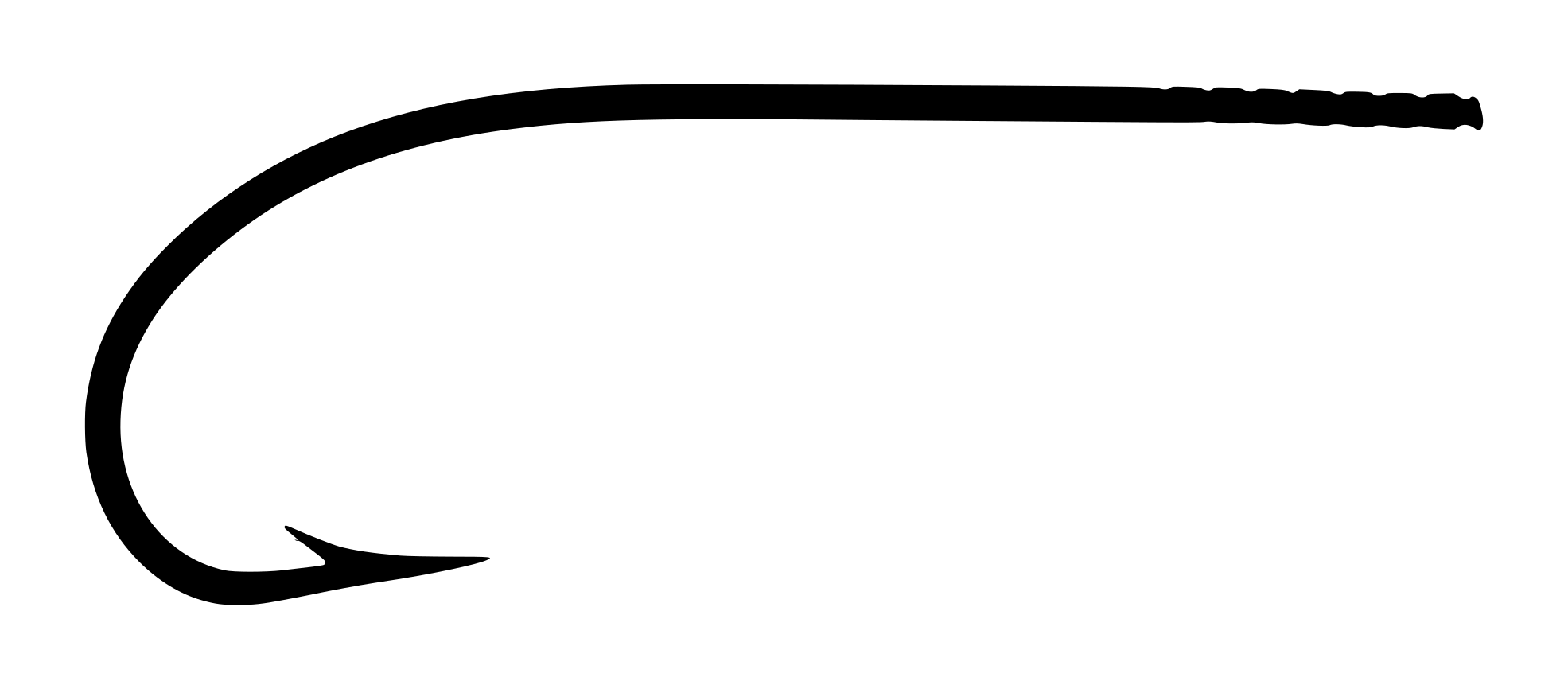
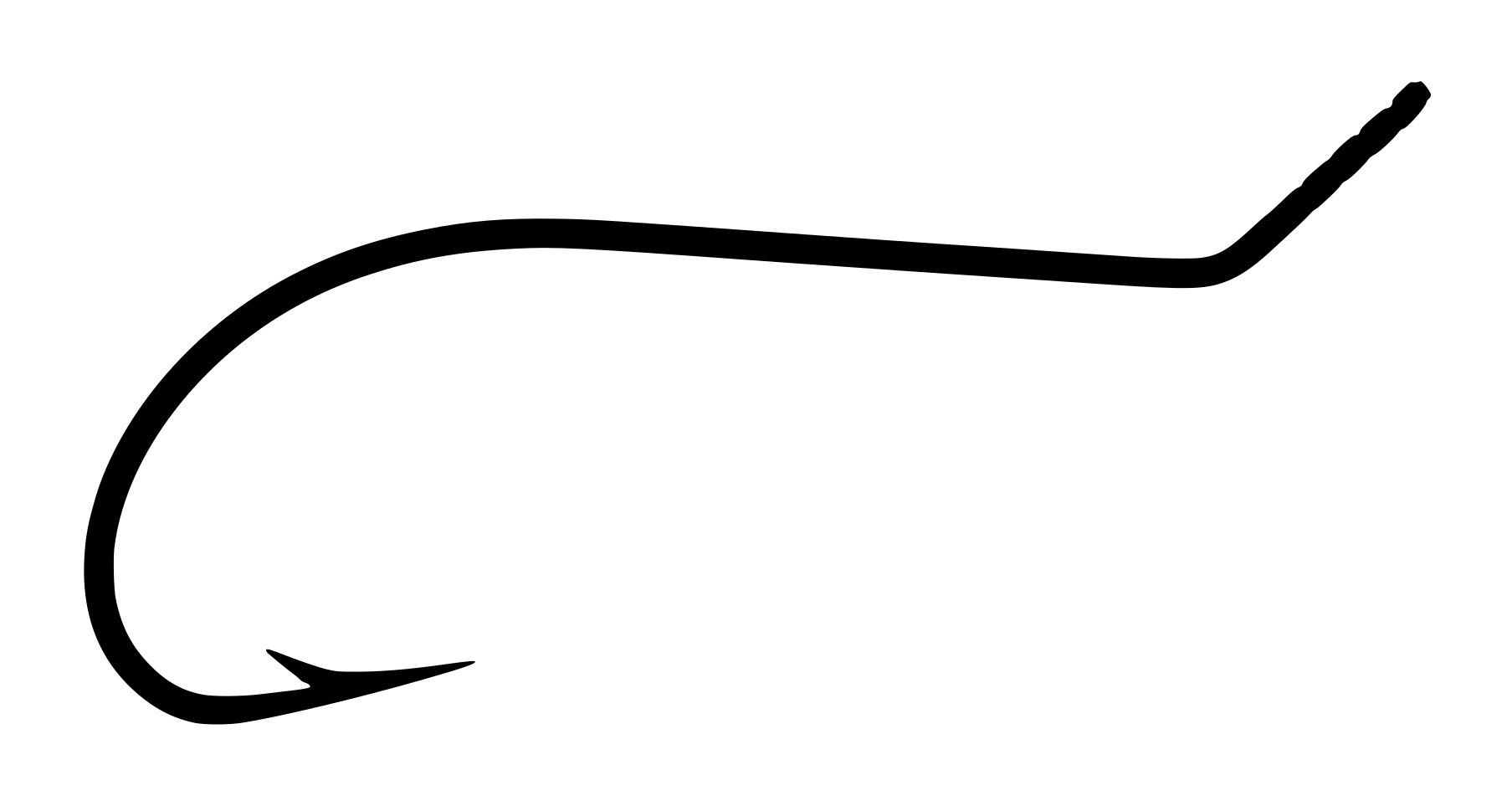
Defining feature: marked (ridged) blind-eye construction with Sproat bend and hollow point. The ridges near the head served a dual purpose—preventing the snelling whip from slipping under tension and retaining soft baits in mixed bait-and-fly presentations. The Sproat bend’s parabolic geometry provided exceptional mechanical hold for American trout streams, while the hollow point enabled rapid tissue penetration with minimal force, ideal for soft-mouthed species like brook and brown trout.
This hook represents the period when Mustad continued manufacturing specialized blind-eye runs for the American market despite the global shift toward eyed hooks. The eight-line label, Oslo designation (post-1925), and bronzed finish place this firmly in the interwar and mid-century era when serious anglers still valued traditional snelling techniques for premium dry and wet fly construction.
Mustad Qual. 3959 blind-eye hook, size 12, shown on measurement grid with 0.1-inch divisions. The blind flatted shank end and forward-set barb are clearly visible. Bronzed finish shows warm gold tone.
Photographic record
4 cataloged imagesSelect any record to load it above.
4 images shown
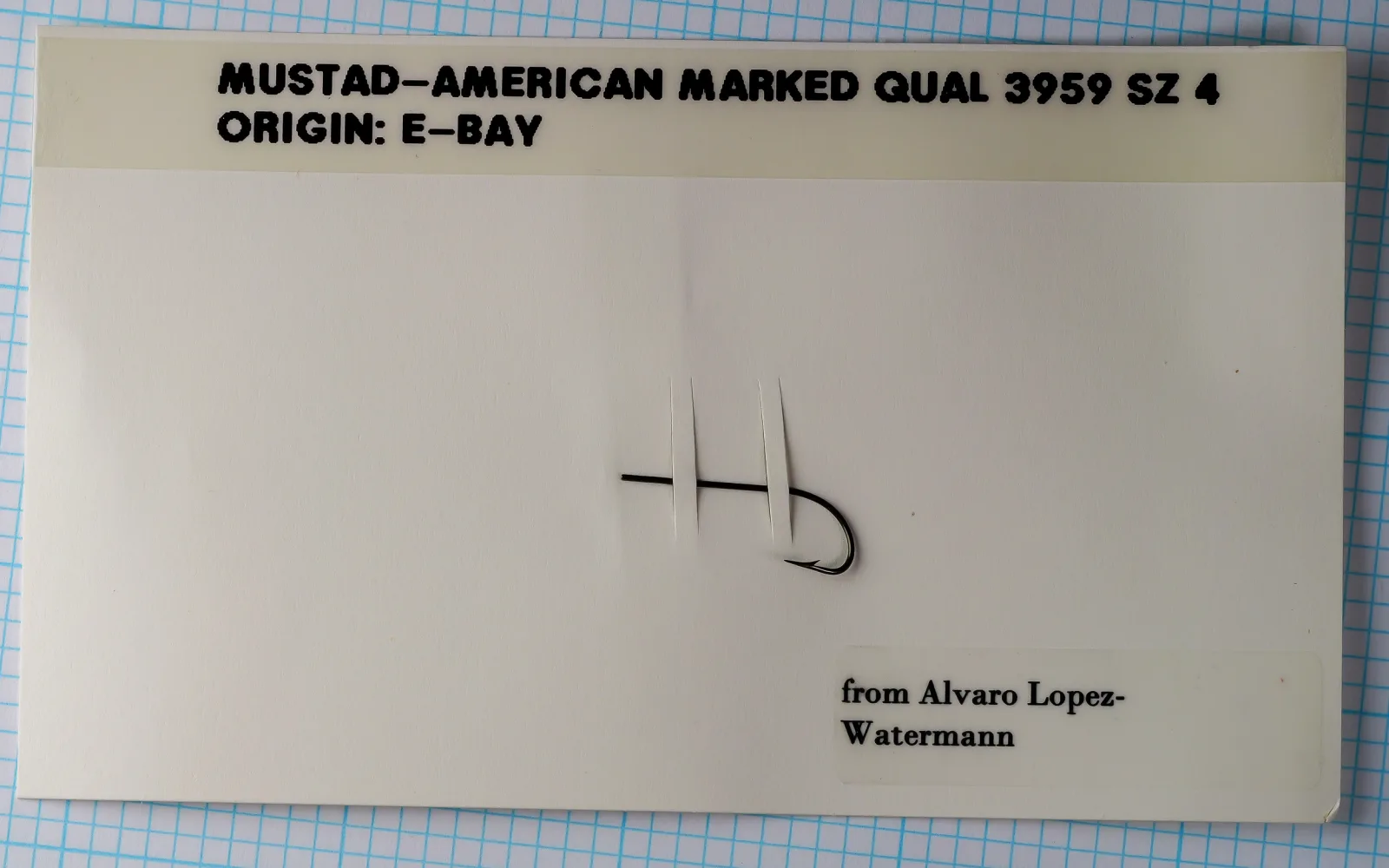
Mustad 3959 Size 12 Hook Specimen — Front Face on GridMustad Qual. 3959 blind-eye hook, size 12, shown on measurement grid with 0.1-inch divisions. The blind flatted shank end and forward-set barb are clearly visible. Bronzed finish shows warm gold tone.Open originalMustad 3959 Size 12 Hollow Point DetailClose-up of the Mustad 3959 hollow point showing the concave taper from tip to barb base. The fine, hand-ground geometry and rapid flare toward the barb are characteristic of the hollow-point design for soft-mouthed trout.Open originalMustad 3959 Size 12 Full Profile — Sproat BendProfile view of the Mustad 3959 on measurement grid, showing the complete Sproat bend curve, marked (ridged) shank, and proportions. The parabolic bend geometry distributes stress evenly for wet-fly swing fishing.Open originalMustad 3959 Original Sales Card LabelEight-line Mustad label on original cardboard sales card. Label displays Key Brand logo, manufacturer identity (O. Mustad & Son), Oslo-Norway origin, Qual. 3959 model code, Hollow Point designation, Mustad-American Trout Hooks pattern name, Marked Bronzed finish, and 100-hook count, size 4 notation. Label printed in olive-green ink on cream cardboard stock.Open original
Technical profile
Eye
Blind — Marked Shank
Wire
Fine (1X Fine), Round
Shank
1X Long — Marked / Ridged
Bend
Sproat, Standard gap, Offset / kirbedClassic Sproat parabolic bend—smooth, sweeping curve sitting geometrically between a perfect round (Aberdeen) and sharp angular (Limerick) P. The bend radius provides even stress distribution across the steel under load, making it ideal for both dry fly and wet fly swing applications in current P.
Point
Hollow Point (concave inner face)Hand-ground barb with moderately sharp, swept angle typical of hollow-point construction P. Barb placement is forward-set near the point, consistent with Mustad's mechanized grinding process of the era P.
Finish
Bronzed — Confirmed (stated on packaging)Bronzed finish exhibits warm, dark brownish-gold tone characteristic of baked-on lacquer mimicking bronze hue P. Finish is uniform across the wire with minimal wear on specimen, indicating either light historical use or excellent preservation P. This muted finish was highly favored by freshwater fly tyers seeking to avoid unnatural metallic flash in clear water (V per reference document).
Specimen hooks show bright bronzed finish with no visible corrosion or pitting P. The original eight-line label card is intact with minimal toning and edge wear consistent with age and storage in dry conditions P. All hooks appear present and unbroken on the card P.
Hollow Point Engineering: The hollow point’s concave inner face is ground from the tip down to the barb base, creating a ‘dished-out’ silhouette rather than a straight wedge. This geometry achieves an incredibly fine, razor-sharp tip that flares rapidly toward the barb. The mechanical advantage is minimal penetration resistance—the point can penetrate soft tissue with nearly zero applied force, critical for trout with delicate mouth membranes. Once the sharp tip passes the barb, the flaring geometry provides rapid mechanical lock without creating an overly large entry wound that could tear open during the fight.
Marked Shank Purpose: The ridges cut into the rear of the shank serve two distinct functions. For snelled hooks, the ridges provide mechanical grip for the fine silk whipping thread, preventing the knot from slipping under the tension of a fighting fish. For bait-and-fly presentations common in American trout streams, the ridges physically grip soft natural baits (worms, grubs, small minnows), preventing them from sliding down the shank toward the bend during casting or in heavy current.
Sproat Bend Mechanics: The parabolic (non-circular) bend geometry distributes the mechanical strain of a fighting fish evenly across the entire bend radius. A pure circular bend concentrates stress at the apex; a sharp angular bend creates stress concentrators at the corners. The Sproat’s hybrid curve, sitting exactly between these extremes, resists both straightening and fracturing under sudden, violent load—essential for American trout streams where 5-pound-plus fish on silk lines were not uncommon and multiple-hook losses meant real economic hardship for working anglers.
Bronzed Finish Chemistry: Despite the name, bronzed hooks are not forged from a bronze alloy (which would be too soft). Instead, they are high-carbon steel coated in a specialized baked-on lacquer or chemical compound formulated to mimic the dark brownish-gold hue of bronze. This coating provides excellent rust resistance while offering a muted, natural color profile highly favored by freshwater fly tyers and bait anglers seeking to avoid the unnatural flash of bright metal in clear water.
This entry documents one of the few surviving complete cardboard sales cards for a Mustad blind-eye American Trout hook with original eight-line label intact and legible. Within the garrenwood.com catalog, this hook exemplifies the transitional blind-eye era (1925–1950) and preserves direct evidence of Mustad's formalized quality-code labeling system. The marked-shank feature combined with hollow-point construction is relatively uncommon compared to single-feature hooks.
Own this hook? Help us measure it.
We have measurement for size 4. Know any others? Submit calipered measurements and we'll review and add them. Thank you!
Historical context
mustad
O. Mustad & Søn was founded in 1832 in Gjøvik, Norway, originally as Brusveen Spiger- og Staltradfabrikk, producing basic metal goods including nails and steel wire. The company was taken over by Ole Hovelsen Mustad and his son Hans Mustad, who rebranded it as O. Mustad & Søn.
The defining pivot occurred in 1877 when Mathias Topp invented the first fully automated hook-making machine—a revolutionary advancement that allowed raw steel wire to be continuously fed, cut, bent, barbed, and pointed at unprecedented speed. Rather than filing for patents (which would have required public disclosure), Mustad relied on intense corporate secrecy and strict non-disclosure agreements to protect the technology. This strategy proved devastatingly effective against rival manufacturing centers in Redditch, England, and Japan.
By the 1950s, Mustad had secured approximately 50% of the global hook production market, establishing sales offices and manufacturing facilities across multiple continents. The company’s reliance on mechanization, combined with aggressive reverse-engineering of regional hook patterns (Cincinnati, Limerick, Sproat, Aberdeen), allowed them to standardize and mass-produce localized designs for global export markets. The Qual. 3959 represents a specialized exception to this industrial strategy—a premium, limited-production run maintaining traditional blind-eye construction for the American market’s snelling tradition.
Series History
The Mustad-American Trout Hooks series represents a product line specifically engineered to capture the American freshwater market in the early-to-mid 20th century. This series was notable for preserving blind-eye construction at a time when most manufacturers had transitioned to eyed hooks—a deliberate decision to serve anglers (particularly in the American Northeast and Midwest) who valued traditional snelling techniques for premium wet and dry fly construction.
The Qual. 3959 sits within Mustad’s broader Quality-coded tier system: model numbers in the 3000–3999 range represented Quality products—mid-tier hooks manufactured to exacting dimensional and tempering standards. Unlike economy models (1000–2999), the 3959 received careful finish work and precision point grinding. Unlike premium models (4000+), it was intended for high-volume commercial and serious amateur markets rather than specialized niche applications.
The ‘American’ branding on the label reflects Mustad’s strategy of reverse-engineering and standardizing regional American patterns. The Sproat bend itself was not originally an American design—it originated with William Sproat in England circa 1845—but Mustad had recognized that American wet-fly anglers had adopted the Sproat as their preferred bend for swing fishing in fast currents, and they manufactured this line specifically to compete with domestic Redditch and American producers (notably Pflueger and Herters) in that market segment.
The marked (ridged) shank feature on the 3959 was intentional: it served both the snelling angler (preventing the whip knot from slipping under tension) and the bait-and-fly angler (preventing soft bait from sliding down the shank). This dual-purpose engineering suggests the series was marketed to generalist anglers rather than specialists in dry-fly-only or bait-only fishing.
No documented discontinuation date is known; however, the blind-eye format was largely obsolete by the 1960s as monofilament lines and direct-tied eyed hooks became universal. Production likely ceased in the early 1950s as demand for snelled hooks evaporated among the broader American market.
Era and Packaging Dating
Label shows 'OSLO - NORWAY' designation on Line 3, establishing production post-January 1, 1925 (when Christiania was renamed to Oslo). The eight-line Mustad typographic label format, Key Brand trademark, and specific model numbering (Qual. 3959) all point to mid-20th century production. Blind-eye hooks with marked shanks continued in specialized production runs for the American market well into the 1950s, though the 1925–1950 window is most likely based on the Oslo designation, packaging print method (letterpress), and design conventions. No barcode is present, confirming pre-1974 manufacture.
The Mathematical Bend: William Sproat's Parabolic Revolution
The Sproat bend, while standardized by Mustad and adopted globally, was named after <strong>William Sproat of Ambleside, England</strong>, a 19th-century fly tier and angling author who documented the parabolic geometry around 1845. Sproat's innovation was mathematical in nature—he understood that a bend curve sitting precisely between a pure circle (Aberdeen) and a sharp angle (Limerick) would distribute mechanical stress more evenly across the steel during a hard-fighting fish's runs and head shakes. American anglers embraced the Sproat for wet-fly swing fishing in fast mountain streams and big rivers, where the parabolic geometry prevented straightening under the combined stress of current and a heavy fish. By the early 20th century, the Sproat had become so synonymous with American serious fly tying that Mustad created the entire 'American Trout Hooks' line around it—a testament to how a single geometric insight could reshape global tackle design.
Design lineage and influence
The Qual. 3959 represents a conservative holdover from 19th-century British snelling traditions, preserved and mechanized by Mustad for the American market. Its predecessor designs include the blind-eye hooks produced by Redditch craftsmen (Allcock, Partridge, H. Milward & Sons) from the 1860s onward. These British blind-eye hooks were initially designed for snelling with silkworm gut, a painstaking process where a snood of soaked gut was whipped directly to the shank using fine silk thread and pitch.
The Sproat bend itself originated with William Sproat (Ambleside, England, c. 1845) as a refinement of earlier round bends. The parabolic geometry was adopted rapidly by American fly tyers in the Northeast and Midwest, where it became the standard for wet-fly swing fishing in fast currents. Mustad’s decision to combine the Sproat bend with marked-shank, hollow-point, blind-eye construction created a specialized product line intended to compete directly with Redditch makers and domestic American producers (notably Pflueger and Herters) who dominated the snelling market.
Downstream influence: The blind-eye format itself became largely obsolete by the 1960s with the widespread adoption of monofilament lines and direct-tied eyed hooks. However, the Sproat bend and hollow-point geometry lived on and continue in modern Mustad and competitor designs. Specialized makers like Partridge of Redditch still produce blind-eye salmon hooks (e.g., CS10/1) for purist fly tyers, but a size 4 blind-eye trout hook is now a historical artifact and collector’s piece rather than an active fishing tool.
Best matchRelated by Attribute
Computed automatically from catalog data — updated as new hooks are added.
Matches: Bend, Gap, Eye, Eye Orient., Application +2 moreDiffers: Shank: 1X Long vs Standard; Wire: Fine (1X Fine) vs Standard; Point: Hollow Point vs Standard / Spear +2 more
Matches: Bend, Gap, Eye, Eye Orient., Point +2 moreDiffers: Shank: 1X Long vs Standard; Wire: Fine (1X Fine) vs Extra-Fine; Forging: Round vs Forged +2 more
The Qual. 3959 was designed as a premium wet-fly hook for traditional fly tying using hand-snelled construction. Anglers would soak a short length of silkworm gut or fine silk thread and whip it directly to the blind shank using specialized knots and pitch—a labor-intensive process that could take 15–20 minutes per fly but produced an exceptionally strong connection between fly and leader. The marked shank’s ridges prevented the whip knot from slipping under tension during the fight.
Primary species: brook trout, brown trout, and Atlantic salmon in American Northeast and Eastern Canadian streams. The hollow point enabled rapid penetration of delicate mouth tissue without tearing. The Sproat bend’s parabolic geometry was particularly favored for swing fishing—drifting the fly on a tight line across fast currents—where the even stress distribution prevented hook straightening under the combined loads of current and fish weight.
Historical context: This hook represents the tail end of the 19th-century tradition of snelling, which was still the standard practice among serious American trout anglers in the 1930s–1940s but had largely been abandoned by recreational anglers using modern eyed hooks and improved knots by the 1950s. The Mustad-American Trout series was a deliberate effort to serve the remaining traditional anglers and professional guide market who viewed snelling as superior to any eyed-hook knot.
Secondary Applications
Mixed bait-and-fly presentations common to American trout streams (small worms, grubs, or minnow strips combined with feather wings). Early 20th-century still-fishing with live bait in slow pools and spring creeks.
Classic Fly Patterns
Traditional wet fly patterns of the late 19th and early 20th centuries, including: Professor, Grizzly King, Queen of the Woods, Greenwell's Glory, March Brown, Coachman, Royal Coachman, Cahill. Also suitable for traditional soft-hackle and partridge-and-orange style wet flies.
Modern Equivalents
Hook
Match Quality
Notes
Partridge CS10/1
Excellent
Blind-eye salmon hook in similar Sproat-like bend; most direct modern parallel to the snelling tradition
Mustad 3906B
Very Good
Modern eyed version of the Sproat bend; same bend geometry but with standard ball eye, eliminating need for snelling
Tiemco 200R
Good
Contemporary Sproat-bend wet fly hook; eyed, fine wire, suitable for traditional wet fly tying without snelling
Daiichi 1640
Moderate
Modern wet fly hook with similar bend profile; lacks historical character but functionally equivalent for wet fly swing applications
Collector notes
Rated 5.5/10—Scarce to uncommon. The blind-eye format and marked Sproat bend make this hook historically significant within the American fly-tying tradition, but production volume was substantial enough that complete original cards appear sporadically on the market. Collector demand is moderate to strong among Redditch specialists, fly-tying historians, and purist anglers, but limited compared to rare Partridge or English maker blind-eye hooks. Size 4 is more common than smaller sizes (No. 6, 8, 10, 12), which were more heavily used and have lower survival rates.
Reference value
$18 – $42 USD estimate
Packaging condition
Very Good — light wear, fully legibleRecorded specimen
Packaging format
GW-M-03Catalog code
What Makes This Collectible: The Qual. 3959 is a direct link to the snelling tradition—a manufacturing artifact documenting Mustad’s deliberate strategy to serve conservative American fly tyers even as the industry shifted toward eyed hooks. The blind-eye, marked-shank combination is visually distinctive and instantly communicates historical significance. The eight-line label itself is a detailed historical document encoding manufacturing era, point geometry, finish, and pattern name in a standardized industrial language. Original cards with full hook counts are increasingly rare as surviving examples are often depleted or damaged.
Limiting Factors: (1) Mustad’s industrial scale meant tens of thousands of these hooks were produced, so they are not exceptionally rare in isolation. (2) The blind-eye format has no modern utility, limiting demand to historians and traditionalists rather than working anglers. (3) Smaller sizes (No. 8, 10, 12) are genuinely scarce—they were fished more heavily and have lower survival rates than larger sizes. (4) Packaging condition is critical: a sealed or near-sealed card commands a premium; loose hooks or incomplete cards lose 40–60% of value.
Most Desirable Variants: Size No. 10 and smaller on original, sealed or near-sealed cards with fully legible labels. Original boxes (if any survive) would be exceptionally rare and valuable. Multiple cards representing the full size range (4, 6, 8, 10, 12) would be a significant collection piece. Variants with different finishes (if any) or different packaging printings would be highly sought by specialists.
Condition Impact on Value: Mint (sealed/near-sealed card, 100% hook count, label fully legible, no wear): top of high range. Excellent (opened, complete or near-complete count, label bright, minimal wear): mid-high range. Very Good (complete or missing 1–2 hooks, card has visible creasing/toning, label slightly faded): mid-low range. Good (missing 3–5+ hooks, significant card wear, label difficult to read): bottom of range or below.
Packaging
Eight-line typographic label on cardboard sales card. Label printed in olive-green (bronzed gold) ink on cream-colored stock using offset lithography. Text elements: Key Brand logo (skeleton key) in upper left; Lines 1–2: 'O. MUSTAD & SON' and 'MANUFACTURERS'; Line 3: 'OSLO - NORWAY'; Line 4: 'Qual. 3959'; Line 5: 'Hollow Point'; Line 6: 'Mustad-American Trout Hooks'; Lines 7–8: 'Marked Bronzed'; bottom left: '100 No. 4' (quantity and size, with handwritten notation of size in pencil). Card edges are bordered with repeating decorative cross-hatch or asterisk pattern. Paper stock is medium-weight cardboard with slight aging patina consistent with mid-20th-century manufacture. Hooks affixed via two horizontal slits punched through the card; original twine or thread loops visible where hooks were attached.
Market Value Notes
Low ($18): Good condition — opened card with 80–90% hook count, visible wear to packaging, label faded but legible. High ($42): Excellent to Mint condition — sealed or near-sealed card, 100% hook count, packaging bright with minimal wear, label fully legible. Premium factors: Size 4 is relatively common in surviving stock; smaller sizes (No. 8, 10, 12) command 30–50% premiums. Sealed cards command 40–60% premium over opened cards. Platforms: eBay UK and US, specialist fly-fishing auctions (Heritage Auctions, local UK/US tackle sales), private dealer networks. Confidence: E Estimated based on limited comparable sales data. Mustad blind-eye cards of similar era and size range typically sell in the $12–50 range depending on condition and size; this hook's scarcity and historical significance place it in the mid-to-high portion of that range.
Where to Find
eBay UK (periodic listings, 2–4 per year). Heritage Auctions and regional UK/US tackle auctions. Specialist vintage tackle dealers in Redditch area (England) and American Northeast (Pennsylvania, New York). Fly fishing heritage societies and museum gift shops occasionally list surplus stock. International fly-tying conventions and tackle shows. Private sales among serious collectors are common but difficult to track publicly.
Preservation
Storage and Preservation
Store in a cool, dry environment away from moisture and humidity. The bronzed finish is susceptible to patina development and light oxidation with humidity exposure; some collectors consider a light, even patina desirable as it indicates age and authenticity, while others prefer the original warm bronze tone. Do not attempt to restore or polish the finish—any abrasion will reduce value significantly.
Preserve the original cardboard card rather than removing hooks. The card itself is a critical historical document encoding the eight-line label system, manufacturing era, point designations, and finish specifications. Loose hooks lose 40–60% of their value compared to carded examples. Store the card horizontally in a protective sleeve or acid-free archival box to prevent bending, creasing, or light damage to the label.
Avoid contact with other metals (steel, aluminum, copper) to prevent galvanic corrosion, particularly in humid conditions. Do not store alongside modern stainless steel hooks or tools. Keep away from direct sunlight, which can fade the olive-green label printing over time. Ideal storage temperature is 60–70°F with relative humidity below 45%. Periodic inspection for signs of corrosion or label fading is recommended, though intervention should be minimal.
If the card shows signs of foxing (age spots) or mold growth, consult a professional archival conservator before attempting any cleaning. Handle by the card edges only; avoid direct contact with the label or hooks to prevent fingerprint oils from accelerating oxidation.
Primary Source
Reading the Eight-Line Label: Mustad's Industrial Language
Source: Mustad Label: A Comprehensive Typology and Decryption of Vintage O. Mustad & Søn Hook Labels (Reference Document 1)
The eight-line label on this card is a masterclass in industrial standardization. Each line encodes specific technical information in a formalized hierarchy, designed to communicate across linguistic and geographical barriers to international wholesalers, retailers, and individual anglers.
Line 1: ‘O. MUSTAD & SON’ — Establishes ultimate corporate authority and brand identity. The full, unabbreviated title ensures brand recognition and legal ownership are immediately clear. (V per reference document)
Line 2: ‘MANUFACTURERS’ — Critical distinction in an era when import agents, jobbers, and regional distributors frequently purchased bulk hooks and repackaged them under secondary brand names. By cementing their role as primary manufacturers, Mustad ensured brand retention and loyalty directly from the end-user, regardless of the distribution network. V
Line 3: ‘OSLO – NORWAY’ — The geographic origin serves as a chronological bracket. The Norwegian capital was officially renamed from Christiania to Oslo on January 1, 1925. Therefore, any Mustad box bearing the Oslo designation can be conclusively dated to post-1925. V Conversely, boxes reading ‘CHRISTIANIA – NORWAY’ are pre-1925. This single line element enables precise era dating to within ±1 year.
Line 4: ‘Qual. 3959’ — The model code represents Mustad’s proprietary quality tier system. The 3000–3999 range denotes ‘Quality’ products—mid-tier hooks manufactured to exacting dimensional and tempering standards, targeted at serious amateur and professional anglers. Economy models (1000–2999) were high-volume, low-cost; premium models (4000+) were specialized, refined designs. V The seemingly arbitrary numeric code is, in fact, highly structured according to manufacturing tolerances and target demographics.
Line 5: ‘Hollow Point’ — This line is strictly reserved for defining the geometric shape and quality grade of the hook point. Under no circumstances does this line specify wire gauges, shank lengths, bend styles, or eye configurations. V The hollow point designation identifies a concave inner face forming an inward curve—essential for soft-mouthed fish like trout. V
Line 6: ‘Mustad-American Trout Hooks’ — Identifies the overarching geometric pattern or style of the hook’s bend and shank. This line encodes the ‘cloned’ regional pattern name. Mustad became the world’s largest hook manufacturer by reverse-engineering regional patterns (Cincinnati from the American Midwest, Limerick from Ireland, Sproat from England) and producing them with industrial efficiency. V The ‘American’ branding signals deliberate market targeting.
Lines 7–8: ‘Marked Bronzed’ — The final lines describe anatomical modifications and metallurgical finishes applied to the base pattern. ‘Marked’ refers to the ridges cut into the shank for snelling grip and bait retention. ‘Bronzed’ denotes the baked-on lacquer finish mimicking bronze hue, providing excellent rust resistance while maintaining a muted, natural color profile. V
Bottom Notation: ‘100 No. 4’ — Indicates the box count (100 hooks per card) and physical hook size (No. 4). The handwritten pencil notation of size alongside the printed designation suggests this card may have been manually sorted or inventoried at a retailer or wholesaler, a common practice in early-to-mid 20th century tackle distribution. P
Marking Analysis
Handwritten Annotations and Collector Marks
The card displays a single handwritten pencil annotation in the bottom-left area: ‘4’ (in circle or simple notation), appearing to supplement or clarify the printed ‘No. 4’ designation. The handwriting is in a clean, utilitarian style consistent with early-to-mid 20th century retail or warehouse inventory practice. The pencil medium (rather than ink) suggests this was a working annotation rather than a permanent label update, possibly indicating warehouse reclassification, retail sorting, or inventory count.
Additional printed text in the lower right: ‘from Alvaro Lopez-Watermann’ appears in typeset (not handwritten), indicating this card was part of a named collector’s holdings, suggesting it was either catalogued or provided as a donation/gift from the collector named. This attribution may assist researchers in tracing provenance through collector networks or institutional archives if records exist.
No other markings, stamps, or annotations are visible on the card specimen photographed. The overall condition of the card and absence of heavy marking suggests careful curation and preservation by the collector.
Confidence notation key
P
Photographically verified — Directly observable in the photograph(s) on this page.
V
Verified by documentation — Confirmed by manufacturer catalog, spec sheet, or published reference.
I
Inferred — A logical deduction from observable or documented evidence, not directly stated.
E
Estimated — An approximation based on visual comparison, proportional analysis, or limited data.
S
Speculative — A reasoned hypothesis that cannot be confirmed from available evidence.
Claims with no notation are confirmed by multiple independent sources. All photographs on garrenwood.com are taken on a measurement grid where each square equals 1/10 inch (0.1″ / 2.54 mm).