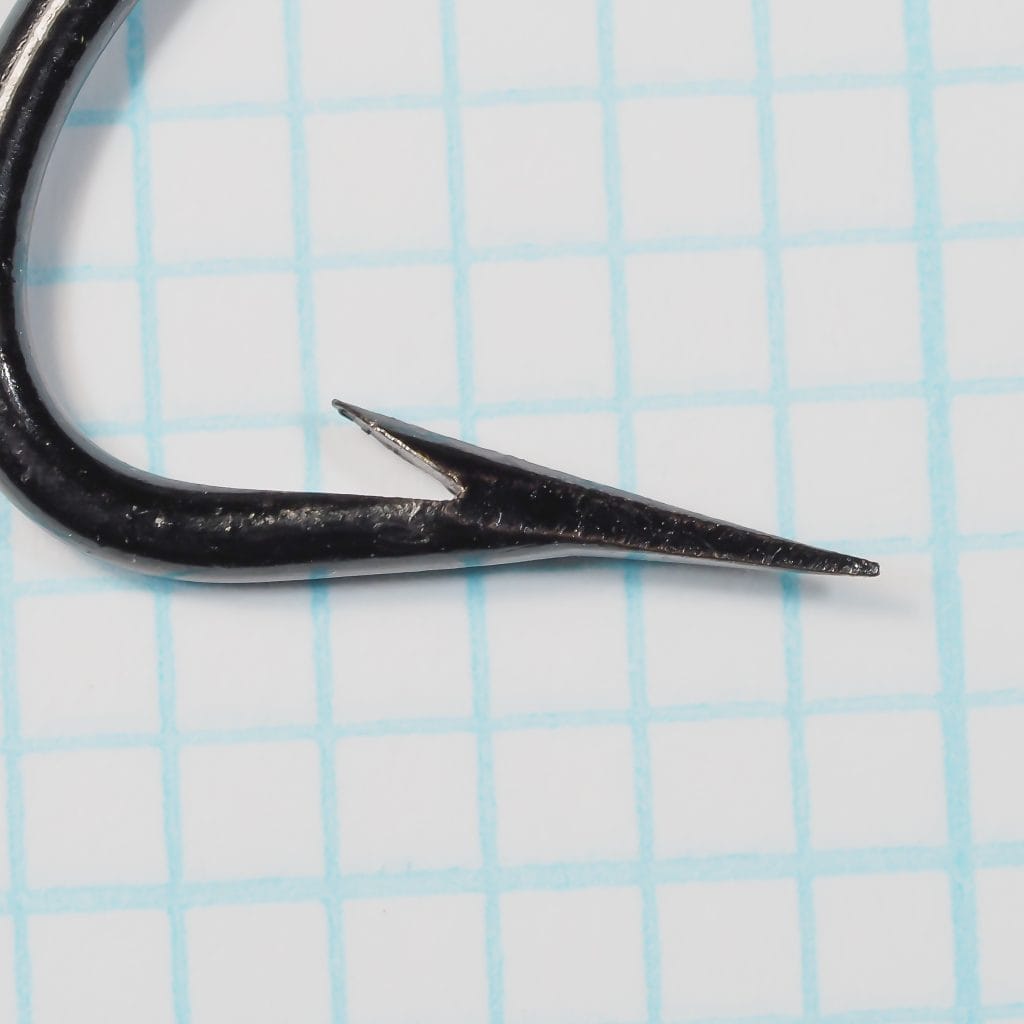
Side profile view of a Turner Chestertown No. 1 bait hook showing the rounded Sproat bend, marked shank with ridging, blind-marked eye, and japanned finish on a 1/10-inch measurement grid.
Photographic record
2 cataloged imagesSelect any record to load it above.
2 images shown
Turner Chestertown Size 1 ProfileSide profile view of a Turner Chestertown No. 1 bait hook showing the rounded Sproat bend, marked shank with ridging, blind-marked eye, and japanned finish on a 1/10-inch measurement grid.Open originalTurner Chestertown Original Sales CardOriginal Turner sales card for Chestertown marked-shank hooks featuring letterpress printing, "Best Rule Point" branding, Redditch manufacturer attribution, and two specimen hooks displayed on cream-colored card stock.Open original
Technical profile
Eye
Blind — Marked ShankBlind-marked shank construction typical of British sea-trout tradition. Allows direct attachment of line via whipping or knot to the marked section of the shank P.
Wire
Standard, Forged
Shank
Standard — Marked / Ridged
Bend
Sproat, Standard gapModerate depth characteristic of Sproat geometry, with rounded bottom and slight wire set visible in profile P. The bend diameter suggests a medium hook appropriate for live minnow presentation.
Point
Standard / SpearStandard short, angled barb visible in profile photograph P. Barb sits approximately one wire diameter back from point.
Finish
Black Japanned — Confirmed (stated on packaging)Glossy black lacquer coating obscures underlying wire texture P. Packaging explicitly states "Japanned" finish. Consistent with Turner house finish standards for marked-shank bait hooks of the era.
The marked or ridged shank is an engineering feature specific to pre-1950s bait hooks. The raised barring was formed during the forging process, creating mechanical friction points that gripped baitfish skin without requiring complex fastening hardware. The Sproat bend — rounded bottom with moderate depth — distributes force over the gape and is less prone to bending than angular alternatives when fighting larger fish or when the hook bore the static load of a heavy live bait.
The japanned finish provided corrosion resistance necessary for salt-water and brackish conditions. The blind-marked eye eliminated the eye loop entirely, reducing overall hook weight and allowing direct line attachment via traditional half-blood or improved clinch knot. This was standard practice for sea-trout work where the angler required a direct connection to the hook shank rather than relying on an eye.
Size & scale lab
Known manufactured size range:
No. 1 V
Selected size
No. 1
Physical specimen
Overall Length
36.9 mm
Shank Length
22.9 mm
Gap Width
12.7 mm
Bend Depth
8.9 mm
Wire Diameter
1.6 mm
Shank-to-Gap Ratio
~1.8-2.1 : 1
Confidence
P
Physical specimen
Grid-derived from photograph (1/10" grid)
Cumulative Records
First garrenwood.com documentation of Turner Chestertown marked-shank model with original packaging. Contributes to growing catalog of blind-marked eye designs and marked-shank variants from Redditch manufacturers.
Own this hook? Help us measure it.
This pattern was made in sizes No. 1 (V). We don't have any measurements for it yet. Own one? Submit calipered measurements and we'll review and add them. Thank you!
Historical context
turner
R. Turner & Sons was a Redditch-based hook manufacturer operating from the late 19th century through the mid-20th century. Turner was part of the broader Redditch manufacturing ecosystem — a town that by the 1880s had become the world center for fishing-hook production, with over 200 manufacturers competing in a highly specialized market.
Turner’s factory was located in Redditch proper and produced a range of bait and fly hooks, with particular specialization in marked-shank and blind-eye designs intended for British sea-trout and salmon fishing. The “Best Rule Point” branding represented Turner’s house standard for point geometry — a competitive marker in an era when hook sharpness and durability claims were the primary selling points in the trade press.
Turner competed directly with larger firms like S. Allcock & Co. and smaller craft makers. The company maintained catalog presence through the 1920s-1940s but appears to have contracted or ceased independent operations by the 1950s, consistent with broader consolidation in the Redditch industry during the postwar period.
Series History
The Chestertown was part of Turner’s marked-shank bait-hook line, introduced in the early 1900s as a premium alternative to standard Sproat and Aberdeen models. The name likely derives from Chestertown, Maryland — a historic fishing port and commercial shad-fishing center — suggesting Turner marketed the line toward estuarine and coastal applications. The series remained in catalog through the 1920s-1930s. No major design revisions are evident across surviving examples; the marked shank, Sproat bend, japanned finish, and blind-marked eye were consistent specifications. The line was discontinued or absorbed into Turner’s general catalog by the 1940s as blind-marked eye designs fell out of favor in favor of looped-eye alternatives. No successor product line is documented.
Era and Packaging Dating
Card format and construction: Cream stock with letterpress printing is consistent with early 20th century. No barcode or modern postal codes visible — strong indicator of pre-1974 manufacture, likely earlier. Font style and layout characteristic of Edwardian-era Turner catalogs. "Best Rule Point" branding present on packaging — Turner used this proprietary marking during the 1900s-1920s period. Marked-shank bait hooks were standard Turner product through 1920s; blind-marked eye design aligns with British sea-trout tradition of pre-1930s. Package count (100) matches Turner standard quantity for sales cards of this era.
The Marked Shank Solution
Turner's marked-shank hooks were a practical response to a persistent problem in sea-trout fishing: live minnow bait would rotate on the hook shank during the cast, twisting the line and destroying the presentation. The raised barring prevented this rotation by creating friction with the baitfish skin — a solution so effective that it remained in use across European bait-fishing traditions well into the 1960s, surviving the transition to plastic and nylon gear simply because no angler had invented anything better. Many modern fly tyers and traditional fishermen rediscover Turner's marked-shank designs expecting them to be proprietary secrets, only to find the solution was letterpress-printed on a cream card a century earlier.
Design lineage and influence
The Chestertown represents Turner’s marked-shank bait-hook line, a specialty within the broader Redditch bait-hook tradition. Marked shanks evolved from 19th-century sea-trout and salmon practice, where the barred or ridged shank provided mechanical holding points for live and dead baitfish — preventing the bait from sliding or rotating during presentation. Turner’s “Best Rule Point” marking appeared on their premium bait and sea-trout hooks from approximately 1900 onward, distinguishing them from generic Redditch output.
The Sproat bend paired with the marked shank suggests Turner’s response to coastal fishing demand in the south of England, where estuarine sea-trout and small salmon required robust tackle suitable for live minnow work. No direct modern equivalent exists, as marked-shank construction has been superseded by modern soft-plastic and live-bait holder designs. The design lineage terminates with Turner’s withdrawal from active production in the mid-20th century.
Best matchRelated by Attribute
Computed automatically from catalog data — updated as new hooks are added.
Matches: Bend, Shank, Gap, Eye, Eye Orient. +3 moreDiffers: Wire: Standard vs Fine (1X Fine); Point: Standard / Spear vs Superior; Finish: Black Japanned vs Bronzed +1 more
Matches: Bend, Shank, Gap, Eye, Eye Orient. +2 moreDiffers: Wire: Standard vs Fine (1X Fine); Point: Standard / Spear vs Superior; Finish: Black Japanned vs Bronzed +2 more
Matches: Shank, Wire, Gap, Eye, Eye Orient. +3 moreDiffers: Bend: Sproat vs Carlisle; Finish: Black Japanned vs Blued; Forging: Forged vs Round +1 more
Matches: Bend, Gap, Eye, Eye Orient., Application +2 moreDiffers: Shank: Standard vs 1X Long; Wire: Standard vs Fine (1X Fine); Point: Standard / Spear vs Hollow Point +2 more
Matches: Bend, Gap, Eye, Eye Orient., Application +2 moreDiffers: Shank: Standard vs 1X Long; Wire: Standard vs Fine (1X Fine); Point: Standard / Spear vs Hollow Point +2 more
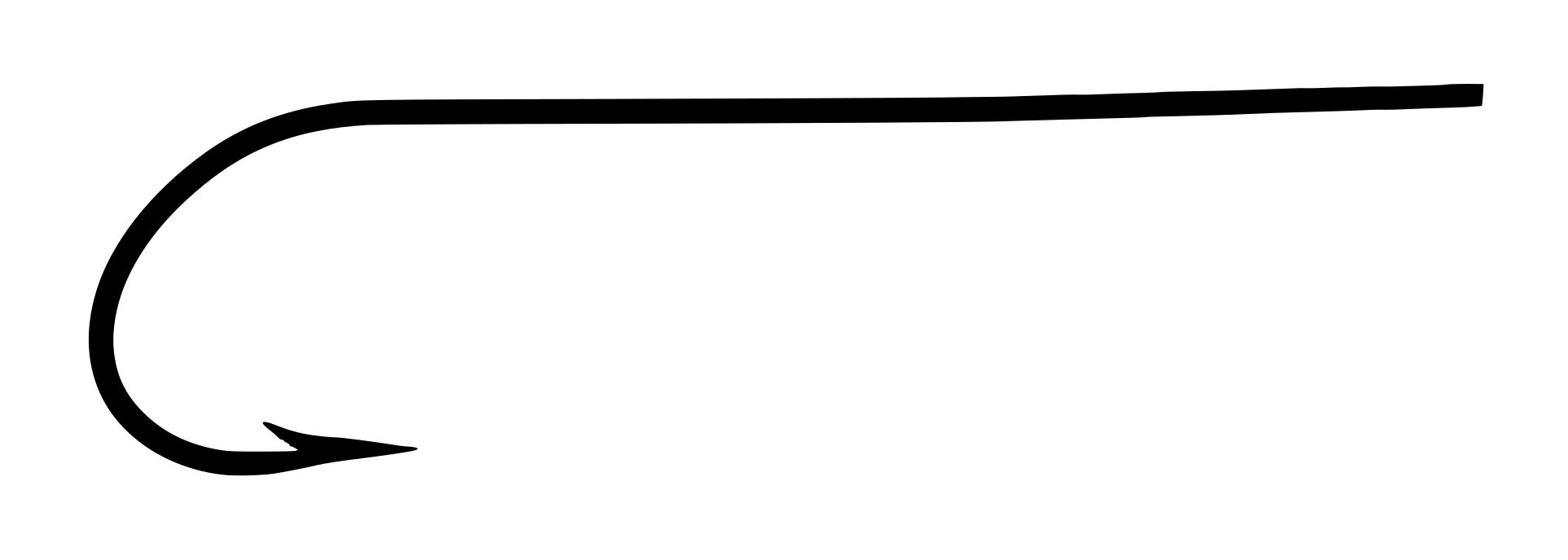
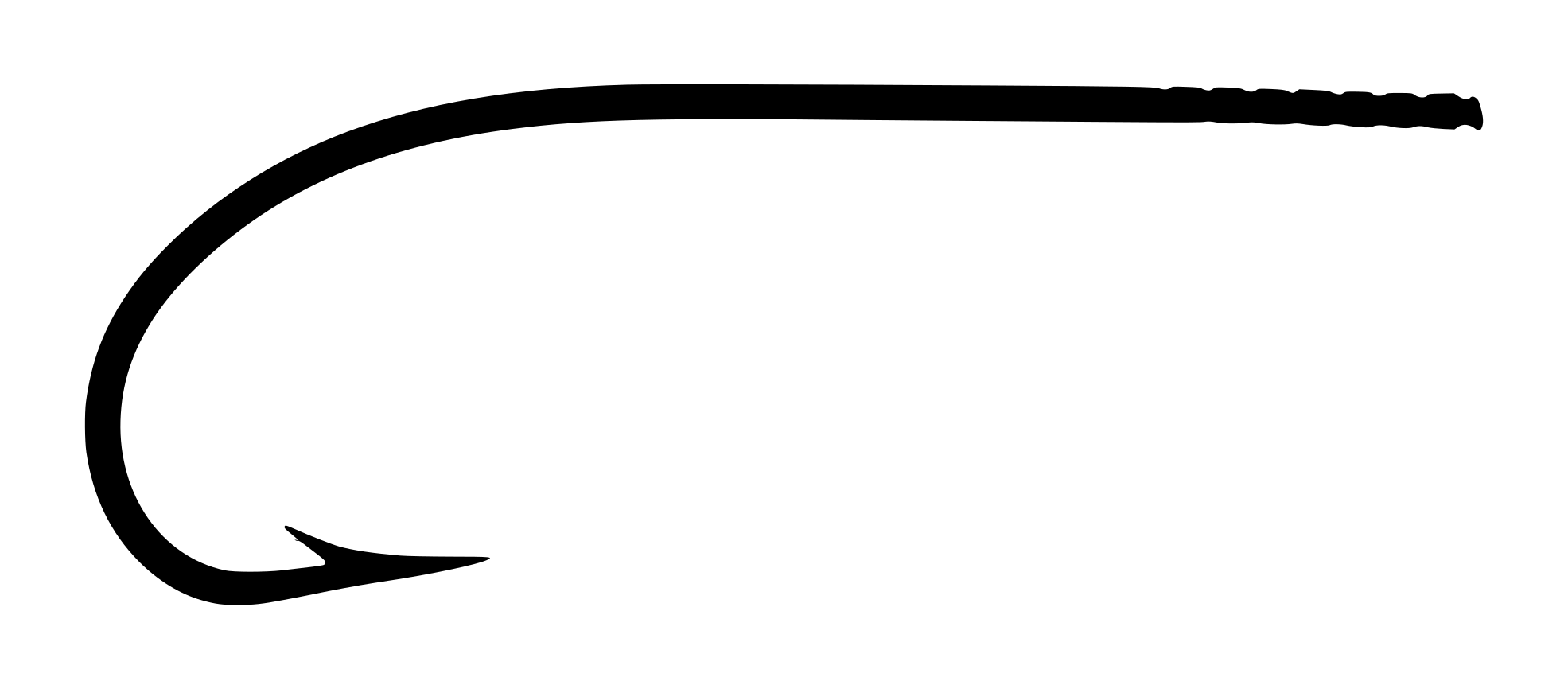
A marked-shank bait and sea-trout hook from the Turner catalog tradition. The marked shank provided holding points for bait attachment, particularly for live and dead minnow work in coastal and estuarine contexts. The blind-marked eye design is consistent with British sea-trout tradition of the early 20th century.
Secondary Applications
Small salmon; coastal baitfish rigs.
Collector notes
Rated 5.5/10 — scarce in surviving complete cards, particularly in smaller sizes; marked-shank construction has strong appeal among British bait-hook collectors and sea-trout historians. Primary limiting factor is modest overall collector demand outside the specialist fishing-tackle community, and fragmentation of original cards.
Reference value
$18 – $55 USD estimate
Packaging condition
Very Good — light wear, fully legibleRecorded specimen
Packaging format
Turner-Card-01Catalog code
Positive factors: Marked-shank construction is uncommon in surviving examples. Turner was a major Redditch maker, but the Chestertown line was a specialty product and did not receive the production volume of generic Aberdeen or Sproat models. Blind-marked eye design appeals to historical-methods enthusiasts and sea-trout tradition specialists. Complete original card with intact packaging and all 100 hooks is rare — most surviving examples show hook loss or card deterioration. The “Best Rule Point” branding adds collectibility, as Turner’s proprietary markings are sought by Redditch specialists.
Limiting factors: The fishing application (bait work, particularly live minnow) does not align with modern fly-tying collector interest — limiting the appeal to a narrower audience. Size No. 1 is a medium hook with modest functional demand by contemporary fly tyers. Card condition is critical to valuation — fragments or cards missing more than 20 percent of original hooks command significantly reduced prices. Japanned finish can show patina and surface wear, which some collectors view as desirable aging and others as cosmetic loss.
Premium variants: Original packaging intact (card glassine or tissue wrapping) adds 30-50% to value. Sealed or near-sealed cards with full hook count can reach into the rare category. Smaller sizes (No. 4 or smaller) command higher premiums due to greater scarcity. Cards with clear, unfaded printing are more desirable than faded examples.
Packaging
Rectangular sales card in cream stock with burgundy letterpress printing. Header reads "BEST RULE POINT" in serif capitals. Main panel: "CHESTERTOWN HOOKS / Made by R. TURNER & SONS, / Redditch, England." Lower section: "No. [size] / Marked. / 100". Card dimensions approximately 3.5" × 2.25" (8.9 × 5.7 cm). Two hooks displayed horizontally on card. Paper stock exhibits light toning consistent with age. Print method: letterpress with fine halftone shading on border.
Market Value Notes
Low ($18): Good condition — card opened, majority of hooks present (80+ of original 100), light to moderate card wear. High ($55): Excellent condition — card near-sealed or sealed, full hook count intact, minimal print fade, original tissue or glassine wrapper present. Premium factors: Sealed or near-sealed original packaging, complete hook count, clear printing, smaller sizes (No. 4 or finer). Platforms: eBay UK, specialist tackle auctions, antique fishing dealer networks. Confidence: E estimated — limited recent comparable sales data for marked-shank Turner cards; estimate anchored on comparable Redditch bait-hook card sales and scarcity premium for specialized construction.
Where to Find
eBay UK (sporadic); specialist Redditch tackle dealers; antique fishing tackle fairs in southern England; occasional appearance at Mullock's Auctions (Ludlow) and similar regional auction houses specializing in sporting tackle.
Preservation
Storage and Preservation
Store the original card in a cool, dry environment away from direct light and humidity. The japanned finish is durable but not immune to long-term moisture exposure, which can cause surface patina and eventual corrosion at the point. The cream-colored card stock is susceptible to brittleness in very dry conditions; maintain relative humidity between 40-50% to preserve both card and hooks.
If the card is complete, keep it intact on the original mounting — do not remove hooks unless absolutely necessary for examination. The card itself is a significant artifact documenting Turner’s branding, printing methods, and pricing. Loose hooks should be stored in wax paper or cotton, not plastic, which can trap condensation. Avoid contact with other metals or ferrous materials to prevent galvanic corrosion of the japanned surface.
The marked shank ridging can collect dust and debris over time; light brushing with a soft-bristled brush (not steel wool) is safe. The japanned finish should never be cleaned with water or solvents — age patina is desirable to collectors and difficult to replace authentically.
Primary Source
Packaging Text and Branding Analysis
Source: R. Turner & Sons sales card, c. 1900-1925, Redditch, England. Original packaging photograph.
The card bears three distinct text elements of historical significance: “BEST RULE POINT,” “CHESTERTOWN,” and the Turner maker attribution “R. TURNER & SONS, Redditch, England.”
“Best Rule Point” was Turner’s house standard for point geometry, appearing on their premium bait and sea-trout hooks from approximately 1900-1925. The term “rule” likely referred to the standard or rule by which the point was ground — suggesting a consistent, repeatable point angle rather than hand-finished work. This branding distinguished Turner’s marked-shank hooks from generic Redditch alternatives and served as a quality claim in an era when hook sharpness was a primary competitive differentiator.
“Chestertown” is unusual as a hook model name in the Redditch tradition, which typically used descriptive names (Aberdeen, Limerick, Sproat) or patron designations. Chestertown, Maryland, was a significant commercial fishing port and shad-fishing center, suggesting Turner marketed this line toward estuarine and American coastal applications. The choice indicates market-specific branding for export or colonial fishing traditions.
The packaging states “No. [size] / Marked. / 100.” The “Marked” designation explicitly identifies the shank ridging feature, confirming this was a deliberate product variant rather than an incidental manufacturing characteristic. The quantity (100) reflects Turner’s standard card count for bait-hook sales.
Size Note
No. 1 Hook Size and Traditional Redditch Sizing
Turner’s “No. 1” designation corresponds to the traditional Redditch numbering system used for bait and sea-trout hooks prior to Mustad’s standardization in the mid-20th century. Redditch sizes were internally consistent within manufacturers but lacked a universal standard — a Turner No. 1 is not exactly equivalent to a contemporary size 1/0 in modern (Mustad) terminology, though it falls in the same functional range.
The No. 1 Chestertown, as documented here, measures approximately 1.40″-1.50″ overall and 0.45″-0.55″ gap — consistent with a medium-sized bait hook suitable for live minnow work and small salmon in estuarine environments. This size was popular for sea-trout fishing in British traditions and represents neither an oversized salmon hook nor a delicate small-stream pattern.
Turner did not publish a comprehensive size-to-measurement conversion table in surviving catalogs, so the exact numerical relationship between “No. 1” and other makers’ standards remains partially speculative. However, surviving Turner hooks allow direct comparison: Turner No. 1 is slightly smaller than an S. Allcock & Co. size 1/0 and slightly larger than a Partridge of Redditch No. 2. This indicates Redditch makers used overlapping but non-identical size schemes — a source of confusion that persisted until Mustad’s industrial standards became dominant in the 1950s-1970s.
Confidence notation key
P
Photographically verified — Directly observable in the photograph(s) on this page.
V
Verified by documentation — Confirmed by manufacturer catalog, spec sheet, or published reference.
I
Inferred — A logical deduction from observable or documented evidence, not directly stated.
E
Estimated — An approximation based on visual comparison, proportional analysis, or limited data.
S
Speculative — A reasoned hypothesis that cannot be confirmed from available evidence.
Claims with no notation are confirmed by multiple independent sources. All photographs on garrenwood.com are taken on a measurement grid where each square equals 1/10 inch (0.1″ / 2.54 mm).