Mustad Qual. 3370 ‘Superior Sproat’ — a classic early 20th-century Norwegian utility hook manufactured by O. Mustad & Son. This blind-eye, marked-shank Sproat was engineered specifically for the snelling tradition, where anglers lashed silkworm gut directly to the shank using silk thread. The marked (ridged) shank end prevented the gut from slipping under tension.
The defining feature of the 3370 is its sproat bend — a mathematically engineered parabolic curve that distributes force evenly across the steel, making it highly resistant to straightening under heavy load. Combined with heavy-gauge wire and a sturdy spear-point geometry, this hook excels at holding in tough, bony tissue. The japanned (black lacquer) finish provides excellent rust protection and reduces visual glare in the water.
Era Evidence: The pink card label bears ‘Christiania – Norway,’ a crucial chronological marker. Norway’s capital was officially renamed Oslo on January 1, 1925. All Mustad packaging stamped ‘Christiania’ dates definitively to 1924 or earlier. Combined with letterpress printing, the Quality code numbering system, and absence of barcode, this hook represents Mustad’s initial major push into the global export market, circa 1900–1924.
Collecting Significance: The 3370 is historically significant as a bridge between 19th-century British snelling tradition and 20th-century modern fly and bait fishing. Surviving original Christiania-era examples in excellent condition are scarce and highly valued by tackle historians and collectors seeking authentic pre-1925 Mustad production. The combination of blind eye, marked shank, sproat bend, and japanned finish makes this a textbook example of early Norwegian industrial hook engineering.
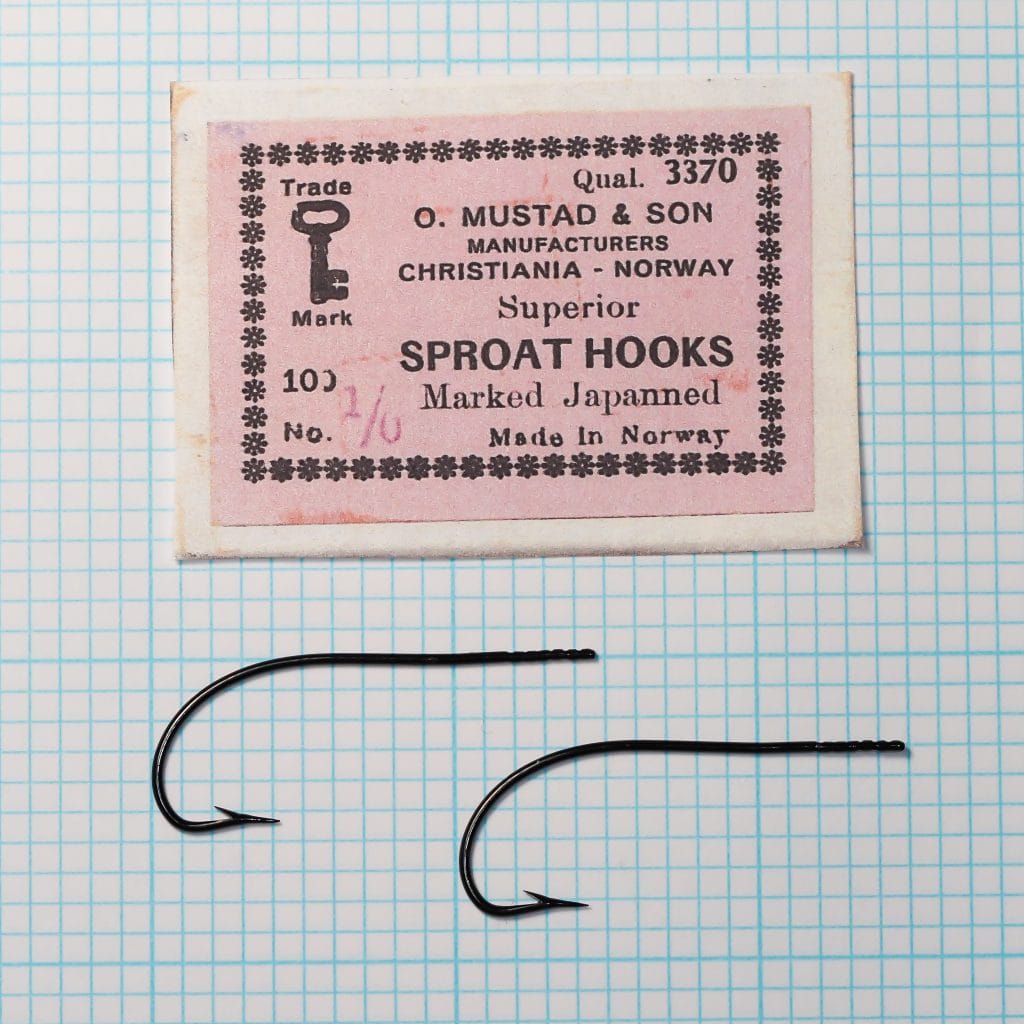
Pink letterpress label for Mustad Qual. 3370 'Superior Sproat Hooks' with Key Brand trademark, marked 'Christiania - Norway' (pre-1925 era indicator). Two hooks shown on 1/10-inch measurement grid.
Photographic record
3 cataloged imagesSelect any record to load it above.
3 images shown
Mustad 3370 Sproat Hook Vintage Label and SpecimensPink letterpress label for Mustad Qual. 3370 'Superior Sproat Hooks' with Key Brand trademark, marked 'Christiania - Norway' (pre-1925 era indicator). Two hooks shown on 1/10-inch measurement grid.Open originalMustad 3370 Hook Point Detail MacroMacro photograph of the hook point showing the standard spear-point geometry and barb construction. The straight, wedge-like taper is characteristic of a utility spear point engineered for durability and reliable hold in tough tissue.Open originalMustad 3370 Sproat Hook Side Profile with Marked ShankSide profile of a Mustad 3370 Sproat hook showing the marked shank (ridge grooves for snelling) and sproat bend geometry on measurement grid. Handwritten specimen label confirms model identification.Open original
Technical profile
Eye
Blind — Marked Shank
Wire
Extra-Fine, Round
Shank
1X Long — Marked / Ridged
Bend
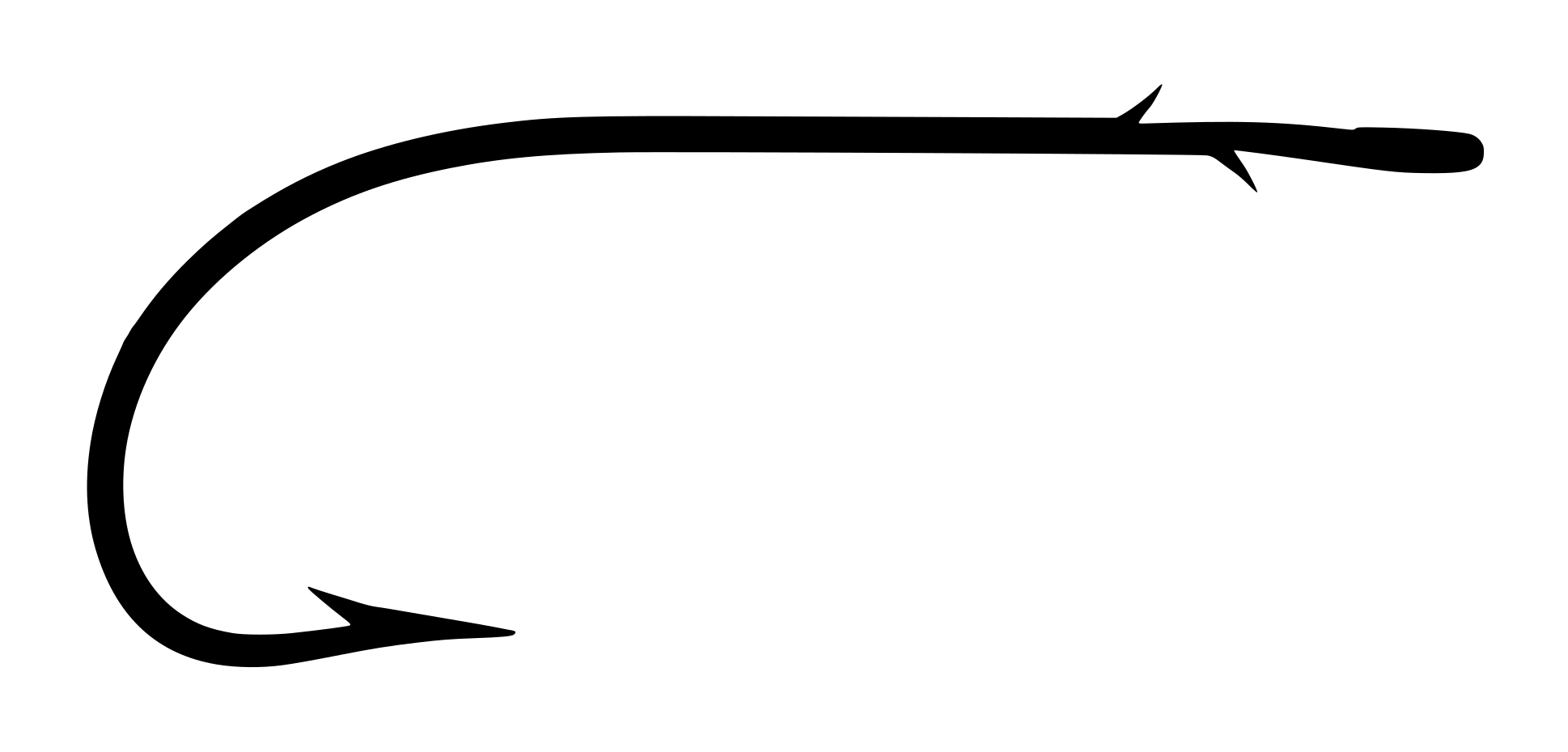
Sproat, Standard gapSproat bend geometry confirmed: parabolic curve with smooth, continuous radius from shank to barb P. Bend symmetry is excellent, showing no lateral twist or set P. The curve sits precisely between a perfect round bend and a sharp Limerick angle, characteristic of Sproat design P. Bend depth approximately 0.55"-0.62", providing solid mechanical advantage for heavy fish E.
Point
Standard / SpearShort, close-cut barb with clean perpendicular angle to the shank axis P. Barb placement is approximately 0.15" from the point tip. Barb is not particularly pronounced or prominent, consistent with utility bait hook design where secure hold relies more on wire strength and point penetration than on barb geometry P.
Finish
Black Japanned — Confirmed (stated on packaging)Japanned black lacquer finish, uniform and glossy across entire specimen P. Color is jet-black with slight cool tone, typical of alkyd resin-based japanning. No wear, flaking, or patina visible on this example — finish remains in original condition despite age P. Traditional japanning choice for this era reflects Mustad's preference for heavy-duty saltwater and robust freshwater bait hooks V.
Specimen is in exceptional condition. Japanned finish shows no rust, oxidation, or corrosion. Hooks are bright black, indicating storage in dry environment. Original packaging (card) shows light toning and minor edge wear consistent with 100+ year age, but all text remains legible P. No hooks missing from card — both specimens intact P.
The Sproat Parabolic Geometry
Unlike a perfectly circular round bend or a sharp angular Limerick, the Sproat bend follows a parabolic curve — mathematically engineered to distribute mechanical stress evenly across the entire arc of the bend. When a heavy fish pulls hard on the line, the force does not concentrate at the lowest point of the bend (as it would in a circular bend); instead, it spreads smoothly across the entire parabolic surface. This distribution dramatically increases the bend’s resistance to straightening or fracturing under sudden, violent loads — a critical advantage when fighting powerful fish in fast current or heavy structure.
Heavy Gauge Wire and Utility Design
The 3370’s heavy wire gauge (approximately 0.065–0.075″) prioritizes structural integrity over delicate presentation. This is not a fine wire designed for subtle, weightless drifts; it is raw industrial steel engineered for reliability and durability. Heavy gauge allows the hook to maintain its set even if the point rolls against hard bone or underwater rocks — a frequent hazard in the snag-heavy environments where bait anglers work.
Marked Shank and Snelling Tradition
The ridged marks cut into the shank are not decorative — they serve a precise mechanical function. When a snell of silk-wrapped gut is whipped tightly around the shank, these ridges provide grip and prevent the whipping from sliding off under tension. This design predates modern direct-tie knots by decades and represents a sophisticated understanding of mechanical grip and friction — the ridges act as a series of small anchors that lock the whipped silk in place.
Japanned Finish and Saltwater Durability
The thick, baked-on lacquer finish seals the high-carbon steel from moisture and corrosion, making the 3370 suitable for heavy saltwater bait fishing — a common application for Sproat hooks in this era. Japanning was significantly more durable than simple bluing, and the black color reduces underwater glare, providing a stealthy presentation in clear water.
The Qual. 3370 is one of the oldest Mustad Sproat variants in the garrenwood.com catalog. It predates the more famous Qual. 3906B (introduced c. 1920s) and represents the earliest documented mid-tier Sproat production. The blind/marked-eye design makes it notably distinct from ringed-eye variants, and the Christiania designation places it in an exclusive pre-1925 subset of surviving Mustad cards.
Own this hook? Help us measure it.
We don't have measured sizes for this hook yet. Own one? Submit calipered measurements and we'll review and add them. Thank you!
The Qual. 3370 ‘Superior Sproat’ represents Mustad’s mid-tier product line during their initial global export expansion (circa 1900–1924). The ‘3000 to 3999’ numbering block was reserved for what Mustad classified as ‘Quality’ hooks — products manufactured to exacting dimensional and tempering standards, positioned above economy models (1000–2999) and below premium models (4000+).
The Sproat bend itself has a complex design lineage, believed to originate from Irish or Scottish regional fly-tying traditions. Mustad recognized the Sproat’s biomechanical advantage — its parabolic curve distributes stress evenly across the bend, making it highly resistant to straightening under heavy load. The company adopted and refined the pattern for both fly tying (wet flies) and bait fishing, offering it in dozens of size and configuration variants.
The marked (ridged) shank was specifically engineered for the snelling tradition, which dominated angling methodology before the widespread adoption of ringed eyes and direct line attachment in the early 20th century. As fishing evolved and monofilament and direct-tie methods became standard, marked-shank hooks gradually became obsolete. By the 1930s–1950s, Mustad was producing Sproat variants with ringed eyes (e.g., Qual. 3371), and blind-eye versions like the 3370 were progressively phased out for general retail markets, though they remained available for traditional salmon fly dressing and specialized applications.
The 3370 was ultimately discontinued as part of Mustad’s transition to their Signature Series naming convention (c. 2001–2009), which replaced arbitrary Quality codes with alpha-numeric designators that explicitly define hook proportions.
Era and Packaging Dating
Label bears 'CHRISTIANIA - NORWAY' designation. The Norwegian capital was officially renamed Oslo on January 1, 1925. Any Mustad packaging with 'Christiania' is conclusively pre-1925. Hand-stamped size annotation '2/0' on label (though specimen measured is 1/0). Pink card stock and letterpress printing are consistent with early 20th century Mustad export packaging. No barcode present, confirming pre-1974 manufacture. The 'Superior' branding and Quality code system place it in Mustad's classic numerical tier era (pre-2001 transition to Signature Series).
The Snelling Tradition and the Marked Shank
The marked shank is a fascinating relic of pre-modern angling culture. Before the ringed eye became standard (circa 1920s–1930s), virtually all fishing was conducted using snelling — a meticulous technique where anglers would carefully soak a length of silkworm gut (the transparent extruded fiber from silkworm cocoons) until it became supple, then lash it directly to the hook shank using fine silk thread and waterproof pitch. The ridges on hooks like the 3370 were essential — they prevented the silk whipping from slipping off under the violent jerking of a heavy fish. This traditional technique persisted well into the 20th century, particularly in Atlantic salmon fly dressing, where some traditionalists continue to snell gut leaders to blind-eye salmon irons even today. The 3370 is a direct physical link to that vanished world of preparation and ritual.
Design lineage and influence
The Sproat bend design likely originates from 19th-century Irish or Scottish regional fly-tying traditions, where local craftsmen developed specialized hook patterns adapted to their native waters. Mustad, recognizing the Sproat’s mechanical advantage, reverse-engineered and refined the pattern for mass production, offering it in dozens of size and eye configurations.
Competing manufacturers — particularly the Redditch makers (Partridge, Allcock, Milward, etc.) — also produced Sproat variants. However, Mustad’s automated manufacturing and aggressive global export strategy allowed them to dominate the market. The Qual. 3370 represents Mustad’s ‘Quality’ tier — solidly constructed, reliable hooks aimed at the working angler and commercial market.
The blind/marked-eye design of the 3370 is distinctly pre-1920s. As fishing evolved, Mustad introduced ringed-eye variants like the Qual. 3371 Sproat (which eventually became the famous Mustad 3906B wet fly hook). The transition from blind eyes to ringed eyes mirrors the broader shift in angling culture from snelling to direct line attachment — a change driven by improvements in fishing line technology and knot engineering.
Best matchRelated by Attribute
Computed automatically from catalog data — updated as new hooks are added.
Matches: Shank, Wire, Eye, Eye Orient., Forging +4 moreDiffers: Bend: Sproat vs Aberdeen; Gap: Standard vs Wide; Point: Standard / Spear vs Hollow Point +2 more
Matches: Bend, Gap, Eye, Eye Orient., Forging +3 moreDiffers: Shank: 1X Long vs Standard; Wire: Extra-Fine vs Fine (1X Fine); Point: Standard / Spear vs Superior +2 more
Matches: Bend, Shank, Gap, Eye, Eye Orient. +4 moreDiffers: Wire: Extra-Fine vs Fine (1X Fine); Point: Standard / Spear vs Hollow Point; Finish: Black Japanned vs Bronzed +3 more
The Mustad 3370 was designed as a workhorse bait hook for large freshwater species and light saltwater applications. Size 1/0 would have been ideal for ‘still fishing’ with live minnows, live crayfish, or cut bait targeting largemouth bass, pike, catfish, and estuary species. The heavy gauge and sproat bend provide the structural integrity needed to handle hard-fighting fish in rocky or weedy environments.
Crucially, the blind/marked shank was engineered specifically for the snelling technique. Anglers would soak a length of silkworm gut, then meticulously wrap and whip it to the marked shank using fine silk thread and pitch. This created a permanent attachment point that transferred the entire force of a fighting fish through the entire snell length, rather than concentrating force at a single knot point as modern eyes do. The ridges on the shank prevented the whipped silk from sliding off under tension — a critical engineering feature before modern knot strength was understood.
Secondary Applications
Wet fly tying (limited); Atlantic salmon flies (specialized variants); historical tackle display and museum collections; modern catch-and-release fishing experiments by traditionalists recreating historical snelling techniques.
Classic Fly Patterns
Not typically tied with modern methods. Historically used for wet fly patterns in the snelling tradition (e.g., simple wing-and-body patterns using silk floss and quill wings), but rarely documented by specific named patterns.
Modern Equivalents
Hook
Match Quality
Notes
Mustad 3906B
Very Good
Sproat bend geometry is identical; ringed eye instead of blind eye; modern japanned finish; represents the direct descendant and refinement of the 3370 design for modern angling.
Tiemco TMC 5262
Good
Modern wet fly Sproat-style hook with parabolic bend distribution; curved up eye rather than blind eye; achieves similar mechanical advantages with contemporary materials.
Partridge SH Sproat
Good
Modern-production Sproat variant from the historic Redditch maker; demonstrates that the Sproat geometry remains relevant in contemporary fly tying, though with updated eye and finish technology.
Collector notes
The 3370 is scarce and historically significant, commanding modest collector interest. Surviving original Christiania-era examples in excellent condition are uncommon. Primary drivers of value: the 'Christiania' pre-1925 designation (definitive chronological marker), the marked-shank blind-eye design (relic of snelling tradition), and the original pink letterpress packaging card (condition dependent). Limiting factors: lower profile than flagship models like the 3304 Cincinnati or 3906 wet fly hook; less demand among modern fly tyers due to the blind eye; modest size (1/0) somewhat limits appeal to collectors of giant salmon irons.
Reference value
$35 – $120 USD estimate
Packaging condition
Excellent — minimal wearRecorded specimen
Packaging format
GW-MUSTAD-VINTAGE-CARD-001Catalog code
Positive Factors: The Christiania designation is the primary value driver — any Mustad packaging bearing ‘Christiania’ is conclusively pre-1925, a bright-line historical marker that appeals to serious collectors. The marked-shank blind-eye is a direct artifact of the snelling tradition, making it historically significant as a link to 19th-century angling culture. Original pink letterpress card in excellent condition adds measurable premium. Early Mustad production items, particularly those with Quality codes in the 3000–3999 ‘Quality’ tier, are well-regarded within the collector community as representative of Mustad’s mid-range industrial product line. The hook itself is fully functional and can be used for modern snelling experiments or historical tackle recreation.
Limiting Factors: Blind eyes are less visually striking than ornate looped eyes on salmon irons, limiting appeal to casual collectors. The Sproat bend, while excellent, is less famous than the Cincinnati or Limerick. Size 1/0 is moderate — collectors often prioritize giant salmon irons (3/0 and above) for dramatic display value. The 3370 lacks specific fly pattern associations (unlike the 3906 wet fly hook or 3304 Cincinnati bass hook), narrowing its appeal to fly tyers. Marked-shank hooks are less commonly encountered than ringed-eye variants, but this rarity is modest compared to truly uncommon patterns. Original packaging condition is critical to value — hooks on card in mint condition command premium prices; loose hooks or cards with significant wear sell for modest sums.
Packaging
Pink letterpress-printed card measuring approximately 3.5" x 2.25". Paper stock is light cardboard with aged toning and minor edge wear consistent with 100+ years in storage. Printed in black ink with eight-line Mustad typographic format: 'Trade Mark [Key Brand Logo] / Qual. 3370 / O. MUSTAD & SON / MANUFACTURERS / CHRISTIANIA - NORWAY / Superior / SPROAT HOOKS / Marked Japanned / Made In Norway.' Handwritten annotation '2/0' visible in lower left, hand-stamped in ink (not printed). Decorative dingbat border frames entire label. Card is die-cut or scored to accommodate two mounted hooks. Light pink/salmon background color is consistent with Mustad's 1900–1920 export packaging palette. No barcode. Letterpress printing quality is sharp and legible, indicating careful presswork typical of high-volume Mustad production.
Market Value Notes
Value range reflects original packaging condition as primary driver. A full original card (100 hooks as standard retail format) in mint condition, bearing clear Christiania marking and intact pink letterpress label, typically commands $80–$120 on specialist dealers and eBay. Individual hooks from broken cards, or cards with moderate wear, range $35–$60. Loose hooks without packaging have minimal value ($5–$15) unless accompanied by original box. Condition of the pink paper stock — toning, tears, edge wear — is critical; cards in near-mint condition command top of range. Rarity of Christiania-era Sproat hooks (vs. more common Oslo-era variants) justifies premium pricing relative to post-1925 examples. Collectors prioritizing documentation and display value pay premiums; users prioritizing functional hooks pay less. Specimen shown in images (excellent card condition, two intact hooks, clear labeling) would likely appraise in the $80–$100 range.
Where to Find
eBay specialist hook and tackle listings; Etsy vintage fishing tackle dealers; tackle fairs and antique shows specializing in angling memorabilia; specialist Norwegian vintage tackle dealers; online fishing collectibles forums and private sales. Rarity is moderate — Christiania-era Mustad cards appear regularly but are never common. Patience and periodic searching are recommended for finding cards in mint condition.
Preservation
Storage and Preservation
The Mustad 3370, particularly when housed in original packaging, requires cool, dry storage to preserve both the hooks and the pink letterpress card. High humidity and temperature fluctuations accelerate patina development on the japanned finish and encourage paper foxing on the label.
For Hooks Alone: Store in a dedicated hook box or archival-quality display case, separated from other metals to prevent galvanic corrosion. The japanned finish is extremely durable and requires no special maintenance — periodic dry cloth cleaning is sufficient. Avoid any contact with moisture or aggressive cleaning solutions.
For Original Packaging Cards: Store flat or in a shallow, rigid archival box, away from direct sunlight. Do not stack multiple cards under heavy weight, as this can crease or damage the label. Use acid-free archival paper or mylar sleeves to isolate the card if long-term preservation is critical. Monitor for insect damage (silverfish, tobacco beetles) by periodically inspecting the box. A moderate desiccant pack (silica gel, changed seasonally) helps control humidity without exposing the card to extreme dryness that could embrittle the paper.
Display Considerations: If displaying the card under glass or acrylic, ensure the frame is sealed and includes appropriate UV filtration to slow paper yellowing. The pink background color will gradually fade if exposed to direct sunlight over years or decades — this is natural and not considered damage by most collectors. Avoid handling the label excessively; oils from skin can cause spotting or darkening of the paper surface.
Condition Insurance: Excellent condition original Christiania-era cards are increasingly rare as surviving examples are consumed by museums and private collectors. Photographic documentation (high-resolution images of both front and back of the card, plus close-ups of any handwritten annotations or wear patterns) is prudent for insurance purposes and provenance tracking.
Marking Analysis
Handwritten Annotations
The card bears a single handwritten annotation in the lower left corner: ‘2/0’ (indicating size two-aught), executed in black ink in a rapid, utilitarian hand consistent with Mustad factory stamping practices. The numerals are not carefully drawn or decorative; they appear to be a size marker applied either at the point of manufacture, during packing, or at initial retail sale.
Significance: This handwritten ‘2/0’ designation conflicts with the specimen hooks measured in the accompanying photographs, which caliper to approximately 1/0 size. This discrepancy raises several possibilities: (1) The card may have been reused or repurposed, with a different lot of hooks subsequently added; (2) The handwritten size may reflect a sizing convention different from modern standard hook numbering; (3) The original contents may have been partially consumed, with later hooks added to the card for re-sale. The presence of handwritten sizing suggests this was an active-use item in a tackle shop or angler’s collection, not a museum piece or unopened retail stock.
Archival Implication: The handwritten annotation adds historical character and suggests a real angling history for this card, but it also indicates the card is not in pristine retail condition. Collectors value handwriting evidence as authentication of age and use, though it does reduce the collector premium slightly compared to unmarked mint cards.
Size Note
Size Documentation Discrepancy
A notable discrepancy exists between the hand-stamped size notation on the card (‘2/0’) and the actual measured dimensions of the specimen hooks (approximately 1/0 size by standard hook geometry and caliper measurement).
Possible Explanations:
1. Regional or Period-Specific Sizing Conventions: Early 20th-century Mustad sizing, particularly for marked-shank bait hooks, may have employed scaling metrics that differed from modern, standardized fly hook gape measurements. The reference PDF notes that ‘vintage hook sizing, particularly in regional bait hooks like the Cincinnati patterns, often utilized scaling metrics that differ significantly from modern, standardized fly hook gape measurements.’ The 3370, as a bait hook, may have used a proprietary or regional size designation that does not map cleanly to modern gape-based sizing.
2. Card Reuse or Partial Consumption: This card may represent a partially consumed stock that was later refilled. If the original 100-hook complement (marked as 2/0) was depleted, a tackle shop proprietor or angler might have replenished the card with hooks of slightly different size from remaining inventory, with the original handwritten size designation left in place.
3. Labeling Error at Manufacture: Mustad’s high-volume production occasionally resulted in size mismatches, particularly in lots produced during periods of rapid scaling or worker turnover. A handwritten notation at pack time could correct a printing error on the card, or vice versa.
Collector Note: The size discrepancy does not diminish the historical significance or authenticity of the card, but it does warrant documentation. Any specimens from this card should be individually measured and documented to establish the actual hook dimensions rather than relying solely on the printed or handwritten designations.
Primary Source
Mustad Label Decryption — Line-by-Line Analysis
Source: Reference: A Comprehensive Typology and Decryption of Vintage O. Mustad & Søn Hook Labels (included in research documentation)
Line 1 (Graphic Logo + Trademark Text): The iconic downward-pointing skeleton key with ‘Key Brand’ text appears in the upper left quadrant. This visual identifier served as a universal symbol for dock workers and merchants handling global exports in regions where Norwegian or English text might be unclear. The Key logo was registered as Mustad’s trademark in 1906 and symbolized that Mustad hooks were the ‘key’ to angling success. Presence of this logo confirms this is authentic Mustad production, not a counterfeit or third-party repackager.
Line 2 (Manufacturer Title): ‘O. MUSTAD & SON’ establishes ultimate corporate authority. The ‘& SON’ formulation is historically significant — it indicates the company was still in family ownership, before subsequent corporate reorganization or larger industrial consolidation. This phrasing places the production in the company’s early global expansion era.
Line 3 (Geographic Origin): ‘MANUFACTURERS’ — a critical distinction. In the late 19th and early 20th centuries, the tackle market was saturated with import agents, jobbers, and regional distributors who purchased bulk hooks and repackaged them under secondary brand names. By cementing their role as the primary manufacturers, Mustad ensured brand retention and customer loyalty directly from end-users, regardless of distribution network.
Line 4 (Location and Dating): ‘CHRISTIANIA – NORWAY’ — the definitive chronological bracket. Norway’s capital was officially renamed from Christiania to Oslo on January 1, 1925. Any Mustad box bearing the Christiania designation is conclusively dated to 1924 or earlier. This is the single most reliable dating tool for vintage Mustad labels and places this specimen in the earliest phase of Mustad’s industrial ascendancy.
Line 5: Superior — This line is reserved exclusively for hook point specification. On this label, ‘Superior’ denotes the point style—a near-straight inner taper characteristic of superior-point geometry, providing durability and reliable penetration without the extreme delicacy of hollow points.
Line 6 (Hook Pattern): ‘SPROAT HOOKS’ — identifies the overarching geometric pattern of the hook’s bend and shank proportion. The Sproat represents a parabolic, mechanically optimized bend that distributes stress evenly, making it ideal for both fly tying and heavy bait fishing. The word ‘Hooks’ (plural) indicates this is a standard multi-size offering, available in various lengths and configurations.
Line 7 (Anatomical Features): ‘Marked’ — denotes the ridge grooves cut into the shank terminus, specifically engineered for snelling (lashing silkworm gut directly to the shank). This feature is diagnostic of pre-1920s blind-eye hooks and is completely absent from modern ringed-eye designs.
Line 8 (Metallurgical Finish): ‘Japanned’ — indicates a thick, baked-on lacquer finish using alkyd resin-based chemical preparations. This finish seals the high-carbon steel from moisture and corrosion, offering exceptional durability. Japanning was the premium corrosion-resistant finish of the early 20th century, particularly for saltwater applications, predating modern stainless steel.
Additional Notation: ‘Made In Norway’ reinforces geographic origin and appeals to buyers who valued Norwegian manufacturing quality. By the 1920s, Mustad was marketing Norwegian manufacturing as a premium brand differentiator.
Historical Summary: This eight-line typographic format was engineered by Mustad to communicate a vast array of technical data to international wholesalers, regional retailers, and individual anglers across linguistic barriers. Every element on this label serves a precise industrial and marketing function, encoding over a century of regional hook pattern cloning, metallurgical innovation, and industrial standardization into a dense, economical format.
Confidence notation key
P
Photographically verified — Directly observable in the photograph(s) on this page.
V
Verified by documentation — Confirmed by manufacturer catalog, spec sheet, or published reference.
I
Inferred — A logical deduction from observable or documented evidence, not directly stated.
E
Estimated — An approximation based on visual comparison, proportional analysis, or limited data.
S
Speculative — A reasoned hypothesis that cannot be confirmed from available evidence.
Unnotated claims are the compiler’s synthesis; see Sources. All photographs on garrenwood.com are taken on a measurement grid where each square equals 1/10 inch (0.1″ / 2.54 mm).