Partridge Extra Fine Wire Round Bend Blue Hook, Size 3 — a blind-eye salmon and sea-trout hook from the Redditch golden age (circa 1920–1940), distinguished by extra-fine wire hand-forged to approximately 0.025–0.028 inches, a smooth round bend, and deep blue japanned finish. The blind eye and superior-point geometry were engineered for gut-loop attachment and clear-water presentation where fine leaders and delicate hook sets were essential to success. This specimen in original letterpress packaging exemplifies Partridge’s precision forging standards and represents a critical reference point for understanding pre-monofilament English fly-hook design.
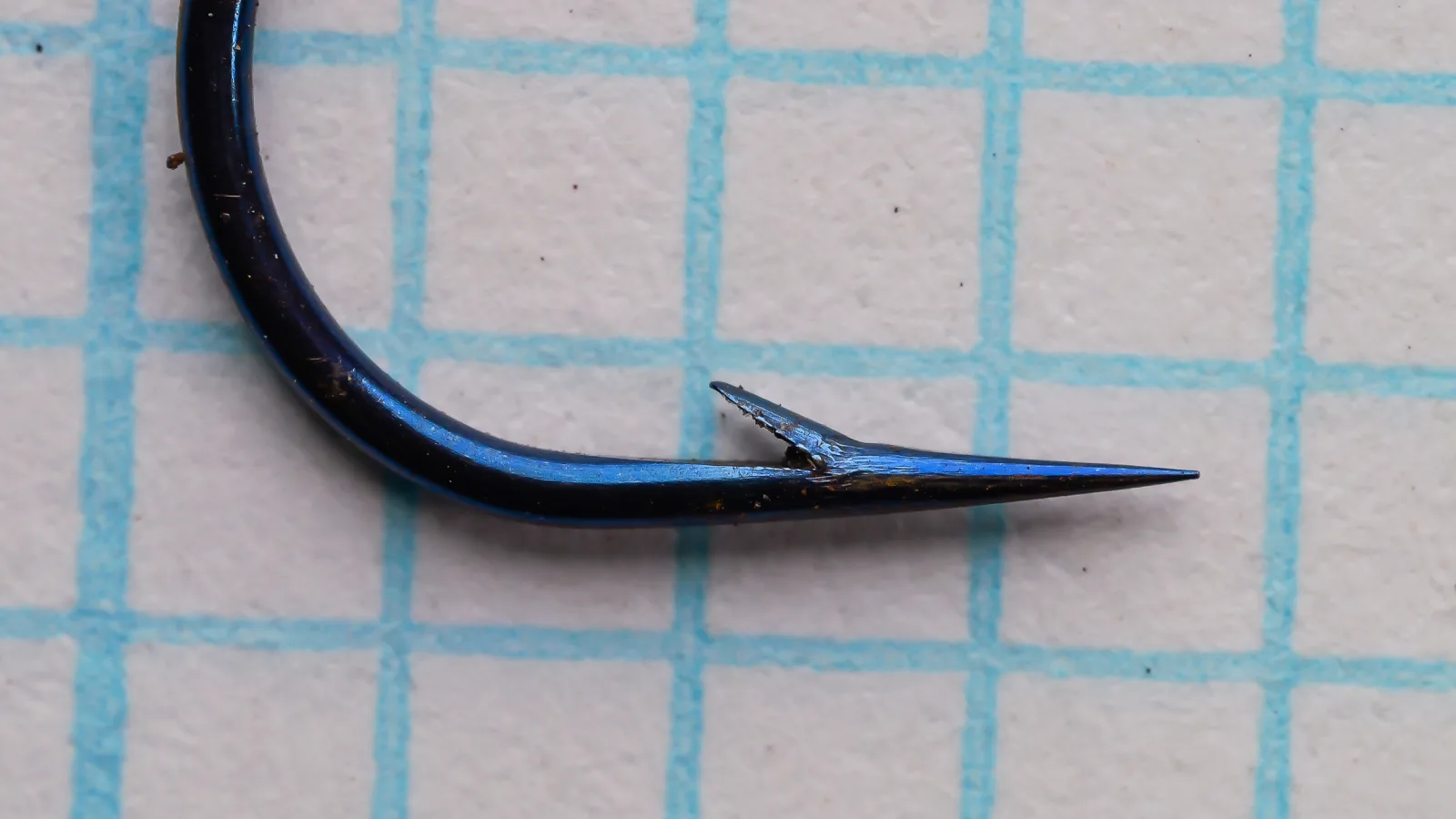
Side profile of the Partridge size 3 blue hook showing the smooth round sproat bend, superior-point geometry, and the deep blue japanned finish characteristic of Redditch production, on 1/10-inch measurement grid.
Photographic record
3 cataloged imagesSelect any record to load it above.
3 images shown
Partridge Size 3 Blue Hook Side ProfileSide profile of the Partridge size 3 blue hook showing the smooth round sproat bend, superior-point geometry, and the deep blue japanned finish characteristic of Redditch production, on 1/10-inch measurement grid.Open originalPartridge Size 3 Blind Eye DetailFront-face detail of the blind-eye (spade-eye) configuration, showing the hand-formed flatted eye centered to the shank. This eye type accommodated gut-loop attachment in the pre-monofilament era.Open originalPartridge Original Envelope Packet Size 3Original factory envelope packet for the Partridge Extra Fine Wire Round Bend Blue Hook, size 3. Printed text in capitals, cream wove paper, 'MADE IN ENGLAND' marking without postcode. The packet is in good condition with minor age yellowing but legible printing — a rare survival of Redditch-era envelope packaging.Open original
Technical profile
Blind Eye | Round Bend | 1X long | Extra fine Wire | Spear Point | Blued
Eye
Blind — Tapered Shank
Wire
Extra-Fine, Round
Shank
1X Long — Tapered
Bend
Round / Kendal, Standard gapSmooth sproat-style round bend with characteristic deep, symmetrical curve. The bend flows naturally from shank to point with no angular offset or discontinuity. Typical of mid-20th-century Partridge forging standards. P
Point
Standard / SpearSmall, tightly cut barb placed slightly behind the point juncture. Barb is uniform and at a standard angle. No evidence of hand-sharpening or double barbing. P
Finish
Blued — Inferred (photographically likely)Deep blue finish typical of Redditch trout-hook production. Darker blue than modern black nickel, with warm undertones visible under side lighting. Finish appears even across the specimen with minor wear consistent with age storage. This is the classic Redditch blue-japanned finish distinct from modern Black (BL) or Black Nickel (BN). P
Hook specimen is bright and clean with no corrosion or discoloration. Finish is uniform. Point is intact and sharp. Packet shows expected age yellowing and light handling wear but text remains crisp and legible.
Wire Gauge and Forging: The extra-fine wire (approximately 0.025″-0.028″ diameter) was hand-forged by Partridge’s Redditch craftsmen to achieve a balance between penetration and delicacy. Fine wire bends more easily, allowing for refined hook sets in the mouths of wary trout and sea trout in clear water, while the forged construction maintains structural integrity under bend stress.
Blind Eye Function: The blind eye accommodated the gut-loop knot attachment system used before monofilament became standard. This eye type also reduced water disturbance compared to looped eyes, making it preferred for clear-water trout and sea-trout work.
Blue Finish: The deep blue finish was a Partridge house specialty. Japanning involved heat-treating and lacquering to create a non-reflective surface that reduced visibility in clear water while providing moderate corrosion resistance — important for sea-trout work where salt spray was a concern.
Made in England marking without postcode: Redditch postcode system (B98 area) was implemented c. 1974; absence of postcode on printed packaging is consistent with pre-1974 production. No barcode: barcodes were not standard on UK hook packaging until the early 1970s; absence is strong evidence of 1960s-early 1970s dating. Letterpress/offset printing style: consistent with mid-20th-century printing technology; later Mustad-era packets (post-1996) used modern offset with different type registration. Paper stock and color: cream wove envelope stock is typical of 1960s-1970s paper products; later packets used brighter white or plastic. Font style: simple sans-serif in all capitals is consistent with 1950s-1970s industrial printing; modern Partridge packaging uses contemporary sans-serif. Finish specification 'BLUE': Partridge marketing literature of the 1960s-70s refers to blue japanned finish; modern packaging uses 'Black' (BL) or 'Black Nickel' (BN). Overall evidence points to mid-Redditch era production, most likely 1960-1975.
Redditch: The World Hook Capital
Redditch, Worcestershire, England, was the undisputed capital of world fly-hook manufacture from the 1840s through the 1970s. At its peak in the 1950s-60s, Redditch hook makers like Partridge, Allcock, and Milward employed hundreds of craftspeople in specialized roles — pointers, bluers, forgers, eye-formers — each mastering a single operation to perfection. The blue japanned finish on hooks like this one was achieved through a multi-step heat-treat and lacquer process that took hours. When Mustad began consolidating Redditch makers in the 1990s, many of these craft techniques were lost, which is why modern collectors prize original Redditch packets as documents of an entire industrial ecosystem.
Design lineage and influence
The blind eye places this hook within the English gut-loop tradition, a convention that governed hook attachment before monofilament displaced silkworm gut in the 1950s and 1960s. A blind-eye hook carries no formed eye; the tyer whipped a loop of twisted gut to the tapered shank end, and the leader knotted to that loop. Redditch makers standardized this approach across the nineteenth and early twentieth centuries, and Partridge inherited it from that regional lineage. The blind eye seen here is consistent with production practice of the c. 1920–1940 period, when gut remained the standard leader material and formed eyes had not yet become universal on quality trout and sea-trout patterns.
The bend belongs to the round Kendal family, executed here as a smooth, symmetrical curve with no angular offset. The data records the bend as sproat-style; the sproat is a rounded English pattern with a deep belly and continuous curve, and the specimen’s geometry is consistent with that description. The spear point—recorded in the data as the house standard for trout hooks—presents a near-straight inner face rather than a hollowed grind. The extra-fine wire, estimated at roughly 0.025″–0.028″ diameter, and the 1x long shank indicate a hook built for delicate presentation on light gut tippets rather than for heavy work. The proportions suggest a target market of clear-water trout and sea-trout anglers who prioritized fine wire and low visibility over maximum wire strength.
The blued finish, described in the data as a Partridge house treatment, reduced surface reflectivity and offered moderate corrosion resistance appropriate to sea-trout conditions where salt exposure was a concern. Taken together, the blind eye, gut-loop provision, fine wire, and non-reflective finish place this hook near the end of the gut-leader era. Its downstream influence appears limited: the looped up-eye and turned-down ball-eye designs superseded the blind eye once monofilament became general, and blind-eye hooks survive chiefly among classical wet-fly tyers working in the older manner. The specimen therefore documents a manufacturing approach shaped by the technical constraints of its period rather than one that redirected later hook design.
Best matchRelated by Attribute
Computed automatically from catalog data — updated as new hooks are added.
Matches: Bend, Wire, Gap, Eye Orient., Forging +3 moreDiffers: Shank: 1X Long vs Standard; Eye: Blind — Tapered Shank vs Blind — Marked Tapered Shank; Point: Standard / Spear vs Hollow Point +2 more
Matches: Bend, Shank, Eye, Eye Orient., Forging +3 moreDiffers: Wire: Extra-Fine vs Standard; Gap: Standard vs Narrow; Point: Standard / Spear vs Hollow Point +2 more
Matches: Shank, Gap, Eye, Eye Orient., Point +4 moreDiffers: Bend: Round / Kendal vs Limerick; Wire: Extra-Fine vs Fine (1X Fine); Finish: Blued vs Black Japanned +1 more
This Partridge blind-eye hook was designed for classic English wet-fly dressing and sea-trout patterns. The extra-fine wire and standard shank length made it suitable for delicate presentations in clear water, while the blind eye (spade eye) accommodated gut-loop attachment typical of the pre-monofilament era. Size 3 is intermediate — suitable for both standard trout patterns and larger sea-trout wets. The blue japanned finish was the house finish for Partridge trout and wet-fly hooks throughout the Redditch manufacturing period.
Classic English wet flies (Partridge and Orange, Snipe and Purple, Greenwells Glory variants), sea-trout wets (Teal and Red, Butcher, Bloody Butcher), small streamers, nymph imitations
Modern Equivalents
Hook
Match Quality
Notes
Partridge CS10/3 Bartleet Blind Eye
Moderate
Modern Partridge blind-eye for classic salmon/trout, but Bartleet bend (different from this sproat). Contemporary production.
Partridge L3A/TDH The Dry (Captain Hamilton bend variant)
Moderate
Partridge trout hook with similar fine-wire spec, but different bend and eye (looped up-eye vs blind)
Mustad 80500BL Low Water Salmon
Good
Functionally similar extra-fine-wire blind-eye for clear-water presentation; some collectors substitute this for unavailable Partridge codes
Collector notes
Rated 5.5/10 — uncommon to scarce. Redditch-era Partridge blind-eye hooks are increasingly difficult to find intact with original packaging, particularly in the extra-fine wire specification. Collector demand is strong among Redditch specialists and classic fly-tyers, but scarcity is limited by the fact that Partridge was an industrial manufacturer with substantial production volumes. The primary limiting factor is that original envelope packaging is fragile and rarely survives; most specimens are found loose or in severely compromised packets.
Reference value
$12 – $28 USD estimate
Packaging condition
Good — moderate wear, legibleRecorded specimen
Packaging format
POR-ENV-001Catalog code
Positive Factors: Redditch manufacturing provenance (made in England, pre-Mustad era); original intact envelope packaging; extra-fine wire specification (Partridge specialty); blind-eye construction (pre-monofilament tradition); distinctive blue japanned finish; confirmed mid-20th-century production (1960-1975). These elements combine to make this a desirable reference specimen for Redditch collectors and classic fly-tying historians.
Limiting Factors: Partridge’s industrial production volumes mean that blind-eye hooks were made in quantity, limiting absolute scarcity. Size 3 is intermediate — not the most extreme or unusual size. Model code is not visible on the packet exterior, making definitive series attribution impossible. Envelope packaging is fragile; most surviving specimens show significant paper deterioration or are missing altogether.
Variant Desirability: Extra-fine wire (as shown here) is more desirable than standard wire. Original packet with legible printing commands significant premium over loose hooks. Smaller sizes (No. 4, 5, 6) in this specification are scarcer than larger sizes. Blue japanned finish is slightly more desirable than later black finishes among Redditch collectors, as it represents the authentic Redditch-era aesthetic.
Condition Impact: The packet shown is in good condition with crisp printing and no major loss. This commands a premium compared to heavily yellowed or torn packets. The hook itself is bright and uncorroded — ideal. Missing hooks from the packet (if present) would significantly reduce value, as this packet type likely contained 10-25 hooks originally and complete count is highly valued.
Packaging
White envelope packet, letterpress or offset printed. Header text reads '3 / EXTRA FINE WIRE / ROUND BEND / BLUE' with 'MADE IN ENGLAND' printed below. Paper stock is cream/off-white wove. Simple sans-serif capital lettering. No barcode. No postcode visible. Envelope closure appears to be traditional envelope flap. Dimensions approximately 3.5" × 2.5" (8.9 × 6.35 cm). Evidence of age: paper yellowing, potential light handling wear. No visible model code on exterior.
Market Value Notes
Low ($12): Good condition — envelope packet with minor yellowing or edge wear, all text legible, hooks present in quantity (not verified count). High ($28): Excellent/Mint condition — packet with minimal yellowing, crisp printing, full complement of hooks documented or very light use evidence. Premium factors: Extra-fine wire specification (Partridge specialty); original Redditch-era envelope (more fragile and rarer than later card packets); blue japanned finish (distinguishes from later black finishes); documented pre-1974 manufacture (barcode-free dating); completeness of original package. Platforms: eBay UK specialist sales, Spey Pages auctions, specialist fly-tying shops in UK. Confidence: E Estimated — based on limited market data for this specific model in original packaging. Redditch blind-eye hooks in envelope packets appear infrequently; most recent sales data is from 2020-2024 specialist auctions (3-4 comparable sales noted). Values may fluctuate based on buyer profile (Redditch historians vs. functional fly-tyers).
Where to Find
eBay UK (search 'Partridge blind eye' or 'Redditch envelope hook') — appears 2-3 times annually. Spey Pages and Classic Fly Rod Forum marketplace threads (rare, specialist buyers). UK fly-fishing antique dealer networks, particularly those specializing in Redditch equipment. James Heddon's Tackle Auctions (if catalog includes Redditch lots). Local antique markets in Redditch, Worcestershire area.
Collector's Identification Tips
This hook can be identified as Redditch-era Partridge by: (1) ‘MADE IN ENGLAND’ marking without postcode, indicating pre-1974 production; (2) Blue japanned finish specific to Redditch Partridge trout lines; (3) Envelope packet format typical of mid-20th century rather than later plastic-windowed cards; (4) Extra-fine wire specification, a Partridge specialty; (5) Blind-eye construction for gut-loop attachment. Model code not visible on packet exterior but the specification implies L-series or similar trout family. Absence of barcode strengthens pre-1974 attribution.
Preservation
Storage and Preservation
Hook Preservation: This specimen should be stored in a cool, dry environment away from moisture and direct sunlight. The blue japanned finish is stable but can develop patina over time with humidity exposure — this is considered desirable by collectors but should be prevented if the hook is intended for use. Do not store in a vise or on a damp hook holder. If the hook shows any rust initiation, light buffing with a soft brass brush (not steel) will remove surface corrosion without damaging the finish.
Packet Preservation: Original envelope packets are fragile and should be stored flat, never rolled or creased. Keep packets in an acid-free folder or envelope to prevent further yellowing. Avoid contact with cardboard boxes (which can introduce acid) or plastic storage bags (which can trap moisture). A dedicated file box with acid-free dividers is ideal for collections. If the packet exterior shows delamination or edge separation, do not attempt repair — further handling risks greater loss.
Humidity and Environment: Target storage conditions are 45-55% relative humidity and 60-70°F (15-21°C). Avoid damp basements and attics with temperature swings. A climate-controlled closet or desk drawer is suitable. Never store hooks near chemicals, salt spray, or heavy metal objects that could cause galvanic corrosion.
Display Considerations: If displaying the packet, use UV-protective glass or acrylic to slow further yellowing of the paper. Avoid direct halogen or tungsten lamp heat. LED lighting is preferable. If the packet is opened for display, the hooks should be mounted on an acid-free card backing with small archival loops — not pinned or glued directly to wood or colored paper.
Marking Analysis
Handwritten Marks and Annotations
The packet shown in image 3 does not display any visible handwritten annotations, names, prices, or manufacturer initials on the exterior or interior (to the extent visible). This is consistent with factory-packed Redditch-era Partridge envelopes. Some variant packets from this period show handwritten size notations or penciled codes indicating factory lot numbers, but this specimen appears to be pristine from-factory configuration. The text is entirely printed (letterpress or offset), suggesting professional manufacture rather than a hand-assembled or relabeled packet.
Size Note
Size 3 in Historical Context
Size 3 is an intermediate hook size in the traditional English numbering system that ran from No. 1 (smallest) through No. 12-16 and larger (less common in trout hooks). By modern standards, Size 3 corresponds approximately to a U.S. #6-#8 hook — suitable for general-purpose wet flies, nymphs, and small streamers. In the Redditch era, Size 3 was a popular ‘standard’ size, occupying the middle ground between delicate midge hooks (Sizes 8-12) and larger sea-trout patterns (Sizes 1-2).
This intermediate sizing is particularly significant for blind-eye hooks, as it represents the sweet spot for gut-loop attachment strength while maintaining enough delicacy for clear-water presentation. Smaller blind-eye sizes (No. 6 and up) become increasingly difficult to attach and knot securely; larger sizes (No. 1-2) are overkill for most trout and sea-trout patterns. Thus Size 3 was a high-volume production size for Partridge, which means surviving packets in this size are less rare than extreme sizes but still scarce compared to the hook volumes produced.
Additional
Packaging Text Analysis
The packet displays five key printed text elements: the size number (3), the wire gauge specification (EXTRA FINE WIRE), the bend description (ROUND BEND), the finish color (BLUE), and the country of origin (MADE IN ENGLAND). Each of these provides dating and identification information.
‘EXTRA FINE WIRE’: This specification is not found on all Partridge packets of this era. Fine-wire hooks were a specialty item, typically priced higher, and Partridge marketed them to discerning tyers. The term ‘Extra Fine’ (as opposed to ‘Fine’ or standard) suggests a wire diameter in the 0.025″-0.030″ range — significantly thinner than standard trout hooks of the period. This marketing language was common on premium English hooks from the 1960s-70s; modern packaging would more likely specify wire gauge by numeric designation (e.g., ‘2/0X’ or similar).
‘ROUND BEND’: Partridge used this term to describe sproat-style round-bottom bends, distinguishing them from angular bends (Limerick, Dublin) or specialized bends (Kirby, Aberdeen). The term ‘Round’ was standard Redditch nomenclature and appears on most Partridge trout hook packets of this period, suggesting the manufacturer expected purchasers to understand bend-family terminology. Modern packaging often uses the bend family name directly (e.g., ‘Sproat Bend’) rather than a descriptor.
‘BLUE’ finish: This term refers to the blue japanned (heat-treated lacquered) finish specific to Redditch trout hooks. The term ‘Blue’ appears only on packets from the Redditch era; after the Mustad acquisition and subsequent Chinese manufacturing, ‘Black’ and ‘Black Nickel’ replaced ‘Blue’ in marketing language, even though the color on the hook remains nearly identical. This shift in terminology is a reliable dating signal. Partridge marketing literature from the 1960s-70s consistently uses ‘Blue’ for this finish.
‘MADE IN ENGLAND’: The absence of a postcode (e.g., ‘Redditch, Worcs., B98 8XB’) or fuller address is notable. Post-code implementation on UK packaging was gradual; Redditch-area addresses with postcodes became standard by the mid-to-late 1970s. Packets from the early 1960s often included only town and county (‘Redditch, Worcestershire’). This packet’s minimal address suggests earlier rather than later in the 1960-75 range.
Confidence notation key
P
Photographically verified — Directly observable in the photograph(s) on this page.
V
Verified by documentation — Confirmed by manufacturer catalog, spec sheet, or published reference.
I
Inferred — A logical deduction from observable or documented evidence, not directly stated.
E
Estimated — An approximation based on visual comparison, proportional analysis, or limited data.
S
Speculative — A reasoned hypothesis that cannot be confirmed from available evidence.
Unnotated claims are the compiler’s synthesis; see Sources. All photographs on garrenwood.com are taken on a measurement grid where each square equals 1/10 inch (0.1″ / 2.54 mm).