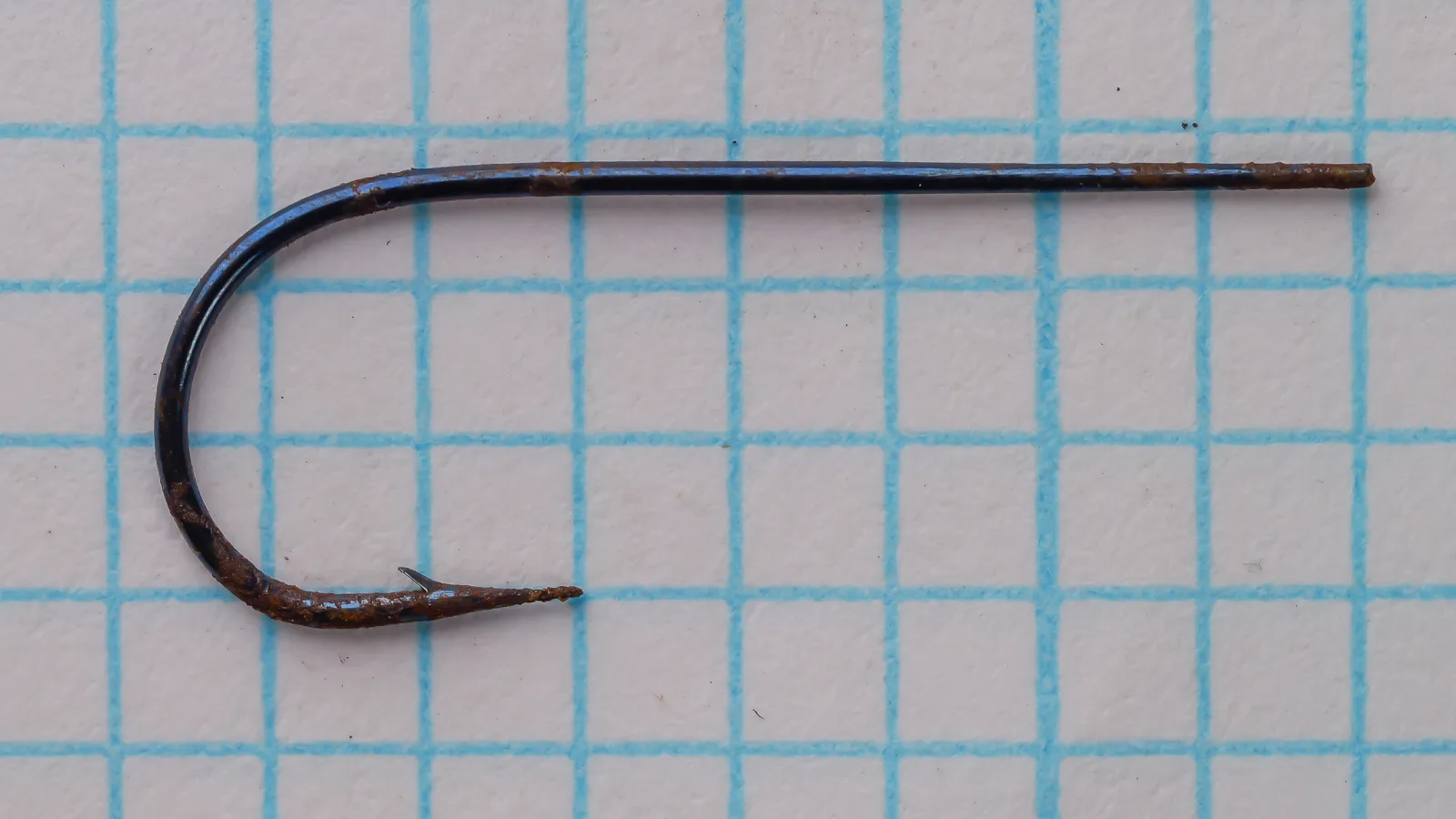
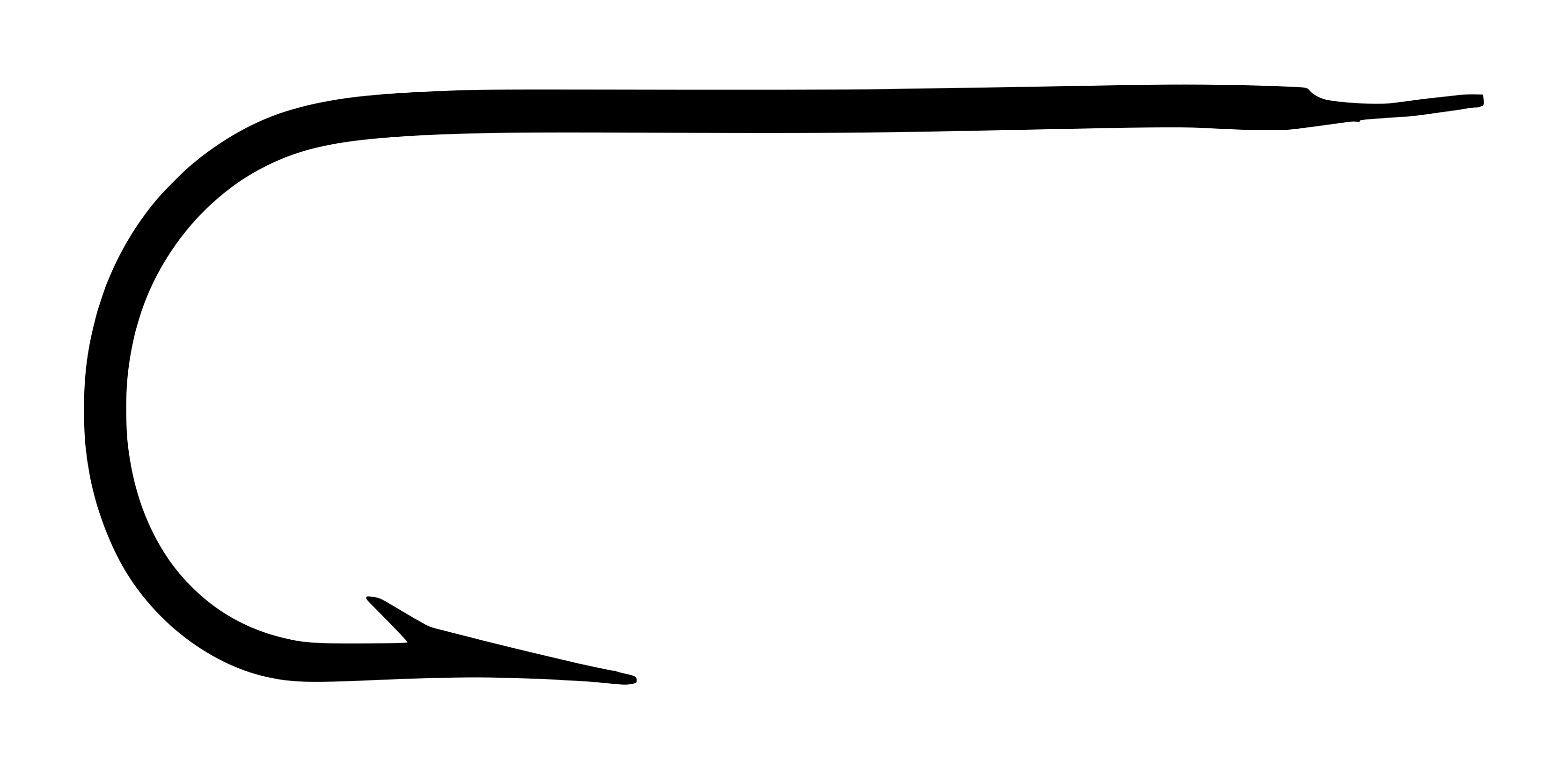
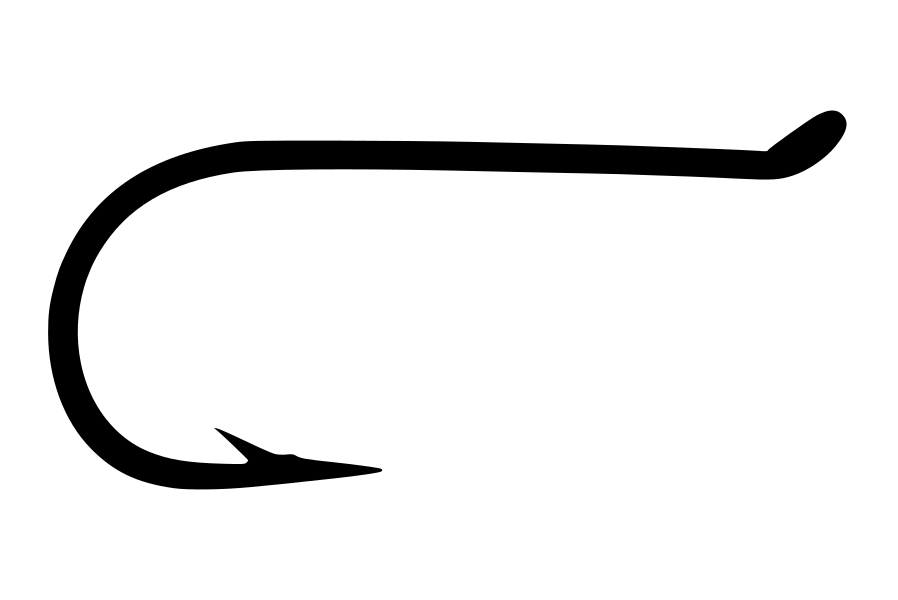
Partridge of Redditch Round-Bend Trout Hook in extra-fine wire, size No. 6, blued finish. This is a classic example of Redditch craft-era small-stream trout fly hooks from the 1950s–1960s. The defining feature is the tapered blind eye — a smooth, rounded taper at the shank tip with no spade or flattening — characteristic of traditional British fly-tying design for delicate presentations.
The extra-fine wire gauge (approximately 0.08″–0.09″ diameter) is optimized for small dry flies and wet patterns on clear-water chalk streams and small rivers. The round-bend geometry and blued oxide finish represent the conservative, time-tested design philosophy of Redditch makers who prioritized subtle presentation over mass-market appeal.
This hook’s original envelope packaging — buff-colored with letterpress printing and no barcode — dates the production to c. 1950–1970, during the height of the Redditch craft tradition. Partridge hooks are actively collected for their engineering quality and historical significance as representatives of British fly-tying heritage.
Overhead view of a Partridge of Redditch Round-Bend Extra-Fine Wire hook, size 6, blued finish, showing the characteristic smooth tapered blind eye and moderate-depth round bend on measurement grid.
Photographic record
2 cataloged imagesSelect any record to load it above.
2 images shown
Partridge Round-Bend Extra-Fine Wire Size 6 Blued FinishOverhead view of a Partridge of Redditch Round-Bend Extra-Fine Wire hook, size 6, blued finish, showing the characteristic smooth tapered blind eye and moderate-depth round bend on measurement grid.Open originalPartridge Round-Bend Extra-Fine Wire Size 6 Original PackagingOriginal buff-colored envelope packaging for Partridge Round-Bend Extra-Fine Wire hooks, size 6, showing letterpress-printed text and collector's handwritten mark.Open original
Blind — Tapered ShankTapered blind eye — shank tapers to a smooth, rounded point with no flattening or spade construction. Gut would be attached via loop tied around the taper. V
Wire
Extra-Fine, Round, Est. ~0.08"-0.09" (~2.0-2.3 mm)
Shank
Standard — Plain
Bend
Round / Kendal, Standard gapClassic rounded bottom typical of Kendal/Round-Bend design. Moderate depth relative to shank length. Symmetrical wire set. P
Point
Standard / SpearClose-cut, well-proportioned barb positioned approximately 1/3 from bend apex toward gap. Barb angle is standard (approximately 45° to shank axis), not exaggerated. Barb size is consistent with extra-fine wire gauge — small but clearly defined. P
Finish
Blued — Confirmed (stated on packaging)Cool blue-grey oxide characteristic of traditional blued finish. Steel texture faintly visible beneath coating. Uniform coverage except minor wear at bend apex from specimen age. P
Envelope shows light toning and foxing consistent with age. Paper is intact with no tears or serious creasing. Letterpress printing remains legible though faded to brown. Handwritten collector mark is non-destructive ink. The specimen hooks visible inside are bright with no corrosion; extra-fine wire shows no bends or breakage.
The superior point geometry — nearly straight inner taper with a flat inside face — is the traditional Redditch standard. This design maximizes penetration and hook-holding without creating the dramatic concavity of a hollow point. The narrow point is achieved through careful grinding and honing during the finishing process, a labor-intensive technique that reflects the craft tradition.
Extra-fine wire at approximately 0.08″–0.09″ diameter is approximately 40% lighter than standard-gauge wire in the same size. This reduction in mass allows smaller fly profiles and more delicate presentations while maintaining adequate strength for trout. The tapered blind eye eliminates the knot-weakening stress point created by a ball eye or turned-down eye, directing force more evenly through the shank taper.
The blued oxide finish is an iron oxide layer achieved through heating and cooling cycles. Unlike japanning (which uses lacquer) or nickelling (which uses electroplating), bluing creates a thinner, more natural coating that preserves the steel’s tactile character while providing moderate corrosion resistance. The blued finish requires proper care to prevent rust but develops a subtle patina with age that many collectors find aesthetically desirable.
Size & scale lab
Selected size
6
Physical specimen
Overall Length
20.1 mmP
Shank Length
14.4 mmE
Gap Width
6.6 mmP
Bend Depth
8.5 mmE
Wire Diameter
2.2 mm
Weight
Not available
Shank-to-Gap Ratio
~2.1:1 to 2.3:1
Confidence
P
Physical specimen
Physical measurement with calipers
Own this hook? Help us measure it.
We don't have measured sizes for this hook yet. Own one? Submit calipered measurements and we'll review and add them. Thank you!
Historical context
partridge
Partridge of Redditch was one of the most respected fly-hook manufacturers in the English Redditch tradition, competing directly with Allcock and Milward through the mid-20th century. The company maintained a reputation for meticulous hand-finishing and the use of tapered blind eyes — a hallmark of the Redditch craft approach that contrasted with the simplified, flatter eye constructions adopted by mass-market manufacturers like Mustad.
Partridge hooks were particularly favored by traditionalist fly tyers and chalk-stream fishermen who valued delicate presentation. The company’s product line emphasized extra-fine wire gauges, superior point geometry, and conservative bend designs. Partridge remained independent through the 1950s and 1960s but was eventually acquired by Mustad, which continued the brand into the modern era with less emphasis on craft tradition and more on industrial efficiency.
Series History
The Partridge Round-Bend line represents the core small-stream trout fly hook offering from the manufacturer. Round-bend hooks (also known as Kendal bends) have deep, symmetrical curves that balance hook strength with fly-holding capability. This design was particularly popular for soft-hackle wets and small dry flies on chalk streams and spring creeks.
The extra-fine wire version was introduced to serve fly tyers working with the finest materials on the most selective waters. Extra-fine wire allows smaller fly profiles and cleaner knots while maintaining adequate hook strength for smaller fish. The tapered blind eye — Partridge’s signature construction — was retained throughout this line’s production run, distinguishing it from competitors’ offerings.
The blued finish was standard across the Redditch craft makers and was chosen for its subtle appearance in clear water and its traditional aesthetic rather than any performance advantage over alternatives. This model was discontinued when Mustad acquired Partridge and consolidated manufacturing, shifting toward more economical production methods.
Era and Packaging Dating
No barcode present — strong pre-1974 indicator. Envelope packaging (not printed card) characteristic of 1950s–1960s Partridge stock. Letterpress printing technique with faded brown/tan ink and buff-colored paper consistent with mid-20th century production. Hook design — round-bend with tapered blind eye — represents classic Redditch craft tradition, particularly dominant c. 1950–1970. No modern postal codes, no decimal currency marks. Handwritten 'X' collector mark suggests later acquisition by modern collector.
The Death of Craft: Partridge and Industrialization
Partridge of Redditch was so committed to the tapered blind-eye construction that they continued using it into the 1960s and early 1970s, long after most competitors had switched to simpler, faster eye designs. A professional chalk-stream gillie (fishing guide) in Hampshire in the 1960s would have recommended Partridge hooks specifically because of the tapered eye — it was the mark of a hook designed by someone who had actually fished and understood the nuances of delicate presentation. When Mustad acquired Partridge in the 1970s, one of the first changes was simplifying the eye construction, which long-time Partridge users lamented as a loss of craftsmanship.
Design lineage and influence
The round-bend geometry has roots in the Kendal tradition of English freshwater hooks, but Partridge’s version refined it for small-stream chalk-stream use. The bend is notably shallower than the earlier O’Shaughnessy or Dublin bends, reflecting a design philosophy that favored subtlety over strength — appropriate for small fish on clear water.
The tapered blind eye is unique to high-end Redditch makers (Partridge, and to some extent Allcock). Competitors like Milward adopted the blind-flatted (spade) eye, which was faster to manufacture but slightly less refined. Mustad, by the 1950s, had standardized on ball eyes and ringed eyes, which were industrially efficient but lacked the subtle engineering of the tapered taper.
The downstream influence of this design was limited by Partridge’s small production volume and craft focus. Industrial manufacturers did not adopt the tapered blind eye because it was labor-intensive. However, modern boutique hook makers (e.g., Tiemco’s high-end offerings, some Japanese makers) have occasionally returned to tapered-eye designs, acknowledging the Redditch tradition as a historical inspiration for premium small-stream hooks.
Best matchRelated by Attribute
Computed automatically from catalog data — updated as new hooks are added.
Matches: Bend, Shank, Gap, Point, Application +2 moreDiffers: Wire: Extra-Fine vs Fine (1X Fine); Eye: Blind — Tapered Shank vs Tapered Eye; Eye Orient.: N/A — Blind vs Turned Down +2 more
Matches: Bend, Wire, Gap, Eye Orient., Point +2 moreDiffers: Shank: Standard vs Short (1X–2X Short); Eye: Blind — Tapered Shank vs Blind — Marked Shank; Finish: Blued vs Bronzed +2 more
Matches: Bend, Shank, Gap, Eye Orient., Point +3 moreDiffers: Wire: Extra-Fine vs Fine (1X Fine); Eye: Blind — Tapered Shank vs Blind — Flatted; Finish: Blued vs Tinned +1 more
Matches: Bend, Shank, Gap, Point, Application +1 moreDiffers: Wire: Extra-Fine vs Fine (1X Fine); Eye: Blind — Tapered Shank vs Tapered Eye; Eye Orient.: N/A — Blind vs Turned Up +2 more
Partridge Round-Bend Extra-Fine Wire hooks were designed primarily for trout and grayling on small to medium streams. The extra-fine wire and tapered blind eye are optimized for delicate presentation and small fly patterns. The blued finish provides corrosion resistance while maintaining a subtle appearance in the water. This model represents the traditional Redditch craft approach to small-stream fly fishing, particularly suited to chalk-stream and clear-water conditions where fish are selective.
Secondary Applications
Small wet flies, palmered patterns, soft-hackle traditionals
Classic Fly Patterns
Partridge and Orange, Hare's Ear, March Brown, Snipe and Purple, soft-hackle variants
Modern Equivalents
Hook
Match Quality
Notes
Tiemco TMC 100
Good
Round-bend small-stream dry fly hook; modern wire, ball eye. Geometry is close; lacks the tapered eye.
Partridge Hopper (modern production)
Moderate
Modern Partridge offering under Mustad ownership; round bend but simplified eye construction.
Daiichi 1160
Moderate
Japanese round-bend small-stream hook; fine wire gauge comparable to original, but different eye type.
Collector notes
Rated 5.5/10 — Scarce in original packaging, particularly in smaller sizes. Partridge hooks command moderate-to-strong collector demand among British tackle specialists and traditionalist fly tyers. The tapered blind-eye construction and extra-fine wire are distinguishing features that appeal to both historical and functional collectors.
Reference value
$12 – $35 USD estimate
Packaging condition
Very Good — light wear, fully legibleRecorded specimen
Packaging format
Partridge-Envelope-Mid20thCatalog code
Positive Factors: Partridge of Redditch is highly regarded for engineering quality and craft tradition. The tapered blind eye is a signature feature that distinguishes this maker from industrial competitors like Mustad. Extra-fine wire in a small size (No. 6) is less common than larger sizes and appeals to serious small-stream specialists. Original envelope packaging (rather than a printed card) is scarcer than boxed alternatives and more desirable to collectors of packaging history. The blued finish is period-correct and adds authentication value.
Limiting Factors: Partridge hooks were produced in meaningful quantities and have not become truly rare — they can be found with patience on eBay and at UK tackle dealers. The lack of distinctive branding or a clear product code on the envelope makes attribution slightly more challenging, which may dampen appeal to novice collectors. Size No. 6 is a fairly standard/common size; smaller sizes (10–14) would command higher collector premiums. Condition of the specimen and packaging is critical — incomplete envelopes or damaged hooks drop significantly in value.
Most Desirable Variants: Sizes 10–14 in original sealed envelopes with all hooks present. Complete unused sets (multiple envelopes of the same pattern/size) command strong premiums. Examples with handwritten catalog notation (indicating long storage in a professional tyer’s collection) are sought after as historical documentation.
Condition Impact: Sealed, unopened envelopes can fetch 40–60% premiums over opened examples. Hooks with visible corrosion or breakage reduce value by 30–50%. Complete hook counts and intact printed text are essential; faded or illegible envelopes suffer a moderate discount.
Packaging
Buff/cream colored envelope or packet, approximately 3.5" × 2.25" exterior envelope. Letterpress-printed text in brown ink: size '6' upper left, centered text reads 'ROUND BEND' and 'EXTRA FINE WIRE', partial word 'BLU[E]' visible right edge. No printed box, no branded header card — direct envelope enclosure typical of Redditch craft makers. Single handwritten mark 'X' in upper left corner (collector notation, not factory mark). Paper stock: lightweight wove, consistent with 1950s–1960s. No barcode, no product code printed on envelope face.
Market Value Notes
Low ($12): Good condition; opened envelope, 1–2 hooks missing or showing minor wear, envelope with light foxing but legible printing.<br />
High ($35): Excellent condition; sealed or near-sealed envelope with all hooks present, minimal wear, printing clearly visible.<br />
Premium factors: Sealed envelope condition (40–60% premium), complete hook count, legible factory markings, small sizes (10–14), multiple complete sets as a lot.<br />
Platforms: eBay UK, eBay US, UK online tackle dealers, vintage fishing tackle auctions, regional tackle fairs (UK Midlands).<br />
Confidence: E estimated — limited recent eBay sold data for Partridge envelopes in small sizes; value derived from comparative analysis of Allcock and Milward equivalents and general Partridge collectability trends. Single-size pricing inherently uncertain; lot sales of multiple sizes command better per-unit value.
Where to Find
eBay UK (search 'Partridge Redditch Round Bend' or 'Partridge extra-fine wire'); UK online vintage tackle dealers (e.g., Devon & Cornwall Fishing History); UK regional tackle fairs in the Midlands; international auctions specializing in vintage English fly-tying equipment. Scarcer in North America — search US eBay with less frequency; may require international shipping from UK sellers.
Preservation
Storage and Preservation
Store the envelope in a cool, dry environment away from direct light and moisture. The blued finish will develop subtle patina with age — many collectors consider this desirable, but it can progress to rust if exposed to humidity. Keep the original envelope intact rather than removing hooks; the packaging is part of the historical artifact and significantly affects collector value.
If the envelope has become brittle or fragile, consider placing it in an acid-free mylar sleeve or archival plastic pocket for protection while maintaining visibility. Do not store in sealed plastic bags, which trap moisture; allow air circulation. Avoid contact with ferrous metals (steel) or copper alloys, which can cause galvanic corrosion of the hook wire.
If any hooks show early signs of rust (orange spotting), remove them immediately from the envelope and treat with light mineral oil or a specialized rust converter. The extra-fine wire is prone to corrosion if neglected, but careful storage will preserve the hooks for decades.
Marking Analysis
Collector Marks and Notation
A handwritten ‘X’ mark is visible in the upper left corner of the envelope. This mark was added by a later collector or amateur tyer, not by the factory. The ‘X’ likely served as a simple inventory or organization mark — possibly indicating one of multiple envelopes of the same pattern, or a personal coding system. The mark is consistent with mid-20th century collector notation and does not detract from the envelope’s authenticity or value; if anything, it provides evidence of the hook’s active use in a professional or serious amateur tyer’s collection.
No factory-applied markings (stamps, serial numbers, or production codes) are visible on the envelope face — typical of Partridge’s minimalist envelope design from this era. The absence of detailed product coding is consistent with 1950s–1960s Redditch production practices, where inventory was managed through size notation and printed bend/wire description rather than sku codes.
Primary Source
Printed Specifications and Marketing Claims
Source: Partridge of Redditch envelope, c. 1950–1970
The envelope’s printed text is minimal and entirely technical rather than marketing-oriented. The layout — size, bend type, and wire gauge — reflects the Redditch tradition of prioritizing engineering specification over brand narrative. There are no claims about performance, fish-catching ability, or comparative advantage. This restraint contrasts sharply with contemporary American mass-market hooks (e.g., Mustad), which often included aspirational language (‘Superior,’ ‘Perfect,’ ‘Tested’).
The choice to label the hook simply as ‘EXTRA FINE WIRE’ (with no qualitative modifier like ‘finest’ or ‘premium’) suggests confidence that the designation was self-explanatory to the target audience — professional fly tyers and serious amateurs who understood wire gauge and its implications. The blued finish is noted in abbreviated form (‘BLU[E]’) as a matter-of-fact specification, not highlighted as a special feature.
The buff-colored paper and letterpress printing technique indicate conservative manufacturing — no expensive colored inks or modern offset printing. This suggests Partridge was operating on tighter margins or viewed packaging as secondary to the hook itself. The envelope format (rather than a boxed or carded presentation) was common in the Redditch tradition but became less fashionable as packaging evolved during the 1960s–1970s.
Additional
The Tapered Blind Eye: Redditch Craft Tradition
The tapered blind eye is one of the most distinctive and labor-intensive eye constructions in fly-hook history. Rather than looping the wire to form a ring (ball eye) or flattening and folding it (blind-flatted/spade eye), the Redditch craft makers tapered the shank to a smooth, rounded point and allowed the fly tier to attach the gut cast or modern tippet by wrapping a loop around the taper.
This approach offered several advantages: the tapered taper distributes load more evenly than a sharp corner (as in a ball-eye knot), there is no sharp edge to weaken the knot, and the construction is extremely lightweight. For very small, delicate flies — particularly soft-hackle wets and small dry flies — this eye construction was superior to ball eyes or blind-flatted eyes.
The tapered blind eye required precision forging and hand-finishing. Each hook had to be carefully shaped so that the taper was smooth, the rounded point strong enough not to break, and the overall profile consistent across production batches. This labor intensity meant that tapered blind eyes were gradually abandoned as manufacturers industrialized (Mustad’s acquisition of Partridge marked a turning point). Modern fly tyers who use these vintage hooks often admire the eye construction as much as the bend itself.
Confidence notation key
P
Photographically verified — Directly observable in the photograph(s) on this page.
V
Verified by documentation — Confirmed by manufacturer catalog, spec sheet, or published reference.
I
Inferred — A logical deduction from observable or documented evidence, not directly stated.
E
Estimated — An approximation based on visual comparison, proportional analysis, or limited data.
S
Speculative — A reasoned hypothesis that cannot be confirmed from available evidence.
Claims with no notation are confirmed by multiple independent sources. All photographs on garrenwood.com are taken on a measurement grid where each square equals 1/10 inch (0.1″ / 2.54 mm).