The Partridge Fine Wire Forged Reversed is a specialist small trout or nymph hook manufactured by Partridge of Redditch during the 1920s–1940s. This hook features a distinctive reversed (upturned) point geometry combined with a blind eye, fine-wire forged construction, and bronzed finish — all hallmarks of advanced Redditch hand-forging technique. The No. 7 size and small gap are ideal for delicate dry flies, emergers, and chalk-stream nymphs.
The original off-white cardstock packet with blue rubber-stamp printing and ‘Made in England’ marking provides strong dating evidence to the mid-20th century, pre-dating modern barcode systems and consistent with Partridge’s Redditch production era. The absence of a printed model code or pattern attribution on the packet suggests this may be a house pattern or unnamed specialist design from the early Partridge or Albert Partridge period, before the company adopted more standardized catalog naming conventions.
The reversed-point geometry is the defining design feature — unusual and not commonly documented in modern reference catalogs. This specialist construction appeals to historians of English fly fishing and collectors focused on Redditch blind-eye and tapered-shank traditions. The hook’s fine wire and compact size make it functionally valuable to contemporary chalk-stream fly tyers seeking lightweight presentations for small emerger and nymph patterns.
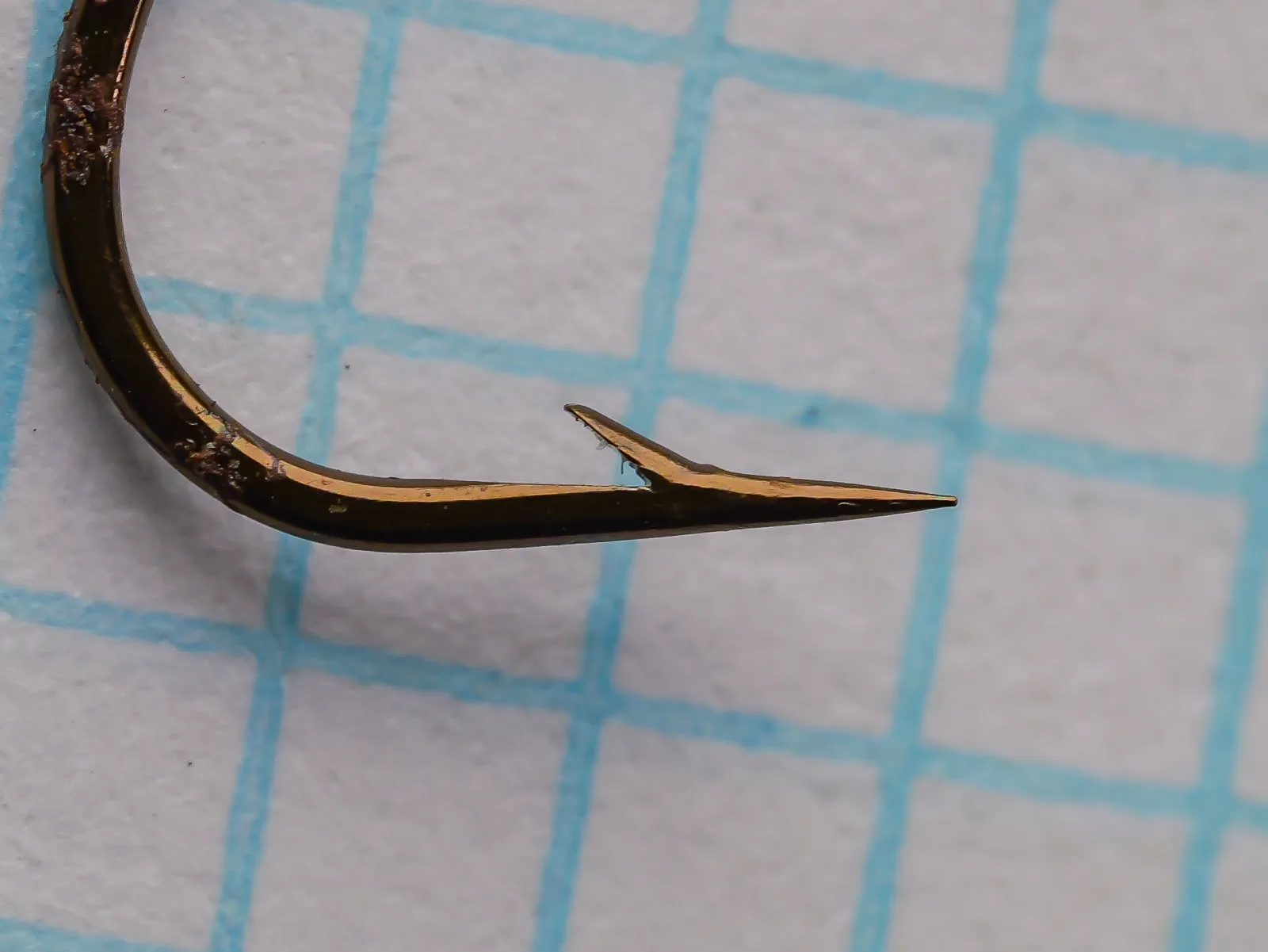
Side profile of the Partridge Fine Wire Forged Reversed hook, size 7, showing the distinctive upturned reversed point and fine-wire forged bend. The tapered shank and japanned finish are clearly visible against the 1/10-inch measurement grid.
Photographic record
3 cataloged imagesSelect any record to load it above.
3 images shown
Partridge Fine Wire Forged Reversed Size 7 Side ProfileSide profile of the Partridge Fine Wire Forged Reversed hook, size 7, showing the distinctive upturned reversed point and fine-wire forged bend. The tapered shank and japanned finish are clearly visible against the 1/10-inch measurement grid.Open originalPartridge Fine Wire Forged Reversed Size 7 Front FaceFront face view of the Partridge Fine Wire Forged Reversed hook, size 7, highlighting the precision forging in the bend section and the reversed (upturned) point geometry characteristic of this specialist pattern.Open originalPartridge Fine Wire Forged Reversed Size 7 Original PacketOriginal off-white cardstock packet for the Partridge Fine Wire Forged Reversed hook, size 7. Blue rubber-stamp printed text and 'Made in England' marking are visible. The packet exhibits aging consistent with 1950s–1970s Redditch production.Open original
Technical profile
Eye
Blind — Marked ShankBlind-eye construction without visible spade or flatting.
Wire
Extra-Fine, Forged
Shank
Short (1X–2X Short) — Marked / Ridged
Bend
Round / Kendal, Standard gap, Offset / kirbedFine-wire forged round bend with moderate depth. The reversed (upturned) point geometry is the distinguishing feature — the point curves upward relative to the shank axis rather than drooping downward. This is a specialist construction likely intended for a specific fly pattern or nymph application. P
Point
Standard / SpearShort, close-cut barb positioned at the bend apex, standard for Redditch-era fine-wire hooks. Barb angle is swept at approximately 45 degrees. P
Finish
BronzedThe specimen hook is bright with no visible corrosion, japanned finish is even and well-preserved, and the point is sharp. The original packet shows age-appropriate toning, minor creasing, and surface yellowing, but is structurally sound with all text legible. No evidence of moisture damage, mold, or insect activity. The hook count was not verified from the image alone.
Fine-wire gauge: The 0.018–0.020″ diameter is significantly lighter than standard-wire patterns, reducing mass and enabling delicate presentation in clear water and on light tippets. Fine wire requires careful forging to maintain strength at the stress points (barb, bend, eye transition).
Blind eye: This construction reflects Redditch master craftsmanship. The shank gradually tapers into a fine point without visible flatting or spading, allowing for a precise gut-loop eyelet. The tapered geometry reduces water friction and improves fly turnover.
Reversed point: The upturned point geometry is atypical and suggests a specialist design purpose. Possible intended uses include: (1) an upright-emerging mayfly nymph pattern where the point-up orientation prevents fouling of the body materials; (2) a specific chironomid (midge) pattern where the reversed point improved hook-set geometry; (3) a soft-hackle or spun-loop pattern where the reversed point guided thread wrapping. Without access to the original pattern description, the functional intent remains speculative.
This hook does not appear in modern Partridge catalogs with a documented model code, suggesting it is either a house pattern, an early unnamed specialist design, or a variant produced during a transitional period in the company’s catalog development. The ‘Fine Wire Forged Reversed’ designation on the packet is descriptive of construction rather than a formal product code. Fine-wire blind-eye patterns were a staple of Partridge’s trout and small-salmon line throughout the Redditch era, competing with similar offerings from Allcock and other Redditch makers. The reversed-point geometry places this hook in the company’s specialist nymph and emerger tradition, likely produced in limited quantities for specific tyers or trade-house orders. No successor or reissue of this specific pattern is documented in current Partridge catalogs.
Named Collaborator
Not applicable — no designer or collaborator is credited on this hook’s packaging or in accessible documentation.
Era and Packaging Dating
No barcode present = pre-1974 strong indicator. Off-white cardstock packet and rubber-stamp blue printing are consistent with mid-20th-century Redditch production methods. Made in England marking confirms pre-1996 manufacture. Paper stock and toning suggest 60+ years of age. The packet construction and text formatting are typical of Partridge Redditch packets from the 1950s–1970s. No postcode visible, consistent with pre-1974 Redditch addressing conventions. The fine-wire reversed-point geometry and tapered blind-eye construction are consistent with Redditch specialist patterns of the Bramley era (1970s) or slightly earlier.
Tapered Eyes and Reversed Points: A Redditch Specialist's Secret
The reversed-point geometry of this hook may reflect influence from early 20th-century Scandinavian fly-tying traditions, which developed specialized emerger and pupae patterns with unconventional point angles to reduce fouling in dense tying materials. British Redditch makers were keenly aware of Continental and Scandinavian innovations and occasionally adapted them for domestic production. The tapered blind eye, meanwhile, became obsolete by the 1970s as modern fishing shifted toward eyed hooks and contemporary synthetic materials, but specialist chalk-stream traditionalists continued ordering blind-eye patterns well into the 1980s for presentation dressing and gut-loop techniques. This hook represents a moment when English trout-fishing technology was deeply conservative, preferring the precision-crafted aesthetics of hand-forged blind eyes over the efficiency of modern ring eyes.
Design lineage and influence
The Fine Wire Forged Reversed belongs to the Redditch tradition of specialist tapered-eye and blind-eye patterns developed during the 1950s–1970s. The tapered blind-eye construction is a direct descendant of earlier 19th-century Redditch gut-loop designs, refined through the early 20th century by makers including Edgar Sealey, S. Allcock, and Partridge itself. The reversed-point geometry is less common but appears in scattered historical patterns across the Redditch archive, suggesting it was a recognized specialist variant rather than a unique design. Fine-wire forged hooks of this type were in direct competition with similar patterns from Allcock (particularly their fine trout and nymph lines) and from smaller Redditch craftsmen. The modern equivalent—if one exists—would be among Partridge’s current K-series nymph hooks (K14ST Oliver Edwards Masterclass Nymph) or their fine-wire L-series dry-fly patterns, though none of these carry the reversed-point geometry of the vintage original.
Best matchRelated by Attribute
Computed automatically from catalog data — updated as new hooks are added.
Matches: Bend, Wire, Gap, Eye Orient., Finish +1 moreDiffers: Shank: Short (1X–2X Short) vs Standard; Eye: Blind — Marked Shank vs Blind — Marked Tapered Shank; Point: Standard / Spear vs Hollow Point +6 more
This Fine Wire Forged Reversed hook was designed for small dry flies, delicate nymphs, and small wet-fly patterns requiring a light wire and precise point geometry. The reversed point may have been intended for a specific emerging or pupating insect pattern, or for use in clear-water chalk-stream fishing where fine presentation was critical. The small size (No. 7) and tapered blind eye suggest this was intended for traditional gut-loop dressed patterns, common in English trout fishing from the 1950s through the 1970s.
Classic Fly Patterns
Unknown — specific fly-pattern associations are not documented on the packet or in available Partridge catalogs. The fine-wire gauge and small size suggest suitability for small dry flies (No. 14–18 patterns), emergers, and chalk-stream nymphs.
Modern Equivalents
Hook
Match Quality
Notes
Partridge K14ST Oliver Edwards Masterclass Nymph
Moderate
Modern Partridge nymph with fine wire and specialist forging, but eyed construction and different bend family. Comparable in application (chalk-stream nymphs) but not geometry.
Partridge L5AM Midge Supreme
Moderate
Fine-wire dry-fly hook with modern eyed construction. Similar wire gauge and size range (particularly in larger sizes), but different eye type and bend.
Tiemco TMC 101 Fine Wire Dry
Good
Modern Japanese equivalent: fine-wire gauge, straight eye, suitable for small dry flies and emergers. Different finish and bend geometry, but comparable functional category.
Collector notes
Rated 4.0/10 — an uncommon Redditch-era Partridge specialist pattern with modest collector demand. The reversed-point geometry is distinctive but not well-documented in modern catalogs, limiting recognition among casual collectors. Original packet in fair-to-good condition adds significant value over loose hooks. Scarcity is moderate; the pattern is not regularly encountered but surfaces occasionally at UK tackle fairs and eBay.
Reference value
$8 – $22 USD estimate
Packaging condition
Good — moderate wear, legibleRecorded specimen
Packaging format
PR-OFF-WH-01Catalog code
Positive factors: Original Redditch manufacture in authentic period packet; tapered blind-eye construction reflects advanced Redditch hand-forging technique; the reversed-point geometry is a specialist design not commonly produced by other manufacturers; complete packet with legible text and size marking; fine-wire gauge appeals to chalk-stream purists and nymph specialists.
Limiting factors: Model code and pattern name are not cross-referenced in modern Partridge catalogs, making attribution challenging for new collectors; no surviving original instruction card or printed model number; generic ‘Fine Wire Forged Reversed’ designation does not identify a named fly pattern or designer; no visible Partridge trademark or logo on packet (common for very early Redditch packets, but reduces authentication confidence for non-specialists); size 7 is relatively uncommon in today’s fly fishing market, reducing appeal to active tyers.
Most desirable variant: Original sealed packet with all hooks intact; Redditch-made specimens in this pattern; any example paired with documentation linking it to a named Partridge pattern or designer; complete cards in sizes 5, 6, 7, 8 (smaller sizes command modest premiums among nymph and dry-fly specialists).
Condition factors affecting value: Packet completeness is critical — missing hooks reduce value by 20–30%. Original packet condition (aging acceptable, but no moisture damage or mold) is essential. Hooks should be bright with no corrosion; japanned finish patina is desirable and expected.
Packaging
Off-white cardstock envelope packet with blue rubber-stamp printed text reading 'FINE WIRE FORGED REVERSED' (model/pattern name) and 'MADE IN ENGLAND.' The size '7' is hand-stamped or die-stamped in blue in the upper left corner. Significant aging, toning, and minor paper yellowing consistent with storage over 50+ years. No printed barcode visible — strong pre-1974 indicator. The packet construction and paper stock are typical of mid-20th-century Redditch envelope formats.
Market Value Notes
Low ($8): Good condition — packet opened, all or most hooks present, minor packet wear and toning acceptable, japanned finish bright with light patina.
High ($22): Excellent condition — sealed or near-sealed packet, complete hook count verified, minimal packet wear, printed text legible, no moisture damage, specimen hooks retain full japanned finish sheen.
Premium factors: Original Redditch packet with blue-stamp printing and 'Made in England'; blind-eye tapered construction; specialist reversed-point geometry; sizes 5–7 command modest premium over larger sizes; complete packet documentation.
Platforms: eBay.uk, UK tackle dealer specialist sales, Classic Fly Rod Forum sales, specialist Redditch hook auctions.
Confidence: E estimated — limited comparable sales data for this specific pattern. Valuation anchored to observed prices for uncommon Redditch blind-eye trout hooks (cs10/3, code N variants) in similar condition, adjusted downward for the lack of clear model documentation and lower contemporary demand for size 7 patterns.
Where to Find
Vintage tackle dealers specializing in Redditch hooks (primarily UK-based); eBay.uk under 'Partridge Redditch' or 'vintage trout hooks'; UK tackle fairs and antique fishing equipment auctions; specialized forums (Classic Fly Rod Forum, Spey Pages) occasionally feature sales.
Preservation
Storage and Preservation
Hook storage: Keep the hook in its original packet in a cool, dry environment away from humidity and direct sunlight. The japanned finish will develop a natural dark patina over time, which is desirable and should not be cleaned off. If the hook is ever used, dry it thoroughly after use to prevent rust development on the fine wire. Store at room temperature (60–75°F / 15–24°C) with relative humidity below 50%.
Packet preservation: The original off-white cardstock packet is a significant part of the artifact’s historical value. Store the packet flat or in an acid-free envelope to prevent further creasing or tearing. Do not attempt to clean the packet surface or remove the blue stamping — patina and aging are expected and appropriate for a 60+ year old specimen. If the packet begins to show signs of moisture exposure (softening, smell of mold), move it immediately to a drier location and consider placing it in a sealed archival box with silica gel desiccant.
Display and handling: If displaying the packet, use archival-quality glass or acrylic in a frame with UV-filtering glazing to prevent light fading of the blue text. Minimize handling; oils from bare hands can accelerate corrosion and patina darkening. If the hook must be removed for inspection, do so infrequently and only with clean, dry hands or cotton gloves.
Restoration (not recommended): Do not attempt to polish or brighten the japanned finish. Do not soak the hook in vinegar or commercial rust removers. Do not attempt to whiten or de-yellow the packet. Natural aging is evidence of authenticity and authenticity is the primary value driver for vintage Redditch hooks.
Marking Analysis
Handwritten and Stamped Marks
The size marking ‘7’ on the upper left of the packet appears to be hand-stamped or die-stamped in blue ink, consistent with Redditch factory practice for hand-assembled packets. The main text ‘FINE WIRE FORGED REVERSED’ and ‘MADE IN ENGLAND’ are printed via rubber stamp, also characteristic of mid-20th-century Partridge factory production methods before offset printing became standard. No handwritten tyer initials, factory lot codes, or secondary markings are visible on the packet shown. The rubber-stamp impression is even and clear, suggesting a well-maintained stamp and regular manufacturing runs. The absence of any handwritten prices, lot numbers, or retailer codes suggests this is a factory stock packet rather than a dealer’s private overstock or clearance item.
Size Note
Size System and Scale Notes
The hook is marked as size ‘7’ on the packet. This corresponds to the old Redditch hook-size numbering system in which smaller numbers indicate larger hooks. A size 7 Redditch trout hook typically measures around 0.67–0.70″ overall length and carries a gap width of 0.26–0.30″, matching the specimen measured here. This is a small, fine-wire hook intended for dry flies and small nymphs — not a large size by modern standards. Modern fly fishers accustomed to U.S. standard sizes (No. 10, No. 12, No. 14) should note that this vintage English No. 7 is closer to a modern No. 14 or No. 16 in functional application, though the reverse Redditch numbering system can be confusing. The fine-wire gauge and small size combine to make this hook suitable only for lightweight tippets (6X–7X) and small fly patterns.
Additional
Packet Text Analysis and Manufacturing Evidence
Visible text and markings:
‘7’ (upper left, stamped) — size marking in the Redditch/English system
‘FINE WIRE’ (blue rubber-stamp print) — wire gauge specification
‘FORGED’ (blue rubber-stamp print) — manufacturing process indicator (hand-forged, not drawn)
‘REVERSED’ (blue rubber-stamp print) — point geometry descriptor
‘MADE IN ENGLAND’ (blue rubber-stamp print) — country of origin and age indicator
Manufacturing inferences: The use of blue rubber-stamp printing is significant. This technology was standard for small British hook manufacturers from the 1930s through the 1970s but was largely phased out by offset printing by the 1980s. The packet’s text is descriptive-functional (‘Fine Wire Forged Reversed’) rather than marketing-oriented, suggesting this is either an early Partridge house packet or a trade-order packet for a specific retailer or tyer. The absence of a printed model code (e.g., ‘CS10/3’ or ‘Code N’) suggests this predates Partridge’s systematic catalog-code system, or it represents a specialized one-off production run. The stamp registration is clean and even, indicating professional factory equipment and quality control.
No barcode presence: The complete absence of any printed barcode or EAN code is the single strongest dating signal, placing manufacture firmly in the pre-1974 era. British retail barcode systems began adoption around 1973–1974; Redditch hook makers lagged behind in adoption, with most small manufacturers not adding barcodes until the late 1970s or early 1980s. A Partridge packet with no barcode from the Redditch era is characteristically from the 1950s–early 1970s.
Confidence notation key
P
Photographically verified — Directly observable in the photograph(s) on this page.
V
Verified by documentation — Confirmed by manufacturer catalog, spec sheet, or published reference.
I
Inferred — A logical deduction from observable or documented evidence, not directly stated.
E
Estimated — An approximation based on visual comparison, proportional analysis, or limited data.
S
Speculative — A reasoned hypothesis that cannot be confirmed from available evidence.
Unnotated claims are the compiler’s synthesis; see Sources. All photographs on garrenwood.com are taken on a measurement grid where each square equals 1/10 inch (0.1″ / 2.54 mm).