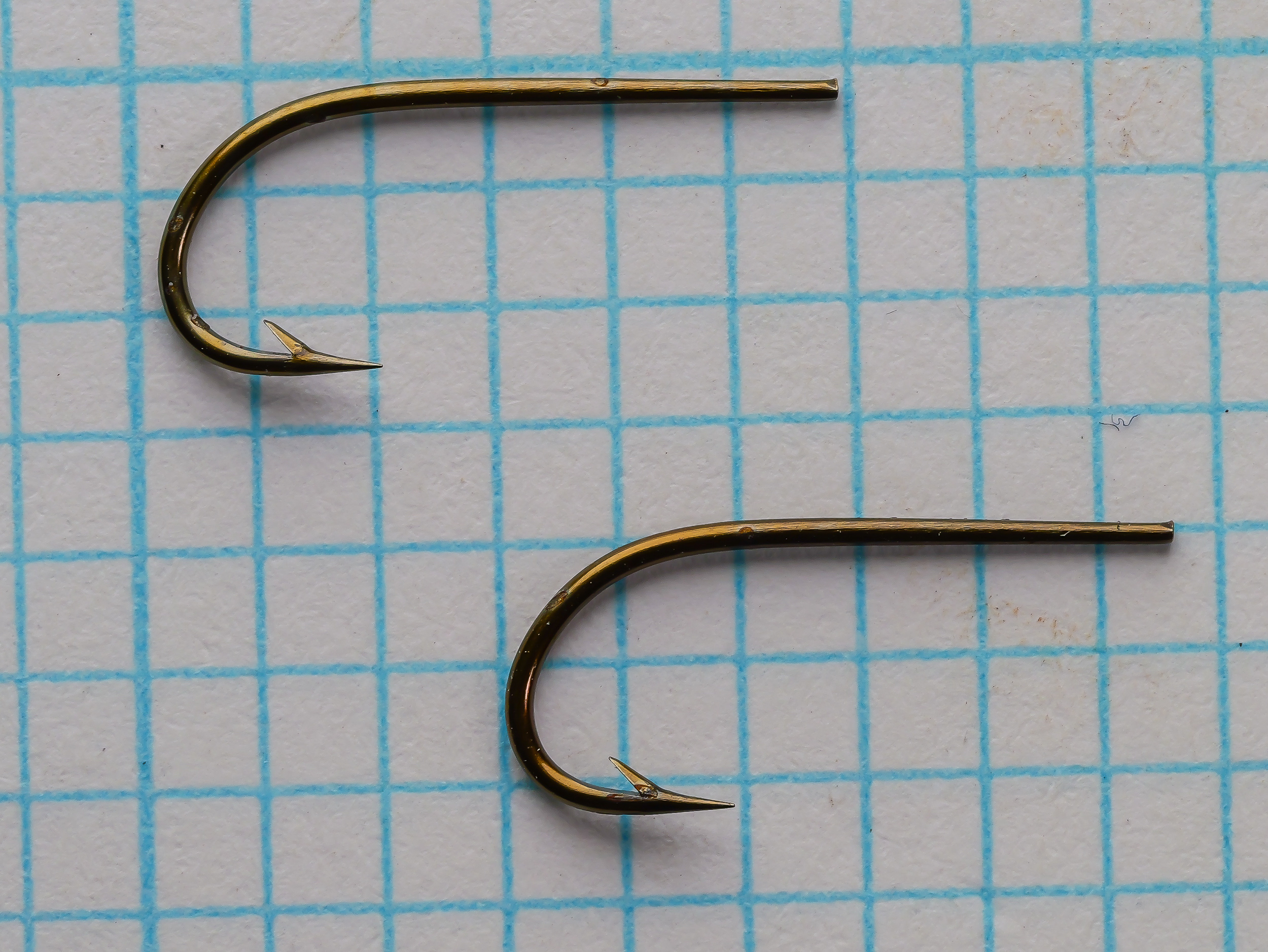
The Partridge Trout Taper is among the rarest surviving examples of pre-war Redditch hook-making — a blind-eye trout hook manufactured by Partridge of Redditch in the 1910s–1930s, during the twilight of the era when silk-wrapped silkworm gut connections were still considered superior to the knotted eyed hook for presentation on chalk streams and spate rivers. Featuring a shank that tapers to a fine needle point for snelling directly to gut, a classic Sproat bend, standard wire, and a bronzed finish in size 6, the Trout Taper represents a technology and a philosophy of fly fishing that has almost entirely vanished from the modern tackle landscape. Whether you’re a vintage Partridge hook collector, a classic wet fly dresser working to authenticate period patterns, or a fly fishing historian researching the transition from blind eye to eyed hooks, this reference guide covers identification, technical specifications, era dating, and the realities of finding a modern substitute.
Made by Partridge of Redditch England


Partridge Trout Taper Hooks – Additional Info
1. Identification
- Brand: Partridge of Redditch
- Model/Code: Trout Taper (Blind Eye)
- Size: 6
- Estimated Era: 1910s–1930s. The “Taper” designation for blind eye hooks was common during the transition period when eyed hooks were rapidly becoming the standard but blind eye versions were still being produced for traditionalists and export markets. The simple paper packaging and rubber-stamp typography are consistent with Partridge production before and just after their formal incorporation as A.E. Partridge & Sons in 1933.
2. Technical Specifications
- Eye: Blind / Tapered Shank. The shank ends in a fine, drawn-out needle taper rather than a formed loop, designed to allow a smooth, clean snelled connection when whipped to silkworm gut. The absence of a knot at the hook-leader junction was considered to produce a more natural presentation and less water disturbance than a knotted eyed hook.
- Wire: Standard, tapering significantly at the shank end where the “Trout Taper” grind thins the wire to a needle point.
- Shank/Bend: Straight shank with a Sproat bend — the dominant wet fly bend in English hook making of this era, characterized by a round upper curve that straightens into a more angular lower section before meeting the point.
- Finish: Bronzed.
- Material: Sheffield High Carbon Steel.
3. Historical Context
These hooks represent a specific and increasingly rare artifact of fly fishing history — the period when blind eye hooks were still preferred by serious wet fly purists over the newly standardized eyed hook. The “Trout Taper” refers to the manufacturing process in which the end of the shank was drawn or ground out to a smooth wedge or needle taper, allowing the angler to snell (dress) a length of silkworm gut to the hook shank using fine silk thread. This traditional technique — properly called dressing to the gut — created a seamless, low-profile connection between hook and leader that many chalk stream and wet fly purists considered functionally and aesthetically superior to anything a knotted eyed hook could produce.
- Factory Status: While Partridge continues as a brand today, the skilled manual process of drawing and grinding these specific tapered blind shanks to the precision required for clean gut-dressing is no longer practiced in commercial production anywhere in the world.
- Fun Fact: The extreme fineness of the taper on these hooks was a point of genuine craft pride among Redditch hook makers. A well-drawn Trout Taper needed to be thin enough for a neat silk whipping, smooth enough not to split the gut, and strong enough not to snap during a fish fight — three competing demands that required considerable skill and experience to balance correctly.
4. Usage & Equivalents
- Best Used For: Traditional wet fly patterns tied in the authentic pre-war style — classic English wet flies such as those documented in Ray Bergman’s Trout, traditional Clyde Style spiders from the Scottish soft hackle tradition, and exhibition or restoration work where an authentic blind-eye hook is required to achieve a historically accurate dressed fly. These are the correct iron for any tier working to recreate period-accurate patterns from the late Victorian through the interwar era.
- Modern Equivalent: True blind-eye trout taper hooks are extremely rare in modern production.
- Partridge CS10/3 (Blind Eye Salmon): Available in some specialist catalogs, though typically in heavier wire than a trout pattern requires.
- Specialist suppliers: A small number of British and European classic fly suppliers occasionally stock new-old-stock or reproduction blind-eye trout hooks — sourcing from these vendors is a more reliable path than improvised workarounds.
- Practical note: Some classic tiers incorporate a short loop of fine gut or monofilament beneath the thread foundation of the fly to simulate the gut-eye connection, tied on a standard eyed hook. While not authentic, it replicates the presentation aesthetic credibly.
5. Collectability
Ranking: 9/10
Blind eye hooks in original “Trout Taper” Partridge packaging are among the most historically significant items in any serious vintage hook collection, for three reasons:
First, the production window is genuinely narrow. By the 1930s, eyed hooks had become the overwhelming standard and blind eye production was declining sharply — surviving stock from this transitional period is correspondingly rare.
Second, these hooks have a dual audience: the collector who wants them for historical completeness, and the classic fly dresser who will actually tie on them to produce period-accurate patterns. That crossover demand drives prices meaningfully above equivalent eyed hook packets of the same era.
Third, the craft knowledge required to dress a fly correctly to a blind eye hook — the gut-soaking, the whipping technique, the specific knot sequence — is itself becoming a lost art, and these hooks are one of the few tangible connections remaining to that tradition.