Selected size
1/0
Catalog record
- Overall Length
- 31.5 mm V
- Shank Length
- 18.2 mm V
- Bend Depth
- 10.8 mm V
- Wire Diameter
- 0.9 mm V
- Confidence
- V Catalog record only
 Garren WoodFishing Hook Reference
The Mustad 3101 A represents the golden age of Norwegian hook manufacturing, produced by O. Mustad & Son during their Oslo period before overseas production moved to Asia. This heavy-wire Limerick bend hook with straight ring eye was designed as a reliable workhorse for wet flies and streamers targeting larger game fish P.
The distinctive Key Brand logo and traditional letterpress packaging place this specimen firmly in the 1930-1960 era, when Mustad’s Norwegian factory supplied fly fishers worldwide with affordable, dependable tackle. The 2/0 size made this hook suitable for classic salmon flies and early streamer patterns requiring substantial holding power V.
While not rare, Norwegian-made Mustad hooks have gained modest collector appreciation as symbols of the company’s industrial heritage before globalization transformed tackle manufacturing. The bronzed finish and superior point geometry reflect traditional European hook-making standards P.
4 cataloged imagesSelect any record to load it above.
4 images shown
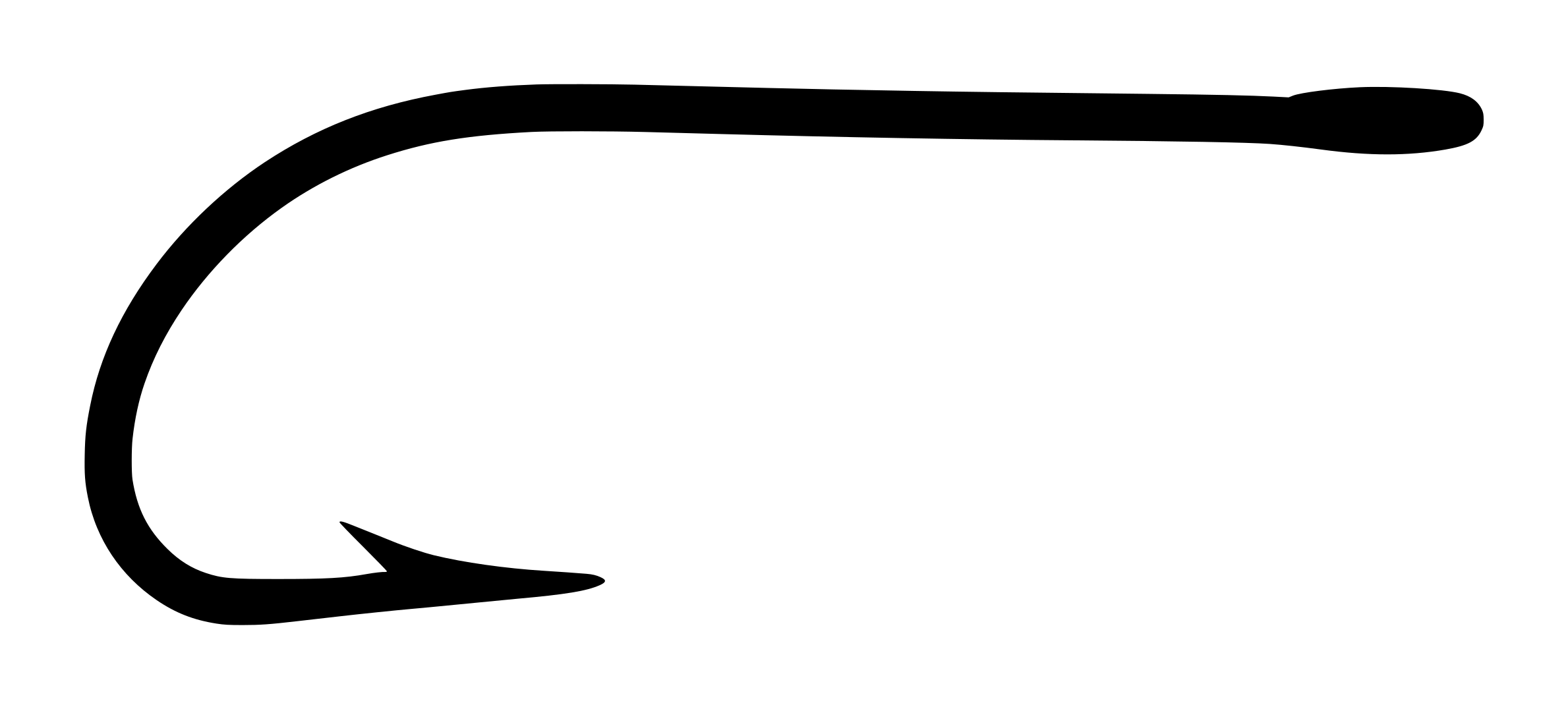
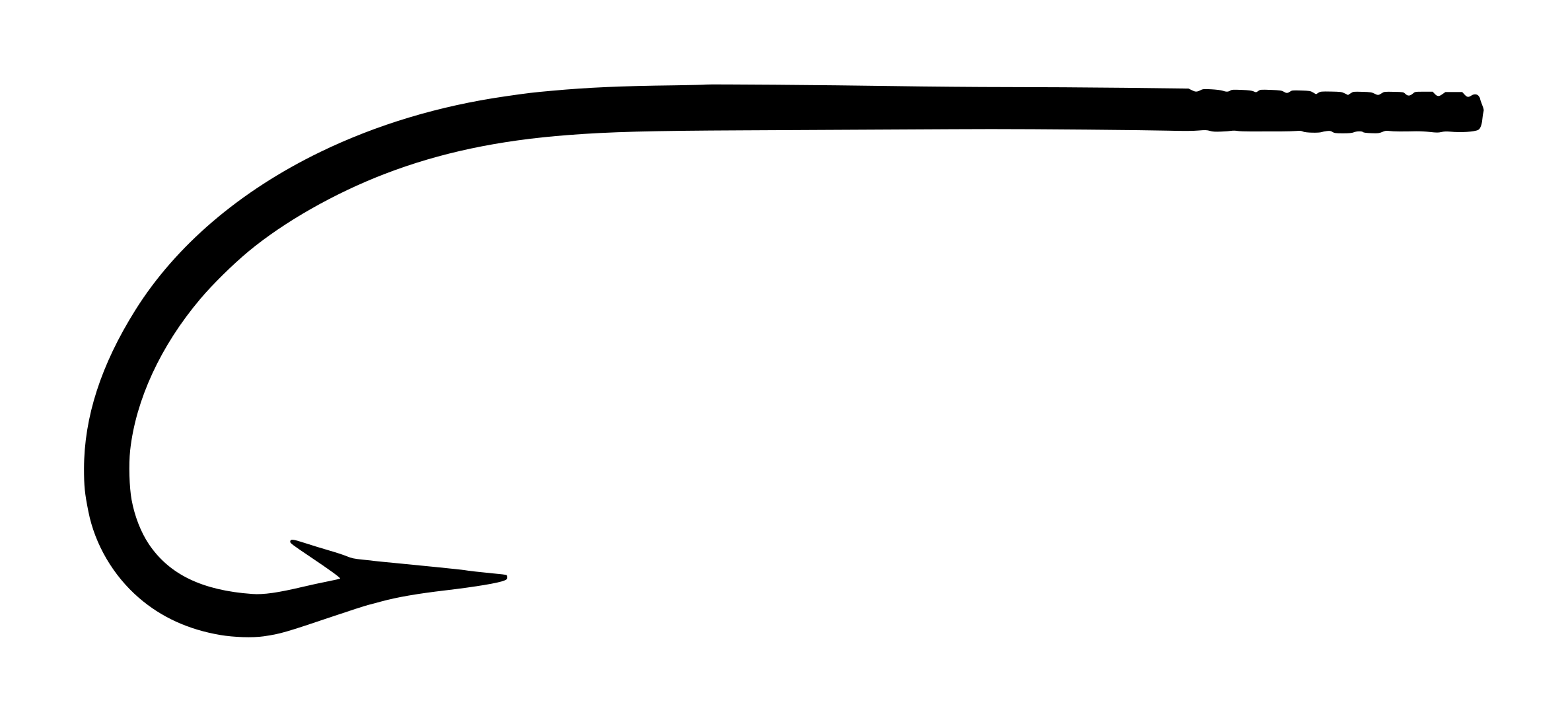
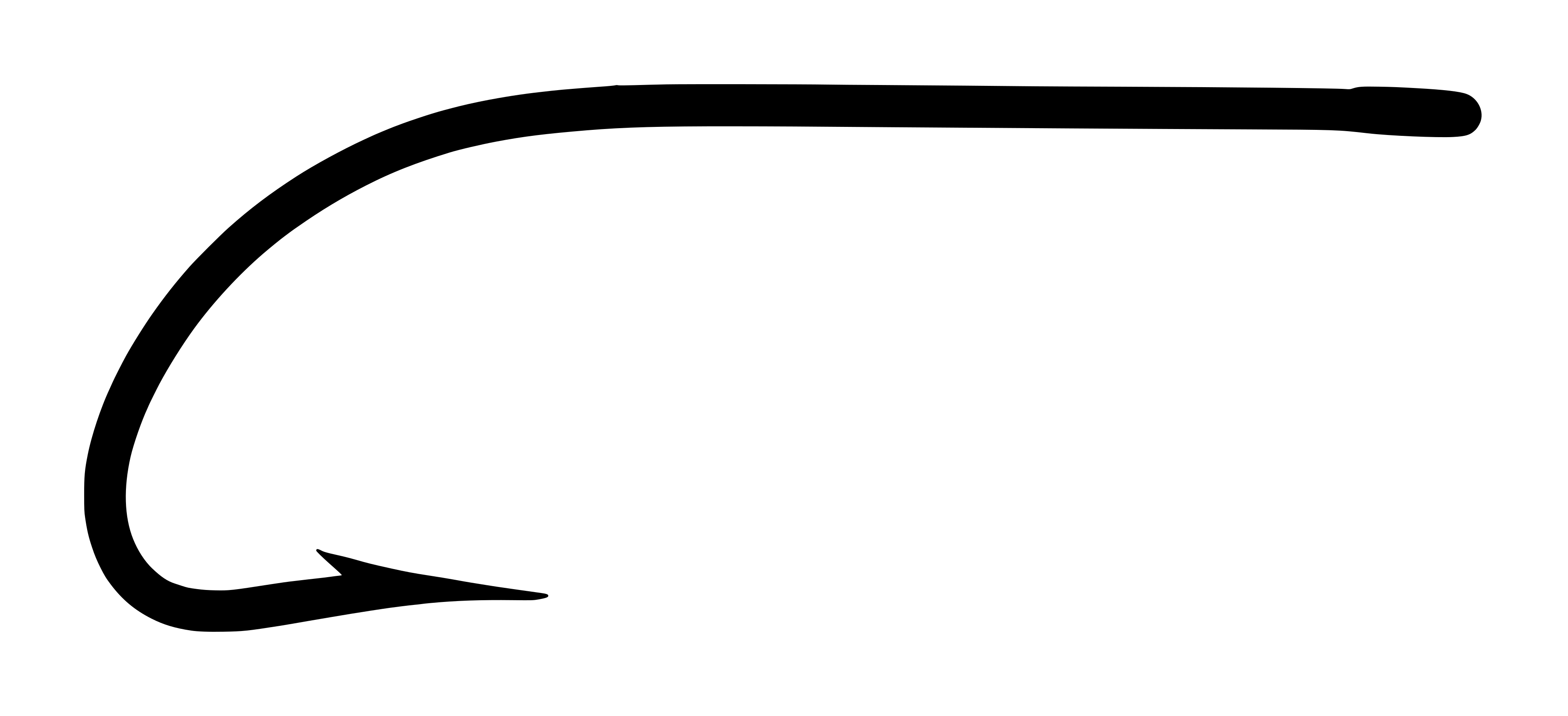
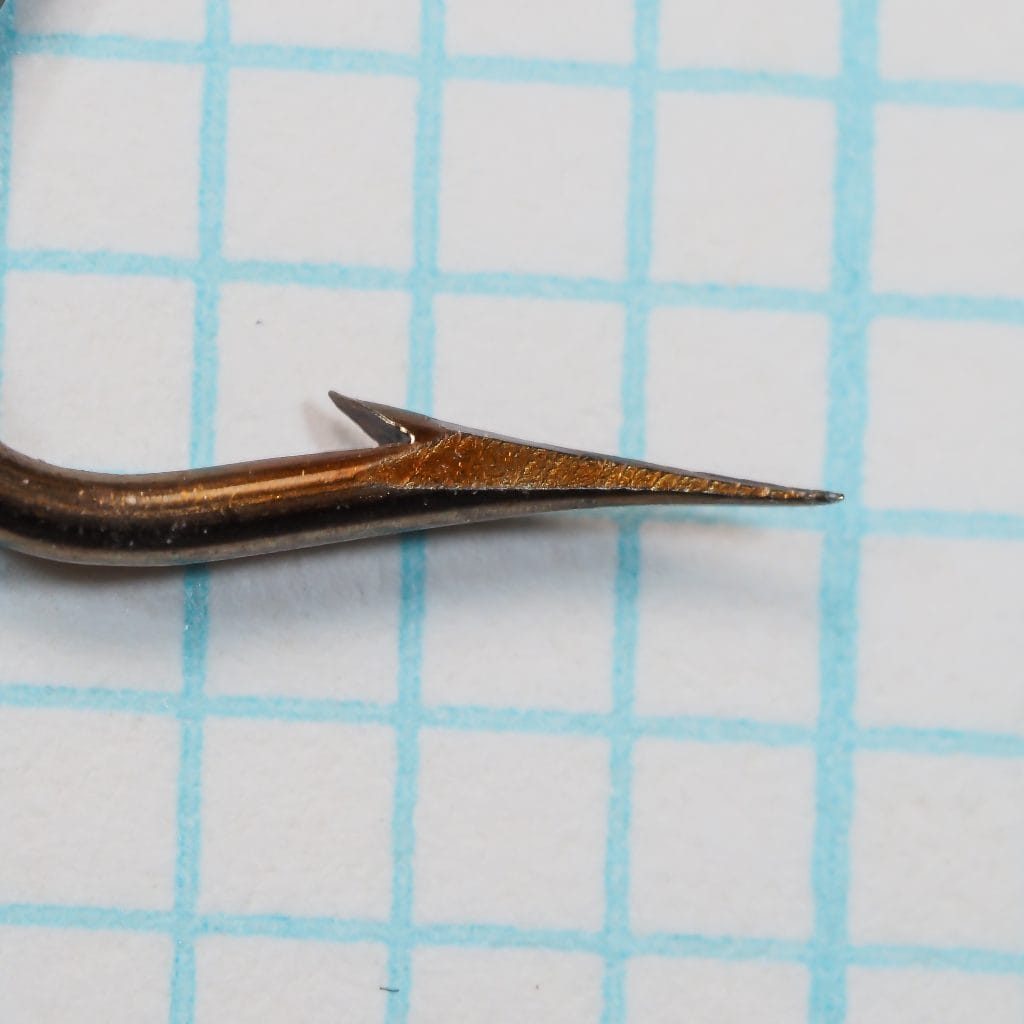
The superior point geometry features a nearly straight inner taper from barb to tip, creating maximum penetration efficiency while maintaining strength. The heavy wire gauge provides holding power necessary for large fish, while the bronzed finish offers corrosion resistance superior to bare steel. The Limerick bend’s angular geometry distributes stress effectively, preventing straightening under load while maintaining a wide gape for secure hooksets P.
Grid-derived from photograph (1/10" grid)
We have measurement for size 1/0. Know any others? Submit calipered measurements and we'll review and add them. Thank you!
O. Mustad & Son was founded in 1832 by Ole Mustad in Gjøvik, Norway, initially as a manufacturer of horseshoe nails and keys. The company’s expansion into fishhooks began in the 1870s, leveraging Norway’s maritime culture and steel-working expertise. By the early 20th century, Mustad had become the world’s largest hook manufacturer, with the distinctive Key Brand logo symbolizing their origins in metalworking.
The Oslo designation on this packaging represents Mustad’s commercial headquarters during the mid-20th century, while production remained centered at the Gjøvik factory. This era marked Mustad’s dominance in global hook supply, with distribution networks reaching every major fishing market. The transition to overseas manufacturing in the 1970s ended the Norwegian production period that collectors now prize.
The Mustad 3101 series was introduced in the early 20th century as an affordable alternative to premium British hooks, targeting the growing American fly fishing market. The series featured consistent Limerick bend geometry across sizes, with various eye configurations denoted by letter suffixes – the ‘A’ specifically indicating the straight ring eye variation.
This series became the backbone of Mustad’s wet fly hook offerings, bridging the gap between expensive hand-forged British hooks and cheaper machine-made alternatives. Production continued through the 1960s, with the series eventually discontinued as modern round bend hooks gained favor among fly tiers seeking more consistent proportions.
Key Brand logo with skeleton key design, Oslo - Norway designation before overseas production, red letterpress printing on cream paper stock, decorative floral border typical of 1930s-1950s packaging design, absence of modern barcode or ZIP code format
The Key Brand logo on Mustad packaging directly references the company's origins as key manufacturers in 19th century Norway. Before Ole Mustad revolutionized fishhook production, the company supplied skeleton keys and door hardware throughout Scandinavia. When Mustad transitioned to hooks, they retained the key symbol as a mark of quality metalworking heritage, creating one of the fishing industry's most recognizable vintage logos.
The 3101 A derives from traditional Irish Limerick hooks, adapted for machine production while retaining the characteristic angular bend geometry. Mustad’s version simplified the complex forging of original Limerick patterns while maintaining functional performance. Contemporary competitors included the Allcock 04991 and Partridge CS10, but Mustad’s industrial scale achieved superior price points.
The straight ring eye represented a Norwegian innovation over traditional turned-down eyes, providing stronger knot attachment for heavy tippets. This design influenced later American manufacturers like Wright & McGill, who adopted similar ring eye construction for their premium lines.
The Mustad 3101 A was designed as a workhorse wet fly and streamer hook for larger patterns targeting game fish. The heavy wire and Limerick bend geometry made it suitable for classic salmon flies, large wet fly patterns like the Parmachene Belle and Leadwing Coachman, and early streamer patterns with feather wings. The 2/0 size positions this hook for predator species including bass, pike, and Atlantic salmon P.
Large bait fishing for pike and musky when live minnows or cut bait required a sturdy hook
Leadwing Coachman, Parmachene Belle, Black Ghost, Gray Ghost, Mickey Finn, classic salmon flies
| Hook | Match Quality | Notes |
|---|---|---|
| Daiichi 2141 | Good | Limerick bend geometry similar, though typically smaller sizes and turned-down eye |
| Mustad 3366 | Moderate | Similar wire gauge and application, but Sproat bend rather than Limerick |
| Gamakatsu S10 | Moderate | Comparable wet fly application and bronze finish, modern round bend |
Modest collector interest due to Norwegian manufacture and Key Brand logo, but limited by common production model status.
The Norwegian-made Mustad 3101 A commands modest collector interest primarily due to its Oslo manufacture period, before production moved to Asian facilities. The distinctive Key Brand logo and traditional packaging design appeal to vintage tackle collectors. However, collectability is constrained by the hook’s status as a standard production model rather than a specialty or limited run. The 2/0 size is less common than smaller wet fly sizes, adding slight premium value.
Paper envelope with red letterpress printing on cream stock. Key Brand logo with skeleton key at left. Decorative floral border. Text reads 'O. MUSTAD & SON Manufacturers OSLO - NORWAY Qual 3101 A Superior Mustad-Ring Tel. Madr-M 100 Steel ring Bronzed No. 2/0' with additional text partially visible.
Full 100-count cards in excellent condition. Individual hooks worth $0.25-0.50. Premium for unopened original packaging.
eBay vintage tackle listings, specialty fly fishing auctions, estate sales in traditional trout regions
Authentic Norwegian Mustad 3101 A hooks display the Key Brand skeleton key logo on original packaging with ‘Oslo – Norway’ designation. Look for red letterpress printing on cream paper stock with decorative borders. Hook finish should be warm brown bronze, not bright or silvery. Straight ring eyes are perfectly round without taper – avoid bent or damaged specimens.
Store Mustad 3101 A hooks in their original envelope when possible, as the packaging significantly enhances collector value. Keep in a cool, dry environment to prevent bronze finish deterioration. The letterpress printing on the envelope is susceptible to fading – store away from direct light sources. If hooks must be removed from packaging, use acid-free storage materials and avoid contact with dissimilar metals that could cause galvanic corrosion.
The bronzed finish will develop natural patina over time, which collectors generally consider desirable rather than detrimental. Avoid aggressive cleaning that might remove original finish. For display purposes, climate-controlled conditions help preserve both hooks and paper packaging for future generations.
The 2/0 designation on this Mustad 3101 A represents the traditional ‘aught’ sizing system where larger numbers indicate bigger hooks. A 2/0 hook is significantly larger than a size 2 – the progression runs size 2, 1, 1/0, 2/0, 3/0, etc. This 2/0 Limerick measures approximately 2.8-3.0 inches overall length, making it suitable for large wet flies and streamers rather than typical trout patterns.
Modern hook sizing has standardized differently, so direct comparisons with contemporary hooks require careful measurement rather than relying solely on numerical designations. The substantial gap width and heavy wire of this vintage 2/0 exceed most modern hooks labeled with equivalent sizes.
| P | Photographically verified — Directly observable in the photograph(s) on this page. |
| V | Verified by documentation — Confirmed by manufacturer catalog, spec sheet, or published reference. |
| I | Inferred — A logical deduction from observable or documented evidence, not directly stated. |
| E | Estimated — An approximation based on visual comparison, proportional analysis, or limited data. |
| S | Speculative — A reasoned hypothesis that cannot be confirmed from available evidence. |
Claims with no notation are confirmed by multiple independent sources. All photographs on garrenwood.com are taken on a measurement grid where each square equals 1/10 inch (0.1″ / 2.54 mm).
Your cart is empty.