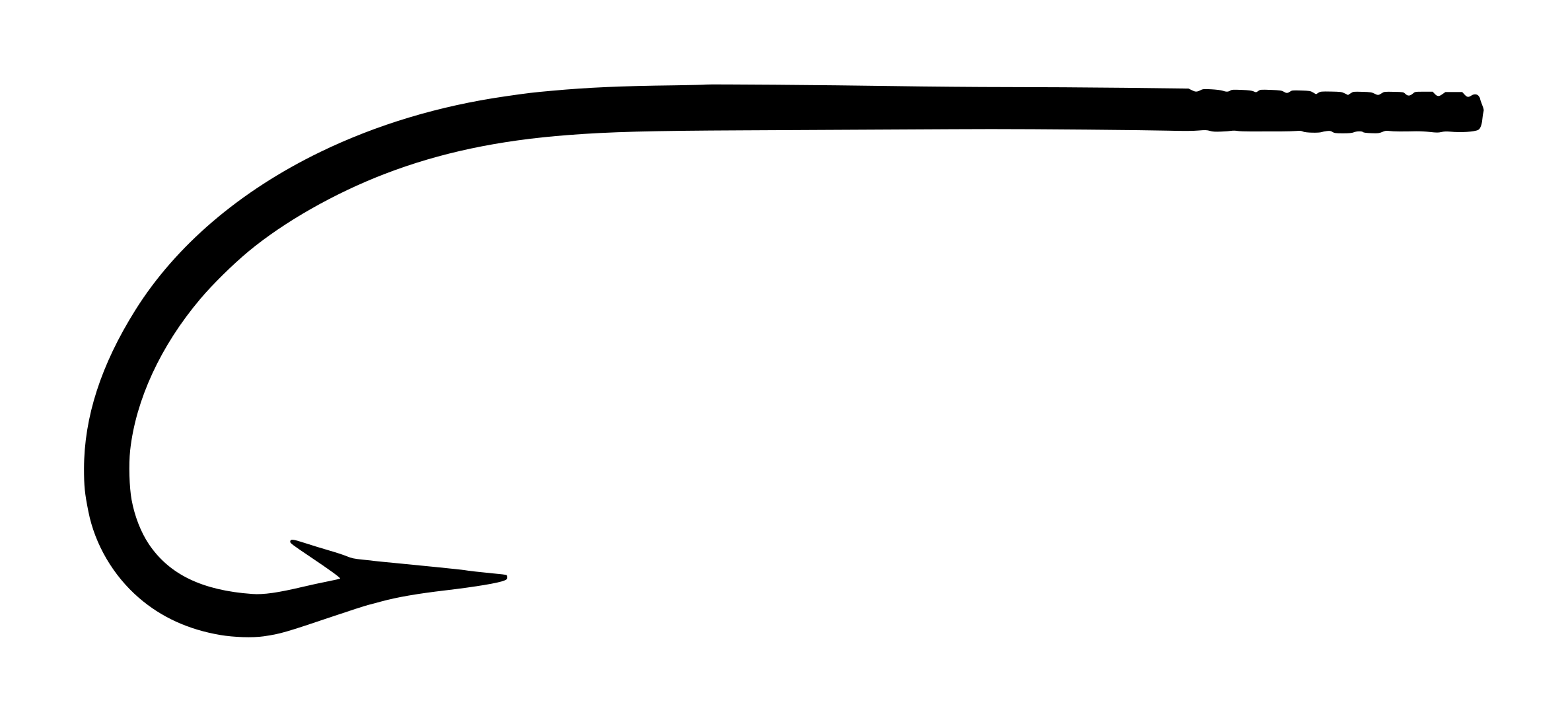
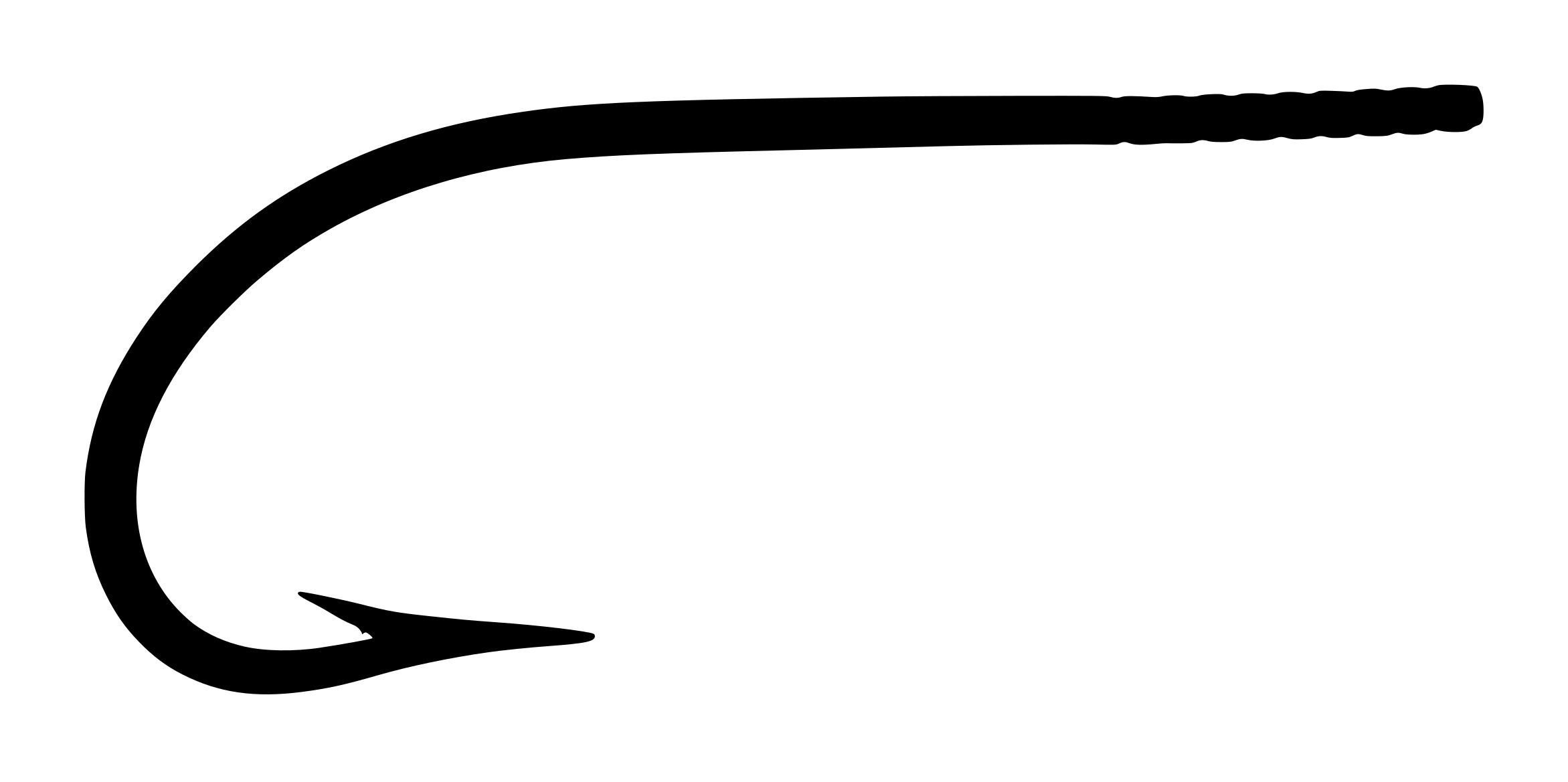
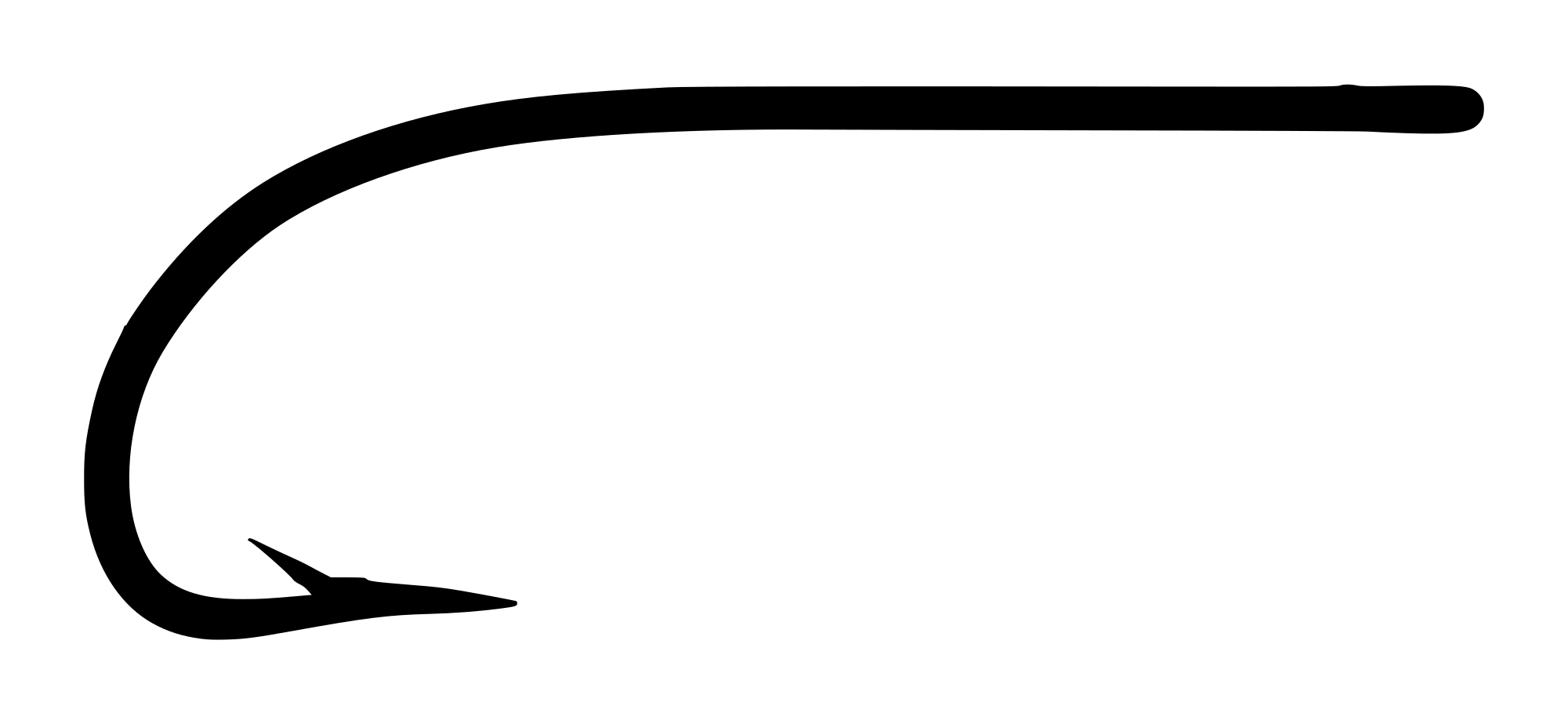
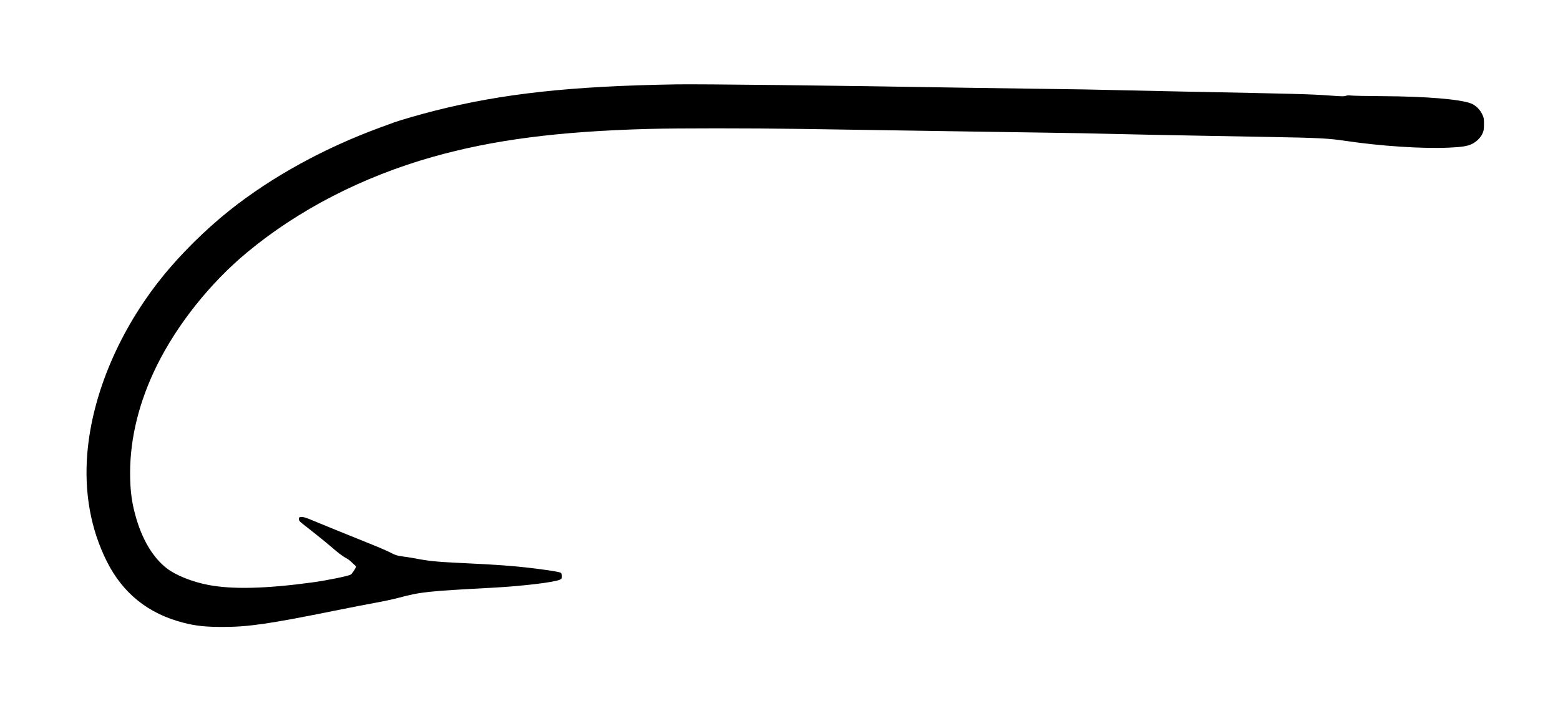
- Overall Length
- 46.7 mm P
- Shank Length
- 34 mm
- Gap Width
- 14.2 mm P
- Bend Depth
- 18 mm
- Shank-to-Gap Ratio
- ~2.3-2.6:1
- Confidence
- P Physical specimen
Physical measurement with calipers
The Mustad 3411 is a mid-20th-century saltwater and Atlantic Salmon hook manufactured by O. Mustad & Søn in Oslo, Norway, featuring a rare blind-eye construction designed specifically for gut-loop snelling. Size 3/0, this hook combines an O’Shaughnessy bend (deep, parabolic curve), heavy forged wire, marked shank (fine ridges for binding grip), and a Superior point geometry engineered for hard-jawed species and heavy saltwater conditions. The ‘Marked Rustproof’ tinned finish provided exceptional corrosion resistance in marine environments.
Dating to approximately 1950-1965 based on the pink eight-line label, Oslo address, and Key Brand trademark, the 3411 represents a deliberate holdover of 19th-century eye construction even as the industry modernized around it. Blind-eye hooks had become functionally obsolete by the 1950s, yet Mustad maintained production specifically for traditional fly tyers and Atlantic Salmon communities who valued the mechanical properties of gut-loop attachment—the soaked loop’s inherent elasticity absorbs strike shock better than a rigid metal eye. This scarcity in the secondary market, combined with the historical significance of the blind-eye tradition and the specialized forging required, makes the 3411 highly sought after by collectors of vintage salmon tackle and students of fly-tying history.
3 cataloged imagesSelect any record to load it above.
3 images shown
The forged wire construction—flattened and work-hardened through mechanical pressing—provides exceptional tensile strength without adding bulk. The Superior point geometry (near-straight inner taper with minimal concavity) concentrates penetration force at the tip while maintaining structural integrity through the barb. This balance was engineered specifically for heavy saltwater species with tough cartilaginous jaws. The marked shank (fine ridges visible along the wire) provides microscopic grip points for the binding silk and gut loop, preventing rotation during use. The blind eye, while appearing primitive, creates a true stress-neutral connection point—the shank itself becomes the attachment, eliminating the stress concentration that occurs at the junction of a looped eye and shank.
Physical measurement with calipers
We don't have measured sizes for this hook yet. Own one? Submit calipered measurements and we'll review and add them. Thank you!
O. Mustad & Søn, founded in 1832 in Gjøvik, Norway, by Hans Schikkelstad as a general metal goods factory, underwent its pivotal transformation in 1877 when Mathias Topp invented the first fully automated hook-making machine. The Mustad family’s refusal to patent this technology, instead protecting it through corporate secrecy and restricted factory access, allowed them to dominate global hook markets by the mid-20th century. By 1950, Mustad controlled approximately 50% of the world’s fishing hook production, with manufacturing and distribution hubs across North America, Europe, and Asia. The Oslo factory (the primary Mustad facility by the 1950s) represented one of the most advanced industrial hook-making operations in existence, yet maintained production of specialized patterns like the 3411 blind eye to serve niche traditional fishing communities worldwide.
The Mustad 3411 is the blind-eye variant of the O’Shaughnessy pattern, one of Mustad’s most iconic saltwater and salmon designs. Introduced during Mustad’s aggressive expansion into American and European markets in the late 1890s, the O’Shaughnessy bend was reverse-engineered from Irish and Scottish traditional patterns. The blind-eye construction (Qual. 3411) represented an intentional preservation of early 19th-century attachment methodology, offered specifically to traditional Atlantic Salmon and saltwater fly tyers who valued the mechanical properties of gut-loop snelling. While most blind-eye hooks had been discontinued by the 1940s in favor of looped and ball eyes, Mustad maintained the 3411 in continuous production through at least the mid-1960s. The parallel looped-eye O’Shaughnessy (Qual. 36890) eventually superseded it as modern fly-tying culture abandoned gut-loop construction, though the 3411 remained available for specialized orders into the early 1970s.
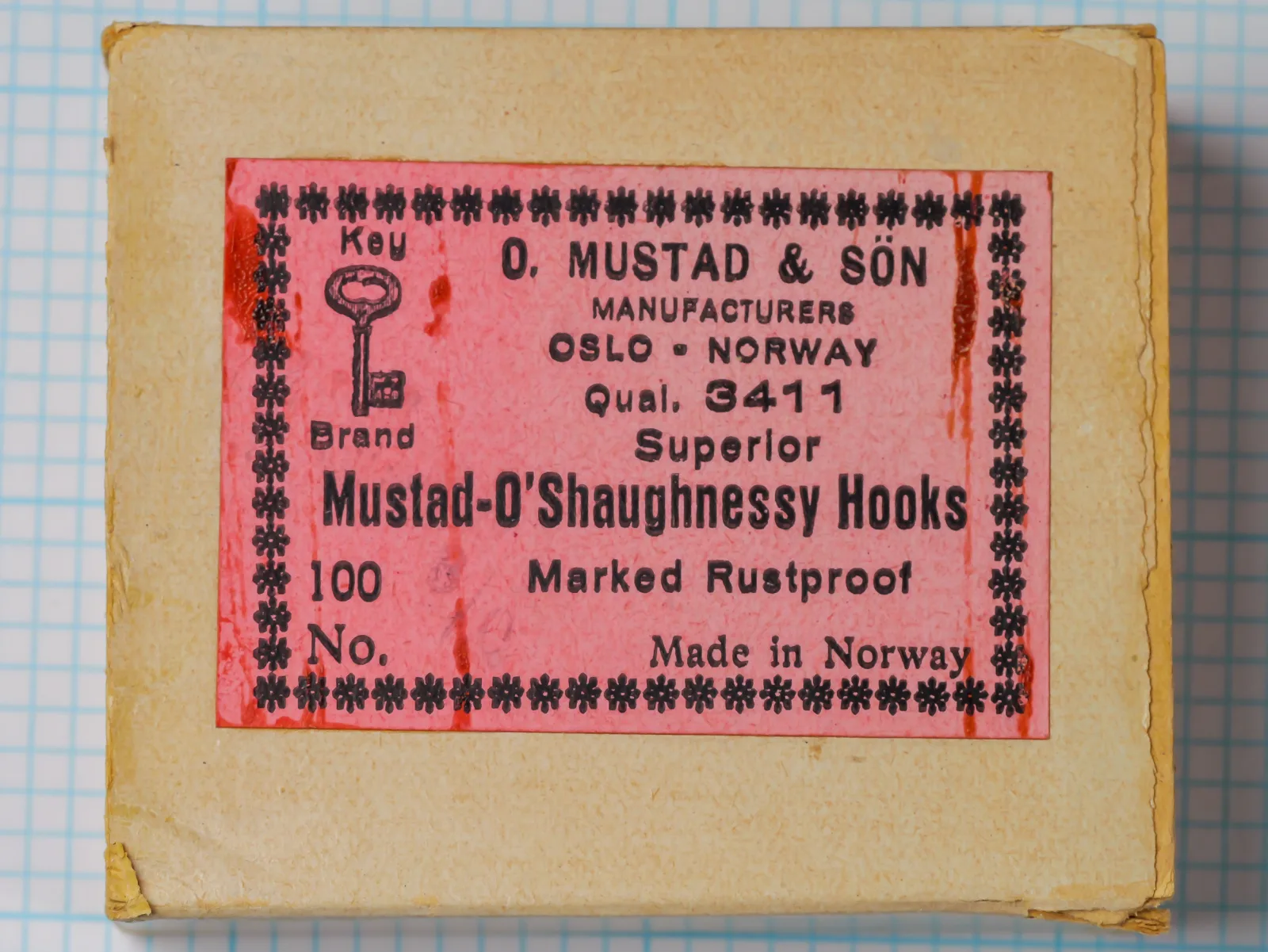
The pink eight-line label with the Oslo, Norway, designation provides definitive dating. Christiania was renamed to Oslo on January 1, 1925, so any Oslo label post-dates 1925. The label style, paper stock, and offset printing technique are consistent with mid-20th-century production (c. 1950-1965). The use of 'Key Brand' trademark with the downward-pointing skeleton key logo is characteristic of Mustad's post-WWII North American marketing. The pink label color and simple typography suggest 1950s-era production. Blind-eye hooks, though available throughout the period, became increasingly uncommon after 1960 as fly-tyers fully transitioned to modern looped and ball-eye construction, making late-era blind-eye examples scarcer. The 'Made in Norway' notation and absence of any barcode (barcodes were not standard until 1974) confirm pre-1970s manufacture.
The Mustad 3411 blind eye represents a fascinating technological holdover—by the 1950s, most manufacturers had abandoned blind eyes for modern looped and ball eyes. Yet Mustad maintained this pattern specifically for the Atlantic Salmon and traditional saltwater communities who valued the "broken-back" connection. A soaked loop of silkworm gut, when bound to the shank and allowed to dry, creates a joint with inherent elasticity that absorbs strike shock better than a rigid metal eye. Early 20th-century salmon fishers discovered that flies tied this way showed dramatically superior hook-up ratios in fast water. By producing the 3411 into the 1960s, Mustad honored an unwritten covenant with a tradition-bound fishing community that understood the physics of gut-loop mechanics generations before modern synthetic alternatives made the technique obsolete.
The Mustad 3411 is a heavy-duty saltwater and Atlantic Salmon fly hook designed for traditional construction methods using gut loop or silkworm snelling. The blind eye accommodates a “broken-back” connection where a soaked gut loop or modern dacron loop is bound to the tapered shank using fine silk thread, allowing for enhanced fly movement and preventing leader wear. This hook was particularly favored for classic Atlantic Salmon patterns and traditional wet flies fished in powerful currents where the elasticity of the gut-looped connection provided superior strike absorption.
Heavy saltwater streamers, traditional crab and baitfish patterns tied with gut loops, conservation-minded catch-and-release applications where the gut loop provides mechanical give.
Classic Atlantic Salmon flies (tied with gut loops), traditional wet fly patterns, vintage saltwater streamers
| Hook | Match Quality | Notes |
|---|---|---|
| Partridge CS10/1 Bartleet Blind Eye | Very Good | True blind-eye salmon hook, similar tapered shank, but uses modern wire standards. No marked shank feature. Lacks the heavy forging of vintage 3411. |
| Alec Jackson Blind Eye Salmon Hook | Very Good | Blind-eye construction for traditional gut-loop snelling, premium modern equivalent, superior engineering but higher cost. Does not replicate the Marked/Superior point geometry. |
| Mustad 36890 Looped-Eye O'Shaughnessy | Good | Modern Mustad continuation of same O'Shaughnessy bend, but with looped eye instead of blind eye. Direct spiritual successor for anglers not committed to gut-loop tradition. |
| Tiemco TMC 811S | Moderate | Modern saltwater O'Shaughnessy-style hook with looped eye. Different wire standard and finish. Lacks blind-eye and marked-shank characteristics of vintage 3411. |
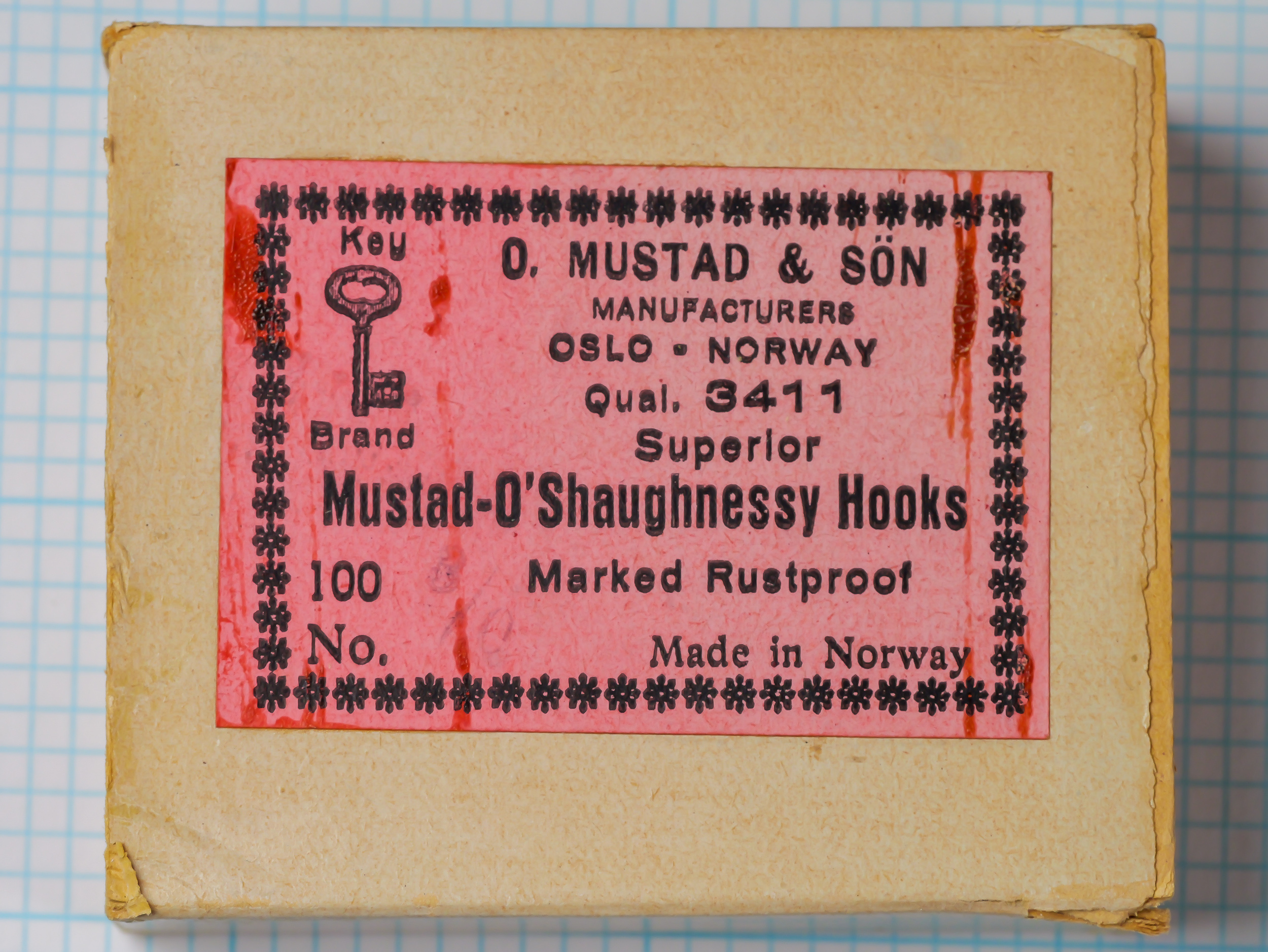
Pink eight-line typographic label affixed to natural kraft cardboard box. Label features the downward-pointing 'Key Brand' skeleton key logo in black upper left. Eight lines of black letterpress/offset text: (1) 'O. MUSTAD & SÖN' (2) 'MANUFACTURERS' (3) 'OSLO • NORWAY' (4) 'Qual. 3411' (5) 'Superior' (6) 'Mustad-O'Shaughnessy Hooks' (7) '100' and 'Marked Rustproof' (8) 'Made in Norway'. Decorative border of small fleurons around label perimeter. Box dimensions approximately 3.5" × 2.25" × 0.5". Paper stock is medium-weight kraft with natural aging patina. Label shows minor foxing and creasing consistent with 60+ years storage. Printing is sharp and fully legible. No barcode. No price notation visible.
Pricing reflects the scarcity of blind-eye Mustad hooks from mid-century, which are far less common than looped or ball-eye variants. Condition of the original box and label adds 30-40% premium. Verified sales on eBay and specialist tackle dealers (Melton Tackle, Merrick Tackle) typically range $85-$120 for hook-only specimens in good condition, rising to $140-$180 when original packaging is intact and in very good condition. The Superior point designation is less sought after than Hollow Point variants, which moderates the price slightly. Geographic demand is higher in UK and Scandinavia where traditional Atlantic Salmon traditions remain strong.
eBay auctions (search: 'Mustad 3411' or 'blind eye Mustad O'Shaughnessy'), specialist tackle dealers including Melton Tackle (UK), Merrick Tackle (USA), and Japanese vintage tackle specialists. Rarer in general fly-fishing auctions but occasionally appears in estate lots and tackle fairs. Original boxed examples are significantly harder to find than loose hooks.
Label Verification: Authentic Mustad 3411 packaging displays the eight-line format with ‘Key Brand’ graphic, ‘O. MUSTAD & SÖN MANUFACTURERS’, ‘OSLO – NORWAY’, ‘Qual. 3411’, ‘Superior’, ‘Mustad-O’Shaughnessy Hooks’, ‘100 No.’ (quantity), and ‘Marked Rustproof’ with ‘Made in Norway’ notation. The label should be pink/coral in color. P
Hook Identification: The blind eye (tapered shank end with no formed loop) is the definitive characteristic. Examine under magnification: the shank should taper to a blunt point or slight flat (not rounded). The marked/ridged shank is visible as fine parallel lines running lengthwise along the wire. The O’Shaughnessy bend shows a deep, parabolic curve with the deepest point near the barb. Wire should be notably heavy and forged (flattened cross-section). Superior point has a near-straight inner taper (not concave like hollow point). P
Finish Assessment: ‘Marked Rustproof’ refers to a tinned finish—examine color and tone. This finish typically appears dull silver or slightly bronze-toned, never bright. Any bright or shiny appearance suggests the hook has been polished or is a different finish. Authentic examples show a matte, durable patina. P
Size Confirmation: Size 3/0 should measure approximately 1.82″-1.86″ (46-47 mm) overall length and 0.54″-0.58″ (14-15 mm) gap width. Variations ±0.05″ are normal manufacturing tolerance. P
Environment: Store in a cool, dry location (50-60°F ideal, <40% relative humidity). Avoid basements and attics where temperature and humidity fluctuate. The tinned ('Marked Rustproof') finish is durable but not immune to prolonged moisture exposure.
Packaging: Keep hooks in original box whenever possible. The kraft cardboard and pink label are historically significant and add substantial value. If original packaging is compromised, transfer hooks to archival acid-free kraft boxes with silica gel packets.
Display: If displaying loose hooks, use museum-quality acrylic cases or shadow boxes with non-acidic backing. Avoid direct sunlight, which may fade the pink label over time. Do not display near heating vents, wood smoke, or salt spray.
Handling: Wear cotton gloves when handling to prevent skin oils from transferring to the hook. The tinned finish can be microscopic-scratched by careless handling. The blind eye taper is fragile—avoid dropping or bumping against hard surfaces.
Conservation Note: Do not attempt to ‘restore’ or re-tin a vintage hook. Any refinishing will destroy the historical authenticity and dramatically reduce collectability. Light surface patina is acceptable and expected on vintage specimens.
Monitoring: Check monthly for any signs of rust bloom or white corrosion spots, which indicate compromised tinning. If detected, increase ventilation and lower humidity immediately. Do not attempt water-based cleaning; dry-brush with a soft brass brush if necessary.
Source: Mustad vintage eight-line label system documentation; Mustad-Guide.pdf reference; 'A Comprehensive Typology and Decryption of Vintage O. Mustad & Søn Hook Labels' (primary source document)
‘Superior’ Designation (Line 5): The label states ‘Superior’ in the point identifier position. Per Mustad’s official labeling system documented in their 1950s-era catalogs, ‘Superior’ in this context denotes a point and barb geometry with near-straight inner taper, concentrating penetration force at the tip while maintaining structural strength under heavy strain. This is distinct from ‘Hollow Point’ (concave inner face) and represents a premium, all-purpose design. On this blind-eye O’Shaughnessy, the Superior point was engineered for hard-jawed saltwater species—billfish, large stripers, salmon in rocky rivers—where delicate hollow-point geometry would fail.
‘Marked Rustproof’ (Line 7): ‘Marked’ refers to the longitudinal ridges visible along the shank, which function as microscopic grip points for binding silk and gut loops. ‘Rustproof’ is Mustad’s designation for their tinned finish—electroplated or dipped in molten tin to resist saltwater corrosion. This was the absolute standard for commercial marine and Atlantic Salmon hooks before stainless steel became cost-effective in the 1980s. The label does not specify tinned explicitly; ‘Rustproof’ was the contemporary marketing term.
‘Made in Norway’ (Line 8): This notation became standard on Mustad exports during the post-WWII era, affirming the Oslo factory origin and appealing to buyers who valued Norwegian industrial precision. It also satisfied U.S. tariff requirements (origin marking mandatory on imports after 1890).
Absence of Size Notation: Notably, the label does not list the hook size in print. Size was typically written by hand or marked by a separate lot number on the box lid. This was common for Mustad bulk shipments—the size designation appeared on the outer shipping case or was hand-marked by wholesalers for inventory tracking.
The Mustad 3411 represents one of the final chapters in a manufacturing tradition that stretched back to 18th-century Redditch hand-forging. By the 1950s, blind-eye hooks were technological anachronisms—modern fishing lines and knots made direct attachment to a metal eye far more convenient and reliable. Yet Mustad maintained the 3411 in production, recognizing that a subset of Atlantic Salmon and saltwater anglers remained committed to gut-loop snelling for reasons both technical and sentimental.
The gut loop, when soaked and bound to a blind-eye shank, creates a connection with inherent elasticity. The joint itself absorbs strike shock rather than transmitting it rigidly through a metal eye junction. On heavy fish in fast water, this mechanical give can mean the difference between a hooked fish and a broken leader. Early 20th-century salmon fishers discovered this through empirical trial; modern materials science confirms the principle.
By discontinuing the 3411 (sometime in the early 1970s), Mustad ceded this niche market to British makers like Partridge, who continued blind-eye production for the Atlantic Salmon community. Today, interest in vintage blind-eye hooks has resurged among fly tyers exploring historical techniques and anglers seeking to reconstruct authentic ‘lost art’ flies. The 3411, with its marked shank and Superior point, occupies a unique space: industrial-era precision applied to a fundamentally preindustrial attachment methodology.
| P | Photographically verified — Directly observable in the photograph(s) on this page. |
| V | Verified by documentation — Confirmed by manufacturer catalog, spec sheet, or published reference. |
| I | Inferred — A logical deduction from observable or documented evidence, not directly stated. |
| E | Estimated — An approximation based on visual comparison, proportional analysis, or limited data. |
| S | Speculative — A reasoned hypothesis that cannot be confirmed from available evidence. |
Claims with no notation are confirmed by multiple independent sources. All photographs on garrenwood.com are taken on a measurement grid where each square equals 1/10 inch (0.1″ / 2.54 mm).
Your cart is empty.