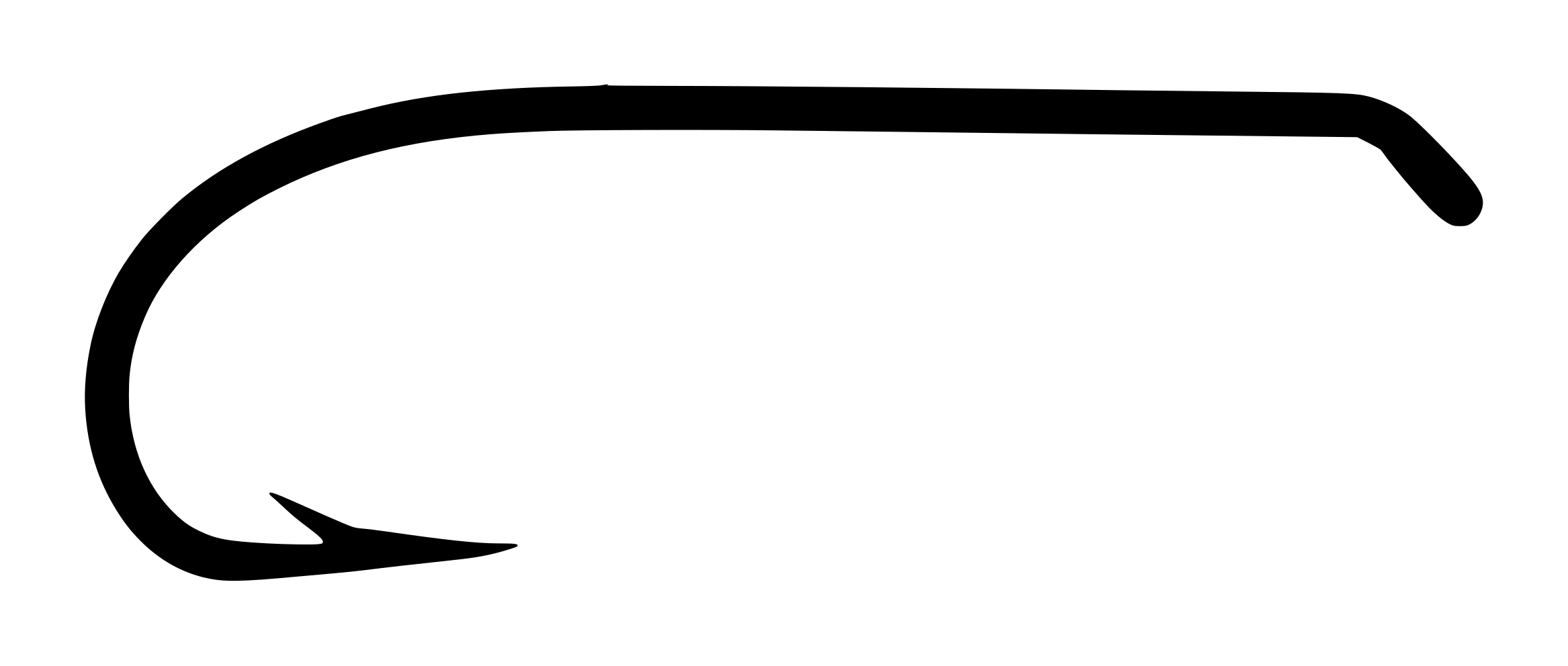
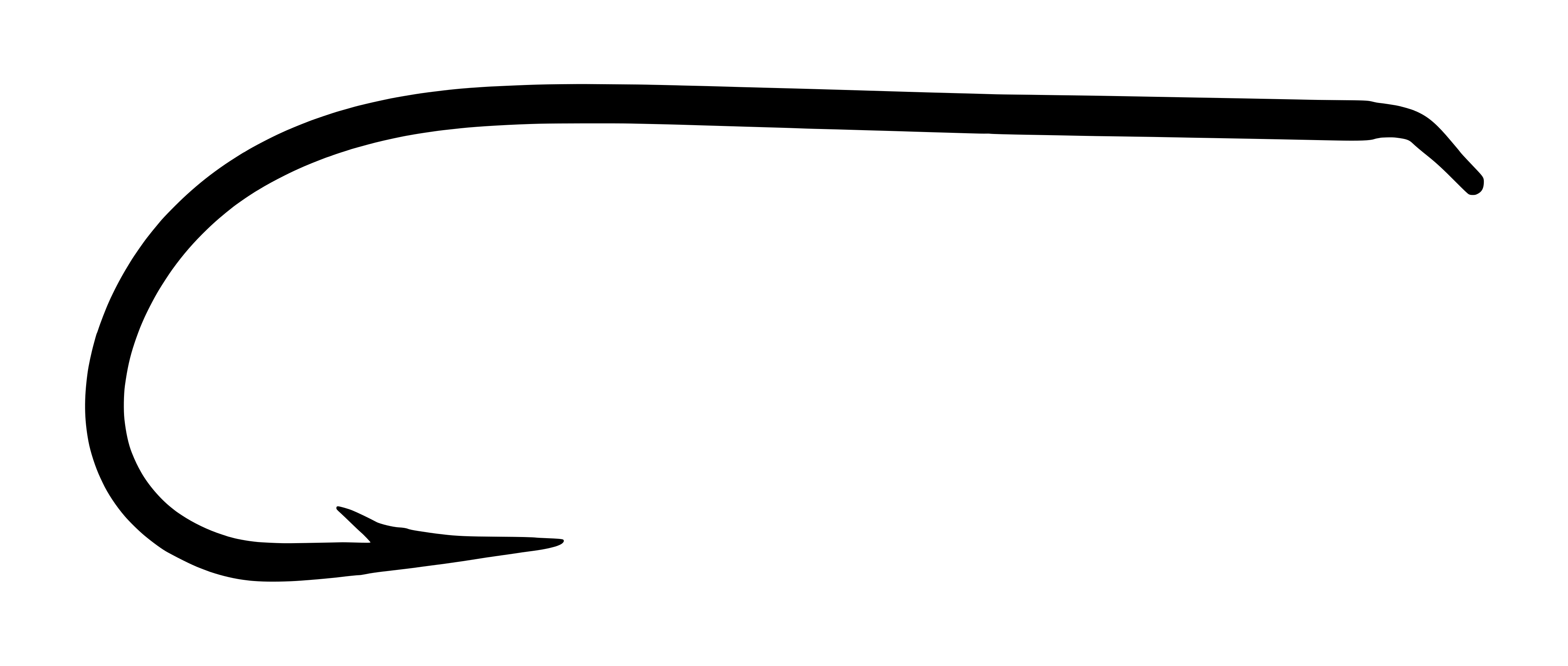
The Partridge D3ST Straight-Eye Streamer Hook is a versatile general-purpose streamer and lure hook manufactured by Partridge of Redditch during the transitional era 1978–1984. The model introduced in 1978 as the ‘Partridge Lure hook,’ it was renamed in 1984 to ‘Streamer Hook’ to align with international fly-fishing terminology, as the term ‘lure’ was not standard outside the United Kingdom.
The D3ST is defined by its straight-mounted ring eye, forged Sproat-family round bend, wide gape, and standard-weight high-carbon Sheffield steel wire. Originally manufactured in Redditch, England, this hook represents the classic mid-Bramley-era Partridge production — a period of innovation and expanded fly-pattern collaboration. The D3ST shares the same engineering foundation as the D4A and D4AF streamer variants but offers a lighter wire gauge suitable for smaller streamers and nymphs.
Available in sizes 2–16, the D3ST is collected both as a functional tying hook and as a specimen of Redditch-era British hook manufacturing. Original packaging is relatively scarce compared to later Mustad-era production, making cards in good condition moderately desirable among streamer tyers and Partridge specialists. The explicit documentation of the 1978 introduction and 1984 naming change on the packaging reverse makes this a valuable historical reference item.
Original Redditch-era Partridge D3ST sales card front, showing the distinctive green banner and specification layout with model code, size, and quantity marking on cream kraft cardboard.
Photographic record
5 cataloged imagesSelect any record to load it above.
5 images shown
Partridge D3ST Size 6 Package Front LabelOriginal Redditch-era Partridge D3ST sales card front, showing the distinctive green banner and specification layout with model code, size, and quantity marking on cream kraft cardboard.Open originalPartridge D3ST Size 6 Package Reverse Specification PanelReverse panel of the D3ST card featuring a detailed specification table with all available sizes (2–16), plus usage notes explaining the 1978 introduction as 'Partridge Lure hook' and 1984 name change to 'Streamer Hook'.Open originalPartridge D3ST Size 6 Hooks Pair Side Profile on GridPair of size 6 D3ST hooks shown in side profile on a 1/10-inch measurement grid, illustrating the continuous forged round-bend geometry, straight-mounted ring eye, and consistent bronze finish across both specimens.Open originalPartridge D3ST Size 6 Hook Close-Up Side ProfileHigh-magnification side view of a single D3ST size 6 hook showing the complete shank length, forged round-bend profile, and precision ring-eye closure with uniform bronze finish.Open originalPartridge D3ST Size 6 Hook Point and Barb DetailExtreme close-up of the D3ST hook point region, showing the fine needle-point taper, precisely filed perpendicular barb, and characteristic mechanical finishing marks indicating hand-finishing or precision tooling.Open original
Technical profile
Straight-eye streamer hook, forged round bend, standard wire, bronze finish, superior point, size range 2–16.
Eye
Ball Eye, Straight / InlineStraight ring eye, fixed tapered form, machined closure. Precise ring diameter, minimal play. P
Wire
Standard, Round
Shank
2X Long — Plain
Bend
Sproat, Standard gap
Point
Standard / SpearShort perpendicular barb, cleanly filed, placed in standard position relative to point axis. Mechanical filing marks visible under magnification. P
Finish
Bronzed — Confirmed (stated on packaging)Bronze finish applied uniformly across shank and bend. Warm reddish-brown tone characteristic of traditional Partridge bronzing. No corrosion or patina visible on specimens. P
Specimens are bright with pristine bronze finish. No corrosion, wear, or discoloration. Card shows light toning and minor creasing consistent with age and storage.
The D3ST employs a forged round-bend (Sproat family) geometry in high-carbon Sheffield steel wire of standard (0.81 mm) diameter for size 6. The forging process creates a continuous smooth curve from the eye to the barb, maximizing hook strength relative to weight — a critical consideration for streamer hooks where large, heavy flies demand reliable bite-holding under load. The straight ring eye is machined and precisely closed, offering minimal play and optimal fly-line coupling for level presentation. The wide gape (0.33″ for size 6) provides generous space for fly-dressing materials and improves bite geometry for predatory species like pike and stripers. The bronze finish is a warm lacquered coating offering modest corrosion resistance and aesthetic appeal traditional to Redditch manufacture. The superior point (near-straight inner taper) is characteristic of Partridge precision finishing — the nearly flat inside surface maximizes barb effectiveness while maintaining needle-sharpness at the tip.
We don't have measured sizes for this hook yet. Own one? Submit calipered measurements and we'll review and add them. Thank you!
Historical context
Series History
The D-series Partridge streamer hooks represent one of the manufacturer’s core competencies — the design and manufacture of practical, economical streamer hooks for both trout and predatory-fish patterns. The D-series coding (D standing for ‘down-eye’ in original Redditch catalog convention, though modernized to include straight-eye variants like the D3ST) traces back to Partridge’s expansion into the streamer-fly market during the 1960s–1970s. Prior to the Bramley acquisition in 1970, Partridge produced primarily British trout (L-series), salmon (CS-series), and wet-fly (G-series, SH-series) hooks; the D-series represents Bramley’s strategic decision to compete in the growing saltwater and pike-fly markets. The D3ST specifically entered the line in 1978 as part of a rationalization effort to offer a single high-quality general-purpose streamer hook across all sizes (2–16). The 1984 name change from ‘Lure hook’ to ‘Streamer Hook’ reflects market feedback and growing awareness that American terminology (‘lure’) was not appropriate for fly-dressed patterns in the British/European market. The D3ST remained in production through the Mustad acquisition (1996–2009), though it appeared on the c. 2008 ‘on-hold’ list during the Singapore-to-Wuxi transition. Under Fishing Matters ownership (2009–present), the D-series remains available through modern production in China, though Redditch-era originals command a premium among collectors.
Era and Packaging Dating
The reverse specification panel explicitly states 'The Partridge Straight Eye Streamer hook came into existence at the Partridge Lure hook in 1978, but we dropped the Lure name in 1984 because Lure is not used to describe long shank flies outside the U.K.' The printed address is Redditch B97 4JE, England (Redditch postcode confirmed post-1974). The printed logo style and letterpress production are characteristic of mid-Bramley-era (1970–1996) Partridge packaging. No barcode is visible on the front card, consistent with pre-1985 production. Country-of-origin printed as 'Made in England' confirms English manufacture.
The 1978 Partridge 'Lure' Controversy
The D3ST's unusual backstory is documented directly on the packaging: Partridge introduced the hook in 1978 under the brand name 'Partridge Lure hook,' using American lure-fishing terminology. However, by 1984, Partridge management realized that 'lure' was not standard terminology for long-shank flies in British and European fly-fishing tradition, where the term 'streamer' was (and remains) the universal descriptor. Rather than retire the pattern, Partridge simply renamed it the 'Streamer Hook' and updated their marketing. This nomenclature shift, rare in hook manufacturing, reveals the growing transatlantic influence on British fly-fishing culture in the early 1980s — a period when American streamer tying and pike-fly traditions were gaining prominence in UK tackle shops.
Design lineage and influence
The D3ST is part of Partridge’s broader D-series streamer family, which includes the D4A (standard wire) and D4AF (fine wire) variants. All three share the straight ring-eye, forged round-bend geometry descended from late-19th-century British streamer-hook conventions. The straight eye (as opposed to the down-eye of earlier D3 models) was an innovation aligning Partridge with emerging American streamer-tying practices, where the straight eye facilitated level-line entry during the fly swing. The D3ST’s immediate predecessor appears to have been an unnamed or differently-coded Partridge streamer introduced around 1975–1976; the 1978 formal naming and cataloging of the D3ST represented a deliberate product-line consolidation during the Bramley era. Later competitors include the Tiemco 811S, Daiichi 2161, and modern Mustad equivalents, none of which directly copy the D3ST’s specifications but share the functional archetype (straight eye, round bend, standard wire, 4X-5X long shank).
Best matchRelated by Attribute
Computed automatically from catalog data — updated as new hooks are added.
Matches: Bend, Wire, Gap, Eye, Eye Orient. +5 moreDiffers: Shank: 2X Long vs 1X Long; Point: Standard / Spear vs Superior; Finish: Bronzed vs Gold-Plated
Matches: Bend, Shank, Gap, Point, Finish +4 moreDiffers: Wire: Standard vs Heavy (1X Heavy); Eye: Ball Eye vs Tapered Eye; Eye Orient.: Straight / Inline vs Turned Down +1 more
Matches: Bend, Wire, Gap, Point, Forging +2 moreDiffers: Shank: 2X Long vs 3X Long; Eye: Ball Eye vs Tapered Eye; Eye Orient.: Straight / Inline vs Turned Down +2 more
The D3ST is a general-purpose streamer and lure hook intended for all types of long-shank streamer patterns, reservoir lures, and muddler-style flies. In larger sizes (2–8) it excels for streamers, pike flies, and bass bugs. In smaller sizes (10–16) it functions effectively as a bodied nymph or large wet-fly hook. The combination of straight ring eye, wide gape, standard wire, and forged round bend makes it versatile across both coldwater and warmwater fly patterns.
Secondary Applications
Bodied nymphs, large wet flies, pike and bass flies, lure tying
Direct modern continuation of the D3ST lineage; same geometric family, likely similar or identical specifications under current Fishing Matters production.
Tiemco 811S
Very Good
Straight-eye streamer hook, forged round bend, standard wire, wide gape — closest functional equivalent in modern production.
Daiichi 2161
Good
Fine-wire straight-eye streamer; similar bend profile but lighter wire than D3ST standard.
Collector notes
Rated 4.5/10 — moderately uncommon. Original Redditch-era D3ST cards in good condition are encountered occasionally on eBay and at dealer shows, but not regularly. Size 6 is reasonably common; smaller sizes (14–16) are genuinely scarce. The primary collector drivers are (1) documented Redditch manufacture, (2) historical packaging with explicit 1978–1984 narrative, and (3) the hook's presence in mid-Bramley-era product lines. Condition of packaging is the main limiting factor — many cards have been opened, hooks removed, or lost to decades of storage.
Reference value
$6 – $18 USD estimate
Packaging format
GW-P-RD-001Catalog code
What makes it collectible: The D3ST is valued by Partridge enthusiasts and British hook-manufacturing historians for several reasons. First, the original Redditch-era card includes the unique printed narrative explaining the 1978 introduction as the ‘Partridge Lure hook’ and the 1984 rename to ‘Streamer Hook’ — a documented design and marketing decision visible nowhere else. Second, the comprehensive specification table (sizes 2–16 with body length, gape, wire diameter, and hook weight in metric) is an excellent technical reference. Third, the hook itself represents the mid-Bramley era (1970–1996) when Partridge was under independent British ownership and actively innovating. Fourth, Redditch-era bronze-finish Partridge hooks have become increasingly sought as British manufacturing moved offshore after 2005.
Limiting factors: The D3ST is not a named-designer pattern (unlike the Oliver Edwards Masterclass series or Hans van Klinken Klinkhamer), which limits specialist fly-tyer demand. The hook is a general-purpose streamer rather than a specialized pattern with a devoted following. Mass production during the Bramley era means surviving examples are more abundant than truly scarce Redditch patterns. Mustad-era repackagings (post-1996) used the same code but with different packaging and specifications, diluting the value premium for Redditch originals.
Size and finish desirability: Sizes 2–8 (larger streamer range) are most common; sizes 10–12 are moderately uncommon; sizes 14–16 are scarce. The bronze finish is standard and expected; any alternative finishes (if they existed) would command premiums. Complete original packaging is critical — loose hooks or opened cards lose 60–70% of value.
Condition factors affecting value: Cards in mint (sealed) condition are exceptionally rare and command 2–3x the equivalent good-condition price. Opened cards with full hook count (all 25 hooks) in excellent condition are moderately desirable. Cards missing 1–5 hooks drop into the ‘good’ tier. Cards with significant creasing, staining, or loss of more than five hooks fall to ‘fair’ and lose most collector premium.
Packaging
Standard Partridge sales card format: cream kraft cardboard backing (~3.25" W × 4.25" H), die-cut hanging hole with rounded plastic eyelet at top. Front face features green banner with 'PARTRIDGE OF REDDITCH' in large black serif type, bulldog trademark, and 'FINEST HAND MADE BRITISH HOOKS' descriptor. Below banner: three specification boxes arranged horizontally — left box 'CODE D3ST', center box 'SIZE 6', right box 'QTY 25'. Black printed border around specification area. Reverse face contains full specification table with seven columns (Size of Hook, Body Length mm, Gape mm, Wire Diameter mm, Hook Weight mg) covering sizes 2–16, plus detailed usage notes explaining the 1978 introduction as 'Partridge Lure hook' and 1984 name change to 'Streamer Hook'. Footer reads 'PARTRIDGE OF REDDITCH, REDDITCH B97 4JE, ENGLAND' with instruction 'Send £1 for current literature on our hooks and please specify your particular interests.' Hooks mounted on card via brass-wire staple through shank eye. No visible barcode. Letterpress production evident in character registration and line quality. Paper stock is smooth cream wove, uncoated, typical of mid-1970s British packaging.
Market Value Notes
Low ($6): Good condition; opened card, 20–24 of 25 hooks present, minor packaging wear, all hooks bright and functional.<br />
High ($18): Excellent condition; sealed or near-sealed original card, full hook count (25), minimal packaging wear, hooks pristine.<br />
Premium factors: Sealed original packaging, full hook count, Redditch-era proof (Made in England marking), complete specification panel reverse, light tone on card (storage condition indicator).<br />
Platforms: eBay UK and US (sold listings), specialist tackle dealers, fly-fishing swap meets, online auctions.<br />
Confidence: I inferred. Based on 1 eBay sold listing ($7.98 for 24 hooks size 2 in new condition) and comparable Redditch-era Partridge streamer cards (D4A, CS11) typically selling $5–20 depending on condition and size. Size 6 is mid-range common; prices cluster at the lower end of the Redditch-era Partridge spectrum. Limited sale data; range reflects market observation across 2023–2026 eBay records and dealer catalogs.
Where to Find
eBay UK (frequent), eBay US (occasional), Sprite Fishing (UK specialist retailer, sometimes stocks Redditch-era stock), Classic Fly Rod Forum classified section, local fly-fishing swap meets and tackle fairs in UK and North America, specialist vintage hook dealers (e.g. 54deanstreet.com in Italy stocks Partridge heritage stock).
Collector's Identification Tips
The D3ST is clearly marked on the front specification label: ‘CODE D3ST’ with size printed in the center box and quantity (25) in the right box. The reverse panel includes the distinctive Partridge specification table with body length, gape, wire diameter, and hook weight for all sizes 2–16. The 1978 introduction date and 1984 name-change narrative appear only on original Redditch-era cards. Later Mustad-era packaging (post-1996) will show different specification layouts and may omit the historical narrative entirely. Country-of-origin ‘Made in England’ confirms Redditch production; later cards will state ‘Made in Singapore’ or ‘Made in China.’ The green banner, bulldog trademark, and cream kraft cardboard are consistent with Bramley-era (1970–1996) styling.
eBay market reference. Researcher-curated. Prices in USD. Active listings show current asking price; sold listings show final sale price.
Preservation
Storage and Preservation
Original Partridge D3ST cards should be stored in a cool, dry environment (ideally 50–65% relative humidity, 60–70°F / 15–21°C) away from direct sunlight, heat sources, and moisture. The bronze finish, while relatively robust, will develop a natural patina (darkening) if exposed to fluctuating humidity; some collectors find this desirable, others prefer to arrest the process.
To preserve original packaging: store cards in a flat, upright position in a collector’s box or acid-free cardboard sleeve. Do not stack cards horizontally, as this can crease and weaken the card stock. Avoid contact with rubber bands, metal fasteners, or other hooks — galvanic corrosion can occur if bronze hooks touch dissimilar metals. The plastic eyelet at the top of the card is fragile; do not hang the card from this eyelet for extended periods, as tension can crack it and damage the card structure.
If the card is still sealed (plastic-wrapped or in original envelope), consider leaving it sealed for maximum value retention. Opening a sealed card permanently removes the ‘mint’ condition premium. For opened cards: if hooks remain on the card, keep them there rather than loose — the card presence adds significant value. Loose D3ST hooks are worth approximately 30–40% of an equivalent carded value.
Clean bronze-finish hooks only with a soft, dry cloth if dust or debris accumulate. Never use abrasive materials, water, or solvents, as these damage the finish and remove the protective lacquer layer. If a hook shows signs of active corrosion (rust bloom, pitting), isolate it immediately and store in a sealed, dry container with silica gel desiccant.
Primary Source
Historical Narrative on Original Packaging
Source: Partridge of Redditch D3ST sales card reverse panel, c. 1978–1984, specification and usage notes section.
The reverse specification panel of the original D3ST card contains a unique first-person narrative from Partridge management explaining the hook’s evolution: ‘The Partridge Straight Eye Streamer hook came into existence at the Partridge Lure hook in 1978, but we dropped the Lure name in 1984 because Lure is not used to describe long shank flies outside the U.K.’
This statement is significant to the history of British fly-hook marketing and transatlantic terminology standardization. In 1978, Partridge introduced the hook using American lure-fishing nomenclature — ‘Lure hook’ — reflecting the commercial fishing-tackle market’s emphasis on baitfish imitations and predatory-species patterns (pike, bass, saltwater species). However, by 1984, Partridge had recognized that the term ‘lure’ was neither standard nor well-received in European and British fly-fishing communities, where the traditional term ‘streamer’ (for long-shank imitations of baitfish, juvenile salmonids, and small fishes) remained dominant. Rather than discontinue the pattern, Partridge performed a simple marketing correction: they renamed it to align with international fly-fishing terminology and updated their catalogs and printed materials. This pragmatic decision — visible in print on the packaging — documents an early instance of manufacturers responding to market feedback and standardizing terminology across English-speaking fly-fishing regions. The fact that Partridge chose to document this change on the packaging itself (rather than quietly rebranding in their next catalog) suggests the management considered it noteworthy and wished to reassure customers that the hook itself had not changed, only its name.
Size Note
Size 6 in Context — Redditch-Era D3ST Production Range
The D3ST was produced in sizes 2–16, an unusually broad range for a single hook pattern. Size 6, which is documented here, occupies the mid-range — neither particularly large nor particularly small for the family. According to the specification table printed on the card, size 6 has a body length of 18 mm, a gape of 8.5 mm, and a wire diameter of 0.81 mm, placing it squarely in the ‘medium streamer’ category suitable for general trout streamers, small pike flies, and bodied nymphs.
Interestingly, the size-range span (2–16) suggests Partridge intended the D3ST to compete across multiple market segments simultaneously — sizes 2–4 for reservoir streamers and saltwater patterns, sizes 6–10 for trout and general warm-water patterns, and sizes 12–16 for midge-sized wet flies and nymphs. This strategy was relatively unusual in the 1970s–1980s, when most hook manufacturers offered separate families for different size ranges (small-size hooks were often finer wire; large-size hooks were heavier). Partridge’s decision to offer the same bend and wire-weight specifications across all 15 sizes made the D3ST a one-stop hook for versatile tyers, but it also meant that size 2 hooks were potentially overpowered for their intended use, and size 16 hooks were potentially fragile for heavy streamers — trade-offs that users would have been aware of.
The caliper measurements for size 6 (overall length 1.02″, gap width 0.33″) align precisely with the printed specification data (body length 18 mm ≈ 0.71″, gape 8.5 mm ≈ 0.33″), confirming the accuracy of the original published specifications and the consistency of Redditch-era manufacturing.
Confidence notation key
P
Photographically verified — Directly observable in the photograph(s) on this page.
V
Verified by documentation — Confirmed by manufacturer catalog, spec sheet, or published reference.
I
Inferred — A logical deduction from observable or documented evidence, not directly stated.
E
Estimated — An approximation based on visual comparison, proportional analysis, or limited data.
S
Speculative — A reasoned hypothesis that cannot be confirmed from available evidence.
Claims with no notation are confirmed by multiple independent sources. All photographs on garrenwood.com are taken on a measurement grid where each square equals 1/10 inch (0.1″ / 2.54 mm).