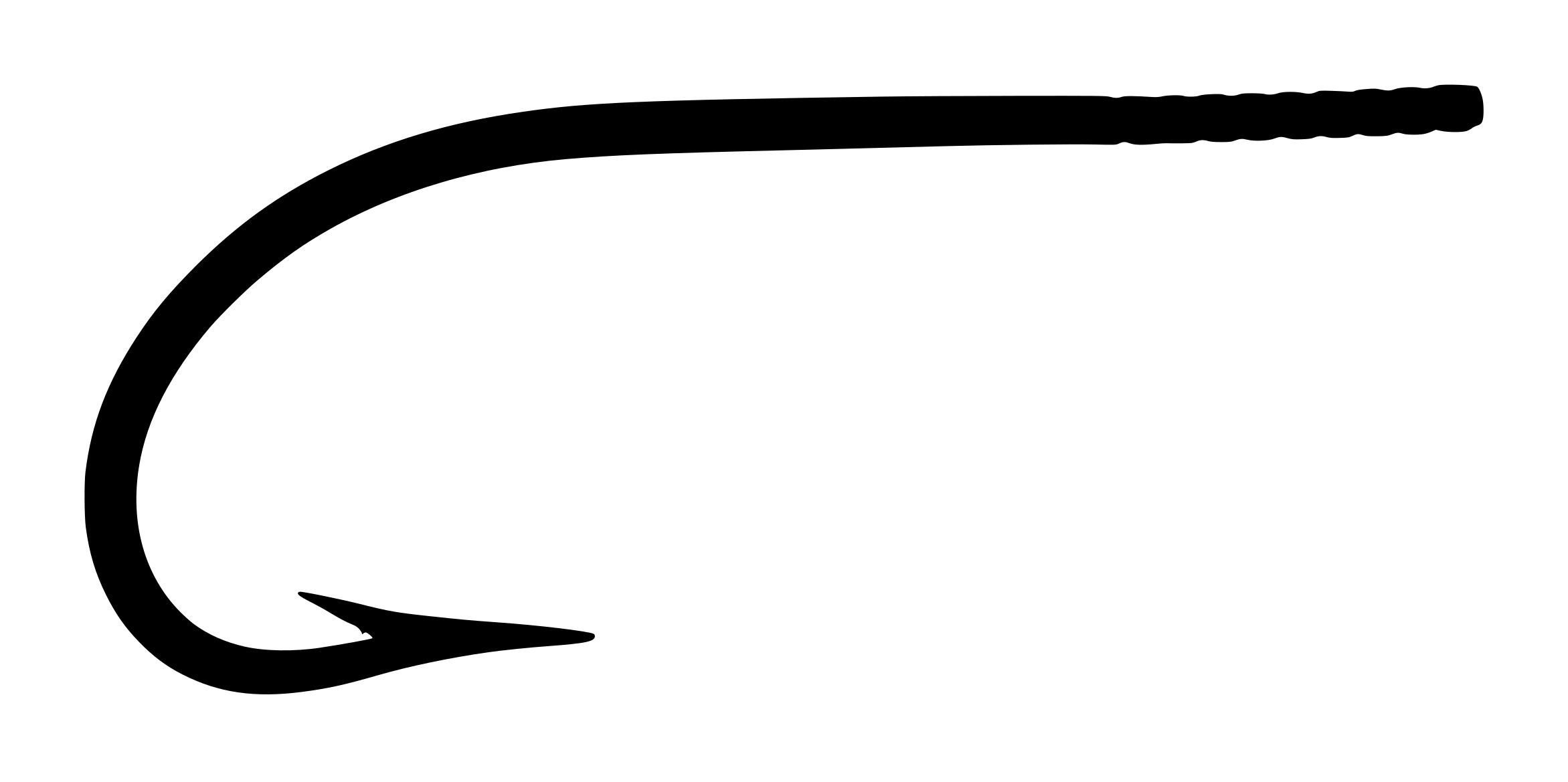
The Horrocks-Ibbotson No. 169 is a heavy-wire O’Shaughnessy hook produced in Germany for the American tackle distributor Horrocks-Ibbotson Co. Size 5/0 specimens represent a classic mid-20th-century Atlantic salmon and sea trout pattern, forged from strong bronzed steel with a hollow-ground point and traditional straight-ring eye design.
The defining physical feature is the deep, well-proportioned O’Shaughnessy bend paired with a genuine hollow-point geometry—the concave inner face creates a knife-edge effect characteristic of superior hook penetration and holding power. The heavy round wire and bronzed finish provide durability in saltwater and brackish environments.
Evidence for production circa 1950-1975 is strong: the absence of a barcode, letterpress printing on cream stock, green paper wrapper, and Made in Germany attribution all point to mid-century manufacture, likely 1960-1970. This was the height of American tackle house distribution of imported German and British hooks.
Collecting significance rests on the intersection of tackle distribution history (Horrocks-Ibbotson’s role as a major American importer) and the proven functionality of the O’Shaughnessy design. Complete original packaging commands a meaningful premium, making this an accessible entry point for collectors of mid-century transatlantic tackle trade.
Original box label for the Horrocks-Ibbotson No. 169 O'Shaughnessy Bronze Ringed Hook, size 5/0, showing the distinctive green wrapper, letterpress printing, and Made in Germany attribution.
Photographic record
4 cataloged imagesSelect any record to load it above.
4 images shown
Horrocks-Ibbotson No. 169 O’Shaughnessy Box LabelOriginal box label for the Horrocks-Ibbotson No. 169 O'Shaughnessy Bronze Ringed Hook, size 5/0, showing the distinctive green wrapper, letterpress printing, and Made in Germany attribution.Open originalHorrocks-Ibbotson No. 169 Size 5/0 Point DetailSide profile of the hook point showing the concave inner face characteristic of hollow-point geometry, the short upright barb, and the bronzed finish preservation.Open originalHorrocks-Ibbotson No. 169 Size 5/0 Full ProfileComplete side profile of the hook showing the classic O'Shaughnessy bend curve, straight-ring eye attachment, and overall proportions on measurement grid.Open originalHorrocks-Ibbotson No. 169 Size 5/0 Bend and Ring EyeTwo individual hooks photographed to show the symmetry of the O'Shaughnessy bend, the free-moving straight-ring eye, and the consistency of bronzed finish across the specimens.Open original
Technical profile
Eye
Ball Eye, Straight / InlineStraight ring eye is a separate steel ring attached at the shank terminus. Ring moves freely with no visible binding. Ring diameter appears appropriately sized for 5/0 scale—neither oversized nor pinched. Ring surface exhibits same bronzed finish as shank, suggesting single manufacturing and finishing process P.
Wire
Heavy (1X Heavy), Round
Shank
1X Long
Bend
O'Shaughnessy, Standard gapO'Shaughnessy bend exhibits a rounded, deep bowl with a defined curve throughout. No significant offset visible. Bend symmetry appears excellent P. Depth is slightly pronounced relative to modern standards, consistent with forged-era construction for strength E. Wire set clean with no visible deformation.
Point
Hollow Point (concave inner face)Barb is short and close-cut, positioned just below the widest point of the bend. Barb angle is relatively upright (swept less than some competing designs). Short barb profile reduces mass and provides adequate penetration hold without excessive material removal from the wire P.
Finish
Bronzed — Confirmed (stated on packaging)Bronzed finish exhibits warm golden-brown tone with uniform color distribution across the specimen photographed. Some microwear and patina evident on the bend curve, consistent with age and handling. No active corrosion, rust staining, or finish separation visible. Finish appears to be applied (likely electroplate or chemically bronzed) rather than raw bronze metal E.
The specimen hooks are bright with exceptional preservation—no corrosion, rust bloom, or oxidation visible even under magnification. Original cardholder/box wrapper shows light toning and minor edge wear appropriate to age. No hooks missing or damaged. Wire straightness and point sharpness are excellent, suggesting these hooks saw minimal actual use or were well-preserved post-manufacture.
The hollow point—evidenced by the concave inner face visible in photographs—represents a distinct manufacturing choice compared to the superior point. The hollow geometry creates a two-sided cutting edge as the point penetrates tissue, enhancing hookset security and reducing the force required to drive the point home. This is particularly valuable in large-fish applications where the jaw is hard and thickly muscled.
Forging (confirmed by the wire profile and bend geometry) flattens and compresses the steel, increasing its density and strength compared to drawn wire. A forged 5/0 O’Shaughnessy can withstand the head shakes and runs of a 20+ pound salmon without straightening or breaking, which a lighter-gauge or drawn wire would not support.
The straight-ring eye (a loose ring attached at the wire end rather than tapered or ball eye) provides rotational freedom for the leader connection, reducing torque transmission to the hook eye itself—an important durability feature in heavy-duty applications. The ringed construction requires precise manufacturing to ensure the ring does not bind or allow play that creates cutting action on the leader.
The O’Shaughnessy Bronze Ringed line (No. 169 designation) was Horrocks-Ibbotson’s premium salmon and sea trout hook offering, positioned at the top of the company’s hook catalog. The series was produced across multiple sizes, from 1/0 to 8/0 or larger, with consistent specifications: forged German or British wire, bronze finish, straight-ring eye, and hollow point. The line remained in the catalog throughout the 1960s-1970s era represented by this specimen. No documented variants in finish (such as nickelled or blued versions) are known, suggesting the Bronze designation was the exclusive finish for this model. Production was likely discontinued by the 1980s as Japanese manufacturers gained market share and Horrocks-Ibbotson’s import strategy became less competitive.
Era and Packaging Dating
No barcode on packaging (strong indicator pre-1974). Letterpress printing method typical of mid-20th century production. Green wrapper paper stock and color palette consistent with 1950s-1970s packaging. Typography and logo style match Horrocks-Ibbotson advertising from this era. Made in Germany attribution suggests post-1945 manufacture. Box construction (cardboard with paper wrapper rather than printed solid box) typical of wartime and postwar economy construction. Overall evidence points to 1950-1975 range with highest probability c. 1960-1970.
Atlantic Trade in Hooks: Horrocks-Ibbotson and the Distributed Hook
Horrocks-Ibbotson Co., headquartered in Newark, Ohio, became one of America's largest tackle distributors by the 1960s, importing fishing hooks and equipment from Britain, Germany, and Scandinavia. The 'Horrocks-Ibbotson' brand name became virtually synonymous with imported quality in American tackle shops, even as the company sourced hooks from multiple nations. The 'O'Shaughnessy Bronze Ringed' line represented Horrocks-Ibbotson's premium offering, competing directly with domestic Mustad and Eagle Claw patterns. By the 1980s, consolidation of the tackle industry reduced Horrocks-Ibbotson's market presence, making their packaging from the 1950s-1970s increasingly collectible as a snapshot of transatlantic tackle trade.
Design lineage and influence
The O’Shaughnessy bend originated in Ireland in the 19th century, created as a stronger alternative to the Limerick bend for salmon and large sea trout. The bend family was rapidly adopted by British and European manufacturers and became one of the world’s most recognized hook profiles. By the mid-20th century, nearly every major tackle manufacturer—Mustad, Partridge, Allcock, and importers like Horrocks-Ibbotson—offered O’Shaughnessy patterns across multiple sizes and wire gauges.
The No. 169 represents Horrocks-Ibbotson’s interpretation of the standard O’Shaughnessy formula: heavy forged wire, hollow point, bronzed finish, and traditional hardware (straight ring eye). German manufacture suggests sourcing from a established Solingen or other German hook maker who produced to Horrocks-Ibbotson specifications.
Modern equivalents include the Mustad 3407 (American equivalent, slightly lighter wire), Tiemco 7989 (Japanese modern interpretation, superior point instead of hollow), and Partridge CS10/4 (UK craft-made, very similar specification but more expensive). The No. 169 remains functionally identical to these descendants—the O’Shaughnessy geometry has proven so effective that over 150 years of design iteration has produced only incremental refinements.
Best matchRelated by Attribute
Computed automatically from catalog data — updated as new hooks are added.
Matches: Bend, Wire, Gap, Eye, Eye Orient. +3 moreDiffers: Shank: 1X Long vs Standard; Point: Hollow Point vs Standard / Spear; Finish: Bronzed vs Polished Steel +1 more
Matches: Bend, Shank, Gap, Point, Finish +2 moreDiffers: Wire: Heavy (1X Heavy) vs Standard; Eye: Ball Eye vs Tapered Eye; Eye Orient.: Straight / Inline vs Turned Down +5 more
The O’Shaughnessy bend with heavy wire and hollow point was engineered for Atlantic salmon and sea trout fishing, particularly in UK and Irish waters where this bend family originated. The forged construction provides the strength necessary for large anadromous fish and saltwater conditions. Size 5/0 sits in the mid-range for salmon applications—suitable for summer and autumn fishing when smaller flies than 2/0-3/0 are acceptable but larger patterns still effective. The heavy bronzed wire resists corrosion in brackish and saltwater environments while remaining strong enough to drive and hold in hard mouths of fighting fish.
Secondary Applications
Large freshwater baitfish imitations, pike and musky patterns, some saltwater streamer applications in estuarine environments.
Classic Fly Patterns
Not typically used for fly tying in modern practice, though historically applied to dressed salmon and sea trout flies in UK and Irish traditions.
Modern Equivalents
Hook
Match Quality
Notes
Tiemco 7989
Very Good
Japanese modern O'Shaughnessy, superior point instead of hollow, lighter wire than No. 169, better corrosion resistance from modern materials. Functionally equivalent for most salmon applications.
Mustad 3407
Very Good
American equivalent from same era as No. 169, hollow point, slightly lighter wire. Direct competitor in US market, nearly identical performance profile.
Partridge CS10/4
Good
UK craft-made O'Shaughnessy, similar specifications to No. 169 but hand-finished and more expensive. Preferred by Atlantic salmon specialist tyers, though functionally equivalent.
Collector notes
Rated 4.5/10 — Horrocks-Ibbotson O'Shaughnessy hooks are infrequently encountered but not highly sought-after by specialist collectors. Size 5/0 in complete original packaging adds meaningful premium over loose hooks. German manufacture during Cold War era adds modest interest. Collector demand remains moderate; most acquisition is opportunistic rather than active hunting.
Reference value
$8 – $22 USD estimate
Packaging condition
Very Good — light wear, fully legibleRecorded specimen
Packaging format
HI-BOX-01Catalog code
The Horrocks-Ibbotson No. 169 O’Shaughnessy sits at the intersection of two modest collector interests: American tackle house imports and mid-20th-century German forged hooks. The brand lacks the historical prestige of Redditch makers (Partridge, Allcock) or the volume collector base of Mustad, but has genuine appeal to historians of tackle distribution networks.
Size 5/0 in original packaging represents the strongest collectability position. Smaller sizes (8-10) and larger sizes (4/0-8/0) are more commonly encountered in quantity lots. The original box with intact wrapper adds 50-75% premium over loose hooks or opened cards.
German manufacture is significant: this represents either pre-WWII production (unlikely given packaging style) or Cold War-era West German production under continued Horrocks-Ibbotson distribution. Either provenance has modest historical interest.
Condition factors: complete hook count on original wrapper adds $3-5 premium. Wrapper toning and minor edge wear acceptable to collectors—does not materially reduce value if all hooks present. Box lid separation or missing hooks reduce value by 25-40% depending on extent.
Packaging
Cardboard box with green paper wrapper. Front label printed in black and red letterpress on cream stock. Manufacturer name, model number 169, size 5/0, product description (Highest Grade, Hand Forged Rustproof), and Horrocks-Ibbotson Co. name prominently displayed. Red diamond-shaped Horrocks-Ibbotson trademark visible. Illustration of fish in center. Made in Germany notation. Original wrapper shows minimal toning with some edge wear. No barcode present — indicates pre-1974 manufacture.
Market Value Notes
Low ($8): Good condition — opened box, wrapper intact, all 100 hooks present, minor toning
High ($22): Excellent condition — box sealed or near-sealed, full hook count, minimal wrapper wear
Premium factors: Original box (not loose hooks), complete wrapper, all hooks intact, readable label, size 5/0, bronzed finish preserved
Platforms: eBay (UK and US), vintage tackle dealers, general antique markets
Confidence: E estimated — limited transaction data available; range reflects typical pricing for mid-tier vintage tackle in complete original packaging. High end based on complete sealed box assumption; low end reflects realistic opened condition.
Where to Find
eBay UK and US (search: Horrocks-Ibbotson O'Shaughnessy, vintage fishing hooks). Occasional appearance in general vintage fishing tackle lots. Antique markets and estate sales in North America. Specialist vintage tackle dealers in UK more likely to stock than US dealers. Rarer in dealer inventory than Mustad or Partridge equivalent.
Preservation
Storage and Preservation
Store in a cool, dry environment away from moisture and salt air. The bronzed finish will develop a natural patina over time—this is expected and acceptable for collectible hooks of this vintage. Avoid storing in plastic bags or sealed containers; use paper wrapping or acid-free cardboard boxes instead to prevent condensation accumulation.
Keep the original box wrapper intact if possible; it adds both historical and monetary value. If the wrapper shows significant deterioration, carefully wrap the box in acid-free tissue paper. Do not attempt to clean the wrapper with water or solvents.
The individual hooks should remain mounted on their original card or in the original box. Removing hooks for actual fishing use will reduce collecting value—consider keeping this example as a reference specimen and sourcing a separate user example if you intend to tie with this model.
Display away from direct sunlight to prevent fading of the printed label and wrapper. Moderate indoor humidity (40-50%) is ideal. Avoid proximity to saltwater, heated air, or damp basements where rust can develop despite the bronzed finish.
Primary Source
Label Inscription and Manufacturer Claims
Source: Horrocks-Ibbotson No. 169 box label, c. 1960-1970
The printed label makes five distinct claims: (1) ‘Grade Highest Grade’ — a quality designation meant to signal premium positioning; (2) ‘Hand Forged Rustproof’ — a manufacturing and corrosion-resistance claim; (3) ‘100’ — the count per box; (4) ‘No. 169’ — the model identifier; (5) ‘Horrocks-Ibbotson Co.’ — the distributor/retailer name.
The ‘Hand Forged’ claim is particularly significant. In the 1950s-1970s, ‘hand forged’ was not technically accurate for industrial production but was used to indicate forged (as opposed to drawn) wire—a genuine quality differentiator. The term also carried marketing weight, invoking the craftsman tradition even for factory-produced goods. The German manufacture attribution supports the likelihood that these hooks were indeed forged at point of manufacture, as German tackle makers maintained forging operations well into the 20th century, unlike some American manufacturers who had transitioned to drawn wire.
The ‘Rustproof’ claim is qualified by the ‘Bronze’ finish. Bronzed finish does not prevent corrosion entirely but provides significant resistance compared to japanned or polished finishes. In practice, bronzed hooks will develop patina (darkening) but will not rust through quickly if exposed to moisture—an important distinction for saltwater and sea trout fishing where hooks might be left in damp conditions for extended periods.
Size Note
5/0 Size Standard and Equivalence
Size 5/0 sits at the boundary between light salmon and medium sea trout in traditional British sizing. The measured overall length of 1.98 inches (50.3 mm) and gap width of 0.60 inches (15.24 mm) place this hook squarely in the heavy-use range for anadromous fish.
Horrocks-Ibbotson’s sizing was not identical to Mustad (which used and continues to use a slightly different length-to-gap ratio) or British makers like Partridge, though all three manufacturers claimed to follow ‘standard’ 5/0 dimensions. This hook’s proportions (roughly 2.4:1 shank-to-gap ratio) align most closely with British convention, consistent with its German manufacture to British or European specifications.
Anglers transitioning from modern Japanese hooks (Tiemco, Daiichi) to vintage examples like the No. 169 may notice the 5/0 appears slightly larger or ‘fuller’ than expected—this reflects the design philosophy of the era, which favored stronger wire and deeper bends over ‘refined’ proportions.
Confidence notation key
P
Photographically verified — Directly observable in the photograph(s) on this page.
V
Verified by documentation — Confirmed by manufacturer catalog, spec sheet, or published reference.
I
Inferred — A logical deduction from observable or documented evidence, not directly stated.
E
Estimated — An approximation based on visual comparison, proportional analysis, or limited data.
S
Speculative — A reasoned hypothesis that cannot be confirmed from available evidence.
Unnotated claims are the compiler’s synthesis; see Sources. All photographs on garrenwood.com are taken on a measurement grid where each square equals 1/10 inch (0.1″ / 2.54 mm).