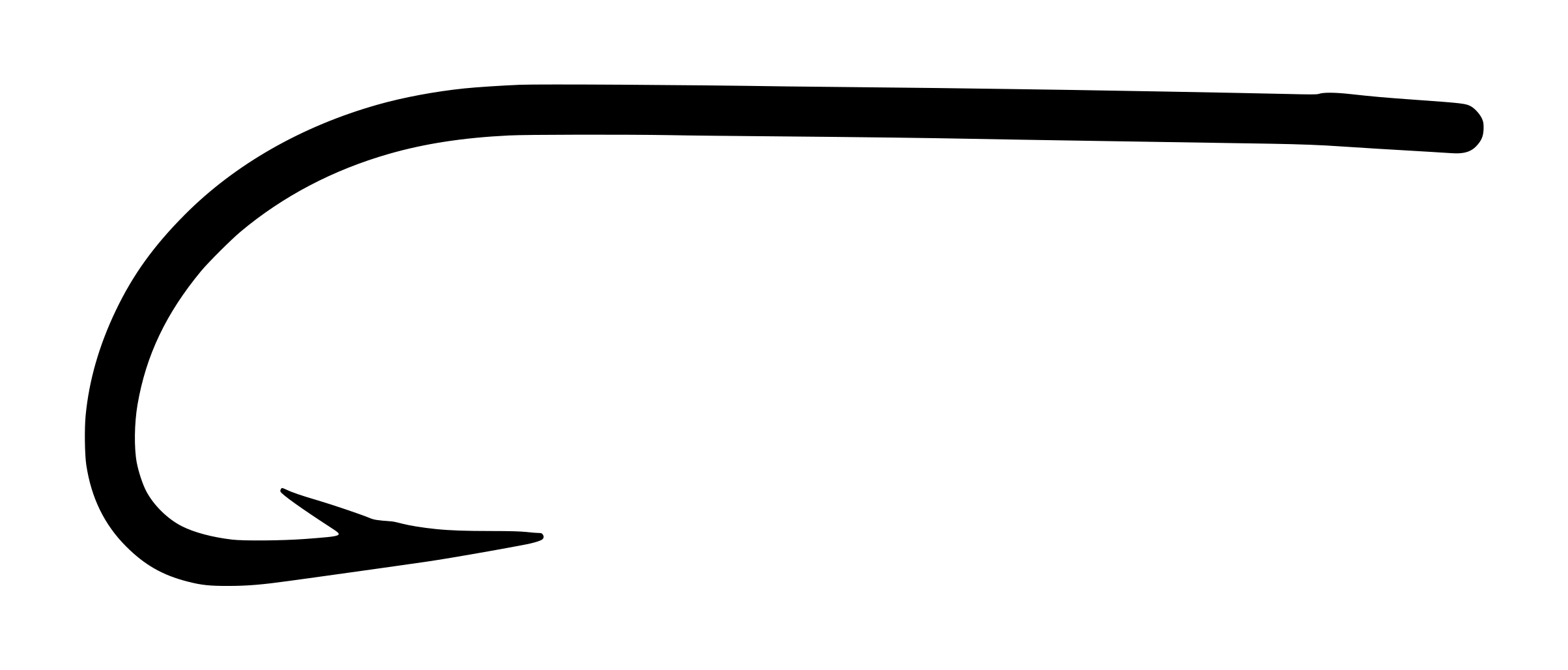
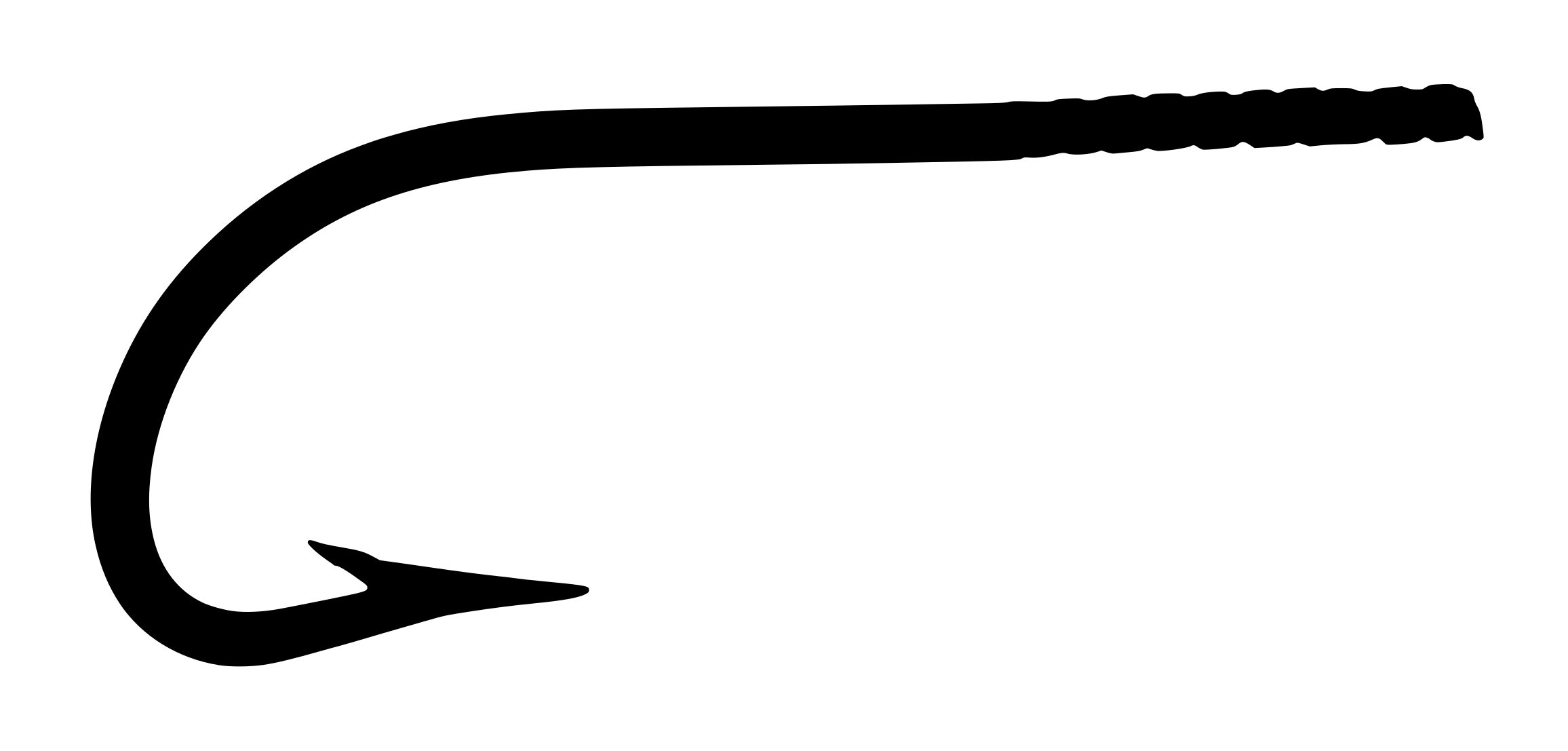
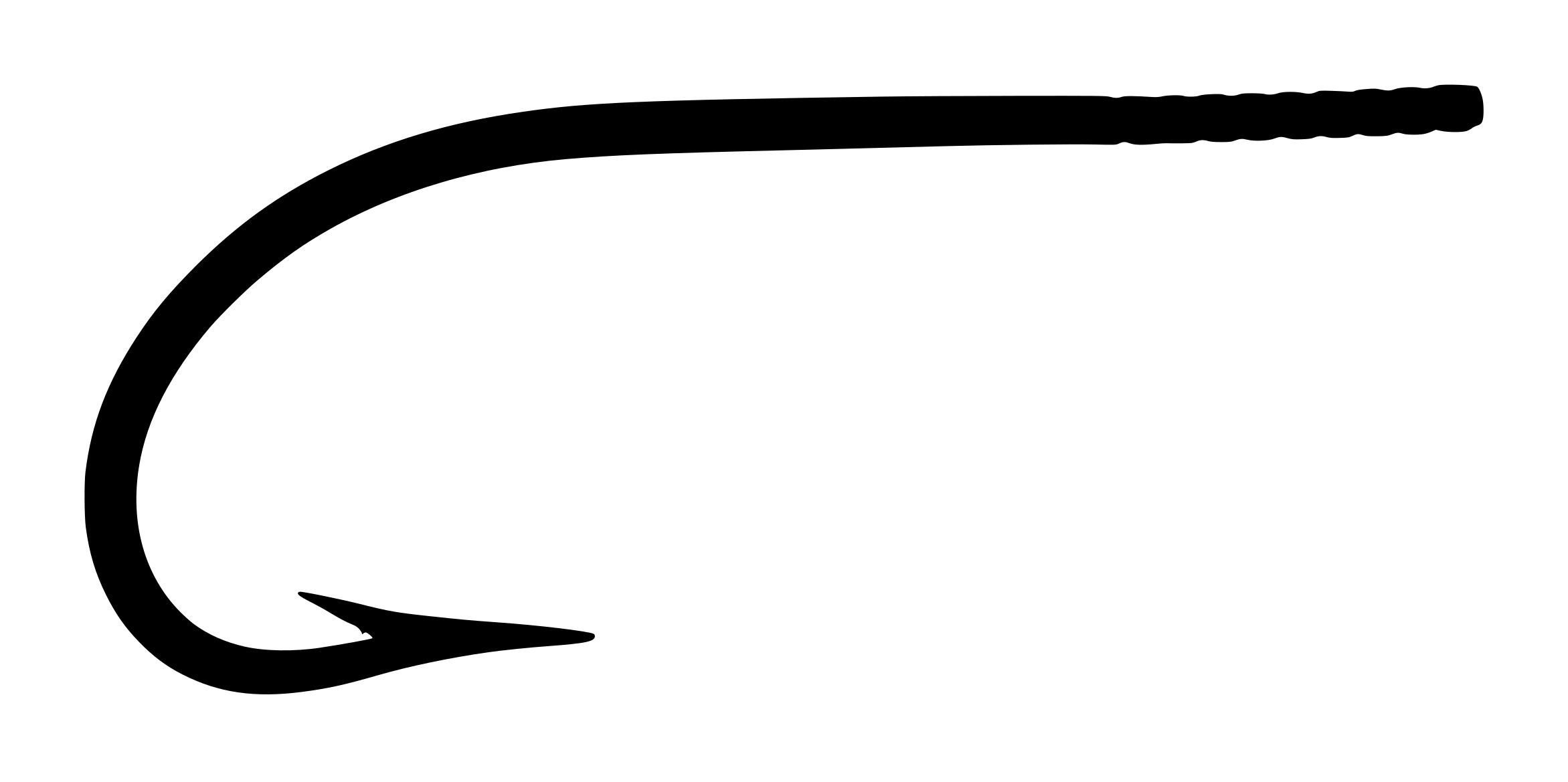
The Mustad 4513 is a vintage Limerick-bend saltwater hook in size 10/0, manufactured by O. Mustad & Søn in Oslo during the 1940s–1950s golden era of mid-century fishing tackle exports. Sporting an extra-heavy wire gauge, ringed eye, and hollow point geometry, this hook represents the industrial pinnacle of pre-modern saltwater tackle design. The japanned (black lacquer) finish provides superior corrosion resistance—essential before stainless steel became cost-effective for marine applications.
This specific specimen is housed in its original light-blue paper sales card with the iconic ‘Key Brand’ trademark and eight-line Mustad label format. The box indicates a count of 100 hooks, typical of wholesale distribution to tackle retailers throughout North America and Europe. The Limerick bend itself originated in the Irish city of Limerick, perfected by generations of regional blacksmiths; Mustad’s industrial reverse-engineering of this pattern made it globally available to anglers who could never have accessed the original craft-made versions.
For collectors, this hook documents a specific transitional era: the shift from empire-era British tackle dominance to Norwegian industrial supremacy. The absence of any barcode, combined with the ‘Oslo’ designation and authentic paper packaging, firmly establishes this as a genuine artifact of the pre-war to early post-war global tackle supply chain. Condition and packaging completeness significantly influence collectibility and market value.
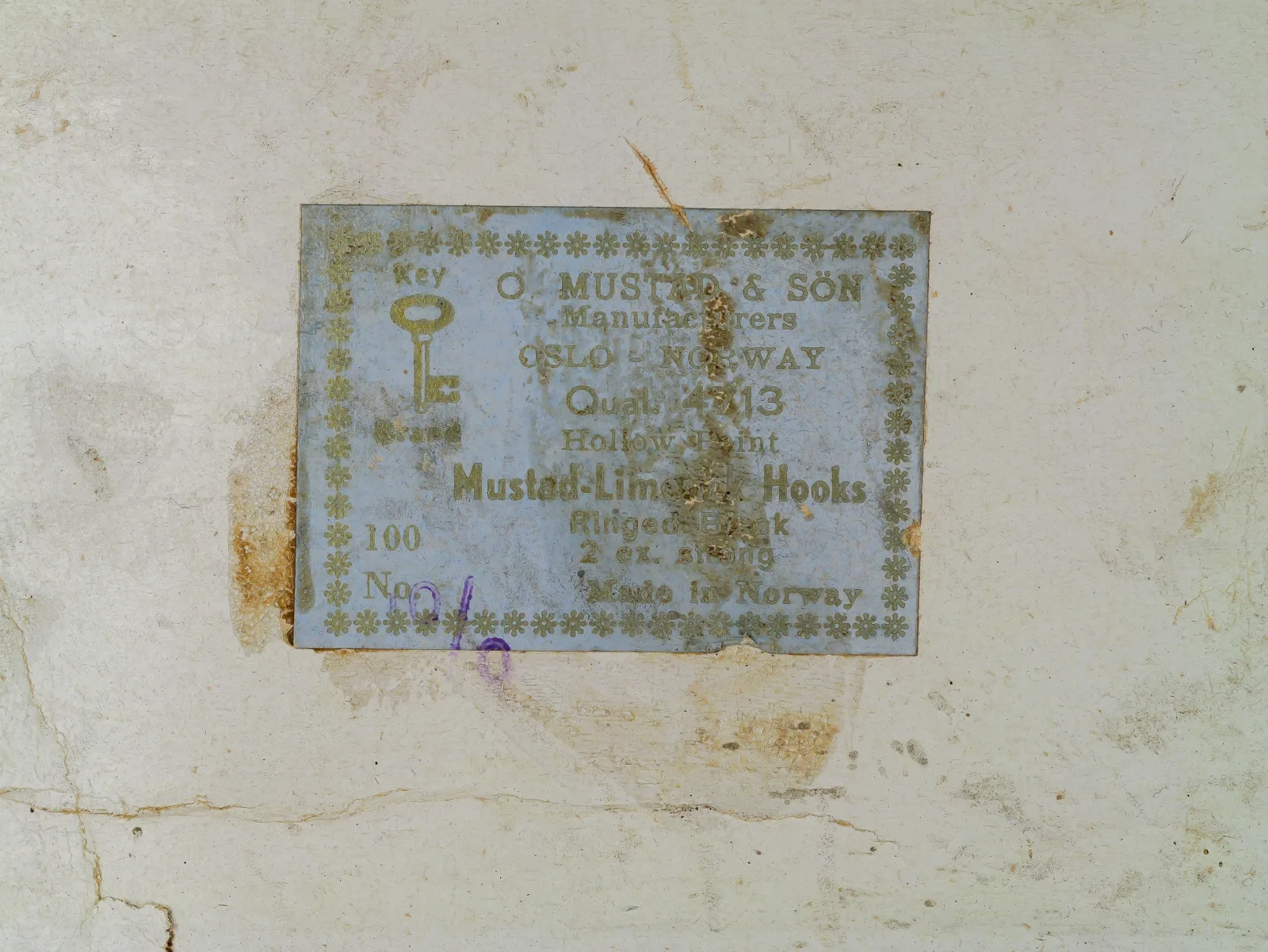
Original cardboard box label for Mustad-Limerick Hooks, Quality 4513, manufactured in Oslo, Norway. Box contained 100 hooks.
Photographic record
3 cataloged imagesSelect any record to load it above.
3 images shown
Mustad 4513 Original Box Label c.1940–1955Original cardboard box label for Mustad-Limerick Hooks, Quality 4513, manufactured in Oslo, Norway. Box contained 100 hooks.Open originalMustad 4513 Limerick Hook Side ProfileSide profile of japanned Mustad 4513 Limerick hook showing characteristic bend geometry and point angle against metric grid.Open originalMustad 4513 Limerick Hook Full ProfileFull profile of japanned Mustad 4513 showing the ringed shank and straight eye alignment typical of Limerick construction.Open original
Technical profile
Hollow Point | Ringed | 2 Extra Strong | Made in Norway
Eye
Ball Eye, Straight / InlineRinged eye is a simple, uniform circular loop formed by bending terminal wire back onto main shank. Loop diameter approximately 0.15"–0.18", cleanly proportioned to the heavy wire gauge and suitable for splicing heavy monofilament or wire leaders. Eye shows characteristic uniform black japanned finish with no visible nicks or deformation P.
Wire
Extra-Heavy (2X+), Round, Est. ~0.095"-0.110" (~2.4-2.8 mm)
Shank
2X Long — Plain
Bend
Limerick, Wide gapDistinctive Limerick bend with sharp, angular curve at the throat (bottom of bend). Shank projects nearly straight from eye; bend angle is pronounced and acute. This geometry locks the jaw securely into the lowest point of the hook—a biomechanical advantage for powerful, thrashing fish. Wire set appears true and centered P.
Point
Hollow Point (concave inner face)Barb is close-cut and moderately sized, positioned perpendicular to the point shank. Barb angle is acute and well-defined P. Barb root sits approximately 0.08"-0.10" from the point tip, typical for Limerick bends of this era.
Finish
Black Japanned — Inferred (photographically likely)Japanned finish (baked-on alkyd resin lacquer) in jet-black tone, uniform across both shank and bend. Finish shows minor wear spots and slight dulling consistent with age; no active rust or flaking observed. Warm black tone (not cool blue-black) typical of Mustad's japanning process from this era. Finish provides excellent corrosion resistance—the original purpose was to seal high-carbon steel from saltwater environments P.
Card exhibits light to moderate age toning and surface wear consistent with 1940s–1950s vintage stock. No creasing or major damage to card face. Hooks themselves show bright black japanned finish with minimal corrosion spotting (two hooks visible in images show even lacquer coverage). Specimen represents excellent 'New Old Stock' (NOS) condition with most or all original hook count present.
The hollow point on the 4513 represents a sophisticated mechanical engineering solution. Unlike a spear point (straight wedge taper), the hollow point features a pronounced concave inner face that tapers rapidly from tip to barb. This geometry creates an exceptionally fine, razor-sharp tip that requires minimal force to penetrate soft tissue—critical for finesse applications. However, once the tip penetrates past the barb, the rapid flare of the hollow point ensures a secure hold without creating an oversized entry wound.
For a heavy saltwater hook targeting large predators with hard mouths (shark, conger, skate), the hollow point’s advantage lies in initial tip engagement. The extra-heavy wire gauge (approximately 0.095″–0.110″ diameter) provides the structural rigidity needed to withstand the crushing jaw pressure and violent runs characteristic of these species. The japanned finish serves dual purposes: it seals the high-carbon steel from corrosion while providing a low-glare, dark presentation that does not spook fish in clear water.
The Limerick bend’s sharp angular curve at the throat is a biomechanical feature, not merely aesthetic. When a large fish strikes and turns to escape, the bend angle forces the jaw toward the lowest, strongest point of the hook—creating a mechanical lock that resists head-shakes and violent lateral stress. This design philosophy dominated saltwater tackle before modern materials made stress analysis routine.
This Mustad 4513 in size 10/0 represents one of the largest documented vintage Mustad sales-card specimens in the garrenwood.com catalog (overall length 3.6" / 91.4 mm). It is among the first documented examples of the 10/0 size in the Mustad reference collection and provides clear visual documentation of the hollow point geometry on an extra-heavy saltwater variant.
Own this hook? Help us measure it.
We don't have measured sizes for this hook yet. Own one? Submit calipered measurements and we'll review and add them. Thank you!
The Limerick bend pattern is not a Mustad invention; it originated in the Irish city of Limerick, where regional blacksmiths perfected the design over centuries. Mustad’s strategic decision to reverse-engineer and mass-produce the Limerick bend for global export was part of their aggressive industrial ‘cloning’ strategy described in the reference document. By replicating highly localized, regionally-favored patterns and producing them with Norwegian factory efficiency, Mustad successfully cornered markets that would otherwise have remained supplier-dependent on British Redditch makers.
The Qual. 4513 designation places this hook in Mustad’s mid-tier quality code range (3000–3999 block), indicating manufacturing to exacting dimensional and tempering standards, as opposed to economy models (1000–2999) or premium specialty hooks (4000+). The ‘2 Extra Strong’ notation on Line 7 of the label indicates a forging or hardening specification beyond standard wire gauges—essential for the crushing jaw pressures of large saltwater predators.
Mustad continued producing Limerick bends in various sizes and configurations throughout the 20th century. Modern equivalents exist, but the specific combination of japanned finish, ringed eye, and hand-labeled paper card packaging places this 4513 firmly in the vintage pre-1960s export era. The model was eventually superseded by the Mustad 31022-DT and other modern Limerick variants featuring stainless steel or Duratin finishes.
Era and Packaging Dating
Packaging shows 'OSLO – NORWAY' on Line 3. Oslo designation indicates manufacture post-1925 (Norwegian capital renamed January 1, 1925). Label typography, light-blue paper stock, and 'Key Brand' logo style are consistent with mid-20th-century Mustad export packaging. No barcode present (strong pre-1974 indicator). Box construction and print method suggest offset lithography typical of 1940s–1950s. Absence of modern synthetic finishes and presence of japanned finish support mid-century dating. Conservative range places this in the post-war boom era of Mustad global expansion.
Shark Fishing on the 10/0
During the 1950s, when this hook was manufactured, shark fishing from British and Scandinavian piers was a widespread recreational pastime—far more accessible than the tropical big-game fishing glamorized in modern media. Anglers would fish live mackerel or mullet on Mustad 4513 hooks from pier pilings in the North Sea and Atlantic approaches, targeting tope sharks, smoothhounds, and the occasional large porbeagle. The size 10/0 was common enough that tackle shops sold them in 100-hook cards at modest cost. Modern saltwater anglers rarely encounter this hook size, as modern spinning tackle and circle hooks have replaced the jigging and static bait techniques that made the 4513 essential. Yet in 1950, this exact hook represented the pinnacle of working-class shark tackle—industrial, reliable, and ubiquitous.
Design lineage and influence
The Limerick bend has direct lineage tracing back centuries to Irish smiths, particularly around the city of Limerick, where the pattern was refined for salmon and sea-trout fishing. British manufacturers including Allcock and S. Kendal & Sons documented and commercialized the Limerick bend throughout the 19th century. Mustad’s reverse-engineering strategy brought the Limerick into industrial mass production around the 1880s–1890s, making what had been a premium, hand-forged specialty hook available globally at commodity prices.
The 4513 sits in the lineage of mid-weight Limerick patterns. Heavier variants (4513 vs. standard Limerick sizes) were engineered specifically for saltwater predators with hard mouths. Competitor designs from this era include the O’Shaughnessy (which borrowed the parabolic Sproat bend but in heavy wire) and the Viking (Mustad’s own premium extra-fine dry-fly variant, Qual. 94840). The hollow point geometry connects to an earlier tradition of ultra-sharp specialty points—the needle point being the evolutionary predecessor.
Post-war, the 4513 was gradually superseded by hooks featuring tinned or stainless finishes (the Mustad 31022-DT, a modern Limerick survivor). However, no direct 1:1 modern equivalent exists that combines the hollow point with japanned finish and the extra-heavy wire gauge in the same quality tier. Modern anglers seeking Limerick bends typically choose stainless variants, reflecting the industry’s shift away from japanning toward permanently corrosion-resistant materials.
Best matchRelated by Attribute
Computed automatically from catalog data — updated as new hooks are added.
Matches: Bend, Shank, Wire, Eye, Point +4 moreDiffers: Gap: Wide vs Standard; Eye Orient.: Straight / Inline vs Turned Down; Finish: Black Japanned vs Bronzed +3 more
Matches: Bend, Shank, Eye, Eye Orient., Finish +4 moreDiffers: Wire: Extra-Heavy (2X+) vs Heavy (1X Heavy); Gap: Wide vs Standard; Point: Hollow Point vs Standard / Spear +3 more
Matches: Bend, Wire, Eye, Eye Orient., Point +5 moreDiffers: Shank: 2X Long vs Standard; Gap: Wide vs Standard; Finish: Black Japanned vs Tinned +2 more
The Mustad 4513 Limerick in size 10/0 is a heavy-duty saltwater hook engineered for large species and robust presentations. The generous 1.0″ gap and extra-heavy wire accommodate live mullet, mackerel, or other substantial natural baits. Historically used for shark, conger eel, skate, and ray fishing from piers and charter boats in northern European and Atlantic fisheries. The sharp angular Limerick bend locks the fish’s jaw securely into the lowest point of the hook, essential for violent head-shakes characteristic of large predators. The ringed eye accommodates heavy monofilament or wire leaders.
Secondary Applications
Heavy offshore trolling, large streamer display hooks (though practical fly applications are rare at this size), bottom fishing for grouper and cod in deep marine environments.
Classic Fly Patterns
Not typically used for fly tying.
Modern Equivalents
Hook
Match Quality
Notes
Mustad 31022-DT Limerick
Good
Modern Limerick bend, ringed eye, Duratin finish; loses the hollow point and japanned aesthetic but maintains the classic bend geometry and general size range.
Tiemco 811S
Moderate
Contemporary saltwater bend with similar weight and eye configuration; different bend profile (not Limerick) but serves comparable heavy saltwater applications.
Collector notes
Rated 5.0/10 — uncommon Mustad vintage in excellent condition with original packaging. Size 10/0 is highly specialized (saltwater/shark), limiting tyer demand. Collector interest is moderate among Redditch/Mustad specialists and mid-century tackle archivists; strong appeal to saltwater fishing historians. Main limiting factor is the lack of fly-tying utility and the specificity of the 10/0 size.
Reference value
$18 – $45 USD estimate
Packaging format
GW-MUS-01-CARDCatalog code
Positive collectibility factors: Original light-blue paper card with authentic eight-line Mustad label, ‘Key Brand’ trademark, and ‘Oslo – Norway’ designation firmly establish dating to mid-20th-century peak production era. Complete or near-complete hook count (100 hooks) adds significant value. Japanned finish is visually distinctive and historically noteworthy—representing pre-stainless-steel corrosion strategy. Size 10/0 is genuinely scarce in comparison to standard sizes (2/0–8/0), reflecting lower production volumes for specialized saltwater applications. Specimen exhibits excellent New Old Stock (NOS) condition with no active corrosion or finish degradation.
Limiting factors: Mustad hooks—even vintage examples—rarely exceed collectability ratings of 6.0 due to the enormous industrial production volumes of the Gjøvik factory. Unlike Redditch craft-maker hooks (Partridge, Allcock, Sealey), Mustad’s mechanized output was staggering. The 10/0 size is essentially unusable for modern fly tying, limiting appeal to functional anglers; primary audience is collectors and tackle historians. Hollow point geometry, while specialist-grade, is less iconic than the Superior point or Dublin point designs. Limerick bend, though classic, is not as regionally distinctive as Aberdeen or Cincinnati patterns.
Desirable variants and condition factors: Sealed or near-complete cards (90+ hooks intact) command premium prices. Cards with minimal toning and sharp original label printing outvalue heavily aged specimens. Any variant with complete original box (shown in image 1) adds 20%–30% premium to card-only values. Size 8/0 and larger (including this 10/0) are more desirable than standard sizes due to rarity. Japanned finish is preferred by collectors over later tinned or blued variants of the same model code, as it documents the pre-modern metallurgical era.
Packaging
Light-blue paper sales card, horizontal format, approximately 4.25" × 3.5". Printed with offset lithography in gold/tan ink. Eight-line Mustad label block centered on card front, featuring: Key Brand logo (skeleton key graphic) in upper left; full manufacturer name 'O. MUSTAD & SÖN'; 'MANUFACTURERS'; 'OSLO – NORWAY'; 'Qual. 4513'; 'Hollow Point'; 'Mustad-Limerick Hooks'; 'Ringed'; 'Ex. strong'; 'Made in Norway'. Bottom left corner shows '100' (quantity) and handwritten 'No.' annotation in blue ink. Decorative floral border of small asterisks frames the entire label. Paper exhibits age-appropriate toning and minor water staining; original glue residue visible on reverse where card was affixed to box. Box itself (visible in image 1) is off-white with matching blue label, showing typical fold-line creasing and light foxing consistent with 70+ years of storage.
Market Value Notes
Low ($18): Good condition — opened card, 80–95 hooks present, moderate toning, label legible but aged. High ($45): Excellent condition — sealed or near-sealed card, 95+ hooks, minimal toning, original box included. Premium factors: Complete hook count, intact original packaging, sharp label printing, size 10/0 (uncommon), japanned finish (historically significant), NOS condition, documented Oslo-era production. Platforms: eBay UK (Mustad vintage sales), vintage tackle dealers, fishing museum auctions, specialist Scandinavian tackle collectors. Confidence: E estimated — limited recent market data for this specific size/model combination; estimate based on comparable Mustad Limerick vintage cards (sizes 2/0–6/0) selling $12–$35, with size premium of ~30% applied to 10/0 rarity.
Where to Find
eBay UK and US (search 'Mustad 4513 vintage' or 'Mustad Limerick 10/0'). Specialist vintage tackle dealers in Scandinavia, UK, and northern US regions. Fishing tackle fairs and auctions in England (particularly near Redditch) and Norway. Online forums dedicated to vintage fishing tackle and Mustad collectors. Occasionally found at estate sales and auctions of fishing memorabilia collections.
Preservation
Storage and Preservation
Store this vintage card in a cool, dry environment away from direct sunlight and fluctuating humidity. The japanned finish is stable and durable, but prolonged exposure to moisture can promote patina development or spotting. Original paper packaging provides excellent protection—keep the hooks on the card rather than removing and storing loose.
Avoid contact with other metals, as galvanic corrosion can occur if the japanned hooks touch copper, aluminum, or other dissimilar metals. If displaying the card, use UV-filtering glass or acrylic to prevent color fading and photodegradation of the printed label.
The light-blue paper card itself is susceptible to foxing (age-related brown spotting) with improper storage. Store flat or vertically in acid-free archival boxes. Do not use rubber bands, which can damage the paper and promote moisture accumulation. Temperature should remain stable (65–70°F / 18–21°C); avoid attics, basements, or uninsulated spaces where temperature and humidity fluctuate seasonally.
If the card shows water staining (as evidenced in this specimen’s light foxing), do not attempt to clean it. Any intervention risks further damage to the label printing and paper integrity. Age-appropriate patina is part of the provenance and authenticity of genuine vintage stock. Collectors actively prefer authentically aged cards over aggressively ‘restored’ examples.
Marking Analysis
Handwritten Annotations
A single blue-ink handwritten annotation is visible on the card lower left, reading ‘No.’ (likely marking the quantity indicator ‘100’). This notation is typical of wholesale or distributor marking and does not appear to be a serial number or inventory code specific to a single hook. The handwriting is informal, consistent with routine stockroom annotation rather than a collector’s mark or maker’s signature.
The annotation’s age and ink tone are consistent with the mid-20th-century packaging context P. This type of marking was common practice among tackle wholesalers and retail stock clerks prior to modern barcode systems, serving as a quick visual check during inventory or reboxing operations. The presence of such marks is generally considered authentic and does not diminish the vintage card’s value.
Primary Source
Label Decryption and Eight-Line Format
Source: Mustad Label Reference Document: A Comprehensive Typology and Decryption of Vintage O. Mustad & Søn Hook Labels; garrenwood.com archive
Line 1–2: ‘O. MUSTAD & SÖN | MANUFACTURERS’ — Establishes corporate identity and role as primary manufacturer (not importer or repackager). The full unabbreviated name and ‘MANUFACTURERS’ statement are standard to all vintage Mustad cards and reinforce brand integrity.
Line 3: ‘OSLO – NORWAY’ — Definitively dates production to post-January 1, 1925 (when Christiania was renamed Oslo). This designation does not appear on pre-1925 Mustad cards, making it a critical chronological marker.
Line 4: ‘Qual. 4513’ — Model code placing this hook in the mid-tier quality range (3000–3999 block) per Mustad’s hierarchical coding system. Economy hooks were 1000–2999; premium specialty hooks 4000+. The 4513 represents a production hook manufactured to exacting standards but not a bespoke or ultra-premium variant.
Line 5: ‘Hollow Point’ — Exclusively defines the point geometry. The hollow point is a concave, inwardly curved design with a razor-sharp tip—distinct from the Superior point (near-straight inner taper) or Dublin point (outward flare). This point style is optimized for rapid, minimal-force penetration, suitable for softer tissues but less ideal for hard bone.
Line 6: ‘Mustad-Limerick Hooks’ — Identifies the bend pattern as Limerick, a regionalized Irish pattern that Mustad reverse-engineered and mass-produced. The use of ‘Mustad-Limerick’ (branded variant name) emphasizes the cloning strategy: taking a local pattern and standardizing it for global export.
Lines 7–8: ‘Ringed | Ex. strong | Made in Norway’ — Specifies eye type (ringed/ball eye), wire gauge modifier (extra strong, denoting 2X nominal weight), and manufacturing location. ‘Made in Norway’ reinforces origin identity, particularly important for marketing to North American and European markets where Scandinavian-made goods carried prestige.
Size and Quantity: ‘100 | No.’ denotes 100-unit wholesale card format—the standard retail/wholesale distribution count for Mustad cards of this era. The handwritten ‘No.’ annotation is a stockroom mark of no significance.
This eight-line format is the defining typographic structure that Mustad maintained across their entire vintage product catalog, from the 1880s through approximately 2000. The rigid adherence to this format allowed rapid identification of hook specifications across linguistic and regional barriers, facilitating global trade. Modern Mustad packaging abandoned this format in favor of the simplified ‘Signature Series’ designation system introduced circa 2001–2009.
Additional
The Oslo Era and Post-War Industrial Expansion
The ‘OSLO – NORWAY’ designation on this card situates it precisely within Mustad’s post-1925 industrial expansion phase, when the company shifted from Gjøvik-focused production to a continent-spanning export infrastructure. The 1940s–1950s represent the apex of this expansion: World War II had devastated British Redditch manufacturing capacity, while Norwegian industrial facilities escaped the worst of the conflict. Mustad capitalized on this advantage to capture market share across North America, where American fishermen had previously relied on British imports.
The japanned finish on this 4513 reflects pre-war metallurgical practices that persisted well into the 1950s. By the 1960s, tin electroplating and later stainless steel would dominate saltwater hook finishes, rendering japanning obsolete. This hook is therefore a material artifact of the technical transition—manufactured during the final two decades when baked-on lacquer was the premium corrosion-protection method. Later variants of the same Qual. 4513 would use tinned or stainless finishes, but those are technically different products despite sharing the model code.
For collectors and historians, this card documents the moment when Norwegian industrial hegemony was replacing British craft tradition in the global fishing tackle market. The 100-hook card format itself reflects this industrial efficiency: mass-produced, standardized, globally distributed. No custom hand-forging, no regional craft variation—just reliable, reproducible industrial manufacturing at commodity scale. This represents both the triumph of mechanization and the loss of individuality that characterized the 20th-century takeover of craft traditions by industrial capitalism.
Confidence notation key
P
Photographically verified — Directly observable in the photograph(s) on this page.
V
Verified by documentation — Confirmed by manufacturer catalog, spec sheet, or published reference.
I
Inferred — A logical deduction from observable or documented evidence, not directly stated.
E
Estimated — An approximation based on visual comparison, proportional analysis, or limited data.
S
Speculative — A reasoned hypothesis that cannot be confirmed from available evidence.
Unnotated claims are the compiler’s synthesis; see Sources. All photographs on garrenwood.com are taken on a measurement grid where each square equals 1/10 inch (0.1″ / 2.54 mm).