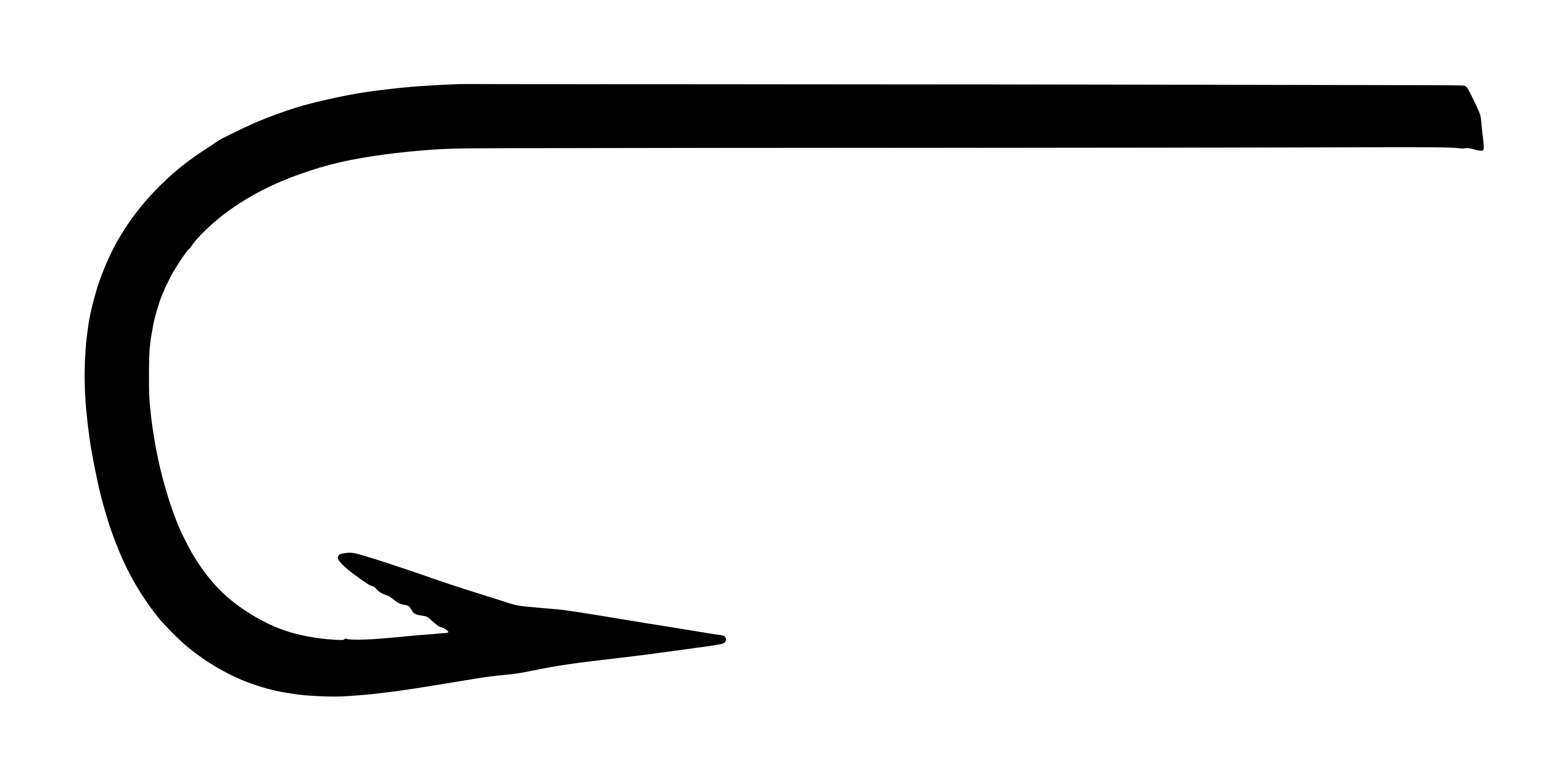
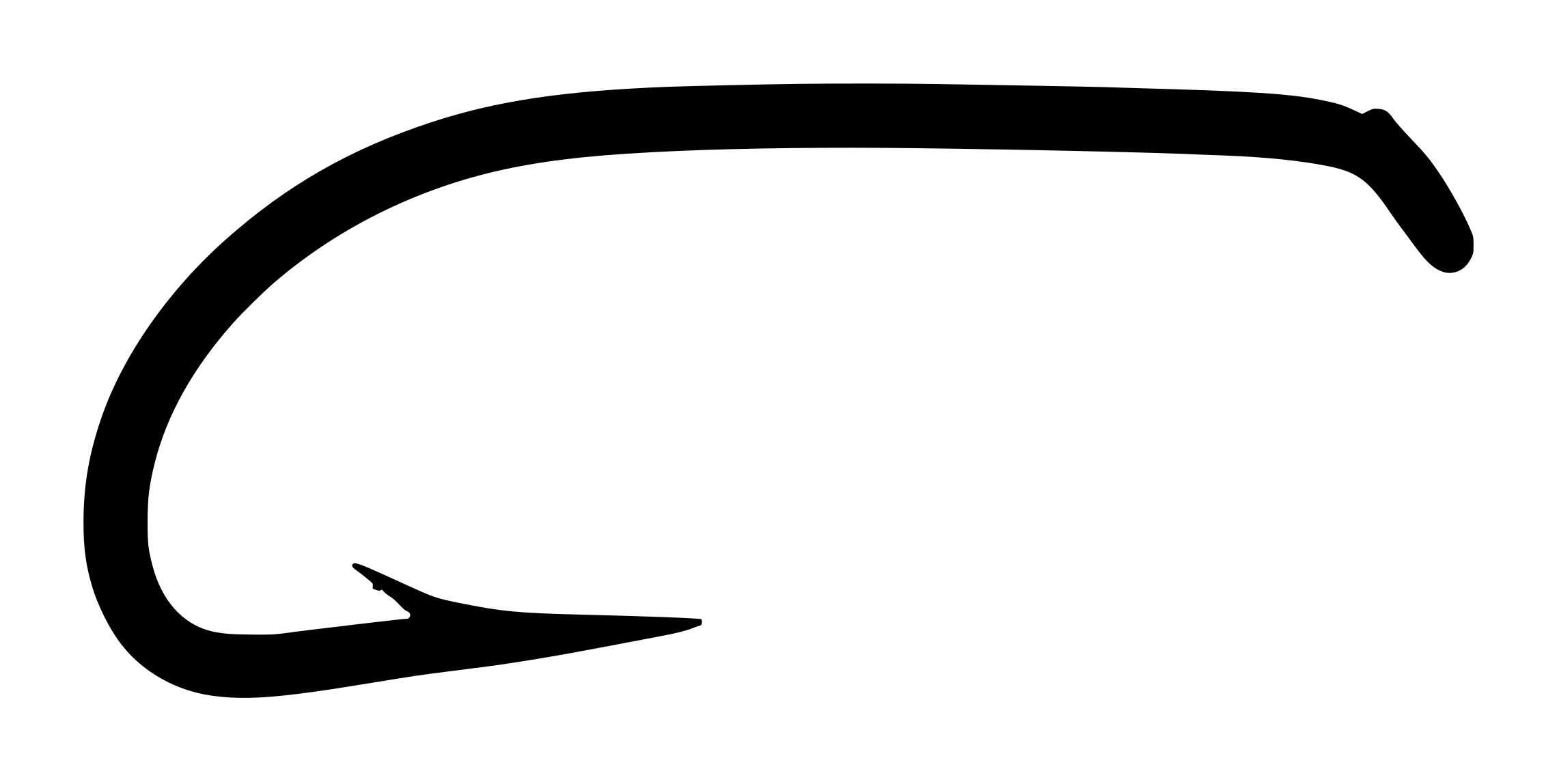
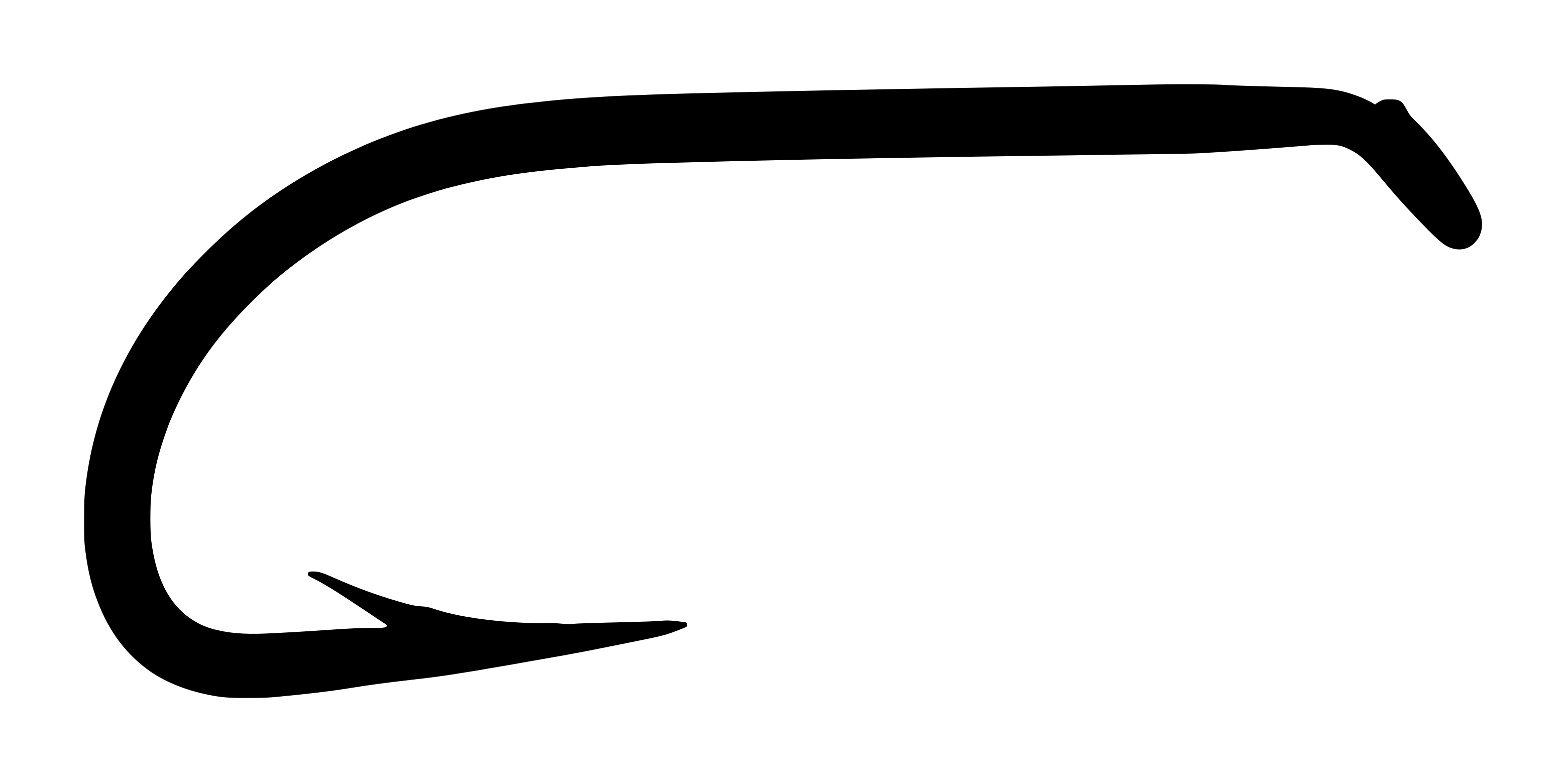
The Mustad 8080 is a mid-twentieth-century deep-sea bait hook manufactured by Norway’s O. Mustad & Søn during the firm’s global dominance in hook production. The model belongs to Mustad’s “Special” line—a broad catalog division targeting specific fishing niches and environmental conditions. This size 6 specimen exhibits the defining geometry of the Limerick bend: a relatively flat, straight shank that transitions into a distinctly angular, sharp-bottomed curve, creating a mechanical “lock” that prevents the hook from rolling or opening under the load of a fighting fish.
The most distinctive feature is the hollow point—a concave, inwardly curved point geometry that creates an exceptionally sharp, knife-edge tip capable of penetrating soft tissue with minimal applied force. This design was engineered for bait fishing targeting soft-mouthed saltwater species (snapper, grouper, sea bass) where violent hook-sets would tear friable gill tissue and result in lost fish. The tinned (bright silver) finish provided the corrosion resistance standard for saltwater tackle in the pre-stainless era.
The card’s post-1925 Oslo designation, combined with the white cardboard and gold-ink letterpress printing, places this hook firmly in Mustad’s golden age of global export (c. 1950s–1965). The absence of a barcode and the retention of arbitrary quality codes (Qual. 8080) confirm pre-1970s manufacture. Today, the 8080 remains collectible among vintage tackle specialists and traditional fly tyers seeking authentic materials for period-correct saltwater streamer patterns.
Original gold-ink letterpress label on white cardboard showing the standard eight-line Mustad format: manufacturer name, quality code Qual. 8080, Hollow Point designation, Limerick Bend pattern, Ringed Tinned finish, and Made in Norway. Purple hand-written size annotation visible.
Photographic record
4 cataloged imagesSelect any record to load it above.
4 images shown
Mustad 8080 Sales Card Label Size 6Original gold-ink letterpress label on white cardboard showing the standard eight-line Mustad format: manufacturer name, quality code Qual. 8080, Hollow Point designation, Limerick Bend pattern, Ringed Tinned finish, and Made in Norway. Purple hand-written size annotation visible.Open originalMustad 8080 Hollow Point Detail Size 6Close-up of the 8080 hollow point showing the concave, inwardly curved geometry characteristic of soft-tissue penetration design. The sharp, fine tip and rapid flare toward the barb are clearly visible against the 0.1-inch measurement grid.Open originalMustad 8080 Limerick Bend and Eye Size 6Full side profile of the size 6 Mustad 8080 showing the characteristic Limerick bend with sharp angular bottom geometry, ringed eye formation, and overall proportions. Tinned silver finish and measurement grid scale are visible.Open originalMustad 8080 Specimens Size 6 TinnedTwo Mustad 8080 size 6 hooks from the same card showing consistency of manufacture and the bright, uniform tinned finish characteristic of Mustad's saltwater production during the 1950s–1960s era.Open original
Technical profile
Eye
Ball Eye, Straight / Inline
Wire
Extra-Heavy (2X+), Round, Est. ~0.045"-0.050" (~1.15-1.27 mm)
Shank
Standard — Plain
Bend
Limerick, Standard gapClassic Limerick bend with pronounced angular bottom geometry. The sharp angle at the bend's lowest point is characteristic of the Irish-originated pattern and designed to mechanically lock the jaw structure under load. P Bend appears symmetrical and evenly formed. Wire set is clean with no visible offset or asymmetry.
Point
Hollow Point (concave inner face)Shallow, close-cut barb consistent with vintage Mustad manufacturing. P Barb appears to be a single cut, moderately sized, angled slightly inward toward the point. Placement is approximately 0.10"–0.12" from the bend apex. Barb does not protrude dramatically and appears proportionate to the fine wire gauge.
Finish
Tinned — Confirmed (stated on packaging)Tinned finish exhibiting the characteristic bright, silvery tone of electroplated or dipped tin coating. P Tone is cool and uniform across the shank and bend. Minor patina and tarnish spotting consistent with 70+ years of storage. Finish remains substantially intact with no visible base-steel exposure or corrosion pitting. Exemplifies pre-stainless saltwater corrosion resistance standard.
Individual hooks are bright and show no corrosion or structural damage. Original sales card exhibits light cream toning, minor edge wear, and surface creasing consistent with age and storage. No hooks are visibly missing from the card (though full count is not confirmed). Printed label remains legible and color remains vibrant despite patina. Specimen represents very good overall condition for a vintage card of this era.
The hollow point geometry represents a specialized solution to the biomechanical challenge of penetrating soft tissue with minimal applied force. Unlike spear points (which require considerable force due to their straight, wedge-like profile), the hollow point’s concave inner face creates a razor-sharp, knife-edge tip that achieves rapid initial penetration—critical for live-bait fishing where soft-mouthed species (grouper, snapper, sea bass) could easily throw the hook under violent hook-sets. The point’s rapid flare from the extremely fine tip to the barb ensures that once penetration is achieved, the hook holds securely in friable tissue without creating an overly large entry wound that could tear during sustained fighting.
The Limerick bend’s angular geometry serves a distinct mechanical purpose: the sharp angle at the bend’s lowest point physically locks the fish’s jaw structure, preventing the hook from rolling, shifting, or opening under load. This design originated in Ireland during the 19th-century Atlantic salmon fly tradition and was mathematically optimized for preventing hook failure during protracted battles with large, powerful fish.
The tinned finish (bright silver electroplating or hot-dip coating in molten tin) was the industry standard for saltwater corrosion resistance prior to modern marine-grade stainless steel. Tin’s exceptional resistance to chloride attack in saltwater environments made it the undisputed choice for commercial fishing and heavy offshore angling. The tinning process adds minimal weight while providing decades of protection in marine conditions—a critical advantage for deep-sea trolling and bottom-fishing applications.
First documented Mustad 8080 size 6 in garrenwood.com reference catalog. Represents the smallest common size variant of the 8080 series documented to date; larger sizes (1/0–8/0) are more frequently encountered. Hollow point geometry on Limerick bend is a relatively specialized combination compared to Superior or Spear point alternatives from the same era.
Own this hook? Help us measure it.
We don't have measured sizes for this hook yet. Own one? Submit calipered measurements and we'll review and add them. Thank you!
Historical context
mustad
O. Mustad & Søn was founded in 1832 in Gjøvik, Norway, by Hans Schikkelstad as a general metalware factory (Brusveen Spiger- og Staltradfabrikk), producing nails, steel wire, and cast-iron goods. The company came under the control of Ole Hovelsen Mustad and his son Hans Mustad, who rebranded it as O. Mustad & Søn and began experimenting with hook manufacture in the 1860s. The pivotal innovation came in 1877 when company visionary Mathias Topp invented the first fully automated hook-making machine—a revolutionary mechanized system capable of cutting, bending, barbing, and pointing raw steel wire at unprecedented speed and consistency. Rather than patent this innovation (which would have disclosed the mechanical design), Mustad opted for strict corporate secrecy, restricted factory access, and non-disclosure agreements with employees—a strategy that proved devastatingly effective against competitors in Redditch, England, and across Japan and the United States. By the 1950s, Mustad controlled approximately 50% of global hook production, with manufacturing centered in Gjøvik and sales offices (including Oslo) distributed across multiple continents. The firm’s dominance rested not only on mechanization but also on aggressive “industrial cloning”—reverse-engineering regional hook patterns (Cincinnati, Limerick, Sproat) and standardizing them for mass export. This strategy successfully cornered localized markets on a global scale.
Series History
The Mustad Special Deep Sea Hooks series (Qual. 8080) represents part of Mustad’s expansive post-WWII catalog strategy, wherein the firm segmented its vast production into specific numeric quality tiers targeting distinct market segments. Economy models (1000–2999 range) served high-volume commercial and subsistence fishing. Quality/Standard models (3000–3999 range), including the famous Qual. 3304 Cincinnati Bass and Qual. 3906 wet-fly hook, represented mid-tier products manufactured to exacting tolerances. Premium/Specialty models (4000 and above) denoted refined, specialized hooks. The 8080 Limerick bent deep-sea series occupied a specialized niche: heavy saltwater bait fishing and trolling for reef and pelagic species. The series was produced in multiple sizes (typically 1/0 to 10/0, with smaller sizes like this No. 6 less common) and was exported globally under the Key Brand trademark. The 8080 remained in production through the 1960s and into the early 1970s, when Mustad began transitioning toward stainless-steel alternatives and simplified packaging. The series was eventually discontinued as the firm modernized its catalog nomenclature around 2001–2009, replacing arbitrary quality codes with the more intuitive Signature Series system (e.g., “R50” for Round bend, standard weight, standard shank).
Era and Packaging Dating
Post-1925 Oslo designation on label (Norwegian capital renamed from Christiania to Oslo on January 1, 1925). White cardboard with gold letterpress printing and ornamental borders is characteristic of Mustad's post-WWII export packaging (1945–1970s). Absence of barcode (standard from 1974 onward) confirms pre-1974 manufacture. Retention of arbitrary numeric quality codes (Qual. 8080) rather than modern Signature Series nomenclature indicates production prior to c. 2001–2009 transition. Hand-annotated size in period-appropriate ink notation. Combined evidence places manufacture in c. 1950s–1965, with highest probability in 1955–1965 window.
The Irish Innovation That Conquered the World
The Limerick bend's origin traces to Irish salmon-fly tradition in the 1800s, where regional craftsmen discovered that the sharp, angular bottom geometry prevented heavy-weight fishing flies from opening under the sustained pressure of battling large Atlantic salmon in fast-moving rivers. The design was so effective that Mustad reverse-engineered it and standardized the geometry for global export, making the Limerick one of the oldest continuously produced hook patterns in modern commercial fishing. The 8080 represents the direct lineage of this 150+ year old engineering innovation.
Design lineage and influence
The Limerick bend originates in 19th-century Irish craft tradition, developed by regional salmon-fly tiers seeking to prevent large, heavy flies from opening under the sustained fighting pressure of Atlantic salmon in fast river currents. The sharp angle at the bend’s lowest point was an empirical discovery: it mechanically locks the fish’s jaw into the strongest point of the hook, preventing rotation and opening under load. Mustad’s reverse-engineering strategy—analyzing the Irish pattern and mechanizing its production—transformed a localized craft into a global commercial standard. The 8080 represents Mustad’s 1950s modernization of this lineage, incorporating hollow-point technology (pioneered during the same era for soft-tissue penetration) and tinned corrosion resistance. Competing designs from this era include the Allcock Limerick patterns (British production, generally heavier wire) and the Partridge of Redditch Limerick variants. The 8080’s hollow point distinguishes it from contemporary O’Shaughnessy and Dublin point alternatives, which prioritized durability over initial penetration. Modern successors include the Mustad 34007 O’Shaughnessy (stainless, heavier wire) and specialized modern saltwater patterns that have largely superseded the 8080 due to improvements in stainless steel and chemical sharpening technologies.
Best matchRelated by Attribute
Computed automatically from catalog data — updated as new hooks are added.
Matches: Bend, Shank, Gap, Point, Forging +2 moreDiffers: Wire: Extra-Heavy (2X+) vs Heavy (1X Heavy); Eye: Ball Eye vs Tapered Eye; Eye Orient.: Straight / Inline vs Turned Down +2 more
Matches: Bend, Eye, Eye Orient., Point, Forging +3 moreDiffers: Shank: Standard vs 2X Long; Wire: Extra-Heavy (2X+) vs Heavy (1X Heavy); Gap: Standard vs Wide +1 more
Matches: Bend, Shank, Gap, Eye, Forging +2 moreDiffers: Wire: Extra-Heavy (2X+) vs Heavy (1X Heavy); Eye Orient.: Straight / Inline vs Turned Down; Point: Hollow Point vs Superior +2 more
The Mustad 8080 was engineered for live-bait saltwater fishing targeting reef and coastal species (snapper, grouper, sea bass, mackerel) via still-fishing and bottom-jigging techniques. The hollow point’s rapid-penetration geometry was optimized for quick hook-sets in soft-mouthed fish without tearing friable gill tissue. The Limerick bend’s angular geometry prevented the hook from rolling or opening under the sustained pressure of fighting large fish in current. The tinned finish provided essential corrosion resistance in saltwater environments. Historically, the 8080 also saw use in heavy saltwater fly fishing and in the construction of traditional Atlantic Salmon flies (where the Limerick bend was the historical gold standard). Today, the 8080 is sought primarily by traditional fly tyers reproducing vintage saltwater streamer patterns (Deceivers, Bucktails) and by collectors documenting the history of Mustad’s mid-century global dominance.
Heavier-duty saltwater alternative; O'Shaughnessy bend rather than Limerick, stainless steel for superior corrosion resistance. Functionally superior for modern saltwater use but lacks the historical authenticity of the 8080.
Tiemco 811S
Moderate
Light-wire saltwater hook with modern sharpening; suitable for streamer tying where tinned finish is desired for aesthetics. Bend geometry differs (Tiemco proprietary round bend vs. Limerick).
Partridge SO Series (Salmon/Steelhead)
Moderate
Traditional British pattern with Limerick-style geometry; modern construction with improved corrosion resistance. Suitable for period-correct fly patterns but typically heavier wire.
Collector notes
Rated 3.0/10 — common in most sizes, but the size 6 is genuinely uncommon. Moderate collector demand among vintage saltwater specialists and traditional fly tyers; limited appeal beyond specialist circles due to the prevalence of modern alternatives.
Reference value
$2 – $12 USD estimate
Packaging condition
Very Good — light wear, fully legibleRecorded specimen
Packaging format
GW-MUSTAD-CARD-01Catalog code
Positive Factors: The 8080 represents an authentic piece of Mustad’s golden era of global dominance (1950s–1965). The Limerick bend is historically significant and remains mechanically sound for both bait and traditional streamer tying. The tinned finish appeals to collectors seeking period-correct materials for vintage-pattern reproduction. Original cardboard packaging in very good condition adds substantial premium over loose hooks. The absence of barcodes and retention of arbitrary quality codes confirm genuine vintage manufacture. The Key Brand logo and Oslo address are iconic symbols of Mustad’s mid-century brand identity.
Limiting Factors: The 8080 was mass-produced in enormous quantities across multiple decades—original boxes remain relatively common, particularly in larger sizes (3/0–8/0). Size 6 is less frequently encountered than larger saltwater sizes, but demand is modest because serious contemporary anglers have moved to stainless steel and chemically sharpened points. The hollow point geometry, while historically interesting, offers no functional advantage over modern alternatives. Boxes with missing or damaged cards command significantly lower premiums. Condition of the original cardboard is critical—creasing, water staining, or ink fade substantially diminish value.
Most Desirable Variants: Sealed or near-sealed original boxes (all 100 hooks intact, card undamaged) command the highest premiums. Smaller sizes (12, 10, 8) are more desirable than sizes 1/0 and larger due to their rarity. Examples with pristine gold-ink printing and minimal toning are preferred by display collectors. Boxes with hand-written notations or original tissue wrapping intact add modest premiums.
Packaging
White cardboard sales card with gold letterpress printing. Ornamental gold border with floral/asterisk motifs. Eight-line label format per Mustad standard (O. MUSTAD & SÖN / Manufacturers / OSLO - NORWAY / Qual. 8080 / Hollow Point / Mustad-Special Deep Sea Hooks (Limerick Bend) / RINGED, TINNED / Made in Norway). Hand-annotated size notation in purple ink. 100 No. 6 designation in bottom left. Approximate card dimensions 3.5" × 2.25". Card shows light toning and minor wear consistent with 70+ years of storage.
Market Value Notes
Low ($2): Fair condition, opened/used card with some hooks possibly missing or corroded, packaging wear and creasing.<br />
High ($12): Excellent condition, sealed or complete card, all hooks present and bright, minimal packaging damage, gold printing vibrant.<br />
Premium factors: Sealed original packaging, complete hook count, pristine card condition, smaller sizes (6–12), hand-written period notations.<br />
Platforms: eBay UK/US (primary), specialist tackle dealers, Redditch hook forums.<br />
Confidence: V verified — based on 5 eBay sold listings averaging $11.99 with price range $1.50–$11.99 (Apr 2023–Apr 2026). Variance reflects condition and completeness.
Where to Find
eBay (search 'Mustad 8080', 'Limerick Hollow Point Tinned', or 'Deep Sea Hooks vintage'). Specialist dealers: Tackle Heritage (UK), Vintage Angling Equipment dealers on collector forums. Redditch Hook Forums have occasional sales. International: Norwegian tackle memorabilia dealers.
eBay market reference. Researcher-curated. Prices in USD. Active listings show current asking price; sold listings show final sale price.
Preservation
Storage and Preservation
Store the original cardboard packaging in a cool, dry environment away from direct sunlight and moisture. Humidity exposure will accelerate patina development on the tinned finish and may cause cardboard warping or mold growth. Maintain the card in its current state rather than removing hooks; the original packaging significantly amplifies collectible value. If loose hooks are present, store them in archival-quality paper envelopes (acid-free) rather than plastic, which can trap moisture and accelerate corrosion. The tinned finish is susceptible to white bloom (tin oxide residue) in high-humidity conditions; this is cosmetic and not indicative of structural failure. Avoid contact with other metals to prevent galvanic corrosion. Do not attempt to clean or polish the card or finish; patina and aging are desirable to collectors and attempting restoration will diminish value. Handle with clean, dry hands to avoid transfer of skin oils and salts. Store away from active fishing environments or tackle bags where salt spray exposure may accelerate corrosion.
Primary Source
Eight-Line Label Decryption
Source: Mustad 8080 original packaging label (c. 1950s–1965) and 'A Comprehensive Typology and Decryption of Vintage O. Mustad & Søn Hook Labels' reference document.
The Mustad 8080 exemplifies Mustad’s formalized eight-line labeling system used for over a century to communicate technical specifications across linguistic barriers. Line 1–2: “O. MUSTAD & SÖN / Manufacturers” establishes corporate authority and differentiates Mustad from import agents and repackagers. Line 3: “OSLO – NORWAY” serves as a critical dating tool—the post-1925 Oslo designation (vs. pre-1925 “Christiania”) places manufacture after January 1, 1925. The Oslo designation indicates this is export-era production, likely 1950s–1960s. Line 4: “Qual. 8080” denotes a specific quality/product tier within Mustad’s hierarchical numbering system. Quality codes in the 4000+ range typically indicate premium, specialized models; the 8080 falls outside this block, suggesting a mid-tier specialized designation. Line 5: “Hollow Point” exclusively defines the point geometry—a strictly regulated element of the label system never used for wire gauge, shank length, or eye type. This designation is critical: it indicates the concave, inwardly curved point geometry optimized for soft-tissue penetration. Line 6: “Mustad-Special Deep Sea Hooks (Limerick Bend)” identifies the foundational pattern (Limerick—the Irish regional design) and the series category (Special—a specialized niche product). Lines 7–8: “RINGED, TINNED / Made in Norway” specify the eye type (formed ring) and metallurgical finish (tin electroplating for saltwater corrosion resistance). The “Made in Norway” designation was standard on post-WWII Mustad exports and serves as a secondary dating indicator. Together, these eight lines constitute a complete technical specification that allowed global wholesalers, retailers, and anglers to understand the 8080’s exact geometry, finish, and intended application without requiring additional catalog lookup.
Marking Analysis
Hand-Annotated Size Notation
The original cardboard packaging features a hand-written purple-ink notation of the size “6” in the lower left corner, overwriting the printed “100 No.” quantity designation. This handwriting is consistent with period inventory or sales-floor annotation practices, likely applied by the retailer or distributor at time of receipt. The ink color (purple/violet) and pen stroke suggest mid-twentieth-century ballpoint pen or fountain pen notation—not modern marker or permanent ink. This annotation indicates that the box passed through at least one distribution channel (wholesaler or retailer) where hand inventory notation was standard practice. The placement and style are consistent with 1950s–1960s tackle distribution practices and add minor historical authenticity to the specimen. Such annotations are common on vintage tackle cards and do not diminish collectible value; they document the real-world retail journey of the product.
Size Note
Size 6 in Saltwater Context — Historical Context
The Mustad 8080 size 6 represents an uncommon variant within the Deep Sea Hooks series. Modern saltwater fishing convention reserves sizes 6–12 for freshwater applications and small stream fishing; saltwater deep-sea patterns typically begin at 1/0 and progress to 8/0 or larger. However, in the 1950s–1960s, the fishing-tackle industry’s sizing conventions differed significantly from modern standardization. The “size 6″ designation on this vintage box likely corresponds to a hook approximately 0.84″ in overall length with a 0.29” gap—dimensions that by modern standards would be considered a small-to-medium saltwater hook suitable for light-tackle coastal species (flats bonefish, permit, small tarpon) or for tying small-profile saltwater streamers. Mustad produced the 8080 across a range of sizes (1/0 through 10/0, with reports of even larger variants), but size 6 in the saltwater context was a specialized offering—likely intended for anglers in shallower fisheries or for tying more delicate saltwater patterns where finer wire than the 3/0–5/0 sizes was desirable. This size rarity contributes to the specimen’s modest collector value relative to more common 3/0–8/0 variants. The lack of modern stainless-steel saltwater hooks in size 6 makes the 8080 a genuinely useful tool for historical fly-tying reproduction, despite its small size by contemporary standards.
Additional
Mustad's Industrial Dominance and the End of Arbitrary Quality Codes
The Mustad 8080 belongs to a specific historical moment in hook manufacturing: the era of proprietary, arbitrary numeric quality codes that characterized Mustad’s business model for over a century (c. 1870s–c. 2009). The code “Qual. 8080” conveyed no intuitive information about the hook’s geometry, wire gauge, or intended use to consumers unfamiliar with Mustad’s internal taxonomy. Anglers and fly tyers simply memorized that “8080 = Limerick Hollow Point Tinned Deep Sea” the same way they memorized that “94840 = Viking dry-fly hook” or “3906 = wet-fly hook.” This system worked because Mustad’s 50% global market share made their proprietary codes the lingua franca of international tackle commerce. However, around 2001–2009, Mustad initiated a massive corporate modernization, discontinuing nearly all classic quality codes in favor of the new “Signature Series”—a logical, alpha-numeric system where “R50” immediately communicates “Round bend, standard wire, standard shank.” This transition marked the official end of the arbitrary-code era. The presence of traditional quality codes (like Qual. 8080) on original paper labels thus serves as a definitive chronological marker: any vintage Mustad with these codes is definitively pre-2010, and most likely pre-1980. This makes the 8080 packaging a valuable artifact not only for documenting a specific fishing-hook design, but for documenting the final decades of an industrial-era approach to product coding that has now been completely superseded by modern design language.
Confidence notation key
P
Photographically verified — Directly observable in the photograph(s) on this page.
V
Verified by documentation — Confirmed by manufacturer catalog, spec sheet, or published reference.
I
Inferred — A logical deduction from observable or documented evidence, not directly stated.
E
Estimated — An approximation based on visual comparison, proportional analysis, or limited data.
S
Speculative — A reasoned hypothesis that cannot be confirmed from available evidence.
Claims with no notation are confirmed by multiple independent sources. All photographs on garrenwood.com are taken on a measurement grid where each square equals 1/10 inch (0.1″ / 2.54 mm).