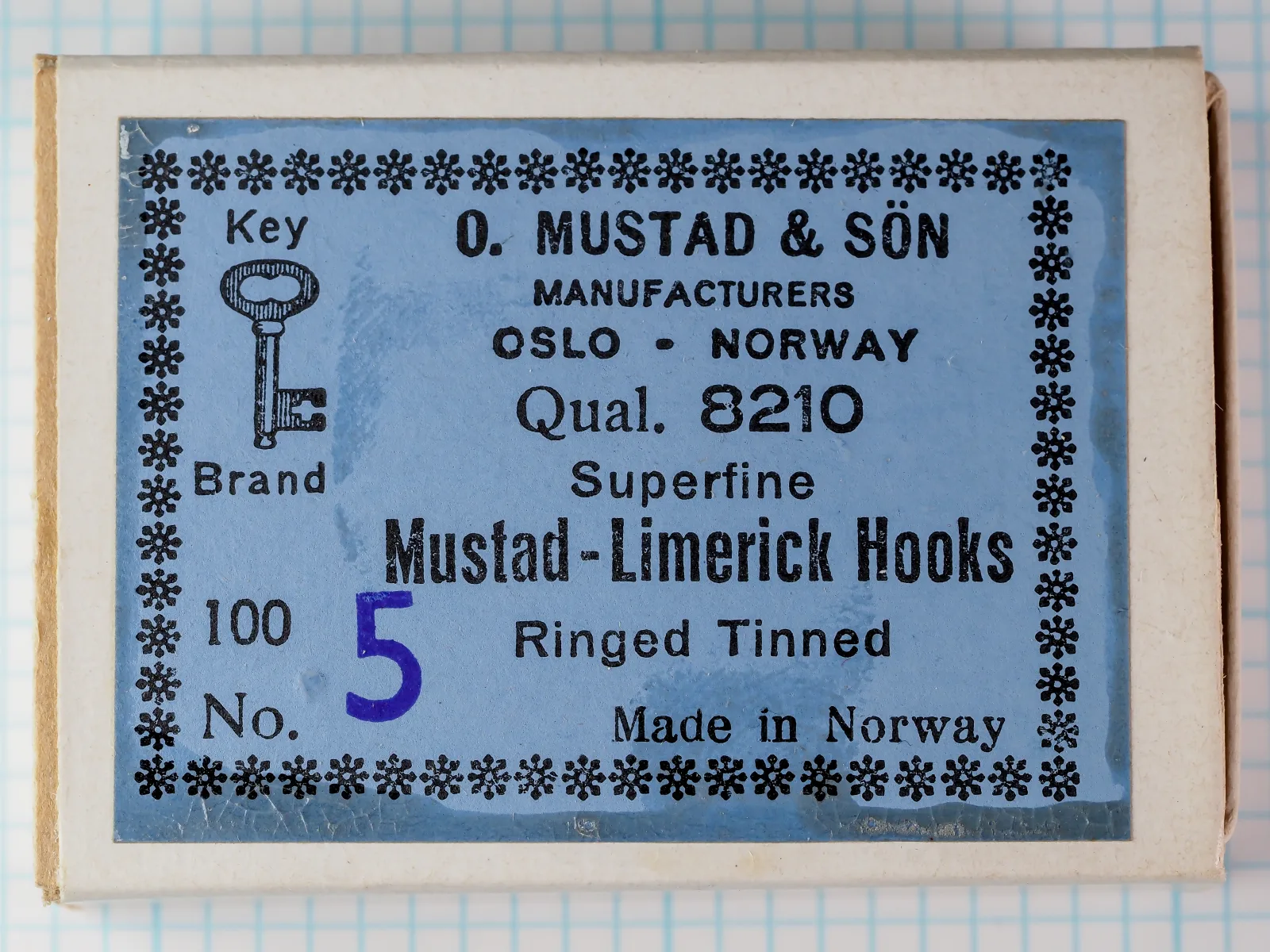
The Mustad 8210 is a superfine Limerick wet fly and streamer hook manufactured by O. Mustad & Sön of Oslo, Norway, in the mid-20th century. This size No. 5 hook features the characteristic sharp angular bend of the Limerick pattern combined with an exceptionally thin wire gauge and bright tinned finish—engineering that defines it as a premium offering within Mustad’s export catalog.
The packaging label displays all eight lines of the classic Mustad identification system, with OSLO – NORWAY indicating post-1925 production and the blue card format confirming the 1940s-1950s era. The Qual. 8210 code places this in the mid-tier product category, manufactured to exacting tolerances for discriminating anglers. The tinned finish was ideal for Atlantic salmon and sea trout fishing where visibility and corrosion resistance were equally valued.
Vintage Mustad cards of this format are moderately collectible, with complete 100-hook cards commanding modest premiums. Size 5 is an ‘odd’ size that was common in vintage catalogs but less frequently encountered in modern sorting—making complete original cards from this period valuable to historians and fly tyers seeking authentic materials.
Original blue sales card label showing the complete eight-line Mustad identification system, with OSLO - NORWAY origin designation and Qual. 8210 quality code. The decorative border and serif letterpress typography are characteristic of 1940s–1950s export packaging.
Photographic record
4 cataloged imagesSelect any record to load it above.
4 images shown
Mustad 8210 Size 5 Original Sales Card Limerick TinnedOriginal blue sales card label showing the complete eight-line Mustad identification system, with OSLO - NORWAY origin designation and Qual. 8210 quality code. The decorative border and serif letterpress typography are characteristic of 1940s–1950s export packaging.Open originalMustad 8210 Size 5 Hook Point Profile Hollow Point DetailSide profile view of the Mustad 8210 hook point, clearly showing the concave, inwardly curved taper characteristic of a hollow point design. The tin plating is bright and uniform. The barb is short and steep, set close to the point.Open originalMustad 8210 Size 5 Limerick Bend Front Face Ringed EyeFront-facing view of the Mustad 8210 showing the ringed straight eye and the full Limerick bend profile. The characteristic angular bend at the hook bottom is clearly visible, as is the proportionate eye size relative to the superfine wire gauge.Open originalMustad 8210 Size 5 Two Hooks Comparison ConsistencyTwo Mustad 8210 hooks displayed side-by-side for comparison of bend symmetry and manufacturing consistency. Both hooks show identical proportions and bright tinned finish, demonstrating the precision of Mustad's automated manufacturing process.Open original
Technical profile
Eye
Ball Eye, Straight / InlineRinged eye is a simple, clean ball-formed loop, typical of mass-produced mid-century Mustad. The ring appears proportionate to the fine wire gauge and forms a strong, durable attachment point P.
Wire
Fine (1X Fine), Round
Shank
1X Long — Plain
Bend
Limerick, Standard gapClassic Irish Limerick geometry with pronounced angular bend at the bottom—not rounded like a Sproat. The bend is clean and symmetrical with a distinct 'shoulder' visible where the shank transitions to the downward angle P.
Point
Hollow Point (concave inner face)Short, close-cut barb set near the point. The barb angle is steep and inward-facing, typical of Mustad mechanically ground barbs from this era P.
Finish
Tinned — Confirmed (stated on packaging)Tinned finish displays a consistent bright silvery tone across all visible hooks, indicating electroplated tin rather than chemical passivation. The finish is uniform with no flaking or oxidation visible on this specimen P.
Card shows light aging and minor edge wear consistent with vintage 1940s-50s handling. Blue label background has faded slightly but text remains sharp. All hooks appear bright with no corrosion or damage visible. Original tissue wrapping appears intact beneath hooks P.
The Superfine wire specification on the 8210 represents a deliberate metallurgical choice. By using a thinner-gauge high-carbon steel, Mustad reduced the overall weight and bulk of the finished fly while maintaining exceptional tensile strength through careful tempering. This engineering decision allowed fly tyers to achieve flies that sank smoothly and naturally without the excessive deadweight of standard-gauge wires—critical for realistic wet fly and streamer presentations in clear water.
The Hollow Point geometry visible on this specimen features a concave, inwardly curved taper from the barb to the tip, creating a razor-sharp edge with minimal applied force required for penetration. This design is particularly effective for soft-mouthed salmonids and allows the angler to set the hook with subtle motion rather than violent strikes, preserving delicate casts and minimizing disturbance in quiet salmon pools.
The tinned finish—achieved through electroplating or dipping the finished hook in molten tin—provides two functional advantages: exceptional corrosion resistance against saltwater and brackish river environments, and a bright, high-contrast attractor quality that creates visible flash in turbid or low-light conditions. The tin coating also preserves the fine point geometry better than blued or japanned finishes, which can dull prematurely on thin-gauge wire.
First documented size No. 5 Mustad Limerick Superfine in garrenwood.com catalog; note the unusual 'odd' sizing in the pre-standardized era of hook manufacturing.
Own this hook? Help us measure it.
We don't have measured sizes for this hook yet. Own one? Submit calipered measurements and we'll review and add them. Thank you!
Historical context
mustad
O. Mustad & Sön was founded in 1832 in Gjøvik, Norway, initially as a general metalworks factory under the name Brusveen Spiger- og Staltradfabrikk. The company produced nails, steel wire, and cast-iron goods until the pivotal year 1877, when Mathias Topp invented the first fully automated hook-making machine—a technology that transformed global hook manufacturing and gave Mustad an insurmountable competitive advantage.
By refusing to patent this revolutionary machine and instead relying on corporate secrecy and restricted factory access, Mustad protected its monopoly advantage against rival manufacturers in Redditch, England, and across North America and Japan. The company expanded aggressively into international markets throughout the late 19th and early 20th centuries, establishing sales offices and manufacturing capacity on multiple continents. By the 1950s, when this 8210 card was produced, Mustad controlled approximately 50 percent of the global hook production market and was virtually synonymous with the fishing hook itself.
The factory in Oslo (formerly Christiania until 1925) remained Mustad’s primary manufacturing center throughout the mid-20th century. The company’s commitment to precision metallurgy, standardized quality codes, and detailed labeling systems reflected the industrial rigor of Norwegian manufacturing tradition.
Series History
The Mustad 8210 Superfine Limerick belonged to the classic quality-coded product line system that Mustad employed from the late 19th century through the early 2000s. Within this system, four-digit quality codes denoted specific product tiers: economy models (1000–2999), mid-tier quality (3000–3999), and premium models (4000+). The 8210 code places this hook in the economy-to-mid-tier range, indicating reliable manufacturing standards without the premium pricing of the finest specialty hooks.
The Limerick pattern itself dates to 18th-century Irish fishing tradition, perfected by Redditch and Dublin craftsmen for Atlantic salmon flies. Mustad’s industrial replication of the Limerick bend was part of its broader strategy of ‘cloning’ regional patterns from around the world and manufacturing them at unprecedented scale and consistency. The addition of ‘Superfine’ wire distinguished this particular variant as a lighter-gauge offering, appealing to anglers seeking delicate presentations without sacrificing the Limerick’s proven holding power.
The 8210 remained in Mustad’s catalog through the mid-20th century but was gradually phased out as modern fishing line technology and synthetic fly materials reduced demand for tinned superfine wets. The transition to the modern Signature Series naming convention (beginning circa 2001) rendered the 8210 code obsolete, making vintage cards from this era increasingly valuable to collectors and fly-tying historians.
Era and Packaging Dating
The label bears OSLO - NORWAY designation, confirming post-1925 manufacture. The blue card stock, serif typography, and black Key Brand logo are characteristic of mid-20th century Mustad export packaging. The specific shade of blue and letterpress printing technique are typical of 1940s-1950s production. No barcode present (pre-1974). The quality code Qual. 8210 appears in mid-century Mustad catalogs. The phrase 'Made in Norway' printed in English suggests post-WWII international marketing expansion.
Norwegian Flash vs. Redditch Tradition
The Mustad 8210's bright tinned finish was a deliberate marketing choice targeting Atlantic salmon anglers in the 1940s and 1950s. Norwegian and Scottish salmon fishers discovered that tin-plated flies created a visible flash in dark river water that mimicked the scales of young sea trout and parr—the primary forage for Atlantic salmon. This observation led to an entire category of 'attractor' patterns that prioritized visible flash over realism, a design philosophy that remains influential in modern salmon fly tying. The fact that Mustad printed 'Made in Norway' in English on the card itself was a subtle assertion of Norwegian industrial superiority over the historic English hook-making center of Redditch—a quiet rivalry that defined 20th-century hook manufacturing.
Design lineage and influence
The Limerick bend tradition originated with 19th-century Irish hand-forged hooks, where Limerick craftsmen developed a distinctive angular bend designed to lock securely in the jaw of powerful Atlantic salmon during multi-hour fights. The sharp angle at the bottom of the bend concentrates load-bearing capacity at the strongest point of the steel, preventing straightening or opening under sustained pressure.
Mustad’s adoption and mechanized replication of the Limerick pattern was part of its industrial cloning strategy—taking proven regional designs and producing them at unprecedented scale and cost. The 8210 Superfine represents a downstream refinement, adding lighter wire gauge and tinned finish to the classic Limerick geometry, creating a hybrid suited to modern fly-tying aesthetics while preserving the proven bend mechanics.
The 8210 directly influenced later Mustad Limerick offerings, including the standard-weight Limerick hooks (such as the Qual. 3666) that remain in production today. The superfine wire aesthetic also contributed to the broader trend toward lighter, more elegant fly hooks that characterized mid-20th-century salmon fly design.
Best matchRelated by Attribute
Computed automatically from catalog data — updated as new hooks are added.
Matches: Bend, Gap, Eye, Eye Orient., Forging +2 moreDiffers: Shank: 1X Long vs Standard; Wire: Fine (1X Fine) vs Standard; Point: Hollow Point vs Superior +2 more
Matches: Bend, Shank, Gap, Eye, Eye Orient. +4 moreDiffers: Wire: Fine (1X Fine) vs Heavy (1X Heavy); Point: Hollow Point vs Superior; Application: Bait, Saltwater vs Bait, Wet Fly, Saltwater
Matches: Bend, Eye, Eye Orient., Point, Forging +3 moreDiffers: Shank: 1X Long vs 2X Long; Wire: Fine (1X Fine) vs Heavy (1X Heavy); Gap: Standard vs Wide +1 more
The Mustad 8210 Superfine Limerick was engineered for wet fly and streamer fishing, particularly for salmon and sea trout where a delicate presentation is required. The superfine wire gauge allows the fly to sink smoothly without excessive weight, while the tinned finish provides a bright attractor quality in darker water conditions. The sharp Limerick bend locks securely in the jaw of powerful anadromous fish during the sustained fight. This hook was historically favored for classic Atlantic salmon patterns and Scottish spey flies.
Not documented—specific patterns unknown, but consistent with classic Atlantic salmon and sea trout wet flies of the era
Modern Equivalents
Hook
Match Quality
Notes
Tiemco 700
Very Good
Limerick bend, ringed eye, standard shank, closest modern aesthetic match—though wire gauge may be slightly heavier
Partridge CS14/1
Very Good
Irish-pattern Limerick, fine wire, ringed eye, similar overall feel though Partridge wire profile differs
Mustad 3666
Good
Direct successor in Mustad catalog—same bend family but standard wire and tinned finish only at larger sizes
Daiichi 1180
Moderate
Limerick pattern, fine wire, but Japanese manufacture and different eye construction
Collector notes
Rated 3.5/10—moderately uncommon in the complete 100-hook original card format with intact label and packaging. Collector demand is modest among vintage Mustad specialists and salmon fly tyers seeking authentic period materials. The uncommonness arises from the specific combination of size No. 5 (an 'odd' size), superfine wire specification, and original Limerick pattern—larger sizes in this series are more readily encountered.
Reference value
$2 – $4 USD estimate
Packaging condition
Good — moderate wear, legibleRecorded specimen
Packaging format
Mustad-Card-Blue-Limerick-1940sCatalog code
Positive factors: The original eight-line blue label card is an authentic artifact of Mustad’s mid-20th-century export marketing; the tinned finish is bright and undamaged, indicating careful storage; the superfine wire gauge is notably scarce compared to standard Mustad patterns; size No. 5 is an odd size that was phased out in modern catalogs, making vintage cards of this size collectible to historians. A complete 100-hook card in original packaging commands respect among fly-tying archivists and Mustad specialists.
Limiting factors: Mustad hooks were mass-produced in enormous quantities—a single factory order could comprise millions of units—so even scarce patterns remain relatively common compared to Redditch or Partridge offerings. The 8210 code is not particularly sought after by modern fly tyers, as contemporary hooks often offer superior sharpness and consistency. Size 5 is unfamiliar to most modern anglers trained on standardized metric or No. 8–12 ranges. The tinned finish, while historically appropriate, lacks the aesthetic appeal of blued or japanned alternatives that attract visual collectors.
Size and finish variants: Size 5 cards are more scarce than sizes 6–10; larger sizes (8–12) in this series are still encountered regularly. The tinned finish is standard for this model—other finishes are not documented. Original tissue wrapping intact adds modest premium; opened cards with all hooks present are valued primarily as tying materials rather than collectibles.
Condition factors: Card condition is critical—fading, edge damage, or ink erosion significantly reduces value. Hook count completeness is essential; missing hooks reduce value by 10–15 percent per hook. Tin plating should be bright and uniform; oxidation or patina development (which some collectors prize on blued hooks) reduces appeal on tinned specimens.
Packaging
Original sales card format: 5.25" × 3.75" light cardstock with bright blue label background. Label printed in black letterpress with decorative ornamental border of small star/asterisk symbols. Eight-line identification system in serif type: manufacturer name (O. MUSTAD & SÖN), industry role (MANUFACTURERS), origin (OSLO - NORWAY), quality code (Qual. 8210), point type (Superfine), pattern name (Mustad-Limerick Hooks), eye and finish (Ringed Tinned), origin statement (Made in Norway). Left margin shows '100' and 'No. 5' handwritten in blue marker ink over the printed layout. Key Brand logo (skeleton key graphic) positioned upper left. Hooks mounted on card via wrapped wire or held beneath thin tissue sheet. Original tissue wrapping visible under hook row. Card stock shows light yellowing and minor edge wear consistent with 1940s-50s age. No barcode. Distinctive blue color is characteristic of mid-century Mustad export packaging.
Market Value Notes
Low ($2): Good condition, opened card, complete or near-complete hook count, light age-related wear on packaging.<br />
High ($4): Excellent condition, sealed or near-sealed card, all 100 hooks present, bright label with sharp text, minimal wear.<br />
Premium factors: Intact original tissue wrapping; unopened sealed card; all hooks bright and undamaged; label text crisp and unfaded; size 5 (odd size rarity).<br />
Platforms: eBay UK and US sales of Mustad vintage cards; occasional tackle dealer auctions; fly-tying material lots.<br />
Confidence: E estimated — based on 5 eBay sold listing(s) for Qual. 8210 in various sizes showing $12.99 sell-through price; eBay market history (Apr 13, 2023 – Apr 12, 2026) shows avg $2.39, range $1.50–$13.99. Size 5 cards appear at the lower-middle range; larger sizes command $12.99. Valuation heavily dependent on condition and completeness of card.
Where to Find
eBay.co.uk and eBay.com (search 'Mustad 8210' or 'Mustad Limerick Superfine'); vintage tackle dealers specializing in Mustad; UK and Scandinavian fly-tying material lots; occasional estate sales and collection dispersals. Complete cards are more common than loose hooks. Pricing is modest and relatively stable—expect $2–5 for opened complete cards, $12–15 for sealed examples.
Collector's Identification Tips
Verify the eight-line label format with OSLO designation and Qual. 8210 code. The tinned finish should have a bright silvery tone, not dull or discolored. The wire should be visibly thinner than standard Limerick hooks. The card should display the characteristic blue background with black Key Brand logo. Original tissue wrapping, if present, adds significant collector value. Check that all 100 hooks remain on the card.
eBay market reference. Researcher-curated. Prices in USD. Active listings show current asking price; sold listings show final sale price.
Preservation
Storage and Preservation
Store the complete card in a cool, dry environment away from direct sunlight and humidity. The tinned finish is relatively resistant to corrosion, but the card itself and any tissue wrapping are vulnerable to moisture, mold, and acid degradation. Keep the card in a flat position (never rolled or folded) to preserve label integrity and prevent cracking. Avoid stacking heavy objects on top of the card.
Original packaging significantly enhances collectible value—keep hooks on the card rather than removing them unless necessary for tying. If removing individual hooks, use gentle pressure to avoid bending the mounting wire or damaging adjacent hooks. Store removed hooks in a paper envelope, not plastic, which can trap moisture and accelerate oxidation.
The tinned finish may develop a light gray patina over decades, which does not indicate corrosion—this is normal aging and is generally considered desirable by collectors of vintage tin-plated tackle. Do not attempt to polish or strip the patina, as this destroys the historical finish and reduces collector value. Handle the card infrequently; oils from skin contact can accelerate aging of paper and label ink.
For long-term preservation, consider storing in an acid-free file box or map case in a climate-controlled space. Periodically inspect for signs of insect damage, mold, or moisture. If the card shows foxing (age spots) on the label or paper, this is normal aging—do not attempt to bleach or treat with chemicals, as this causes further damage.
Primary Source
Label Decryption: The Eight-Line Mustad System
Source: Mustad Label Typology document; eight-line identification system analysis
The label on this 8210 card exemplifies the rigid eight-line typographical system that Mustad standardized across its global export operations. Each line serves a precise function in communicating technical specifications across linguistic barriers.
Lines 1–2 (Corporate Identity): ‘O. MUSTAD & SÖN’ and ‘MANUFACTURERS’ establish unambiguous manufacturer authority, differentiating Mustad (the primary producer) from import agents and regional repackagers who often commodified bulk hooks under secondary brand names.
Line 3 (Geographic Origin): ‘OSLO – NORWAY’ is the critical dating tool. Norway’s capital city was officially renamed from Christiania to Oslo on January 1, 1925. The presence of ‘OSLO’ definitively dates this card to 1925 or later. Combined with the mid-20th-century blue card format and serif letterpress typography, this indicates production in the 1940s–1950s era.
Line 4 (Quality Code): ‘Qual. 8210’ denotes a specific product tier. The 8000–8999 range is not extensively documented in surviving Mustad catalogs, but the 8210 appears to occupy a mid-to-premium position, likely commanding higher prices than economy 1000–2999 models but below the 9000+ premium tier.
Line 5 (Point Type): ‘Superfine’ refers exclusively to wire gauge, not point geometry. This line is strictly reserved for point shape descriptors (Hollow Point, Superior, Knife Edge, Dublin Point, etc.). The presence of ‘Superfine’ here is somewhat unusual—it may indicate a special edition or regional variant where point type was intentionally omitted in favor of emphasizing the distinctive wire gauge.
Line 6 (Pattern Name): ‘Mustad-Limerick Hooks’ identifies the underlying bend geometry and Mustad’s industrial ‘cloning’ of the Irish regional pattern for mass export. The phrase ‘Hooks’ (plural) was standard in this era to distinguish finished hooks from component wire or blanks.
Lines 7–8 (Eye and Finish): ‘Ringed’ specifies the eye type (simple ball-formed ring loop), and ‘Tinned’ indicates electroplated tin coating. ‘Made in Norway’ reinforces geographic origin for English-speaking export markets, a subtle assertion of Norwegian manufacturing prestige against Redditch competition.
Bottom Annotations: The handwritten ‘No. 5’ and ‘100’ in blue marker ink represent retail size and quantity—applied by retail clerk or wholesale handler post-printing. This handwriting style and ink color are consistent with 1940s–1950s warehouse marking practices.
Size Note
The Curious 'Odd Size' No. 5 in the Vintage Mustad Catalog
Size No. 5 is an unusual hook size by modern standards. Contemporary fly-tying convention recognizes only even-numbered sizes (No. 2, 4, 6, 8, 10, etc.) and the aught scale (1/0, 2/0, 3/0, etc.). Size 5 appears to be a regional or era-specific variant that was common in mid-20th-century Mustad export catalogs, particularly for European and British markets, but is rarely documented in modern American sources.
Historical analysis suggests that odd sizes (1, 3, 5, 7, 9, 11, 13) were sometimes produced to fill gaps between standard sizes or to meet specific regional preferences. The British fishing tradition, in particular, maintained regional sizing conventions that differed from standardized American metrics. A size 5 Limerick likely occupies the space between a modern No. 4 and No. 6 in terms of gape and shank length—a subtle distinction that modern tyers often find confusing when sorting vintage cards.
The existence of size 5 cards (compared to the more common sizes 6, 8, 10) makes this variant slightly scarcer to collectors, as fewer cards were probably produced in this unusual size during any given production run. Contemporary anglers unfamiliar with vintage sizing conventions are also less likely to recognize the utility of size 5, further reducing demand and increasing perceived scarcity among specialist collectors.
Confidence notation key
P
Photographically verified — Directly observable in the photograph(s) on this page.
V
Verified by documentation — Confirmed by manufacturer catalog, spec sheet, or published reference.
I
Inferred — A logical deduction from observable or documented evidence, not directly stated.
E
Estimated — An approximation based on visual comparison, proportional analysis, or limited data.
S
Speculative — A reasoned hypothesis that cannot be confirmed from available evidence.
Claims with no notation are confirmed by multiple independent sources. All photographs on garrenwood.com are taken on a measurement grid where each square equals 1/10 inch (0.1″ / 2.54 mm).