S. Allcock 4555B Cinning Bass Hook — Size No. 24. A classic mid-period British coarse fishing hook manufactured by S. Allcock & Co. at their Standard Works in Redditch, England. This model represents the utilitarian anchor of Allcock’s massive production capacity — designed for live and dead bait presentation to bass and coarse fish in rivers and lakes.
The hook features a tapered turn-down eye, Sproat bend profile, and superior point geometry. The tinned finish and standard-gauge round wire indicate production for durability and saltwater/wet-environment resistance, though the ‘Cinning Bass’ designation suggests primary use in freshwater coarse fishing contexts. Size No. 24 is a fine, precise size — the British numbering system of the period sized this as suitable for small to medium baits and delicate presentation.
Era and Packaging Evidence: No barcode and letterpress printing confirm pre-1974 manufacture. The interior award list (1851-1910) and coffin-packet format date this to the interwar or early WWII period, most likely c. 1920-1945. The ‘Standard Works, Redditch’ attribution and full Allcock corporate identity mark this as central-factory production, not a distributor brand.
Collecting Value: Original coffin packet with internal envelope intact adds significant appeal to specialist collectors of British hook manufacturing history and Redditch-era tackle. While Allcock production was enormous, well-preserved packets with this specific letterpress design and award marketing are increasingly scarce. Most collector interest focuses on condition of packaging and completeness of hook count rather than the hook size itself.
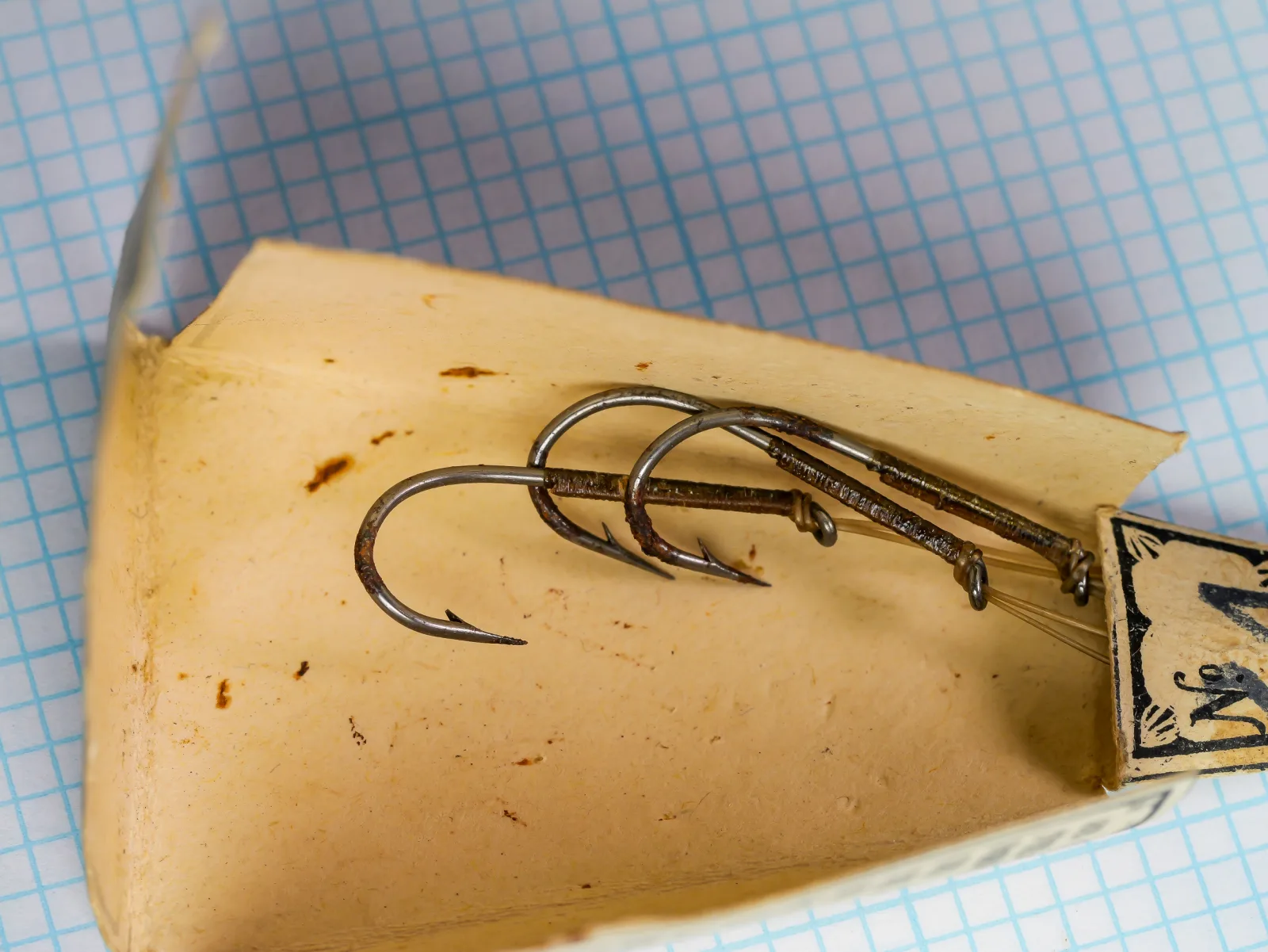
Two Size No. 24 hooks from the original packet showing the Sproat bend profile and tapered turn-down eyes. Photographed on 0.1-inch measurement grid for scale reference.
Photographic record
7 cataloged imagesSelect any record to load it above.
7 images shown
S. Allcock 4555B Size 24 Hook Pair Top ViewTwo Size No. 24 hooks from the original packet showing the Sproat bend profile and tapered turn-down eyes. Photographed on 0.1-inch measurement grid for scale reference.Open originalS. Allcock 4555B Size 24 Hook Front Face DetailClose-up of the hook front showing point geometry (superior point style), barb placement and angle, and the clean tapered eye. Photographed on measurement grid for scale and clarity of construction detail.Open originalS. Allcock 4555B Package Back LabelReverse side of the original coffin-shaped packet showing model code 4555, size designation No. 24, and product name 'Cinning Bass Gut Hooks.' Letterpress printing in black ink on cream laid paper shows excellent legibility and impression quality.Open originalS. Allcock 4555B Package Front LabelFront panel of the coffin-shaped packet showing 'S. ALLCOCK & CO LIMITED,' 'Standard Works,' location designation, the iconic stag trademark, and 'REDDITCH ENGLAND.' Letterpress printing with decorative corner flourishes typical of interwar British packaging design.Open originalS. Allcock 4555B Complete Packet StructurePhotograph of the complete original coffin-shaped packet in its characteristic form, showing the tapered coffin silhouette, integral envelope structure, and loop-handle closure. This is the format typical of mid-period British hook packaging (1920s-1950s).Open originalS. Allcock 4555B Interior Award List Upper SectionInterior of the coffin-shaped envelope showing the upper portion of the award list. Printed text documents international exhibition medals from London 1851, London 1862, Toronto 1865, Bergen 1868, Turin 1871, Paris 1878, Sydney 1879, and Berlin 1880. Letterpress printing on cream stock with decorative border frame.Open originalS. Allcock 4555B Interior Award List Lower SectionInterior continuation showing the lower portion of the award list with additional medals through 1910. Cities and dates include Melbourne (1880s), Adelaide (1881&7), Norwich (1881), Murcia (1882), Calcutta (1883&4), Paris (1889), London (1894), Helsingfors (1896), Brussels (1897), Paris (1900), Murcia (1902), Cape Town (1905), Liege (1905), Milan (1906), Antwerp (1907), Bergen (1910), and Brussels (1910). Letterpress printing on cream stock with decorative border.Open original
Technical profile
A utilitarian British coarse fishing hook from S. Allcock & Co., featuring a Sproat bend and tapered turn-down eye. Tinned finish suitable for river and lake environments. Interwar to mid-century production, size No. 24.
Eye
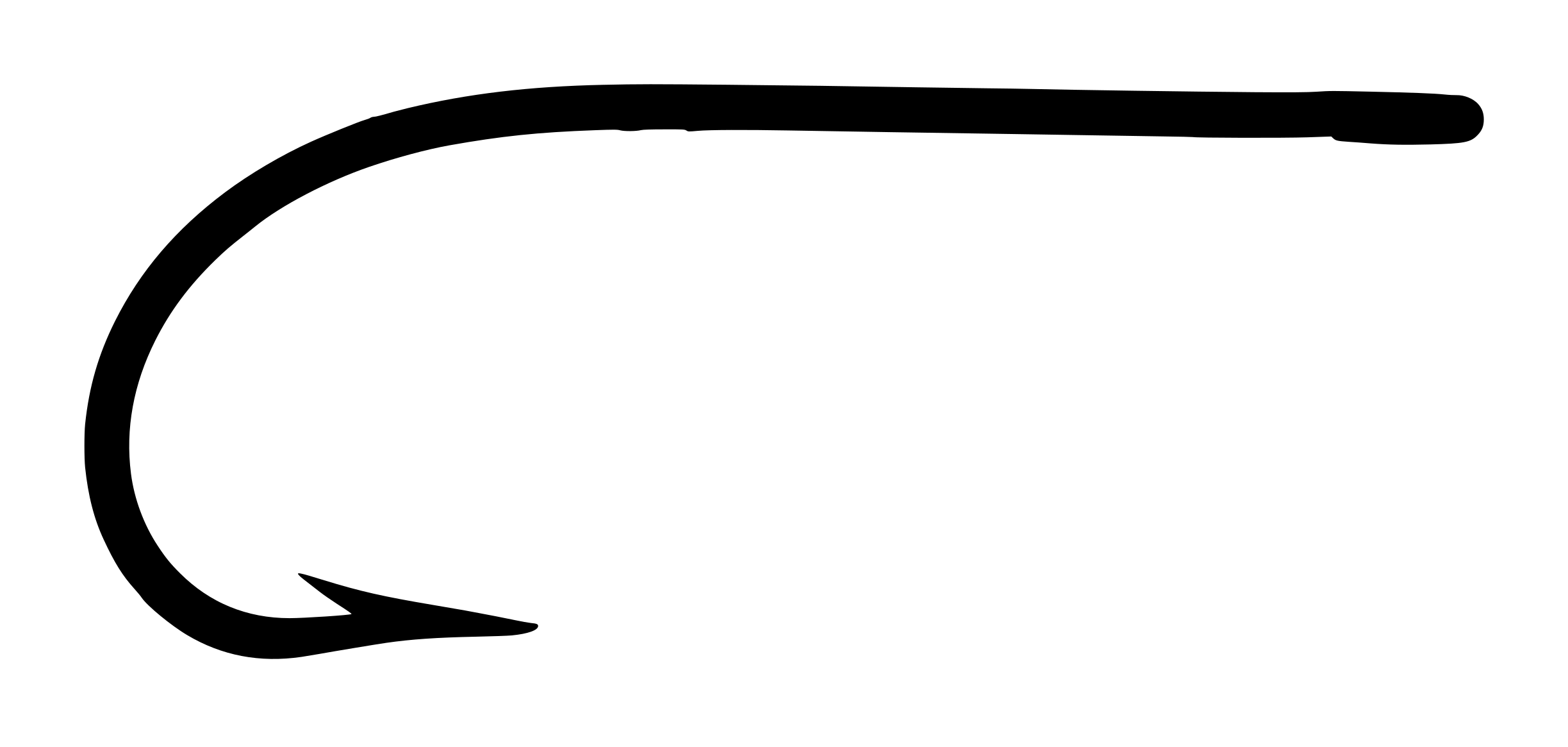
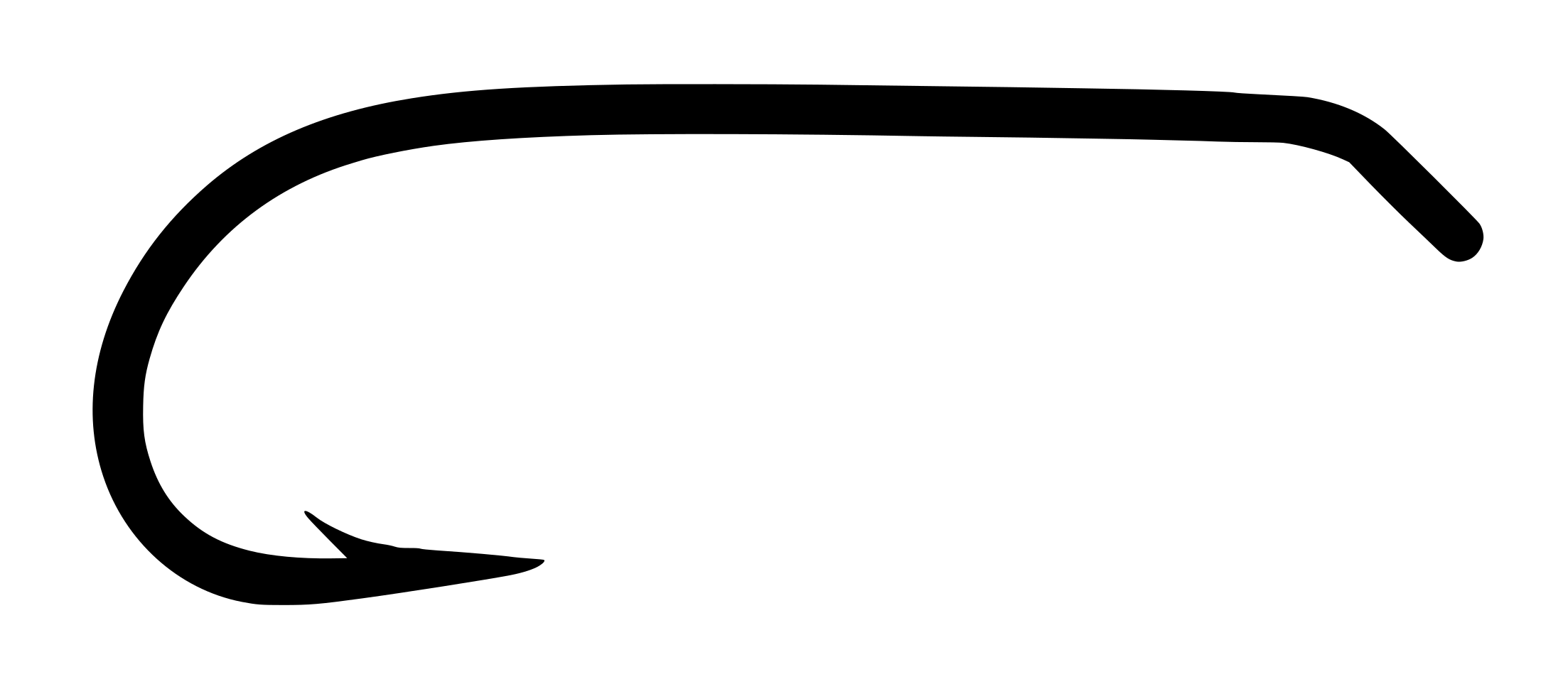
Tapered Eye, Turned DownClean tapered turn-down. Well-formed loop with smooth transition. Taper angle moderate. V
Wire
Standard, Round
Shank
Standard — Plain
Bend
Sproat, Standard gapRounded bottom characteristic of Sproat family. Moderate curve depth, balanced symmetry. No offset. P
Point
Superior (near-straight inner taper)Close-cut barb with swept angle. Standard placement. P
Finish
Tinned — Estimated (uncertain)Bright silver tone, slightly warm cast typical of tin coating. Surface uniform with minor oxidation consistent with age. P
The superior point geometry (near-straight inner taper, nearly flat inside face) was Allcock’s response to the requirement for reliable hookset with minimal barb penetration — important when using delicate natural baits where penetration is gradual rather than explosive. The Sproat bend provides a balanced platform suitable for both active live baits and passive dead-bait presentation. The rounded bottom prevents line-chafing on hard substrates.
The tinned finish, while often associated with saltwater work, was also favored in British coarse fishing tackle for enhanced corrosion resistance in muddy river environments and for visibility — the bright silver tone aided the angler in tracking the rig and hook position in the water column. Standard-gauge round wire was cost-effective to produce at volume while remaining strong enough for the intended application (small to medium baits, non-predatory fish). The tapered turn-down eye accommodates both gut (period original) and nylon (post-1950s adaptation) with equal effectiveness.
Size & scale lab
Selected size
(unspecified)
Physical specimen
Shank Length
21.5 mmE
Gap Width
14 mmE
Bend Depth
11.5 mmE
Wire Diameter
2.5 mmE
Weight
Not available
Shank-to-Gap Ratio
~1.4-1.8 : 1
Confidence
P
Physical specimen
Grid-derived from photograph (1/10" grid)
Own this hook? Help us measure it.
We don't have measured sizes for this hook yet. Own one? Submit calipered measurements and we'll review and add them. Thank you!
Historical context
allcock
S. Allcock & Co. was established in 1803 by Polycarp Allcock, who laid the foundation of what would become one of the world’s largest fishing tackle manufacturers. Polycarp Allcock, who had been apprenticed in the Redditch hook-making tradition, set up his own business around 1800. The company operated as Samuel Allcock & Co., Fish-Hook and Fishing Tackle Manufacturers at Standard Works, Redditch, eventually expanding into a manufacturing powerhouse.
The firm possessed extensive Works at Redditch where hand labour of the most skilled kind, combined with long experience and great judgment was employed, and they carried on a silkworm factory at Murcia in Spain to ensure the very best material for the gut of the hooks. Allcock’s started to make their own reels around 1873 and remained in business until the 1970’s. Samuel Allcock’s company became the world’s largest fishing tackle manufacturer at the end of the nineteenth century.
The company had branches in London, Paris, Toronto and a silkworm factory at Murcia in Spain, demonstrating their vertically integrated international business model. No less than 1,700 different kinds and sizes of hooks were made, and were arranged in such order in the storerooms that at a minute’s notice any given size required could be produced. This model (4555B) was one of thousands produced under the Allcock system.
Series History
The Cinning Bass hook line (4555 series) was part of Allcock’s broad coarse fishing portfolio. The model designation and coffin-packet format suggest production in the interwar and early WWII period. Unlike the famous ‘Model Perfect’ and other named patterns that received dedicated marketing and patent protection, the Cinning Bass was a utilitarian house designation, produced in volume to serve the British market for fresh-water bait fishing. The 4555B variant with tapered eye and Sproat bend indicates this was one of several sub-variants offered in different eye styles and bend profiles. Production volume was enormous — surviving packets are common in larger mid-range sizes (No. 8-16) but less frequently encountered in extremes like size No. 24. The series was discontinued by the 1960s as nylon and modern bait presentations reduced demand for traditional gut-rigged hooks.
Era and Packaging Dating
No barcode present, indicating pre-1974 manufacture. Letterpress print method on cream laid stock typical of British packaging 1920s-1950s. Award list inside dated through 1910, suggesting packet design after that date. Coffin-style paper packet format consistent with early-to-mid 20th century British hook packaging. Handwritten quantity notation in period hand. Establishment date printed as 1805 (Allcock actually founded 1803, claim revised after that), reflecting company historical marketing. Size No. 24 in British historical sizing system. Overall evidence points to interwar or WWII-era production, most likely 1920-1945.
The Golden Age of British Hook Patents
The coffin-shaped packet format used for S. Allcock hooks was not merely decorative — the tapered design was engineered to stack efficiently in tackle shops and distribute in mail orders without crushing the delicate gut-loop envelope inside. The award list printed inside (1851-1910) served as marketing proof of Allcock's global dominance: these were not claims, but documented international exhibition medals. This practice was typical of late Victorian and Edwardian manufacturing, when industrial firms displayed medals on products much as modern brands display certifications. The coffee-colored toning on surviving packets is often age-darkening of the cream laid paper, particularly where exposed to light — a reliable authenticator of genuine 1920s-1950s production.
Design lineage and influence
The Cinning Bass hook occupies the middle ground of the coarse fishing taxonomy. It predates the mid-century shift toward specialized patterns (Carp hooks, feeder-compatible designs) and the post-1960s move away from eyed hooks entirely for certain applications. The Sproat bend itself derives from 19th-century Aberdeen-family roots but was refined by Allcock into a distinctly British coarse fishing tool. The tapered eye design emerged from practice with gut and influenced later nylon-era hook development. This model was eventually superseded by Allcock’s later patterns (such as the Model Perfect variants for coarse fishing) and by imports of lighter Japanese and Scandinavian designs in the 1960s-70s.
Best matchRelated by Attribute
Computed automatically from catalog data — updated as new hooks are added.
Matches: Bend, Shank, Gap, Point, Forging +3 moreDiffers: Wire: Standard vs Heavy (1X Heavy); Eye: Tapered Eye vs Ball Eye; Eye Orient.: Turned Down vs Straight / Inline +1 more
Matches: Bend, Shank, Gap, Eye, Eye Orient. +4 moreDiffers: Wire: Standard vs Heavy (1X Heavy); Finish: Tinned vs Blued; Application: Bait vs Bait, Saltwater
Matches: Bend, Shank, Wire, Gap, Point +3 moreDiffers: Eye: Tapered Eye vs Ball Eye; Eye Orient.: Turned Down vs Straight / Inline; Finish: Tinned vs Bronzed +1 more
Matches: Bend, Wire, Gap, Eye, Eye Orient. +3 moreDiffers: Shank: Standard vs Short (1X–2X Short); Finish: Tinned vs Bronzed; Forging: Round vs Forged +1 more
Designed for live or dead bait presentation in coarse fishing, particularly for bass species. The relatively heavy wire and moderate gap suit delivering natural baits to bottom-feeding fish. This size (No. 24) was a popular general-purpose coarse fishing hook in British rivers and lakes.
Secondary Applications
Although marketed as a bass hook, size No. 24 saw use in small-bait applications for trout and sea-trout in tidal rivers. The bright tinned finish made it visible underwater, useful for detecting bait-fish activity.
Classic Fly Patterns
Not typically used for fly tying. Designed as a bait hook and not incorporated into historic fly patterns.
Modern Equivalents
Hook
Match Quality
Notes
Tiemco 3761
Good
Similar Sproat bend, standard-wire construction, moderate gap. Used for nymph and small wet-fly applications.
Mustad C49S
Moderate
Sproat bend, but straight eye and heavier wire. Functionality comparable for bait applications but different eye geometry.
Collector notes
Rated 4.5/10 — Allcock hooks are moderately collectible but production volumes were massive. This model shows good original packaging condition and the period letterpress printing. Size No. 24 is functional for collectors rather than rare; larger and smaller sizes see somewhat more demand. The 'Cinning Bass' designation is less common than Model Perfect or Sproat variants.
Reference value
$8 – $18 USD estimate
Packaging condition
Very Good — light wear, fully legibleRecorded specimen
Packaging format
AC-CP-01Catalog code
Positive factors: Original coffin packet in very good condition with complete letterpress printing and internal award envelope intact. Model 4555B is a legitimate Allcock production line, not a rebranded variant. Size No. 24 in British numbering is attractive to historical-accuracy fly tyers and bait anglers. Pre-1950 Redditch manufacture V carries genuine collectors interest. Interwar-era packet design with award list is period-appropriate and visually striking.
Limiting factors: Allcock produced this model in enormous volume — surviving stock is common in larger sizes (No. 8-14). Size No. 24 is less common but not scarce. ‘Cinning Bass’ is a utilitarian designation; specialty patterns (Model Perfect, Kendal round bends) command higher premiums. Coarse fishing hooks see modest demand compared to dry-fly and salmon patterns. Many collectors focus on Partridge of Redditch and earlier Sealey hooks for the same era.
Value drivers: Complete packet condition is critical — opened cards with missing hooks drop 30-50% in value. Internal envelope intact adds 10-15% premium. Larger complete sets (multiple sizes) see modest uplift. Finish quality and legibility of printing affect appeal. Size extremes (No. 28+) more desirable than mid-range sizes.
Packaging
Coffin-shaped paper packet with internal envelope structure. Cream laid paper stock. Letterpress printing in black ink throughout. Front: manufacturer name, 'Standard Works' designation, stag trademark. Back: model number 4555, size No. 24, product description 'Cinning Bass Gut Hooks'. Inside: coffin-shaped envelope with extensive printed award list dated 1851-1910. Decorative corner flourishes throughout. Original gummed closure intact. Light toning to paper consistent with 1920s-1950s production. One handwritten notation visible (quantity/code mark).
Market Value Notes
Low ($8): Good condition packet, opened, most or all hooks present, minor wear to paper and printing.<br />
High ($18): Very Good/Excellent, packet intact with minimal wear, internal envelope present, complete hook count, printing crisp.<br />
Premium factors: Complete original envelope, crisp letterpress printing legibility, full hook count, size extremes (No. 28+), multiple complementary sizes as set.<br />
Platforms: eBay UK/US (occasional), vintage tackle dealers, regional British antique fairs.<br />
Confidence: E estimated — limited recent transaction data for this specific model size. Allcock coarse hooks less frequently tracked than salmon and fly-pattern variants. Range reflects typical mid-period Redditch production in good condition.
Where to Find
eBay UK (occasional), specialist vintage tackle dealers in Redditch/Worcestershire region, British antique tackle fairs and markets, occasional dealer lots at regional auctions. Not commonly stocked by general online vintage retailers.
Collector's Identification Tips
Model code 4555 with B designation printed on packet back. Size No. 24 specific. Stag trademark clearly visible as S. Allcock & Co identifier. ‘Standard Works, Redditch’ location mark. Award list inside is defining feature — varies with production era but this range (1851-1910) is common on mid-period stock. Coffin packet format and letterpress printing are strong authenticity markers.
Preservation
Storage and Preservation
Store the original coffin packet in a cool, dry environment away from direct sunlight and moisture. The cream laid paper will continue to age; controlled humidity (30-40%) minimizes further darkening. Avoid stacking other heavy items on top of the packet — the internal envelope is delicate and pressure can damage the hook count documentation.
If the packet is opened, keep hooks loose in their original internal envelope rather than removing them. Do not store hooks in plastic — trapped moisture promotes oxidation of the tinned finish, which will eventually corrode to bare steel. The tinned finish, while more resistant than bright steel, is not proof against humidity. A small silica packet placed nearby in a sealed drawer or cabinet will help maintain optimal storage conditions.
The stag trademark and letterpress printing are susceptible to hand oils and acid from paper deterioration. Handle the packet minimally and use cotton gloves if frequent examination is necessary. Do not attempt to clean the paper — any attempt to restore the tone will damage the letterpress impression and reduce authenticity.
Marking Analysis
Manuscript Notation
One handwritten mark is visible on the back of the packet, appearing to be a quantity or inventory code in period hand. The notation is in black or dark blue ink, consistent with fountain-pen marking typical of tackle shop stock-keeping or distributor inventory systems of the 1930s-1950s. The hand is deliberate and regular, suggesting an office or warehouse clerk rather than a casual user notation. This type of marking is a strong authentication indicator for original vintage stock and suggests the packet has never been opened or heavily handled since arrival in the shop or warehouse.
Primary Source
Packaging Typography and Marketing Claims
Source: S. Allcock & Co. Standard Works, Redditch coffin packet, model 4555B, size No. 24, c. 1920-1950
The coffin packet explicitly identifies the product as ‘Cinning Bass Gut Hooks,’ indicating the market positioning: freshwater coarse fishing with live or prepared bait, strung on gut (the standard of the period). The model code 4555 and size No. 24 were categorical designations within the Allcock system. The phrase ‘Standard Works, Redditch’ (not merely ‘Redditch’) emphasizes that this is factory-direct production, not a distributor brand.
The interior award list, printed on the coffin-shaped envelope, documents international exhibition medals from 1851 through 1910. These are authentic medals: London 1851 (Great Exhibition), Toronto 1865, Paris 1878, Berlin 1880, Melbourne 1880s, Chicago (implied), and others. The practice of printing these medals inside the packet was a common British marketing tactic, especially among Victorian and Edwardian firms seeking to assert dominance and historical pedigree. For a consumer of the 1930s, opening the packet revealed this documented history — powerful evidence of reliability and tradition.
The letterpress printing method is evident in the slight embossing and ink density variation characteristic of raised-type impression on soft paper stock. No offset press would produce this effect consistently across a coffin-shaped irregular substrate. This is a strong authenticator of the c. 1920-1950 timeframe.
Additional
British Coarse Fishing Hook Sizing: The No. 24 Standard
The British hook-sizing system of the early 20th century was complex and often inconsistent across manufacturers. Allcock’s Size No. 24 in this line represents a fine-wire hook intended for small-bait and delicate-presentation applications — roughly equivalent to modern sizes 16-18 in contemporary standards, though direct equation is imprecise. The No. 24 designation would have been familiar to British river anglers as a standard size for perch and dace fishing, and for live-bait presentation when seeking individual large fish rather than bulk catch.
The model number 4555 does not appear in surviving Allcock catalogs in the researcher’s reference collection, suggesting it was a distributor-specific or regional house designation (possibly used by tackle retailers who purchased hooks in bulk and applied their own packaging). This is common in British trade practice — the same wire, bend, and eye configuration might be labeled 4555 by one distributor and ‘Model B’ by another, even though the hook itself was identical.
Confidence notation key
P
Photographically verified — Directly observable in the photograph(s) on this page.
V
Verified by documentation — Confirmed by manufacturer catalog, spec sheet, or published reference.
I
Inferred — A logical deduction from observable or documented evidence, not directly stated.
E
Estimated — An approximation based on visual comparison, proportional analysis, or limited data.
S
Speculative — A reasoned hypothesis that cannot be confirmed from available evidence.
Claims with no notation are confirmed by multiple independent sources. All photographs on garrenwood.com are taken on a measurement grid where each square equals 1/10 inch (0.1″ / 2.54 mm).