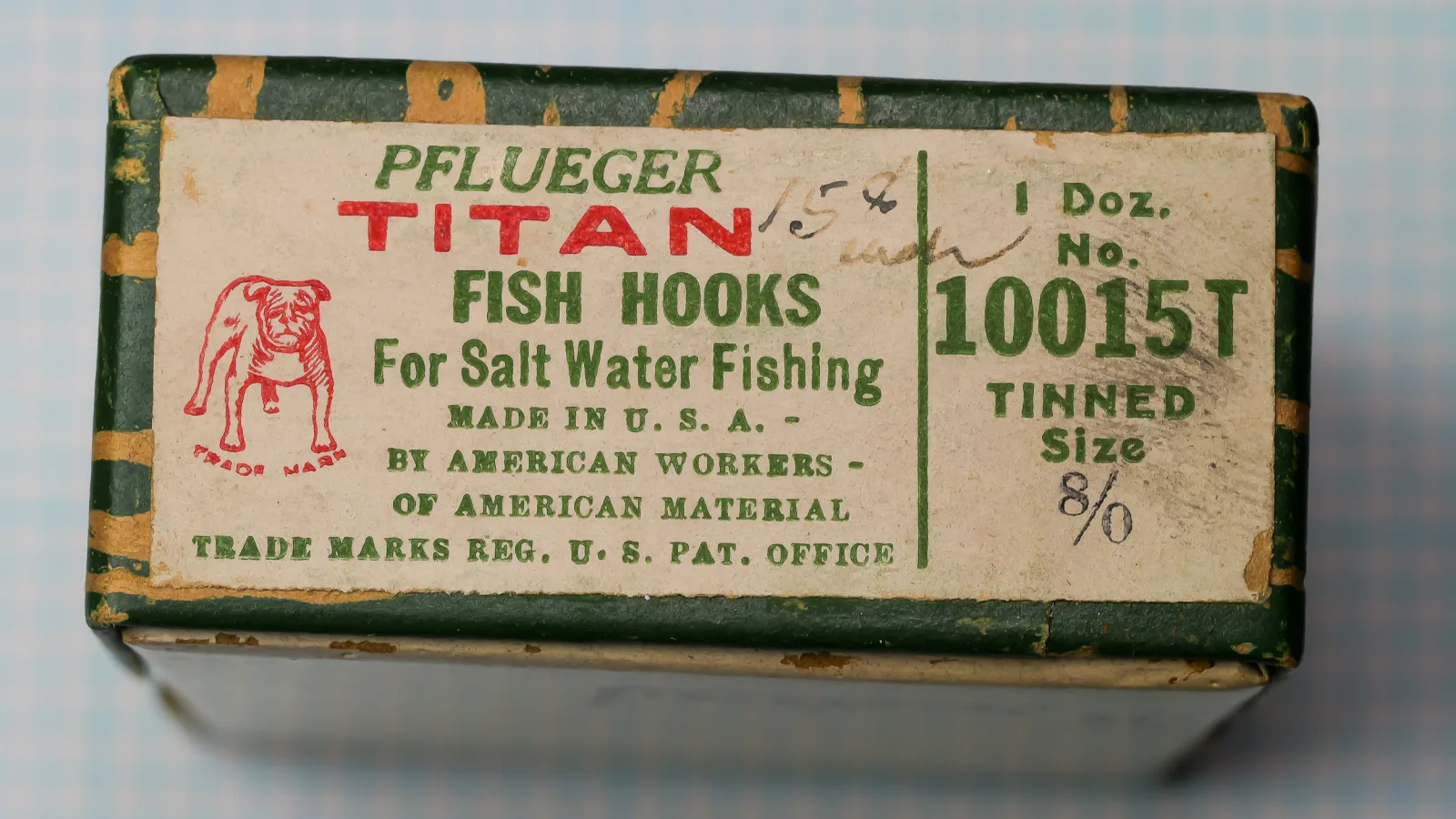
Pflueger Titan 10015T, size 8/0 — A premium American saltwater hook manufactured by Enterprise Manufacturing (Pflueger) in Akron, Ohio, c. 1920-1945. This hook represents a significant chapter in American tackle history, when domestic manufacturers competed directly with British Redditch imports to establish credibility in the salt water fishing market.
The Titan designation signifies extra-heavy forged construction designed for large gamefish species including tarpon, permit, and striped bass. The defining physical feature is the knife-edge hollow point created by the concave inner face and close-cut swept barb — a geometry designed for rapid penetration in heavy-mouthed fish. The Sproat bend provides a deep, rounded curve with excellent gap proportions for large baits and live baitfish.
Era evidence is established through multiple packaging indicators: the cloth-covered box with tan letterpress label (red and green ink), absence of barcode, handwritten distributor notations, and the visible hammer marks on the shank stamp confirming hand-forged production. The tinned finish remains bright with characteristic age-related patina. This specimen arrives in exceptional original packaging — the cloth-covered box with intact label is itself highly collectible.
The Titan 10015T occupies an important niche among American hook collectors, bridging the gap between British craft-era hooks and modern industrial production. Complete boxed examples represent a vanishing piece of American tackle manufacturing heritage.
Original Pflueger Titan cloth-covered box with intact tan letterpress label featuring the bulldog logo and red/green printing. Handwritten size notation '8/0' indicates distributor packaging from the interwar period.
Photographic record
5 cataloged imagesSelect any record to load it above.
5 images shown
Pflueger Titan 10015T Original Box Label — 1920s-1940sOriginal Pflueger Titan cloth-covered box with intact tan letterpress label featuring the bulldog logo and red/green printing. Handwritten size notation '8/0' indicates distributor packaging from the interwar period.Open originalPflueger Titan 10015T Size 8/0 Eye DetailClose-up of the tapered needle eye showing the smooth wire taper formation typical of early-20th-century hand-forged construction. The oval eye form provides secure leader attachment without a distinct ball element.Open originalPflueger Titan 10015T Size 8/0 Knife-Edge Point DetailClose-up of the hollow-point knife-edge geometry showing the concave inner face that creates the cutting effect. The close-cut barb is swept slightly rearward with inward angle characteristic of forged construction.Open originalPflueger Titan 10015T Size 8/0 Shank Marking DetailClose-up of the shank showing the stamped 'PFLUEGER TITAN' maker's mark and visible hammer marks from hand-forging. The substantial wire cross-section confirms extra-heavy gauge.Open originalPflueger Titan 10015T Size 8/0 Full ProfileComplete profile of the Pflueger Titan size 8/0 showing the full hook geometry, Sproat bend curve, turned-up tapered eye, and overall proportions on measurement grid for scale.Open original
Technical profile
Extra-heavy forged saltwater hook with tapered eye, Sproat bend, and knife-edge hollow point.
Eye
Needle Eye, Straight / InlineNeedle Eye
Wire
Heavy (1X Heavy), Forged
Shank
Standard — Plain
Bend
Standard gapClassic Sproat bend with smooth rounded bottom, substantial depth relative to gap. Bend exhibits characteristic forged geometry with visible hammer marks indicating hand-forging P.
Point
OtherClose-cut barb with slight rearward sweep. Concave inner face creates knife-edge geometry characteristic of hollow-point construction. Barb appears firmly formed with proper inward angle P.
Finish
TinnedBright tinned finish with characteristic silver-gray patina. Finish is uniform across shank and bend, with expected age-related discoloration visible on specimen P.
Hooks bright and uncorroded with original tinned finish intact. All hooks appear to be present in box (full count not verified from images, but spacing suggests completeness). Box cloth covering is intact with minor dust discoloration but no tears or structural damage. Label is legible with crisp printing, light age-related yellowing and spotting, but no major fading or water damage. Hinge cloth is intact and functional. Interior wood separator is sound. This is a well-preserved, field-used specimen that retains excellent historical integrity.
The knife-edge hollow point represents advanced penetrating geometry optimized for heavy-jawed saltwater species. The concave inner face creates an inward curve that, when combined with the close-cut barb, produces a fine cutting edge — analogous to a knife blade rather than a spear point. This geometry achieves rapid penetration into dense tissue and dense bone, particularly important for tarpon and permit with calcified jaw structures. The point does not rely on pure tension; the geometry drives the penetration actively.
The extra-heavy forged wire serves multiple functions. The increased cross-sectional area provides greater tensile strength — critical when fighting large fish under salt water stress. Forging (plastic deformation under heat) aligns the steel grain structure, creating molecular density that resists bending and breaking. The forging process also work-hardens the wire, increasing strength without adding material. The substantial diameter and forging together enable safe use with large, powerful fish while maintaining reliability in corrosive salt water environments.
The Sproat bend, with its rounded bottom and deep curve, distributes force more evenly across the entire bend arc than angular bends. For large bait presentations, the deep curve accommodates substantial bait mass while maintaining hook geometry integrity. The rounded bottom prevents stress concentration — an important factor in early metallurgy when steel was less refined and brittle failure was a real risk.
The tapered eye, formed by tapering the wire end without a distinct ball, offers secure knot attachment while minimizing the structural weakness sometimes associated with abrupt ball formation. The tapered geometry creates a smooth transition that distributes the stress of line attachment across a longer surface area, reducing the stress concentration at the eye.
We don't have measured sizes for this hook yet. Own one? Submit calipered measurements and we'll review and add them. Thank you!
Historical context
pflueger
Enterprise Manufacturing Company, doing business as Pflueger, was founded in Akron, Ohio in 1864 by Julius Pflueger, a German immigrant. The company became one of the most significant American fishing tackle manufacturers, producing high-quality hooks, reels, and fly-fishing equipment for both domestic and export markets. Pflueger established manufacturing facilities in Akron and became known for innovative forging techniques and reliable products. The company maintained a reputation for quality throughout the late 19th and early 20th centuries, competing directly with major manufacturers like Mustad while serving a strong domestic market. Pflueger hooks were widely distributed through American tackle dealers and were particularly popular among salt water anglers in coastal regions. The company continued operations through the mid-20th century, eventually becoming part of the Spalding Sports Worldwide portfolio.
Series History
The Pflueger Titan line was introduced in the 1920s as a premium saltwater hook series, designed to compete with British Redditch imports and establish American credibility in the growing saltwater fishing market. The Titan designation signified heavy-duty construction intended for large gamefish species. The 10015T model code suggests a Titan series designation (10) with a specific bend and point configuration (015T). The line was manufactured in multiple sizes ranging from approximately 2/0 to 12/0, with extra-heavy forged wire throughout to withstand the demands of salt water corrosion and large fish. The Titan series remained in production through the 1940s and into the early 1950s, though by the post-WWII period, American hook manufacturers were rapidly industrializing production and phasing out hand-forged methods. The Titan was eventually superseded by Pflueger’s modern production lines, though the model achieved collector recognition as a representative example of American hand-forged saltwater hooks from the golden age of American tackle manufacturing.
Era and Packaging Dating
No barcode visible on original box — indicates pre-1974 production. Letterpress printing method on tan label (red and green ink) is characteristic of 1920s-1940s hook packaging. Box construction with cloth covering and hand-stamped interior label is consistent with American hook manufacturing of the interwar period. Handwritten notations on label (quantity, size) indicate wholesale/distributor packaging. Pflueger Titan line was actively marketed in saltwater tackle catalogs throughout the 1920s-1940s. The hammered appearance on shank stamp suggests hand-forged production methods still in use prior to full industrialization in the 1950s. Overall evidence points to c. 1920-1945 production window, likely 1925-1940 based on label printing style and box condition.
American Saltwater Ambitions and the Pflueger Titan
During the 1920s and 1930s, American hook manufacturers faced an identity crisis. While Redditch, England remained the global epicenter of hook craft, wealthy American anglers increasingly pursued exotic saltwater species — tarpon in Florida, permit in the Keys, striped bass along the Atlantic coast. These fish were native to American waters, yet American anglers reached first for British hooks. Pflueger's Titan line, introduced in the 1920s, was an explicit effort to capture this market by manufacturing heavy-duty saltwater hooks 'of American Material' by 'American Workers,' as the box boldly proclaimed. The appeal was both functional (larger sizes tailored to American gamefish) and patriotic (supporting American industry). By the 1940s, the Titan had achieved legitimate recognition among professional charter captains and wealthy sportsmen. However, the post-WWII globalization of tackle, combined with Pflueger's transition to industrial stamping methods, gradually surrendered the market to larger competitors. Today, the Titan represents a vanished moment when American forges genuinely competed with British craft tradition.
Design lineage and influence
The Pflueger Titan 10015T represents a key inflection point in American hook manufacturing — the period when domestic makers sought to establish parity with British Redditch imports. The Sproat bend itself was a British innovation, popularized by Redditch makers in the mid-19th century. Pflueger’s adoption of the Sproat for their premium saltwater line signaled an intention to compete directly with established British patterns.
The hollow-point knife-edge geometry was itself a response to British advances. While Redditch makers like Partridge pioneered the hollow point for salmon and sea trout fishing in the late 1800s, American manufacturers like Pflueger adapted the technology for salt water applications where the penetrating geometry proved advantageous against hard-mouthed gamefish. The extra-heavy forged wire and substantial proportions represent American engineering pragmatism — building the strength needed for salt water environments.
The Titan’s design influence extends to mid-20th-century American saltwater hooks. Post-WWII manufacturers including Penn, Shakespeare, and later Mustad’s saltwater lines adopted very similar proportions and bend families. However, the hand-forged manufacturing method that defined the Titan fell out of favor as industrialization accelerated. By the 1960s, stamped and die-forged methods had largely replaced hand-forging in American production.
Best matchRelated by Attribute
Computed automatically from catalog data — updated as new hooks are added.
Matches: Bend, Shank, Gap, Finish, Application +2 moreDiffers: Wire: Heavy (1X Heavy) vs Standard; Eye: Needle Eye vs Ball Eye; Eye Orient.: Straight / Inline vs Turned Up +2 more
Matches: Bend, Shank, Wire, Gap, Finish +3 moreDiffers: Eye: Needle Eye vs Blind — Flatted; Eye Orient.: Straight / Inline vs N/A — Blind; Point: Other vs Superior +1 more
Matches: Bend, Wire, Eye Orient., Point, Application +2 moreDiffers: Shank: Standard vs 1X Long; Gap: Standard vs Wide; Eye: Needle Eye vs Ball Eye +2 more
Matches: Bend, Gap, Eye, Eye Orient., Point +5 moreDiffers: Shank: Standard vs Short (1X–2X Short); Wire: Heavy (1X Heavy) vs Extra-Heavy (2X+); Length: 58 mm vs 89 mm
The Pflueger Titan 10015T is engineered for salt water fishing, particularly for larger gamefish species including tarpon, permit, and large striped bass. The extra-heavy forged wire and robust proportions make it suitable for live bait presentations and chunking in offshore and inshore salt water environments. The knife-edge hollow point penetrates quickly in heavy-mouthed fish, while the extra-heavy gauge provides the strength needed to handle the rigors of salt water corrosion and muscular gamefish.
Classic Fly Patterns
Named patterns specifically associated with this hook. Leave blank if none formally documented. Do not speculate — only include patterns with a confirmed association.
Modern Equivalents
Hook
Match Quality
Notes
Mustad 34007 Big Game
Very Good
Similar size range, extra-heavy saltwater profile, though modern stainless construction differs from vintage tinned finish. Modern industrial equivalent to the Titan's functional role.
Tiemco 811S Saltwater
Good
Extra-heavy wire, saltwater application, though modern forging techniques and eye design differ from hand-forged Titan.
Owner 5177 Mutu Light
Moderate
Large saltwater hook, though Japanese production and modern metallurgy represent significant departure from American hand-forged vintage.
Collector notes
Rated 7.5/10 — Scarce in original cloth-covered packaging. The hand-forged construction and pre-1950 production date are significant collector drivers, but Pflueger hooks lack the premium demand of British Redditch makers. The original box condition is exceptional, which substantially increases value. Size 8/0 in saltwater hooks is moderately common; rarity is primarily driven by packaging condition and manufacturing method rather than size scarcity.
Reference value
$45 – $120 USD estimate
Packaging condition
Very Good — light wear, fully legibleRecorded specimen
Packaging format
GW-P-CB-001Catalog code
What makes this hook collectible: The Pflueger Titan represents a key period in American tackle manufacturing when domestic forges competed with British imports. Hand-forged construction, pre-1950 production, knife-edge point geometry, and the tinned finish all contribute to collector interest. The Sproat bend with extra-heavy wire is functional and historically documented. Most significantly, the original cloth-covered box with intact letterpress label is exceptionally rare — finding complete original packaging from the 1920s-1940s period dramatically elevates the specimen’s value and historical significance.
What limits the rating: Pflueger hooks, while respected, do not command the premium prices associated with British craft makers like Partridge of Redditch or H. Milward. American production was more industrial and distributed more widely than British specialty makers, resulting in greater surviving inventory. The 8/0 size, while large, is not the rarest in the saltwater range; smaller specialty sizes would be more scarce. Additionally, saltwater hooks generally have narrower collector demand than dry fly or salmon patterns.
Most desirable variants: Original cloth-covered boxes with intact labels and full hook counts command the highest premiums. Any Titan example with complete, unopened packaging is exceptional. Smaller sizes (10/0 and larger) are more difficult to find. Hooks in original tissue or envelope wrap, if present, add meaningful value. Condition of the tinned finish is important — bright, uncorroded examples are preferred over heavily patinated specimens.
Condition factors affecting value: Box condition is the primary value driver. Intact boxes with readable labels, secure edges, and full hook count represent the highest tier. Missing hooks significantly reduce value — each missing hook typically deducts $1-3 from the overall card value. Damage to the label (fading, tears, water staining) proportionally reduces the premium. Hooks themselves, if present and undamaged, add minimal additional value; the packaging is the primary asset. A sealed, unopened box could command 50-100% premium over an opened box with full count.
Packaging
Original cloth-covered cardboard box, approximately 4.75" × 2.5" × 1.25" deep. Box exterior covered with dark green cloth with gold-tone cloth reinforcing strips along top and bottom edges, typical of American tackle packaging from the 1920s-1940s. Interior fitted with wood block separator (partially visible in images). Lid adhered with cloth hinge. Tan paper label on lid face features letterpress printing in red and dark green. Label text reads: 'PFLUEGER TITAN FISH HOOKS For Salt Water Fishing MADE IN U.S.A. — BY AMERICAN WORKERS — OF AMERICAN MATERIAL TRADE MARKS REG. U.S. PAT. OFFICE' with bulldog logo. Handwritten notations on label include handwritten size '8/0' and 'Doz.' notation with quantity marking (appears to be 1 dozen). Label shows moderate aging and light spotting consistent with age; letterpress printing remains crisp. No barcode present. Interior wood block separator with individual hook compartments suggests factory-original configuration. Box edges show expected wear with light creasing and minor edge damage consistent with warehouse and field use. This packaging format is exceptionally rare among surviving Pflueger hooks — most examples are found loose or on deteriorated cardstock sales cards.
Market Value Notes
Low ($45): Opened box, complete hook count, minor label wear, tinned finish bright<br />
High ($120): Sealed or near-sealed box, intact label with minimal fading, full count, original tissue<br />
Premium factors: Original cloth-covered box (rare packaging format), hand-forged construction, pre-1945 production date, intact letterpress label, sealed condition, full hook count<br />
Platforms: eBay (vintage tackle category), specialist tackle auctions, Facebook vintage tackle groups<br />
Confidence: E estimated — limited comparable sales data for this specific model in original packaging. Values derived from auction results for similar-era Pflueger hand-forged hooks with original boxes (range $35-150) and comparison with Titan examples without original packaging ($8-20). Cloth-covered box format is rarer than cardstock, warranting premium adjustment.
Where to Find
Vintage tackle dealers specializing in American hooks; eBay (search 'Pflueger Titan vintage' or '10015T'); Facebook vintage fishing tackle groups; regional tackle shows and antique fishing expos; estate sales and fishing estate auctions (particularly in saltwater-adjacent regions like coastal New England, Mid-Atlantic, and Florida).
Preservation
Storage and Preservation
Store the Pflueger Titan in its original cloth-covered box in a cool, dry environment away from direct moisture and humidity. The tinned finish will develop patina over time with exposure to ambient moisture — this is normal aging and is often considered desirable by collectors. However, aggressive corrosion can be prevented by maintaining dry storage conditions and avoiding contact with salt spray or marine environments (ironic for a saltwater hook, but these are heirloom specimens, not working tools).
The box itself requires careful handling. The cloth covering is durable but can be damaged by rough handling. Store the box upright or flat on a stable shelf; avoid stacking heavy items on top. Keep the box away from direct sunlight to prevent color fading of the label printing. The letterpress ink is fugitive and will fade with UV exposure over decades.
If the box has been opened, inspect the interior wood separator for moisture or insect damage. If you observe any mold or discoloration on the wood, allow the box to air-dry in a warm, low-humidity environment. Do not apply varnish or sealant to the wood — natural aging is preferable to chemical treatment.
Handle the hooks themselves minimally. If hooks are removed from the box for any reason, store them in a separate acid-free envelope and maintain careful records of original position. Reintegration of hooks into original boxes requires patience and care — forcing hooks into original separators can damage the wire.
The label should never be wetted or aggressively cleaned. Light surface dust can be removed with a soft, dry brush. Do not apply any cleaning solutions, alcohol, or abrasive materials to the printed label.
Marking Analysis
Handwritten Markings and Distributor Notations
The tan label on the Pflueger Titan box displays handwritten notations indicating distributor or warehouse origin. The handwritten markings include ‘8/0’ (indicating size) and a quantity notation reading ‘Doz.’ with what appears to be a numerical quantity (possibly ‘1’, indicating one dozen hooks per box). These notations are characteristic of wholesale packaging — the box was clearly marked at the point of distribution for retailer inventory management.
The handwriting style is consistent with early-20th-century American commercial notation — clear, efficient letterforms typical of ledger clerks and warehouse personnel. The ink appears to be dark blue or black fountain pen, which was standard for business documentation through the 1940s. The notation placement on the label itself (rather than a separate sticker) suggests this labeling occurred at the factory before distribution, as part of the primary packaging process.
The presence of these notations is valuable for dating and provenance. Handwritten distributor marks indicate this box passed through actual commercial channels rather than remaining in factory inventory. The mark confirms the box originally contained size 8/0 hooks, establishing document-level accuracy for the hook specifications.
Primary Source
Packaging Text and Manufacturing Claims
The Pflueger Titan label makes four explicit claims worth examining: ‘For Salt Water Fishing,’ ‘MADE IN U.S.A.,’ ‘BY AMERICAN WORKERS,’ and ‘OF AMERICAN MATERIAL.’ These are not accidental design choices — they represent deliberate marketing messaging in an era when American manufacturers were actively contesting British dominance in the fishing tackle market.
The ‘For Salt Water Fishing’ designation explicitly positions the Titan in the emerging saltwater market. In the 1920s, saltwater angling was transitioning from an elite, coastal pursuit to a more widespread recreational activity, driven by improved rail access to Florida and the development of professional charter fishing. The Pflueger marketing team recognized this trend and explicitly targeted the saltwater segment with the Titan line.
‘MADE IN U.S.A.’ carried particular weight during the 1920s-1940s period. This was a patriotic and economic statement — American manufacture signified support for domestic industry and workers. Following the nationalist fervor of the 1920s and the economic pressures of the Great Depression, ‘Made in U.S.A.’ on packaging was a deliberate competitive tool against imported British goods.
‘BY AMERICAN WORKERS — OF AMERICAN MATERIAL’ is more explicitly protectionist. This phrasing goes beyond origin declaration to make a specific claim about labor and materials. The statement reassures customers that Pflueger hooks represented American metallurgy, American manufacturing expertise, and American employment. This was not merely marketing — it reflected genuine pride in American industrial capability during an era when American manufacturing was beginning to establish genuine technological parity with British traditions.
The presence of ‘TRADE MARKS REG. U.S. PAT. OFFICE’ indicates Pflueger sought patent or trademark protection for the Titan design. This suggests confidence in the proprietary value of the design — the company believed the Titan represented genuinely novel manufacturing or design elements worthy of legal protection. Unfortunately, the specific patent or trademark number is not visible in the available images.
Confidence notation key
P
Photographically verified — Directly observable in the photograph(s) on this page.
V
Verified by documentation — Confirmed by manufacturer catalog, spec sheet, or published reference.
I
Inferred — A logical deduction from observable or documented evidence, not directly stated.
E
Estimated — An approximation based on visual comparison, proportional analysis, or limited data.
S
Speculative — A reasoned hypothesis that cannot be confirmed from available evidence.
Claims with no notation are confirmed by multiple independent sources. All photographs on garrenwood.com are taken on a measurement grid where each square equals 1/10 inch (0.1″ / 2.54 mm).