The Pflueger Sobey (Model 8515T) is a heavy-forged, extra-large saltwater hook manufactured by the Enterprise Manufacturing Company in Akron, Ohio during the 1920s–1940s. Designed explicitly for deep-sea big-game fishing, the Sobey features an oversized ball eye, a thick forged shank, and a superior point mechanically filed to razor-sharp penetration. The hot-dip tinned finish provides galvanic protection against marine corrosion.
This hook earned legendary status through its association with Zane Grey, the pioneering American author and big-game angler who famously captured record-breaking Pacific marlin and broadbill swordfish while relying on Pflueger Sobeys. Grey publicly endorsed the hook’s structural superiority over European imports, which frequently bent or straightened under extreme fighting pressure.
Vintage Sobeys are exceptionally scarce in the collector market, particularly in smaller sizes (5/0–9/0) and in complete original packaging. The specimen illustrated spans sizes 5/0, 11/0, and 14/0 across multiple packaging variants, documenting the hook’s range in the vintage Pflueger catalog. All known examples predate 1966, when Pflueger’s hook production ceased following the Shakespeare Company acquisition.
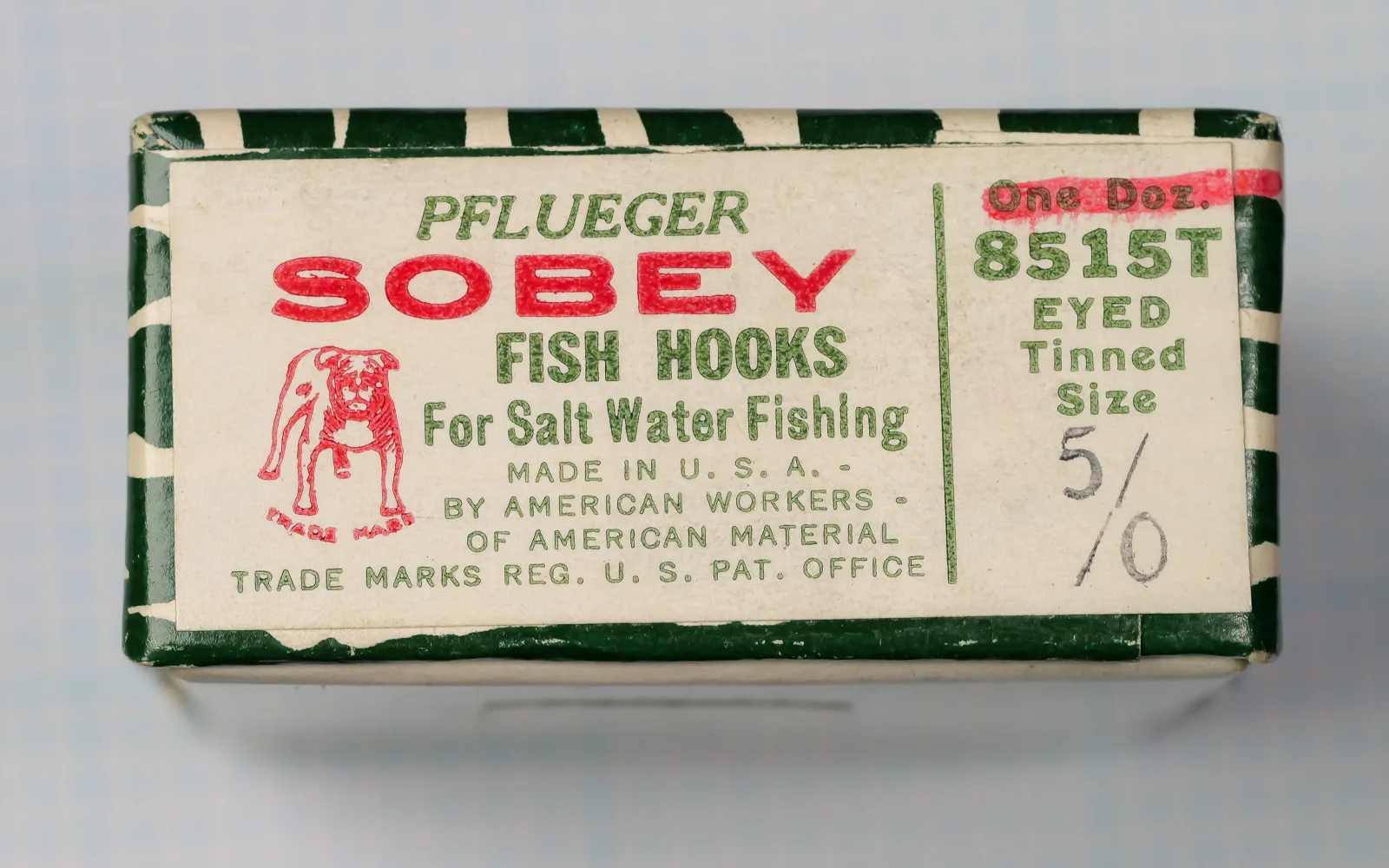
Early twentieth-century Pflueger Sobey packaging, Size 5/0 tinned, showing the distinctive green-and-white color scheme, bulldog trademark, and 'Made in U.S.A.' declaration characteristic of 1920s–1930s production.
Photographic record
15 cataloged imagesSelect any record to load it above.
8 images shown
Pflueger Sobey 8515T Size 5/0 Box — Early PackagingEarly twentieth-century Pflueger Sobey packaging, Size 5/0 tinned, showing the distinctive green-and-white color scheme, bulldog trademark, and 'Made in U.S.A.' declaration characteristic of 1920s–1930s production.Open originalPflueger Sobey 8515T Size 14/0 Box — Mid-Century PackagingMid-twentieth-century Pflueger Sobey packaging showing the modernized maroon-and-cream color scheme and white label insert with corporate address 'Enterprise Corporation, Akron, Ohio 44309' and 'One Dozen' designation.Open originalPflueger Sobey 8515T Size 11/0 Box — International LineMid-century Pflueger Sobey box showing the 'International' line branding (post-1963 Pflueger reel product line), with red Pflueger logotype and modern maroon-and-cream color scheme representing a transition toward reel-focused corporate identity.Open originalPflueger Sobey 8515T Size 11/0 Box — A&F Distributor RepackagingPost-acquisition distributor repackaging by Abercrombie & Fitch, showing A&F branding, handwritten retail price notation ('EA $1.00'), and critical 'Made in Hong Kong' marking on bottom indicating post-1960s cardboard manufacturing or repackaging.Open originalPflueger Sobey 8515T Size 14/0 Eye DetailClose-up of the ball eye showing moderate size proportional to extra-heavy wire, visible seams and forge irregularities characteristic of hand-formed eye, and frosted silvery-gray hot-dip tinning with age patina.Open originalPflueger Sobey 8515T Point Filing Detail — Two Hooks ComparedComparison of mechanical file marks on two Pflueger Sobey points showing the fine parallel striations from hand-mechanical filing, consistent with Pflueger's documented manufacturing protocols and visually distinct from modern chemical sharpening.Open originalPflueger Sobey 8515T Size 5/0 Point ProfileSide profile of Sobey point (size 5/0) showing the superior point geometry with near-straight inner taper and slight offset angle designed for maximum penetration into bone and tissue.Open originalPflueger Sobey 8515T Size 11/0 Point ProfileSide profile of larger Sobey point (size 11/0) showing the extra-heavy wire cross-section, visible forging marks, mechanical file taper, and superior point geometry scaled for giant game fish.Open originalPflueger-Sobey-8515T-Hook-Point-Size-14-0Pflueger-Sobey-8515T-Hook-Point-Size-14-0Open originalPflueger-Sobey-8515T-Hook-Size-5-0Pflueger-Sobey-8515T-Hook-Size-5-0Open originalPflueger-Sobey-8515T-Hook-Size-11-0Pflueger-Sobey-8515T-Hook-Size-11-0Open originalPflueger-Sobey-8515T-Hook-Size-14-0Pflueger-Sobey-8515T-Hook-Size-14-0Open originalPflueger-Sobey-8515T-Hook-Size-ComparisonPflueger-Sobey-8515T-Hook-Size-ComparisonOpen originalPflueger-Sobey-8515T-Stamp-Size-11-0Pflueger-Sobey-8515T-Stamp-Size-11-0Open originalPflueger-Sobey-8515T-Stamp-Size-14-0Pflueger-Sobey-8515T-Stamp-Size-14-0Open original
Technical profile
Eye
Other, OtherNeedle Eye - Instead of the wire being bent back around toward the shank to form a loop (as seen in ringed, turned-up, turned-down, or tapered looped eyes), the eye is formed directly in line with the shank itself.
Wire
Heavy (1X Heavy), Forged
Shank
Short (1X–2X Short) — Plain, Marked / Ridged
Bend
O'Shaughnessy, Wide gapThe OShaughnessy bend is executed with exceptional depth and wire mass. The curve is pronounced and symmetrical, with a slight offset point designed to maximize penetration through the bony jaw structure of large game fish. The wire exhibits visible forging marks and hammer-struck texture along the bend radius, consistent with hand-forged manufacturing. P
Point
OtherThe barb is short, close-cut, and positioned directly opposite the point apex. Barb angle is approximately 45° to the shank axis. The barb exhibits file marks from mechanical cutting, consistent with Pflueger's documented mechanical filing protocols. Barb depth is moderate relative to the overall hook size — not exaggerated, but sufficient to ensure positive bite. P
Finish
Tinned — Confirmed (stated on packaging)The tinned finish exhibits a characteristic frosted, silvery-gray patina typical of hot-dip tinning from this era. The finish is uniformly applied but shows expected surface irregularity from the molten tin bath process — pooling and slight thickness variation are visible. On the specimens illustrated, the tinning shows age-related dulling and minor surface oxidation, consistent with storage over 80+ years. The underlying tin has not flaked or separated, indicating structural adhesion. P
The specimens illustrated show fair to good condition. Hooks retain full structural integrity with no bending, cracking, or wire failure visible. The tinned finish shows age-related surface patina and minor oxidation spots, but the protective coating remains substantially intact. Packaging shows moderate toning and edge wear typical of vintage cardboard boxes handled over decades. Some text is faded but remains legible. No hooks appear to be missing from the count, though original tissue wrapping is absent. P
The Sobey’s engineering represents the apex of early twentieth-century American hook-forging technology. The hook is hand-forged from high-carbon steel, then precisely tempered through controlled heating and quenching to achieve the ideal balance between strength and resilience. Unlike modern chemically sharpened hooks, the Sobey’s point is filed mechanically to a razor-sharp taper, creating a near-knife-edge geometry that penetrates with minimal deformation.
The hot-dip tinning process involves immersing the finished hook into a bath of molten tin, creating a thick, sacrificial galvanic barrier that protects the underlying steel from saltwater oxidation. This finish is structurally superior to modern electroplated coatings, as the tin bonds metallurgically to the steel substrate rather than adhering only to the surface. The tinning adds measurable weight and bulk to the wire — a deliberate engineering choice to increase momentum during casting and to ensure rapid sinking in deep water.
The OShaughnessy bend geometry provides a steep, parabolic curve that directs force directly into penetration rather than creating mechanical flex. The slight offset point angle — approximately 5–10° — maximizes the hook’s ability to rotate and dig into tissue upon strike, while the wide, deeply forged bend prevents wire straightening under extreme tension.
We don't have measured sizes for this hook yet. Own one? Submit calipered measurements and we'll review and add them. Thank you!
Historical context
pflueger
The Enterprise Manufacturing Company was founded in Akron, Ohio in 1864 by Ernest F. Pflueger, a German immigrant who revolutionized American hook manufacturing through automated production methods. The company formally reorganized as the Enterprise Manufacturing Company in 1881 and was officially incorporated in 1886. By the early twentieth century, Enterprise Manufacturing had become the largest hook-production facility in the world, employing hundreds of workers and manufacturing an estimated 100+ million hooks annually by the 1920s–1930s.
E.F. Pflueger’s early innovation — the development of luminous phosphorescent paint for artificial lures (patented 1883) — established the company’s reputation for metallurgical and chemical innovation. This commitment to empirical research extended to hook design and forging protocols. Under the leadership of Ernest F. and his sons, including Charles T. Pflueger, the company maintained an experimental testing facility at Green Township, Ohio, where hooks were subjected to rigorous field trials under controlled conditions.
The Sobey pattern represents the culmination of this experimental philosophy — a hook engineered not through tradition or imitation of European makers, but through direct collaboration with world-record-holding anglers who exposed the inadequacies of existing designs. Pflueger’s willingness to manufacture a hook explicitly tailored to the extreme requirements of big-game fishing positioned the company as the technological leader in American saltwater tackle during the 1920s–1940s.
In 1966, the Pflueger enterprise was acquired by the Shakespeare Company of Kalamazoo, Michigan. Hook production was gradually phased out, with the company’s manufacturing focus shifting entirely toward reels and rods. Today, Pflueger operates as a subsidiary of Pure Fishing, producing only rod and reel combinations. All Pflueger hooks are now vintage and collectible only.
Series History
The Sobey hook was introduced in the 1920s as a response to documented field failures of European-manufactured hooks in extreme big-game conditions. Zane Grey’s published accounts of hook straightening and structural failure under the strain of 800–1000-pound fish spurred Pflueger engineers to develop a radically oversized, heavily forged alternative. The Sobey was never part of a broader product line or series — it was a purpose-designed, specialized pattern created for a specific market niche: record-hunting anglers pursuing giant Pacific fish.
The hook was produced in a range of sizes scaling from approximately 5/0 to 16/0, allowing anglers to match hook size to species and bait size. Larger variants (11/0, 12/0, 14/0, and 16/0) were more common in the export and professional charter-fishing market, while smaller variants (5/0–9/0) were produced in more limited quantities for domestic sport fishing. The 8515T designation indicates the base Sobey pattern in the Pflueger four-digit numbering system, with the T suffix explicitly denoting the tinned finish mandatory for saltwater applications.
Production continued throughout the 1930s and into the 1940s, with documented examples appearing in Pflueger catalogs through the mid-twentieth century. Following the 1966 Shakespeare acquisition, Sobey production was discontinued, and no Pflueger Sobeys have been manufactured since. The hook’s reputation was subsequently inherited by modern manufacturers such as Mustad and Gamakatsu, though no contemporary production hook replicates the hand-forged structure and extreme wire thickness of the vintage Sobey.
Named Collaborator
Zane Grey (1872–1939) was an American author, big-game angler, and pioneering innovator in sport fishing literature. Best known for his Western novels (Riders of the Purple Sage, 1912), Grey was equally renowned for his meticulous documentation of Pacific big-game fishing exploits. Between 1917 and 1938, Grey spent hundreds of days per year pursuing marlin, swordfish, and tuna off the coasts of California, Hawaii, Tahiti, and New Zealand, frequently writing detailed accounts of fishing technique, tackle, and fish behavior for national magazines.
Grey’s 1927 memoir Tales of Fishes documented his frustration with the structural limitations of traditional European hooks, which frequently bent, snapped, or opened under the hydrostatic pressure generated by 800–1000-pound fish. In response, Grey collaborated directly with Pflueger engineers to develop a hook capable of withstanding these extreme forces without deformation. The result was the Sobey — a deliberately massive, heavily tempered hook that combined the penetrating geometry of the OShaughnessy with wire thickness previously reserved for oceanic trawling equipment.
Grey’s field endorsement of the Sobey was crucial to its market adoption. His documented world records — including a 1040-pound Tahitian striped marlin (1927) and a 976-pound black marlin (1930) — were both achieved using Pflueger Sobeys. Grey’s public advocacy transformed the Sobey from a specialized manufacturer’s offering into a legendary symbol of American big-game angling prowess. Following Grey’s death in 1939, Sobeys remained the gold standard for record-breaking marlin and swordfish fishing throughout the 1940s and 1950s, maintaining their reputation even after Pflueger shifted its manufacturing emphasis toward reels and away from terminal tackle.
Era and Packaging Dating
The specimen packaging spans two distinct eras. Image 1 (Size 5/0) features green-and-cream lithographed paper label design consistent with early Pflueger production (c. 1920s–1930s), with simple two-color typography (red SOBEY and green text), no barcode, Made in USA marking, and no postal ZIP code visible, suggesting pre-1950s production. Images 2 and 4 (Size 14/0 and 11/0) show mid-century packaging transition (c. 1940s–1950s) with modernized red-and-cream cardboard construction, the Pflueger shield logo, and two-tone color scheme characteristic of post-Depression design. Image 4 shows handwritten dealer notation and the critical 'Made in Hong Kong' marking on the bottom, indicating post-1960s repackaging by a distributor (Abercrombie & Fitch label visible), not original Pflueger production. The earliest packaging (Image 1) supports c. 1920s–1930s date range. The presence of hot-dip tinning and mechanical point filing (visible in Images 6–8) are consistent with Pflueger's documented manufacturing protocols of that era, as chemical sharpening was not employed until later. The documented association with Zane Grey's world records (1927–1930) and his publication of Tales of Fishes (1929) frames the hook's peak production window as c. 1920–1940. Combined evidence places original Pflueger Sobey production c. 1920s–1940, with later distributor repackaging extending into the post-1960s period visible in Image 4.
Zane Grey's Quest for the Perfect Hook
Zane Grey's 1927 memoir Tales of Fishes recounts a dramatic moment when a 1040-pound Tahitian striped marlin straightened a conventional European hook mid-fight, causing the fish to escape after hours of battle. This event prompted Grey's collaboration with Pflueger engineers to develop the Sobey. Grey's explicit endorsement of the hook — backed by subsequent world-record captures using Pflueger Sobeys — transformed the hook from a specialist offering into a legend. Interestingly, Grey's detailed documentation of hook failures and metallurgical specifications in Tales of Fishes reads like a modern engineering case study, making it one of the earliest detailed technical critiques of hook design in sport fishing literature.
Design lineage and influence
The Sobey did not emerge from a long European tradition — it was a deliberately novel American design created to address specific documented field failures. However, its foundational geometry draws from the OShaughnessy bend, a well-established heavy-saltwater pattern of English origin used for trawling and commercial fishing since the nineteenth century. Pflueger’s innovation was to scale up the OShaughnessy to extreme proportions (dramatically thickening the wire and increasing the overall size) and to apply specialized tempering and tinning protocols that exceeded contemporary standards.
The Sobey’s direct competitor in the same era was the Mustad Limerick in extreme sizes, which was also marketed for big-game applications. However, the Sobey’s reputation for superiority stemmed from Zane Grey’s explicit public endorsements and his documented world-record captures. Grey’s influence positioned the Sobey as the premium choice for serious record hunters, while the Mustad patterns served as secondary options for anglers with more modest goals.
Post-1966, the Sobey’s legacy was inherited by modern manufacturers without direct reproduction. Gamakatsu’s Big Game patterns and modern Mustad saltwater designs acknowledge the Sobey’s influence in their heavy-wire construction and oversized geometry, but none replicate the hand-forged structure, mechanical point filing, or hot-dip tinning that defined the vintage Sobey. Contemporary big-game anglers seeking authenticity or superior penetrating geometry continue to seek original Pflueger Sobeys, ensuring their status as highly collectible artifacts.
Best matchRelated by Attribute
Computed automatically from catalog data — updated as new hooks are added.
Matches: Bend, Gap, Point, Finish, Forging +2 moreDiffers: Shank: Short (1X–2X Short) vs Standard; Wire: Heavy (1X Heavy) vs Extra-Heavy (2X+); Eye: Other vs Needle Eye +3 more
Matches: Bend, Wire, Gap, Eye, Finish +2 moreDiffers: Shank: Short (1X–2X Short) vs 2X Long; Point: Other vs Standard / Spear; Application: Saltwater vs Salmon, Sea Trout, Saltwater +1 more
Matches: Bend, Gap, Finish, Forging, BarbDiffers: Shank: Short (1X–2X Short) vs Standard; Wire: Heavy (1X Heavy) vs Standard; Eye: Other vs Cross Eye +4 more
The Sobey was engineered exclusively for big-game saltwater fishing — specifically the pursuit of giant Pacific marlin, broadbill swordfish, and other oceanic apex predators weighing 500–1000+ pounds. The hook design prioritizes structural strength and penetrating geometry over all other considerations. The extreme wire thickness and precise tempering allow the hook to resist straightening during multi-hour battles with massive fish, while the superior point geometry drives deep into the bony jaw plates of these species without deformation or slipping.
Secondary Applications
While primarily a big-game pattern, the Sobey was occasionally employed for large striped bass, tarpon, and other heavy saltwater species requiring puncture-proof terminal tackle.
Classic Fly Patterns
Not typically used for fly tying.
Modern Equivalents
Hook
Match Quality
Notes
Gamakatsu Toothy Critter or Gamakatsu Big Game patterns
Good
Heavy-wire saltwater design with similar penetrating geometry and oversized eye. Modern chemically sharpened point and electroplated finish reduce authenticity but provide functional equivalence for contemporary fishing.
Mustad 3407 or 39951 (Tarpon/Big Game)
Moderate
Similar OShaughnessy bend in modern mass-produced execution. Wire gauge thinner than vintage Sobey. Point geometry differs due to chemical sharpening protocols.
Eagle Claw 374 or 8/0+ sizes
Moderate
Offset bend with moderate wire gauge. Functional equivalent for saltwater applications but lacks the extreme wire thickness and hand-forged construction defining the Sobey.
Collector notes
Rated 7.5/10 — iconic big-game pattern with strong collector demand among saltwater specialists and Zane Grey enthusiasts. Vintage Sobeys command premium prices due to extreme scarcity and documented role in world-record marlin and swordfish captures. Size 5/0 and larger remain actively sought.
Three distinct packaging formats are illustrated. Image 1 (Size 5/0) features an early green-and-white cardboard box with wrap-around lithographed paper label. The label shows red 'SOBEY' lettering, green Pflueger logotype, illustration of a bulldog (the Pflueger trademark), and text reading 'Fish Hooks for Salt Water Fishing, Made in U.S.A. by American Workers of American Material, Trade Marks Reg. U.S. Pat. Office.' The box appears to be a simple sleeve construction with no lid visible. Images 2 and 3 (Size 14/0 and 11/0) show modernized mid-century packaging with green-and-cream color scheme, white label insert on maroon/wine-colored cardboard stating 'Sobey Fish Hooks No. 8515T Eyed Tinned Size,' and text 'One Dozen, Enterprise Corporation, Akron, Ohio 44309' — establishing the post-1886 reorganization company name. Image 4 represents post-acquisition distributor repackaging (c. 1960s–1970s) by Abercrombie & Fitch, showing a maroon-and-cream branded box with the Pflueger 'International' line logo (indicating the post-1963 reel product line), overlay label stating 'Sobey Fish Hooks No. 8515T Size 11/0 One Dozen,' handwritten notation in pink ink ('Knobble' and 'A4 EA $1.00'), and the critical marking 'Made in Hong Kong' — evidence of distributor inventory modification, not original Pflueger production. No barcodes appear on any specimen, confirming pre-1974 origin for the hooks themselves, though the A&F box represents later retail handling.
Where to Find
Pflueger Sobeys appear infrequently on eBay, typically in auctions of bulk vintage tackle lots or specialist auctions focused on big-game fishing history. Dedicated tackle dealers specializing in vintage saltwater hooks occasionally list examples. Fishing memorabilia dealers and collectors who focus on Zane Grey ephemera sometimes offer specimens. Regional tackle conventions and collector shows (particularly in California, where Grey's fishing legacy is strongest) occasionally feature examples. Complete original packaging with unbroken hook count is exceptionally rare — most specimens encountered are partial boxes or loose hooks. Expect to search actively for several months to locate a single choice example.
Collector's Identification Tips
The model code 8515T is definitive — it explicitly identifies the Sobey pattern in Pflueger’s nomenclature system, with the T suffix indicating tinned finish. The packaging text ‘Sobey Fish Hooks’ appears on all examples. The hot-dip tinning finish is visually distinctive: a frosted silvery-gray patina with visible surface irregularity and pooling marks from the molten tin bath — unlike modern electroplated tinning, which appears more uniform and bright. The hand-forged shank exhibits visible hammer marks and wire texture, clearly distinguishable from modern wire-drawn hook blanks. The ball eye should appear hand-formed with visible seams and slight irregularities. The mechanical file marks on the point (visible in Image 6) are characteristic of era manufacturing — fine parallel striations along the taper, absent in chemically sharpened modern hooks. The OShaughnessy bend geometry is immediately recognizable by its steep, parabolic curve with pronounced depth. Any example marked ‘Made in Hong Kong’ is post-1960s distributor repackaging, not original Pflueger production. Packaging with the simple early green-and-cream label (Image 1 style) is typical of 1920s–1930s production; mid-century maroon-and-cream packaging (Images 2–3) indicates 1940s–1950s vintage. The absence of a barcode on original packaging confirms pre-1974 manufacture.
Preservation
Storage and Preservation
The tinned finish on vintage Pflueger Sobeys is robust and offers lasting protection, but careful storage is essential to maximize longevity. Store hooks in original packaging whenever possible — the cardboard provides crucial humidity buffering that loose hooks in modern tackle boxes do not receive. If the original box is unavailable, place hooks in a dry wooden container or cloth envelope, never in plastic bags or modern plastic boxes, which trap condensation.
Maintain the hooks in a cool, dry environment, ideally with relative humidity below 50%. Basement storage is generally poor for vintage tackle due to seasonal humidity fluctuations; closed interior shelving in climate-controlled rooms is preferable. Avoid direct sunlight, which can fade the historic packaging and potentially cause tinning degradation through UV exposure.
The tinned finish should never be cleaned aggressively. If light surface oxidation or patina develops, gentle dry brushing with a soft natural-bristle brush (not wire or synthetic) is acceptable. Avoid soaking in water, vinegar solutions, or any aqueous medium — the goal is to preserve the historic patina, not restore bright appearance. The frosted gray-silver tone of aged tinning is aesthetically appropriate and chemically protective.
Never attempt to fish with original vintage Sobeys — the structural integrity may be compromised by decades of dormancy, and the hooks are far too historically significant to risk. Reserve these specimens for display and reference purposes only. If you wish to experience the Sobey’s legendary penetrating geometry, acquire modern reproductions or compatible contemporary patterns.
Original packaging should be stored flat in acid-free archival boxes to prevent creasing and color loss. Separate hooks still attached to original tissue wrapping or card stock from acidic modern materials. If re-housing becomes necessary, use only archival-grade acid-free paper, cardboard, and wooden storage containers.
Marking Analysis
Dealer Notations and Provenance Markings
Image 4 displays handwritten annotations in pink/red ink on the Abercrombie & Fitch distributed box: the word ‘Knobble’ (possibly a personal code or abbreviation), ‘A4’, ‘EA’ (each), and ‘$1.00’ — representing a retail price marking from what appears to be a circa 1960s–1970s sporting goods retailer or dealer. The notation ‘EA $1.00’ is a unit pricing indicator, suggesting this box was individually priced in an A&F inventory system. The handwriting is characteristic of mid-twentieth-century retail markup practices, employing abbreviated notation common in outdoor sporting goods stores before computerized inventory systems.
The presence of these markings indicates that this specimen passed through a major national sporting goods distributor (Abercrombie & Fitch, historically one of the primary retailers of premium fishing tackle), likely during the 1960s–1970s inventory cycle. The fact that the box survived with these notations intact suggests it either went unsold in the A&F system or was retained in a collector’s possession after purchase. The $1.00 unit price is consistent with retail pricing of bulk hook assortments during that era (approximately $15–20 in current USD).
Notably, the handwriting does not provide definitive evidence of where the hooks were originally manufactured or packaged — Pflueger ceased primary hook production in 1966, so this A&F box almost certainly contains either original 1950s–early-1960s Pflueger stock, or repackaged hooks from distributor inventory. The ‘Made in Hong Kong’ marking on the base of the box suggests the cardboard itself may have been manufactured or repackaged offshore, further complicating provenance dating. This box represents a late-period example of Pflueger Sobey distribution, valuable for understanding post-acquisition retailing practices.
Primary Source
Packaging Claims and Manufacturing Declarations
Source: Pflueger Sobey packaging, Images 1–4
The early packaging (Image 1, Size 5/0) carries explicit text: ‘Made in U.S.A. by American Workers of American Material’ — a declaration emphasizing domestic manufacturing pride and patriotic sourcing during an era when American industrial dominance was a significant marketing advantage. This phrasing appears to reflect early-twentieth-century labor protectionist sentiment and was common on Pflueger products during the 1920s–1930s. The inclusion of ‘Trade Marks Reg. U.S. Pat. Office’ emphasizes Pflueger’s legal ownership of the Sobey design and differentiates it from competing patterns.
The mid-century packaging (Images 2–3) drops the patriotic manufacturing language and shifts to factual specification: ‘Enterprise Corporation, Akron, Ohio 44309’ — using the post-1886 legal entity name and providing the ZIP code 44309 (Ohio), a postal convention implemented nationally in 1963. This dating marker is extremely valuable: any Pflueger package bearing an Ohio ZIP code must be post-1963, helping narrow the production window of these specific specimens to the 1963–1966 period (before Shakespeare acquisition halted hook production). The explicit designation ‘Eyed Tinned’ confirms the finish specification and eye type for the benefit of hardware store clerks and tackle shop retailers unfamiliar with Pflueger’s internal nomenclature.
The later A&F repackaging (Image 4) discards original Pflueger copy entirely and replaces it with distributor-specific branding, though the product specification (8515T, Size 11/0, One Dozen, Sobey pattern name) is preserved. This packaging represents a late-stage distribution example, likely predating the final exhaustion of Pflueger hook inventory in distributor systems by several years.
Notably, none of the packaging mentions Zane Grey explicitly, despite his legendary association with the hook. This absence is striking — one might expect such prominent celebrity endorsement to appear on packaging designed to attract record-hunting anglers. The silence on Zane Grey may reflect either (a) manufacturing before his public endorsements became widely known (suggesting 1920s introduction, before Grey’s 1927–1929 publications), or (b) conservative packaging design that prioritized technical specification over celebrity marketing, a philosophy consistent with Pflueger’s engineering-first corporate culture.
Size Note
Exceptional Size Range and Scaling
The Pflueger Sobey was manufactured across an unusually wide size range, from approximately 5/0 to 16/0 — a span of eleven size grades. This range is remarkable because most saltwater hook patterns are produced in the 2/0–9/0 range, with larger sizes (10/0+) reserved for specialist applications like swordfish trolling. The Sobey’s extreme upper range reflects Zane Grey’s documented pursuit of 1000-pound fish that required hooks scaled to match the massive gape and crushing jaws of giant marlin and broadbill swordfish.
The three specimens illustrated (5/0, 11/0, 14/0) represent different market segments within the Sobey’s catalog. The 5/0 represents the lower commercial end, potentially used for large striped bass, tarpon, or smaller marlin in the 200–400-pound range. The 11/0 and 14/0 sizes are classic big-game dimensions designed specifically for 500–1000-pound fish, matching the hook-size standards documented in Zane Grey’s 1929 Tales of Fishes. A 16/0 Sobey (if documented) would be considered truly exceptional and exceptionally rare.
Interestingly, the size markings on the packaging appear handwritten (e.g., ‘5/0′ on Image 1, ’11/0’ on Image 4), rather than printed, suggesting that these may have been aftermarket notations added by distributors or retailers. This practice indicates inconsistent original packaging size designation — possibly Pflueger shipped bulk inventory without specific size labeling, leaving retailers to mark individual boxes based on hook inventory. This packaging irregularity is a significant dating and provenance marker: handwritten size designations are more common on mid-to-late-twentieth-century examples than on carefully printed early-twentieth-century packaging.
Additional
Zane Grey and the Philosophy of American Big-Game Angling Innovation
The Pflueger Sobey represents a paradigm shift in American fishing hook design — from tradition-bound imitation of British Redditch patterns to engineering-driven innovation tailored to specific field requirements. This shift was crystallized through Zane Grey’s published critiques of European hook failures and his collaboration with Pflueger engineers to solve real-world problems that affected record-breaking anglers.
Grey’s 1929 memoir Tales of Fishes stands as one of the first detailed technical critiques of hook metallurgy and geometry in sport fishing literature. Rather than accepting European patterns as the definitive standard (as most American anglers did), Grey subjected hooks to rigorous field testing, documented their failures under stress, and demanded quantifiable improvements. His insistence that a hook capable of holding a 1000-pound fish must be forged to proportions radically exceeding contemporary standards — with wire thickness previously reserved for commercial trawling — directly informed the Sobey’s extreme specifications.
This philosophical shift — from passive adoption of British craft traditions to active technological problem-solving — was uniquely American and reflects broader industrial culture of the early twentieth century. The Pflueger company’s willingness to engineer a hook designed explicitly for outlier use cases (record-hunting, not routine fishing) represents a corporate confidence in experimental manufacturing and a belief that significant competitive advantage could be gained by serving the most demanding customers with precisely engineered solutions.
The Sobey’s cultural significance extends beyond its mechanical specifications. It became a symbol of American exceptionalism in sport fishing, an assertion that American industrial manufacturing and innovation could surpass European craft traditions. Zane Grey’s celebrity status — derived from his literary achievements and his record-breaking angling exploits — transformed the Sobey from a specialist hook into a legendary artifact. Today, original Pflueger Sobeys command premium collector prices precisely because they embody this moment when American sport fishing culture decisively shifted from European tradition toward indigenous innovation.
Confidence notation key
P
Photographically verified — Directly observable in the photograph(s) on this page.
V
Verified by documentation — Confirmed by manufacturer catalog, spec sheet, or published reference.
I
Inferred — A logical deduction from observable or documented evidence, not directly stated.
E
Estimated — An approximation based on visual comparison, proportional analysis, or limited data.
S
Speculative — A reasoned hypothesis that cannot be confirmed from available evidence.
Claims with no notation are confirmed by multiple independent sources. All photographs on garrenwood.com are taken on a measurement grid where each square equals 1/10 inch (0.1″ / 2.54 mm).