Van Vleck Hook hook silhouette
Hook Reference › The Van Vleck Hook Co. › The Van Vleck Hook Co. 842,594 — Van Vleck Hook

The Van Vleck Hook Co. 842,594

Van Vleck HookProbably 1907 or later for marked hooks; production dates are not documented I.

Evidence reviewed October 1, 2026. Marks: P photographically · V verified · I inferred · E estimated · S speculative What they mean

Save this hook to your account to build a list you can come back to.

Summary

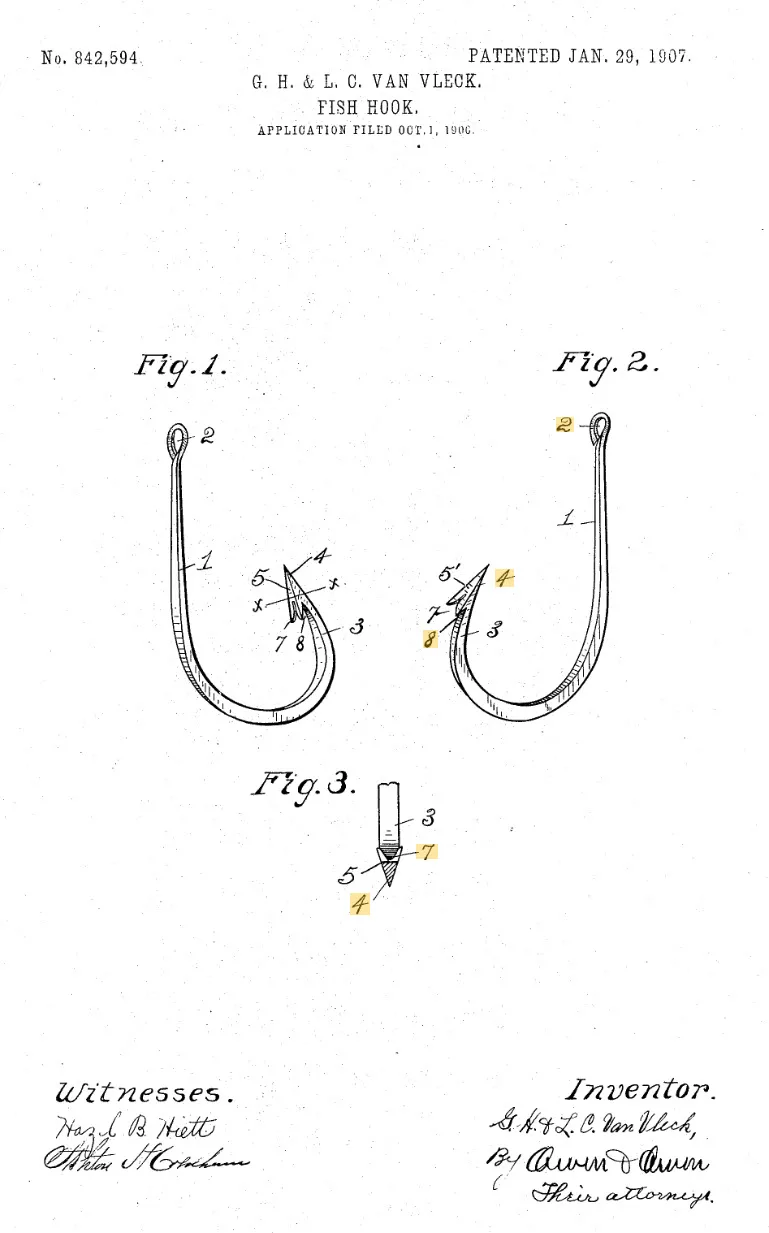
The Van Vleck hook is a single hook patented in the United States as No. 842,594 and granted on January 29, 1907 V. Its patent form has a long, tapering point with a barb that the patent describes as forked V.

The entry draws on the patent record, close photographs of one loose specimen, and collector and marketplace sources. Points the sources leave open are listed in the questions below.

Photographic record

6 photographs

Patent drawing sheet for US 842,594 showing Figs. 1, 2 and 3 of a fish hook.
IMG-1The Van Vleck Hook Co. — New entry — image 1 Drawing sheet of US patent 842,594, granted January 29, 1907 to G. H. and L. C. Van Vleck (P). Yellow highlight boxes on some numerals are not part of the original drawing.

How to identify it

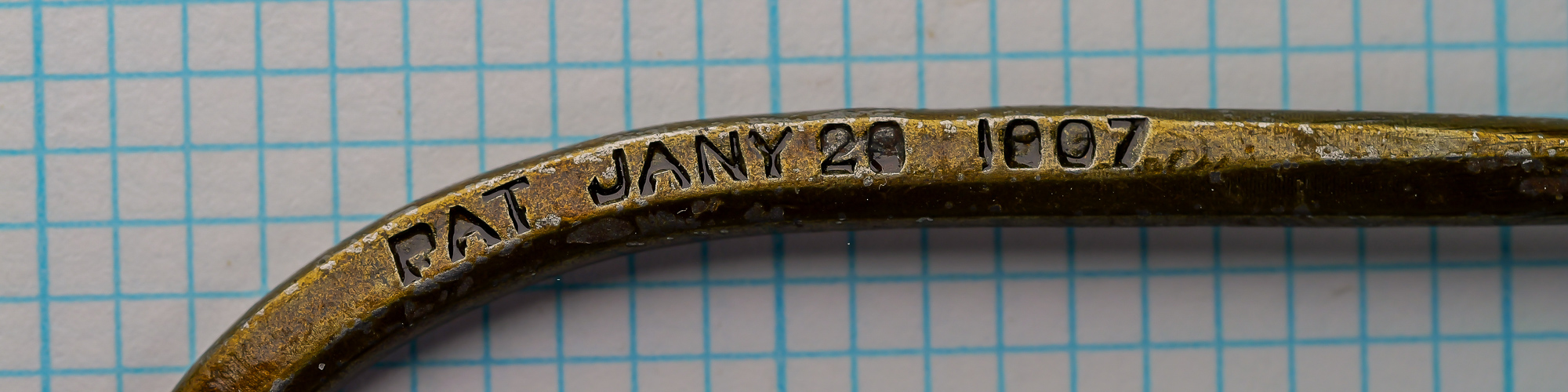
Look for two legends struck on different faces of the bend. One reads IMP’D VAN VLECK HOOK P. The other begins PAT JANY and gives a date P.

On the photographed hook, the date digits are filled with dark residue, and the second digit of the day and of the year cannot be read with certainty P. An auction lot describes two hooks marked “Pat Jany 29 1907” V. Neither legend carries a patent number, so the date is the only link to patent 842,594 I.

Some examples are unmarked V, so a missing legend does not rule the type out. For those, compare the point and barb with the patent drawing I. One collector page notes three sizes, about 10/0, 11/0 and 13/0 V.

Technical profile and measurements

Features of the model, as recorded
FeatureRecordedEvidence
EyeBrazed Eye, Straight / Inline
WireHeavy (1X Heavy), Forged
ShankStandard — Plain
BendWide gap
Show noteHide note

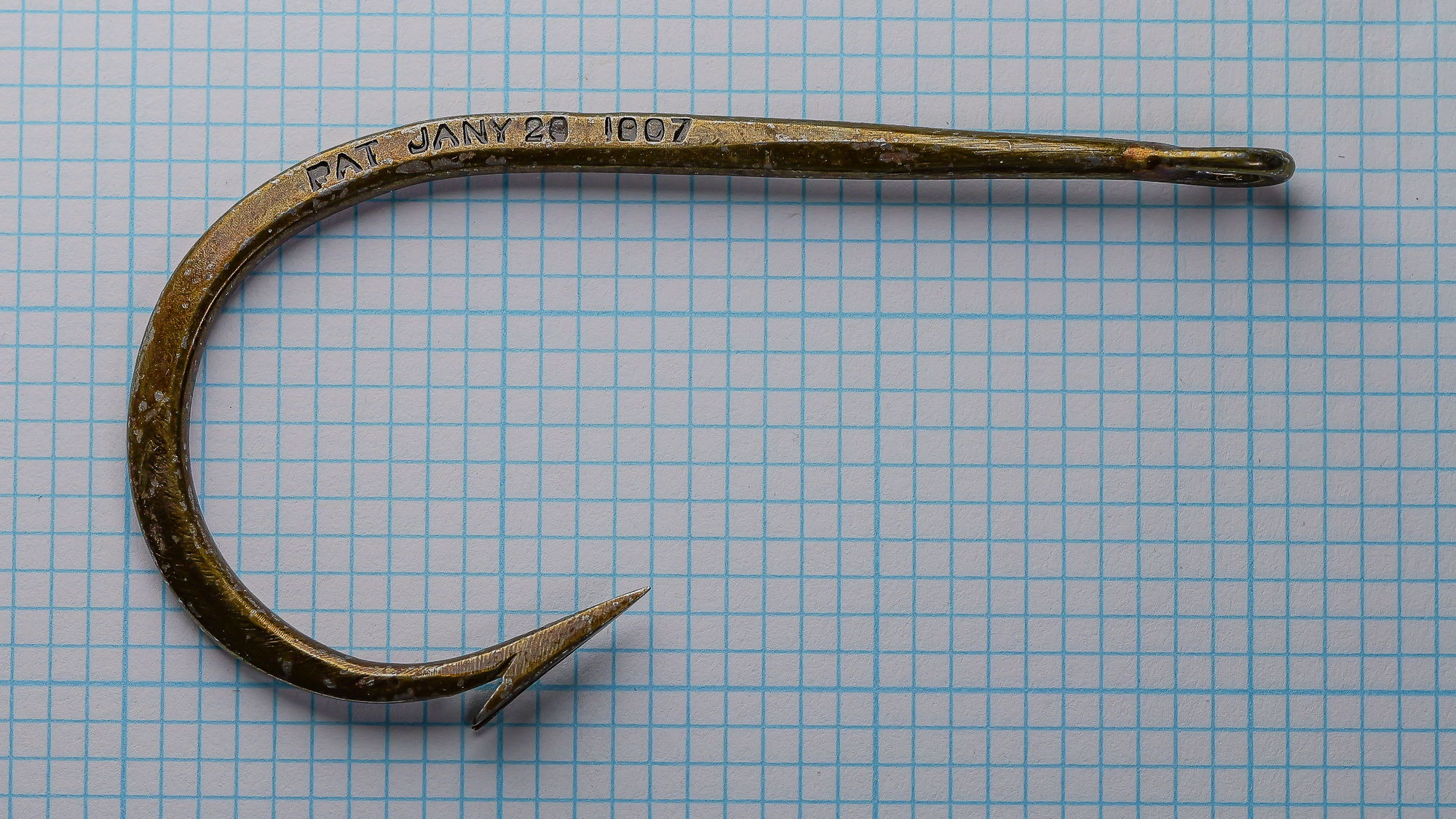
Deep, rounded, U-shaped bend with the point directed back toward the shank. Broad flat faces and angular edges run around the curve P.

OBS-3
Point
Show noteHide note

Barb raised from the outer side of the point, with a cut notch at its root P. Its tip may be forked; the photograph does not confirm it I.

OBS-5OBS-6
FinishBronzed — stated on packaging
Show noteHide note

Surface is golden-brass to olive-brown with grey-silver patches where worn through P. No label or source names the finish, so bronzed is inferred from the color I.

OBS-8

The photographed specimen has a long, tapering point whose straight edges converge to a sharp tip, with fine tooling marks across its face P. The outer-side barb matches the form shown in patent Fig. 2 I.

The shank is flattened, with broad faces and angular edges, and appears to narrow toward the eye P. No ridges, kinks or microbarbs are visible P.

A collector page describes the type as hand-made and forged, with wire more oval than sharply flat-faced V. Wire thickness falls in the heavy range of the catalog E.

Measurements

Measurements · caliper
Overall length79.2 mm E
Shank length65 mm E
Gap width27.3 mm E
Wire diameter4.1 mm E
Shank-to-gap ratio~2.4:1 E
Calibrated SVG True-scale preview

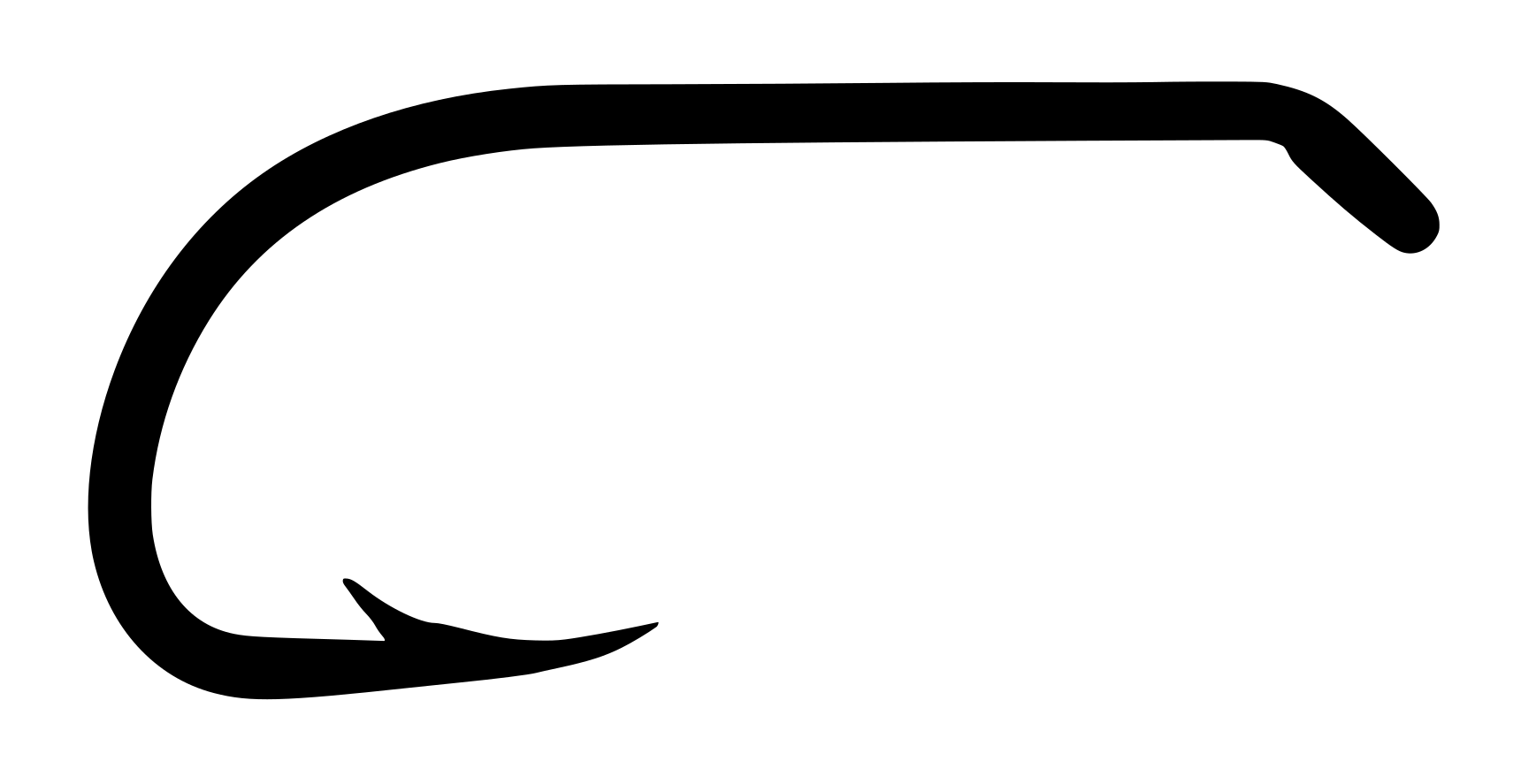
How hook dimensions are measuredA hook outline with dimension lines for overall length, shank length, gap, bend depth, and wire diameter.Overall lengthShank lengthGapBend depthWire diameter
Overall length
Eye to the farthest point of the bend.
Shank length
Eye to the start of the bend.
Gap
Point to shank, at right angles to the shank.
Bend depth
Shank to the bottom of the bend.
Wire diameter
Across the wire, measured by caliper where possible.

Specimens, packaging, and label

This record documents one specimen. It describes that specimen only, not every example of the model.

S1 · Loose hook with two struck legends

Container
Loose (no packaging)
Hook condition
Wear and finish loss over the shank, bend and eye, with reddish-brown staining near the eye closure (P). Legends are partly filled with dark residue. Point, barb and eye appear intact, with no visible bending or breakage (P).
Wear
PAT line, digits after JANY: Dark residue fills the closed parts of the digits after JANY and in the year, so the bowl or tail of the second digit in each cannot be told apart. LBL-3
Wear
shank, bend, eye and point surfaces: Scattered patches of grey, bare-looking metal where the golden-brown surface has worn or flaked; small reddish-brown stained areas, most obvious beneath the eye. LBL-4
Photographs
IMG-2IMG-3IMG-4IMG-5IMG-6

No packaging supplied. No size mark is visible in the photographed areas.

What the label says

LBL-1 printed · outer curve of bend and shank, struck into one face from IMG-4IMG-6
PAT JANY 2[?] 1[?]07
LBL-2 printed · outer curve of bend, other face, inverted in photo from IMG-5
IMP'D VAN VLECK HOOK
As entered on the specimen record
PAT JANY 2[?] 1[?]07
IMP'D VAN VLECK HOOK
Layout
Both legends are struck along the outer curve of the bend and the adjoining shank, one on each face.
Printed marks
Two struck legends. In the PAT legend, the second digit of the day and of the year read ambiguously (9 or 0); PAT JANY 29 1907 is a possible reading.

Pattern history and manufacturer context

Design lineage

The design was patented as US 842,594, titled Fish-hook, by George H. Van Vleck and Louis C. Van Vleck of Toledo, Lucas County, Ohio V. The application was filed October 1, 1906, and the patent was granted January 29, 1907 V.

The patent describes a long, narrow, gradually tapered point, triangular in section, with a flat face that ends in a forked barb. A notch spaces the barbs from the bill, the curved portion of the hook that carries the point V.

In the drawings the barb faces the shank in Fig. 1 and the outside in Fig. 2. The patent calls the outside form preferable and says the bend brings the point near the line of pull V.

Dating

The legend cites a patent date that matches the grant of US 842,594, and its readable characters are consistent with that date I. A hook bearing a patent-date legend was probably made after the grant. No source gives production dates.

The Van Vleck Hook Co. — The patent names two individual inventors and no company V. No factory, production dates or catalog listing are documented in the sources consulted. Read the maker’s history →

Use

  • Saltwater

Primary application

The patent describes the hook for catching tarpon and other large game fish V. No other intended use is documented.

Collecting and buying

No sold results are recorded for this model, so no value range is given. One listing's price was hidden and the other showed no sale result.

Where to find

Marketplace listings and auction lots offer examples, in groups of two or three in the sources consulted V.

Modern equivalents and related hooks

Sources, open questions, and record notes

Sources & Documentation

This specimen and its packaging — photographed, 6 images
Supports: bendbarbfinishoverall lengthshank lengthgap widthwire diameter measuredshank gap ratiomeasurements availablemeasurement notesdating rangemeta titleprimary search termstechnical notesidentification

Entry last updated October 1, 2026. Entries are updated as new specimens, measurements, or documents come to light.