The Mustad Qual. 7680 is a specialized saltwater bait hook marketed as a ‘Blackfish Hook’ for targeting Tautog (Blackfish) and similar hard-mouthed bottom-dwelling species along the North American Atlantic coast. Manufactured by O. Mustad & Søn in Christiania, Norway, this hook features a distinctive filed low point geometry, wide gap, and heavy-gauge wire designed to penetrate the thick, leathery mouth of Blackfish while withstanding their crushing jaw pressure.
The ‘Christiania’ designation on the label provides definitive dating to 1924 or earlier, as Oslo was officially renamed from Christiania on January 1, 1925. Combined with the classic Key Brand logo and vintage letterpress printing, this specimen belongs to the late Victorian or Edwardian era of fishing tackle manufacture (c. 1880–1910), when Mustad was aggressively reverse-engineering and cloning regional North American hook patterns to dominate global markets.
This hook is moderately collectible among specialists in vintage saltwater tackle and regional Tautog fishing traditions. The specimen is valuable as a documented example of Mustad’s industrial strategy and the specialized hooks engineered for 19th-century American regional fisheries that are now largely forgotten.
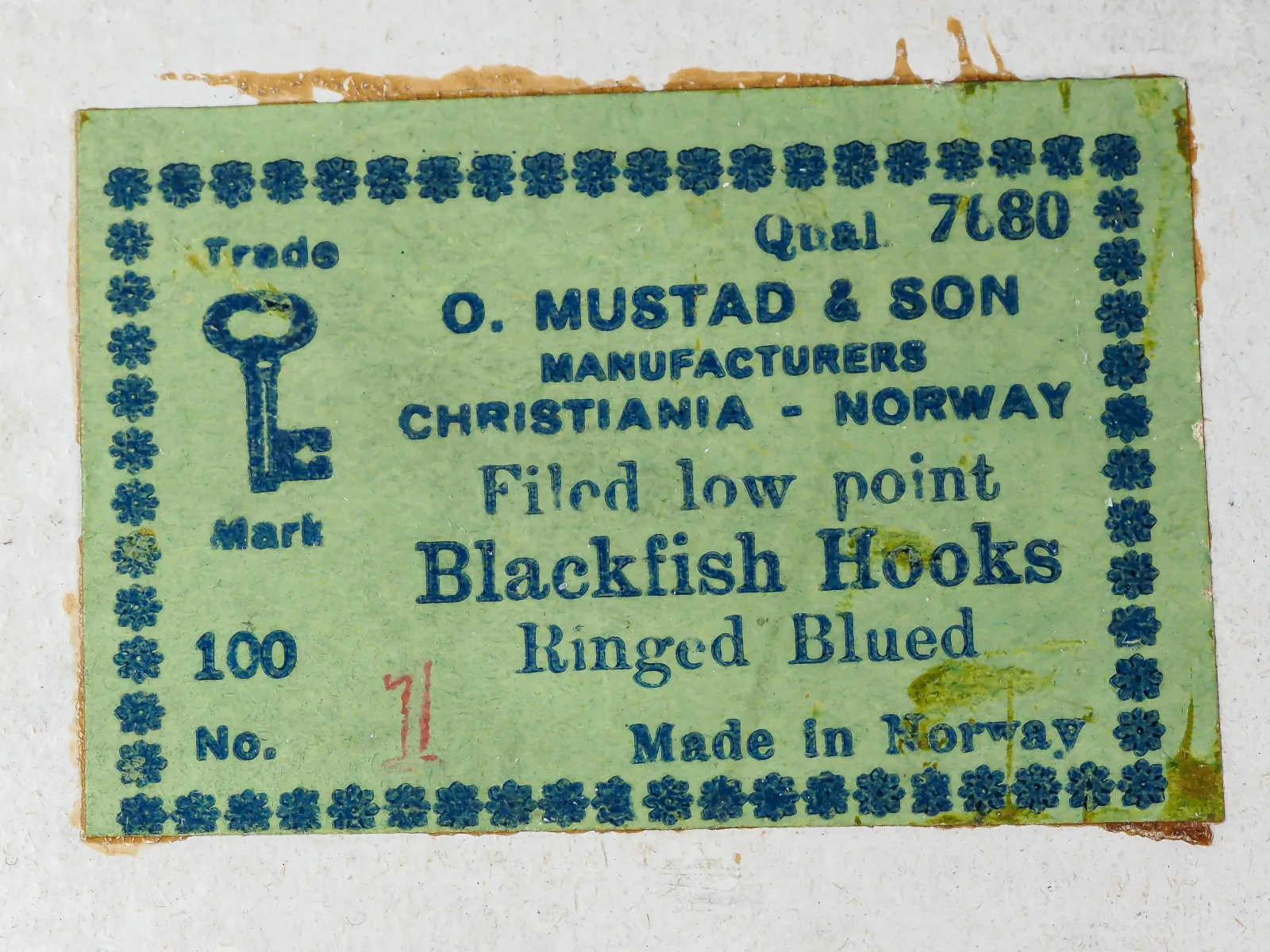
Complete original Mustad Qual. 7680 sales card showing the classic eight-line label format with 'Christiania – Norway' designation, Key Brand logo, and all 100 hooks present. The green card stock and decorative floral border are typical of Mustad's 1880–1910 era packaging.
Photographic record
3 cataloged imagesSelect any record to load it above.
3 images shown
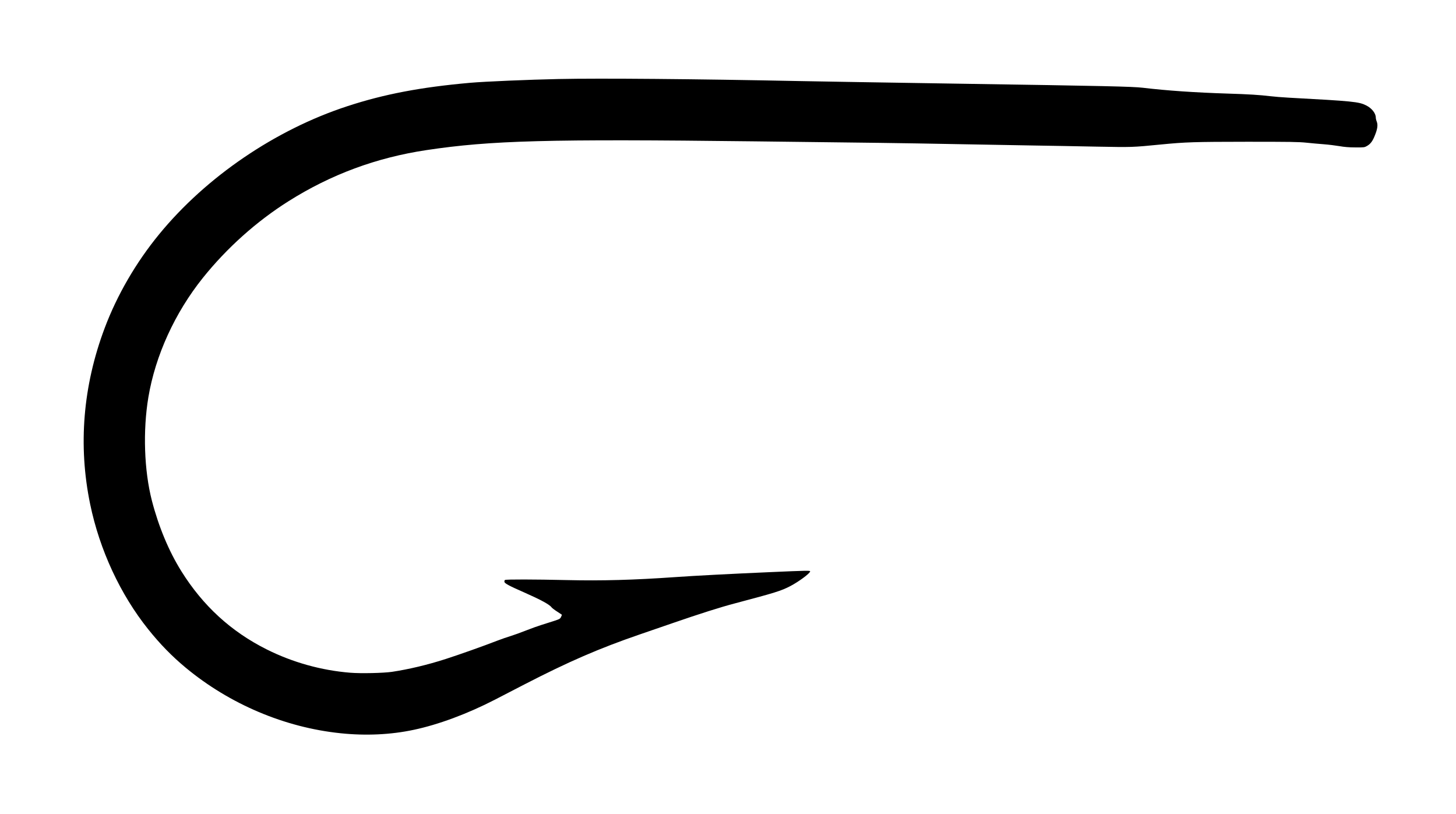
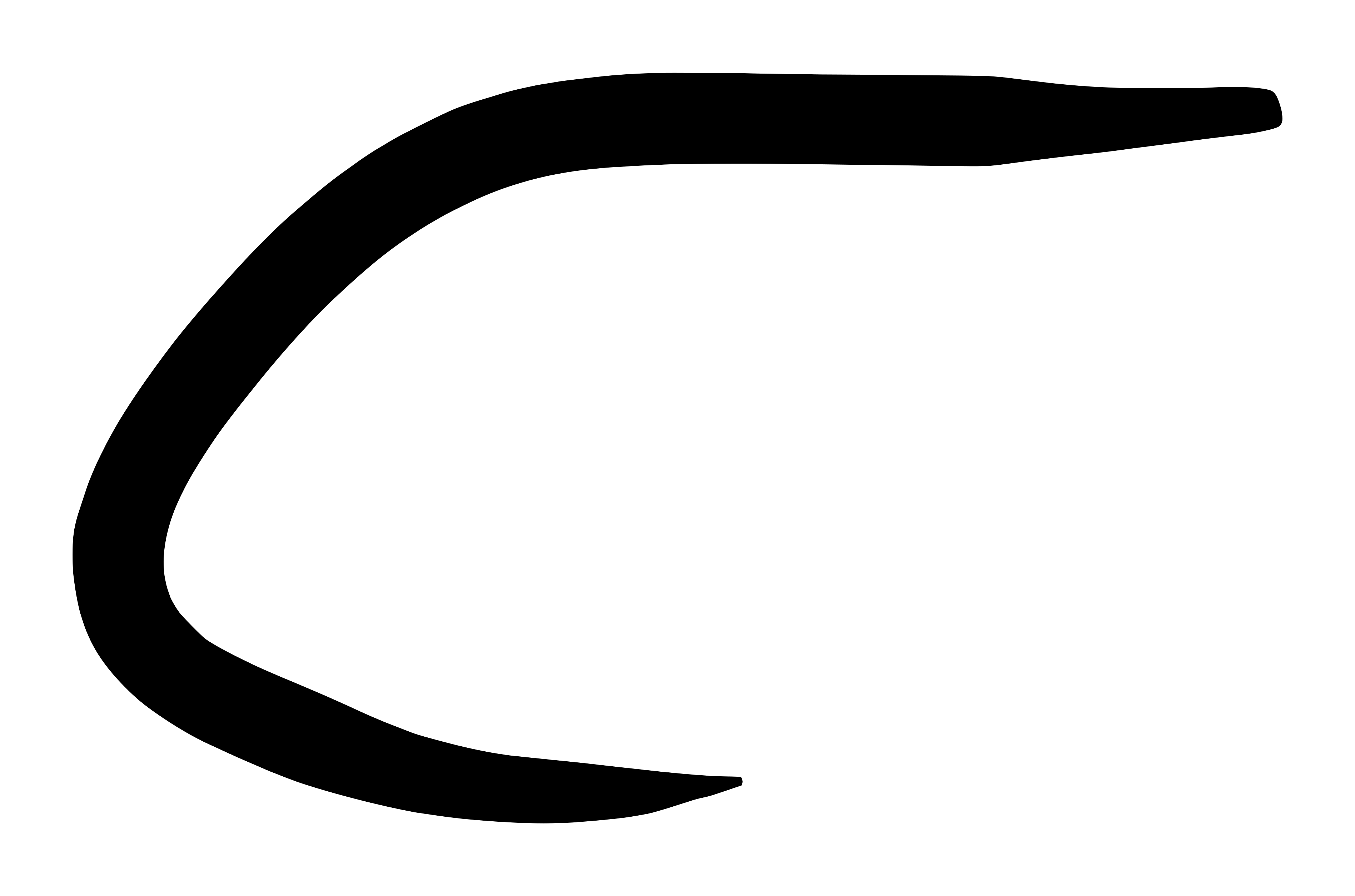
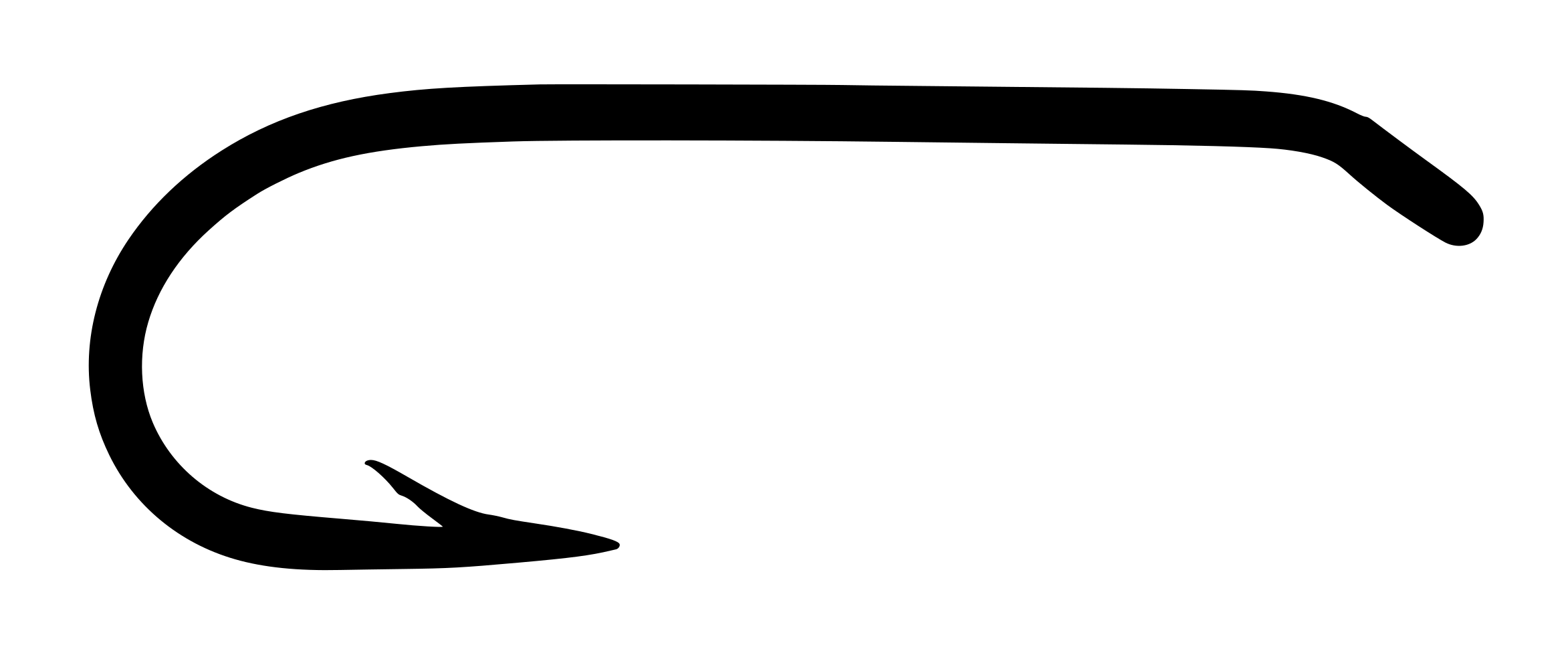
Mustad 7680 Blackfish Hook Original Sales CardComplete original Mustad Qual. 7680 sales card showing the classic eight-line label format with 'Christiania – Norway' designation, Key Brand logo, and all 100 hooks present. The green card stock and decorative floral border are typical of Mustad's 1880–1910 era packaging.Open originalMustad 7680 Point Detail and Filing PatternClose-up detail of the Mustad 7680's distinctive filed low point, showing the characteristic filing marks on the point, the barb position close to the point body, and the blued finish coloration under raked light.Open originalMustad 7680 Full Hook Profile and GeometryFull profile view of the Mustad 7680 Blackfish Hook, size No. 1, displayed on measurement grid. Shows the wide-gap U-bend, relatively long shank, ringed (ball) eye, and overall proportion optimized for bulky natural baits and hard-mouthed saltwater species.Open original
Technical profile
Eye
Ball Eye, Straight / InlineThe eye is a simple ringed (ball) eye formed by bending the terminal wire back onto the main shank, creating a circular loop approximately 0.08–0.10 inches in diameter. The wire diameter at the eye is consistent with the rest of the shank, indicating no tapering. The eye sits perpendicular to the shank plane. P
Wire
Heavy (1X Heavy), Round
Shank
1X Long — Plain
Bend
Wide gapThe bend is characterized by a relatively wide, open U-shape with significant depth—approximately 0.75–0.85 inches in this specimen—suitable for accommodating bulky natural baits. The bend profile is strictly straight along the shank axis with no lateral offset (not a Kirby pattern). The geometry is designed for maximum gape without sacrificing structural rigidity. P
Point
OtherThe barb is small, sharp, and close-cut relative to the point. It is positioned at a shallow angle and sits very close to the filed point body, creating minimal separation between the barb shoulder and the point shaft. This design minimizes catch area while maintaining secure hold. The barb edge shows the characteristic filing marks of hand- or early machine-grinding processes. P
Finish
Blued — Confirmed (stated on packaging)The blued finish displays a dark, charcoal-black coloration with a slight blue undertone visible in raked light. The finish is uniform across the shank and bend, with no visible flaking or wear on the specimen. The finish is consistent with heat-treated chemical passivation (bluing) rather than japanning or lacquer coating. This finish provides moderate corrosion resistance in saltwater environments, which was the standard for American bait hooks of the era. P
The specimen is in very good condition. All 100 hooks remain on the original sales card (no missing hooks documented). The card stock shows age toning and surface wear consistent with genuine vintage packaging, with light foxing on the edges and discoloration from handling and storage. The label remains fully legible with no significant paper loss. Hook finish is uniform and shows minimal handling damage or corrosion.
The filed low point geometry is the defining engineering feature of the Qual. 7680. Unlike hollow points (which feature a concave, dished inner face designed for minimal-pressure penetration in soft-tissue fish) or knife-edge points (which are two-sided flats designed for slicing bone), the filed low point is a hand-filed or machine-ground taper that creates a relatively blunt, durable tip capable of penetrating tough, leathery oral tissue without snapping or rolling under extreme pressure.
The term ‘filed low point’ indicates that the taper was ground at a low, shallow angle—meaning the point begins its taper some distance back from the very tip, creating a short, tough working length rather than a long, delicate cone. This geometry is optimized for species with thick lips, dense mouth tissue, and powerful crushing jaws, where a standard needle or hollow point would either fail to penetrate or be severely damaged by the initial strike.
The heavy-gauge round wire provides structural rigidity and tensile strength to resist bending open during the sustained head-shaking and crushing behavior of Blackfish and Sheepshead. The wide gap maximizes the spread of the hook when rigged with bulky natural baits, ensuring the point remains fully exposed and ready to engage the fish’s jaw regardless of how the bait settles or moves in the current. The long shank provides mechanical leverage and stand-off distance, improving the odds of a solid corner-of-the-mouth or hard-tissue hook set.
The filed low point represents a distinctive point geometry rarely encountered in the garrenwood.com catalog. This hook exemplifies Mustad's regional cloning strategy and serves as documentation of the specialized tackle engineered for the North Atlantic Tautog fishing tradition—a now-obscure regional fishery that demanded specialized hook designs. The Christiania designation represents the absolute terminus ante quem dating methodology, making this specimen valuable for establishing provenance and era-dating protocols for other Mustad cards bearing similar geographic nomenclature.
Own this hook? Help us measure it.
We don't have measured sizes for this hook yet. Own one? Submit calipered measurements and we'll review and add them. Thank you!
Historical context
mustad
O. Mustad & Søn was founded in 1832 in Gjøvik, Norway, initially as a general metalworking facility under the name Brusveen Spiger- og Staltradfabrikk, producing nails, steel wire, and cast-iron goods. The company was taken over by Ole Hovelsen Mustad and his son Hans Mustad, who rebranded it as O. Mustad & Søn and began hook production. The defining moment in the company’s history occurred in 1877 when Mathias Topp, an engineer within the firm, invented the first fully automated hook-making machine—a mechanized system capable of continuously cutting, bending, barbing, and pointing hooks at unprecedented scale and speed.
Recognizing the competitive advantage of this proprietary technology, the Mustad family chose not to file patents (which would require public disclosure of mechanical details) but instead relied on corporate secrecy, strict non-disclosure agreements, and restricted factory access to protect their methods. This strategy proved devastatingly effective against rival hook manufacturers in Redditch, England, and throughout Japan and the United States. By the 1950s, Mustad controlled approximately 50 percent of global hook production and had established sales offices and manufacturing facilities across multiple continents, making the name ‘Mustad’ virtually synonymous with the fishing hook itself.
Series History
The Qual. 7680 belongs to Mustad’s expansive catalog of regionally cloned saltwater bait hooks, produced during the company’s aggressive industrial ‘reverse-engineering’ campaign of the 1870s–1920s. This hook does not represent a broader named series but rather a standalone quality-code designation within Mustad’s numerical tier system.
The ‘7680’ quality code places this hook in the premium tier (4000 and above), indicating highly specialized, refined hooks manufactured to exacting dimensional and tempering standards. The ‘Blackfish Hook’ nomenclature on the label reflects Mustad’s strategy of marketing regionally specific patterns to localized North American fishing traditions—in this case, targeting the dedicated Tautog fishery of the Atlantic coast, particularly in New York and New England.
This hook was likely produced in limited quantity compared to mass-market patterns like the 3304 Cincinnati Bass or the 3906 Sproat, making surviving examples moderately scarce. The model does not appear in modern Mustad catalogs, indicating discontinuation sometime in the mid-20th century as fishing traditions shifted and regional specialty hooks fell out of favor in the era of standardized, multipurpose patterns.
Era and Packaging Dating
The label bears the designation 'CHRISTIANIA – NORWAY,' establishing an absolute terminus ante quem of January 1, 1925, when Oslo was officially renamed. The Christiania spelling, the classic skeleton-key 'Key Brand' trademark, the letterpress printing technology with characteristic serif typeface, the light green card stock, the decorative floral border design, and the absence of any barcode all point to late 19th- or early 20th-century manufacture. The handwritten size notation in red ink is consistent with pre-1920s Mustad practice. Historical documentation indicates heavy Mustad exports to North American markets circa 1880–1910, aligning with this specimen. No other packaging or documentary evidence contradicts this dating window.
The Reverse-Engineering Strategy
In the late 19th century, Mustad's industrial dominance was so complete that the company strategically reverse-engineered and cloned localized hook patterns from fishing traditions across North America, Britain, and Europe—purchasing examples from regional blacksmiths and tackle makers, photographing them, and then manufacturing mechanized versions at Norwegian production speeds. The Qual. 7680 'Blackfish Hook' is one of hundreds of such regionally cloned patterns, each engineered to satisfy a specific local fishing tradition. By 1900, Mustad's Oslo factory was producing over 50,000 different hook configurations, making the company's catalogs longer and more comprehensive than many tackle retailers' entire product lines. This vertical integration of regional knowledge into global industrial scale is a cornerstone of Mustad's market dominance throughout the 20th century.
Design lineage and influence
The Qual. 7680 does not appear to have direct predecessors or successors in documented hook genealogy. However, it is part of a broader lineage of hard-water saltwater bait hooks designed for crushing-jawed fish. Contemporary competitors included the O’Shaughnessy (known for heavy-gauge wire and robust construction) and various regional American bait patterns (Cincinnati, Virginia, Kendal) adapted by Mustad for saltwater applications.
Modern successors would include the Mustad 92553 (Beak Hook) and specialized hooks engineered for modern Tautog fishing, such as Owner’s SSW cutting-point designs and circle hooks, which have largely replaced the filed low point design in contemporary practice. The shift away from the filed low point reflects broader changes in fishing technique—modern anglers favor self-setting designs (circle hooks) or cutting points (for better penetration in hard bone) over the brute-force geometry of the vintage filed low point.
Best matchRelated by Attribute
Computed automatically from catalog data — updated as new hooks are added.
Matches: Bend, Wire, Eye Orient., Point, Application +2 moreDiffers: Shank: 1X Long vs Standard; Gap: Wide vs Standard; Eye: Ball Eye vs Needle Eye +2 more
Matches: Bend, Eye Orient., Point, Application, Shank Feat. +1 moreDiffers: Shank: 1X Long vs Standard; Wire: Heavy (1X Heavy) vs Extra-Heavy (2X+); Gap: Wide vs Standard +3 more
Matches: Bend, Gap, Eye Orient., Point, Forging +2 moreDiffers: Shank: 1X Long vs Short (1X–2X Short); Wire: Heavy (1X Heavy) vs Extra-Heavy (2X+); Eye: Ball Eye vs Needle Eye +2 more
Matches: Bend, Gap, Eye, Eye Orient., Point +3 moreDiffers: Shank: 1X Long vs Extra-Extra Long; Wire: Heavy (1X Heavy) vs Standard; Finish: Blued vs Bright / Uncoated Steel +1 more
The Mustad 7680 was engineered specifically for still-fishing with natural baits targeting Tautog (Blackfish, Tautoga onitis) and related hard-mouthed bottom-feeding species such as Sheepshead and grunt. The filed low point geometry is designed to penetrate the exceptionally thick, leathery oral tissue and crushing jaw structure characteristic of these species. The wide gap accommodates bulky live baits—typically small crabs, squid, or pieces of herring—without sacrificing hook-point exposure. The heavy-gauge round wire resists bending under the violent head-shaking and crushing bite pressure of large Tautog, while the long shank provides additional stand-off distance from the bait to improve hook-up odds.
Secondary Applications
Sheepshead (Archosargus probatocephalus), Sea Robin, large Porgies, other hard-mouthed saltwater bottom species.
Classic Fly Patterns
Not typically used for fly tying.
Modern Equivalents
Hook
Match Quality
Notes
Mustad 92553 Beak Hook
Good
Modern saltwater hook with reversed offset and heavy wire for hard-mouthed species. Different point geometry but similar functional purpose for Tautog and Sheepshead.
Owner SSW Cutting Point
Good
Specialized hook with cutting-point design for penetrating dense bone and cartilage in hard-mouthed saltwater species. Represents evolution toward slicing rather than filing geometry.
Mustad 36890 or modern circle hooks
Moderate
Contemporary Tautog specialists increasingly prefer circle hooks for self-setting and conservation-friendly corner-of-jaw hooking, departing from the filed low point tradition entirely.
Collector notes
Reference value
$7 – $14 USD estimate
Packaging condition
Good — moderate wear, legibleRecorded specimen
Packaging format
mustad-vintage-card-01Catalog code
Packaging
Light green card stock with decorative floral border pattern (small four-petaled flowers) printed in dark blue ink. Dimensions approximately 3.5" × 2.5" (89 × 64 mm). Printed text in serif letterpress typeface, dark blue ink on green stock. Left side features the iconic skeleton-key 'Key Brand' trademark logo (downward-pointing key with 'Mark' label). Text layout follows Mustad's standardized eight-line label format with additional size and quantity notations. Card includes handwritten red-ink size marking '/1' over the printed label. All 100 hooks remain on card, held in place by original paper wrapper or binding (partially visible). Card edges show light foxing and age toning consistent with 120+ year age. Printing shows no offset or bleeding, indicating professional letterpress production. No barcode visible (confirms pre-1974 manufacture).
Collector's Identification Tips
Model Code Verification: The quality code ‘Qual. 7680’ is clearly printed on the label in the upper right quadrant, consistent with Mustad’s eight-line label format (Line 4: Quality Model Code). Some sources suggest ambiguity between 7680 and 7880; careful examination of the first digit (clearly a ‘7’) and the second digit (clearly a ‘6’, not an ‘8’) resolves this to 7680.
Geographic Origin Marker: The ‘CHRISTIANIA – NORWAY’ designation on Line 3 of the label is a definitive dating indicator. Christiania was Oslo’s name prior to January 1, 1925. Any Mustad card bearing ‘Christiania’ with the classic Key Brand logo and this typography dates to 1924 or earlier, making it a genuine antique.
Size Marking: The handwritten size marking ‘/1’ in red ink over the label indicates No. 1 size. This handwriting style is consistent with pre-1925 Mustad practice. Modern Mustad labels (post-1950) use printed size designations rather than handwritten notation.
Packaging Format: The card format—light green stock with decorative floral border, letterpress serif typography, and the iconic skeleton-key trademark—matches confirmed examples of Mustad’s 1880–1910 sales card design. The presence of all 100 hooks on the card is a significant authenticity factor, as vintage cards with complete hook counts are less common than opened or depleted examples.
eBay market reference. Researcher-curated. Prices in USD.
Preservation
Storage and Preservation
Store this vintage card in a cool, dry environment away from direct sunlight and moisture. The blued finish is relatively durable but will gradually oxidize if exposed to high humidity; a consistent relative humidity below 50 percent is ideal. Do not attempt to clean or polish the blued finish, as this may remove the protective oxidation layer.
Original packaging is a significant part of the specimen’s value and historical authenticity. Keep the hooks on the original sales card rather than removing them to loose storage. Store the card flat or at a slight angle to avoid bending and card warping. Avoid contact with acidic materials (newsprint, unaltered cardboard), which may accelerate deterioration. Archival-quality acid-free storage boxes or folders are recommended for long-term preservation.
If any hooks show signs of active rust (reddish oxidation rather than the original dark blue patina), isolate the affected specimens immediately to prevent rust bloom from spreading to adjacent hooks. The blued finish will naturally develop a light gray patina over decades—this is not corrosion but rather a desirable aging characteristic prized by collectors.
Primary Source
Mustad Label Analysis: Eight-Line Format Decryption
Line 1 (Manufacturer Title): ‘O. MUSTAD & SÖN’ — The full, unabbreviated corporate name, establishing primary manufacturing authority. The Nordic spelling ‘SÖN’ (son) rather than modern ‘SON’ is typical of late 19th-century Norwegian corporate branding.
Line 2 (Industry Role): ‘MANUFACTURERS’ — A deliberate assertion of Mustad’s role as the primary producer, not a wholesaler, jobber, or repackager. This distinction was commercially critical in an era when numerous regional distributors purchased bulk hooks and relabeled them under secondary brand names.
Line 3 (Geographic Origin): ‘CHRISTIANIA – NORWAY’ — Provides absolute chronological dating. Christiania, Norway’s former name, was officially changed to Oslo on January 1, 1925. Any label bearing ‘CHRISTIANIA’ with the classic Key Brand logo dates definitively to 1924 or earlier.
Line 4 (Quality Code): ‘Qual. 7680’ — The numerical quality tier. Codes 4000 and above denoted premium, highly specialized hooks. This premium designation indicates the Blackfish Hook was engineered for a specific, demanding application rather than as a general-purpose bait hook.
Line 5 (Point Identifier): ‘Filed low point’ — A rare and specific point description. Unlike standard Mustad descriptors (Hollow Point, Superior, Knife Edge), the ‘filed low point’ nomenclature emphasizes the hand-filing or machine-grinding manufacturing technique and the shallow taper angle. This geometry is optimized for penetrating thick, leathery oral tissue.
Line 6 (Pattern Name): ‘Blackfish Hooks’ — The regional marketing designation, targeting the North American Atlantic coast Tautog (Blackfish) fishing tradition. ‘Hooks’ (plural) indicates a general category rather than a singular named pattern.
Line 7 & 8 (Features & Finishes): ‘Ringed Blued’ — Specifies the eye type (ringed ball eye) and the metallurgical finish (blued, a heat-treated chemical passivation providing dark coloration and rust resistance).
Size and Quantity: The handwritten notation ‘100 No. 1’ indicates 100 hooks per box, size No. 1. The handwritten red-ink style is characteristic of pre-1920s Mustad labeling practice.
Marking Analysis
Handwritten Notations and Marking Practice
The size designation ‘/1’ is marked in red ink over the printed label, likely applied by a warehouse laborer or salesman during order fulfillment. The handwriting style is consistent with early 20th-century cursive, with a slightly irregular slant and characteristic serif ink bleed patterns typical of nib-pen application rather than modern ballpoint or marker inks.
This handwritten notation serves as an authenticity marker. Modern counterfeit or reproduction cards typically use printed size designations or modern pen styles. The presence of a period-appropriate handwritten size mark—combined with the Christiania designation and classic Key Brand logo—strongly supports the specimen’s genuine vintage provenance and dating to the 1880–1910 period.
The placement of the notation (directly over the printed label text rather than in a designated blank space) suggests this was a standard Mustad practice during the era when card designs had not yet incorporated dedicated size-marking spaces. Later Mustad cards (post-1925) typically featured printed size designations or dedicated handwriting areas with ruled guidelines.
Additional
The North American Blackfish (Tautog) Tradition
The Tautog, Tautoga onitis, is a bottom-dwelling Atlantic coast species prized for its hard-fighting behavior and delicate white flesh. Found from Nova Scotia to South Carolina, with greatest abundance in New York and New England estuaries and bays, Tautog have been a staple of regional fishing traditions since colonial times. However, the species’ unique physiology—including an exceptionally thick, leathery lip, powerful crushing teeth, and bone-hard oral structure—demanded specialized hook designs that differ dramatically from standard freshwater or even general saltwater patterns.
Traditional Tautog fishing relies on still-fishing with natural hard-shell crab baits, fiddler crabs, squid, or clam, deployed on heavy sinker rigs along rocky bottoms, pilings, and breakwaters where Tautog aggregate. The species’ habit of ‘mouthing’ bait before fully committing to a strike demands hooks capable of penetrating thick tissue without a violent hook-set—a gentle, steady pressure is more effective than an aggressive yank.
The Qual. 7680’s filed low point, wide gap, and heavy wire are all engineered for this specific behavioral and anatomical context. The hook’s design reflects a century of accumulated regional knowledge about Tautog behavior, codified into Mustad’s product catalog during the company’s aggressive campaign to dominate North American regional fishing markets. By offering a hook specifically optimized for Tautog, rather than forcing anglers to adapt a generic pattern, Mustad captured loyal customers in a niche but dedicated regional fishery.
Today, the Tautog fishing tradition persists along the Atlantic coast, though modern anglers have largely shifted to circle hooks and contemporary designs. The vintage filed low point represents an artifact of a fishing culture that valued specialized, regionally adapted tackle—a philosophy increasingly rare in an era of standardized, multipurpose hook designs.
Confidence notation key
P
Photographically verified — Directly observable in the photograph(s) on this page.
V
Verified by documentation — Confirmed by manufacturer catalog, spec sheet, or published reference.
I
Inferred — A logical deduction from observable or documented evidence, not directly stated.
E
Estimated — An approximation based on visual comparison, proportional analysis, or limited data.
S
Speculative — A reasoned hypothesis that cannot be confirmed from available evidence.
Claims with no notation are confirmed by multiple independent sources. All photographs on garrenwood.com are taken on a measurement grid where each square equals 1/10 inch (0.1″ / 2.54 mm).