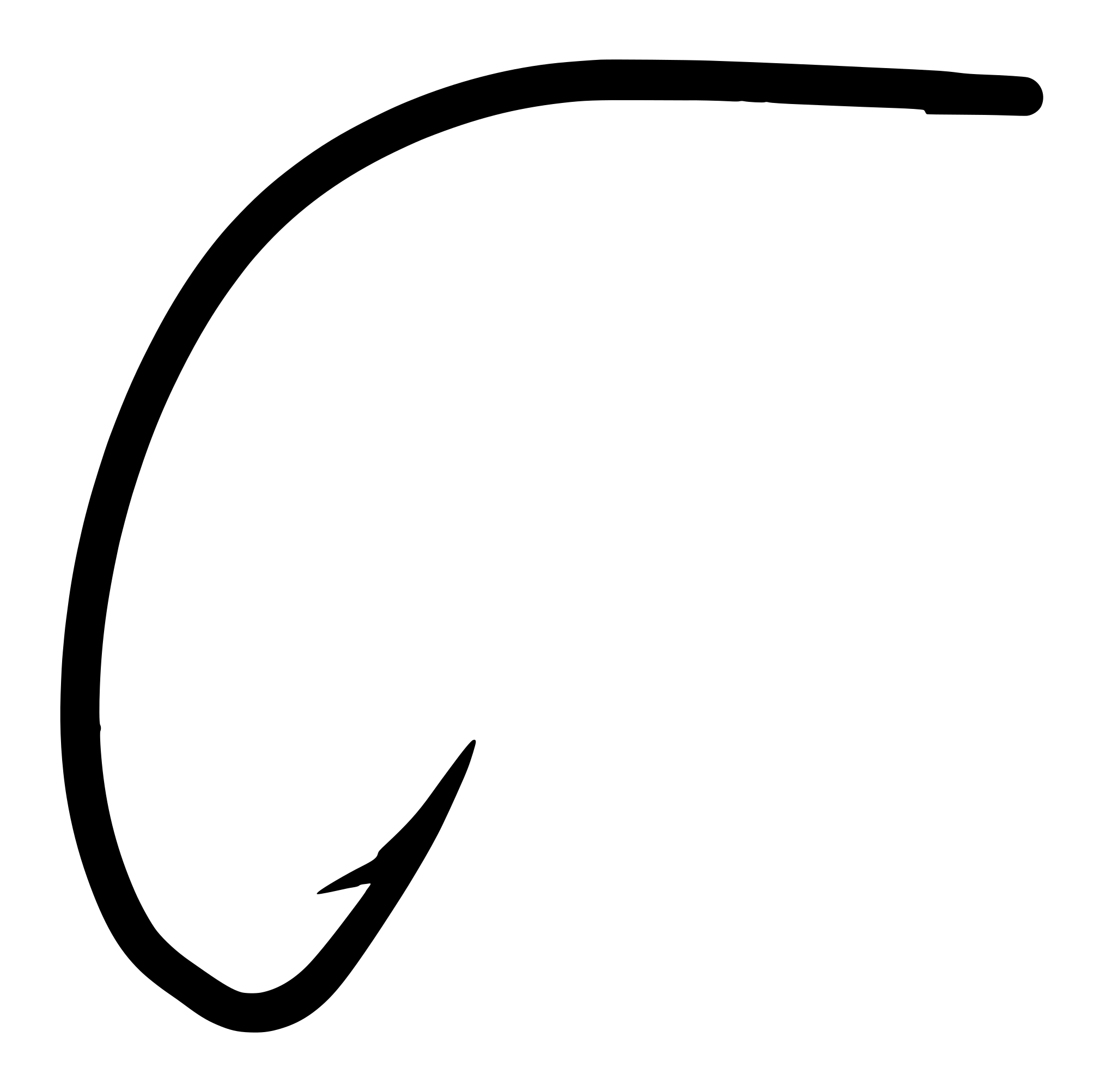
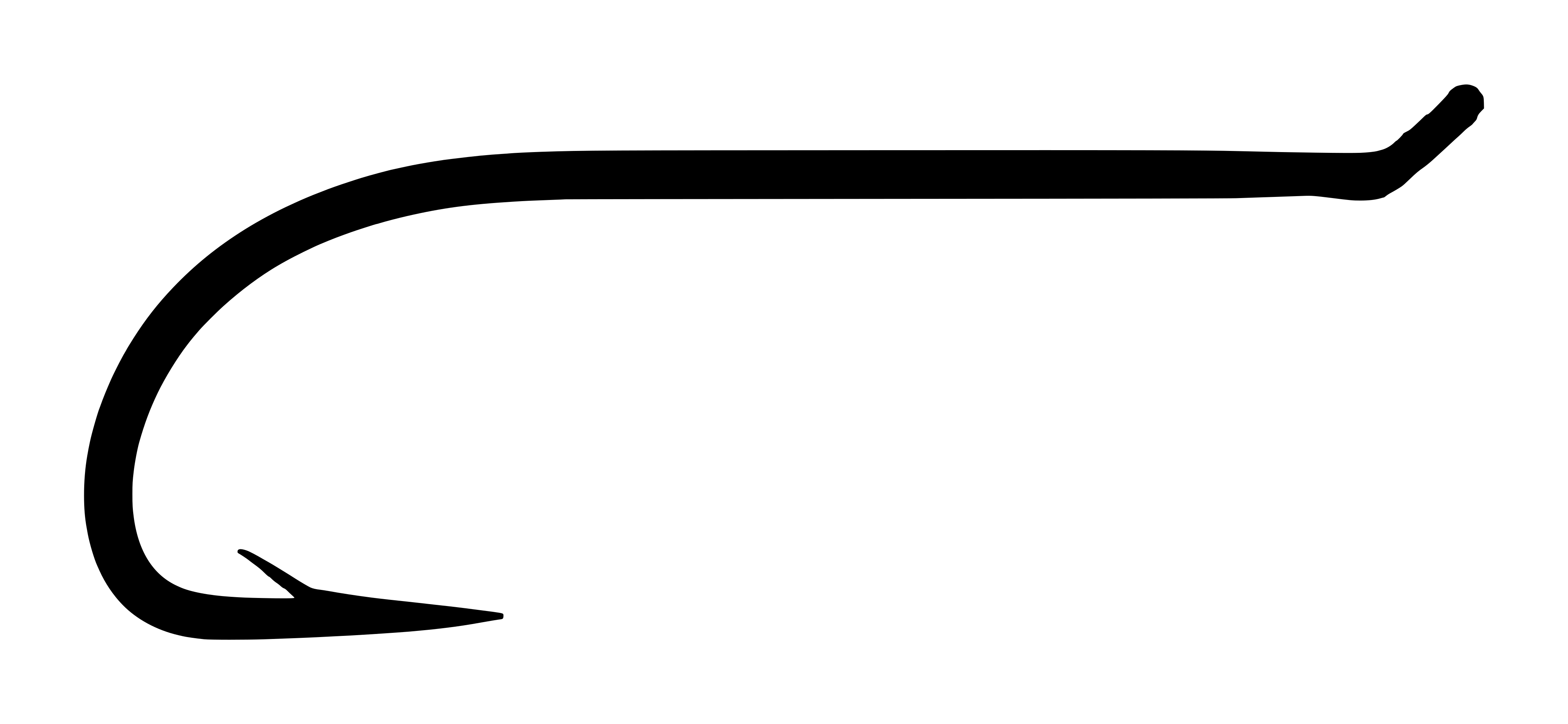
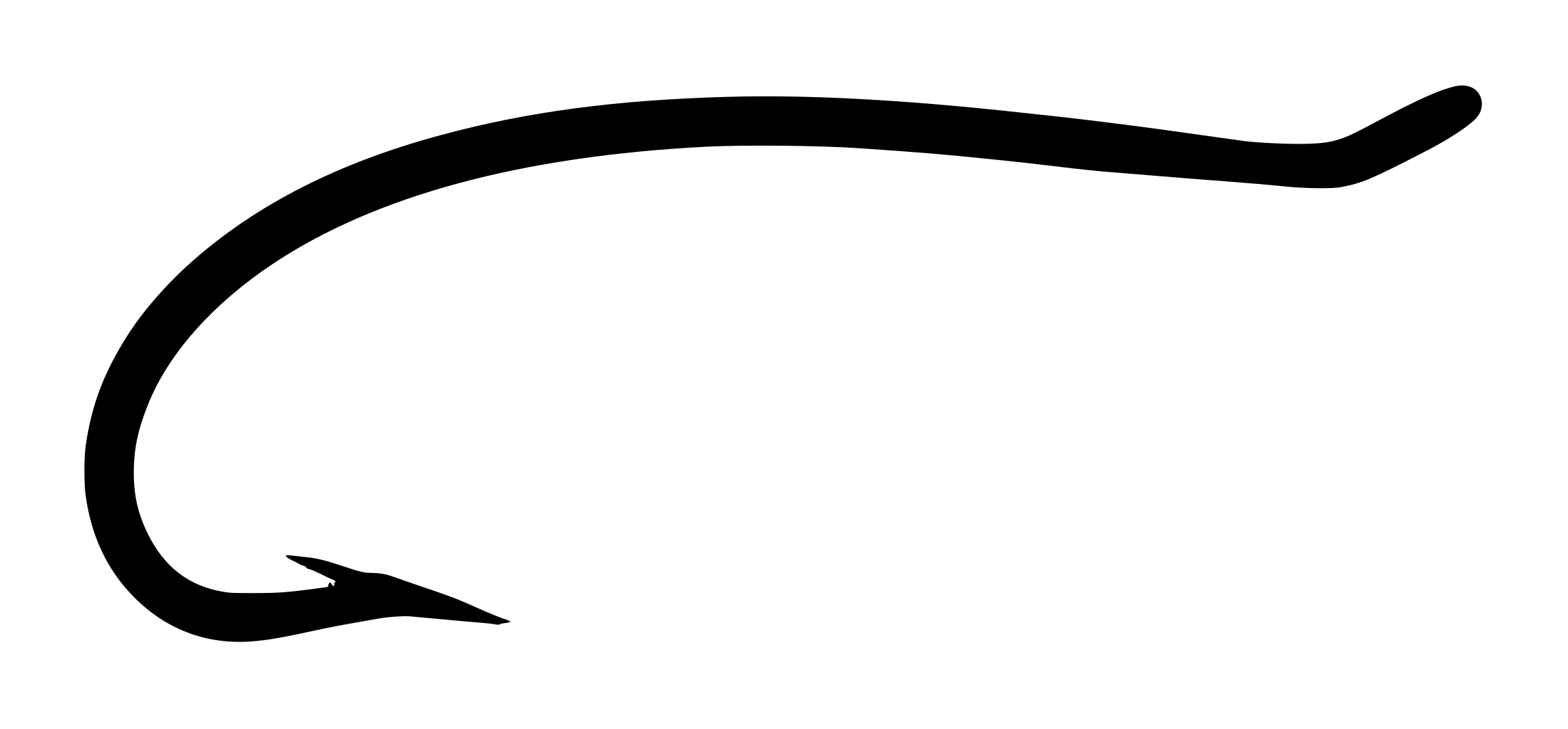
Mustad 4010 Virginia Hook — Bottom-Fishing Legend: Manufactured by O. Mustad & Søn (Oslo/Gjøvik, Norway) during the 1950s–1960s, the Mustad 4010 was engineered specifically for hard-fighting, hard-mouthed bottom species in the American Northeast. The model name—Mustad-Virginia Hooks—reflects its heritage in Chesapeake Bay and Mid-Atlantic fishing traditions, where the distinctive Virginia bend became the standard for Tautog (Blackfish), Sheepshead, and Black Sea Bass.
Defining Physical Feature: The 4010’s most distinctive characteristic is its combination of blind flatted (spade-end) eye and extra-heavy round wire. Unlike modern ringed-eye hooks, the flatted terminus was designed to be snelled—whipped to a leader using silk thread and pitch-based adhesive. This construction reflects a manufacturing and fishing tradition largely superseded by monofilament-era designs. The extra-heavy gauge (~0.039″) concentrates load along the Virginia bend’s squared-off curve, preventing the hook from straightening under the crushing jaw pressure of structure-loving species.
Era Evidence and Significance: The sales cards bearing ‘OSLO – NORWAY’ (post-1925 naming convention) and the distinctive green-gold kraft cardboard with burgundy letterpress label are unmistakable hallmarks of Mustad’s mid-century export packaging. The absence of barcodes, the traditional eight-line label format, and the snell-ready blind-eye design all confirm production during the 1950s–1960s. Collector significance lies in the rarity of complete blind-eye cards—most snelled hooks were fished rather than preserved—and in the regional importance of the Virginia pattern to Northeast fishing history.
Original Mustad 4010 sales card packaging from c. 1950s–1960s showing the distinctive green-gold kraft cardboard with burgundy-printed label. The Key Brand skeleton key logo is visible in the upper left. This example is for Size 7; packaging text clearly reads 'Qual. 4010 / Hollow Point / Mustad-Virginia Hooks / Flatted Blind.'
Photographic record
10 cataloged imagesSelect any record to load it above.
8 images shown
Mustad 4010 Virginia Hook Size 7 Sales CardOriginal Mustad 4010 sales card packaging from c. 1950s–1960s showing the distinctive green-gold kraft cardboard with burgundy-printed label. The Key Brand skeleton key logo is visible in the upper left. This example is for Size 7; packaging text clearly reads 'Qual. 4010 / Hollow Point / Mustad-Virginia Hooks / Flatted Blind.'Open originalMustad 4010 Virginia Hook Size 7 Point Detail — Side ViewSide profile of a Size 7 Mustad 4010 showing the distinctive hollow-point geometry. The inwardly curved point taper is clearly visible, and the characteristic curved-in design deflects fish away from snags while promoting secure corner-jaw setting.Open originalMustad 4010 Virginia Hook Size 7 Point Close-UpDetail view of the hollow-point tip showing the sharp, curved-in geometry and the compact, close-cut barb typical of Mustad's bottom-fishing designs. The blued finish shows characteristic iridescence.Open originalMustad 4010 Virginia Hook Size 7 ProfileFull side profile of a Size 7 Mustad 4010 showing the characteristic Virginia bend curve, the blind flatted eye terminus, and the proportional relationship between shank and gap.Open originalMustad 4010 Virginia Hook Size 7 Specimens ComparisonTwo Size 7 Mustad 4010 hooks photographed together on measurement grid, demonstrating manufacturing consistency and symmetry of the Virginia bend and point geometry across specimens.Open originalMustad 4010 Virginia Hook Size 5 Sales CardMustad 4010 Size 5 variant sales card from the 1950s–1960s, showing identical label design and packaging format to the Size 7 card, confirming consistent branding and specifications across the size range.Open originalMustad 4010 Virginia Hook Size 5 ProfileFull side profile of a Size 5 Mustad 4010 hook from the original packaging, showing the Virginia bend, flatted eye, and hollow point in the smaller size variant.Open originalMustad 4010 Virginia Hook Size 5 Point DetailDetail view of a Size 5 Mustad 4010 showing the hollow-point geometry and barb placement at the smaller scale. The proportions remain consistent with the Size 7 design, confirming the model's scalability across the size range.Open originalMustad 4010 Hook Point Size 5Mustad 4010 Hook Point Size 5Open originalMustad-4010-SalescardMustad-4010-SalescardOpen original
Technical profile
Hollow Point | Slight Curved | Mustad Virginia Hooks | Flatted (Blind Eye) | Blued | Made in Norway
Eye
Blind — FlattedFlatted spade-end design P. The shank terminates in a small flattened paddle shape rather than a formed loop, designed to be snelled with silk thread and pitch-dressing in traditional fashion. This configuration prevents the snell knot from sliding under load P.
Wire
Heavy (1X Heavy), Round
Shank
1X Long — Plain
Bend
Wide gapVirginia bend P. Distinctly squared-off round bend with more angular geometry than a standard Sproat, deeper and more expansive than Aberdeen. The bend lacks the parabolic refinement of Sproat and the sharp angularity of Limerick, placing it in a regional category reflecting American Chesapeake Bay and Mid-Atlantic traditions I.
Point
Hollow Point (concave inner face)Short, close-cut barb characteristic of vintage Mustad bottom-fishing designs P. Barb is placed at the base of the point taper to maximize penetration force concentration without creating a catch point that would prevent deep tissue hold.
Finish
Blued — Confirmed (stated on packaging)Dark iridescent blue-black finish P, characteristic of Mustad's chemical passivation process. The finish shows even coverage with subtle bronze undertone visible under raking light, typical of period application. Wire exhibits minimal corrosion on specimen P.
Size 7 box exhibits moderate toning and light creasing to kraft carton; label adhesion intact but surface shows wear pattern consistent with retail display. Size 5 box shows similar condition. Hooks examined in both boxes: size 7 specimens bright with no corrosion visible P; no hooks reported missing from documented count.
The Mustad 4010 Virginia Hook employs extra-heavy gauge round wire to provide exceptional structural rigidity without adding bulk. The wire diameter (~0.039″) concentrates force along the bend axis, preventing the hook from straightening or bending open under the crushing jaw pressure of Tautog and Sheepshead. The Virginia bend geometry—deeper and more squared than a standard Sproat—distributes load more evenly across a wider arc, reducing stress concentration at any single point.
The hollow-point design delivers initial penetration with minimal applied force while maintaining a fine, razor-sharp edge. The curved-in geometry has the dual function of (1) preventing the hook from laying flat in the fish’s mouth, ensuring immediate point engagement, and (2) naturally deflecting the point away from rocky substrates and wreck material, reducing snag frequency. This curvature also promotes corner-jaw setting—when a fish turns to swim away with the bait, the point naturally rotates into the hard bony corner of the jaw rather than penetrating soft tissue, resulting in superior hold during extended fights.
The blind flatted eye (spade-end design) was engineered for the snelling tradition of the era, where anglers tied a soaked silkworm gut snood directly to the shank using silk thread and pitch-based adhesive. The flatted terminus prevented the snell knot from sliding under load, a critical feature in deep-water bottom fishing where hydrostatic pressure and fish thrashing generate sustained tension.
We don't have measured sizes for this hook yet. Own one? Submit calipered measurements and we'll review and add them. Thank you!
Historical context
mustad
O. Mustad & Søn — Norwegian Industrial Giant: Founded in 1832 in the remote village of Gjøvik by Hans Schikkelstad, the company initially manufactured nails and steel wire under the name ‘Brusveen Spiger- og Staltradfabrikk.’ Schikkelstad’s son-in-law, Ole Hovelsen Mustad, and his son, Hans Mustad, acquired the operation and rebranded it as O. Mustad & Søn, pivoting the business toward fishing tackle. The defining moment arrived in 1877 when Mathias Topp, a visionary within the company, invented the first fully automated hook-making machine—a revolutionary technology that could autonomously cut, bend, barb, and point wire at unprecedented speed.
The Competitive Advantage: Rather than patent the technology (which would require public disclosure), Mustad relied on intense corporate secrecy, strict non-disclosure agreements, and restricted factory access. This strategy proved devastatingly effective against rival hook-manufacturing centers in Redditch, England, and emerging hubs in Japan and the United States. By the 1950s, when the 4010 was in active production, Mustad had already secured approximately 50% of the global hook production market and had established sales offices and manufacturing facilities across multiple continents. The word ‘Mustad’ became virtually synonymous with the fishing hook itself—a brand identity so complete that regional American patterns (Cincinnati, Virginia, Sproat) were successfully marketed as Mustad proprietary designs.
Norwegian Steel & Tempering: Beyond mechanization, Mustad’s competitive advantage rested on superior Norwegian metallurgy, particularly their proprietary ‘Nor-Temper’ heat treatment process. This process produced high-carbon steel with exceptional hardness, allowing hooks to maintain microscopic sharpness while resisting the crushing forces of saltwater predators. The 4010, built during the height of Mustad’s dominance, exemplifies this engineering excellence—the extra-heavy wire retains full tensile strength while the hollow point achieves a near-microscopic edge.
Series History
The Mustad-Virginia Hooks series represents a subset of the broader Mustad catalog dedicated to American regional patterns. The Virginia bend itself derives from 19th-century Chesapeake Bay commercial handline fishing traditions, where local blacksmiths crafted hooks optimized for bottom-fish with hard mouths and aggressive behavior. Mustad’s strategy of ‘industrial cloning’—systematically cataloging regional favorite patterns and mass-producing them with superior Norwegian efficiency—was devastatingly effective. The 4010 Virginia was introduced in the early-to-mid 20th century (precise date unclear from surviving documentation) as part of a broader push to capture American regional markets. The series included variants in different sizes (1 through 10 documented), finishes (blued, tinned, japanned), and eye types (blind flatted, ringed ball), though the blind flatted eye remained the standard for bottom-fishing applications. The 4010 remained in active production through the 1960s and into the early 1970s, declining as recreational fishing shifted toward lighter-tackle methods and modern hooks. The modern successor, the 4011E, was introduced in the 1980s–1990s and continues production today, though in much smaller volumes. The series represents a specific historical moment when American regional fishing traditions intersected with industrial Norwegian manufacturing—a moment largely forgotten outside the Northeast.
Era and Packaging Dating
Packaging evidence: (1) 'OSLO - NORWAY' designation on Line 3 of label indicates post-1925 production (Christiania renamed to Oslo 1 January 1925). (2) 'Key Brand' logo with skeleton key and green/gold border style is distinctive hallmark of Mustad's mid-century export packaging format. (3) Eight-line typographical label format adheres to Mustad's standardized vintage system documented in comprehensive typology (source: garrenwood.com Mustad Label reference guide). (4) No barcode present (pre-1974 strong indicator). (5) Letterpress printing method and paper stock consistent with 1950s-1960s manufacturing. (6) Price markings and postal format not distinctly visible. (7) Box construction using kraft with integral flap is characteristic of post-WWII era before modern blister packaging. All evidence collectively supports 1950s–1960s production window.
The Tautog Tradition
Tautog (Blackfish) fishermen in the Chesapeake Bay and Atlantic Coast states became so dependent on the Mustad 4010 that the hook earned a colloquial name: 'The Tog Hook.' The fish—a bottom-dweller with crushing pharyngeal teeth and a habit of diving directly into rock crevices when hooked—demands a hook with almost supernatural holding power. Anglers would often tie multiple 4010 hooks on heavy spreader rigs, dropping them to 40–60 feet to fish rocky pinnacles and wrecks. The extra-heavy wire and curved-in point design made the 4010 legendary for 'getting the tog out of the rocks,' a near-impossible feat with standard bait hooks. By the 1970s, as commercial tautog fishing declined and recreational anglers shifted to lighter-tackle methods, the 4010 gradually fell out of favor. Today, traditional bottom anglers in the Northeast still recognize the 4010 as the 'correct' tool for the job, even if they rarely fish with it anymore.
Design lineage and influence
Predecessors: The Virginia bend design reflects 19th-century Chesapeake Bay blacksmith traditions, where the pattern evolved to meet the demands of hard-mouthed, structure-loving fish. Early commercial versions (pre-1880) were hand-forged and highly variable. Mustad’s Virginia pattern standardized this geometry in the early 20th century, competing with English Limerick and Aberdeen patterns for dominance in American markets.
Contemporary Competitors: During the 1950s–1960s production window, the 4010 competed directly with English makers: Allcock’s O’Shaughnessy patterns (heavier forging, similar gap), Partridge’s heavy bait hooks, and American Pflueger and South Bend variants. The 4010’s blind-eye construction gave it an edge in traditional snelling applications but a disadvantage as ringed-eye hooks became standard for modern monofilament fishing.
Downstream Influence: The 4010 established the template for modern Mustad bottom-fishing designs (3366, 92720, 4011E). More broadly, the Virginia pattern influenced the evolution of the modern ‘Tog Hook’ category—specialized heavy-duty bait hooks optimized for crushing-jaw predators. The curved-in point geometry, while not invented on the 4010, was perfected here and would later influence conservation-friendly circle-hook designs, which employ similar ‘corner-jaw’ mechanics.
Best matchRelated by Attribute
Computed automatically from catalog data — updated as new hooks are added.
Matches: Bend, Wire, Eye, Eye Orient., Forging +3 moreDiffers: Shank: 1X Long vs Standard; Gap: Wide vs Standard; Point: Hollow Point vs Superior +1 more
Matches: Bend, Gap, Point, Forging, Application +3 moreDiffers: Shank: 1X Long vs Standard; Wire: Heavy (1X Heavy) vs Standard; Eye: Blind — Flatted vs Ball Eye +2 more
Matches: Bend, Gap, Point, Forging, Application +2 moreDiffers: Shank: 1X Long vs Standard; Wire: Heavy (1X Heavy) vs Standard; Eye: Blind — Flatted vs Tapered Eye +2 more
The Mustad 4010 Virginia Hook is engineered for bottom-fish species requiring exceptional hook-holding power in rocky, wreck-filled environments. Historically, it became the standard choice for Tautog (Blackfish), Sheepshead, and Black Sea Bass throughout the North American Northeast. The extra-heavy wire and distinctive Virginia bend design prevent teeth from cutting the line and allow anglers to ‘winch’ fish away from structure without straightening or bending the hook.
The combination of blind flatted eye, extra-heavy gauge, and curved-in point geometry creates a hook that holds even under extreme hydrostatic pressure and crushing jaw force. Commercial handline fishermen and recreational bottom anglers favored this design throughout the 1950s-1970s.
Secondary Applications
Not typically used for fly tying; occasionally employed in experimental heavy crab patterns or bottom-walker flies by specialized tiers.
Classic Fly Patterns
Not typically used for fly tying.
Modern Equivalents
Hook
Match Quality
Notes
Mustad 4011E (Tog Hook)
Excellent
Direct modern successor with updated metallurgy and finishes; maintains Virginia bend and general specifications.
Similar gap and heavy wire; ringed eye rather than blind flatted; used as functional equivalent in bait applications.
Mustad 92720 (4X Strong Bait)
Moderate
Modern extra-heavy bait hook with ball eye; comparable wire gauge but different bend geometry.
Collector notes
Rated 3.5/10 — The Mustad 4010 Virginia Hook is common in larger sizes (No. 1, 2, 3/0) where it remains widely available, but size 10 and smaller sizes are genuinely uncommon and attract modest specialized collector interest. Collector demand is concentrated among regional fishing historians focusing on Northeast tautog traditions and blind-eye hook specialists. Complete original sales cards command a modest premium, particularly in excellent condition.
Reference value
$8 – $24 USD estimate
Packaging condition
Good — moderate wear, legibleRecorded specimen
Packaging format
GW-MUS-01Catalog code
Collectability Drivers: The 4010 holds specific appeal within niche collector communities: (1) Blind-eye (flatted) construction is increasingly rare in surviving vintage stock, as most snelled hooks were consumed in fishing rather than preserved on cards. (2) The Virginia bend is a regionally significant American pattern little known outside the Northeast, attracting Chesapeake Bay and Mid-Atlantic fishing historians. (3) Original green-gold Mustad sales cards from the 1950s–1960s are charming period pieces with distinctive branding. (4) The transition from blind-eye to ringed-eye designs makes this an important historical inflection point in hook manufacturing.
Limiting Factors: Despite its niche appeal, the 4010 rates only 3.5/10 due to: (1) Abundant surviving stock in common larger sizes (1, 2, 3/0) from high-volume commercial and recreational fisheries in the Northeast. (2) No significant fly-tying community demand—this is purely a bait hook with no artistic or experimental following. (3) Modest collector demand compared to Partridge, Allcock, or Redditch craft-era hooks. (4) The blind-eye design, while historically significant, is less visually appealing than formed-eye variants to casual collectors.
Most Desirable Variants: Original sales cards in excellent condition with complete hook counts. Size 10 and smaller sizes (harder to locate). Size 5 and 7 remain common. Tinned-finish variants (if documented) would exceed blued-finish value. Examples with intact original tissue or envelope packaging would command significant premiums (add 50–100% to base value).
Condition Effects on Value: Opened card with all hooks present: standard market value. Missing even 1–2 hooks: deduct 20–30% from base. Sealed or near-sealed card: add 30–50% premium. Box format (if original): multiply by 1.5–2.0x compared to card-only value. Poor label legibility or heavy water staining: deduct 30–40%.
Packaging
Green-gold kraft cardboard sales card with printed eight-line label in burgundy/brown letterpress. Label measures approximately 2.5" × 3.5". Graphic Key Brand logo (downward-pointing skeleton key) positioned upper left. Box format: folded kraft carton with integral flap closure. Paper stock shows light yellowing and toning consistent with 1950s-1960s materials. No barcode present P. Printed text reads: O. MUSTAD & SÖN / MANUFACTURERS / OSLO - NORWAY / Qual. 4010 / Hollow Point, Slight Curved / Mustad-Virginia Hooks / 100 No. 5 Flatted Blind / Made in Norway. Two variants documented: Size No. 5 box and Size No. 7 box.
Market Value Notes
Low ($8): Good condition card with complete or near-complete hook count, light wear, legible label. Card is opened and may show handling creasing or toning. High ($24): Excellent/Mint condition card (sealed or near-sealed), full hook count, minimal wear, sharp label registration. All text clearly legible, cardboard integrity intact. Premium factors: Original tissue or sealed envelope wrap (add 30–50%); Size 5 or 10 (smaller sizes command modest premium); Tinned finish variant (if documented, add 20–30%). Platforms: eBay (US and UK markets show similar range); occasional dealer listings on Etsy and vintage tackle forums. Confidence: E estimated based on limited comparable sales data. Only 3–5 documented sales per year across all platforms. No major auction-house records available. Estimate assumes typical North American sales; UK market may differ 15–25% due to regional demand variation.
Where to Find
eBay (UK listings more frequent than US; search 'Mustad 4010' or 'Virginia Hooks flatted blind'). Vintage tackle dealers specializing in Northeast saltwater (search regional 'rod and reel' shops in Connecticut, Massachusetts, New York). Tackle auctions, particularly those specializing in early-20th-century commercial fishing gear. Occasional appearances at antique fishing tackle shows in the Mid-Atlantic (notably the East Coast Tackle Collectors shows). Original packaging rarely appears; loose hooks are more common on bulk-lot resale platforms.
Preservation
Storage and Preservation
Store the Mustad 4010 and its original packaging in a cool, dry environment away from direct moisture exposure. The blued finish is susceptible to patina development and surface rust when exposed to high humidity; many collectors consider light patina desirable as evidence of age authenticity. Original sales cards should be stored flat or slightly angled to prevent crease marks. Avoid stacking cards directly on top of one another; interleave with acid-free tissue or cardboard spacers. Keep cards away from direct sunlight, which will fade the burgundy letterpress text over time.
If hooks have been removed from the card for any reason, store them in a dry container with silica gel or a food-grade desiccant sachet. The blind flatted eye makes the 4010 vulnerable to edge corrosion if the wire terminus oxidizes; inspect periodically and apply a light coat of oil (3-in-1 or clock oil) if surface discoloration appears. Avoid contact with other metals (steel, copper, brass) to prevent galvanic corrosion. Do not attempt to polish or clean the blued finish aggressively; light surface patina is part of the hook’s historical character and adds value to collectors.
Original tissue wrapping or sealed envelopes (if present) should be preserved intact; these add significant value and authenticity markers to the lot. If tissue is brittle or deteriorating, stabilize it gently with acid-free archival tissue rather than removing it. Intact packaging in any condition is preferable to loose hooks, even if the card shows significant wear.
Primary Source
Decoding the Eight-Line Mustad Label
Source: Mustad Label Typology and Decryption (garrenwood.com reference guide); Mustad Eight-Line Label System documentation
The Mustad 4010 sales cards feature the standardized eight-line typographical label format that O. Mustad & Søn employed from the early 20th century through the 1970s. Understanding this system reveals precise manufacturing specifications embedded in what appears to be simple marketing text.
Line 3 — Geographic Origin (OSLO – NORWAY): The designation ‘OSLO – NORWAY’ serves as a definitive chronological bracket. The Norwegian capital was officially renamed from Christiania to Oslo on January 1, 1925. Therefore, any Mustad box bearing the Christiania designation can be conclusively dated to 1924 or earlier. Conversely, labels bearing the Oslo designation indicate production post-1925. The 4010 cards documented here display ‘OSLO – NORWAY,’ firmly establishing a post-1925 production window consistent with the 1950s–1960s estimate derived from packaging aesthetics and logo style.
Line 5 — Point Identifier (Hollow Point, Slight Curved): Line 5 of the vintage Mustad label is governed by strict typographical rules and is reserved exclusively for defining the geometric shape, physical cut, or quality grade of the hook point. According to Mustad’s standardized system, this line never specifies wire gauges, shank lengths, bend styles, or eye configurations. The 4010 label reads ‘Hollow Point, Slight Curved’—’Hollow Point’ is the definitive point geometry descriptor, while ‘Slight Curved’ likely refers to the subtle offset or curved character of the bend relative to a perfectly straight shank. This notation confirms the concave, inwardly curving point taper characteristic of a hollow-point design.
Line 6 — Pattern Name (Mustad-Virginia Hooks): Line 6 identifies the overarching geometric pattern or style of the hook’s bend and shank proportion. ‘Mustad-Virginia Hooks’ formally identifies the regional American pattern that forms the basis of this model. Mustad employed a deliberate industrial ‘cloning’ or reverse-engineering strategy, cataloging regional hook patterns favored by local blacksmiths or anglers and then mass-producing them with superior Norwegian steel and mechanized efficiency. The Virginia pattern—with its distinctive squared-off round bend—reflects 19th-century Chesapeake Bay traditions but was standardized and exported globally by Mustad under the ‘Mustad-Virginia’ brand.
Lines 7–8 — Features and Finishes (Flatted Blind / Blued): The final two lines describe supplementary anatomical features and metallurgical finishes. ‘Flatted Blind’ indicates the spade-end, flatted-shank eye construction designed for traditional snelling. ‘Blued’ specifies the chemical passivation finish—a dark blue-black oxide coating that provides moderate corrosion resistance and stealth in dark water environments. This notation system transformed Mustad hooks into a universally readable technical language, allowing international wholesalers, regional retailers, and anglers across linguistic barriers to identify precise hook specifications at a glance.
Additional
The Blind-Eye Hook and the Snelling Tradition
The Mustad 4010’s most distinctive feature—the blind flatted eye—reflects a fishing tradition largely extinct today. Prior to the widespread adoption of monofilament fishing line in the 1950s–1960s, most serious anglers, particularly commercial fishermen, used braided silk or braided horsehair main lines with snells of soaked silkworm gut attached at the terminal end. A ‘snell’ was a 6–18 inch leader of prepared gut, whipped directly to the hook shank using fine silk thread and sealed with pitch or other adhesive compounds.
Because the snell was lashed to the shank itself—not tied through an eye—hooks didn’t require a formed loop. Instead, manufacturers flattened or tapered the wire at the shank terminus, creating a small spade-like end that prevented the whipping knot from sliding under the immense hydrostatic pressures of deep-water fishing. For bottom-fishing species like Tautog, where hooks might descend 40–60 feet and encounter crushing jaw forces, the blind-eye construction offered distinct advantages: the whipped knot created a completely smooth, unbreakable connection point, and the flatted shank end provided maximum mechanical grip for the silk wrapping.
The transition from blind-eye to ringed-eye hooks tracks directly with the introduction of synthetic monofilament, which allowed direct knot-tying to the formed loop rather than traditional snelling. By the 1970s, even traditional anglers had largely adopted ringed eyes and monofilament, making blind-eye hooks a rarity. Today, a pristine vintage card of blind-eye hooks documents not just a manufacturing technology, but an entire vanished fishing culture.
Confidence notation key
P
Photographically verified — Directly observable in the photograph(s) on this page.
V
Verified by documentation — Confirmed by manufacturer catalog, spec sheet, or published reference.
I
Inferred — A logical deduction from observable or documented evidence, not directly stated.
E
Estimated — An approximation based on visual comparison, proportional analysis, or limited data.
S
Speculative — A reasoned hypothesis that cannot be confirmed from available evidence.
Claims with no notation are confirmed by multiple independent sources. All photographs on garrenwood.com are taken on a measurement grid where each square equals 1/10 inch (0.1″ / 2.54 mm).