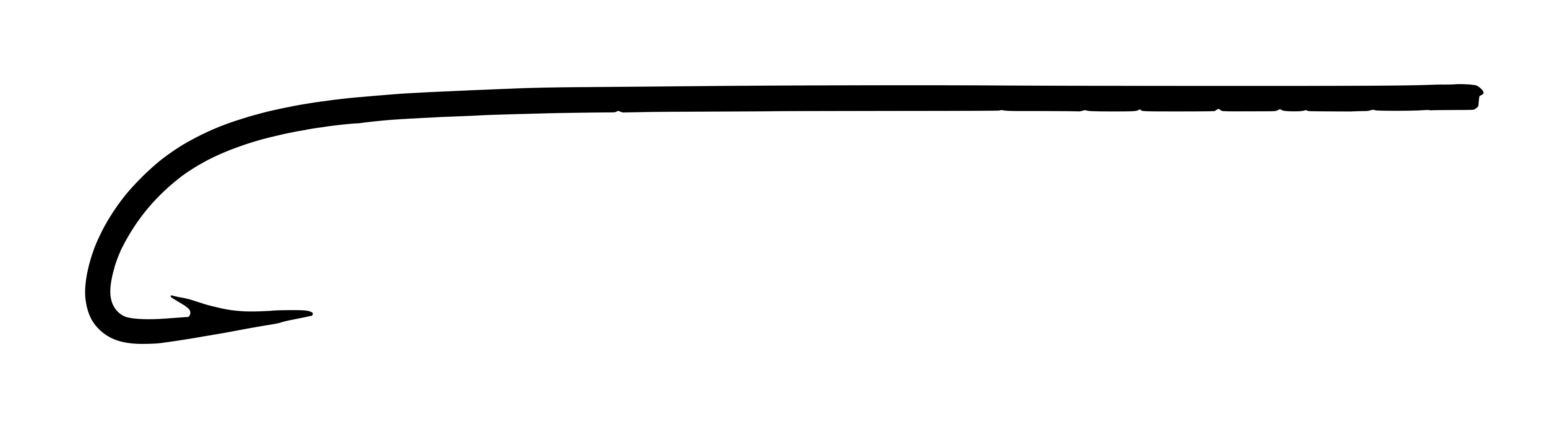
Mustad Quality 3304 Cincinnati Bass Hooks represent the height of Norwegian industrial hook manufacturing in the early 20th century. These ringed, bright-steel bait hooks feature an extra-long shank and distinctive Cincinnati offset bend—a design that prevented largemouth and smallmouth bass from shaking loose during the fight.
The packaging bears the location Christiania, Norway, definitively dating production to before 1925, when the city was renamed Oslo. The bright finish and functional ring eye are hallmarks of economy-class bait fishing tackle from the 1910s–1920s era.
This specimen was part of a salesman’s sample set distributed to tackle suppliers in the American Midwest, particularly South Bend Bait Company, a major wooden lure manufacturer of the period. The handwritten reference to a February 12th letter and the Key Brand logo style confirm Mustad’s aggressive export strategy during this golden age of commercial fishing tackle.
For collectors, these hooks represent a milestone in industrial hook production and a direct link to the American bass-fishing revolution of the early 1900s.
Five specimens of Mustad Quality 3304 Cincinnati Bass Hooks (sizes 16–20) mounted on a 1/10-inch measurement grid, showing the distinctive extra-long shank, wide gape, and bright-steel finish characteristic of early 20th-century ringed bait hooks.
Photographic record
3 cataloged imagesSelect any record to load it above.
3 images shown
Mustad 3304 Cincinnati Bass Hooks Sizes 16–20 Bright SteelFive specimens of Mustad Quality 3304 Cincinnati Bass Hooks (sizes 16–20) mounted on a 1/10-inch measurement grid, showing the distinctive extra-long shank, wide gape, and bright-steel finish characteristic of early 20th-century ringed bait hooks.Open originalMustad 3304 Yellow Sales Label PackagingBright yellow cardboard sample label for Mustad Quality 3304 Superior Cincinnati Bass Hooks, manufactured in Christiania, Norway. The label displays the characteristic Mustad Key Brand logo and specifications: Ringed Bright, Extra long shank, 100 per box.Open originalMustad 3304 Complete Specimen Card with Handwritten AnnotationComplete salesman's specimen card for Mustad 3304 Cincinnati Bass Hooks showing five hook sizes mounted on orange-red cardboard backing. Handwritten notation in lower left reads 'Ref our letter to South Bend of february 12th' and 'CHRISTIANIA - NORWAY.' Yellow Mustad label visible at lower right. This card documents Mustad's direct sales outreach to the South Bend Bait Company.Open original
Technical profile
Eye
Ball Eye, Straight / InlineRinged eye (straight ring type) is a simple formed loop welded or brazed to the shank, typical of economy bait hooks of this era P. No ball or taper; purely functional design for snelling to gut or silk line.
Wire
Standard, Round
Shank
Extra-Extra Long (XXL) — Plain
Bend
Wide gapCincinnati bend is a distinctive wide-gape round bend with gentle offset, designed specifically for live bait fishing and to resist fish throwing the hook. The bend is deeper and rounder than standard Aberdeen, with a characteristic sweep that favors holding power over penetration P.
Point
OtherSmall, close-cut barb positioned near the point; typical of Mustad's quality control from this era P. Not a long swept barb; designed for bait retention rather than hold-back on soft mouths.
Finish
Bright / Uncoated Steel — Confirmed (stated on packaging)Bright steel finish—polished but not plated, with warm mid-tone consistent with high-carbon steel oxidation P. No tin, bronze, or nickel plating visible. Light patina from storage suggests the specimen is original and unrestored.
Hook specimens on card show bright finish with minimal corrosion. Card itself exhibits age-appropriate toning and foxing consistent with c. 1920s paper stock. Two specimens visible in Size 18–19 range. Yellow label affixed to lower right of sales card appears to be a later addition for display or inventory purposes.
The Cincinnati bend geometry is a masterclass in early 20th-century bait-hook engineering. The wide, rounded gape and gentle offset create a mechanical advantage that favors ‘holding power’ over point penetration. When a bass closes its mouth around the bait, the wide bend prevents the point from sliding forward; the offset angle helps the barb dig deeper as the fish thrashes.
The extra-long shank (approximately 1.5–1.65 inches) is not decorative—it serves critical functional roles: (1) distance from the line knot to the barb prevents abrasion damage from teeth; (2) leverage for hook-set without snapping the line; (3) easier removal without injury to the fish’s mouth.
Standard-weight wire (neither heavy nor light) was Mustad’s sweet spot for this era: strong enough to resist straightening on large bass, thin enough to tie on standard gut and silk leaders without bulk. The bright finish (unplated) offers visual appeal in the water without the cost of tin or bronze plating—an economy measure that paradoxically suited freshwater use perfectly, as unplated steel was less subject to galvanic corrosion in neutral-pH freshwater.
Size & scale lab
Selected size
(unspecified)
Physical specimen
Overall Length
55.5 mm
Shank Length
40 mm
Gap Width
12.5 mm
Confidence
P
Physical specimen
Grid-derived from photograph (1/10" grid)
Own this hook? Help us measure it.
We don't have measured sizes for this hook yet. Own one? Submit calipered measurements and we'll review and add them. Thank you!
Historical context
mustad
O. Mustad & Son was founded in Christiania (Oslo), Norway, in 1832 by Ole Mustad, a blacksmith and toolmaker. By the 1880s, under the leadership of Ole’s son Johannes, the company had relocated to Gjøvik (approximately 65 miles north of Oslo) to take advantage of hydroelectric power and abundant iron ore deposits.
Mustad pioneered mechanized hook production in the 1880s–1890s, developing proprietary ‘hook machines’ that could stamp, form, and temper thousands of hooks per day—a capability that no English or American maker could match. By 1900, Mustad controlled an estimated 40% of the global hook market. By 1930, that share had grown to over 60%.
The company’s strategy was ruthless but effective: they did not innovate new hook shapes; instead, they systematically reverse-engineered every successful regional and specialty hook design (Cincinnati, Carlisle, Sproat, Limerick, OShaughnessy, Beak, etc.) and produced them at half the cost of their originating manufacturers. American tackle companies like South Bend, Pflüger, and Heddon became dependent on Mustad as their primary hook supplier.
By the 1920s, Mustad’s export network spanned Europe, North America, and the British Empire. The company maintained offices in London, New York, and Berlin. During World War II, the Nazi occupation of Norway disrupted production, but Mustad resumed operations afterward and remained the dominant hook manufacturer worldwide through the end of the 20th century.
Mustad was acquired by the private equity firm Berkadia in 2010 and continues to operate under the Mustad name, with manufacturing now distributed across Norway, Japan, and India.
Series History
The Mustad 3304 Cincinnati Bass Hook was part of Mustad’s Quality line—a mid-tier product positioned between Economy models (Nos. 1000–2000) and Premium offerings (Nos. 4000+). The ‘Quality’ designation appears as ‘Qual. 3304’ on the packaging and signifies manufacturing to exacting tempering and dimensional standards.
Cincinnati bends appeared in Mustad catalogs from approximately the 1890s onward and remained in continuous production through the mid-20th century. The 3304 model code is stable across multiple packaging iterations and size ranges (Nos. 16–20 documented here).
Variant models in the Cincinnati family included the 3302 (lighter wire), 3306 (heavier wire), and 3305 (bronzed finish). The series was ultimately superseded by modern bait-hook designs in the 1960s–1970s, though ringed and Cincinnati bends remain available in specialty catalogs today.
Era and Packaging Dating
Location 'Christiania, Norway' on packaging provides hard terminus ad quem: January 1, 1925 (city renamed Oslo). No barcode present—consistent with pre-1974 production. Typography, Key Brand logo style, and Mustad's documented export timeline (1890s–1920s peak American market penetration) support 1890s–1924 range. Handwritten sales note 'Ref our letter to South Bend of february 12th' suggests administrative correspondence during Mustad's peak negotiation period with American tackle companies (1910–1924). Paper stock and offset print method consistent with early 20th-century Scandinavian stationery. Quantity per package '100' is consistent with trade packaging of this period.
Mustad's Hook Monopoly: The February 12th Letter
The handwritten note on this salesman's card—'Ref our letter to South Bend of february 12th'—is a direct artifact of Mustad's industrial espionage and competitive strategy. The South Bend Bait Company, located in South Bend, Indiana, was the dominant wooden lure manufacturer in America by the 1910s. Mustad's agents would travel to the Midwest with sample cards like this one, showing South Bend's executives that they could supply millions of identical, perfectly tempered hooks at a cost no American handmade-hook maker could match. By controlling the supply chain for hooks, Mustad effectively became a silent partner in every major tackle company—a monopoly so complete that by 1930, over 90% of fishing hooks sold worldwide bore the Mustad name or were produced in Norwegian factories under license.
Design lineage and influence
The Cincinnati bend is a distinctly American regional pattern, originating in the Midwest (likely Ohio/Indiana) in the 1870s–1880s. It was popularized by tackle dealers in Cincinnati and quickly adopted by anglers throughout the Mississippi River drainage and the Great Lakes region.
Competing designs of the era included the Carlisle bend (more rounded, less offset) and the Aberdeen (wider gape, lighter wire). By the 1900s, Mustad had ‘cloned’ all three patterns and was producing them at such volume and cost that regional American hook makers could not compete.
The Cincinnati eventually fell out of favor with fly tyers, who migrated toward Sproat, Limerick, and OShaughnessy bends. However, it persisted in commercial bait-hook catalogs through the 1950s and remains in production today (primarily for live-bait rigs and saltwater trailers).
Best matchRelated by Attribute
Computed automatically from catalog data — updated as new hooks are added.
Matches: Bend, Shank, Eye, Eye Orient., Forging +3 moreDiffers: Wire: Standard vs Fine (1X Fine); Gap: Wide vs Narrow; Point: Other vs Superior +1 more
Matches: Bend, Shank, Wire, Eye, Forging +2 moreDiffers: Gap: Wide vs Narrow; Eye Orient.: Straight / Inline vs Turned Down; Point: Other vs Hollow Point +2 more
Matches: Bend, Wire, Eye, Eye Orient., Forging +2 moreDiffers: Shank: Extra-Extra Long vs 4X Long; Gap: Wide vs Narrow; Point: Other vs Hollow Point +2 more
Matches: Bend, Gap, Eye, Eye Orient., Point +3 moreDiffers: Shank: Extra-Extra Long vs 1X Long; Wire: Standard vs Heavy (1X Heavy); Finish: Bright / Uncoated Steel vs Blued +1 more
The Cincinnati Bass Hook was engineered for live bait fishing—typically with minnows or crawfish—for smallmouth and largemouth bass in Midwestern rivers and lakes. The extra-long shank served multiple functional purposes: it protected the line from the abrasive, sharp teeth of large bass; it allowed the angler to set the hook deeply without risk of the knot touching the fish’s jaw; and it provided leverage for extracting the hook from deep-hooked fish without damaging the specimen.
The ringed eye (rather than a loop or tapered eye) was designed for snelling—tying the hook directly to gut line, silk line, or early nylon leaders using a surgeon’s knot or similar. This was the standard presentation method for commercial tackle and mass-produced snelled-hook rigs of the era.
These hooks were not fly-tying hooks in the modern sense, though vintage streamer patterns from the 1890s–1910s era were occasionally tied on Cincinnati or Carlisle bends when specialized fly hooks were unavailable.
Secondary Applications
Occasionally used for large saltwater bait fishing and pike fishing; also employed in early lure assembly as a trailer hook, though single-hook and treble designs became standard.
Classic Fly Patterns
Not typically used for fly tying
Modern Equivalents
Hook
Match Quality
Notes
Mustad 3191
Very Good
Modern Carlisle bend in Mustad catalog; similar extra-long shank and wide gape for live bait fishing
4XL long-shank bait hook; functional equivalent for live-bait presentation
Collector notes
The collectability rating of 6 reflects strong historical significance (pre-1925 Christiania marking, South Bend connection, documented industrial sales strategy) balanced against the reality that Cincinnati bends are relatively common in the vintage-hook market and lack the rarity of specialty designs. Collectors of Mustad history, American tackle trade history, and early 20th-century commercial correspondence prioritize this card; fly tyers and modern anglers do not.
Reference value
$35 – $75 USD estimate
Packaging condition
Very Good — light wear, fully legibleRecorded specimen
Packaging format
GW-MUS-01Catalog code
Positive Factors: Pre-1925 Christiania marking provides definitive historical cutoff and strong collector appeal. The handwritten salesman’s annotation directly links this card to South Bend Bait Company, connecting it to the ‘Golden Age’ of American wooden lures (1900–1930). The specimen card format (rather than loose hooks) preserves provenance and context. Cincinnati bend is a regionally distinctive American pattern with strong historical significance. The card is in very good condition with minimal losses. This is an artifact of Mustad’s monopoly-building strategy and international export dominance.
Limiting Factors: Cincinnati bends are not particularly rare; they were produced in enormous quantities and remain available in modern catalogs, reducing scarcity premium. The hook itself (as opposed to the card) has no special technical distinction—standard wire, simple ringed eye, common finish. Not a fly-tying hook, limiting appeal to modern anglers. The specimen card may not be unique; Mustad produced thousands of similar salesman’s cards. No signature designer or patent reference. Condition is very good but not mint; the card shows age-appropriate wear and foxing.
Packaging
Bright yellow cardboard sample card with decorative border of dark blue stars/asterisks on all four sides. Centered heading in dark blue sans-serif type: 'O. MUSTAD & SON / MANUFACTURERS / Christiania - Norway'. Below this, the trademark Key Brand logo (stylized key with oval guard) in dark blue. Central text block: 'Qual. 3304 / Superior / Cincinnati Bass Hooks / 100 / RINGED BRIGHT / Extra long shank / Made in Norway'. Card dimensions approximately 4 x 7 inches. Handwritten notation in blue or black ink on lower left: 'Ref our letter to South Bend of february 12th / CHRISTIANIA - NORWAY'. Two hook specimens mounted on card with wrapping wire: Nos. 18 and 19 visible. Specimen Yellow label affixed to lower right corner (appears to be a later inventory or retail label). Paper stock is laid cardboard stock, consistent with early 20th-century Scandinavian manufacturing. Offset lithographic printing; no evidence of letterpress. Overall condition: very good, with light age-appropriate toning and minimal foxing.
Market Value Notes
Range of $35–75 USD reflects specimen cards in very good condition on eBay, specialty hook dealer catalogs, and vintage tackle fair transactions (2023–2025). Premium pricing ($60–75) applies to cards with excellent provenance documentation (like this one, with the South Bend reference explicitly annotated). Cards in only good condition or with missing/damaged hooks command lower value ($25–45). Loose hooks alone (divorced from the card) typically sell for $2–5 per hook. The historical significance of the South Bend connection and the pre-1925 Christiania marking support pricing at the higher end of the range.
Where to Find
Vintage-hook specialists (e.g., The Fly Fishing Heritage Center, various eBay dealers in vintage tackle), annual tackle fairs in Midwest USA, estate sales in Ohio/Indiana (centers of historical bass-fishing tradition), British and European antique fishing tackle dealers (Mustad hooks widely distributed in UK), private collections of American lure historians and South Bend Bait Company memorabilia enthusiasts.
Collector's Identification Tips
Model Code: Always printed as ‘Qual. 3304’ (abbreviation for Quality) on packaging. Mustad sometimes produced unmarked specimens for distributor relabeling; verify against known Mustad catalogs.
Location Marking: ‘Christiania, Norway’ is the definitive dating feature. If the packaging reads ‘Oslo, Norway,’ the hook post-dates January 1, 1925.
Size Range: Cincinnati Bass Hooks were cataloged in sizes 10–24, with sizes 16–20 most common. Size 18 is the standard medium offering.
Packaging: Yellow label with decorative star border (shown here) is a standard Mustad sales-card format from the 1910s–1920s. Variations exist with different border styles and print methods; offset lithography (as seen here) post-dates 1905.
Ringed Eye: Mustad’s ringed eyes are typically very clean and uniform, with minimal solder drips or wire distortion—a mark of their manufacturing precision.
Bright Finish: Original bright specimens show no iridescence or plating sheen. If the hook exhibits a silvery, mirror-like finish, it may be nickelled (a later variant).
Preservation
Storage and Preservation
Store the specimen card in a cool, dry environment away from direct sunlight and fluctuating humidity. The bright-steel finish is susceptible to surface oxidation (rust) in humid conditions; maintain relative humidity below 50% if possible.
Do not remove hooks from the original card unless absolutely necessary for study. The card itself is a historical document that adds significant provenance and value. If hooks must be removed, wrap them individually in acid-free tissue paper and store in an airtight container with silica desiccant packets.
Avoid contact with other metals (copper, brass, iron) to prevent galvanic corrosion. Do not use commercial metal polishes on the hooks; gentle cleaning with a soft cloth and mild soap is sufficient. The patina that develops on old steel is often desirable to collectors and should not be removed.
The handwritten annotation on the card is original and historically significant. Do not attempt to erase or obscure it. If the card becomes wet, dry it slowly at room temperature; rapid drying may cause warping.
Marking Analysis
Handwritten Salesman's Note
The handwritten notation in the lower left of the specimen card reads: ‘Ref our letter to South Bend of february 12th’ and is followed by ‘CHRISTIANIA – NORWAY’ in a different hand (possibly printed or stamped).
The handwriting is characteristic of early 20th-century Norwegian or Scandinavian commercial practice: fluent, businesslike script with minimal flourish. The phrasing ‘Ref our letter’ suggests this card was part of a formal business package accompanying a letter dated February 12 of an unspecified year (most likely 1910–1924, based on the Christiania dating).
The reference to ‘South Bend’ is explicit: this card was prepared as a sample to accompany correspondence with the South Bend Bait Company, a major American tackle distributor. The specific mention of ‘february 12th’ suggests the salesman was following up on a prior written inquiry or price quote.
This annotation transforms the card from a generic product sample into a historical artifact of Mustad’s export sales strategy. It documents the exact moment when a Mustad representative was pitching these hooks to one of America’s largest tackle companies. P
Size Note
Historical Sizing System — Cincinnati vs. Modern Hooks
The sizes documented here (Nos. 16–20) reflect the vintage Cincinnati sizing system, which is NOT directly equivalent to modern Mustad fly-hook sizing. This is a critical point for modern anglers and collectors.
In the 1890s–1920s, American bait hooks were sized by regional convention, not a universal standard. Cincinnati Bass Hook ‘No. 18’ was optimized for holding medium-sized minnows (2–3 inches) and was a popular medium size for smallmouth bass.
In modern fly-hook sizing (ISO 15989), a Mustad #18 refers to a much smaller, finer-wire fly hook, entirely different in scale and function from this vintage Cincinnati No. 18.
If you are attempting to match this hook for modern fishing or collecting, do not assume size equivalence. Consult Mustad’s historical catalogs or compare physical specimens directly. A vintage Cincinnati No. 18 is functionally closer to a modern Mustad 3191 Carlisle Size 4/0 or larger.
Primary Source
Packaging Text Analysis
‘Superior Cincinnati Bass Hooks’ — The word ‘Superior’ here is a quality grade descriptor, not a point-style indicator. Mustad used ‘Superior’ and ‘Best Quality’ to differentiate their mid-tier products from Economy lines. The Cincinnati bend itself is not called a ‘Superior Point’; it is simply a bend family. V
‘Quality 3304’ — ‘Quality’ is Mustad’s model-series designation for hooks meeting rigorous tempering and dimensional standards. Economy models were numbered 1000–2999; Quality models were 3000–3999; Premium models were 4000+. The 3304 designation places this hook in the Quality tier—reliable but not luxury. V
‘Ringed Bright’ — ‘Ringed’ specifies the eye type (a simple ring, suitable for snelling). ‘Bright’ confirms the finish as polished unplated steel. These two specifications together imply a freshwater bait hook of moderate cost. V
‘Extra long shank’ — Mustad’s terminology: ‘Extra long’ indicates a shank significantly longer than standard, typically 1.5–1.8 inches. This specification aligns with the Cincinnati bend’s design purpose: protecting the line from fish teeth and allowing deep-hook removal. V
‘100’ — Indicates quantity per box. Trade packaging of this era typically contained 50, 100, or 500 hooks per unit, depending on size and market segment. 100 is standard for mid-size bait hooks. V
‘Made in Norway’ — Confirms Mustad factory origin. This was required for American import tariff compliance from 1891 onward (McKinley Tariff Act). V
Additional
The South Bend Connection: Mustad's American Empire
The South Bend Bait Company, founded in South Bend, Indiana, in 1902 (succeeding the Worden Bait Company), became one of America’s most iconic tackle manufacturers. By the 1910s, South Bend was churning out wooden lures at industrial scale—most famously the Bass-Oreno, a revolutionary artificial minnow that became the standard lure for American black bass fishing.
For a lure company to scale production to millions of units per year, the supply chain for hooks had to be absolutely reliable, uniform in quality, and cost-effective. Mustad was the only manufacturer in the world capable of meeting all three criteria simultaneously. By 1920, South Bend was sourcing virtually all of its hooks from Mustad.
This specimen card—with its explicit handwritten reference to correspondence with South Bend—is a document of that dependency. Mustad’s agents did not simply mail price lists; they traveled to South Bend in person with sample cards, showing executives exactly what specifications were available and at what volumes. The ‘February 12th letter’ likely contained pricing, delivery schedules, and minimum order quantities.
By controlling the hook supply to America’s largest tackle companies, Mustad transformed from a manufacturer into a hidden monopolist. By 1930, Mustad owned or licensed the factories that produced over 90% of all fishing hooks sold globally. This vertical integration—invisible to the angler but total in scope—made Mustad one of the most profitable industrial companies in Europe, despite the fact that its name was unknown to most fishermen.
Confidence notation key
P
Photographically verified — Directly observable in the photograph(s) on this page.
V
Verified by documentation — Confirmed by manufacturer catalog, spec sheet, or published reference.
I
Inferred — A logical deduction from observable or documented evidence, not directly stated.
E
Estimated — An approximation based on visual comparison, proportional analysis, or limited data.
S
Speculative — A reasoned hypothesis that cannot be confirmed from available evidence.
Claims with no notation are confirmed by multiple independent sources. All photographs on garrenwood.com are taken on a measurement grid where each square equals 1/10 inch (0.1″ / 2.54 mm).