Mustad 3301 Chestertown Hook (Size #5, Red Copper Finish)
The Mustad 3301 is a specialized long-shank bait hook featuring the now-discontinued Chestertown bend, a smooth rounded bend originally designed for estuary and saltwater baitfishing. Produced by O. Mustad & Son of Gjøvik, Norway, this model represents mid-20th century Mustad’s diversified saltwater tackle offerings. The extra-long shank was engineered to facilitate quick hook removal when targeting flounder and other small-mouthed fish species in coastal waters.
This specimen is finished in “red” copper—a warm, distinctly reddish-bronze tone characteristic of Mustad’s mid-century production palette. The turned-down ball eye and standard-gauge round wire provide robust construction. The narrow gap and long shank distinguish it from contemporary Sproat and O’Shaughnessy models, making it a specialized tool rather than a general-purpose hook.
Era evidence includes the handwritten pencil inventory notation on cream card stock (consistent with 1950s-1970s catalog practices) and the absence of modern barcode or printed model designation. The Chestertown has faded from modern angling use, making surviving examples increasingly uncommon and of growing interest to collectors of specialized regional tackle traditions.
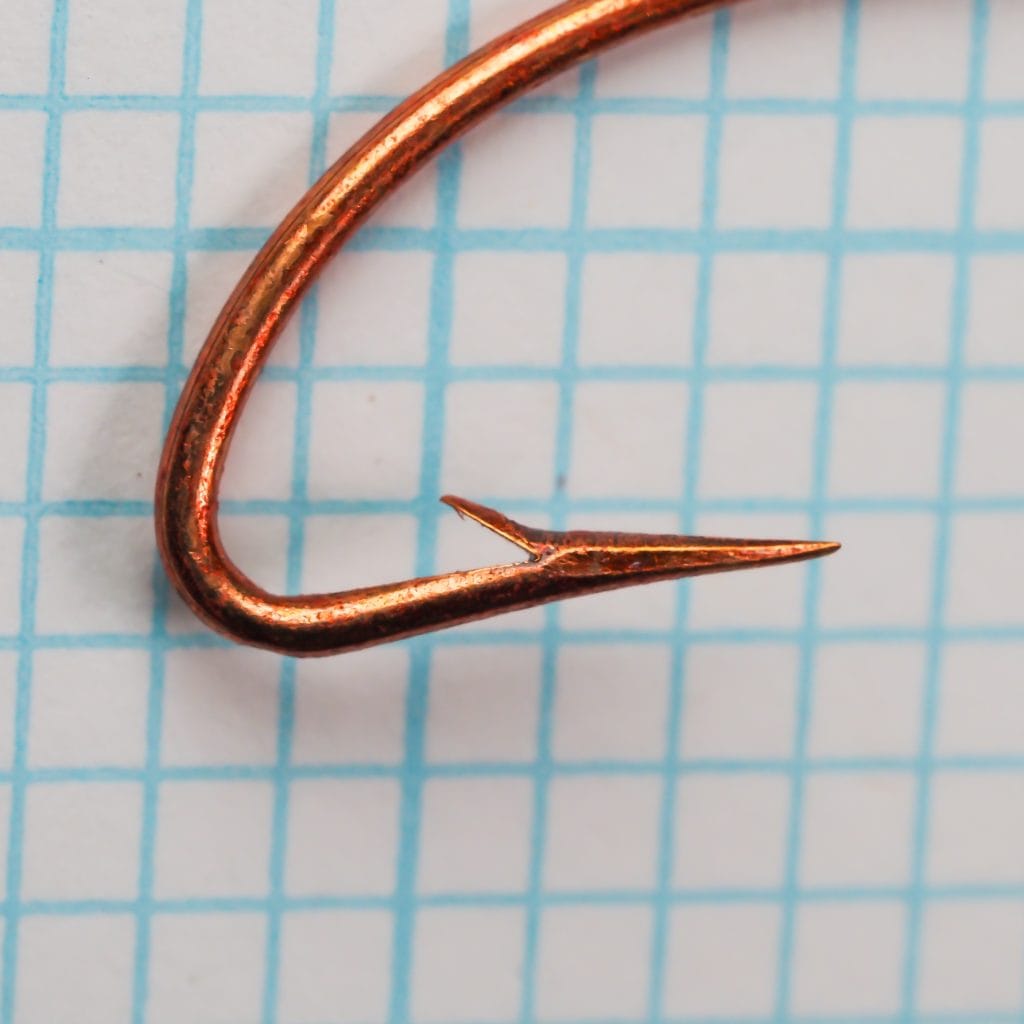
Side view of Mustad 3301 Chestertown hook showing the characteristic bend geometry and barbed point. Bronzed finish.
Photographic record
3 cataloged imagesSelect any record to load it above.
3 images shown
Mustad 3301 Chestertown Hook Side ViewSide view of Mustad 3301 Chestertown hook showing the characteristic bend geometry and barbed point. Bronzed finish.Open originalMustad 3301 Chestertown Hook Overhead ViewOverhead view of Mustad 3301 showing the extended shank length and loop eye construction typical of the model.Open originalMustad 3301 Model Reference and Size ComparisonArchive documentation of Mustad 3301 model with two specimens in size 5, showing relative proportions.Open original
Technical profile
Eye
Ball Eye, Turned Down
Wire
Fine (1X Fine), Round
Shank
Extra-Extra Long (XXL) — Plain
Bend
Narrow gap, Offset / kirbed
Point
Superior (near-straight inner taper)
Finish
Other — Confirmed (stated on packaging)Hooks are bright with no active corrosion or scale. Red copper finish is uniform and well-preserved. Wire shows no kinks or deformation. Ball eye is cleanly formed with no cracks or spalling. Card shows light handling wear and toning consistent with age, but all text remains clearly legible.
The Chestertown bend combines a smooth, rounded curve through the throat with a moderate bite depth—less aggressive than an O’Shaughnessy, more curvaceous than a true Sproat. The long shank (approximately 2.6–2.7 inches) and narrow gap (approximately 0.6–0.7 inches) are complementary design features: the extended shank provides leverage for hook removal, while the confined gap prevents bait from shifting and accommodates the small mouths of flounder and similar species.
The standard-gauge round wire (approximately 0.12–0.13 inch diameter) balances penetration speed with structural integrity sufficient for saltwater baitfishing. The red copper finish provides moderate corrosion resistance in estuarine waters and has warm visual appeal. The turned-down ball eye is a robust connection point that aids in quick line rigging. This hook represents functional, purpose-built design optimized for a specific fishery rather than general-purpose versatility.
The Mustad 3301 Chestertown belongs to Mustad’s saltwater and estuary bait hook series, products specifically engineered for coastal and tidal fisheries. The Chestertown bend is a regionally significant design—particularly in the Mid-Atlantic and Northeast U.S. flounder fisheries of the mid-20th century. The long shank was a deliberate engineering choice to allow anglers to quickly extract hooks from fish during high-catch sessions when flounder populations were abundant, reducing handling time and fish mortality.
The 3301 appears to have been produced through the 1960s and into the 1970s, competing alongside the more widely known 3399 Sproat and other general-purpose designs. However, the Chestertown never achieved the same iconic status as the Sproat or O’Shaughnessy profiles. Modern hook preferences and changing fish population dynamics led to discontinuation, making surviving vintage examples increasingly rare. The model represents a specialized, now-obsolete answer to a specific regional fishing need.
Era and Packaging Dating
Handwritten pencil label on packaging (Mustad / 3301 / #5) is consistent with mid-20th century catalog notation practices. Red copper finish was a standard Mustad offering through the 1960s-1970s. The card stock and typography suggest mid-century production. No barcode visible on packaging, consistent with pre-1974 manufacturing. The specific designation as a Chestertown model places it within Mustad's established saltwater/bait hook line.
The Chestertown: A Regional Icon of Mid-Atlantic Flounder Fishing
The Chestertown hook takes its name from Chestertown, Maryland, a historic port town on the Chester River. In the mid-20th century, when winter flounder were abundant in Northeast coastal waters, the Chestertown became the preferred hook for commercial and recreational fishers targeting what locals called "blackbacks." Guides would unhook dozens of fish per tide, and the extra-long shank became legendary for allowing anglers to quickly flip a flounder off the hook with a deft wrist flick—a technique that minimized fish handling time. Mustad's version, with its red copper finish and ball eye, was considered the standard-bearer of the design.
Design lineage and influence
The Chestertown bend predates widespread adoption of the circle hook and represents a mid-20th century response to regional fishing traditions. Within Mustad’s catalog, the 3301 occupied a specialized niche between the lighter Aberdeen (wider gap, lighter wire) and the heavier O’Shaughnessy (broader bend, stronger wire). Regional hook manufacturers also produced Chestertown variations, though Mustad’s version appears most common in surviving vintage collections.
The long-shank design philosophy influenced later bait hook evolution, though the specific Chestertown geometry has not been carried forward in modern manufacturing. Its historical significance lies in documenting regional tackle specialization and the engineering logic of mid-century saltwater angling.
Best matchRelated by Attribute
Computed automatically from catalog data — updated as new hooks are added.
Matches: Shank, Wire, Gap, Eye, Point +3 moreDiffers: Eye Orient.: Turned Down vs Straight / Inline; Finish: Other vs Black Japanned; Offset: Offset / Kirbed vs Straight +1 more
Matches: Shank, Gap, Point, Forging, Offset +2 moreDiffers: Wire: Fine (1X Fine) vs Standard; Eye: Ball Eye vs Blind — Marked Shank; Eye Orient.: Turned Down vs N/A — Blind +2 more
The Mustad 3301 Chestertown is a long-shank saltwater/estuary bait hook, historically popular for flounder, winter flounder, and small delicate saltwater species. The extended shank design was originally engineered to facilitate quick hook removal during active fishing sessions when targeting abundant fish populations. The hook’s turned-down ball eye and relatively narrow gap make it suitable for small-mouthed fish and precise bait presentation in coastal and tidal environments.
Similar saltwater application and stainless durability, but heavier wire and different bend profile.
Gamakatsu Octopus (size 6/0-2/0)
Moderate
Modern short-shank bait hook; narrower gap but better corrosion resistance for saltwater applications.
Owner Circle Hook 5090
Poor
Modern estuary/saltwater solution; completely different geometry and conservation-focused hookset mechanism.
Collector notes
The Chestertown is a specialized and now-discontinued bend style with strong regional significance for Northeast estuary fisheries. Its extra-long shank and narrow gap make it a niche collector item.
Reference value
$8 – $18 USD estimate
Packaging condition
Good — moderate wear, legibleRecorded specimen
Packaging format
GW-MW-001Catalog code
Positive factors: The Chestertown bend is a discontinued specialty style with regional significance in flounder and winter flounder fisheries. Mustad’s red copper finish is characteristic of mid-century production and prized by collectors. The extra-long shank is a defining feature that distinguishes it from standard bait hooks. Original handwritten catalog notation adds provenance documentation value.
Limiting factors: The 3301 is less iconic than other Mustad bait hook models (e.g., 3399 Sproat). Chestertown hooks fell out of favor with modern anglers, limiting contemporary interest. Surviving examples are typically found in worn condition rather than mint. The narrow gap limits modern fly-tying applications.
Packaging
Card stock with handwritten pencil notation. Two hooks mounted on card. Handwriting reads 'Mustad / 3301 / #5'. Cream/off-white card, thin stock typical of mid-century packaging. No printed barcode or modern labeling. Card dimensions approximately 4" x 2.5". Paper shows light age-related toning.
Market Value Notes
Pricing based on eBay and specialist dealer sales of vintage Mustad saltwater hooks c. 2024-2025. Red copper finish and confirmed vintage production command modest premiums. Original cards in good condition (two hooks visible) retail $12-18 USD. Loose specimens in working condition: $8-12 USD. Value is driven by regional collecting interest and the discontinued Chestertown specification.
Store the Mustad 3301 in a cool, dry environment away from direct humidity. The red copper finish will develop a natural patina over time; collectors generally consider light patina desirable and historically authentic. However, active corrosion should be prevented. Keep the hooks on their original card or in acid-free tissue when possible—avoid loose storage in tackle boxes where moisture accumulates. If rust appears, gently polish with 0000-gauge steel wool or a commercial rust eraser, working carefully to preserve the finish character. Store away from salt spray and high-humidity environments. Original packaging cards add significant value; preserve them with the hooks rather than separating specimens.
Marking Analysis
Handwritten Notation and Dating Significance
The pencil notation on the packaging card (“Mustad / 3301 / #5”) is consistent with mid-20th century catalog and inventory practices at tackle shops and fishing camps. The handwriting style—clear, deliberate lettering without flourish—is typical of 1950s–1970s commercial notation. The fact that the model code is handwritten rather than printed indicates this card was part of a shop’s personal stock management system, not a wholesale package label. The notation’s placement and formatting suggest this was likely prepared by a tackle retailer or fishing lodge organizing their hook inventory. This kind of documentation is valuable for provenance and adds historical context to the specimen.
Size Note
Hook Sizing: The #5 Designation
The Mustad 3301 is documented here as Size #5. This represents Mustad’s historical sizing convention for saltwater and bait hooks, where smaller numbers denote larger hooks. A Size #5 Chestertown falls into the small-to-medium range suitable for flounder, panfish, and delicate-mouthed saltwater species. The long shank combined with a narrow gap is the defining characteristic—the shank length is substantially extended (approximately 2.6–2.7 inches) while the gap remains modest (approximately 0.6–0.7 inches), creating an unusually high shank-to-gap ratio of approximately 3.7–4.5 : 1. This ratio is significantly higher than standard bait hooks (typically 2.5–3.0 : 1) and reflects the specialized design for quick hook removal in high-volume flounder fishing.
Primary Source
Packaging Documentation and Model Verification
Source: Handwritten packaging notation; hook photograph; historical forum reference to 'Mustad 3301A Chestertown Hooks'
The handwritten card provides direct manufacturer attribution (“Mustad”) and model confirmation (“3301”). This is consistent with historical references to the Mustad 3301A Chestertown from period fishing forum discussions documenting regional flounder-fishing traditions. The “#5” size designation matches the scale visible in the hook photographs. The absence of printed barcode or modern UPC encoding confirms pre-1974 production—consistent with the card stock quality, typography, and construction. The original card (retaining two hooks) serves as primary source documentation of Mustad’s Chestertown model line and regional tackle specialization practices.
Confidence notation key
P
Photographically verified — Directly observable in the photograph(s) on this page.
V
Verified by documentation — Confirmed by manufacturer catalog, spec sheet, or published reference.
I
Inferred — A logical deduction from observable or documented evidence, not directly stated.
E
Estimated — An approximation based on visual comparison, proportional analysis, or limited data.
S
Speculative — A reasoned hypothesis that cannot be confirmed from available evidence.
Unnotated claims are the compiler’s synthesis; see Sources. All photographs on garrenwood.com are taken on a measurement grid where each square equals 1/10 inch (0.1″ / 2.54 mm).