The Mustad 3298 represents a fascinating piece of regional American angling history, engineered specifically for winter flounder fishing along the US East Coast. Named after Chestertown, Maryland, this specialized hook features a distinctively narrow gap and long shank designed to fit the small mouths of winter flounder while providing leverage for safe unhooking.
This example dates to the 1950s-1960s based on the orange Key Brand packaging with Oslo mark and classic floral border design. The ‘Ex. strong’ wire specification and japanned black finish reflect the hook’s saltwater pedigree and the need for durability when prying hooks from deep-hooked fish.
While the Chestertown pattern has been largely discontinued, vintage examples like this remain highly sought after by collectors and specialized flounder anglers. The hook’s engineering represents a perfect marriage of form and function for a specific fishery that once supported major commercial and recreational activity in the Chesapeake Bay region.
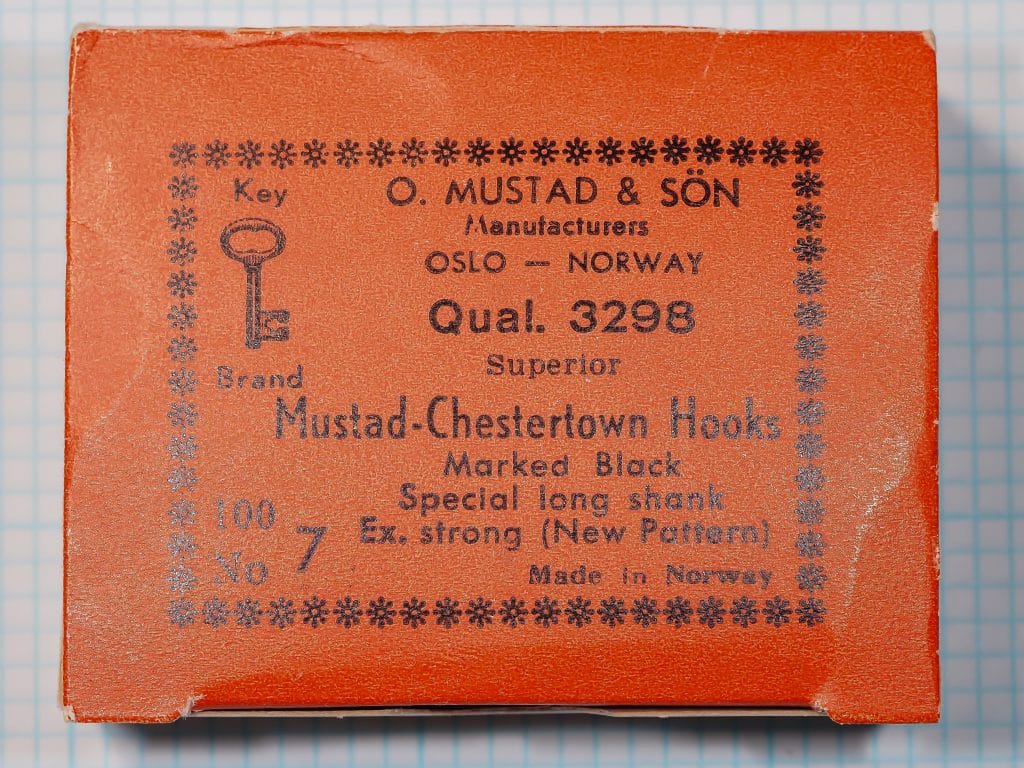
Original Mustad 3298 Chestertown hook box featuring the classic Key Brand export design with floral border, documenting the hook's Norwegian manufacture and American market targeting.
Photographic record
3 cataloged imagesSelect any record to load it above.
3 images shown
Mustad 3298 Orange Key Brand BoxOriginal Mustad 3298 Chestertown hook box featuring the classic Key Brand export design with floral border, documenting the hook's Norwegian manufacture and American market targeting.Open originalMustad 3298 Hooks on GridTwo Mustad 3298 Chestertown hooks photographed on 1/10-inch measurement grid, clearly showing the distinctive long shank and narrow gap geometry designed for winter flounder fishing.Open originalMustad 3298 Point DetailDetailed view of the Mustad 3298's point geometry and barb construction, showing the near-straight inner taper characteristic of superior point style and the robust barb designed for secure hooksets.Open original
Technical profile
Mustad-Chestertown Hooks | Marked Black | Special long shank | Ex. strong (New Pattern) | Made in Norway
Eye
Blind — Marked Shank
Wire
Standard, Round
Shank
Extra-Extra Long (XXL) — Marked / Ridged
Bend
Narrow gap, Offset / kirbedChestertown bend features a very narrow gap and round bottom that curves abruptly into a straight vertical return at the point V. This specialized geometry was engineered for winter flounder with their characteristically small mouths P.
Point
Superior (near-straight inner taper)
Finish
Black JapannedMarked Black finish, likely traditional japanned enamel coating used before chemical sharpening became standard V. Provides corrosion resistance for saltwater use I.
Box shows edge wear and minor surface scuffs consistent with age but retains structural integrity and legible text. Hooks appear unused with original japanned finish intact.
The Chestertown’s engineering reflects deep understanding of winter flounder behavior and anatomy. The narrow gap (approximately 0.35″-0.45″) was sized specifically for the characteristically small, delicate mouths of winter flounder, while the long shank (~1.30″-1.45″) served multiple functions: providing adequate thread length for marine worms, acting as a mechanical lever for safe unhooking, and keeping the angler’s fingers away from the fish’s throat. The extra-strong wire construction was essential for the hook’s primary function – being pried out of deep-hooked fish without bending or breaking.
The Chestertown pattern was specifically designed for winter flounder fishing, with long shanks and narrow gaps to accommodate the small mouths of these flatfish while allowing for easy unhooking. The pattern gained popularity when flounder were plentiful, as the long shank helped anglers unhook fish quickly to catch more. The 3298 was part of Mustad’s export line targeting American East Coast fisheries, though the pattern has since been largely discontinued as flounder populations declined and fishing methods evolved.
Era and Packaging Dating
Orange paper box with Key Brand logo and Oslo mark (post-1925), floral decorative border, letterpress printing on cardstock, no barcode (pre-1974), classic mid-century export packaging style typical of 1950s-1960s era.
Marketing the 'New Pattern'
The packaging's 'New Pattern' designation was typical marketing flair of the 1950s-60s era. Mustad frequently made subtle adjustments to tempering processes or bend angles and released them as 'New Patterns' to revitalize sales against British competitors like Allcock and Partridge. This marketing strategy helped maintain customer interest even when the actual changes were minimal.
Design lineage and influence
The Chestertown represents a uniquely American adaptation of traditional long-shank patterns. While European manufacturers focused on salmon and sea trout applications, American hook makers and Mustad’s export division recognized the specific needs of Chesapeake Bay flounder fishermen. The pattern’s narrow gap and straight return distinguish it from broader European patterns like the Aberdeen, which shares the long shank but maintains a wider gap for different target species.
Best matchRelated by Attribute
Computed automatically from catalog data — updated as new hooks are added.
Matches: Shank, Wire, Gap, Eye, Eye Orient. +4 moreDiffers: Bend: Other vs Carlisle; Finish: Black Japanned vs Blued; Offset: Offset / Kirbed vs Straight +4 more
Matches: Shank, Wire, Gap, Eye, Eye Orient. +5 moreDiffers: Bend: Other vs Sproat; Point: Superior vs Standard / Spear; Offset: Offset / Kirbed vs Straight +1 more
Matches: Shank, Wire, Gap, Eye, Eye Orient. +5 moreDiffers: Bend: Other vs Carlisle; Point: Superior vs Hollow Point; Finish: Black Japanned vs Blued +2 more
Matches: Shank, Gap, Point, Forging, Offset +2 moreDiffers: Wire: Standard vs Fine (1X Fine); Eye: Blind — Marked Shank vs Ball Eye; Eye Orient.: N/A — Blind vs Turned Down +2 more
Specifically engineered for winter flounder fishing in the Chesapeake Bay and US East Coast waters V. The narrow gap was designed to fit easily into the small mouths of flounder, while the long shank served as a lever for unhooking fish without fingers entering the fish’s throat V. The extra-strong wire was necessary to pry hooks out without bending V.
Secondary Applications
Long-bodied streamers, modern bait fishing for perch and panfish where deep hooking is a risk
Classic Fly Patterns
Not typically used for fly tying
Modern Equivalents
Hook
Match Quality
Notes
Discontinued - no direct modern equivalent
Poor
The specific Chestertown bend geometry is no longer manufactured
Mustad 3261 Long Shank Aberdeen
Moderate
Similar long shank but wider gap, lighter wire construction
Mustad 34007 Stainless O'Shaughnessy
Poor
Provides strength but lacks narrow Chestertown gap geometry
Collector notes
Historically significant regional pattern with strong collector interest, but production volume limits rarity premium.
Reference value
$15 – $35 USD estimate
Packaging condition
Very Good — light wear, fully legibleRecorded specimen
Packaging format
MUS-EX-02Catalog code
Positive factors: The Chestertown pattern represents important American regional fishing history and is increasingly difficult to find in original packaging. The specialized engineering and connection to Chesapeake Bay flounder fisheries gives it strong historical significance beyond typical vintage hooks.
Limiting factors: Mustad produced these in large quantities (100-count boxes) for commercial distribution, so surviving examples aren’t exceptionally rare. The 1950s-60s era is recent enough that many examples survive, and the hook’s utilitarian nature means most specimens show wear from actual use.
Packaging
Orange cardstock box with Key Brand logo, decorative floral border, letterpress printing. Text includes O. Mustad & Son Manufacturers Oslo - Norway, Qual. 3298 Superior, Mustad-Chestertown Hooks, Marked Black, Special long shank, Ex. strong (New Pattern), Made in Norway, 100 No. 7. Shows typical 1950s-60s export packaging design with worn edges but readable text.
Market Value Notes
Complete orange box in excellent condition commands premium. Individual hooks worth $0.50-1.00 each to flounder specialists.
Where to Find
eBay auctions, East Coast tackle fairs, estate sales in Chesapeake Bay region, vintage tackle dealers
Collector's Identification Tips
Key identifiers: orange Key Brand box with Oslo mark (post-1925), Chestertown name on packaging, narrow gap geometry, long straight shank, blind eye construction. The ‘Superior’ marking refers to quality grade, not Superior Point style – examine actual point geometry which appears to be superior style with near-straight inner taper.
Preservation
Storage and Preservation
Store in a cool, dry environment to prevent further oxidation of the japanned finish. The original orange packaging is historically significant and should be preserved – avoid removing hooks unnecessarily from the box. If displaying, keep away from direct sunlight which can fade the orange cardstock and cause brittleness. The letterpress printing is susceptible to wear, so handle the box minimally and by the edges. For long-term storage, consider placing the entire box in an archival sleeve to prevent further edge wear while maintaining visibility of the graphics.
Size Note
Vintage Size 7 Equivalency
The documented size No. 7 in this vintage Mustad numbering system does not directly correlate to modern hook sizing. Based on the measured dimensions and historical sizing practices, this size 7 would approximate a modern size 6 or 8, falling between standard contemporary sizes. Collectors should be aware that direct size comparisons between vintage Norwegian export hooks and modern standardized sizing can be misleading, as manufacturing tolerances and numbering systems evolved significantly over the decades.
Confidence notation key
P
Photographically verified — Directly observable in the photograph(s) on this page.
V
Verified by documentation — Confirmed by manufacturer catalog, spec sheet, or published reference.
I
Inferred — A logical deduction from observable or documented evidence, not directly stated.
E
Estimated — An approximation based on visual comparison, proportional analysis, or limited data.
S
Speculative — A reasoned hypothesis that cannot be confirmed from available evidence.
Unnotated claims are the compiler’s synthesis; see Sources. All photographs on garrenwood.com are taken on a measurement grid where each square equals 1/10 inch (0.1″ / 2.54 mm).