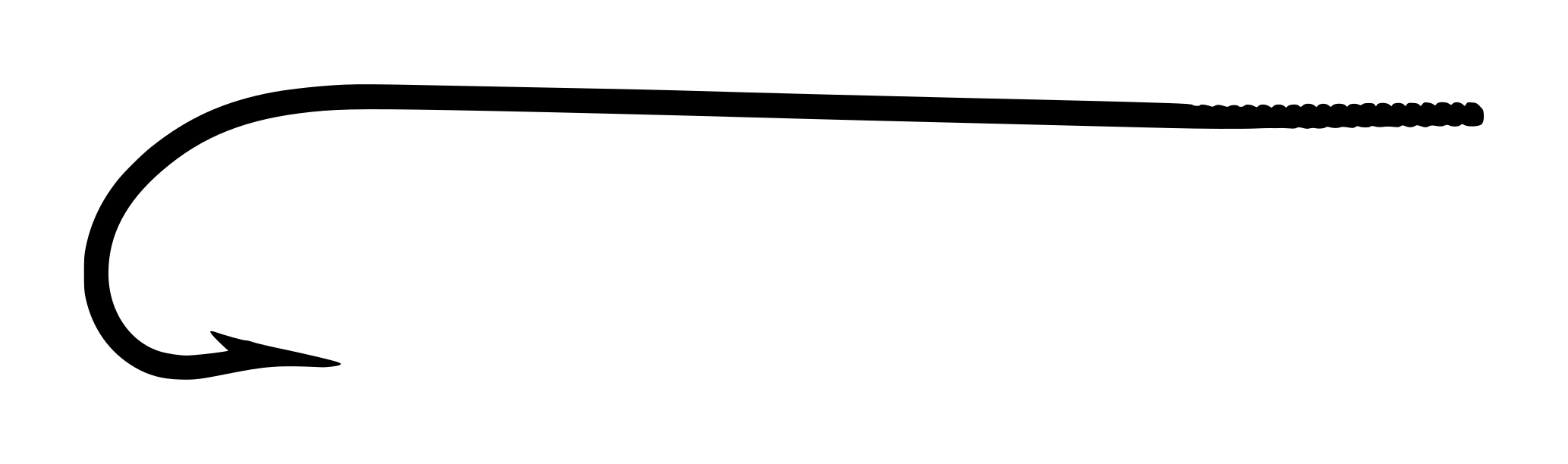
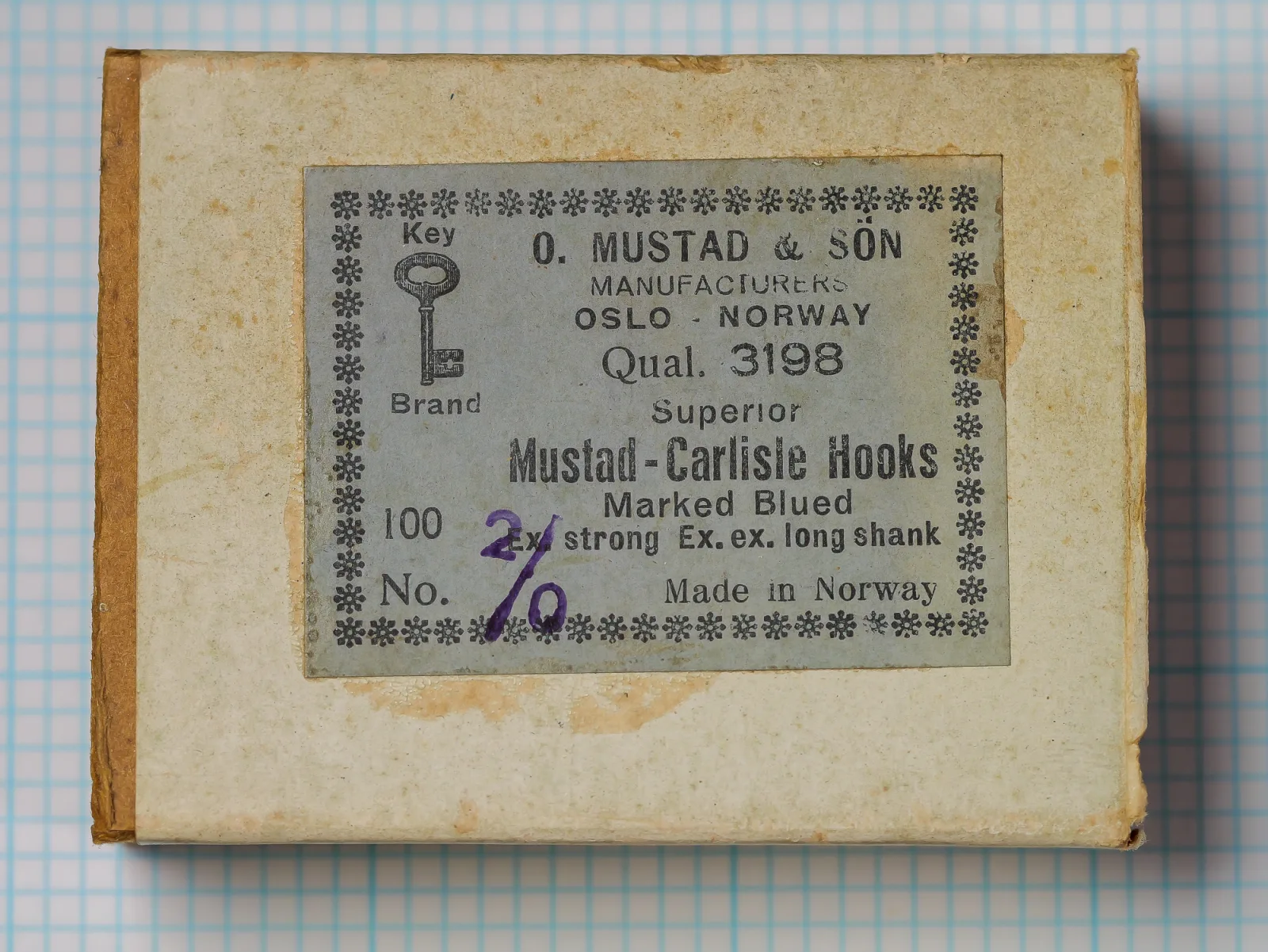
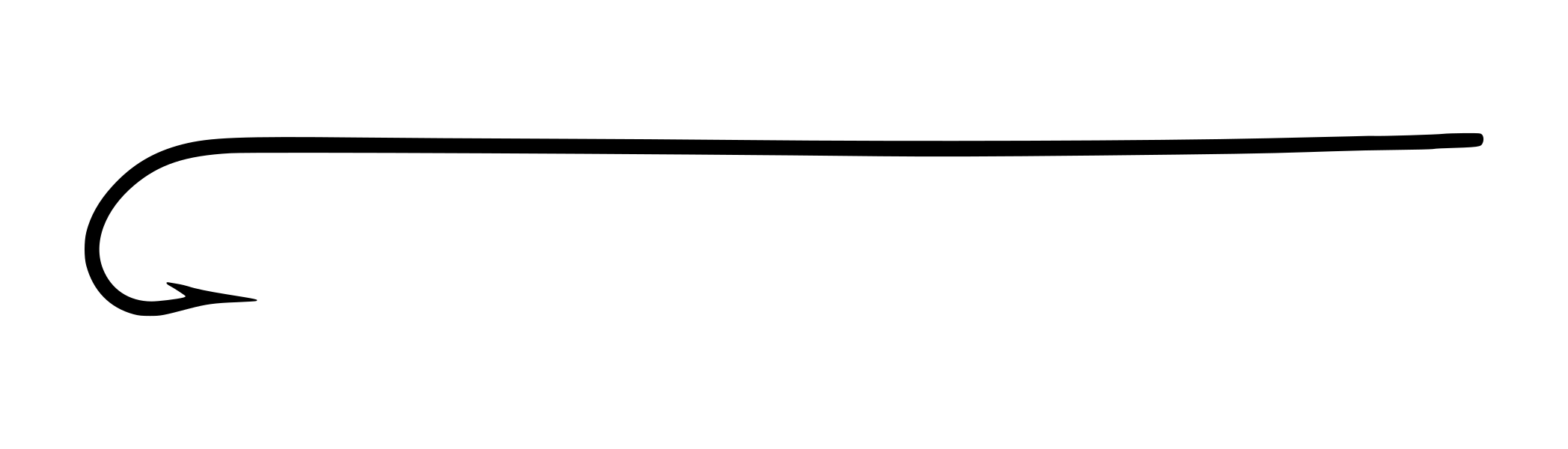
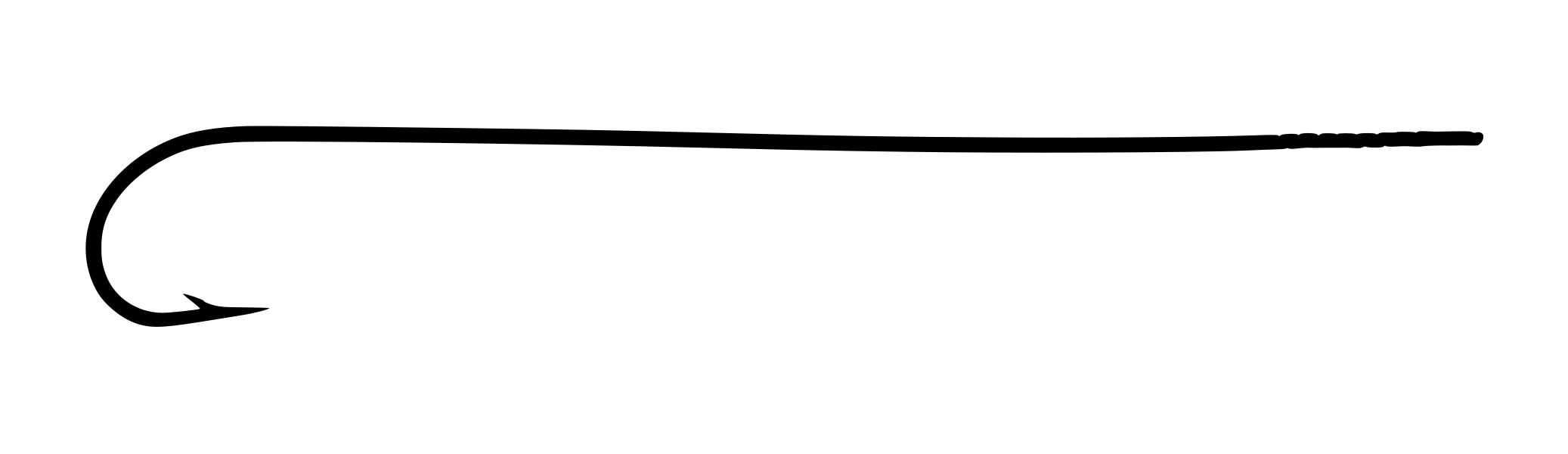
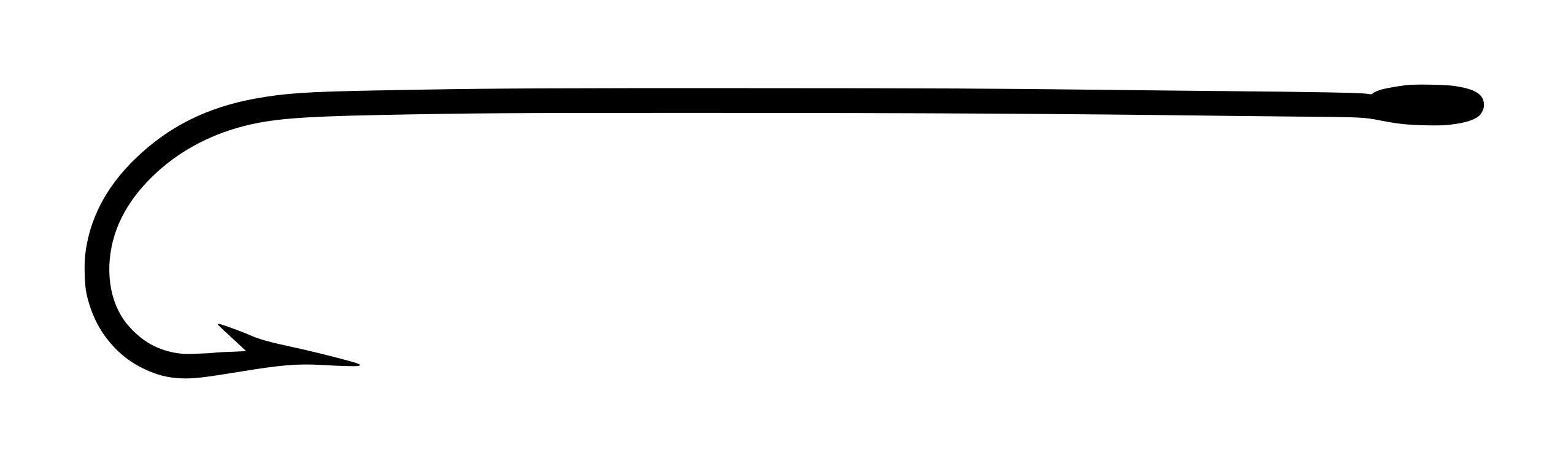
O. Mustad & Son Quality 3198, Mustad-Carlisle Hooks in size 2/0 — a bait hook featuring the Carlisle bend form, extra-extra-long shank, and blued finish. The hook carries a blind marked eye with ridged shank, designed for secure bait attachment rather than fly tying.
The packaging label is printed letterpress on laid paper stock, a characteristic of Mustad’s production from the 1950s-early 1960s. The blued finish and construction geometry are original to the period; the hooks remain bright with no corrosion. This is a functional bait hook from Mustad’s mid-century industrial output, representing the Norwegian manufacturer’s commitment to marking-shank design for live and dead bait fishing in European markets.
Original label card for Mustad Quality 3198, size 2/0, printed letterpress on laid stock. Shows Key Brand logo, manufacturer credentials (Oslo-Norway), product specifications (Marked Blued, Ex. ex. long shank), and handwritten quantity notation (100, marked with purple "70").
Photographic record
3 cataloged imagesSelect any record to load it above.
3 images shown
Mustad Quality 3198 Label Card Size 2/0Original label card for Mustad Quality 3198, size 2/0, printed letterpress on laid stock. Shows Key Brand logo, manufacturer credentials (Oslo-Norway), product specifications (Marked Blued, Ex. ex. long shank), and handwritten quantity notation (100, marked with purple "70").Open originalMustad Quality 3198 Size 2/0 Side Profile Bend DetailSide profile of the Mustad Carlisle hook on measurement grid, showing the moderate-depth rounded bend form, extra-extra-long shank proportions, and narrow gap. The blued finish appears as a cool blue-grey tone. Visible ridging on the shank indicates the marked-shank feature for bait grip.Open originalMustad Quality 3198 Size 2/0 Top-Down ViewTop-down view of the Mustad Carlisle hook showing the blind marked eye (spade-type terminus with ridged surface for bait grip), point profile, and overall slender shank proportions on measurement grid.Open original
Technical profile
Blind Eye Marked Shank | Carlisle | Extra-Extra Long | Superior Point | Blued
Eye
Blind — Marked ShankBlind marked shank construction. The terminus is marked with raised longitudinal ridges for securing bait, characteristic of Mustad's bait hook design P.
Wire
Standard, Round
Shank
Extra-Extra Long (XXL) — Marked / Ridged
Bend
carlisle, Narrow gapCarlisle bend form — a medium-weight, rounded bend with moderate depth and width. The shank is proportionally long relative to gap, creating a slender profile suited to bait presentation P.
Point
Superior (near-straight inner taper)Standard barb placement below the point, angle consistent with Superior point geometry — slight upward set relative to the inner face P.
Finish
Blued — Confirmed (stated on packaging)Blued finish exhibits cool blue-grey oxide coating with metallic sheen, visible in photograph. Steel grain texture shows faintly beneath the thin oxide layer, consistent with period blued Mustad construction P.
Specimen exhibits no corrosion; blued finish is uniform across bend and shank. Packaging shows age toning and typical wear consistent with pre-1960s storage.
The Superior point geometry — characterized by a near-straight inner face and minimal curvature — creates a point that penetrates reliably across bait textures without the concentration point stress of a hollow point. The design is robust and holds its edge despite repeated contact with hard baits (small fish, shellfish, bone).
The marked (ridged) shank employs raised longitudinal ridges cast or formed into the wire surface during manufacture. These ridges mechanically grip the bait, preventing rotation and slip during the cast-and-retrieve cycle or bottom drift. This is particularly important for live-bait presentations where bait rotation leads to line twist and compromised bait action.
The extra-extra-long shank (approximately 5.5:1 shank-to-gap ratio) spreads the hook geometry forward, positioning the bend and barb well behind the bait mouth. This geometry reduces missed hookups from short-striking fish (pike, perch, catfish) that mouth baits before committing to the take.
The narrow gap complements the long shank: a narrower gap prevents the hook point from fouling the bend during the strike and reduces the gape the bait must open to accommodate the hook. Together, these dimensions create a mechanical advantage for solid hookup.
This pattern was made in sizes 2/0 (V). We have measurement for size 2/0. Know the others? Submit calipered measurements and we'll review and add them. Thank you!
Historical context
mustad
O. Mustad & Son was founded in Oslo, Norway in 1832 by Ole Mustad. The company rapidly became one of the world’s largest industrial hook manufacturers, establishing the Gjøvik factory in central Norway by the mid-1800s. By the early 1900s, Mustad was distributing globally through established wholesale networks and direct export to fishing tackle retailers across Europe, North America, and beyond.
The company’s competitive advantage derived from industrial efficiency and consistent quality control. Unlike the craft-based Redditch manufacturers, Mustad employed large-scale machinery and standardized forging and finishing processes. This enabled production volumes that drove down per-unit costs while maintaining functional reliability. By the 1950s, Mustad dominated the European bait hook market, offering extensive size ranges across standardized bend families.
The Quality series designation (e.g., 3198) was used to catalog hook models across bend types and sizes. Each quality number represented a specific combination of bend, shank length, and eye type. This systematic numbering simplified ordering and inventory for wholesalers and retailers, particularly in European markets where bait fishing dominated recreational angling.
Series History
The Mustad-Carlisle series represents the manufacturer’s application of the Carlisle bend form to bait-fishing designs. The Carlisle bend — a rounded, moderate-depth form — was popular in European freshwater bait fishing for pike, perch, and catfish. Mustad offered the Carlisle across multiple shank lengths and eye configurations, with the marked-shank variant optimized for live bait presentation.
Quality 3198 appears in Mustad’s mid-century catalog as a standard offering, produced continuously from at least the 1950s through the 1970s. The blued finish was the standard for bait hooks during this period, offering adequate corrosion resistance for freshwater use at minimal cost. The 2/0 size was a popular commercial offering for general-purpose bait fishing across pike, sea trout, and saltwater contexts.
The series was discontinued as nylon-monofilament tackle and modern bait-fishing techniques displaced traditional blind-eye designs in the 1970s-1980s. Surviving inventory consists primarily of dealer stock and unused original packaging.
Era and Packaging Dating
No barcode visible on packaging — consistent with pre-1974 manufacture. Letterpress printing on laid stock typical of 1950s-early 1960s Mustad labeling. Label design and ornamental border styling consistent with Mustad's mid-century graphics. Norwegian manufacturing claim (Made in Norway) and Oslo address align with Mustad's Gjøvik factory production period. The handwritten quantity annotation in purple ink is consistent with period inventory marking. Overall packaging condition and discoloration patterns suggest 60+ years of storage, pointing to early 1960s as most probable manufacture window, with 1950-1965 as reasonable confidence band.
The Key Brand and Industrial Trust
The Key Brand symbol — a simple brass key in an oval — was Mustad's registered trademark from the 1800s onward, appearing on every label and hook packaging as a guarantee of origin. In European tackle markets, where English and Norwegian hooks competed aggressively on price, the Key Brand became synonymous with reliable industrial production. Retailers and anglers trusted the symbol as a mark of consistent quality at competitive cost. The Key Brand was so iconic that it appeared on Mustad packaging for nearly 150 years, surviving wars, economic upheaval, and wholesale shifts in fishing technology.
Design lineage and influence
The Carlisle bend form originated in the English Redditch tradition, where it served as a general-purpose round-bend design suitable for bait and light fly work. Mustad adopted the form early in the 1900s, standardizing it across their range to compete directly with Allcock and Partridge in European markets.
The marked-shank feature was not unique to Mustad — Allcock, Partridge, and other English makers employed similar ridging for bait security. However, Mustad’s industrial approach to producing marked shanks reduced manufacturing cost, enabling wider distribution to mass-market retailers.
The Superior point was Mustad’s response to the market demand for robust points that would not chip or fold under heavy use. Competing designs from English makers employed hollow points for lighter applications; Mustad’s Superior point traded some bite speed for mechanical durability.
Later successors include modern Mustad bait designs such as the Aberdeen series (1950s onward) and O’Shaughnessy patterns, which simplified shank features and adopted brighter finishes (nickeled, japanned) as market preferences shifted. The marked Carlisle gradually withdrew from production as nylon-based tackle and modern terminal rigs displaced traditional blind-eye designs.
Best matchRelated by Attribute
Computed automatically from catalog data — updated as new hooks are added.
Designed for bait fishing with live or dead bait. The extra-extra-long shank and narrow gap allow placement of small to medium baitfish or worm baits with secure engagement. The marked (ridged) shank prevents bait slip during casting and drift. The narrow gap reduces the incidence of missed hook-ups when bait is presented on or near the bottom.
Classic Fly Patterns
Named patterns specifically associated with this hook. Leave blank if none formally documented. Do not speculate — only include patterns with a confirmed association.
Collector notes
Rated 3.5/10 — Mustad bait hooks from this period are common in surviving inventory, but the marked-shank Carlisle in extra-extra-long size is less frequently encountered than standard configurations. Collector demand is modest, primarily from specialist bait-fishing historians. The complete original label and functional condition add some premium, but value is primarily driven by packaging preservation rather than inherent rarity.
Reference value
$3 – $12 USD estimate
Packaging condition
Good — moderate wear, legibleRecorded specimen
Packaging format
mustad_label_cardCatalog code
Positive factors: Original label intact with period typography and manufacturer credentials. Hooks remain uncorroded and structurally sound. The blued finish is uniform and authentic to the era. Complete label with handwritten quantity note documents inventory practices.
Limiting factors: Mustad’s industrial production volume means even scarce configurations remain common relative to Redditch craft makers. Bait hooks lack the collector cachet of salmon or specialty patterns. The 2/0 size, while useful for certain fisheries, is not a premium size tier. Marks-shank design, though functional, represents a commodity feature rather than a design innovation.
Value drivers: Label condition is primary — sealed cards or those with minimal toning command premium. Complete hook count (100 shown on label) increases value over partial cards. The handwritten inventory note, while not rare, documents period stock management and adds provenance interest. Size variants (particularly if smaller sizes such as 1/0 or larger sizes such as 3/0 are documented) may command slight premiums.
Condition factors: Hook corrosion significantly reduces value. Label damage, fading, or loss reduces value by 30-50%. Missing hooks deduct proportionally. Excellent label condition with intact, bright hooks represents the high end of value range.
Packaging
Mounted label affixed to cardboard support. Label stock is laid paper, text printed by letterpress. Layout includes manufacturer name (O. Mustad & Son, Oslo-Norway), Key Brand logo (brass key symbol), model code (Qual. 3198), product line (Superior), hook description (Mustad-Carlisle Hooks), finish specification (Marked Blued), size description (strong Ex. ex. long shank), quantity (100, marked with handwritten "70" in purple ink), and manufacturing origin (Made in Norway). Decorative border of ornamental marks. Label shows discoloration consistent with 60+ years of storage.
Market Value Notes
Low ($3): Good condition — opened or loose hooks, label present but with toning or minor wear, most hooks present but a few missing. High ($12): Excellent to near-mint condition — sealed or just opened, label bright with minimal toning, complete hook count, hooks bright with no corrosion. Premium factors: Sealed packaging, handwritten inventory notation, complete label typography, unopened factory box if available. Platforms: eBay, specialist fishing tackle dealers, online auction sites. Confidence: E estimated — data limited; Mustad bait hook pricing varies widely by size, finish, and condition. Values assume complete label card; loose hooks would realize $1-4 only.
Where to Find
eBay (US and UK vintage tackle sections), vintage fishing tackle dealers specializing in European imports, occasional specialist fishing auctions. Less commonly found in general antique markets compared to Aberdeen or Sproat patterns. Norwegian tackle collectors and Mustad specialists are primary market.
Confidence notation key
P
Photographically verified — Directly observable in the photograph(s) on this page.
V
Verified by documentation — Confirmed by manufacturer catalog, spec sheet, or published reference.
I
Inferred — A logical deduction from observable or documented evidence, not directly stated.
E
Estimated — An approximation based on visual comparison, proportional analysis, or limited data.
S
Speculative — A reasoned hypothesis that cannot be confirmed from available evidence.
Claims with no notation are confirmed by multiple independent sources. All photographs on garrenwood.com are taken on a measurement grid where each square equals 1/10 inch (0.1″ / 2.54 mm).