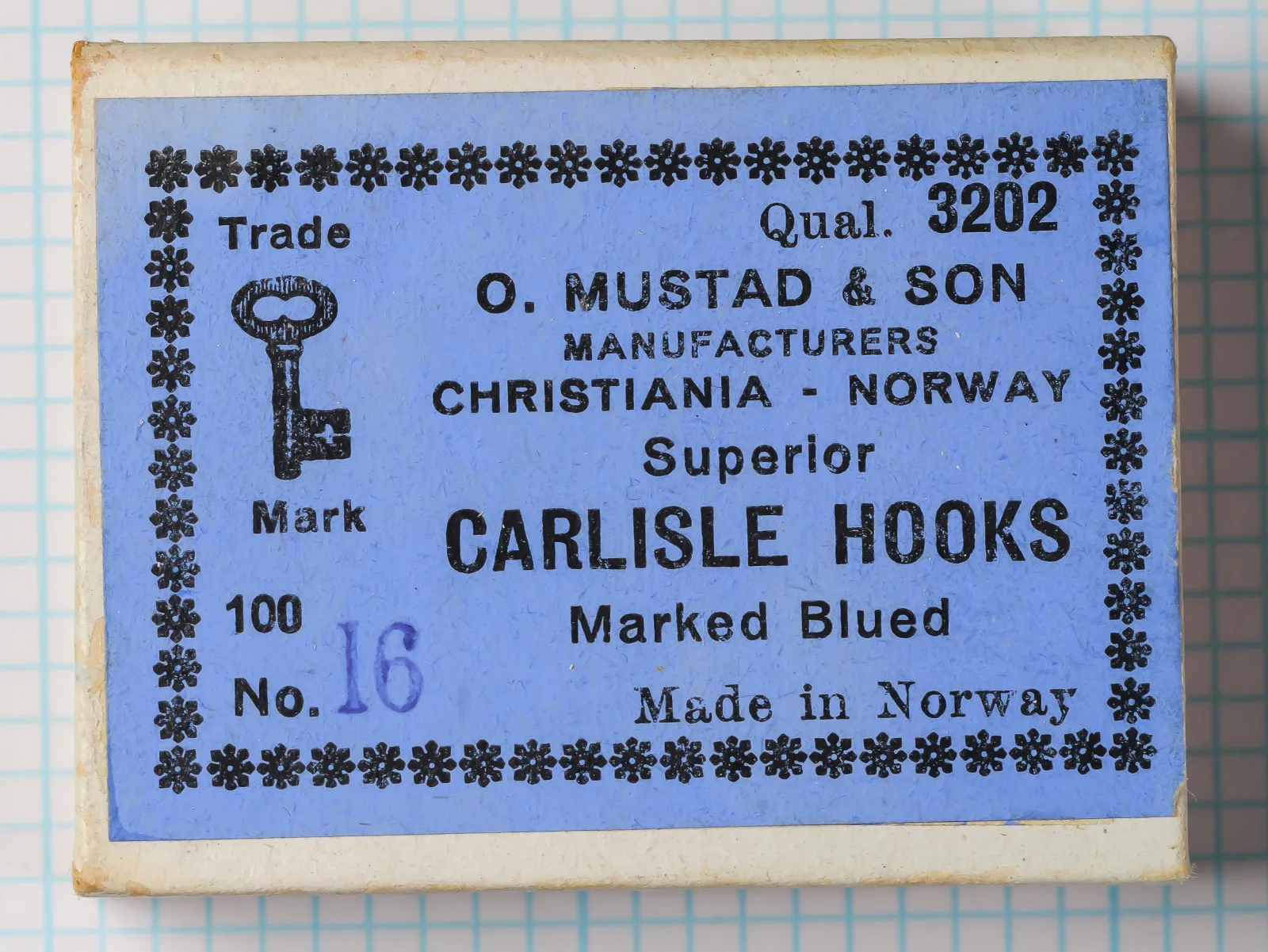
The Mustad 3202 is a rare and historically significant vintage Carlisle hook produced by O. Mustad & Son during the late 19th to early 20th century. Distinguished by its ‘Christiania, Norway’ packaging — a label Mustad continued using on export boxes well beyond Norway’s 1877 official renaming, skipping the ‘Kristiania’ spelling entirely and updating directly to ‘Oslo’ after 1925 V.
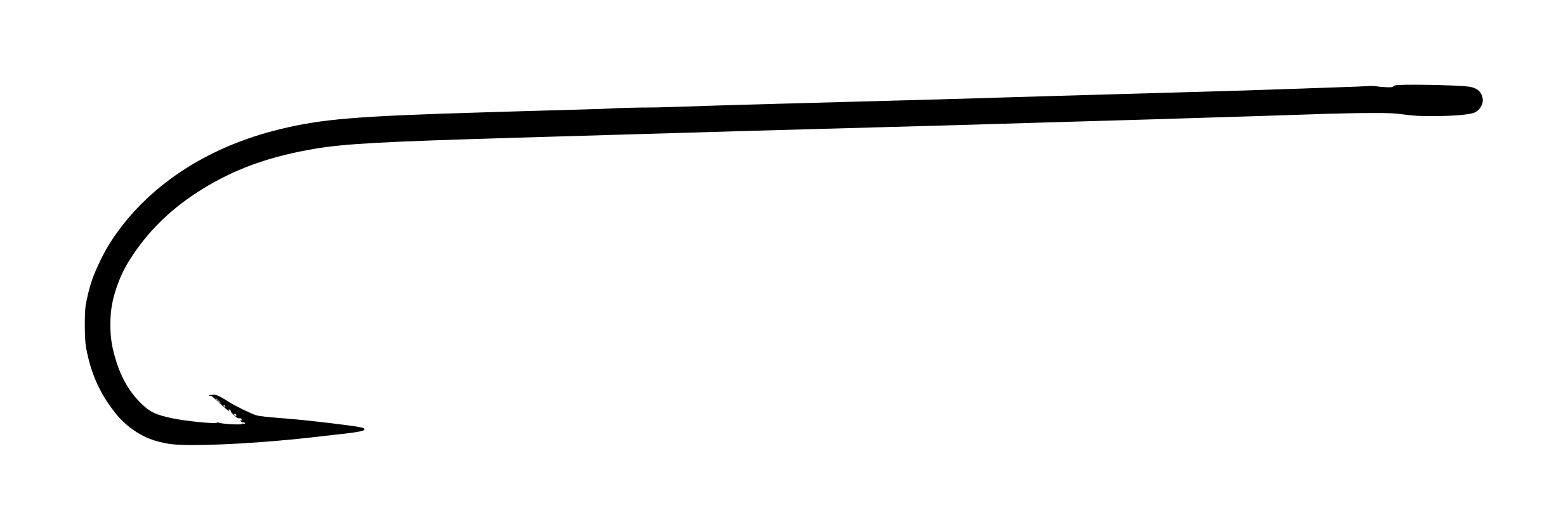
This size 16 specimen features a blued finish, extra fine wire, and an exceptionally long shank with marked ridges designed to grip a traditional gut or silk snell P. The blind eye construction represents the pre-eyed hook era when snelled attachment was standard practice P.
For collectors of vintage fishing tackle or Mustad history researchers, this represents some of the earliest known examples of Mustad’s international export packaging, complete with the original ‘Key Brand’ trademark and ornate decorative border P.
Original packaging label for Mustad Superior Carlisle Hooks model 3202, size 16, marked blued finish. Made in Norway by O. Mustad & Son, Christiania.
Photographic record
9 cataloged imagesSelect any record to load it above.
8 images shown
Mustad 3202 Carlisle Hook Box LabelOriginal packaging label for Mustad Superior Carlisle Hooks model 3202, size 16, marked blued finish. Made in Norway by O. Mustad & Son, Christiania.Open originalMustad 3202 Carlisle Hook Side ProfileSize 16 Mustad 3202 Carlisle hook displaying the characteristic long, sweeping bend and fine barbed point typical of the Carlisle pattern.Open originalMustad 3202 Carlisle Hook Dorsal ViewDorsal view of size 16 Mustad 3202 showing the extended shank length relative to the gape and the proportions of the Carlisle bend.Open originalMustad 3202 Hook Box FrontFront of original Mustad 3202 Superior Carlisle box, size 16, 100-hook count. Blued finish, made in Norway.Open originalMustad 3202 Carlisle Size 16 Hook DetailMustad 3202 size 16 hook shown in dorsal view with point angled downward. Blued finish visible on curved bend and shank.Open originalMustad 3202 Carlisle Hook Bend DetailClose-up of the Mustad 3202 Carlisle hook bend showing the sweeping curve and tapered barbed point in blued finish.Open originalMustad-3202-HooksMustad-3202-HooksOpen originalMustad-3202-LabelMustad-3202-LabelOpen originalMustad-3202-3203-SalescareMustad-3202-3203-SalescareOpen original
Technical profile
Eye
Blind — Marked ShankBlind eye construction
Wire
Fine (1X Fine), Round
Shank
Extra-Extra Long (XXL) — Marked / Ridged
Bend
carlisle, Narrow gap, Offset / kirbedClassic Carlisle geometry with exceptionally long shank-to-gap ratio. Symmetrical rounded bend with no offset. Wire set provides good hookup angle P.
Point
Superior (near-straight inner taper)Small, close-cut barb set at standard angle. Proportionate to wire gauge and point geometry P.
Finish
Blued — Confirmed (stated on packaging)Deep blue-black blued finish consistent throughout. Shows typical Mustad bluing quality of the era with even color distribution and good corrosion resistance P.
Hook shows excellent preservation with bright finish and sharp point. Original packaging in very good condition with light toning and minor edge wear but complete labeling.
The extra-long shank serves multiple functions: preventing deep swallowing by fish, providing leverage for easier hook removal, and keeping sharp-toothed species away from leader connections. The marked ridges create mechanical grip points that prevent snell slippage under load.
The superior point geometry offers excellent penetration while maintaining strength in the fine wire gauge. The blued finish provides corrosion resistance superior to bright steel while maintaining a subtle underwater profile.
We don't have measured sizes for this hook yet. Own one? Submit calipered measurements and we'll review and add them. Thank you!
Historical context
mustad
O. Mustad & Son was founded in 1832 by Ole Mustad in Gjøvik, Norway, and grew to become the world’s largest fishhook manufacturer. The company revolutionized hook production by developing automated machinery that could mass-produce complex English bend patterns with consistent quality. By the late 19th century, Mustad was aggressively expanding into international markets, particularly the United States.
The ‘Christiania’ branding reflects Mustad’s early export strategy, maintaining familiar geographic references even after official place name changes. This conservative approach to packaging helped establish brand recognition in foreign markets while Norwegian political geography evolved.
Series History
The 3202 was part of Mustad’s early catalog of traditional English patterns adapted for industrial production. The Carlisle bend was among the most popular 19th-century bait hook designs, originally developed in English tackle shops for its deep-hooking prevention characteristics.
Mustad’s version maintained the essential geometry while adding their marked shank feature and superior bluing process. The series was likely introduced in the 1870s-1880s as Mustad expanded beyond basic patterns into specialized traditional designs. Production continued into the early 20th century before being superseded by eyed hook variants.
Era and Packaging Dating
Packaging shows 'Christiania - Norway' location marking. Christiania was the official name from 1624-1877, then Kristiania 1877-1925, then Oslo from 1925. However, Mustad continued using the Christiania spelling on export packaging well beyond 1877, apparently skipping Kristiania entirely and updating directly to Oslo around 1925. The ornate snowflake border design and 'Key Brand' trademark are consistent with early Mustad export packaging style.
The Gentleman's Hook
The Carlisle pattern was considered the 'gentleman's hook' in Victorian England because its long shank made it easier to release fish unharmed — an early form of sporting ethics. Mustad's ability to mass-produce these complex bends at affordable prices democratized what had been expensive handmade tackle, helping spread catch-and-release practices among working-class anglers.
Design lineage and influence
The Carlisle bend originated in English tackle shops, named after the city of Carlisle. Traditional versions were hand-forged by local blacksmiths with considerable variation in proportions. Mustad standardized the pattern through industrial production, establishing the definitive geometry that influenced later manufacturers.
This design directly influenced modern long-shank patterns including the Aberdeen and various baitfish hooks. The marked shank feature became a Mustad signature, appearing across multiple pattern families throughout their catalog.
Best matchRelated by Attribute
Computed automatically from catalog data — updated as new hooks are added.
Matches: Bend, Shank, Eye, Eye Orient., Point +4 moreDiffers: Wire: Fine (1X Fine) vs Standard; Gap: Narrow vs Standard; Finish: Blued vs Bronzed +1 more
Matches: Bend, Shank, Eye, Eye Orient., Point +4 moreDiffers: Wire: Fine (1X Fine) vs Standard; Gap: Narrow vs Standard; Forging: Round vs Forged +2 more
Matches: Bend, Eye, Eye Orient., Point, Finish +4 moreDiffers: Shank: Extra-Extra Long vs 4X Long; Wire: Fine (1X Fine) vs Extra-Fine; Gap: Narrow vs Standard +2 more
Designed for traditional bait fishing with natural baits like bloodworms, single salmon eggs, or small maggots. The extra-long shank prevents fish from swallowing the hook deeply and keeps sharp-toothed species away from delicate gut leaders. The marked shank provides mechanical grip for snell attachment P.
Secondary Applications
Long-bodied terrestrial patterns using traditional snell lashing techniques
Classic Fly Patterns
Not typically used for fly tying
Modern Equivalents
Hook
Match Quality
Notes
Mustad Classic Carlisle 3191
Very Good
Direct modern descendant with ringed eye instead of blind construction. Same bend geometry and proportions.
Mustad Aberdeen 3261
Good
Similar extra-long shank profile but with Aberdeen bend geometry. Comparable fishing applications.
Collector notes
High collector value due to rare Christiania packaging and excellent condition of both hook and original box.
Reference value
$75 – $150 USD estimate
Packaging condition
Very Good — light wear, fully legibleRecorded specimen
Packaging format
MUS-BOX-01Catalog code
Positive factors: Extremely rare Christiania-era packaging in excellent condition, complete with original hooks and ‘Key Brand’ trademark. Represents early Mustad export packaging before standardization. Historical significance as example of 19th-century snelled hook design.
Limiting factors: Very specific collector interest in vintage Mustad packaging. Blind eye format limits appeal to modern anglers. Small size may be less visually impressive to casual collectors.
Packaging
Small blue-labeled cardboard box with ornate black snowflake border design. White cardboard construction with applied blue paper label. Letterpress printing with 'Key Brand' trademark symbol. Text includes 'Trade Mark', 'Qual. 3202', 'O. MUSTAD & SON MANUFACTURERS', 'CHRISTIANIA - NORWAY', 'Superior CARLISLE HOOKS', 'Marked Blued', '100 No. 16', and 'Made in Norway'. Shows age toning and light edge wear but label remains bright and fully legible.
Market Value Notes
Premium pricing for complete original packaging with Christiania marking. Individual hooks worth significantly less. Box condition and completeness drive value.
Authentic Mustad 3202s feature the distinctive ‘Qual. 3202’ marking on packaging (never just ‘3202’). Christiania-era boxes have letterpress printing with deep ink impression and ornate snowflake borders. Modern reproductions lack the period-correct paper stock and printing quality. Check for ‘Key Brand’ trademark symbol – essential authentication feature P.
Preservation
Storage and Preservation
Store in cool, dry environment away from moisture to preserve the original blued finish. The historic packaging adds tremendous value — keep hooks in original box rather than transferring to modern storage. Handle minimally to prevent wear on the delicate paper label.
The blued finish is relatively stable but can develop patina with humidity exposure. Some collectors value light patina as authentication of age. Avoid contact with dissimilar metals to prevent galvanic corrosion. Original cardboard may benefit from archival storage box for long-term preservation.
Marking Analysis
Packaging Markings Analysis
The ’16’ size marking appears to be hand-stamped in purple ink over the printed label, indicating individual sizing during packaging P. This hand-application method was typical of early Mustad export production before fully automated labeling systems.
All other text elements are letterpress printed, showing the characteristic deep impression and crisp edges typical of late 19th-century commercial printing. The consistency of ink density and registration marks this as professional production rather than local jobbing work.
Primary Source
Christiania Branding Strategy
Source: Original Mustad 3202 packaging label, c. 1877-1925
The retention of ‘Christiania – Norway’ branding well beyond the 1877 official name change to Kristiania reveals Mustad’s conservative export marketing strategy. Rather than confusing international customers with frequent geographic updates, they maintained familiar branding until the major 1925 change to Oslo.
This approach suggests Mustad prioritized brand consistency over political correctness, understanding that their international reputation was built on geographic stability. The decision to skip ‘Kristiania’ entirely indicates this was a deliberate business strategy rather than oversight.
Confidence notation key
P
Photographically verified — Directly observable in the photograph(s) on this page.
V
Verified by documentation — Confirmed by manufacturer catalog, spec sheet, or published reference.
I
Inferred — A logical deduction from observable or documented evidence, not directly stated.
E
Estimated — An approximation based on visual comparison, proportional analysis, or limited data.
S
Speculative — A reasoned hypothesis that cannot be confirmed from available evidence.
Claims with no notation are confirmed by multiple independent sources. All photographs on garrenwood.com are taken on a measurement grid where each square equals 1/10 inch (0.1″ / 2.54 mm).