The Mustad 3295 Chestertown represents one of the most specialized hook designs in American saltwater angling history P. This Norwegian-manufactured hook features an extra long shank with marked ridges and a distinctively narrow Sproat bend, engineered specifically for winter flounder fishing along the Atlantic Northeast coast P.
The ‘Marked Black’ japanned finish provided essential corrosion resistance for saltwater use, while the blind eye construction with marked ridges offered superior bait-holding capability P. Dating from the classic mid-20th century era based on the red Key Brand label with snowflake border and Oslo marking E, this size No. 11 example showcases the peak of purpose-built hook engineering.
Named after Chestertown, Maryland on the Chester River tributary of Chesapeake Bay, this pattern solved two critical problems: the narrow gap fit easily into small flounder mouths, while the extra long shank provided leverage for deep hook removal V. Today highly sought by collectors of vintage saltwater tackle and historical fishing patterns.
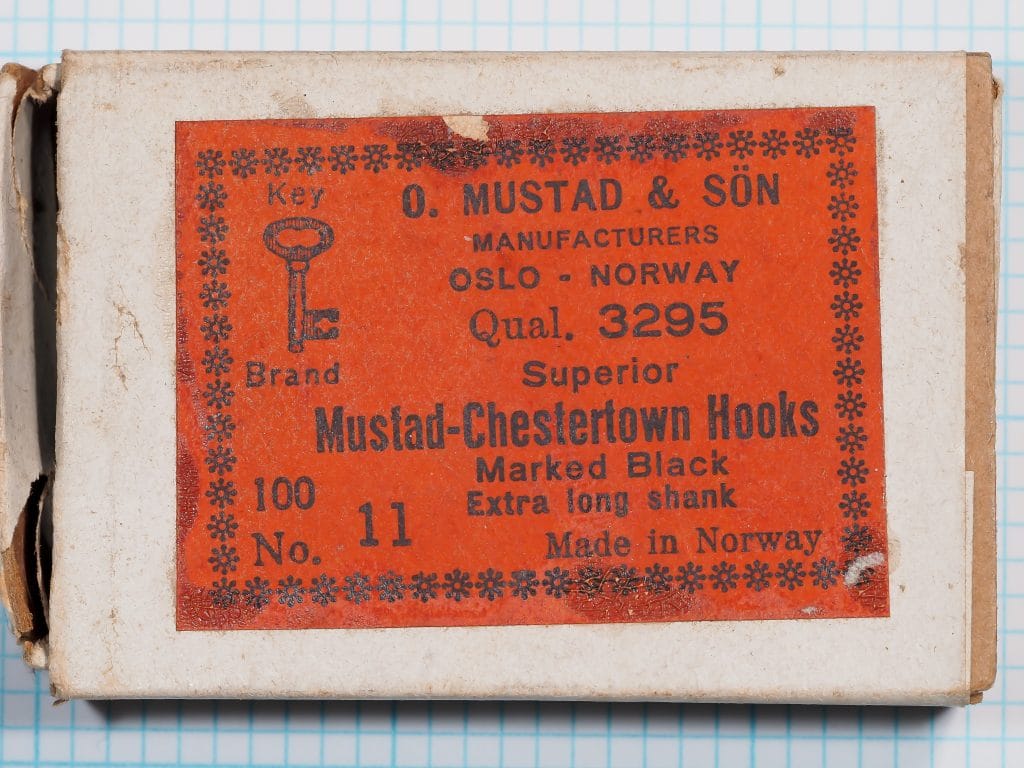
Original Mustad 3295 box with classic red Key Brand label showing full specifications including Oslo Norway manufacture and 'Marked Black' finish designation.
Photographic record
3 cataloged imagesSelect any record to load it above.
3 images shown
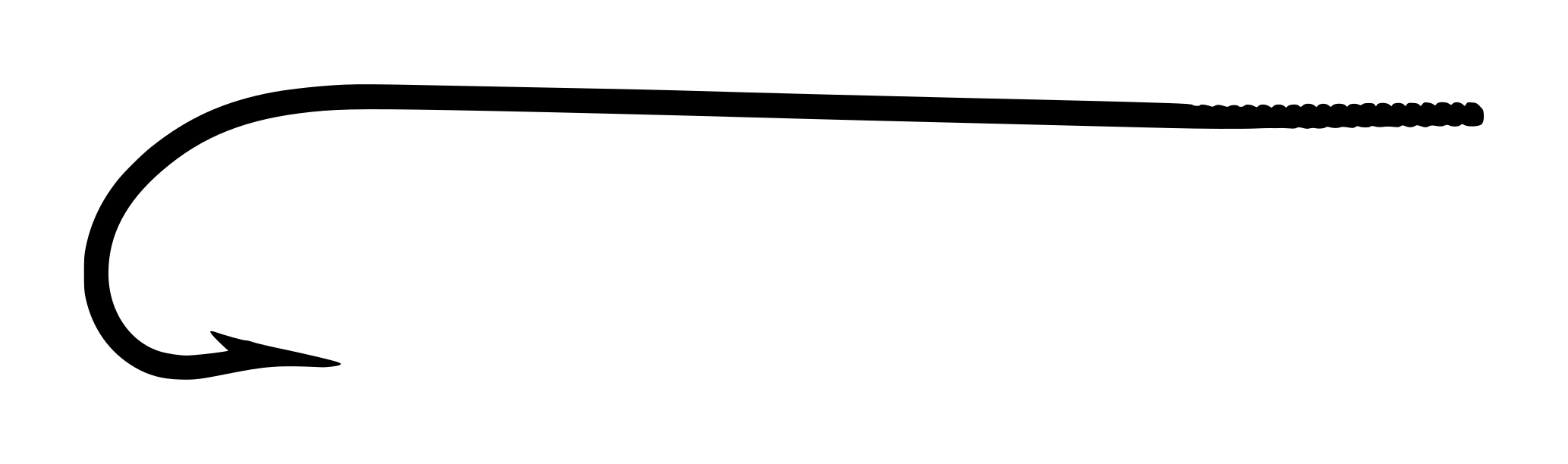
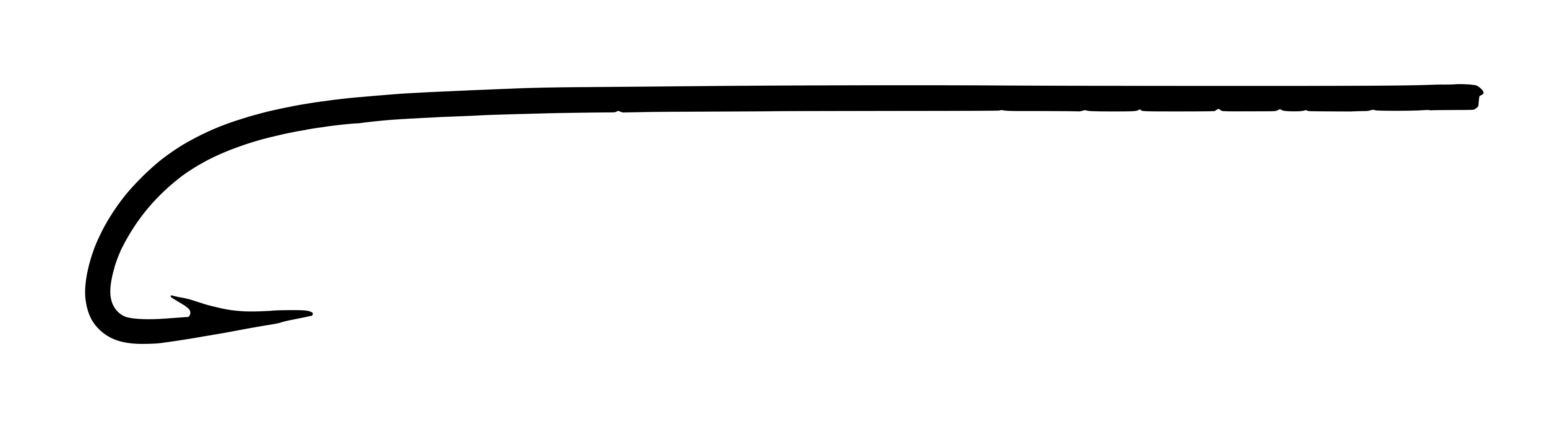
Mustad 3295 Chestertown Box Red LabelOriginal Mustad 3295 box with classic red Key Brand label showing full specifications including Oslo Norway manufacture and 'Marked Black' finish designation.Open originalMustad 3295 Chestertown Hooks ProfileProfile view of Mustad 3295 Chestertown hooks on measurement grid, showing the characteristic extra long shank and narrow gap Sproat bend that defined this classic flounder fishing pattern.Open originalMustad 3295 Point and Barb DetailDetailed view of the Mustad 3295 point showing standard spear geometry with moderate barb sweep, typical of mid-20th century Norwegian manufacturing quality.Open original
Technical profile
Eye
Blind — Marked ShankBlind eye construction with marked ridged surface for traditional snelling technique P
Wire
Standard, Round
Shank
Extra-Extra Long (XXL) — Marked / Ridged
Bend
Sproat, Narrow gapClassic narrow-gap Sproat bend characteristic of Chestertown pattern, optimized for small-mouthed species P
Point
Standard / SpearStandard cut barb with moderate sweep angle, proportioned for size No. 11 specification P
Finish
Black Japanned — Confirmed (stated on packaging)Original 'Marked Black' japanned finish shows characteristic deep black color with slight metallic undertone typical of mid-20th century application P
Box shows typical age toning with intact red label. Hooks appear unused with original japanned finish showing minor storage spotting typical of the era.
The extra long shank serves dual purposes: providing leverage for hook removal when fish swallow bait deeply, and offering extended space for bait presentation that appears more natural to cautious feeders like winter flounder P. The marked ridges create mechanical grip points that help prevent bait from sliding down the shank during casting and retrieval.
The narrow gap Sproat bend geometry ensures the hook point maintains proper orientation relative to the shank while fitting easily into small mouths. The heavy wire gauge provides strength for saltwater use and the leverage forces created by the long shank, while the japanned finish offers corrosion resistance essential for marine environments.
The Chestertown series represents Mustad’s response to the specific needs of Mid-Atlantic estuarine fishing, particularly the winter flounder fishery that was crucial to both commercial and recreational anglers V. The pattern was later continued as the 3300 series, though that model was eventually discontinued, making vintage examples like this 3295 increasingly valuable to collectors.
The series was characterized by the combination of extra long shank, marked ridges for bait retention, and the narrow gap Sproat bend that defined its functionality. Multiple size offerings allowed anglers to match local conditions and target species, with the larger sizes like this No. 11 suited to substantial winter flounder and similar species.
Era and Packaging Dating
Red paper label with Key Brand logo and snowflake border pattern typical of mid-20th century Mustad packaging. Oslo marking indicates post-1925 production when name changed from Christiania. Box construction and print quality consistent with 1950s-1960s era. No barcode present confirms pre-1974 production.
The Flounder Hook
The Chestertown hook was so closely associated with winter flounder fishing that many Mid-Atlantic anglers simply called them 'flounder hooks' regardless of the manufacturer. The pattern was named after Chestertown, Maryland, located on the Chester River where the distinctive narrow-gap design proved perfect for the area's abundant but small-mouthed winter flounder population.
Design lineage and influence
The Chestertown design evolved from traditional long-shank bait hooks but incorporated specific geometric refinements for flounder fishing. The narrow gap Sproat bend differentiated it from broader patterns like the O’Shaughnessy, while the marked shank provided bait-holding capability without the complexity of true baitholder barbs.
This 3295 model number was eventually superseded by the 3300 series, which maintained the essential Chestertown geometry while updating manufacturing processes. The blind eye construction reflects the era when ringed eyes were less common on utility bait hooks, with the marked flat eye providing secure line attachment through the traditional snelling technique.
Best matchRelated by Attribute
Computed automatically from catalog data — updated as new hooks are added.
Matches: Shank, Wire, Gap, Eye, Eye Orient. +3 moreDiffers: Bend: Sproat vs Carlisle; Point: Standard / Spear vs Hollow Point; Finish: Black Japanned vs Blued +3 more
Matches: Shank, Gap, Eye, Eye Orient., Finish +4 moreDiffers: Bend: Sproat vs Other; Wire: Standard vs Extra-Fine; Point: Standard / Spear vs Hollow Point +1 more
Matches: Shank, Gap, Eye, Eye Orient., Forging +2 moreDiffers: Bend: Sproat vs Carlisle; Wire: Standard vs Fine (1X Fine); Point: Standard / Spear vs Superior +5 more
Matches: Shank, Wire, Gap, Eye, Eye Orient. +4 moreDiffers: Bend: Sproat vs Carlisle; Point: Standard / Spear vs Superior; Finish: Black Japanned vs Blued +2 more
Designed specifically for winter flounder fishing in Atlantic Northeast waters. The extra long shank and narrow gap combination allowed easy insertion into small flounder mouths while providing leverage for hook removal when fish swallowed bait deeply.
Secondary Applications
Also used for blowfish, perch, and other small-mouthed species. Creative fly tyers use these for long slender streamers and pin-fry imitations.
Classic Fly Patterns
Not typically used for fly tying, though modern tyers adapt for specialized streamer patterns
Modern Equivalents
Hook
Match Quality
Notes
None - pattern discontinued
Poor
No current direct equivalent maintains the exact Chestertown geometry and blind eye construction
Collector notes
Strong historical significance as classic American saltwater pattern, enhanced by discontinued status and connection to regional fishing traditions.
Reference value
$15 – $35 USD estimate
Packaging condition
Good — moderate wear, legibleRecorded specimen
Packaging format
MUS-BOX-01Catalog code
Positive factors: The Chestertown pattern holds legendary status in American saltwater angling, particularly along the Atlantic Northeast where it was the standard for winter flounder fishing. The specific 3295 model number represents the classic era of this design, with authentic period packaging that clearly documents its specifications and Norwegian manufacture. The pattern’s discontinuation has increased collector interest, especially among those focused on vintage saltwater tackle.
Limiting factors: While historically significant, Chestertown hooks were produced in substantial quantities during their heyday, making individual examples relatively available to collectors. The specialized nature limits appeal to those specifically interested in saltwater angling history rather than broader hook collecting. Condition varies widely among surviving examples, with many showing use or storage deterioration.
Packaging
Cardboard box with red paper label featuring Key Brand logo and snowflake/asterisk border. Label reads 'O. MUSTAD & SON MANUFACTURERS OSLO - NORWAY Qual. 3295 Superior Mustad-Chestertown Hooks Marked Black Extra long shank Made in Norway 100 No. 11'. Classic mid-20th century Mustad presentation.
Market Value Notes
Prices depend heavily on packaging condition and completeness. Full boxes with intact labels command premium pricing, while loose hooks or partial quantities trade for lower values. Regional interest stronger in Northeast coastal areas where pattern was historically used.
Where to Find
eBay, specialty fishing tackle shows, antique tackle dealers, estate sales in Mid-Atlantic coastal regions
Collector's Identification Tips
Verify ‘Qual. 3295’ model marking and Oslo manufacturer designation. Authentic examples show consistent japanned finish and proper Chestertown bend geometry. Box label should display Key Brand logo with snowflake border pattern.
Preservation
Storage and Preservation
Store in a cool, dry environment away from humidity to prevent further oxidation of the japanned finish. The original cardboard box should be preserved as it significantly enhances collector value – consider archival storage sleeves to protect the label from further deterioration. Hooks can develop light surface rust if exposed to moisture; store with desiccant packets if necessary.
Handle minimally to preserve the original finish. The marked black japanning, while durable, can chip or wear with handling. If displaying, avoid direct sunlight which can fade the red label over time. Original packaging adds substantial historical value and should be preserved whenever possible.
Primary Source
Package Documentation Analysis
Source: Original Mustad 3295 box label, c. 1950-1965
The red label provides comprehensive specification documentation typical of mid-20th century Mustad presentation. The term ‘Superior’ appears as a quality designation rather than point style specification, while ‘Marked Black’ clearly identifies the japanned finish. ‘Extra long shank’ confirms the extended geometry, and ‘Made in Norway’ establishes the Gjøvik/Oslo manufacturing origin during Mustad’s peak production era.
Size Note
Size No. 11 Context
Size No. 11 represents a substantial hook in the Chestertown series, suited to larger winter flounder and similar species. The extra long shank becomes particularly pronounced at this size, creating significant leverage advantage for deep hook removal. This size was less common than smaller Chestertown hooks used for typical flounder fishing, making it somewhat more collectible among pattern enthusiasts.
Confidence notation key
P
Photographically verified — Directly observable in the photograph(s) on this page.
V
Verified by documentation — Confirmed by manufacturer catalog, spec sheet, or published reference.
I
Inferred — A logical deduction from observable or documented evidence, not directly stated.
E
Estimated — An approximation based on visual comparison, proportional analysis, or limited data.
S
Speculative — A reasoned hypothesis that cannot be confirmed from available evidence.
Unnotated claims are the compiler’s synthesis; see Sources. All photographs on garrenwood.com are taken on a measurement grid where each square equals 1/10 inch (0.1″ / 2.54 mm).