O. Mustad & Söe model 92618 Beak Hook, size 9/0. Forged reversedoffset point, extra-extra long shank, straight ball eye. Nickelled finish. Pack of 100 hooks in original manufacturer box. Intended for heavy saltwater bait fishing and trolling applications.
The Beak bend is a specialized saltwater form characterized by a pronounced rightward (reversed) offset that positions the point well clear of the bait mass and shank. Standard wire gauge combined with the extended shank length (nearly 4.5″) makes this a heavy-duty pattern for large baits and commercial trolling rigs.
Production era c. 1955-1970, based on packaging construction, logo style, and nomenclature. The presence of original manufacturer box in excellent condition substantially increases collectability over loose hooks or cards. Mustad Beak Hooks are moderately common but size 9/0 in original packaging commands attention from tackle historians and saltwater bait-fishing specialists.
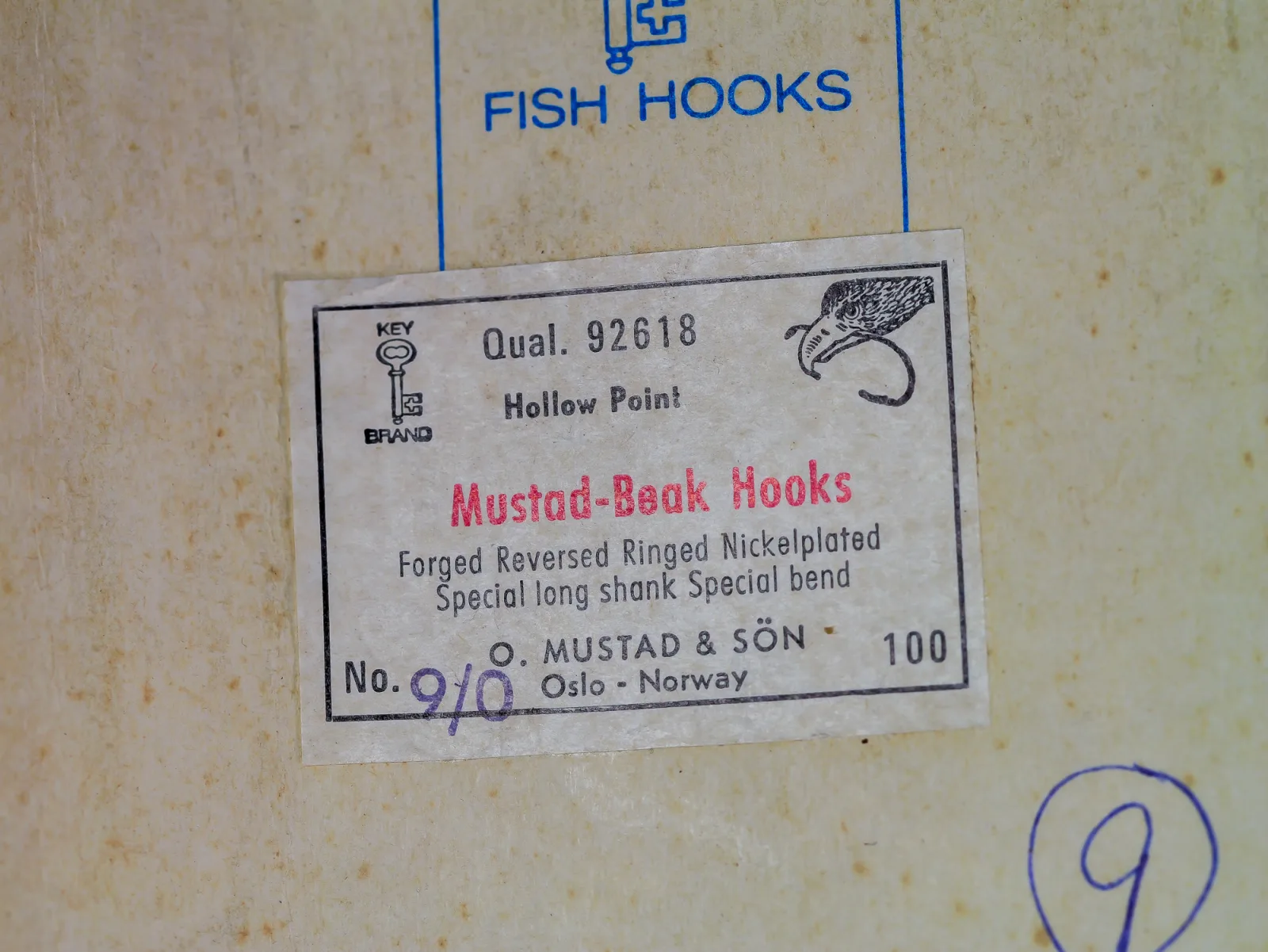
Top label of the original Mustad manufacturer box for the 92618 Beak Hook (size 9/0), showing the Key brand logo, model code, product name in red capitals, and complete specification line. Handwritten blue ink notation of size appears lower-left.
Photographic record
3 cataloged imagesSelect any record to load it above.
3 images shown
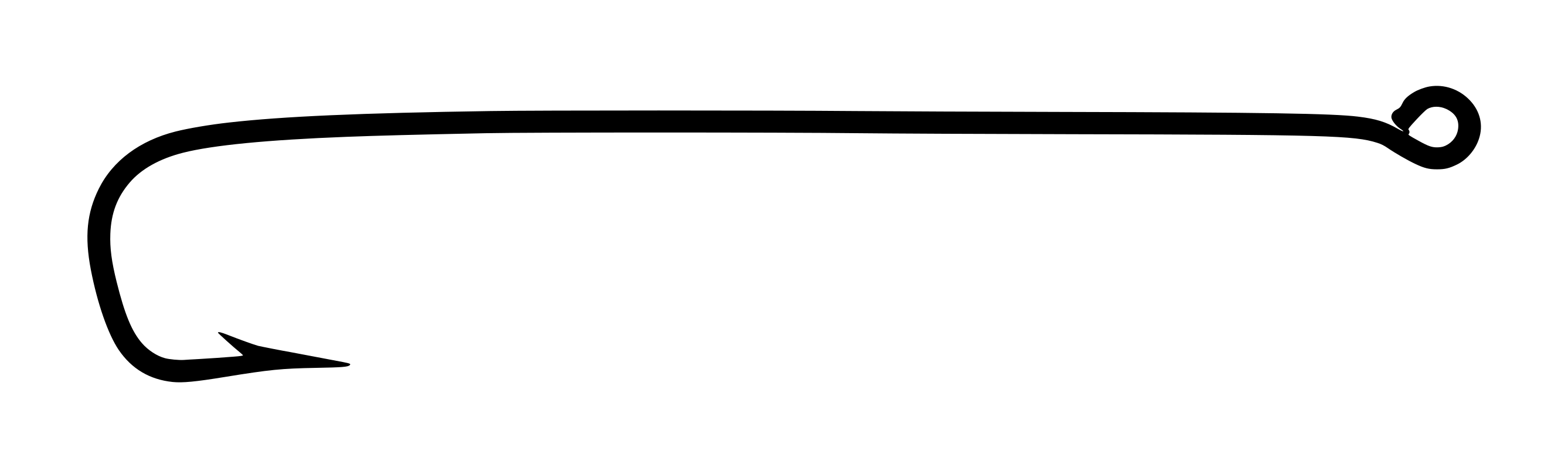
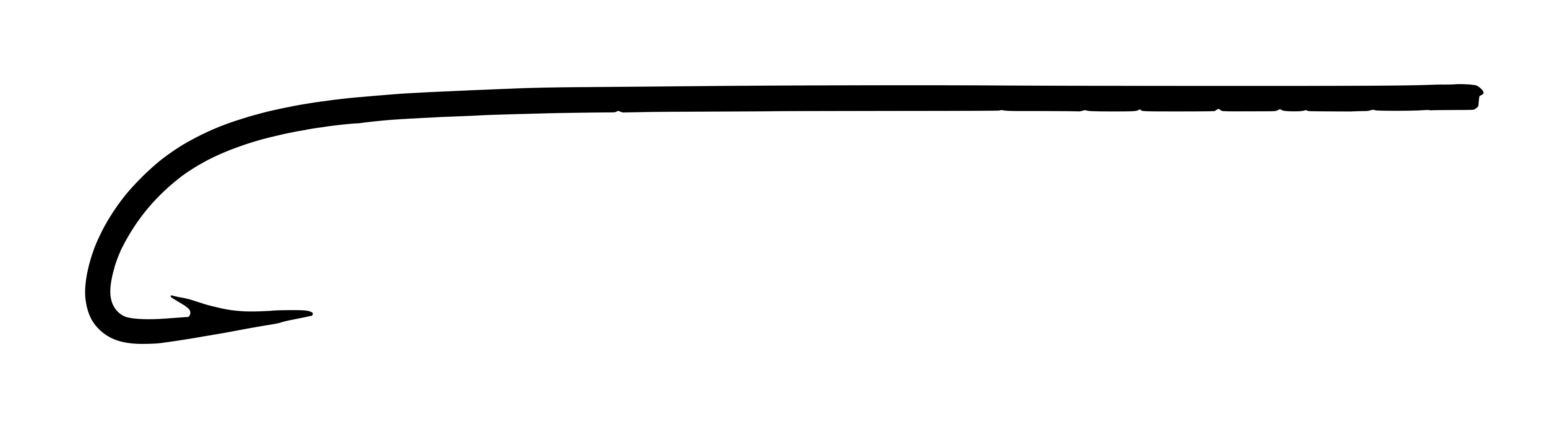
Mustad 92618 Beak Hook — Original Box LabelTop label of the original Mustad manufacturer box for the 92618 Beak Hook (size 9/0), showing the Key brand logo, model code, product name in red capitals, and complete specification line. Handwritten blue ink notation of size appears lower-left.Open originalMustad 92618 Size 9/0 — Bend Profile and Shank DetailOblique close-up of a single Mustad 92618 Beak Hook showing the characteristic reversed-offset bend with pronounced rightward turn of the point. The extended shank runs nearly parallel to the measurement grid, demonstrating the extra-long proportions. Nickelled finish appears as cool silver-grey reflective tone.Open originalMustad 92618 Size 9/0 — Complete Hook Profile on GridFull-profile photograph of the Mustad 92618 Beak Hook (size 9/0) on 0.1-inch measurement grid. The hook extends across approximately 50 grid squares (5 inches), demonstrating the extreme length of the extra-long shank. The straight ball eye, long parallel shank, and reversed-offset bend are all clearly visible. Allows precise measurement of overall proportions.Open original
Technical profile
Straight / Inline Ball Eye | Beak / Reversed Point | Extra-Extra Long | Standard Wire | Beak / Reversed Point | Nickelled / Nickel-plated
Eye
Ball Eye, Straight / InlineStraight or inline ball eye, formed from the wire as a uniform diameter loop. The eye remains in line with the shank axis rather than rotated downward or upward.
Wire
Standard, Forged
Shank
Extra-Extra Long (XXL) — Plain
Bend
Beak / Reversed Point, Narrow gap, Offset / kirbedBeak bend with pronounced reversed (rightward) offset when viewed from above. The bend tapers smoothly from the shank through a controlled curve to the point. Wire set is consistent with forged beak construction.
Point
Beak / Reversed (incurving)Barb is present and appears to be of standard depth for this model class, cut close to the wire at the standard position.
Finish
Nickelled / Nickel-Plated — Confirmed (stated on packaging)Cool silver-grey nickel plating applied evenly across the wire. The finish tone and reflectivity are consistent with Mustad nickelled specifications. Confirmed by printed notation on the manufacturer box.
The manufacturer box is in very good condition overall. The paperboard structure is intact and rigid. The lid closes properly without damage. Printed label shows even color throughout with no fading or significant wear. Surface shows light overall toning consistent with age and storage; corner edges show minor wear typical of handling. The specimen hooks themselves are bright nickelled with no corrosion or defects visible. Complete hook count is present (100 hooks).
The forged wire profile flattens and work-hardens the steel, increasing tensile strength and resistance to bending under load. This is essential for size 9/0 bait hooks, where heavy fish and coarse handling demand durability. Standard wire gauge (approximately 2.5-2.8 mm) provides a balance between strength and penetration—heavier than modern competition rigs but lighter than traditional codfish patterns.
The reversed (rightward) offset geometry seats the point clearly to the right of the shank, creating stand-off distance from large baits. This prevents the bait from dulling or deflecting the point and ensures the barb seats properly on take. The narrow gap (relative to hook length) reflects the design’s suitability for firm-mouthed fish where barb depth rather than gap width determines hold.
The straight (inline) ball eye accommodates heavy mono or braided snells without the rotation stress that downturned eyes create. Nickelling provides superior corrosion resistance in salt environments compared to bronzing or bluing.
This pattern was made in sizes 9/0 (V). We have measurement for size 9/0. Know the others? Submit calipered measurements and we'll review and add them. Thank you!
The Mustad Beak series dates to the early twentieth century as part of Mustad’s expansion into saltwater tackle. The model 92618 (Beak, size 9/0, extra-long shank) appears in Mustad catalogs from the 1950s onward as a standard stock item for commercial and recreational saltwater bait fishing. The Beak line included sizes from approximately 1/0 to 9/0, with shank length variants (standard, long, extra-long) available as separate model codes.
The series remained in production through the 1960s and into the 1970s, though market preference gradually shifted toward lighter wire gauges and more compact bend geometries as modern saltwater fly patterns and spinning reels reduced demand for heavy forged bait hooks. The Beak was ultimately discontinued as a specialty item when Mustad consolidated its saltwater line to higher-volume models.
No significant design changes occurred during the documented production run. The Beak maintained its original specifications: forged wire, reversed offset, straight eye, and nickelled finish throughout its catalog life.
Era and Packaging Dating
No barcode present on packaging, indicating production before 1974. Mustad logo style (Key brand device) is consistent with Mustad's trademark usage in the mid-twentieth century. Box construction in kraft paperboard with printed label is typical of Mustad packaging from the 1950s-1970s. Typography and ink color (black text with red capitals for product name) align with Mustad's printing standards of that period. The notation "Qual." (Quality) followed by model code appears on mid-century Mustad packaging, later replaced by simpler model references. The use of "SÖN" (with diacritic) in "MUSTAD & SÖN" was gradually phased out in favor of anglicized "MUSTAD & SON" during the 1960s-1970s, suggesting earlier end of range. Handwritten size notation in blue ink on box suggests pack-date marking, consistent with 1950s-1960s practices. Overall evidence points to c. 1955-1965 as most likely production window.
Mustad's Saltwater Dominance
By the 1950s, Mustad supplied roughly 50% of the hooks used in commercial saltwater fishing worldwide. The Beak series was part of this industrial expansion—designed not for sport fishing but for trolling operations, hand-line bait fishing, and commercial maritime use. A single large trawler might carry thousands of Beak hooks in multiple sizes. The extra-long shank and reversed offset geometry reflect decades of feedback from commercial fishermen who needed a hook that would hold massive baits and handle the brutal work of deep-water trolling. Today, these same hooks appeal to modern anglers pursuing large saltwater species, but their original market was industrial fishing supply, not retail sport tackle.
Design lineage and influence
The Beak bend is an older Mustad form, reflecting the company’s historical focus on saltwater and commercial bait-fishing rigs. Reversed-offset hooks originated in traditional English bait-fishing patterns and were adopted by Mustad as the company expanded its saltwater line in the early-to-mid twentieth century. The Beak was positioned alongside the O’Shaughnessy and other reversed forms in Mustad’s catalog as a specialized tool for trolling and live-bait applications where the extreme offset kept the point clear of the bait.
The extra-long shank variant (model 92618) represents Mustad’s systematic approach to sizing—extending the shank for larger baits and clearer hook sets in tough-mouthed saltwater species. Later production shifted toward more compact designs and lighter wire gauges as modern drag systems and tackle design evolved.
Best matchRelated by Attribute
Computed automatically from catalog data — updated as new hooks are added.
Matches: Shank, Gap, Eye, Offset, Application +2 moreDiffers: Bend: Beak / Reversed Point vs Other; Wire: Standard vs Fine (1X Fine); Eye Orient.: Straight / Inline vs Turned Down +3 more
Matches: Bend, Eye, Eye Orient., Point, Forging +4 moreDiffers: Shank: Extra-Extra Long vs Special Long; Wire: Standard vs Heavy (1X Heavy); Gap: Narrow vs Standard +3 more
Matches: Bend, Eye, Forging, Offset, Application +2 moreDiffers: Shank: Extra-Extra Long vs 2X Long; Wire: Standard vs Heavy (1X Heavy); Gap: Narrow vs Standard +3 more
Matches: Shank, Wire, Gap, Eye Orient., Offset +3 moreDiffers: Bend: Beak / Reversed Point vs Sneck; Eye: Ball Eye vs Cross Eye; Point: Beak / Reversed vs Superior +5 more
The Mustad Beak (model 92618) was designed for saltwater and heavy bait fishing applications. The reversed offset point and extra-long shank geometry suit large baits and trolling rigs where the extended shank provides stand-off distance from the bait mass and allows the point to maintain clarity and penetration. The forged construction and nickelled finish provide durability in salt environments.
Collector notes
Rated 4.5/10 — Moderately collectible. The original manufacturer box in excellent condition substantially elevates value above loose hooks or card stock equivalents. Size 9/0 is moderately common but more scarce than smaller sizes. Collector demand is present among saltwater bait-fishing historians and Mustad specialists but remains below the level of rare Redditch craftwork or named-designer patterns.
Reference value
$12 – $28 USD estimate
Packaging condition
Very Good — light wear, fully legibleRecorded specimen
Packaging format
GW-MS-06Catalog code
Positive Factors: Original rigid manufacturer box is rarer than card-stock packaging and commands a 2-4x premium. Box condition is very good with intact lid, complete label, and all 100 hooks present. The model is a documented Mustad specialist form with clear historical application. Nickelled finish is highly desirable for salt-water collectors. Size 9/0 represents the upper end of typical bait-hook sizing and appeals to trolling and commercial-gear historians.
Limiting Factors: The Beak form, while specialized, is not rare in the Mustad catalog—production volumes were substantial for mid-century commercial fishing applications. Modern interest in bait-hook collecting is smaller than interest in vintage fly hooks or classic Redditch patterns. Complete original boxes reduce the novelty factor compared to rare card variants. The specialized application (saltwater bait fishing) limits appeal to fly tyers or trout anglers.
Desirable Variants: Smaller sizes (1/0, 2/0) are scarcer than 9/0 and command modest premiums. Original boxes with all hooks intact are essential to strong valuation. Variants on braided snells (if any) would be significantly rarer and more collectible. Hand-notated boxes with fishing records or vintage tackle shop provenance add narrative value.
Condition Drivers: Box integrity (lid closure, label legibility, structural soundness) is the primary value determinant. Missing hooks substantially reduce value. Surface toning and handling wear are acceptable in vintage boxes; aggressive cleaning reduces authenticity. Original tissue wrap, if present, adds 10-15% premium.
Packaging
Rigid manufacturer box with separate lid. Natural kraft paperboard construction with printed label on top surface. Label text printed in black and red ink on white background. Box dimensions approximately 5.5" x 3.5" x 1.2". Top label shows manufacturer Key logo (left), model qualification "Qual. 92618" (center), hand-drawn beak illustration (right), product name "Mustad-Beak Hooks" in red capitals, description line "Forged Reversed Ringed Nickelplated / Special long shank Special bend", manufacturer imprint "O. MUSTAD & SÖN / Oslo - Norway" (center-bottom), and quantity "100" (right). Size marking "No. 9/0" in handwritten blue ink near bottom-left. Printing method appears to be letterpress or offset. Paper stock shows moderate age toning and handling wear. Box lid shows light surface wear and minor creasing. Original tissue wrap not present or visible.
Market Value Notes
Low ($12): Good condition — box intact with minor wear, all hooks present and usable, label legible.
High ($28): Very good/Excellent condition — box lid closes securely, label sharp with no fading, all 100 hooks pristine.
Premium factors: Original manufacturer box (vs. loose or card), complete hook count, size 9/0, intact label, box structural integrity.
Platforms: eBay (US and UK), vintage tackle dealers, online auction platforms focused on saltwater gear.
Confidence: E estimated — limited comparable sales data for boxed Mustad Beak in this size; estimate based on typical mid-century commercial hook box valuations and saltwater bait-hook market trends.
Where to Find
eBay (US), eBay UK, tacklebox.co.uk, vintage saltwater tackle dealers specializing in commercial or trolling rigs. Less commonly seen at general fly-fishing tackle shows; more likely at coastal tackle fairs and saltwater-focused specialty markets. Fishing heritage museums and institutional collections occasionally hold examples.
Collector's Identification Tips
Verify the model code “92618” and product name “Mustad-Beak Hooks” printed on the box lid label. Check for the Key brand logo (circular device with key symbol) on the left side of the label. Confirm the hand-drawn beak hook illustration on the right of the label. Verify “Forged Reversed Ringed Nickelplated” and “Special long shank Special bend” descriptive text. Confirm manufacturer imprint shows “O. MUSTAD & SÖN” and “Oslo – Norway”. Size notation should appear in handwritten blue ink. Count the quantity marking “100”. Original box should be rigid kraft paperboard with printed label; later variants may appear on card stock or in different label formats.
Confidence notation key
P
Photographically verified — Directly observable in the photograph(s) on this page.
V
Verified by documentation — Confirmed by manufacturer catalog, spec sheet, or published reference.
I
Inferred — A logical deduction from observable or documented evidence, not directly stated.
E
Estimated — An approximation based on visual comparison, proportional analysis, or limited data.
S
Speculative — A reasoned hypothesis that cannot be confirmed from available evidence.
Unnotated claims are the compiler’s synthesis; see Sources. All photographs on garrenwood.com are taken on a measurement grid where each square equals 1/10 inch (0.1″ / 2.54 mm).