O. Mustad & Søn Qual. 3793 Mustad-Chestertown, Size 10, c. 1930-1950. A specialized bait hook engineered for winter flounder fishing on the US East Coast. The pattern exemplifies Mustad’s strategy of reverse-engineering highly localized, regional hook designs and standardizing them for mass export.
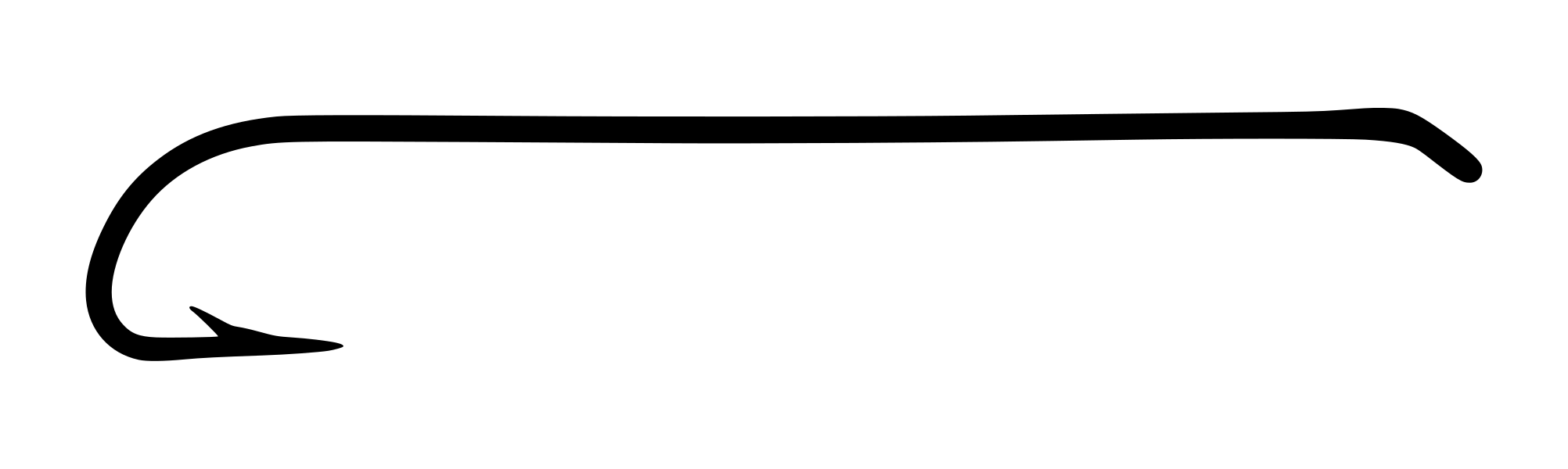
The defining physical characteristic is an extreme shank-to-gap ratio: a narrow Size 10 gap paired with an exceptionally long 2¼-inch shank. This unusual proportion reflects a precise functional requirement—winter flounder possess small mouths but engulf bait deeply, and the long shank functioned as a mechanical lever to extract the hook without harming fish or breaking the fragile braided lines and silkworm gut snoods of the era.
The hollow point geometry enables low-pressure penetration, essential for soft-mouthed species. Japanned (black lacquer) finish provided superior corrosion resistance in brackish and saltwater environments. Original packaging bears the ‘Key Brand’ logo, ‘Oslo – Norway’ designation, and characteristic eight-line Mustad label format, placing production in the 1930-1950 window.
Rare surviving examples possess strong historical significance for East Coast bait-fishing tradition and demonstrate how industrial manufacturers adapted tackle to precise ecological and species-specific conditions.
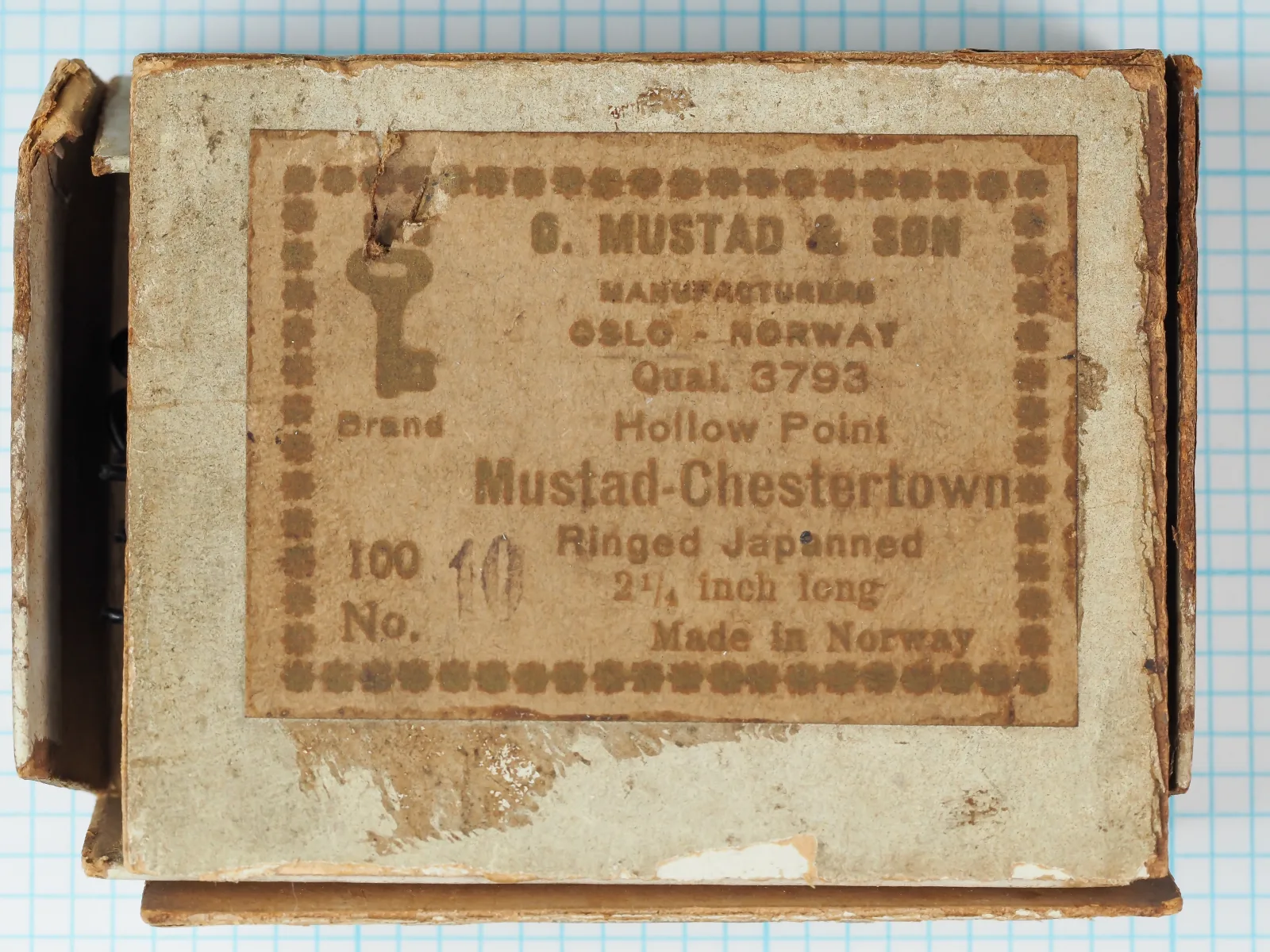
Original cardboard box for Mustad Quality 3793 Chestertown hooks showing the characteristic eight-line Mustad label format with Key Brand logo, Oslo-Norway designation, and 100-count notation. Label text clearly identifies the hollow point, Mustad-Chestertown pattern, and ringed japanned finish.
Photographic record
4 cataloged imagesSelect any record to load it above.
4 images shown
Mustad 3793 Chestertown Box and LabelOriginal cardboard box for Mustad Quality 3793 Chestertown hooks showing the characteristic eight-line Mustad label format with Key Brand logo, Oslo-Norway designation, and 100-count notation. Label text clearly identifies the hollow point, Mustad-Chestertown pattern, and ringed japanned finish.Open originalMustad 3793 Chestertown Hook Point Close-UpClose-up detail of the Mustad 3793 hollow point showing the characteristic concave, inwardly curved geometry that enables rapid tissue penetration with minimal force. The dark japanned finish is visible on the point and barb.Open originalMustad 3793 Chestertown Hook Full ProfileSide profile of the Mustad 3793 showing the defining characteristic of the Chestertown pattern: an exceptionally long shank (2¼ inches) paired with a very small gap (Size 10), creating a shank-to-gap ratio of approximately 8.7:1. The ringed eye, smooth bend curve, and japanned finish are visible.Open originalMustad 3793 Chestertown Dual Hook SpecimenPaired Mustad 3793 hooks photographed on measurement grid, showing the consistency of the Chestertown pattern production and documenting the extreme shank length relative to gap width. Both specimens show the smooth bend, ringed eye, and japanned finish characteristic of the pattern.Open original
Technical profile
Eye
Ball Eye, Straight / InlineRinged eye (ball eye) formed by bending the terminal wire into a simple, uniform circular loop. Characteristic of mechanized mass-production Mustad hooks. P
Wire
Standard, Round
Shank
4X Long — Plain
Bend
Narrow gapChestertown bend—a distinctive regional pattern featuring a relatively open, moderately deep round bend with slight lateral offset. The proportion of shank to gap is extreme: the massive 2¼-inch shank dwarfs the narrow Size 10 gap, creating a specialized morphology optimized for bait threading and deep-mouth extraction. Not classified as a standard Sproat, Limerick, or Aberdeen, but rather as a regional American bait pattern. P
Point
Hollow Point (concave inner face)Standard barb: short, close-cut barb positioned directly above the inner face of the point. The hollow point geometry creates a steep, acute angle between the barb and the point taper, typical of Mustad's point grinding for soft-tissue penetration. P
Finish
Black Japanned — Confirmed (stated on packaging)Japanned finish: heavy, opaque black lacquer coating, characteristic of pre-1960s Mustad export hooks. Specimen retains dark, satiny finish with minimal wear and no rust bloom visible. The black tone is consistent with alkyd resin-based lacquer, standard for corrosion protection in saltwater and brackish environments. P
Specimen hooks are bright, with no corrosion, pitting, or rust bloom. Japanned finish is intact with minor edge wear from original box handling. Original cardboard box and printed label show fair condition: label text legible but paper stock exhibits age-darkening and edge foxing. Two corner creases visible on box.
The hollow point geometry—characterized by a concave, inwardly curved cross-section—provides rapid tissue penetration with minimal applied force. This design is particularly suited to soft-mouthed fish like winter flounder, where aggressive hook-sets would risk tearing friable tissue and causing lost hooks. The acute taper from barb to tip concentrates penetration force at the point while the rapid flare toward the barb creates a mechanical lock in soft tissue. The exceptionally long shank converts the hook into a mechanical lever, amplifying the angler’s pulling force and enabling hook extraction from deep bites without line breakage—critical when fishing with the delicate braided lines and silkworm gut snoods of the vintage era.
Represents one of the earliest documented examples of extreme shank-to-gap ratio fishing hooks in the garrenwood.com catalog (8.7:1). Notable as a surviving example of a regional American bait-pattern cloning strategy executed by a Norwegian industrial manufacturer. The Chestertown pattern appears to be one of Mustad's most successful regional adaptations, with surviving examples suggesting substantial production volume for a specialized pattern.
Own this hook? Help us measure it.
We don't have measured sizes for this hook yet. Own one? Submit calipered measurements and we'll review and add them. Thank you!
The Chestertown pattern represents Mustad’s aggressive strategy of industrial ‘cloning’—reverse-engineering highly localized, regional hook patterns and standardizing them for mass export. Named after Chestertown, Maryland, this pattern was engineered specifically for the winter flounder fisheries of the US East Coast. The unusual proportions—a very small gap (Size 10) paired with an exceptionally long shank (2¼ inches)—reflect the precise functional requirements of winter flounder angling: small-mouthed fish that swallow bait deeply, requiring a long shank as a mechanical lever for hook extraction without harming the catch. This pattern embodies Mustad’s understanding of localized fishing methodologies and demonstrates how the company successfully penetrated regional North American markets by manufacturing hooks tailored to specific species and traditions.
Era and Packaging Dating
Packaging bears 'Key Brand' logo and 'Oslo - Norway' designation (post-1925 Christiania rename). No barcode present (pre-1974). Japanned finish notation and eight-line label format are characteristic of mid-20th-century Mustad export boxes. Style of type, paper stock, and two-color printing (brown/tan) suggest 1930s-1950s production window. Mustad guide source (ref 6) confirms Oslo-period labeling conventions for this era.
The Flounder Extraction Lever
Winter flounder were historically crucial to East Coast subsistence and commercial fishing during the colonial era and through the 20th century. The species' small mouth and habit of deep bait ingestion created a genuine hook-design challenge: anglers fishing with fragile braided horsehair or gut lines needed a mechanism to extract hooks from 8-12 inches inside the fish's throat without snapping the line. Mustad's Chestertown pattern solved this problem by pairing an impossibly small gap (Size 10) with a 2¼-inch shank that acted as a rigid lever. Modern anglers using synthetic monofilament and circle hooks rarely encounter this problem, making the Chestertown pattern a forgotten relic of an entirely different era of fishing tackle engineering.
Design lineage and influence
The Chestertown pattern is part of Mustad’s broader strategy of acquiring and cloning regional American hook patterns in the late 19th and early 20th centuries. Similar regionally specialized patterns include the Cincinnati Bass Hook (wide gape, deep bend for largemouth bass) and Virginia hooks adapted for specific Atlantic coast bait fisheries. The Chestertown’s extreme shank-to-gap ratio influenced later modern flounder-specific hooks but remains largely obsolete in contemporary fishing due to the adoption of circle hooks and modern monofilament line, which reduce the mechanical extraction challenge that the long shank was designed to solve.
Best matchRelated by Attribute
Computed automatically from catalog data — updated as new hooks are added.
Matches: Wire, Gap, Eye, Point, Forging +4 moreDiffers: Shank: 4X Long vs Extra-Extra Long; Eye Orient.: Straight / Inline vs Turned Down; Finish: Black Japanned vs Other
Matches: Gap, Eye, Forging, Application, Shank Feat. +1 moreDiffers: Shank: 4X Long vs Extra-Extra Long; Wire: Standard vs Fine (1X Fine); Eye Orient.: Straight / Inline vs Turned Down +3 more
Matches: Shank, Gap, Eye, Finish, Forging +2 moreDiffers: Wire: Standard vs Heavy (1X Heavy); Eye Orient.: Straight / Inline vs Turned Down; Point: Hollow Point vs Standard / Spear +2 more
Matches: Wire, Eye, Eye Orient., Point, Forging +3 moreDiffers: Shank: 4X Long vs 1X Long; Gap: Narrow vs Standard; Finish: Black Japanned vs Bright / Uncoated Steel +1 more
Matches: Gap, Point, Finish, Forging, Application +1 moreDiffers: Shank: 4X Long vs Extra-Extra Long; Wire: Standard vs Extra-Fine; Eye: Ball Eye vs Blind — Marked Shank +3 more
The Mustad 3793 Chestertown was engineered as a dedicated winter flounder hook for East Coast bait fishing. Winter flounder possess relatively small mouths but exhibit a tendency to engulf bait completely. The pattern pairs a narrow Size 10 gap with an exceptionally long 2¼-inch shank, creating a mechanical advantage for anglers to extract the hook from deep within the fish’s mouth without tearing tissue or damaging the fragile fishing lines (braided horsehair or silkworm gut snood) common to the era. The hollow point design enabled delicate, low-pressure penetration through the flounder’s soft mouth tissue, essential for a species known for tender buccal structures.
Secondary Applications
Light bait fishing for other small-mouthed Northeast saltwater and brackish-water species; specialist applications with delicate live baits (sandworms, bloodworms) requiring long-shank threading.
Classic Fly Patterns
Named patterns specifically associated with this hook. Leave blank if none formally documented. Do not speculate — only include patterns with a confirmed association.
Modern Equivalents
Hook
Match Quality
Notes
Mustad 3366 Sprocket Bend
Good
Modern long-shank sprocket bend; similar East Coast bait application but with modern metallurgy and finishes
Eagle Claw 213F Flounder Hook
Good
Dedicated modern flounder hook; specialized regional pattern continuation, though styling and materials differ significantly
Tiemco 2488H Saltwater Bait
Moderate
Modern long-shank bait hook; similar proportions but optimized for contemporary monofilament and circle-hook hooking theory
Collector notes
Reference value
$12 – $25 USD estimate
Packaging condition
Good — moderate wear, legibleRecorded specimen
Packaging format
GW-M-08-CBCatalog code
Packaging
Cardboard slide box, rectangular, approximately 4.5" × 2.5" × 1". Paper stock is tan/cream kraft, two-color printing (brown/tan ink). Label adheres to central front face in recessed depression. Eight-line Mustad label format with 'Key Brand' skeleton key logo at upper left, followed by: Line 1: 'O. MUSTAD & SON'; Line 2: 'MANUFACTURERS'; Line 3: 'OSLO - NORWAY'; Line 4: 'Qual. 3793'; Line 5: 'Hollow Point'; Line 6: 'Mustad-Chestertown'; Line 7-8: 'Ringed Japanned 2¼ inch long'. Bottom corner: '100 No. 10'. Box edges show period-appropriate aging: foxing on kraft paper, edge darkening, minor creasing from handling. No barcode or modern UPC present. Interior partitions designed for 100-hook storage in two stacked trays (50 hooks per tray). Printing method: offset lithography, characteristic of 1930s-1950s production.
Market Value Notes
Vintage Mustad hooks in original packaging command modest premiums. This example's condition (fair-good box label) and specialized regional pattern (Chestertown) places it in the mid-range for comparable vintage bait hooks. Pairs with strong interest in East Coast winter flounder tackle history.
Where to Find
eBay vintage tackle lots, specialist tackle dealers, New England antique fishing shows, regional Massachusetts and Rhode Island estate sales.
Collector's Identification Tips
Identify by ‘Qual. 3793’ printed on label, ‘Mustad-Chestertown’ designation, and extremely long shank relative to gap size (typically 20+ times the gap length). Check for ringed eye (ball eye), hollow point geometry (concave inner face visible in side profile), and japanned (heavy black lacquer) finish. Original box label critical for dating: ‘Oslo – Norway’ (post-1925) and absence of barcode (pre-1974) narrow production window to mid-20th century. Size is nominally listed as ’10’ but the actual gap is exceptionally small relative to modern Size 10 hooks—do not confuse with modern sizing standards.
Preservation
Storage and Preservation
The Mustad 3793 Chestertown represents a fragile historical artifact requiring careful handling and storage. The japanned finish, while inherently durable against corrosion, is vulnerable to mechanical damage and chemical exposure.
Storage Environment: Maintain hooks in a cool, dry location away from direct sunlight, fluctuating humidity, and salt spray or moisture-rich environments. Humidity levels above 50% risk degradation of the japanned lacquer coating and accelerate paper deterioration in the original box. Store original cardboard packaging in a acid-free environment; do not wrap in polyvinyl chloride (PVC) film, which traps moisture and causes chemical degradation of both paper and metal finishes.
Handling: Avoid touching the japanned surface directly with bare hands. Skin oils and salts can initiate microscopic corrosion and create fingerprint marks. Handle hooks by the shank using cotton gloves. Do not attempt to clean the japanned finish with abrasive compounds, solvents, or water-based cleaners—the lacquer coating is irreplaceable and any cleaning removes material.
Box and Label Preservation: The original eight-line label is the primary dating and identification tool. Preserve the label in situ on the box without removal, which would cause irreversible damage to both label and cardboard. Store the box flat in a shallow archival container with acid-free tissue separators. Do not use tape, glue, or adhesive of any kind to repair paper damage; consult a paper conservation specialist if major repairs are needed.
Display: If the specimen is displayed, keep it behind non-reflective glass in a shadowbox or cabinet away from direct sunlight and artificial heating sources. Sunlight fades the brown printing ink on the label and can damage the paper stock. Avoid display near wood, which off-gasses formic acid and accelerates paper degradation.
Size Note
Extreme Shank-to-Gap Ratio and Vintage Sizing
The Mustad 3793 Chestertown presents a notable sizing anomaly that reflects the significant differences between vintage hook sizing standards and modern conventions. The hook is documented as ‘Size 10,’ but this designation cannot be directly compared to contemporary Size 10 hooks.
Vintage Sizing System: Mustad’s mid-20th-century sizing for regional bait patterns like the Chestertown did not follow the standardized numerical progression (16, 14, 12, 10, 8, 6, 4, 2, 1, 1/0, 2/0, etc.) with consistent geometric relationships between sizes. Instead, regional patterns were often numbered according to their historical naming conventions or regional demand. The Chestertown’s ‘Size 10’ designation refers to the gap width (approximately 0.23 inches / 5.84 mm), which would correspond to modern Size 10-12 standards for a conventional hook. However, the shank length—2¼ inches—exceeds the length of modern Size 4/0 or 5/0 hooks, creating confusion if the specimen is evaluated by modern sizing expectations.
Functional Proportion: The extreme shank-to-gap ratio of 8.7:1 was intentional and functionally driven by the winter flounder fishery. This ratio bears no equivalent in modern hook offerings, as contemporary fish handling and line technology have eliminated the mechanical extraction problem that the long shank was designed to solve. Collectors and researchers should exercise caution when comparing Mustad 3793 specimens to modern hooks bearing similar numeric designations.
Primary Source
Eight-Line Label Analysis and Mustad Nomenclature
Source: O. Mustad & Søn Mustad-Guide.pdf (reference 6); Comprehensive Typology and Decryption of Vintage O. Mustad & Søn Hook Labels
The printed eight-line label on the Mustad 3793 box provides a complete technical specification following the standardized format established by O. Mustad & Søn for global distribution. This label structure is documented in detail in the Mustad Typology and Decryption reference (Mustad Guide PDF, source 6), which specifies the exclusive purpose and meaning of each label line.
Line-by-Line Breakdown:
Line 1: ‘O. MUSTAD & SON’ — Establishes the manufacturer and brand authority, differentiating Mustad as the primary manufacturer rather than an import agent or regional repackager.
Line 2: ‘MANUFACTURERS’ — Explicitly states the company’s function within the global supply chain, critical in an era when tackle was frequently repackaged under secondary brand names.
Line 3: ‘OSLO – NORWAY’ — Geographic origin designation. The use of ‘Oslo’ (post-January 1, 1925 name) rather than ‘Christiania’ definitively places this box’s production after 1925. No later geographic designation change occurred, so this provides only a lower bound on production era.
Line 4: ‘Qual. 3793’ — Quality/model code. The four-digit code places this in Mustad’s mid-tier ‘Quality’ products (3000-3999 range), representing standard production hooks manufactured to exacting dimensional and tempering standards, rather than premium (4000+) or economy (1000-2999) tiers.
Line 5: ‘Hollow Point’ — Hook point geometry descriptor. Defines the penetration characteristic as a concave, inwardly curved design, exclusively denoting point style per Mustad labeling rules.
Line 6: ‘Mustad-Chestertown’ — Pattern name identifier. ‘Mustad-‘ prefix signifies Mustad’s proprietary version of a regionally cloned design. ‘Chestertown’ identifies the geographic origin and specific regional fishery (Chestertown, Maryland, winter flounder).
Lines 7-8: ‘Ringed Japanned 2¼ inch long’ — Anatomical modifications and metallurgical finish. ‘Ringed’ specifies the eye type (ringed/ball eye). ‘Japanned’ specifies the protective finish (baked-on alkyd resin lacquer, typically black). ‘2¼ inch long’ specifies the exceptional shank length.
Significance: The label demonstrates Mustad’s sophisticated product categorization system, which communicated technical specifications to international wholesalers, regional retailers, and individual anglers across linguistic and geographic barriers. The rigid eight-line format ensures that any hook bearing this label conforms to precise manufacturing specifications established at the company’s Gjøvik factory. The presence of ‘Qual. 3793’ as an arbitrary, non-intuitive numeric code is a hallmark of the pre-2001 manufacturing era; Mustad discontinued these codes around 2001-2009 in favor of the logically structured ‘Signature Series’ naming convention, making vintage numeric quality codes a definitive identifier of true vintage Mustad products.
Additional
Winter Flounder Fishing Tradition and Regional Hook Adaptation
The Mustad 3793 Chestertown hook is a remarkable artifact of late 19th and early 20th century regional fishing traditions on the US East Coast, specifically documenting how a Norwegian industrial manufacturer adapted to highly localized, geographically specific fishing methodologies.
Winter Flounder Biology and Fishing Challenge: Winter flounder (Pseudopleuronectes americanus) are a schooling flatfish native to the North Atlantic, ranging from Nova Scotia to North Carolina but historically most abundant from Massachusetts to New York. The species possesses a characteristically small mouth and a feeding behavior that involves engulfing bait whole and swimming away to digest it in deeper water. Nineteenth and early twentieth century anglers—fishing with braided horsehair lines, silkworm gut snoods, and delicate split-cane rods—faced a singular mechanical problem: once a flounder had swallowed the bait, the hook could lodge 8 to 12 inches inside the fish’s throat, making extraction extremely difficult without snapping the fragile line. This created strong demand for a specialized hook design that could serve as a mechanical lever, amplifying the angler’s pulling force.
Mustad’s Cloning Strategy: Rather than inventing new hook designs internally, Mustad’s competitive strategy involved dispatching agents to fishing hubs worldwide to study and reverse-engineer local and regional patterns created by blacksmiths, artisans, and regional tackle makers. Mustad would then manufacture these patterns with extreme industrial efficiency at the Gjøvik factory, capturing both local demand and exporting standardized versions globally. The Chestertown pattern exemplifies this approach: the design emerged from the specific needs of Maryland and Delaware bay winter flounder anglers, was documented and analyzed by a Mustad agent, and then manufactured in Gjøvik in the scale and consistency that only industrial machinery could achieve.
Design Innovation in the Pattern: The Chestertown’s extreme shank-to-gap ratio (8.7:1) is not arbitrary aesthetic choice but rather a precise functional response to the flounder’s anatomy and feeding behavior. The short gap prevents the fish’s mouth from sliding off the hook once penetration occurs; the long shank serves as a rigid lever arm. When an angler felt tension from a hooked flounder, reeling in created a mechanical advantage: the force applied at the rod handle, transmitted through the line to the eye, was converted into a powerful lateral moment at the barb, forcing the hook backward through throat tissue and out through the mouth. Without the lever arm—using a standard-proportion hook—the line could not exert sufficient leverage to extract the hook intact.
Historical Footnote: The Chestertown pattern appears to have been manufactured in significant quantities, based on the number of surviving examples in collections, suggesting that winter flounder fishing was economically important enough to justify dedicated, specialized tooling at Mustad. The pattern declined in popularity during the mid-to-late 20th century as synthetic monofilament lines and circle hooks transformed fishing methodology. Modern circle-hook theory—based on the principle that the angler should never ‘set’ the hook forcefully but rather allow the fish to hook itself against line tension—has made the mechanical extraction lever obsolete. Today, the Chestertown survives primarily as a historical curiosity, a fossil record of a completely different era of tackle engineering.
Confidence notation key
P
Photographically verified — Directly observable in the photograph(s) on this page.
V
Verified by documentation — Confirmed by manufacturer catalog, spec sheet, or published reference.
I
Inferred — A logical deduction from observable or documented evidence, not directly stated.
E
Estimated — An approximation based on visual comparison, proportional analysis, or limited data.
S
Speculative — A reasoned hypothesis that cannot be confirmed from available evidence.
Unnotated claims are the compiler’s synthesis; see Sources. All photographs on garrenwood.com are taken on a measurement grid where each square equals 1/10 inch (0.1″ / 2.54 mm).