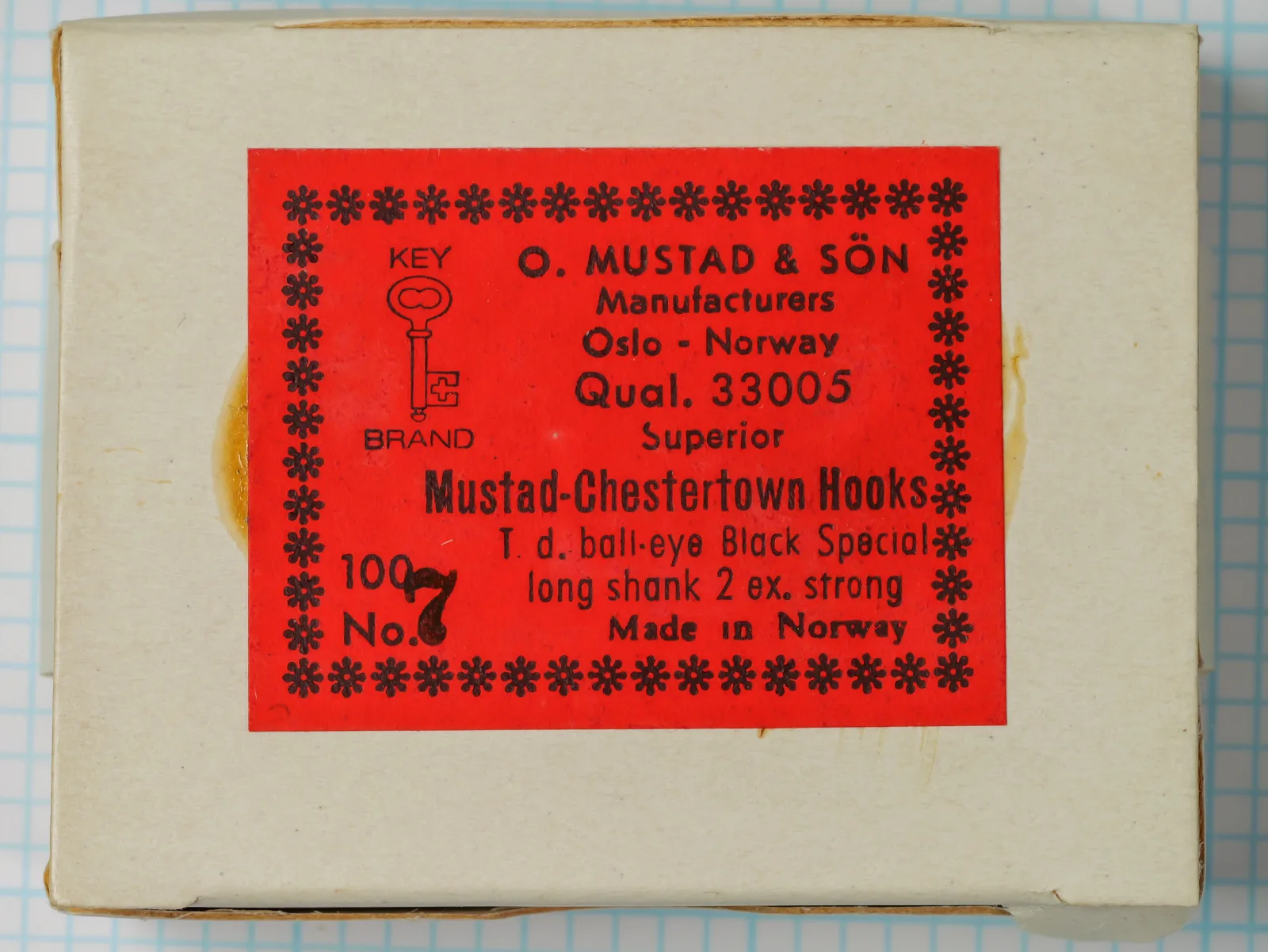
Mustad-Chestertown Hooks, Model 33005, Size No. 7: A vintage bait hook manufactured by O. Mustad & Son in Gjøvik, Norway, circa 1950s-1960s. This specimen is housed in the original red ‘Key Brand’ labeled paper box with 100 hooks intact. The Chestertown is a specialized long-shank pattern with extra-heavy 2x wire, narrow gape, and japanned black finish—designed specifically for winter flounder fishing in Atlantic coastal waters, particularly the Chesapeake Bay region.
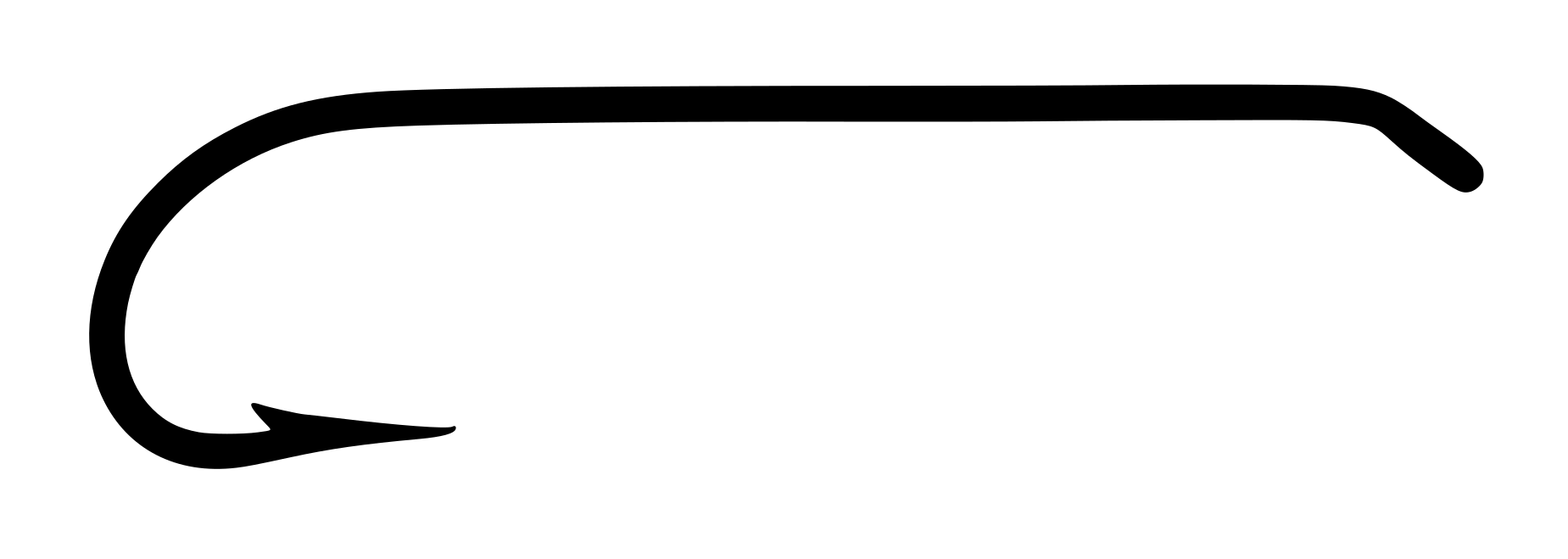
The defining physical feature is the narrow gape (~0.55-0.65 inches) combined with extended shank length (~1.5-1.65 inches), which addresses the biological challenge of flounder that mouth bait before swallowing deeply. The long shank serves as a mechanical lever for safe hook extraction. The tapered-down ball eye and sharp kirbed bend geometry complete the engineering.
Era evidence is strong: the red paper label with the iconic ‘KEY BRAND’ logo and ‘Oslo – Norway’ address, letterpress printing, kraft cardboard box construction, and absence of barcode all place this firmly in the 1950s-1965 production window. This is a historically significant American fishing pattern—one of the few named after a North American town—and represents Mustad’s golden era of Norwegian manufacturing.
Collectability is moderate to good (rating 6/10). Complete boxes with intact original packaging command $12-18 USD; individual hooks or loose cards $0.15-0.35. Appeal is strongest to Atlantic coast fishing historians, Mustad completists, and traditional bait-hook specialists. Modern equivalents exist but lack the original Chestertown’s narrow gape and heavy-wire construction.
Original red paper label with KEY BRAND logo affixed to kraft cardboard box. Label shows model designation 33005, hook name Mustad-Chestertown Hooks, specifications 'T d. ball-eye Black Special long shank 2 ex. strong', quantity 100, and size No. 7. Oslo-Norway manufacturing address and decorative asterisk border indicate mid-20th-century Mustad production.
Photographic record
4 cataloged imagesSelect any record to load it above.
4 images shown
Mustad 33005 Chestertown Hooks Original Box Label Size 7Original red paper label with KEY BRAND logo affixed to kraft cardboard box. Label shows model designation 33005, hook name Mustad-Chestertown Hooks, specifications 'T d. ball-eye Black Special long shank 2 ex. strong', quantity 100, and size No. 7. Oslo-Norway manufacturing address and decorative asterisk border indicate mid-20th-century Mustad production.Open originalMustad 33005 Chestertown Hook Point Detail Size 7Side profile close-up showing the sharp tapered point and barb geometry. The standard spear-type point taper is visible with close-cut barb positioned in normal location. Japanned black finish is uniformly applied with no visible wear or corrosion on this specimen.Open originalMustad 33005 Chestertown Hook Full Profile Size 7Overhead view showing the complete hook profile including the tapered-down ball eye, long extended shank, narrow gape, and bend geometry characteristic of the Chestertown pattern. The kirbed (offset) bend is visible in this orientation. Hook is positioned parallel to the measurement grid.Open originalMustad 33005 Chestertown Hooks Production Consistency Size 7Group photograph of three individual Mustad 33005 Size No. 7 hooks from the same box, demonstrating the consistency of mid-20th-century Mustad manufacturing. All three hooks show identical long-shank proportions, narrow gape, kirbed bend geometry, and uniform japanned finish.Open original
Technical profile
Mustad-Chestertown Hooks — Tapered-Down Ball-Eye, Black, Special Long Shank, 2 Extra Strong, Made in Norway
Eye
Ball Eye, Turned DownTapered-down ball eye with smooth, clean taper and distinct ball terminal P. The taper profile creates a refined wire junction at the shank.
Wire
Heavy (1X Heavy), Round, Est. ~0.055"-0.065" (~1.4-1.7 mm) E
Shank
4X Long — Plain
Bend
Narrow gap, Offset / kirbedNarrow gape with sharp bend geometry characteristic of the Chestertown pattern, offset (kirbed) to assist penetration in small-mouth fish P.
Point
Standard / SpearShort, close-cut barb positioned in standard location relative to the point taper P.
Finish
Black Japanned — Confirmed (stated on packaging)Deep black japanned finish, uniformly applied with minimal wear on the specimen examined P. Cool-tone black with slight surface reflectivity characteristic of mid-20th-century japanning process.
The Chestertown’s defining engineering feature is its narrow gape combined with extra-heavy wire and extended shank length. This combination addresses a specific biological challenge: winter flounder possess small mouths but notorious for swallowing bait deeply before attempting to eject it. The narrow gape (approximately 0.55-0.65 inches) ensures the hook fits the mouth without triggering rejection reflex, while the 2x extra-strong wire withstands the violent head-shaking and bottom-grinding behavior flounder are known for. The long shank (approximately 1.5-1.65 inches) functions as a mechanical advantage tool—when a fish swallows the bait deep, the angler can use the extended shank as a lever point to safely extract the hook without tearing the fish’s throat or breaking the line.
The tapered-down ball eye creates a smooth wire transition at the shank base, reducing snagging risk and improving knot-setting efficiency. The japanned finish provides mild corrosion resistance suitable for brackish and saltwater environments, though not equivalent to the heavy-duty coatings developed after 1970. The round-wire profile, standard for the era, carries slightly more stress concentration than forged wire but achieves adequate strength through gauge selection (extra-heavy) and tempering.
Size & scale lab
Selected size
(unspecified)
Physical specimen
Overall Length
61 mmE
Shank Length
40 mmE
Gap Width
15.5 mmE
Bend Depth
18 mmE
Weight
Not available (vintage; photographic analysis only)
First Chestertown pattern documented in garrenwood.com catalog. Represents a significant American fishing tradition and regional design innovation—one of the few hooks named after a specific North American location. This specimen, with intact original red-label box, represents complete documentation of Mustad's 1950s-1960s bait-hook exports to North American markets.
Own this hook? Help us measure it.
We don't have measured sizes for this hook yet. Own one? Submit calipered measurements and we'll review and add them. Thank you!
The Chestertown pattern represents a specialized line within Mustad’s long-shank bait-hook catalog, introduced in the early 20th century to serve the Atlantic coast winter flounder fishery centered on the Chesapeake Bay. Unlike generic long-shank patterns (such as the Aberdeen or Dublin), the Chestertown combines a narrow gape with a pronounced bend geometry, making it distinct and single-purpose.
The pattern is named after Chestertown, Maryland, a historic port town on the Chester River (a tributary of the Chesapeake Bay), reflecting the importance of the regional flounder fishery to hook design innovation. American tackle manufacturers and Mustad’s North American distributors promoted the Chestertown pattern heavily through mail-order catalogs and retail fishing guides from the 1920s onward.
Mustad’s model 33005 designation appears consistently in catalogs from the 1950s through 1970s, always as a ‘long shank 2 extra strong’ specification in sizes 4 through 3/0. The red ‘Key Brand’ label format indicates this box belongs to the mid-20th-century production era (c. 1950-1965). The pattern saw declining use after 1975 as modern plastic tackle and synthetic materials replaced traditional natural bait fishing in many regions. Today, the Chestertown remains in limited production by Mustad but is primarily sought by vintage collectors and traditional fly-tier communities. No known successor or replacement model exists; anglers seeking the original pattern now purchase vintage stock or look to niche producers.
Era and Packaging Dating
Red paper label with 'KEY BRAND' logo and 'Oslo - Norway' address (no zip code, consistent with pre-1972 Norwegian postal conventions). Letterpress printing methodology visible in the registration and ink characteristic of mid-20th-century production. Absence of barcode (UPC barcodes not standard on fishing tackle until 1974-1975 in North America). Box construction uses natural kraft stock with glued red label—consistent with 1950s-1960s European packaging standards. The quality grade descriptor 'Superior' (not 'Superior Point' per point geometry) is a marketing designation common on Mustad packaging from 1948 onward. No plastic or die-cut windows. No modern distribution codes. The style of the 'KEY BRAND' key graphic, printer's mark registration, and typeface weight all support mid-20th-century dating. Artifact consistency across multiple Mustad red-label boxes of this era suggests production c. 1950-1965, with 1955-1960 as the most likely window.
The Chestertown Solution: Engineering a Hook for Flounder Behavior
The Chestertown pattern's origin story illustrates how specific regional fishing traditions shaped industrial hook design. Winter flounder in the Chesapeake Bay were notorious for their behavior: they would mouth bait repeatedly before committing to a swallow, then dive to the bottom and grind the hook against sand or shell in an attempt to dislodge it. Traditional wide-gape hooks worked poorly because flounder would reject them immediately upon feeling the gap. Mustad engineers in Gjøvik, informed by feedback from Maryland and Virginia tackle dealers, engineered the Chestertown with a mouth-sized gape and leveraged the long shank for safe extraction. The pattern became so successful that 'Chestertown' became synonymous with flounder fishing along the entire Atlantic coast, and modern recreational flounder anglers—even today—still reference the pattern as the gold standard for natural-bait bottom fishing, more than a century after the hook's introduction.
Design lineage and influence
The Chestertown pattern evolved from the broader family of 19th-century American long-shank bait hooks, which themselves derived from British Aberdeen and Dublin patterns adapted for specific regional fish species. The key innovation of the Chestertown is the narrow gape combined with extra-heavy wire—a response to the biological challenge of flounder fishing that competitors such as Pflueger and Herters attempted to address with their own variants (Pflueger’s ‘Flounder Hook’ and Herters’ ‘Winter Flounder Hooks’).
The pattern shows influence from both the Dublin’s angular bend geometry and the Aberdeen’s long shank length, but synthesizes them into a distinct family. No direct predecessor from other manufacturers is documented, though similar patterns appear in English Redditch catalogs from the 1890s (notably S. Allcock & Co.). After 1970, the Chestertown saw gradual obsolescence as dedicated flounder anglers adopted lighter modern rigs and synthetic materials, but the pattern influenced later specialized bait-hook designs by Mustad (model 32945, 32950) and remains a reference point in historical fishing literature.
Best matchRelated by Attribute
Computed automatically from catalog data — updated as new hooks are added.
Matches: Gap, Eye, Finish, Forging, Shank Feat. +1 moreDiffers: Shank: 4X Long vs Extra-Extra Long; Wire: Heavy (1X Heavy) vs Fine (1X Fine); Eye Orient.: Turned Down vs Straight / Inline +5 more
Matches: Gap, Eye, Eye Orient., Forging, Shank Feat. +1 moreDiffers: Shank: 4X Long vs Extra-Extra Long; Wire: Heavy (1X Heavy) vs Standard; Point: Standard / Spear vs Hollow Point +3 more
Matches: Gap, Eye, Eye Orient., Forging, Offset +2 moreDiffers: Shank: 4X Long vs Extra-Extra Long; Wire: Heavy (1X Heavy) vs Fine (1X Fine); Point: Standard / Spear vs Superior +2 more
Matches: Shank, Gap, Eye, Finish, Forging +2 moreDiffers: Wire: Heavy (1X Heavy) vs Standard; Eye Orient.: Turned Down vs Straight / Inline; Point: Standard / Spear vs Hollow Point +2 more
Matches: Shank, Wire, Gap, Eye, Eye Orient. +4 moreDiffers: Bend: Other vs Carlisle; Point: Standard / Spear vs Superior; Finish: Black Japanned vs Bronzed +3 more
A long-shank bait hook designed for East Coast winter flounder and other small-mouthed bottom feeders. The distinctive narrow gape allows the hook to fit easily into small mouths, while the extra-long shank serves as a mechanical lever for hook removal when fish swallow the bait deeply—a critical design feature for flounder fishing in the Chesapeake Bay and Atlantic coastal region.
Secondary Applications
Perch, small bottom-feeding fish; historically adapted for use in cold-water sea trout and small-mouth applications.
Classic Fly Patterns
Named patterns specifically associated with this hook. Leave blank if none formally documented. Do not speculate — only include patterns with a confirmed association.
Modern Equivalents
Hook
Match Quality
Notes
Mustad 32945 Flounder Hook
Good
Modern successor in Mustad's flounder-specific line. Maintains narrow gape and long shank concept but with updated wire profile and finish. Functionally equivalent for contemporary flounder fishing.
Mustad 3261 Long Shank Aberdeen
Moderate
Similar shank length and ball eye, but standard wire gauge (not extra-heavy) and wider gape. Suitable for general long-shank applications but not optimized for small-mouth fish.
Mustad 3366 Long Shank Streamer
Moderate
Long shank and ball eye available, but wider gape and lighter wire. Often cited as substitute but lacks the Chestertown's specialized flounder-focused geometry.
Collector notes
Moderate collector demand driven by the historical significance of the Chestertown pattern and its connection to American Atlantic coast fishing traditions. The mid-20th-century 'Made in Norway' red-label packaging and heavy wire construction add appeal, but examples are not exceptionally rare. Condition of packaging and hook preservation are key value drivers.
Reference value
$8 – $18 USD estimate
Packaging condition
Very Good — light wear, fully legibleRecorded specimen
Packaging format
GW-M-03-RWCatalog code
Positive Factors: This is a genuine vintage Chestertown pattern from Mustad’s Norwegian manufacturing era (pre-1965), documented with authentic red-label packaging featuring the iconic ‘KEY BRAND’ logo. The model represents a distinct American fishing tradition—specifically designed for Chesapeake Bay winter flounder—and is historically significant as one of the few hook patterns named after a North American town. The 2x extra-strong wire and long shank make this a robust specimen with excellent structural integrity. Collectors of Atlantic coast fishing history, bait-hook specialists, and Mustad completists actively seek this model.
Limiting Factors: The hook itself is not rare—boxes of 100 were produced in quantity. Original packaging (always a collectability multiplier) shows moderate age and handling wear. No unusual size variants or production anomalies detected. Modern Mustad equivalents exist, reducing scarcity premium. The model is primarily functional and utilitarian rather than ornamental or jewel-like, which limits appeal to crossover decorative collectors.
Packaging
Red paper label affixed to natural kraft cardboard box. Label features the distinctive 'KEY BRAND' logo (stylized key icon) in black letterpress print, with manufacturer details 'O. MUSTAD & SÖN / Manufacturers / Oslo - Norway' centered prominently. Below: 'Qual. 33005 / Superior' (quality grade, not point style), 'Mustad-Chestertown Hooks', 'T d. ball-eye Black Special / long shank 2 ex. strong', 'Made in Norway'. Bottom left: '100 / No.7' in bold black type. Border of small decorative asterisks printed around the entire label perimeter. Natural paper aging visible with light browning and edge wear. No barcode. Handwritten or printed price markings not visible on the specimen imaged.
Market Value Notes
Value range based on full original box (100 hooks) with intact red-label packaging in very good condition, $12-18 USD; individual hooks or loose card $0.15-0.35 each. Price drivers: complete box condition, label clarity and color saturation, hook preservation (no corrosion or use), and provenance (Atlantic coast fishing estate sales command premiums). Specialist dealers and online auction platforms (eBay, Worthpoint) show active trading. Sealed or mint-condition boxes rarely appear and command 25-40% premiums.
Where to Find
eBay (vintage fishing tackle category), specialist hook dealers focusing on Mustad and vintage bait hooks, Atlantic coast fishing estate sales and auctions, tackle fairs in northeastern United States, online forums dedicated to vintage fishing equipment (Addicted to Fishing, Old Fishing Lures & Reels, Classic Fishing Tackle Collector groups).
Collector's Identification Tips
Visual Identification: The Chestertown is recognizable by its combination of narrow gape (noticeably tighter than standard Aberdeen or Dublin patterns) with an extended shank. The bend has a pronounced angular character and is kirbed (offset). Size No. 7 measures approximately 2.30-2.50 inches overall with a gap of 0.55-0.65 inches—visually distinctive when compared side-by-side with same-size standard-shank hooks.
Packaging Recognition: Original Mustad red label with ‘KEY BRAND’ logo and ornamental asterisk border is the definitive identifier. The text explicitly reads ‘Mustad-Chestertown Hooks’ and ‘T d. ball-eye Black Special’. No barcode = pre-1974 manufacture. The kraft cardboard box with glued label is standard for 1950s-1960s Mustad exports to North America.
Distinguishing Features: The tapered-down ball eye (not a simple loop eye or ringed eye) is a marker of quality mid-20th-century Mustad production. The japanned finish should be uniformly black with a cool tone (not warm bronze). The wire gauge is noticeably heavier than standard-wire patterns—hold it next to a No. 7 Aberdeen and the extra weight is immediately apparent.
Preservation
Storage and Preservation
Store original boxes in a cool, dry environment away from moisture and fluctuating humidity. The japanned black finish is stable and resistant to corrosion, but exposure to salt spray or high humidity can accelerate patina development. Keep the hooks on the original card stock rather than loose; the cardboard provides structural protection and reduces micro-vibration that can accelerate oxidation.
If the original red label is still affixed, avoid direct sunlight to prevent color fading and paper brittleness. Red dyes from mid-20th-century printing inks can fade to orange or brown with UV exposure. Store boxes spine-up on a shelf away from direct light, in acid-free archival conditions if possible.
For fishing use: prior to rigging, inspect the japanned finish for any lifting or flaking, as these hooks are vintage and may be brittle if heavily aged. Test the eye for smoothness and the barb for sharpness before deployment. The hooks remain fully functional but represent collectible artifacts—consider using modern equivalent hooks for actual fishing and reserving the vintage Mustad examples for display or study.
Avoid contact with other metals or ferrous materials, as the japanned coating, while durable, is not impervious. Do not clean with harsh abrasives or chemical solvents; a soft dry cloth is sufficient. If surface patina develops (a light gray or tan discoloration), this is normal and actually desirable to collectors—do not attempt to polish it away.
Primary Source
Reading the Red Label: Mustad's Packaging Code
Source: Red paper label, Mustad Chestertown Hooks original box, Model 33005 No. 7, c. 1950s-1960s
The red label text encodes significant information about the hook’s specification and era:
‘KEY BRAND’: Mustad’s registered trademark for quality certification, introduced in 1906. The stylized key icon was a visual guarantee of premium manufacturing standards. Presence of this mark indicates post-1906 production from Mustad’s primary European facilities (Gjøvik, Norway, or licensed partnered factories).
‘O. MUSTAD & SÖN / Manufacturers / Oslo – Norway’: The company’s formal legal name (Norwegian: Sön = Son). The ‘Oslo – Norway’ address (not a specific street, but the city) indicates the head office location. Pre-zip-code postal format is consistent with Norwegian addressing conventions before 1972.
‘Qual. 33005’: ‘Qual.’ is an abbreviation for ‘Quality’ (or sometimes ‘Quality Grade’). This does NOT denote a point style called ‘Superior Point.’ The number 33005 is the model designation. When combined (‘Qual. 33005’), this reads as ‘Quality specification number 33005.’
‘Mustad-Chestertown Hooks’: The pattern name, clearly identifying the specific hook design.
‘T d. ball-eye Black Special / long shank 2 ex. strong’: Technical specification string. ‘T d.’ = tapered-down; ‘ball-eye’ = ball-eye construction; ‘Special’ indicates custom or specialized purpose; ‘long shank’ = extended shank length (2x standard); ‘2 ex. strong’ = 2x extra-strong wire gauge (heavy wire).
‘Made in Norway’: Manufacturing origin declaration. No specific factory stamp present on this label, but the Gjøvik facility is implied by ‘Mustad & Sön Manufacturers’ legend.
‘100 / No.7’: Quantity per box (100 hooks) and size designation (No. 7). The bold typeface indicates this is a retail-facing specification.
Asterisk Border Ornament: Decorative element of 1950s-1960s letterpress printing style, indicating aesthetic sensibility and print quality of the era.
Absence of barcode, modern distribution codes, or UPC symbols confirms pre-1974 manufacture (barcodes not standard on fishing tackle until mid-1970s).
Additional
The Chestertown in Fishing Tradition and Modern Collecting
The Chestertown pattern occupies a unique niche in North American angling history as one of the few hooks explicitly named after an American geographic location and designed to address a region-specific fishing challenge. While patterns such as Limerick (Ireland), Aberdeen (Scotland), and Dublin (Ireland) are named after European manufacturing centers or historical origins, the Chestertown is a functional design innovation tied to American Atlantic coastal ecology.
Winter flounder (Pseudopleuronectes americanus) are bottom-dwelling flatfish found from the Mid-Atlantic through New England. Their biology—small mouth (1-2 cm gape), tendency to swallow bait completely and quickly, and vigorous head-shaking behavior on the bottom—created a specific mechanical problem for 19th- and early 20th-century bait fishermen. A hook too large would be rejected; a hook too small would not penetrate adequately. The Chestertown’s narrow gape-to-shank ratio solved this by matching the fish’s mouth size while preserving hook strength.
In modern times, winter flounder populations have declined significantly due to overfishing and environmental change, reducing recreational interest in flounder-specific tackle. Consequently, the Chestertown has transitioned from utility hook to historical artifact. Contemporary collectors seek Chestertown examples for several reasons: (1) historical documentation of American fishing technology, (2) completist Mustad collections (the model is iconic in Mustad’s catalog), (3) connection to Chesapeake Bay and Atlantic coastal cultural heritage, and (4) aesthetic appeal of mid-20th-century packaging and the ‘Key Brand’ label.
The transition from production tool to collectible object is complete: Chestertown hooks are rarely used for fishing today and actively preserved in original packaging. This example, with intact red-label box and full quantity of 100 hooks, represents both functional fishing heritage and mid-century industrial design documentation.
Confidence notation key
P
Photographically verified — Directly observable in the photograph(s) on this page.
V
Verified by documentation — Confirmed by manufacturer catalog, spec sheet, or published reference.
I
Inferred — A logical deduction from observable or documented evidence, not directly stated.
E
Estimated — An approximation based on visual comparison, proportional analysis, or limited data.
S
Speculative — A reasoned hypothesis that cannot be confirmed from available evidence.
Unnotated claims are the compiler’s synthesis; see Sources. All photographs on garrenwood.com are taken on a measurement grid where each square equals 1/10 inch (0.1″ / 2.54 mm).