The Mustad 3295 A Chestertown is a bait hook manufactured in Norway circa 1950–1965, purpose-built for bottom-feeding species in coastal Mid-Atlantic and New England fisheries. It combines a blind-marked eye, extra-long shank, fine wire gauge, and japanned finish with a squared-off Chestertown bend geometry that balances narrow gap clearance against robust hook-setting leverage in tough mouth tissue. The marked shank provides positive grip for the snelling knot, while the extended proportions (2.1″ shank, 0.75″ gap) accommodate natural baits without tearing while simplifying the removal of deeply swallowed hooks. This pattern represents a deliberate engineering solution to the specific demands of winter flounder and perch fishing, and surviving examples in original Key Brand packaging document an important chapter in American specialized bait tackle design.
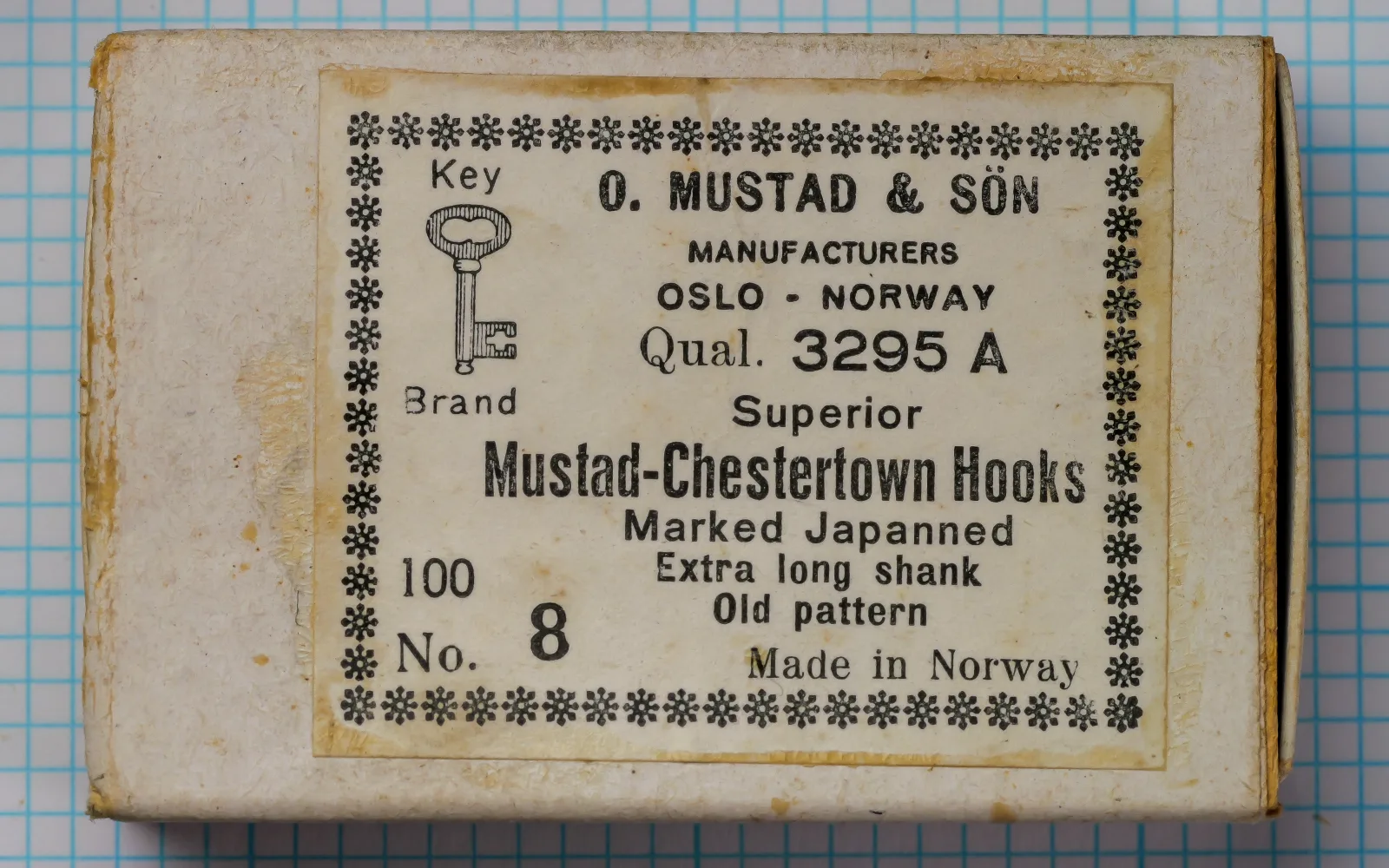
Original Mustad Key Brand packaging for 3295 A Chestertown hooks, size 8, showing distinctive asterisk border design and Oslo, Norway administrative marking from the 1950s-1960s era.
Photographic record
3 cataloged imagesSelect any record to load it above.
3 images shown
Mustad 3295 A Chestertown Key Brand Box Size 8Original Mustad Key Brand packaging for 3295 A Chestertown hooks, size 8, showing distinctive asterisk border design and Oslo, Norway administrative marking from the 1950s-1960s era.Open originalMustad 3295 A Chestertown Point Detail Size 8Close-up of the Mustad 3295 A hook point showing hollow point geometry, standard-cut barb, and deep black japanned finish on measurement grid.Open originalMustad 3295 A Chestertown Full Profile Size 8Complete side profile of the Mustad 3295 A showing the characteristic extra-long shank, Chestertown bend geometry, and marked (ridged) shank end construction.Open original
Technical profile
Blind Eye | Extra long | Fine Wire | Hollow Point | Japanned
Eye
Blind — Marked ShankMarked shank features multiple ridges or serrations cut into the wire near the shank end to provide positive grip for snelling knots, preventing line slippage during fighting fish P. This construction was preferred by traditionalists who believed it provided superior hook-setting geometry compared to ringed eyes.
Wire
Extra-Fine, Round
Shank
Extra-Extra Long (XXL) — Marked / Ridged
Bend
Narrow gap, Offset / kirbedChestertown bend features a somewhat squared-off bottom section that provides excellent bait presentation while maintaining adequate gap clearance for hook setting P. The bend geometry is optimized for the straight-pull forces typical of bottom fishing applications.
Point
Hollow Point (concave inner face)Standard-cut barb positioned close to the point, designed to provide secure holding power without excessive penetration resistance that might tear delicate natural baits P.
Finish
Black Japanned — Confirmed (stated on packaging)Deep black japanned finish shows excellent uniformity and coverage. The enamel coating provides effective corrosion protection while maintaining the non-reflective properties favored for bottom fishing applications P.
Box shows age-appropriate toning and edge wear. Hooks appear in excellent condition with intact japanned finish. Complete quantity present.
The extra-long shank serves multiple functional purposes beyond easy unhooking. The extended length provides superior leverage for setting the hook in the tough mouth tissue of bottom-feeding species, while the narrow gap reduces the likelihood of tearing delicate natural baits during rigging. The marked (ridged) shank construction creates positive grip points for the snelling knot, preventing line slippage under load P.
The japanned finish provides corrosion resistance while maintaining the dark, non-reflective appearance preferred for bottom fishing applications. The standard wire gauge offers adequate strength for the target species while maintaining the fine profile necessary for threading soft baits without excessive damage.
The Chestertown series, named after Chestertown, Maryland, was developed specifically for the American East Coast bait fishing market, with the 3295 A serving as the flagship pattern for winter flounder and perch fishing. The series represented Mustad’s understanding that successful hook design required deep knowledge of local fishing conditions and angling traditions.
The ‘marked’ or blind-eye construction was particularly valued by traditional bait anglers who believed that snelling the line directly to the shank provided superior hook-setting performance compared to ringed eyes. The extra-long shank became the defining characteristic, allowing anglers to easily remove hooks from fish that had swallowed bait deeply, a common occurrence in bottom fishing for species like winter flounder.
Era and Packaging Dating
Key Brand logo with asterisk border is classic mid-century Mustad design. Oslo administrative labeling predates later Gjøvik-only packaging. 'Old Pattern' text suggests traditional design even at time of manufacture. No barcode indicates pre-1974 production.
The Flounder Guide's Secret Weapon
Professional flounder guides in the Chesapeake Bay region were known to hoard boxes of original Mustad 3295 A hooks well into the 1980s, convinced that the marked shank construction gave them a significant advantage over modern ringed-eye replacements. Some guides would travel considerable distances to tackle shops rumored to have remaining old-stock boxes, treating them like precious commodities.
Design lineage and influence
The Chestertown bend represents an evolution of traditional American bait hook geometry, influenced by the specific requirements of Mid-Atlantic coastal fishing. While drawing inspiration from earlier English patterns, the 3295 A’s proportions were refined specifically for the sandworm and bloodworm baits favored in American waters.
The design influenced numerous subsequent bait hook patterns, with modern manufacturers like Eagle Claw developing ringed-eye versions (such as the 214) that maintain the essential long-shank geometry while adapting to contemporary angler preferences for convenience over the traditional snelling techniques.
Best matchRelated by Attribute
Computed automatically from catalog data — updated as new hooks are added.
Matches: Wire, Gap, Eye, Eye Orient., Finish +4 moreDiffers: Shank: Extra-Extra Long vs 3X Long; Point: Hollow Point vs Superior; Application: Bait, Saltwater vs Bait
Matches: Shank, Gap, Eye, Eye Orient., Finish +4 moreDiffers: Bend: Other vs Sproat; Wire: Extra-Fine vs Standard; Point: Hollow Point vs Standard / Spear +1 more
Matches: Shank, Gap, Eye, Eye Orient., Point +4 moreDiffers: Bend: Other vs Carlisle; Wire: Extra-Fine vs Standard; Finish: Black Japanned vs Blued +1 more
Matches: Shank, Wire, Gap, Eye, Eye Orient. +3 moreDiffers: Bend: Other vs Aberdeen; Point: Hollow Point vs Superior; Finish: Black Japanned vs Blued +2 more
Designed specifically for winter flounder, perch, and panfish fishing with natural baits such as sandworms, bloodworms, and clams. The extra-long shank facilitates easy unhooking of fish that tend to swallow bait deeply, while the narrow gap prevents tearing of soft baits during threading P.
Secondary Applications
Also effective for whiting, spot, croaker, and other small to medium bottom fish in coastal waters.
Classic Fly Patterns
Not typically used for fly tying.
Modern Equivalents
Hook
Match Quality
Notes
Eagle Claw 214
Very Good
Very similar long-shank Chestertown geometry but with ringed eye rather than marked shank construction
Mustad 3282
Excellent
Direct modern descendant with identical bend and shank proportions, updated with ringed eye
Collector notes
Strong historical significance to East Coast flounder fishery drives collector interest, though relatively common production limits premium value.
Reference value
$15 – $35 USD estimate
Packaging condition
Good — moderate wear, legibleRecorded specimen
Packaging format
MU-KB-01Catalog code
The 3295 A Chestertown holds significant appeal for collectors focused on American regional fishing heritage, particularly those interested in the legendary winter flounder and perch fisheries of the Chesapeake Bay and Long Island Sound. The ‘marked’ (blind eye) construction represents traditional snelling techniques preferred by serious bait anglers of the era.
However, collectability is somewhat limited by the hook’s widespread production and distribution during its heyday. While historically important, examples are not exceptionally rare, keeping values moderate compared to more specialized or limited-production patterns.
Packaging
Cardboard box with Key Brand logo and asterisk border design. White/cream background with black letterpress printing. Shows quality grade 'Superior', model '3295 A', size '8', quantity '100', 'Marked Japanned Extra long shank Old pattern', and 'Made in Norway'. Oslo administrative marking indicates mid-century production era.
Market Value Notes
Complete 100-hook boxes in excellent condition command premium. Individual hooks or partial boxes significantly less valuable. Oslo labeling adds modest premium over later Gjøvik packaging.
Where to Find
eBay, specialized vintage tackle dealers, East Coast tackle shows and fairs
Collector's Identification Tips
Look for the distinctive Key Brand logo with asterisk border and Oslo marking on packaging. Original boxes will specify ‘Marked Japanned Extra long shank Old pattern’. Hooks should have multiple ridges cut into the shank end rather than formed eye. Authentic specimens show consistent deep black japanned finish.
Preservation
Storage and Preservation
Store in a cool, dry environment away from moisture to preserve the japanned finish, which is susceptible to chipping and corrosion with humidity exposure. Original packaging adds significant collector value — keep hooks on the original card rather than loose storage. The marked shank ends are particularly vulnerable to impact damage, so avoid contact with other metal objects during storage.
When handling, avoid flexing the long shank excessively as the extra length creates increased leverage that can lead to permanent deformation. The japanned finish, while durable, should not be cleaned with abrasive methods — gentle wiping with a dry cloth is sufficient for dust removal.
Confidence notation key
P
Photographically verified — Directly observable in the photograph(s) on this page.
V
Verified by documentation — Confirmed by manufacturer catalog, spec sheet, or published reference.
I
Inferred — A logical deduction from observable or documented evidence, not directly stated.
E
Estimated — An approximation based on visual comparison, proportional analysis, or limited data.
S
Speculative — A reasoned hypothesis that cannot be confirmed from available evidence.
Unnotated claims are the compiler’s synthesis; see Sources. All photographs on garrenwood.com are taken on a measurement grid where each square equals 1/10 inch (0.1″ / 2.54 mm).