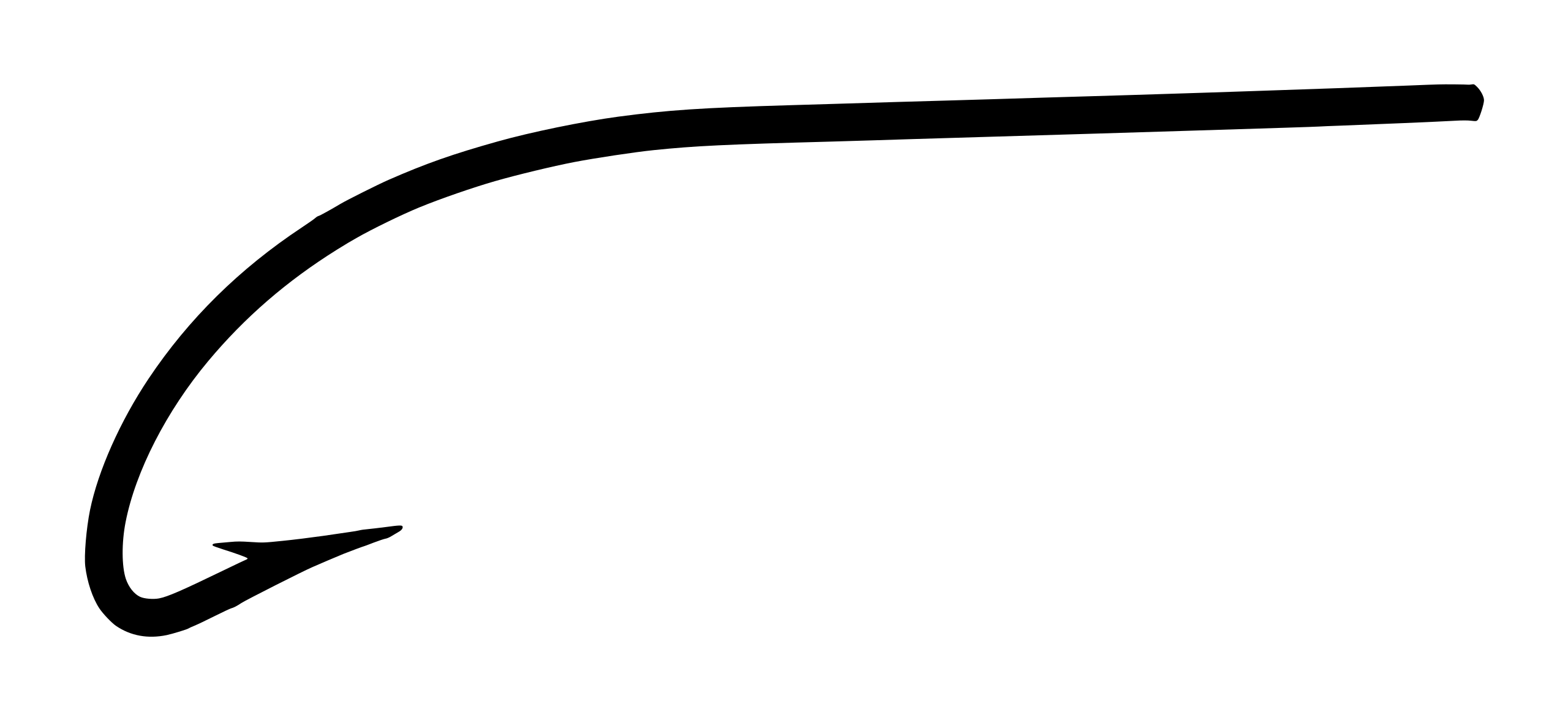
Mustad Hooks – 3290
3290 — Chestertown Hook
At-a-Glance Summary
The Mustad 3290 Chestertown Hook represents a specialized design from Norway’s premier hook manufacturer, dating to the 1950s-1960s E. This blind-eye pattern was specifically engineered for traditional flounder fishing and commercial bottom fishing operations along the East Coast V.
The hook features Mustad’s ‘Superior’ point geometry with a nearly straight inner taper P, combined with a marked and tapered shank for superior bait retention P. The distinctive Chestertown bend profile provides the long shank and narrow gap geometry favored by professional flatfish anglers V.
Packaged in Mustad’s classic red-orange export label with decorative border, this represents the company’s mid-20th century marketing to American fishing markets P. The blind eye construction required traditional snelling techniques, marking the end of an era before eyed hooks became universal V.
Collectibility remains modest due to the hook’s commercial rather than sporting heritage, though the pristine packaging and complete quantity make this a solid reference specimen E.
Photography
Identification
| Manufacturer | mustad |
| Model / Code | 3290 |
| Full Name | Chestertown Hook |
| Size Documented | No. 6 |
| Estimated Era | c. 1950-1965 |
| Country of Origin | Norway |
Technical Specifications
| Eye Type | Blind / Flatted / Spade End |
| Eye Notes | True blind eye construction with tapered shank end P. No formed eye - the wire simply tapers to a point for snelling attachment P. The taper appears smooth and well-finished, typical of Mustad's quality standards E. |
| Wire Gauge | Standard |
| Wire Profile | Round (unforged) |
| Shank Length | Special Long — Marked / Ridged, Tapered |
| Bend Notes | Classic Chestertown geometry with pronounced long shank and narrow, sharp bend P. The bend depth is relatively shallow compared to standard patterns, creating the characteristic flounder hook profile E. Wire set appears straight with no visible offset P. |
| Point Style | Superior (near-straight inner taper) |
| Gap Width | Narrow |
| Barb | Standard-cut barb with moderate sweep angle P. Positioned close to the point in typical Mustad fashion, sized appropriately for the hook gauge E. |
| Finish | Black Japanned — Confirmed (stated on packaging) |
| Finish Notes | Deep black japanned finish typical of the era's 'stealth' hook finishes P. The lacquer appears uniform and well-applied on the specimen, showing minimal wear or chipping P. This finish was specifically chosen to avoid spooking wary bottom fish V. |
| Condition | Label shows excellent preservation with minimal edge wear and no tears P. Colors remain vibrant. Hook specimens appear unused with original japanned finish intact P. |
The Chestertown bend geometry represents a specialized engineering solution for flatfish presentation V. The extended shank length allows for better bait presentation and reduces the chance of short strikes, while the narrow gap maintains strong hooksets in the relatively soft mouths of flounder and similar species V.
The marked shank features raised ridges that grip bait securely, preventing slippage during long soaks on the bottom P. The tapered construction reduces overall weight while maintaining strength in the critical hook point and bend areas E. The Superior point geometry provides excellent penetration characteristics while maintaining durability under commercial fishing conditions V.
Technical Measurements
Size measured: (unspecified). Method: Grid-derived from photograph (1/10" grid).
| Dimension | Value |
|---|---|
| Overall Length | ~2.10"-2.30" (~53-58 mm) E |
| Shank Length | ~1.50"-1.70" (~38-43 mm) E |
| Gap Width | ~0.50"-0.60" (~13-15 mm) E |
| Shank-to-Gap Ratio | ~3.0-3.4 : 1 |
Measurements derived from 1/10 inch grid. Hook appears to span approximately 21-23 small squares in overall length, 15-17 squares in shank length, and 5-6 squares in gap width. Precise counting is challenging due to hook curvature and angle relative to grid lines.
Historical Context
mustad
O. Mustad & Sön was established in Gjøvik, Norway in 1832 by Ole Mustad, initially as a nail-making enterprise V. The company transitioned to fishhook manufacturing in the 1870s and quickly became the world’s dominant producer through industrial-scale manufacturing and aggressive international marketing V.
By the 1950s, when this hook was produced, Mustad had established itself as the Norwegian industrial giant of hook manufacturing, producing one in four hooks worldwide V. The company’s Oslo office handled export operations, while the Gjøvik factory maintained production V. Their ‘Key Brand’ designation marked premium hooks for specific regional markets, particularly the American East Coast commercial fishing industry I.
Series History
The Mustad 3290 Chestertown represents a specialized pattern developed for the American flounder fishing market, likely introduced in the 1940s-1950s as part of Mustad’s expansion into regional commercial patterns I. The Chestertown name references the distinctive bend geometry that became synonymous with East Coast flatfish angling V.
This model was part of Mustad’s numbered quality series, denoted by the ‘Qual. 3290’ designation on the packaging P. The series included various sizes and modifications of the basic Chestertown pattern, all featuring the characteristic long shank and narrow gap that professional flounder fishermen demanded I. Production appears to have continued through the 1960s before being superseded by eyed versions like the 3300 series I.
Era and Packaging Dating
The red-orange label with 'Oslo - Norway' address and '100 No.' quantity notation, combined with the letterpress printing style and decorative border design, indicates mid-20th century production. The absence of any modern postal codes or barcodes supports the pre-1970 dating. The 'Quality' designation was common in Mustad's 1950s-1960s export packaging.
Before the mass adoption of eyed hooks, professional flounder fishermen along the East Coast swore by snelled blind-eye Chestertowns like the 3290. The snelling process created a direct wire-to-line connection that many believed provided superior 'feel' when detecting the subtle takes of bottom-feeding flatfish. Master snellers could tie dozens of these hooks in an evening, creating ready rigs for the next day's fishing.
Design Lineage and Influence
Related Models — mustad
| Model | Description | Relationship |
|---|---|---|
| 3290 (this entry) | This model - blind eye Chestertown with marked tapered shank | This model |
| 3300 | Later eyed version of the Chestertown pattern with ringed eye | Later / successor |
| 3301A | Turned-down ball eye variant of the Chestertown pattern | Variant |
Usage, Fly Patterns, and Equivalents
Primary Application
Originally designed for traditional bottom fishing and flounder fishing along the Atlantic coast P. The Chestertown bend with its characteristic long shank and narrow gap was specifically engineered for presenting natural baits like worms, strips, and small crabs to flatfish V. The blind eye construction required snelling, which was the standard attachment method for commercial fishing operations of the era V.
Secondary Applications
Modern collectors prize these for historical displays and traditional fishing demonstrations. Some contemporary artisan fly tyers use them for recreating Victorian-era patterns with gut loop attachments.
Classic Fly Patterns
Not typically used for fly tying.
Modern Equivalents
| Hook | Match Quality | Notes |
|---|---|---|
| Eagle Claw L042 Chestertown | Good | Similar bend geometry but with turned-down eye and modern finish |
| Gamakatsu Flounder Hook | Moderate | Modern flounder-specific design with comparable proportions but different bend style |
Collectability and Value
| Rarity | Uncommon |
| Market Value (USD) | $15 – $35 |
| Packaging Condition | Very Good — light wear, fully legible |
| Packaging Format | MUST-RED-01 |
Positive factors: Complete original packaging in excellent condition P, represents the end of the blind-eye era in American fishing V, quality Mustad construction and finishing P, specialized Chestertown pattern with regional significance V, clear dating evidence from packaging design P.
Limiting factors: Commercial fishing heritage rather than sporting tradition reduces collector appeal I, blind-eye construction limits modern usability V, relatively recent production era (1950s-1960s) compared to truly vintage patterns E, specialized flounder application rather than general sportfishing use V.
Packaging
Distinctive red-orange paper label with black decorative star border pattern. Letterpress printing on quality paper stock. Measures approximately 4" x 3". Text includes manufacturer name, location, model designation, and quantity. Shows characteristic 1950s Norwegian export label design with Key Brand logo.
Market Value Notes
Complete cards in this condition typically sell for $15-25 on eBay and specialty forums. Premium examples with pristine labels may reach $35. Individual hooks have minimal value, with collectors focusing on complete original packaging.
Where to Find
eBay vintage tackle auctions, specialized fishhook collector forums, East Coast tackle shop old stock, fishing heritage shows and swap meets.
Collector's Identification Tips
Authentic Mustad 3290s feature the distinctive red-orange label with star border pattern and ‘Oslo – Norway’ location marking P. Check for the ‘Qual. 3290’ designation and ‘Superior’ point notation on original packaging P. The hooks themselves show characteristic Chestertown bend geometry with marked tapered shank and blind eye construction P. Reproductions or relabeled hooks will lack the period-correct letterpress printing and paper stock quality E.
Storage and Preservation
Store in a cool, dry environment away from moisture to prevent rust damage to the japanned finish. The red-orange label is particularly susceptible to fading from UV exposure – keep in archival storage boxes or sleeves. Original packaging adds significant collecting value, so handle the label carefully to avoid creasing or tearing. The hooks themselves should remain on the original card rather than being removed, as this maintains the complete historical context. Avoid contact with other metals that might cause galvanic corrosion.
Blind Eye Sizing Context
The No. 6 size designation for blind eye hooks differs slightly from modern eyed hook sizing standards. Mustad’s blind eye patterns were sized based on the gap width and overall proportions rather than just the gap measurement used today. This means a vintage No. 6 Chestertown may not match exactly with a modern No. 6 hook in all dimensions, though the gap width remains the primary size reference. The long shank designation was specific to the Chestertown pattern and doesn’t correspond to modern 2X or 3X long classifications.
Original Packaging Analysis
Source: Original Mustad 3290 packaging label, c. 1950-1965
The label provides several key pieces of historical information: ‘O. Mustad & Sön’ reflects the Norwegian spelling used during the mid-20th century export period. ‘Oslo – Norway’ indicates post-WWII production when the export office operated from Oslo rather than Gjøvik. The ‘Quality 3290’ designation shows this was part of Mustad’s numbered quality series rather than their standard production lines. The ‘Superior’ notation specifically refers to the point geometry, not just a marketing term. The decorative star border and letterpress printing are characteristic of 1950s Norwegian industrial packaging design.
Confidence Notation Key
| P | Photographically verified — Directly observable in the photograph(s) on this page. |
| V | Verified by documentation — Confirmed by manufacturer catalog, spec sheet, or published reference. |
| I | Inferred — A logical deduction from observable or documented evidence, not directly stated. |
| E | Estimated — An approximation based on visual comparison, proportional analysis, or limited data. |
| S | Speculative — A reasoned hypothesis that cannot be confirmed from available evidence. |
Claims with no notation are confirmed by multiple independent sources. All photographs on garrenwood.com are taken on a measurement grid where each square equals 1/10 inch (0.1″ / 2.54 mm).