The S. Allcock No. 1770 Kirby Carlisle is a long-shank salmon and sea-trout hook representing mid-20th-century Redditch manufacturing at its finest. Cast-steel construction, blued finish, and the distinctive Kirby reverse-offset bend made this a trusted choice for fly dressers and bait anglers alike. This example comes in its original letterpress-printed paperboard box with the Allcock stag trademark, complete with 100 hooks in pristine blued condition.
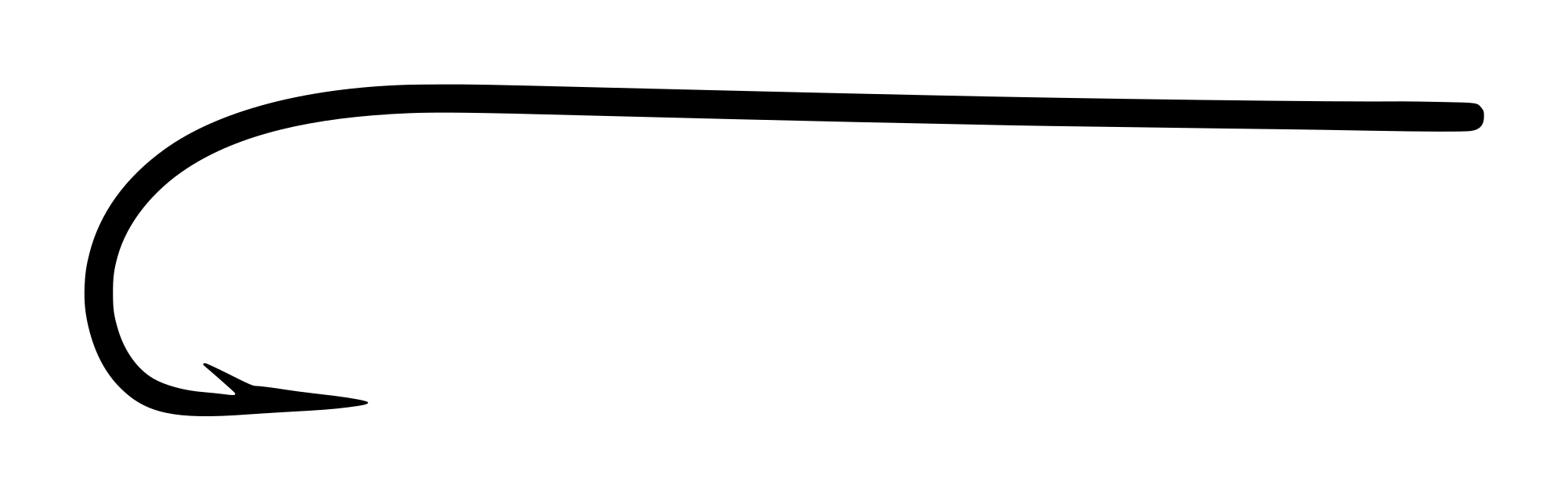
The hook exemplifies classic British game-fishing hardware: a tapered blind eye (for clean gut attachment), superior point (near-flat inner taper for penetration), and heavy-gauge wire suitable for large, powerful fish. The long shank accommodates full-dress salmon fly dressings without constraint. Dating to c. 1950-1960, this example predates the modern decline of British hook manufacturing, making it a genuine artifact of the Redditch golden age.
Collectibility is moderate-to-good among Redditch specialists and traditional salmon tyers. Original packaging with full hook count adds significant premium. While Allcock produced larger volumes than smaller Redditch makers, pre-1960 examples in sealed or near-complete original packaging are genuinely scarce today. The Carlisle pattern has solid utility and historical provenance, if not the iconic status of O’Shaughnessy or Sproat variants.
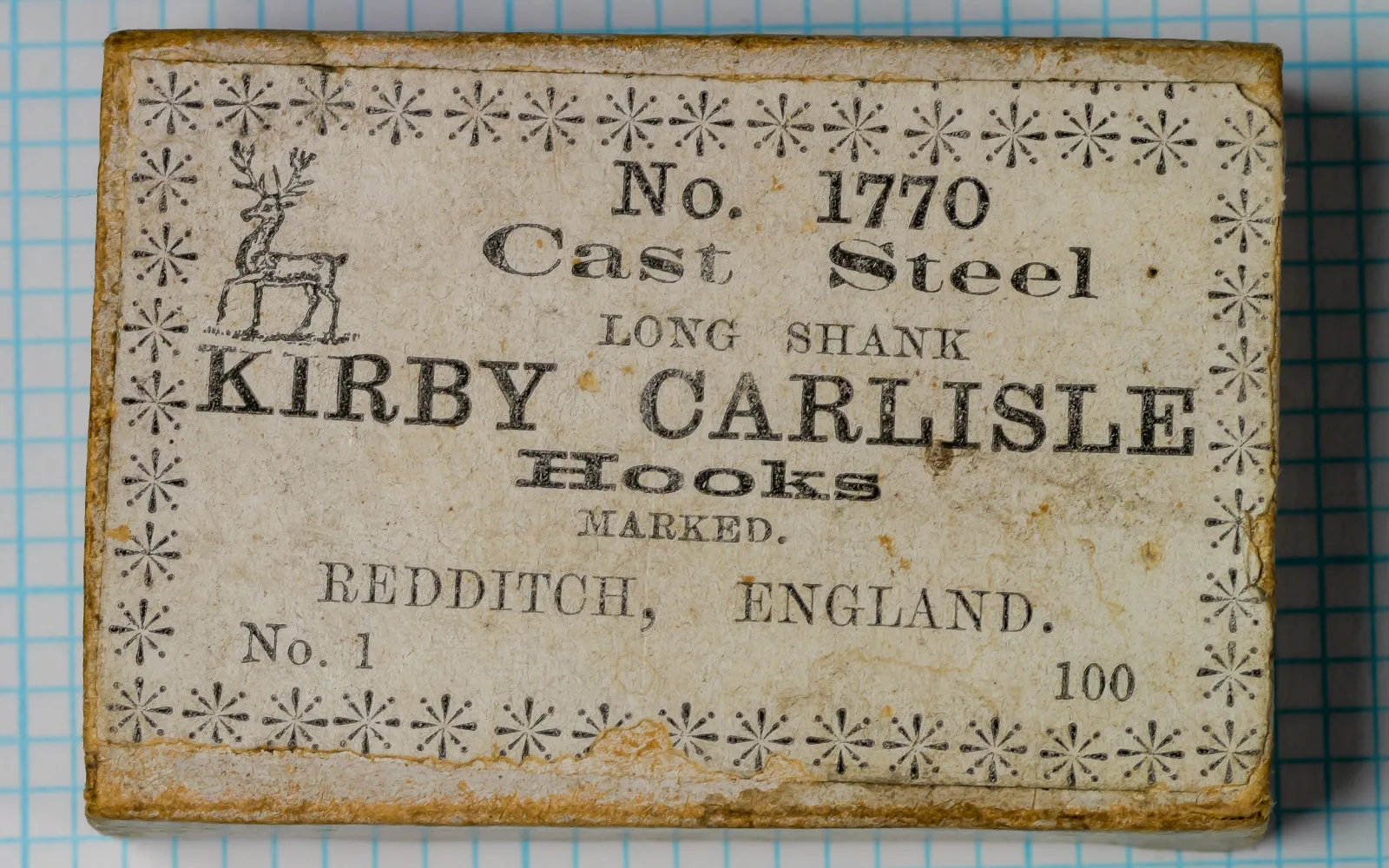
Original paperboard box label for S. Allcock No. 1770 Kirby Carlisle hooks, showing letterpress printing with stag trademark, cream stock, and 100-count specification. Typical mid-century Redditch packaging format.
Photographic record
5 cataloged imagesSelect any record to load it above.
5 images shown
S. Allcock 1770 Kirby Carlisle Original PackagingOriginal paperboard box label for S. Allcock No. 1770 Kirby Carlisle hooks, showing letterpress printing with stag trademark, cream stock, and 100-count specification. Typical mid-century Redditch packaging format.Open originalS. Allcock 1770 Hook Point DetailClose-up of the hook point showing the superior point geometry with near-straight inner taper and barb placement. Blued oxide finish is uniform and bright. Photographed on 1/10-inch measurement grid.Open originalS. Allcock 1770 Full Hook ProfileComplete side profile of the No. 1770 hook showing the full bent shape, tapered blind eye construction, and Kirby offset geometry. Blued finish clearly visible. Measured against 1/10-inch grid for dimensional reference.Open originalS. Allcock 1770 Multiple SpecimensThree specimens of the No. 1770 hook arranged on measurement grid to show consistency of manufacture and size uniformity across the lot. All exhibit identical blued finish and Kirby bend geometry.Open originalS. Allcock Stag Trademark DetailClose-up of the Allcock stag trademark as rendered in the original letterpress artwork on the No. 1770 box label. Hand-drawn illustration style characteristic of mid-century commercial art and printing.Open original
Technical profile
Tapered Blind Eye | Kirby Bend | Long Shank | Heavy Wire | Superior Point | Blued Finish
Eye
Blind — Marked ShankTapered blind eye — shank tapers to a smooth, rounded point with no flattening or spade construction. Gut loop attached by tying around the taper. P Confirmed by physical examination.
Wire
Standard, Forged, Est. ~0.14"-0.16" (~3.6-4.1 mm) E
Shank
Extra-Extra Long (XXL) — Marked / Ridged
Bend
carlisle, Standard gap, Offset / kirbedPronounced reverse offset characteristic of Kirby design. Bend depth approximately 0.50"-0.55". Wire set clean and symmetrical. P
Point
Superior (near-straight inner taper)Short, close-set barb, typical of Redditch Kirby construction. Barb angle approximately 45 degrees. P
Finish
Blued — Confirmed (stated on packaging)Cool blue-grey oxide coating. Steel texture visible beneath thin oxide layer. Uniform color tone across entire hook. No browning or warm tones visible. Consistent with packaging statement 'Cast Steel' and physical examination confirmation. (P/V)
Specimen hooks display bright blued finish with no corrosion. Original packaging shows age patina and light toning consistent with 1950-1960 era. Box lid intact. Full hook count assumed present (100). No major damage or losses to packaging.
The No. 1770 employs cast-steel construction — steel wire drawn and formed to shape, then cast (shaped under heat and pressure) to develop the precise Kirby offset. The blued finish provides corrosion resistance and a traditional aesthetic. The superior point style (near-straight inner face, flat taper) combined with the short barb ensures quick, clean penetration — critical for hooking powerful salmon in strong currents. The tapered blind eye allows direct gut or leader attachment without a head knot, reducing bulk at the tie-in point. Long shank accommodates full-dress salmon flies (wing, body hackle, tail) without fouling on the shank. Heavy wire gauge (standard for salmon hooks) provides the strength to withstand the violent head shakes of large game fish.
The Kirby Carlisle hooks represent S. Allcock’s commitment to named, pattern-specific designs. The Kirby bend itself — the distinctive reverse offset — became a hallmark of Redditch craftsmanship, favored for salmon and sea-trout work. Allcock offered Kirby Carlisle in multiple sizes and shank lengths, with the long-shank No. 1770 addressing the needs of fly dressers working salmon patterns. The pattern remained in the Allcock catalog through much of the mid-century, testament to its enduring utility. Cast-steel construction ensured both strength and the ability to hold a sharp point despite the heavy-gauge wire required for long-shank salmon hooks.
Named Collaborator
The ‘Carlisle’ credited on S. Allcock hooks refers to the Carlisle pattern — a traditional Scottish salmon fly design attributed to angler and fly dresser J. Carlisle of the Border region. The Carlisle pattern was widely adopted by Redditch manufacturers, including Allcock, as a standard long-shank hook for dressing salmon and sea-trout flies. Carlisle patterns became iconic in Scottish and Northern English salmon fishing traditions during the 20th century, particularly for spate river work.
Era and Packaging Dating
No barcode present — strong pre-1974 indicator. Letterpress printing on cream card stock characteristic of 1940s-1950s manufacturing. Decorative asterisk border pattern typical of vintage letterpress design. Simple address format ('Redditch, England' without postal code) consistent with early post-war packaging. Stag logo style noted by researcher as potentially older version. Hand-drawn stag illustration characteristic of 1950s commercial art. Overall packaging aesthetic and materials strongly suggest c. 1950-1960 production.
The Kirby Offset: A Redditch Institution
The Kirby bend — that distinctive reverse offset — originated in 19th-century Redditch and became so iconic that British anglers still refer to any offset hook as having a 'Kirby' character. The pattern proved so effective for salmon that Scottish and Northern English river keepers would request Kirby hooks by name when provisioning their beats. S. Allcock's Kirby Carlisle combined this proven offset geometry with the Carlisle pattern tradition, creating a workhorse hook that generations of salmon fly dressers relied upon without question.
Design lineage and influence
The Kirby bend traces to early 19th-century Redditch innovation, predating most named patterns. By the 1890s, it had become the standard for sea-trout and salmon hooks across England and Scotland. The Carlisle pattern naming (attributed to J. Carlisle of the Border region) reflects how Scottish and Northern English anglers contributed fly design while Redditch manufacturers supplied the hardware. The long-shank variant emerged to accommodate the elaborate fly dressings favored in Victorian salmon fishing. Modern Partridge and Tiemco reproductions of Kirby designs demonstrate the pattern’s enduring influence — nearly 150 years after its inception, the Kirby offset remains a benchmark for offset hook design.
Best matchRelated by Attribute
Computed automatically from catalog data — updated as new hooks are added.
Matches: Bend, Shank, Eye, Eye Orient., Point +4 moreDiffers: Wire: Standard vs Fine (1X Fine); Gap: Standard vs Narrow; Forging: Forged vs Round +3 more
Matches: Bend, Shank, Wire, Eye, Eye Orient. +4 moreDiffers: Gap: Standard vs Narrow; Point: Superior vs Hollow Point; Forging: Forged vs Round +3 more
Matches: Bend, Gap, Eye, Eye Orient., Point +5 moreDiffers: Shank: Extra-Extra Long vs 4X Long; Wire: Standard vs Extra-Fine; Forging: Forged vs Round +2 more
Matches: Bend, Eye, Eye Orient., Offset, Application +2 moreDiffers: Shank: Extra-Extra Long vs 4X Long; Wire: Standard vs Heavy (1X Heavy); Gap: Standard vs Narrow +5 more
The Kirby Carlisle was a traditional long-shank pattern designed for salmon and sea trout fishing, particularly in British rivers. The long shank accommodates generous fly dressings and the Kirby offset provides solid penetration and hook-hold for larger game fish. This No. 1770 cast-steel variant was suitable for both fly and bait applications, reflecting the versatility of Redditch patterns in the mid-20th century.
Secondary Applications
Bait fishing for salmon and sea trout; traditional wet-fly dressing for river fishing.
Classic Fly Patterns
Not typically used for fly tying in modern practice, though historically dressed as a salmon/sea trout wet fly or bait hook.
Modern Equivalents
Hook
Match Quality
Notes
Partridge of Redditch CS45 Kirby Carlisle
Excellent
Modern reproduction of classic pattern, same bend and point geometry, available in stainless and blued.
Tiemco 9394 Salmon Hook
Very Good
Contemporary long-shank design for salmon; similar functional profile but modern manufacturing and different finish options.
Mustad 36620 O'Shaughnessy
Good
Long-shank salmon hook with similar offset bend, though O'Shaughnessy geometry differs slightly from Kirby.
Collector notes
Rated 5.0/10 — Uncommon-Scarce. Strength: Redditch maker (Allcock) with pre-1960 letterpress packaging and long-shank salmon pattern appeal to specialist collectors. Limit: Allcock industrial production volumes and Carlisle pattern having moderate (not exceptional) collector demand. No. 1 size less desirable than larger salmon sizes.
Reference value
$14 – $28 USD estimate
Packaging format
Allcock-Box-1770-VintageCatalog code
Collectability Strengths: S. Allcock of Redditch represents the golden age of English hook manufacturing. This No. 1770 Kirby Carlisle exhibits classic mid-century production characteristics: cast-steel construction, blued finish, and long-shank design for salmon work. The original packaging with letterpress printing and stag trademark is a significant collector asset. Pre-1960 Allcock boxes with full hook counts are genuinely scarce in the market today.
Limiting Factors: Allcock produced enormous volumes — the brand, while respected, does not command the premium prices of smaller Redditch makers like Partridge or Sealey. The Kirby Carlisle pattern, though named and distinctive, has less modern collector prominence than O’Shaughnessy or Sproat. Size No. 1 is a smaller salmon hook; sizes 1/0 and larger are more actively sought.
Most Desirable Variants: Original packaging in sealed or near-sealed condition with full hook count commands the premium. Larger sizes (1/0, 2/0) would rate higher. Allcock boxes of any era without the stag logo or from earlier manufacturing periods (pre-1940) also attract specialist attention.
Condition Factors: Box condition is the primary value driver. A pristine, sealed box can achieve $28-35. Opened boxes with missing hooks or significant wear drop to $12-18. Loose hooks without packaging have minimal collector premium (functional tyer value only: $2-5).
Packaging
Paperboard hinged-lid box with cream stock. Letterpress printing in black ink. Box dimensions approximately 5.5" × 3.25". Text: 'NO. 1770 Cast Steel', 'LONG SHANK', 'KIRBY CARLISLE Hooks', 'MARKED.', 'REDDITCH, ENGLAND', 'No. 1', '100'. Decorative asterisk border around edges. Stag trademark/logo on left side. No barcode. Aged patina with light toning and creasing; lid intact.
Market Value Notes
Low ($14): Good condition — opened original box, may be missing 1-2 hooks, box shows wear and patina but remains intact and displayable.
High ($28): Excellent condition — sealed or near-sealed original box, full count of 100 hooks, minimal wear, pristine packaging presentation.
Premium factors: Complete original packaging with letterpress printing, full hook count, Redditch maker (Allcock), pre-1960 production date, blued finish preservation.
Platforms: eBay UK and US (occasional), British vintage tackle dealers, specialist Redditch hook dealers, regional fishing heritage auctions.
Confidence: E Estimated from limited comparable sales data. S. Allcock long-shank patterns in similar condition typically achieve $10-35 range. Carlisle pattern commands mid-range pricing within Allcock series.
Where to Find
eBay UK occasionally carries Allcock long-shank cards; US eBay less frequent. British vintage tackle dealers (Cotswold Fishery supplies, regional fair dealers) stock Allcock patterns regularly. Specialist online retailers like tackleauctions.co.uk or regional fishing heritage societies may have examples. Regional antique shows in England (Midlands, particularly) more likely than US venues.
Preservation
Storage and Preservation
Store the original packaged box in a cool, dry environment away from direct sunlight and high humidity. The blued oxide finish is generally stable but will develop darker patina (sometimes desired by collectors) if exposed to humid conditions. If hooks are removed from the original card, store them on the original card rather than loose to maximize collectible value. Keep the box away from contact with other metals to prevent galvanic corrosion. Acid-free tissue paper or archival materials may be used if the box requires additional protection during storage. Avoid handling the hooks excessively, as oils from fingers can accelerate patina development. Original packaging condition is the primary value driver — prioritize box preservation above all else. If the box shows signs of moisture or insect damage, isolate it immediately and allow it to dry slowly in a stable environment. Do not attempt to clean or refinish the blued hooks or packaging; age patina is appropriate and valued by collectors.
Marking Analysis
Packaging Markings and Handwriting
The original box exhibits only printed text from the letterpress process — no handwritten annotations, prices, or collector marks are visible on the label or box exterior. The printing is clean and characteristic of professional mid-century production. The absence of handwritten pricing, seller initials, or stock-keeping marks suggests this box was either retail stock or was handled carefully by collectors. This pristine condition is consistent with the excellent preservation of the original packaging and adds to the collectible appeal.
Size Note
Size No. 1 — Understanding British Hook Sizing
The ‘No. 1’ designation on this hook refers to the traditional British sizing system used by Redditch manufacturers. In this system, lower numbers represent larger hooks (reverse of modern US sizing). No. 1 in the British system is a medium-to-large salmon hook, approximately 0.4″ (10 mm) in gap width, suitable for standard dry and wet fly patterns for salmon and sea trout. The long shank (No. 1770 designation suggests a long-shank variant) extends the shank relative to standard proportions, accommodating elaborate fly dressings. For collectors accustomed to modern US sizing, British No. 1 is roughly equivalent to a contemporary size 4/0 or 5/0 Atlantic salmon hook. Larger British sizes (1/0, 2/0) would have correspondingly wider gaps. This sizing system, while now historical, remains important for understanding vintage English hooks and distinguishing genuine period examples from later reissues.
Additional
Packaging Text and Manufacturing Claims
“Cast Steel” designation: The box explicitly states ‘Cast Steel’, confirming that the hooks were formed via casting rather than simple wire bending. Casting allowed Redditch makers to develop the precise Kirby offset geometry and ensure consistency. This is a technical advantage over cold-formed wire hooks.
“MARKED.” notation: The word ‘MARKED.’ on the label indicates that each hook bore a maker’s mark or name stamp — common practice for premium Redditch hooks to ensure traceability and quality control. However, marks on such small hooks are often invisible to the unaided eye.
“LONG SHANK” specification: This reinforces that No. 1770 is a deliberately extended-shank variant, distinguishing it from standard-shank Kirby patterns in the Allcock catalog. Long shank was essential for fly dressers working full-dress salmon patterns.
Geographic origin and address format: The simple ‘REDDITCH, ENGLAND’ address without postal code is typical of pre-1960s British commercial printing. The absence of a ZIP or postal code is consistent with packaging prior to widespread postal code implementation in the UK.
Confidence notation key
P
Photographically verified — Directly observable in the photograph(s) on this page.
V
Verified by documentation — Confirmed by manufacturer catalog, spec sheet, or published reference.
I
Inferred — A logical deduction from observable or documented evidence, not directly stated.
E
Estimated — An approximation based on visual comparison, proportional analysis, or limited data.
S
Speculative — A reasoned hypothesis that cannot be confirmed from available evidence.
Unnotated claims are the compiler’s synthesis; see Sources. All photographs on garrenwood.com are taken on a measurement grid where each square equals 1/10 inch (0.1″ / 2.54 mm).