The Mustad 3191 Carlisle hook represents an unusual application of a traditionally small-hook pattern, produced in large 5/0 and 6/0 sizes for heavy-duty fishing. Manufactured by O. Mustad & Sön in Oslo, Norway, these hooks feature the classic extra-long shank Carlisle design with superior point geometry and bronzed finish P.
Dating to approximately 1950-1965 based on the export labeling format and classic Key Brand packaging, these hooks were designed for large live bait applications—particularly pike, musky, and catfish fishing with substantial minnows or eels. The extended shank serves dual purposes: acting as a bite guard against toothy fish and preventing deep hooking for easier release V.
From a collecting perspective, these represent a significant find. While Carlisle hooks are common in small panfish sizes (#8-#12), the 5/0 and 6/0 sizes are exceptionally scarce, making them valuable to pattern specialists and Mustad historians. The complete original packaging with classic asterisk border design adds considerable appeal to vintage tackle collectors I.
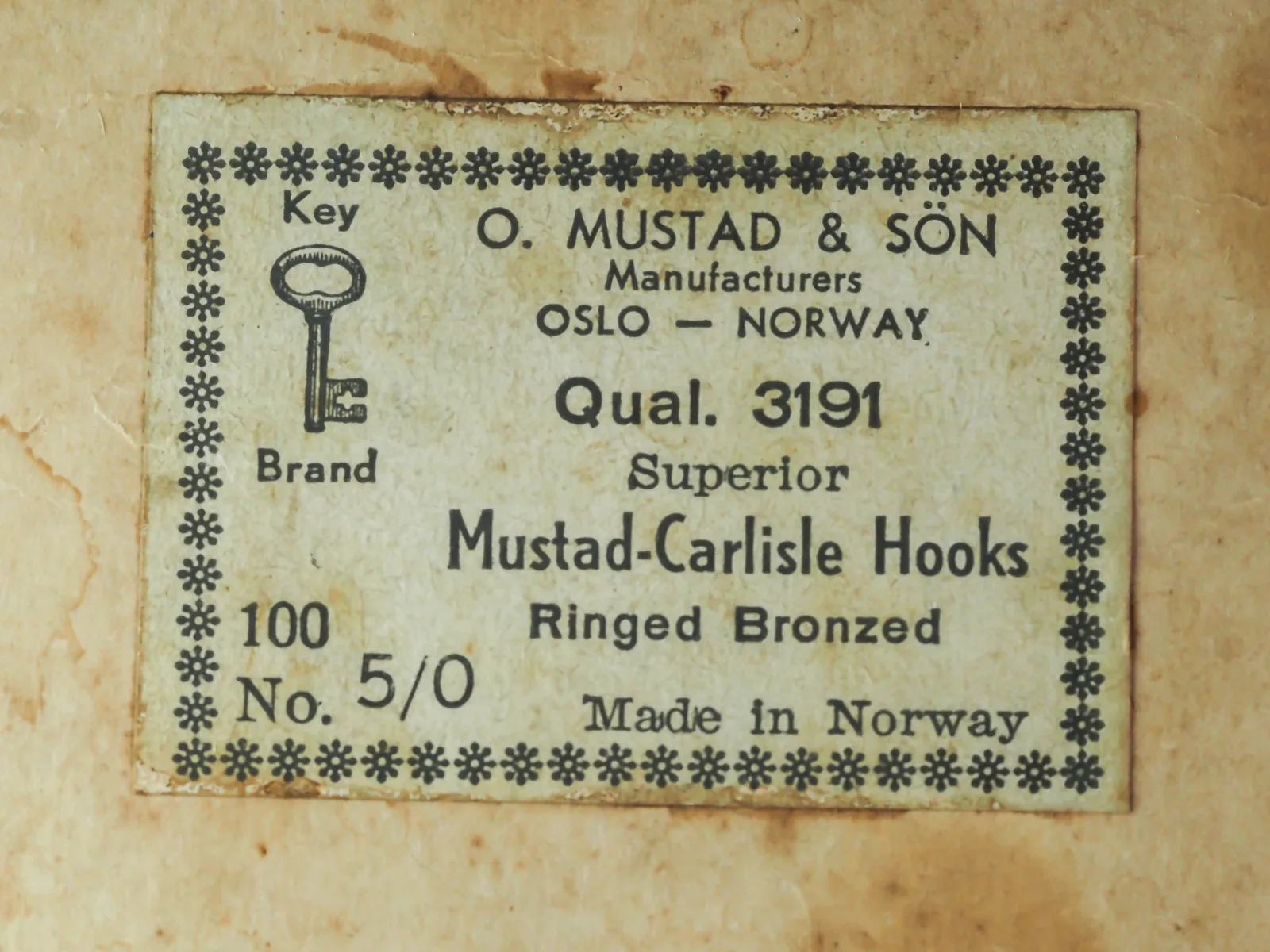
Original Mustad box label showing the classic Key Brand logo with asterisk border design, documenting the 3191 Carlisle pattern in size 5/0.
Photographic record
6 cataloged imagesSelect any record to load it above.
6 images shown
Mustad 3191 Carlisle Size 5/0 Original Box LabelOriginal Mustad box label showing the classic Key Brand logo with asterisk border design, documenting the 3191 Carlisle pattern in size 5/0.Open originalMustad 3191 Carlisle Superior Point Detail Size 5/0Detail view of the superior point geometry showing the near-straight inner taper and proportional barb placement on the heavy wire construction.Open originalMustad 3191 Carlisle Full Profile Size 5/0 BronzedComplete side profile of the Mustad 3191 showing the characteristic extra-long Carlisle shank and wide bend geometry on 1/10-inch measurement grid.Open originalMustad 3191 Carlisle Size 6/0 Blue Box and LabelComplete original packaging showing the blue cardboard box with white paper label for the 6/0 size Carlisle hooks.Open originalMustad 3191 hook point size 6-0Mustad 3191 hook point size 6-0Open originalMustad 3191 Hooks size 6-0Mustad 3191 Hooks size 6-0Open original
Technical profile
Eye
Ball Eye, Straight / Inline
Wire
Extra-Fine, Round, Est. ~0.045"-0.055" (~1.1-1.4 mm) E
Shank
Extra-Extra Long (XXL) — Plain
Bend
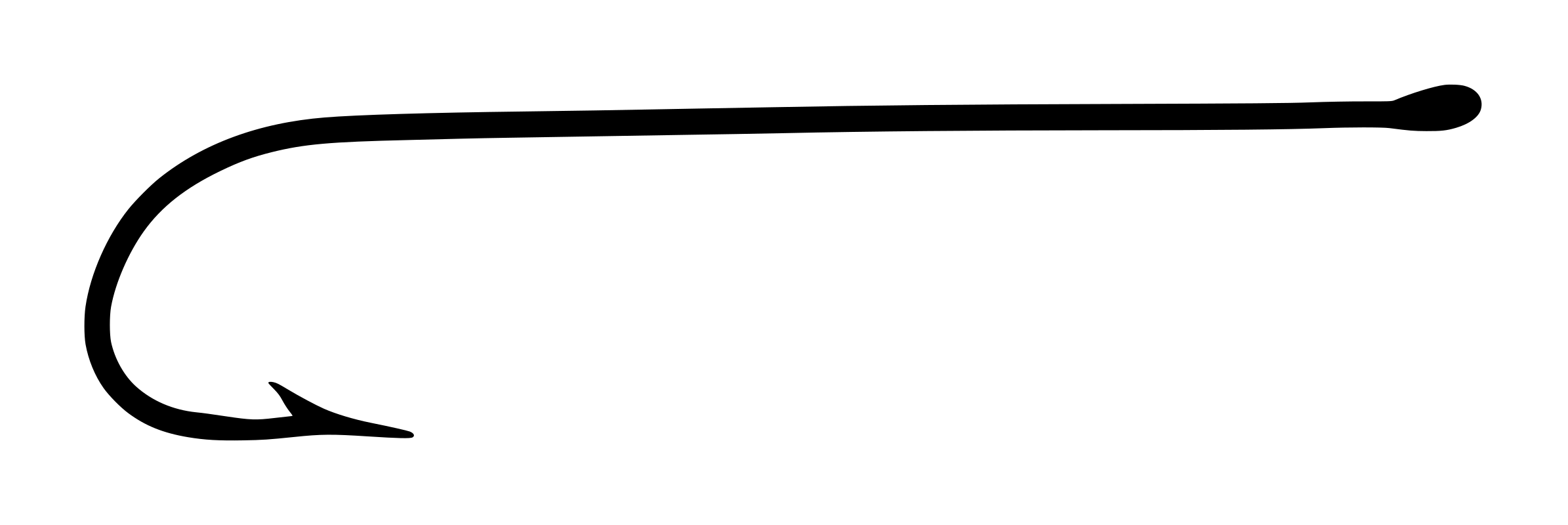
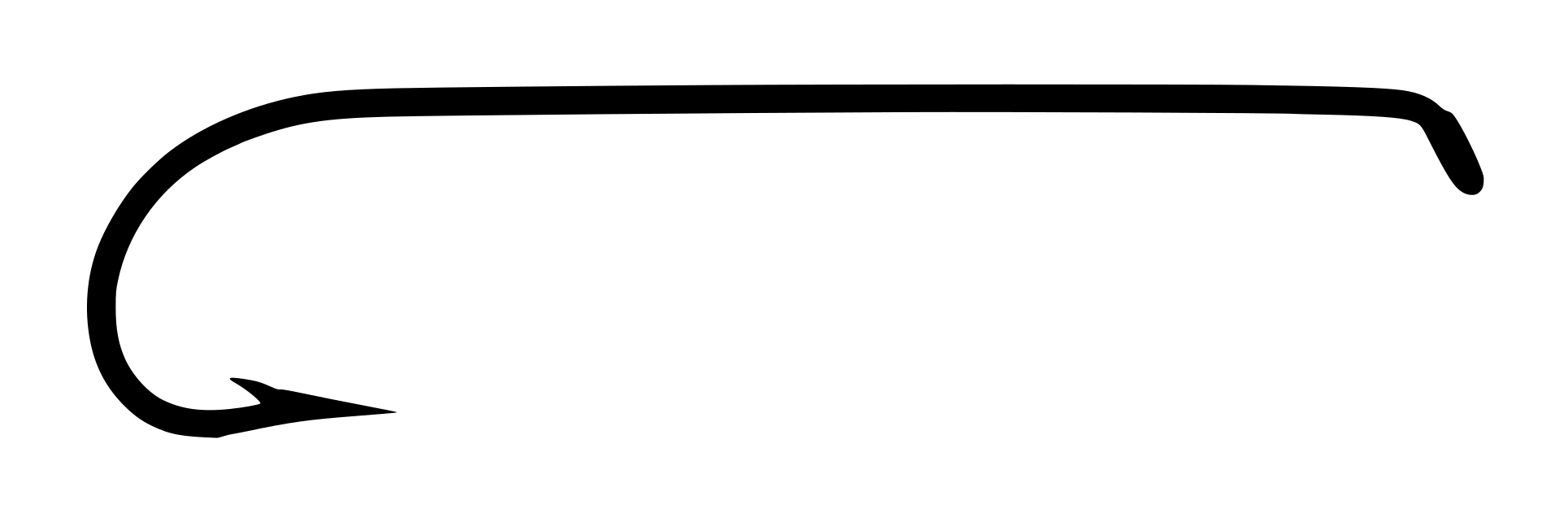
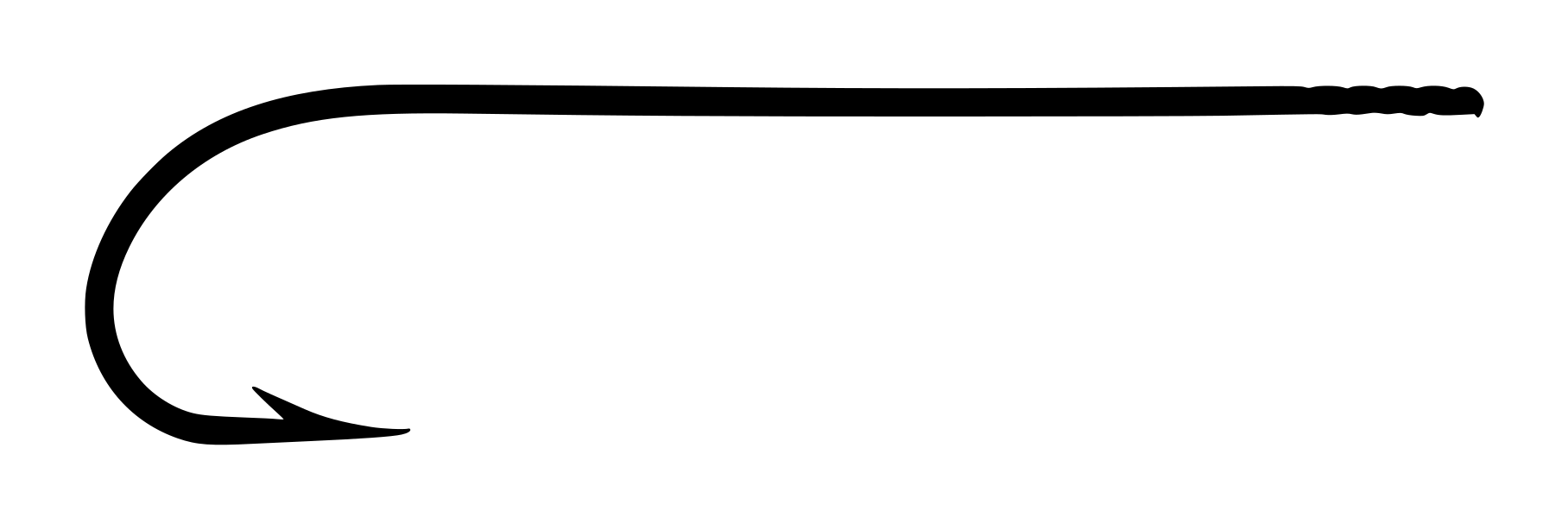
carlisle, Narrow gap, Offset / kirbedWide, sweeping Carlisle bend with generous gap proportional to the hook size. The bend maintains consistent wire spacing throughout the curve P.
Point
Superior (near-straight inner taper)Standard cut barb positioned at approximately 15 degrees to the point, sized proportionally for the heavy wire gauge P.
Finish
Bronzed — Confirmed (stated on packaging)Rich brown bronzed finish with warm undertones. The coating appears uniform with no visible wear spots or corrosion on the specimen shown P.
The superior point geometry provides excellent penetration characteristics through its near-straight inner taper, avoiding the potential for deflection that can occur with hollow-ground points on heavy wire hooks. The extra-long shank serves multiple engineering functions: it positions the hook point well forward of the bait, acts as a bite guard against fish with cutting teeth, and provides mechanical advantage during hook-setting by increasing the moment arm.
The straight ring eye allows the hook to move freely on the leader, reducing leverage that could cause hook pulls during the fight. The bronzed finish provides corrosion resistance while maintaining the dark color preferred for natural bait presentations, as bright finishes can spook wary fish in clear water conditions.
The 3191 Carlisle represents Mustad’s interpretation of the classic English Carlisle pattern, originally developed in the hook-making center of Carlisle, England. The Carlisle bend is characterized by its extra-long shank and wide, sweeping curve, traditionally used for small live baits and worms in panfish applications.
Mustad’s version maintained the essential geometry while adapting it for industrial production and expanding the size range beyond traditional limits. While most Carlisle production focused on sizes #8 through #12 for bluegill and perch fishing, Mustad recognized a market need for large-size versions for pike and musky fishing, hence the unusual 5/0 and 6/0 offerings documented here. The series continued through multiple decades with various finish options, but the large sizes became increasingly uncommon as specialized pike hooks gained popularity.
Era and Packaging Dating
The 'O. MUSTAD & SÖN' marking with umlaut rather than Norwegian ø indicates export labeling from the mid-20th century. The classic Key Brand logo with asterisk border design, blue paper box construction, and letterpress printing are consistent with Mustad's dominant post-WWII export period. The Oslo address (rather than later Gjøvik) places this in the 1950s-1960s timeframe.
From English Border Town to Norwegian Factory
The Carlisle pattern gets its name from the English border city of Carlisle, which was a major hook manufacturing center before Norway's industrial dominance. Ironically, by the 1950s when these Mustad Carlisles were produced, virtually all 'Carlisle' hooks sold worldwide were actually made in Norway. The pattern's extra-long shank was originally designed to keep anglers' fingers away from the sharp teeth of pike and pickerel—a practical consideration that became the hook's defining characteristic.
Design lineage and influence
The Carlisle bend traces its origins to 18th-century English hook makers who served the pike-rich waters of the Lake District and Scottish borders. The pattern was standardized by Redditch manufacturers in the 1800s before being adopted by American companies like Pflueger and Wright & McGill for bass and pike fishing.
Mustad’s version refined the traditional geometry while maintaining the essential long-shank characteristic. Contemporary patterns include the Aberdeen (similar long shank but lighter wire) and various proprietary pike hooks that borrowed the Carlisle’s bite-guard concept but added modern features like offset points or specialized coatings.
Best matchRelated by Attribute
Computed automatically from catalog data — updated as new hooks are added.
Matches: Bend, Gap, Eye, Eye Orient., Finish +5 moreDiffers: Shank: Extra-Extra Long vs 4X Long; Wire: Extra-Fine vs Fine (1X Fine); Point: Superior vs Standard / Spear +2 more
Matches: Bend, Shank, Eye, Eye Orient., Point +4 moreDiffers: Wire: Extra-Fine vs Fine (1X Fine); Gap: Narrow vs Standard; Finish: Bronzed vs Tinned +3 more
Matches: Bend, Gap, Eye, Point, Forging +4 moreDiffers: Shank: Extra-Extra Long vs 4X Long; Wire: Extra-Fine vs Standard; Eye Orient.: Straight / Inline vs Turned Down +4 more
Designed for large live bait fishing, particularly with 6-8 inch minnows, suckers, or eels for pike, musky, and large catfish. The extra-long shank serves as a bite guard against toothy fish while preventing deep hooking. In saltwater applications, these large Carlisle hooks were used for bottom fishing with cut bait or whole small fish P.
Secondary Applications
Modern fly tyers occasionally use these for tying large pike streamers and saltwater patterns requiring extended body length.
Classic Fly Patterns
Not typically used for fly tying
Modern Equivalents
Hook
Match Quality
Notes
Eagle Claw 214
Very Good
Direct Carlisle pattern equivalent, though large sizes like 5/0-6/0 are now difficult to source
Mustad 92641
Good
Modern O'Shaughnessy with similar heavy wire and large size availability, but different bend geometry
Collector notes
Large sizes 5/0 and 6/0 are exceptionally uncommon for the Carlisle pattern, which is typically found in small panfish sizes, making these significant to pattern collectors.
Reference value
$15 – $35 USD estimate
Packaging condition
Very Good — light wear, fully legibleRecorded specimen
Packaging format
MUS-BOX-02Catalog code
Positive factors: These large Carlisle hooks represent an unusual application of a traditionally small-hook pattern. The 5/0 and 6/0 sizes are rarely encountered, as most Carlisle production focused on sizes #8-#12 for panfish. The classic Key Brand packaging with asterisk border is highly recognizable to Mustad collectors. Complete boxes with original labels add significant value.
Limiting factors: While uncommon in large sizes, the Carlisle pattern itself is well-known and widely produced. The post-war era means these aren’t pre-1940 vintage. Condition of bronzed finish affects value, and these working hooks often show corrosion if not properly stored.
Packaging
Blue cardboard box with classic Mustad asterisk border design. White paper label with letterpress printing. Key Brand logo with skeleton key illustration. Text reads 'O. MUSTAD & SÖN Manufacturers OSLO - NORWAY' with product details 'Qual. 3191 Superior Mustad-Carlisle Hooks Ringed Bronzed' and size/quantity information. Box shows age toning but remains structurally sound.
Market Value Notes
Complete boxes in excellent condition command premium pricing. Individual hooks worth $0.50-1.00 each. Collectors pay more for the unusual large sizes than standard small Carlisle patterns.
Where to Find
Vintage tackle shows, estate sales, occasionally on eBay. More common in regions with historical pike and musky fishing traditions.
Preservation
Storage and Preservation
Store these bronzed hooks in a cool, dry environment to prevent oxidation of the finish. The original blue cardboard boxes are susceptible to moisture damage and should be kept in acid-free storage containers if long-term preservation is desired. Avoid handling the hooks unnecessarily, as oils from skin can accelerate corrosion of the bronze coating.
The large size and heavy wire make these hooks relatively durable, but the points should be protected from contact with hard surfaces that could cause dulling. Store hooks in original packaging when possible, as complete boxes with labels represent the highest collector value. If loose storage is necessary, use corrosion-inhibiting papers or desiccant packets in sealed containers.
Size Note
Unusual Size Range for Carlisle Pattern
The 5/0 and 6/0 sizes documented here represent a significant departure from typical Carlisle hook production, which historically focused on small sizes #8 through #12 for panfish applications. These large sizes were specifically developed for pike and musky fishing with substantial live baits, effectively repurposing a delicate panfish pattern for heavy-duty predator fishing.
This size extension demonstrates Mustad’s comprehensive approach to market coverage during their mid-century dominance. Rather than developing entirely new patterns for every application, they adapted successful geometries across unusually wide size ranges, creating unique variants that are highly prized by modern collectors for their rarity and historical significance.
Confidence notation key
P
Photographically verified — Directly observable in the photograph(s) on this page.
V
Verified by documentation — Confirmed by manufacturer catalog, spec sheet, or published reference.
I
Inferred — A logical deduction from observable or documented evidence, not directly stated.
E
Estimated — An approximation based on visual comparison, proportional analysis, or limited data.
S
Speculative — A reasoned hypothesis that cannot be confirmed from available evidence.
Unnotated claims are the compiler’s synthesis; see Sources. All photographs on garrenwood.com are taken on a measurement grid where each square equals 1/10 inch (0.1″ / 2.54 mm).