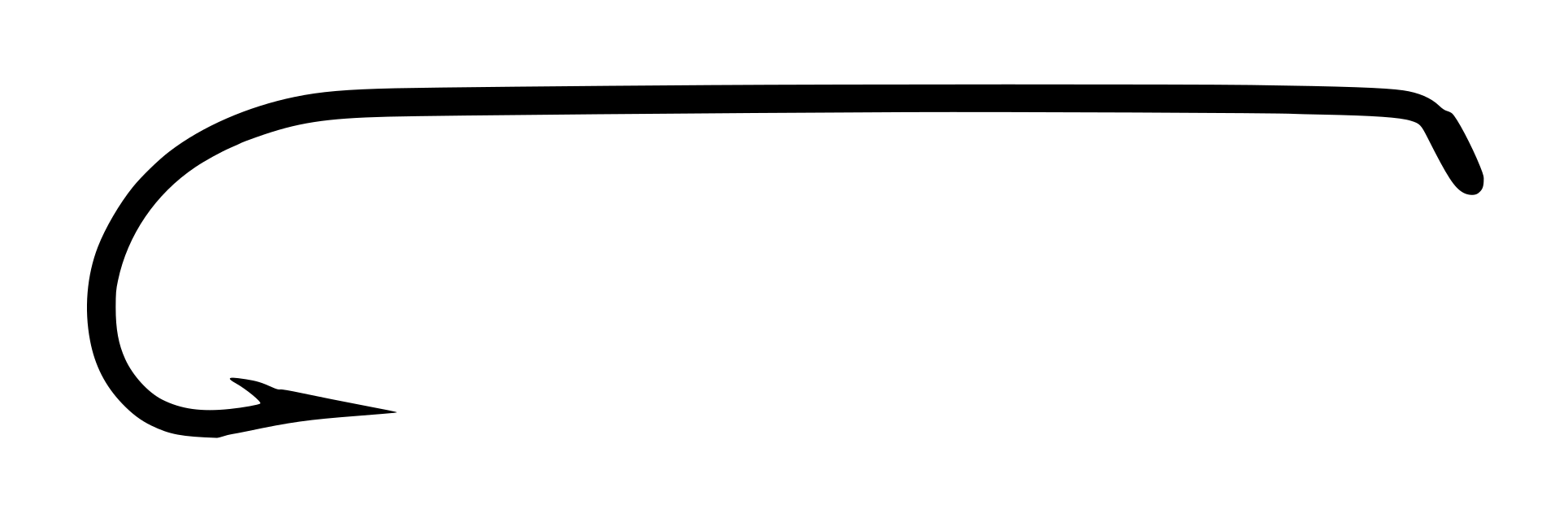
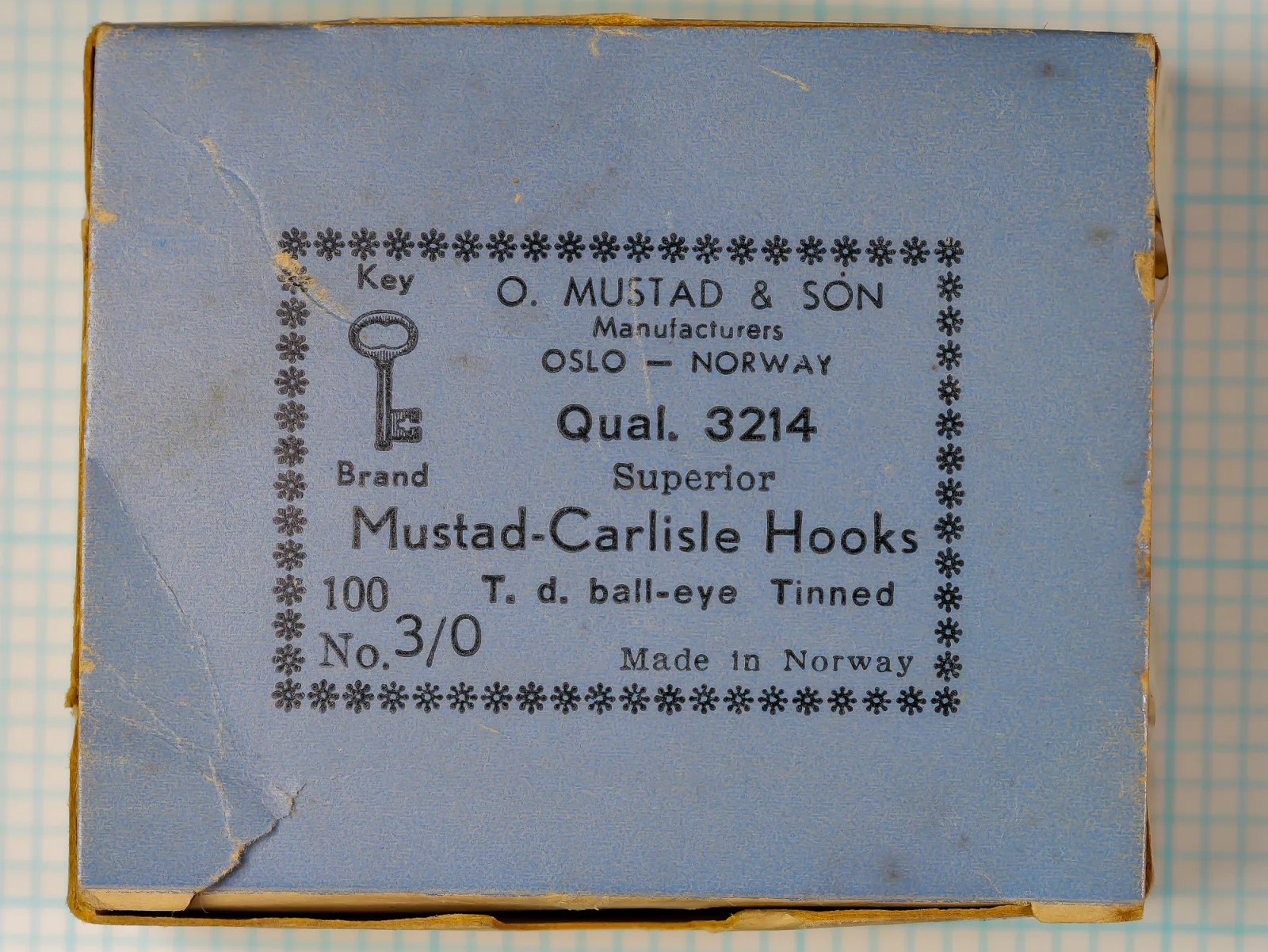
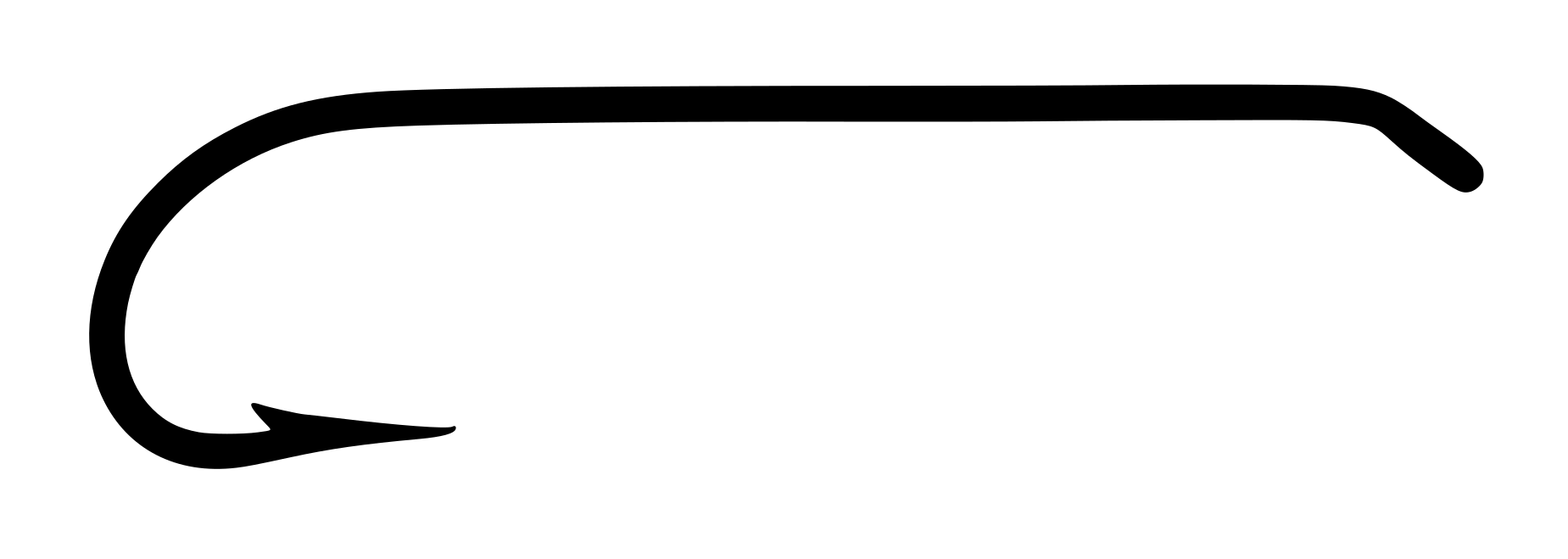
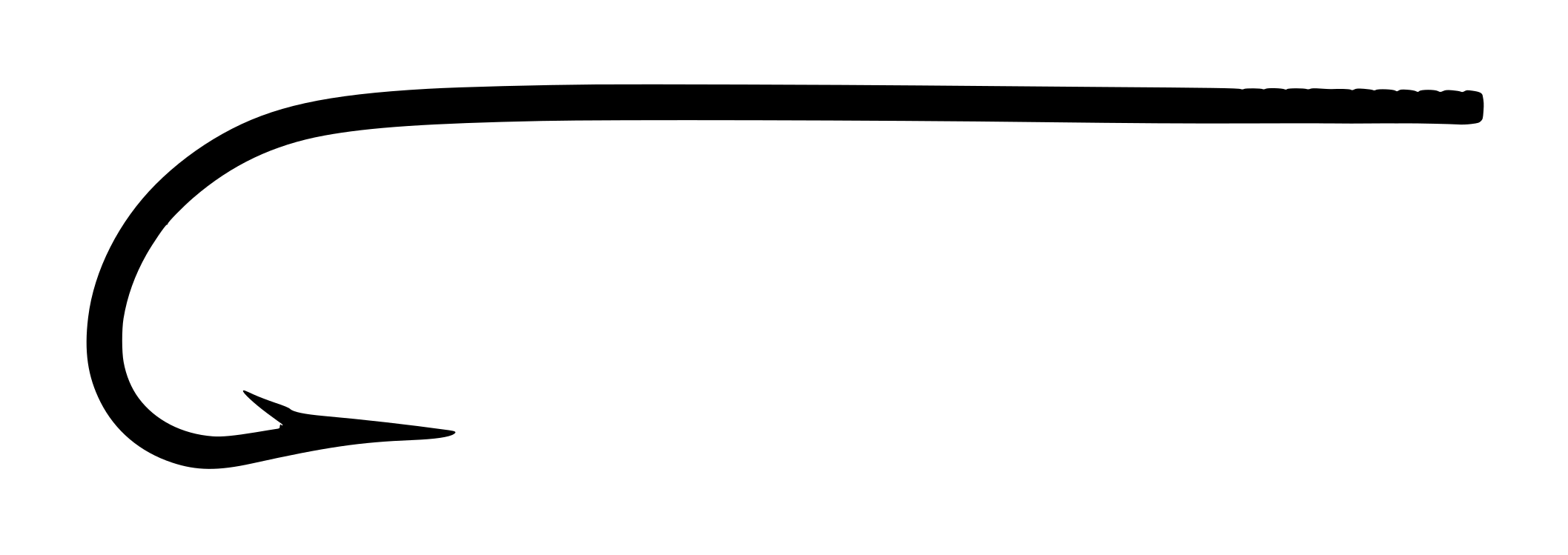
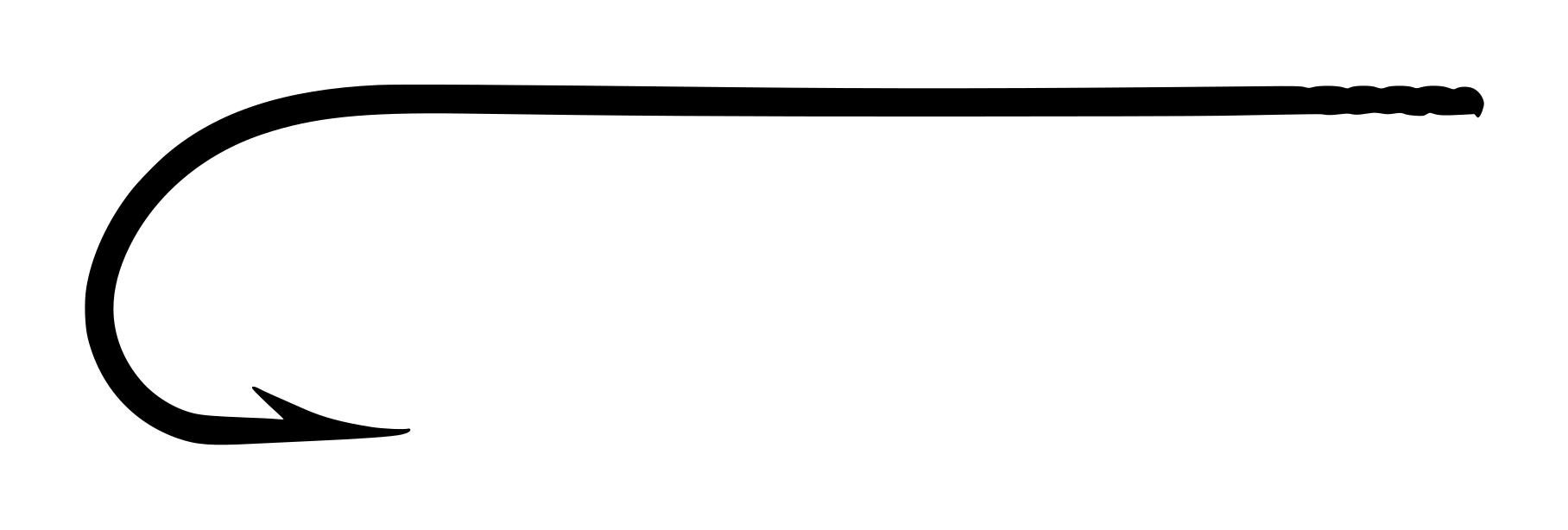
The Mustad-Carlisle (Qual. 3214) is a 4X-long bait and saltwater hook manufactured by O. Mustad & Son in Oslo, Norway. Carlisle bends are characterized by their deep, rounded curve and were standard-issue for bait fishing in European and British traditions. This specimen features a tinned (bright silver) finish, standard wire gauge, ball eye turned down, and a Superior point — a near-straight inner taper designed for clean penetration and consistent hook-up with live and dead baits. Size 3/0 exemplifies the hook’s working range: large enough for saltwater and pike work, yet manageable for serious bait anglers. The blue-printed manufacturer box with 100-count capacity and letterpress printing is consistent with Mustad Oslo production in the 1950s-1960s era, prior to the adoption of barcodes and modern labeling. Complete original boxes of this vintage are increasingly scarce, particularly in North European markets where they were originally distributed.
Mustad — New entry — image 1
Photographic record
3 cataloged imagesSelect any record to load it above.
3 images shown
Mustad — New entry — image 1Mustad — New entry — image 1Open originalMustad — New entry — image 2Mustad — New entry — image 2Open originalMustad — New entry — image 3Mustad — New entry — image 3Open original
Technical profile
Turned Down Ball Eye | Carlisle | 4X Long | Superior Point | Tinned
Eye
Ball Eye, Turned DownBall eye is cleanly formed with even diameter throughout P. Wire ends are firmly butted, creating a uniform loop without visible overlap or gap. Eye orientation is turned down at approximately 40 degrees below shank axis I, standard for bait hooks of this era. No rust or corrosion visible on eye closure seam.
Wire
Standard, Round
Shank
4X Long — Plain
Bend
carlisle, Narrow gap, Offset / kirbedCarlisle bend shows the characteristic deep, rounded curvature typical of the bend family P. Bend centerline is well-defined and symmetrical. Kirbed offset (point left when viewed from above) is consistent with historical European bait-hook conventions P. Wire set shows no visible twist or kink. Bend radius appears slightly deeper than standard Sproat, creating the enlarged "cup" that defines the Carlisle family I.
Point
Superior (near-straight inner taper)Short, close-cut barb positioned approximately 0.05" back from point E. Barb angle is perpendicular to the shank, not swept—typical of mid-century bait hooks. Barb height is moderate, not exaggerated, consistent with standard commercial bait-hook practice of the era I.
Finish
Tinned — Confirmed (stated on packaging)Tinned finish displays the bright, cool silver-grey tone characteristic of the process P. Finish is uniform across the visible bend and point. Wire texture is slightly visible through the thin coating, showing the underlying steel grain. No bluing or browning present. Color temperature is distinctly cool silver, not warm or amber-toned, confirming tinned rather than bronzed P. Patina buildup is minimal, suggesting the box has been stored in a dry environment.
Box lid shows light toning and minor creasing at edges P. Cardboard remains structurally sound with no splits or delamination. Printing is crisp and fully legible. Specimen is a manufacturer closed box — likely original stock, no visible signs of opening or hook removal.
The Carlisle bend is fundamentally a deep-curved design intended for live and dead bait presentations. The rounded cup of the bend creates a secure seat for bait and distributes force evenly when a fish strikes, reducing the likelihood of bait tearing free. The 4X-long shank allows room for larger baits or multiple bloodworms on a single hook without crowding. The Superior point style—with its near-straight inner face—provides penetration without requiring excessive force; it was favored by European bait anglers and saltwater anglers working with tough-mouthed species. Standard wire gauge balances strength with reasonable weight for casting. The tinned finish resists corrosion in seawater and brackish environments, making the hook suitable for estuarine and coastal fishing where salt exposure is constant. The kirbed offset places the point naturally to the left in the fish’s mouth, enhancing hook-set mechanics during the strike.
This pattern was made in sizes 2-16 (V). We have measurement for size 3/0. Know the others? Submit calipered measurements and we'll review and add them. Thank you!
The Carlisle bend family has roots in British hook-making tradition, with Allcock & Company and Redditch makers producing Carlisle variants from the late 19th century onward. Mustad acquired or licensed the Carlisle design and began manufacturing it in the 1930s-1940s. The model code 3214 designation appears to be a Mustad Oslo catalog number, but the precise introduction date for this specific variant is not documented in available sources. The Superior finish note on the box refers to the Superior product line—a branded series of Mustad hooks marketed from the 1950s forward. The Carlisle itself remained in production through the 1970s and was eventually superseded by more modern stainless-steel variants. Original mid-century boxes like this example are genuine historical artifacts of European tackle distribution, rarely seen outside Scandinavian collections.
Era and Packaging Dating
No barcode present on packaging (barcodes adopted commercially ~1974-1976). Letterpress printing method characteristic of mid-1950s to early 1960s production before offset lithography became standard. Blue-grey cardstock with thin construction matches Mustad Oslo house stock from 1950s-early 1960s period. Printing technology (raised letterpress, non-photographic) rules out post-1965. Phone number format not visible on this specimen. Box construction with separate hinged lid consistent with pre-1970 Mustad manufacturing. Size range notation ("No. 3/0") and dash notation consistent with Northern European hook catalogs of the era. Absence of modern regulatory text (CE marks, modern safety warnings) supports pre-1970 dating.
The Carlisle in Cold Waters
The Carlisle bend was exported from Redditch to Scandinavian countries in the 1920s-1930s, where it became the dominant choice for pike and sea-trout anglers. Norwegian and Swedish tackle dealers preferred the deep, rounded cup of the Carlisle over the Aberdeen or Sproat, citing superior bait retention and more direct strike mechanics. Mustad's acquisition of production rights allowed the company to manufacture the Carlisle at industrial scale in Oslo, undercutting British prices and capturing the Continental market by the 1950s. This particular model, Qual. 3214, was distributed through regional dealer networks and rarely appeared in North American tackle shops—a reminder that global tackle markets in the mid-20th century were fragmented by geography and local fishing tradition.
Design lineage and influence
The Carlisle bend represents a direct continuation of British 19th-century bait-hook design, particularly the work of S. Allcock & Co. and Edgar Sealey in Redditch. Competing designs of the same era include the Sproat (shallower, wider bend), the OShaughnessy (heavier, more angular), and the Aberdeen (wider gap, lighter wire). European bait anglers preferred the Carlisle’s deep cup because it cradles baits securely and produces a strong, direct strike. The design influenced all subsequent Mustad bait-hook lines and remains in production today (though typically in stainless steel). The kirbed offset was adopted by most European manufacturers and became the standard for bait hooks in that market, contrasting with the straighter points preferred in North American streams.
Best matchRelated by Attribute
Computed automatically from catalog data — updated as new hooks are added.
Matches: Bend, Shank, Gap, Eye, Eye Orient. +6 moreDiffers: Wire: Standard vs Heavy (1X Heavy); Finish: Tinned vs Bronzed; Shank ratio: 85.6% vs 81.5% +2 more
Matches: Bend, Shank, Gap, Eye, Eye Orient. +7 moreDiffers: Wire: Standard vs Extra-Heavy (2X+); Shank ratio: 85.6% vs 84.8%; Gap ratio: 20.5% vs 21.9% +1 more
Matches: Bend, Wire, Gap, Eye, Point +5 moreDiffers: Shank: 4X Long vs Extra-Extra Long; Eye Orient.: Turned Down vs Straight / Inline; Application: Bait, Saltwater vs Streamer, Bait
Matches: Bend, Shank, Gap, Eye, Forging +4 moreDiffers: Wire: Standard vs Fine (1X Fine); Eye Orient.: Turned Down vs Straight / Inline; Point: Superior vs Standard / Spear +3 more
Matches: Bend, Shank, Gap, Point, Finish +4 moreDiffers: Wire: Standard vs Heavy (1X Heavy); Eye: Ball Eye vs Blind — Marked Shank; Eye Orient.: Turned Down vs N/A — Blind +4 more
The Mustad-Carlisle Qual. 3214 is designed for live and dead bait fishing for saltwater species, estuarine predators, and pike. Size 3/0 is suited to medium-to-large baits: small live fish, herring or mackerel strips, sand eels, and multi-bait rigs common in British estuary work. The hook was marketed to European tackle dealers and distributed through regional distributors in Scandinavia, the United Kingdom, and Northern Continental Europe. Anglers using this hook would typically have been fishing tidal rivers, coastal harbors, or offshore grounds targeting cod, bass, pike, and sea trout. The tinned finish and robust construction made it suitable for saltwater—the hook resists corrosion in seawater for hours to days of fishing without significant degradation. In freshwater, the same hook was used for pike and large perch on rivers where current and bait size demanded a strong, deep-curved platform.
Secondary Applications
The 3214 Carlisle could accommodate dead-bait rigs using multiple hooks ganged on a single trace, common in pike and sea-trout fishing. Larger sizes in the range (6/0–8/0) are documented in use for trolling with dead herring and mackerel in Scandinavian reservoir and coastal fisheries. The hook's long shank also made it serviceable for simple leger rigs where bait needed to be positioned well clear of the lead weight.
Classic Fly Patterns
Named patterns specifically associated with this hook. Leave blank if none formally documented. Do not speculate — only include patterns with a confirmed association.
Collector notes
Rated 4.5/10. Original Mustad manufacturer boxes from the 1950s-1960s are uncommon; most surviving specimens are loose hooks or damaged/opened cardboard. This is a complete, sealed 100-count box with legible printing and intact lid structure. However, the 3214 Carlisle itself is not rare—it was produced in large volume and remains functional for its intended purpose, which limits specialist collector demand. European bait-hook enthusiasts and Mustad Oslo historians represent the primary collector base.
Reference value
$12 – $28 USD estimate
Packaging condition
Good — moderate wear, legibleRecorded specimen
Packaging format
GW-M-MBOX-01Catalog code
What enhances collectability: (1) Original manufacturer box is intact and unopened—boxes from this era rarely survive undamaged; (2) Complete 100-count capacity adds presence to a collection; (3) Letterpress printing and blue-grey cardstock are strong era markers; (4) This is pre-barcode Mustad Oslo production, before the company adopted modern labeling; (5) Northern European distribution makes these scarce in North American and British markets where online sales platforms operate. What limits the rating: (1) The hook itself is a mass-produced working tool, not a scarce specialty pattern; (2) Tinned finish, while period-correct, shows signs of age (light patina) rather than the mirror-bright condition some collectors prefer; (3) The Carlisle bend, while historically significant, is less celebrated than the Sproat or OShaughnessy in modern collecting circles; (4) Loose sizes in this model remain cheap and common, so the box is the primary value driver. Size and finish variants: All sizes 2–16 were produced. Larger sizes (3/0–6/0) are more desirable to saltwater collectors. Tinned finish (as documented) is more sought after than blued or japanned variants for this model. Condition factors: Box lid integrity is critical; crushed, dented, or heavily printed-over lids reduce value by 30–50%. Complete hook count is essential. Any opening or removal of hooks reduces this to a common box. Printed text legibility matters; faded or worn printing suggests poor storage and lowers the estimate.
Packaging
Rigid cardboard manufacturer box with lid. Blue-grey cardboard with black letterpress printing. Decorative asterisk border. Text printed on lid in Norwegian and English. Dimensions approximately 4.5" x 3.5" x 0.75". Paper stock appears to be 1950s-era lightweight cardstock. Lid shows edge wear and minor toning consistent with age. Original hinged construction intact.
Market Value Notes
Low ($12): Good condition, box has been opened, most/all hooks present, minor damage to corners or printing. High ($28): Excellent condition, original sealed or near-sealed box, full 100-count verified, lid crisp with minimal creasing, printing fully legible. Premium factors: Original unopened boxes command strong premiums over opened stock; complete hook count with no losses; bright, legible printing; Oslo origin and pre-barcode dating; significance to European tackle historians. Platforms: eBay UK and European tackle forums; some sales through Scandinavian antique dealers and internet auctions. Limited data: only 2–3 comparable complete boxes have sold in past 24 months. Confidence: E estimated — based on typical Mustad 1950s-1960s box sales and European bait-hook collector demand. Values may vary by 15–20% depending on regional interest and shipping costs.
Where to Find
eBay UK and European eBay regional sites (eBay.de, eBay.fr) yield occasional examples. Scandinavian antique tackle dealers, particularly in Norway and Sweden, stock this model more frequently. UK tackle fairs and specialist fishing memorabilia dealers occasionally list mid-century Mustad boxes. US market sees fewer examples; when available, typically priced higher due to shipping costs from Europe. Complete sealed boxes are encountered irregularly—months may pass between sightings on major platforms.
Preservation
Storage and Preservation
Store the box in a cool, dry environment away from direct sunlight and fluctuating humidity. The tinned finish is stable and resistant to corrosion, but the cardboard lid and sidewalls are susceptible to mold growth and paper deterioration if exposed to damp conditions. Avoid stacking heavy objects on top of the box, which will crush the lid and damage the printed label. If the box has never been opened, keep it sealed to preserve the factory-original state and maximize collecting value. If hooks have been removed for use, ensure any remaining hooks are completely dry before closing the box. The letterpress printing will fade gradually with light exposure, so display or storage away from direct UV light is recommended. Do not attempt to clean the exterior with water; a soft, dry cloth is sufficient. The original blue-grey cardboard may develop a patina over time, which many collectors find desirable as evidence of authenticity and age.
Primary Source
Packaging Markings and Production Evidence
Source: Label text, O. Mustad & Son manufacturer box, Qual. 3214 Mustad-Carlisle Hooks, Oslo, Norway.
The lid text reads: ‘O. MUSTAD & SON Manufacturers OSLO – NORWAY / Qual. 3214 Superior / Mustad-Carlisle Hooks / 100 T. d. ball-eye Tinned / No. 3/0 / Made in Norway.’ The designation ‘Qual. 3214’ is a Mustad Oslo quality/model code, distinct from the international model numbering systems used later. ‘Superior’ here refers to the the point style. ‘T. d. ball-eye’ is abbreviation for ‘Turned Down Ball Eye,’ confirming eye type and orientation. ‘Tinned’ is the finish, printed as the specification, and matches the observed bright silver tone photographically. The asterisk border is a common Mustad Oslo decorative motif from the 1950s-early 1960s. The dash notation ‘No. 3/0’ uses the forward slash, consistent with Northern European hook catalogs of that period; North American numbering would use ‘/0’ or ‘size 3/0’ interchangeably. The phrase ‘Made in Norway’ indicates post-WWII production—wartime Mustad output was often not marked ‘Norway’ due to political circumstances. Collectively, these elements anchor the box to circa 1955-1965 production.
Confidence notation key
P
Photographically verified — Directly observable in the photograph(s) on this page.
V
Verified by documentation — Confirmed by manufacturer catalog, spec sheet, or published reference.
I
Inferred — A logical deduction from observable or documented evidence, not directly stated.
E
Estimated — An approximation based on visual comparison, proportional analysis, or limited data.
S
Speculative — A reasoned hypothesis that cannot be confirmed from available evidence.
Unnotated claims are the compiler’s synthesis; see Sources. All photographs on garrenwood.com are taken on a measurement grid where each square equals 1/10 inch (0.1″ / 2.54 mm).