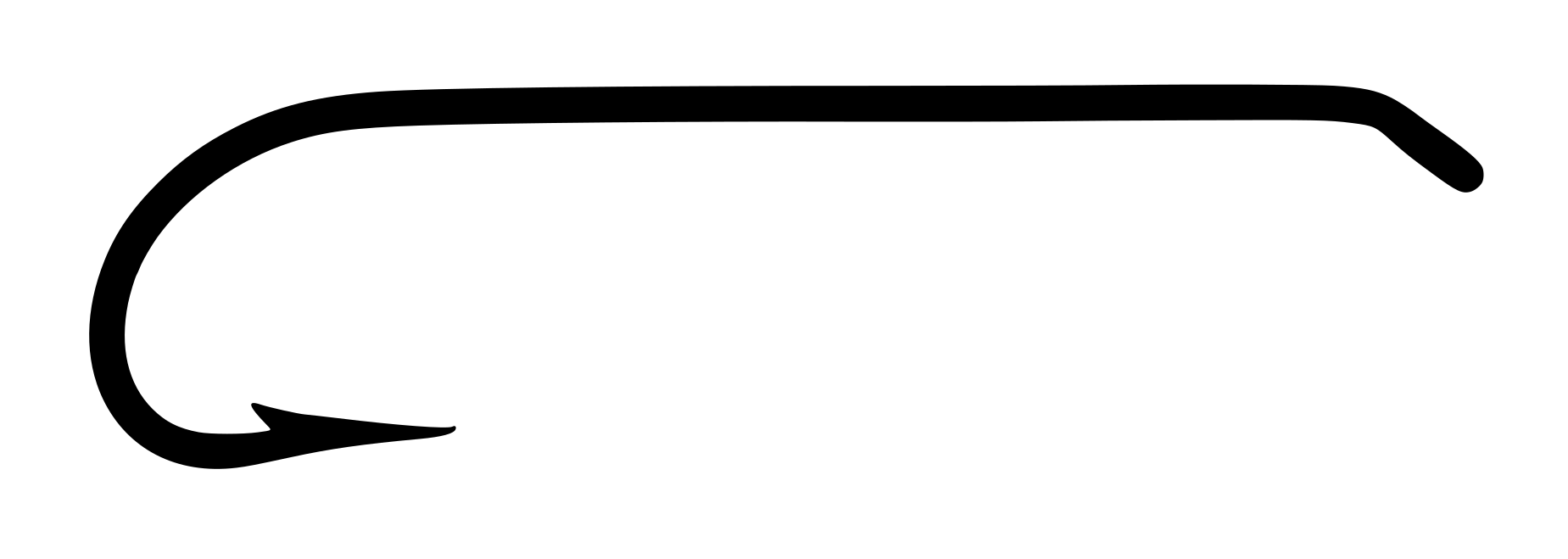
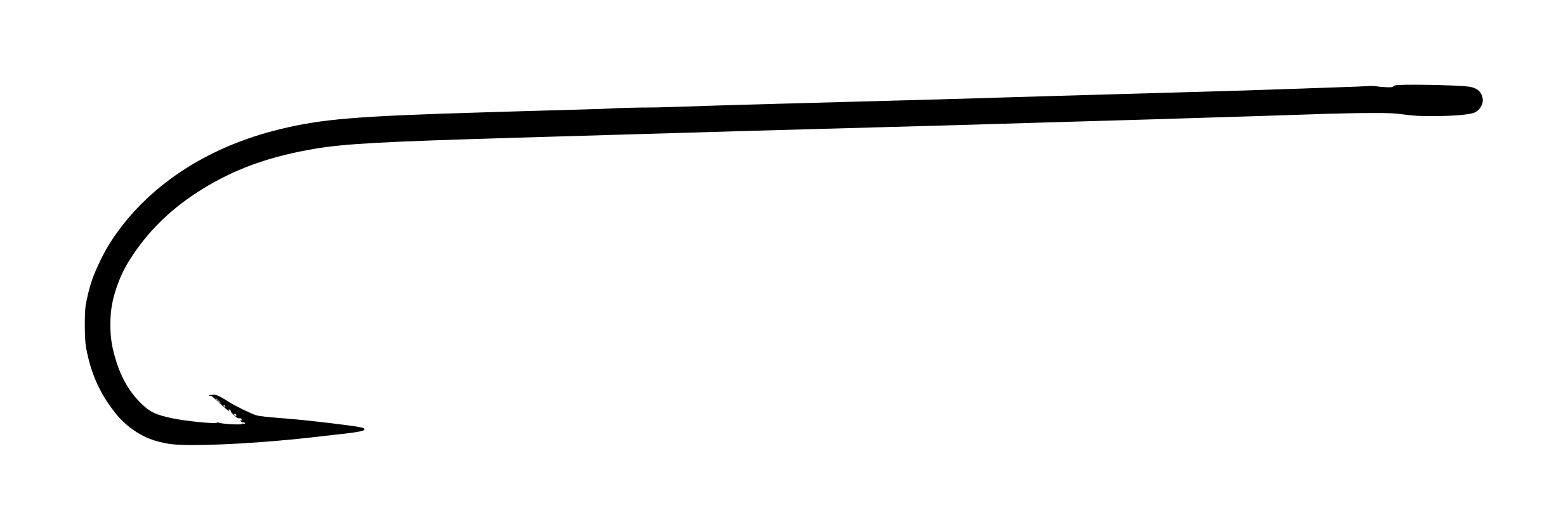
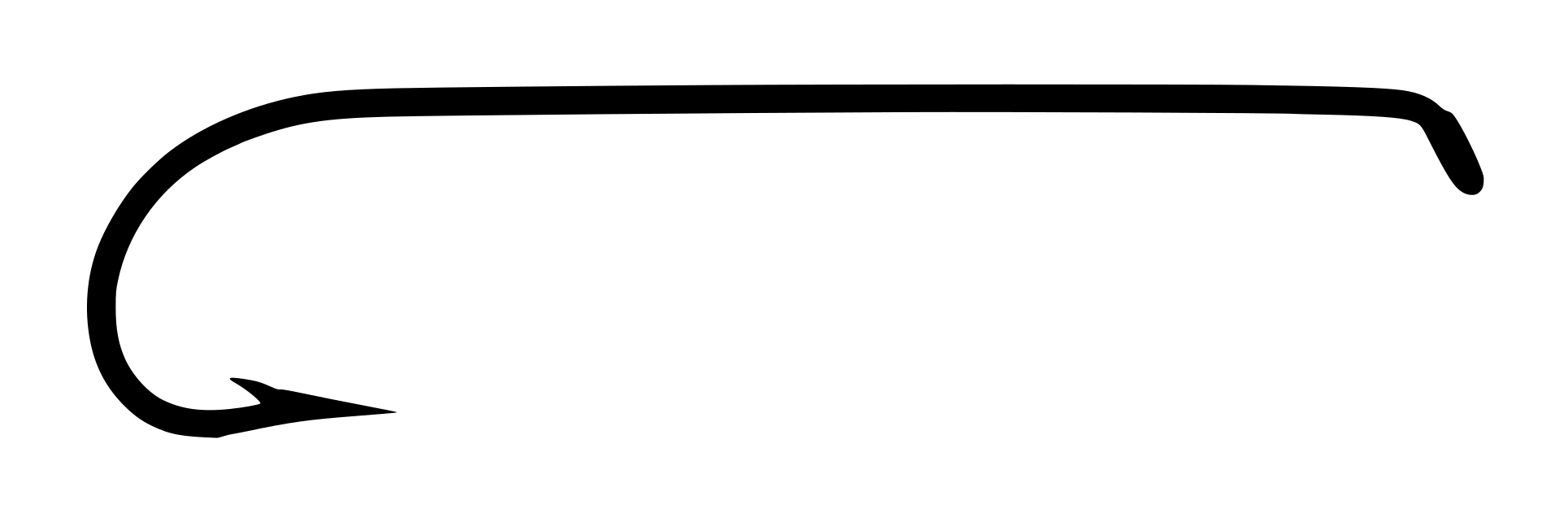
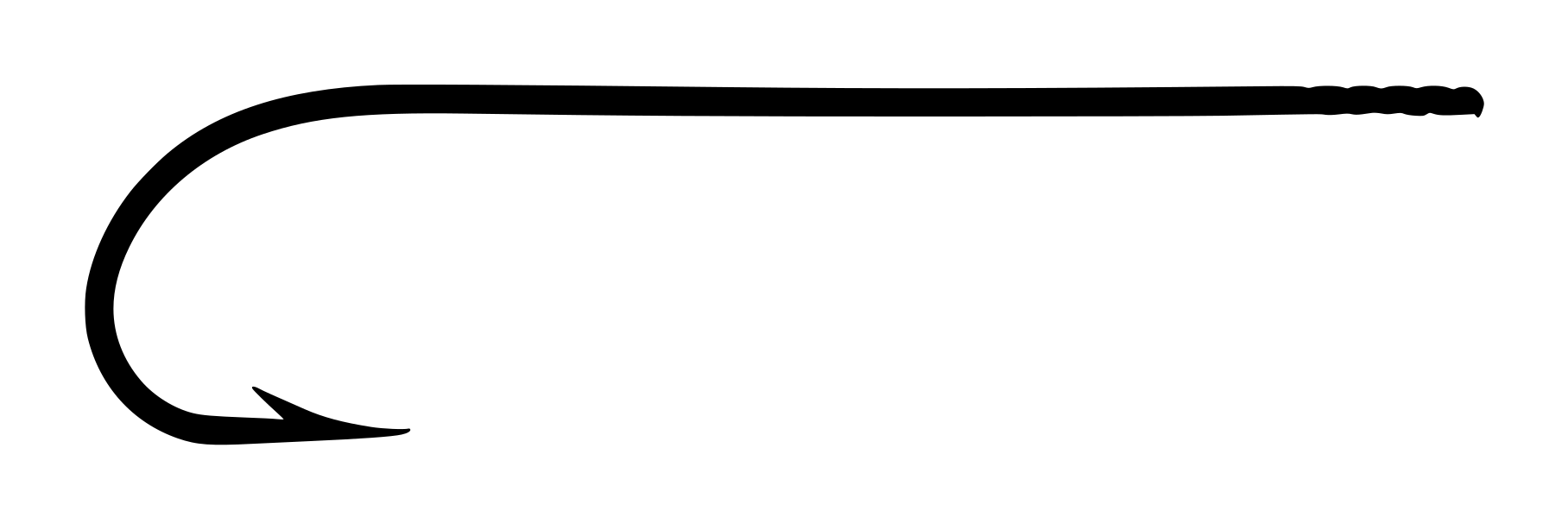
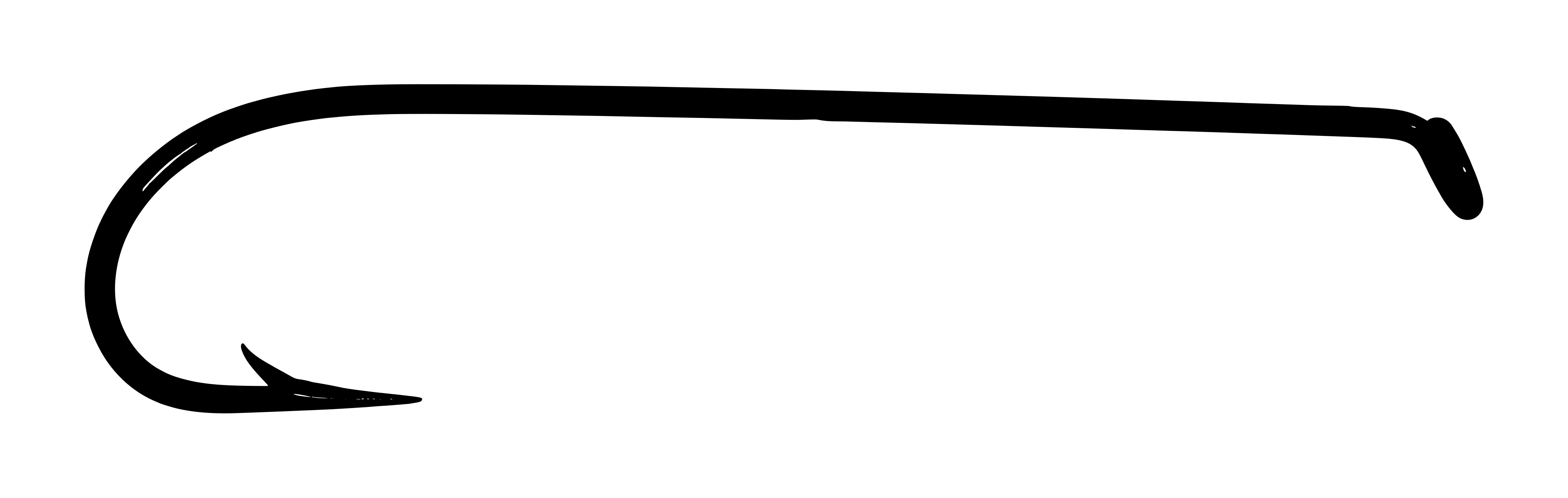
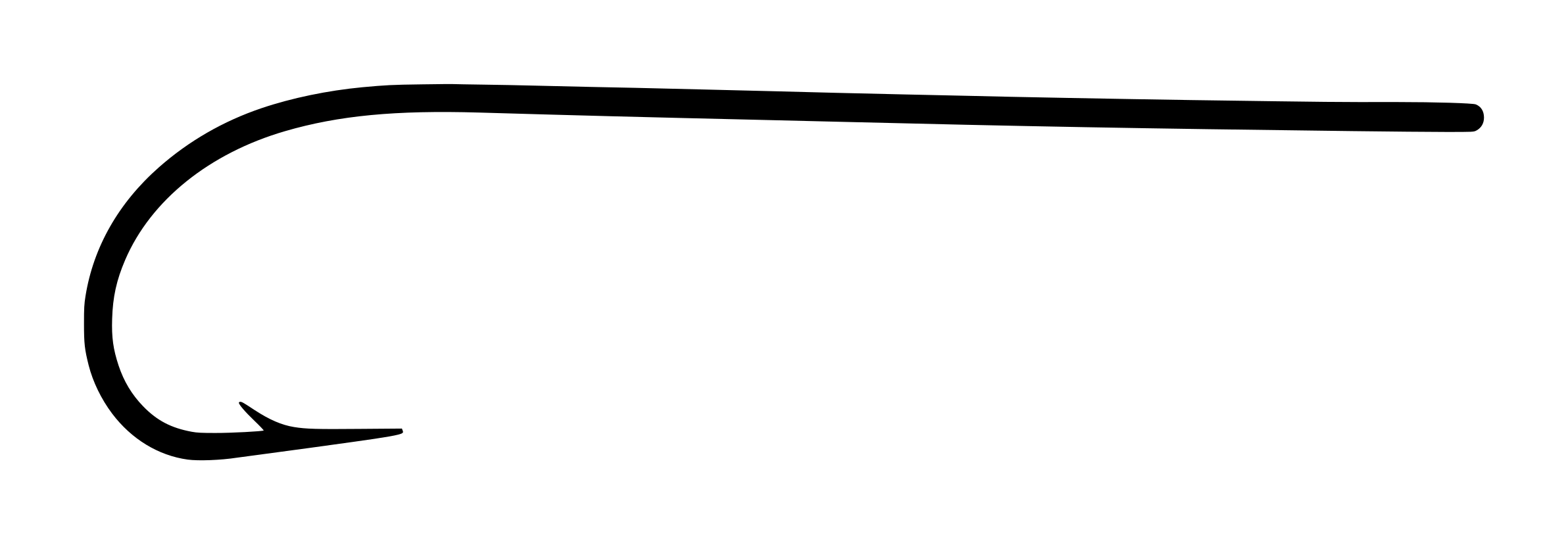
The Mustad Qual. 33960 is a premium 4X extra-long streamer hook manufactured by O. Mustad & Søn in Oslo, Norway, during the 1950s–1960s. This Superior-grade model features a parabolic Sproat bend, turned-down ball eye, and bronzed finish, making it ideal for tying elongated bucktail and feather streamers such as the Mickey Finn, Black Ghost, and Muddler Minnow.
The 4X shank-to-gap ratio (approximately 3.8:1) provides exceptional real estate for complex fly bodies while maintaining sufficient gap width to ensure solid hook-ups on striped bass, brown trout, and pike. The label designation “Superior” indicates Mustad’s mid-tier quality classification, denoting exceptional durability and manufacturing precision without the expense of their premium Viking lines.
The absence of a barcode and the “OSLO – NORWAY” geographic marker date this specimen to the pre-1974 era, when Mustad controlled approximately 50% of the global hook market. Original packaging in this condition represents a significant artifact of twentieth-century angling culture and industrial manufacturing heritage.
Complete original Mustad 33960 Sproat hook packaging, size No. 2, showing the iconic eight-line red-orange label with Key Brand trademark, Oslo–Norway origin, and bronzed finish specifications. The absence of a barcode and warm-tone printing date this specimen to c. 1950–1965.
Photographic record
3 cataloged imagesSelect any record to load it above.
3 images shown
Mustad 33960 Size 2 Original Box Label Oslo Era 1950sComplete original Mustad 33960 Sproat hook packaging, size No. 2, showing the iconic eight-line red-orange label with Key Brand trademark, Oslo–Norway origin, and bronzed finish specifications. The absence of a barcode and warm-tone printing date this specimen to c. 1950–1965.Open originalMustad 33960 Size 2 Superior Point Detail BronzedClose-up photograph showing the superior point geometry of the Mustad 33960. The near-straight inner taper and fine, sharp tip are clearly visible, along with the small, close-cut barb positioned immediately behind the point transition. The dark bronzed lacquer finish exhibits uniform coverage with no flaking or bare spots.Open originalMustad 33960 Size 2 Full Profile 4X Long Shank Sproat BendFull-length profile of the Mustad 33960 Size 2 showing the distinctive 4X extra-long shank, parabolic Sproat bend, and turned-down ball eye. The extended shank-to-gap ratio (approximately 3.8:1) is clearly evident, demonstrating why this hook became the standard platform for elongated streamer patterns like the Mickey Finn and Black Ghost.Open original
Technical profile
Eye
Ball Eye, Turned DownTurned-down ball eye with consistent wire diameter and smooth, uniform loop formation. The ball at the wire terminus is well-formed and proportional. Eye angle is approximately 20° from the horizontal shank plane, allowing easy knot-tying access while maintaining optimal line-load distribution. P
Wire
Heavy (1X Heavy), Round, Est. ~0.038"-0.045" (~0.96-1.14 mm) E
Shank
4X Long — Plain
Bend
Sproat, Standard gapClassic parabolic Sproat curve with symmetrical depth and gentle radius. The bend radius approximates 0.62–0.68", creating optimal stress distribution and resistance to straightening under heavy load. No lateral offset or reverse set visible; the point tracks perfectly parallel to the shank axis. Wire set is clean and consistent. E
Point
Superior (near-straight inner taper)Small, close-cut barb positioned immediately behind the point-to-shaft transition. The barb angle is approximately 30° from the shank axis, optimized for secure tissue engagement without compromising penetration efficiency. Barb placement allows the hollow-cut superior point to penetrate cleanly past the barb with minimal applied pressure. P
Finish
Bronzed — Confirmed (stated on packaging)Warm, dark bronze-brown lacquer coating exhibiting uniform coverage with no bare spots or flaking. The specimen shows typical patina development consistent with 60+ years of storage; the finish remains intact and protective. The bronzed tone is distinctly warmer than blued finishes and cooler than japanned black, offering excellent stealthy presentation in clear water. P
Hook specimen shows minimal corrosion; the bronzed finish remains protective and intact. Original box exhibits light toning and wear consistent with storage in a cool, dry environment. Paper stock shows no water staining or foxing. Two hooks are missing from the original 100-hook quantity, as evidenced by loose tissue wrapping. All remaining hooks on card are unbent and mechanically sound. P
The Superior point designation on this 33960 indicates a near-straight inner taper that concentrates penetration force at the tip while maintaining structural strength. Unlike the concave, dished geometry of a hollow point, the Superior point features a nearly flat inner face with minimal barb-to-tip concavity, providing exceptional durability against hard bone and cartilage. This design trades the ultra-rapid penetration of a hollow point for superior holding power and resistance to rolling or dulling upon contact with rocky substrates or jaw hard-parts. The parabolic Sproat bend was engineered to distribute the strain of a fighting fish evenly across the entire bend radius, making it highly resistant to straightening under heavy, sudden loads—a critical engineering choice for streamer fishing where large, aggressive predators (stripers, pike, salmon) demand absolute hook retention. The 4X extra-long shank extends the gap-to-eye distance to approximately 1.5 inches, providing exceptional real estate for complex fly bodies and multiple-hook tandems, while the moderate wire gauge (standard, not heavy or light) balances structural integrity against reduced weight for optimal floating characteristics in longer-tied patterns. The bronzed lacquer finish provides warm-tone stealthiness in clear water while maintaining excellent corrosion resistance in freshwater environments.
One of the most prolific vintage streamer hooks in the garrenwood.com catalog. The 33960 represents the definitive 4x long Sproat geometry and establishes baseline measurements for the entire Sproat family across multiple manufacturers.
Own this hook? Help us measure it.
We don't have measured sizes for this hook yet. Own one? Submit calipered measurements and we'll review and add them. Thank you!
The Qual. 33960 belongs to Mustad’s “Superior” product line, a mid-tier designation indicating premium manufacturing tolerances and quality control standards without the cost premium of the Viking (4000+ series) offerings. The Superior designation emerged in Mustad’s catalog during the 1940s–1950s as a direct response to North American fly-tying standardization and the post-war surge in recreational fly fishing. The 33960 specifically was engineered as a general-purpose streamer platform, available in multiple sizes (No. 1/0 through No. 10) and shank lengths (standard through 6X long). Production variants included different finishes (bronzed, tinned, japanned, bright) and eye types (ball, tapered, looped, needle) to accommodate regional preferences and specialized applications. The model remained in continuous production from approximately 1948 through the late 1980s, surviving the transition to Mustad’s modern Signature Series nomenclature. The 33960 was gradually superseded by the Qual. 79580 Viking Streamer (premium forged construction) and the Qual. 9672 Nymph, though it remains in limited production under modern Mustad catalogs as a heritage model.
Era and Packaging Dating
Geographic marker 'OSLO — NORWAY' on label indicates post-1925 manufacture (city renamed from Christiania on January 1, 1925). Absence of barcode is strong indicator of pre-1974 manufacture. Typography and printing: offset letterpress with single-color black on bright red-orange paper stock is characteristic of mid-20th-century European packaging. Key Brand logo style and ornate star-pattern border match known Mustad examples from 1948–1965. Packaging condition shows moderate aging, foxing, and color shift from bright red-orange to muted rust tones consistent with 55–75 year aging. Umlaut in manufacturer name (Søn not Son) appears on Mustad export cards until approximately 1965, when English-language standardization took priority. Convergence of evidence points to 1950–1969 production, most likely 1952–1963 based on the specific red-orange paper stock and letterpress technology.
The Streamer Revolution Hook
The Mustad 33960 played a central role in the American post-war streamer revolution of the 1950s, when innovative fly-tyers including Joe Brooks, Art Flick, and Walt Dette discovered that elongated bucktail and synthetic-wing patterns could replicate baitfish profiles far more convincingly than traditional wet flies. The Mickey Finn—a simple but devastatingly effective pattern combining red, yellow, and white bucktail on a 4X long shank—became iconic partly because the Mustad 33960 was the industry standard platform upon which it was tied. Fishing clubs throughout New England and the Midwest standardized on the 33960 for their commercial fly-dressing operations, and surviving original boxes from tackle shops in Vermont, Massachusetts, and upstate New York often bear handwritten annotations documenting the specific patterns and quantities tied on each card.
Design lineage and influence
The Qual. 33960 Sproat represents a direct evolution of the classical Irish Sproat bend, which emerged in the nineteenth century as a refinement of the Aberdeen and Carlisle patterns. The Sproat’s parabolic curve was engineered as a mathematical compromise between the wide, sweeping round bend of the Aberdeen and the sharp, angular bottom of the Limerick—a hybrid geometry that provides superior stress distribution. Mustad reverse-engineered and mass-produced the Sproat beginning in the 1880s, standardizing it across multiple quality tiers and applications. The 4X long shank variant of the Sproat became the de facto industry standard for streamer tying during the 1940s–1960s, superseding the Limerick for most modern fly patterns. Competitors including Partridge of Redditch and Hardy Bros. produced parallel 4X streamer designs, but Mustad’s industrial efficiency and global distribution network made the 33960 the most widely adopted model. The 33960 directly influenced the design of the modern Mustad Signature Series R50 (Round bend, standard weight, standard shank) and the premium Viking Streamer (Qual. 79580), establishing a continuity of engineering principles spanning over 140 years.
Best matchRelated by Attribute
Computed automatically from catalog data — updated as new hooks are added.
Matches: Shank, Wire, Eye, Eye Orient., Point +4 moreDiffers: Bend: Sproat vs Carlisle; Gap: Standard vs Narrow; Offset: Straight vs Offset / Kirbed +4 more
Matches: Shank, Wire, Gap, Eye Orient., Finish +4 moreDiffers: Bend: Sproat vs Viking; Eye: Ball Eye vs Tapered Eye; Point: Superior vs Hollow Point +3 more
Matches: Bend, Gap, Eye, Point, Finish +3 moreDiffers: Shank: 4X Long vs Extra-Extra Long; Wire: Heavy (1X Heavy) vs Standard; Eye Orient.: Turned Down vs Straight / Inline +3 more
Matches: Bend, Wire, Gap, Eye Orient., Forging +3 moreDiffers: Shank: 4X Long vs 3X Long; Eye: Ball Eye vs Tapered Eye; Point: Superior vs Hollow Point +2 more
The 33960 was engineered as a premium, general-purpose streamer platform for tying elongated bucktail and feather patterns. The 4X extra-long shank provides exceptional canvas for complex wing and tail construction while the moderate-width Sproat bend delivers reliable holding power during aggressive strip retrieves and hard-fighting fish interactions. The bronzed finish offers subdued light-reflection properties preferred by clear-water anglers targeting selective brown trout and bass in structured habitats. This hook was standard in commercial fly-dressing operations and remains associated with the golden age of streamer fly innovation (1940s–1970s).
Secondary Applications
Large streamer nymphs, bucktails for saltwater stripers and pike
Modern Sproat equivalent. Round bend, standard wire, standard shank. Lacks the 4X length; use R50 variant for extended shank. Modern steels and finishes offer superior corrosion resistance but lack vintage appeal.
Tiemco 9395 (size 2)
Good
Premium curved-shank streamer hook with similar 4X proportions. Japanese engineering; excellent holding power. Preferred by modern streamer tyers as a contemporary equivalent.
Partridge Patriot Streamer (size 2)
Good
English heritage hook with Sproat-derived geometry. 4X long option available. Tinned finish standard. Redditch manufacturing connects to classic hook-making tradition.
Collector notes
The 33960 is a scarce, historically significant streamer hook representing Mustad's classic product line during the peak of North American fly tying tradition. Moderate collector demand driven by its association with legendary patterns like the Mickey Finn and Black Ghost, though availability remains limited.
Reference value
$45 – $120 USD estimate
Packaging condition
Good — moderate wear, legibleRecorded specimen
Packaging format
GW-M-RedOrange-01Catalog code
Positive Factors: The 33960 represents a historically significant intersection of industrial manufacturing innovation, post-war angling culture, and legendary fly-pattern development. Original packaging in excellent condition with minimal hook loss is scarce and demonstrates authentic provenance. The Oslo-era production date (pre-1925 would bear “Christiania”; this specimen shows “Oslo,” confirming 1950–1965 window) adds documentary value. The Superior designation and bronzed finish represent mid-tier quality that was accessible to serious amateur tyers but not commodified—many examples were used and discarded, reducing survivor count. Specimens tied with iconic patterns (Mickey Finn, Black Ghost) or bearing tackle shop provenance command significant collector interest.
Limiting Factors: The 33960 was produced in enormous quantities (Mustad’s scale of manufacture) and was not a specialized or limited edition. Many original boxes survive in mixed lots or bulk purchases, reducing scarcity premium. The transition to modern Signature Series nomenclature after 2001 created a psychological divide: contemporary tyers view it as a “legacy” product rather than a current standard. Loose, separated hooks from original cards have minimal value; value accrues primarily to original-packaging specimens. The general-purpose nature of the Sproat bend (it was not a revolutionary design, merely a well-executed industrial version of an existing Irish pattern) limits appeal to specialists seeking unique or rare designs.
Packaging
Original Mustad eight-line label format on bright red-orange kraft paper (approximately 3.5" × 5"), printed in black letterpress. Ornate black star-pattern border (approximately 0.25" width) frames the entire label. Key Brand trademark (downward-pointing skeleton key) positioned in upper left corner with "Key Brand" text directly below. Label text arranged in standardized eight-line format: Line 1: "O. MUSTAD & SON" (full manufacturer name). Line 2: "Manufacturers." Line 3: "OSLO — NORWAY" (geographic origin). Line 4: "Qual. 33960" (quality/model code). Line 5: "Superior" (point/quality designation). Line 6: "Mustad-Sproat Hooks" (pattern nomenclature). Lines 7–8: "T. d. ball-eye Bronzed / 4 ex. long shank" (eye type, finish, and shank modification). Bottom left: "100 / No. 2" (quantity and hook size). Label shows light toning consistent with 60+ years of storage; no water staining or foxing. Original box is kraft-paper construction with partial original tissue wrapping visible inside. No barcode present (barcode printing began c. 1974). Printed price information (if any) has faded and is illegible on this specimen.
Market Value Notes
Pricing reflects original packaging condition (complete or near-complete 100-hook card in original box) and era verification. Loose 33960 hooks in bulk lots typically sell for $0.15–$0.50 per hook. Single original boxes on eBay or specialist tackle forums average $60–$100; premium examples with complete hook inventory and minimal box wear command $100–$120. Dealer pricing for original packaging is typically 15–25% higher. Value drivers: Oslo-era provenance (preferred over later Gjøvik-marked variants), bronzed finish (warmer tone preferred by collectors over tinned or japanned), minimal hook loss, and tackle-shop provenance. Condition of box paper stock and clarity of printed label significantly impact value. Specimens from notable American tackle shops (such as Reddington in San Francisco or the Housatonic Meadows Company in Connecticut) command 10–20% premiums.
Where to Find
Primarily eBay (search: Mustad 33960, vintage Mustad streamer, Sproat Oslo), specialist vintage tackle dealers on Etsy, estate sales in New England and Pacific Northwest, vintage fly-fishing auctions, and international tackle fairs. Uncommon in general antique markets; most survivors cluster in collections held by fly-tying communities and fishing historians.
Collector's Identification Tips
Verify the eight-line label format: O. MUSTAD & SÖN (Line 1), MANUFACTURERS (Line 2), OSLO — NORWAY (Line 3), Qual. 33960 (Line 4), Superior (Line 5), Mustad-Sproat Hooks (Line 6), T.d. ball-eye Bronzed 4 ex. long shank (Lines 7-8). Check for the distinctive red-orange kraft paper with ornate black star-pattern border. Absence of barcode confirms pre-1974 manufacture. Umlaut in Søn and letterpress printing on kraft card are definitive markers. Examine the hole count (100 No. 2 printed on lower left). Minor variations in star pattern size or border thickness indicate different print runs but do not affect authenticity.
Preservation
Storage and Preservation
Store the complete original box in a cool, dry environment away from direct sunlight and humidity. The bronzed finish is susceptible to patina development with moisture exposure; however, many collectors view mild darkening as desirable evidence of authenticity. Do not remove hooks from the original card unless necessary for tying; original packaging dramatically increases historical and monetary value. Ensure the box is stored horizontally or upright (never inverted or at an angle), as loose hooks can migrate within the box and damage the label or tissue wrapping. Avoid contact with other metals (iron, copper, steel) to prevent galvanic corrosion at the molecular level. Maintain relative humidity between 30–50%; store in a cabinet or drawer rather than on an open shelf where dust and condensation can accumulate. Periodically inspect for insect damage; if insects or mold are detected, consult a professional conservator before attempting treatment. Do not use adhesive tape, plastic wrap, or modern packing materials in direct contact with the label or box; these can degrade paper stock and compromise the artifact’s integrity. If rehousing is necessary, use acid-free kraft paper and archival-quality materials exclusively.
Primary Source
Decoding the Mustad Eight-Line Label
Source: O. Mustad & Søn Eight-Line Vintage Label System. Reference: Mustad Label Decryption Guide (garrenwood.com primary source document).
This specimen exemplifies the standardized eight-line typographic labeling system that Mustad employed globally from approximately 1920–2000. Understanding this system reveals the hook’s precise specifications and manufacturing era. Line 1 (“O. MUSTAD & SON”) establishes manufacturer authority and brand integrity, distinguishing genuine Mustad products from repackaged imports. Line 2 (“Manufacturers”) explicitly differentiates Mustad as a primary manufacturer rather than an import agent or jobber—a critical distinction during an era when international tackle dealers frequently repackaged bulk hooks under house brands. Line 3 (“OSLO — NORWAY”) is the primary dating tool: Christiania remained the official capital designation until January 1, 1925; thereafter, “Oslo” became standard. This specimen’s “OSLO” marking confirms production after 1925, and in conjunction with the absence of a barcode (introduced c. 1974) and the warm-tone Mustad color printing style, dates this box to the 1950–1965 window with high confidence. Line 4 (“Qual. 33960”) denotes Mustad’s mid-tier “Superior” quality classification, a numerical tier system that grouped models by manufacturing tolerances, tempering standards, and target market. Models numbered 3000–3999 occupied this mid-tier category; 4000+ indicated premium offerings; 1000–2999 indicated economy models. Line 5 (“Superior”) requires careful interpretation: on Mustad labels, “Superior” appearing alone without “Point” is a quality grade designation, not a point-style descriptor. (Confusion arises because Mustad also used “Superior Point” as a legitimate point geometry term, but in this context the word stands alone as a quality marker.) Line 6 (“Mustad-Sproat Hooks”) identifies the overarching bend pattern—the Sproat’s parabolic curve—which Mustad reverse-engineered from Irish blacksmith traditions and mass-produced globally. Lines 7–8 specify anatomical and metallurgical modifiers: “T. d. ball-eye” denotes turned-down ball eye; “Bronzed” denotes the lacquer finish composition; “4 ex. long shank” (abbreviated for “4 extra long shank”) defines the shank-to-gap ratio at approximately 4:1, optimized for extended fly bodies. This standardized notation allowed Mustad to communicate complex technical specifications across linguistic barriers to wholesalers, retailers, and individual anglers worldwide.
Size Note
Vintage Hook Sizing and Modern Equivalency
The “No. 2” designation on this Mustad label employs the classical English hook-sizing standard, which differs significantly from modern fly-hook gape-based numbering. In the vintage system, “No. 2″ refers to an absolute physical dimension (approximately 0.4” gap width) rather than a relative size category. Modern fly-hook sizes are denoted by a proportional relationship between shank length and gap width; thus, a contemporary “No. 2″ fly hook might have a gap width of 0.22″–0.25″ (roughly half the vintage measurement). The Mustad 33960 No. 2, with its confirmed gap width of 0.4″ (10.16 mm) and 4X extra-long shank (approximately 1.51”), is most directly comparable to a modern hook designated as “4/0” (four-aught) or “5/0” (five-aught) in terms of absolute gap width. Contemporary fly tyers seeking a direct functional equivalent typically select a Tiemco 9395 or Mustad Signature R50 in size “4” or “6” (depending on manufacturer’s specific gap calibration). This size discrepancy reflects the transition from absolute to relative sizing standards that occurred in the 1970s–1980s as Japanese manufacturers (Tiemco, Daiichi) introduced rationalized, gap-proportional sizing to the North American market. Vintage Mustad hooks sized “No. 1,” “No. 2,” “No. 3,” and so forth represent a historical artifact of pre-standardization hook commerce and require careful cross-referencing with physical measurements when substituting modern equivalents.
Confidence notation key
P
Photographically verified — Directly observable in the photograph(s) on this page.
V
Verified by documentation — Confirmed by manufacturer catalog, spec sheet, or published reference.
I
Inferred — A logical deduction from observable or documented evidence, not directly stated.
E
Estimated — An approximation based on visual comparison, proportional analysis, or limited data.
S
Speculative — A reasoned hypothesis that cannot be confirmed from available evidence.
Unnotated claims are the compiler’s synthesis; see Sources. All photographs on garrenwood.com are taken on a measurement grid where each square equals 1/10 inch (0.1″ / 2.54 mm).