The Mustad 79578 is a barbless, forged streamer hook manufactured by O. Mustad & Søn of Oslo, Norway, in the mid-twentieth century (c. 1950s–1960s). This model is a specialized variant of the legendary Mustad 7957 series, distinguished by its factory-produced barbless design (indicated by the ‘8’ suffix) and premium construction features. The hook combines a 4X extra-long shank with a Sproat-pattern round bend and a tapered straight eye, making it an ideal platform for tying elongated baitfish imitations, classic streamers, and bulky nymphs.
The defining physical feature is the combination of forged wire (adding structural strength without excess bulk) and the tapered straight eye—a sophisticated engineering choice that ensures dry flies and streamers float or swim true without the downward pitch of a turned-down eye. The barbless construction, marketed as a premium feature suitable for catch-and-release fishing or delicate presentations, was less common in the mid-20th-century market and makes this specific variant genuinely scarce compared to barbed equivalents.
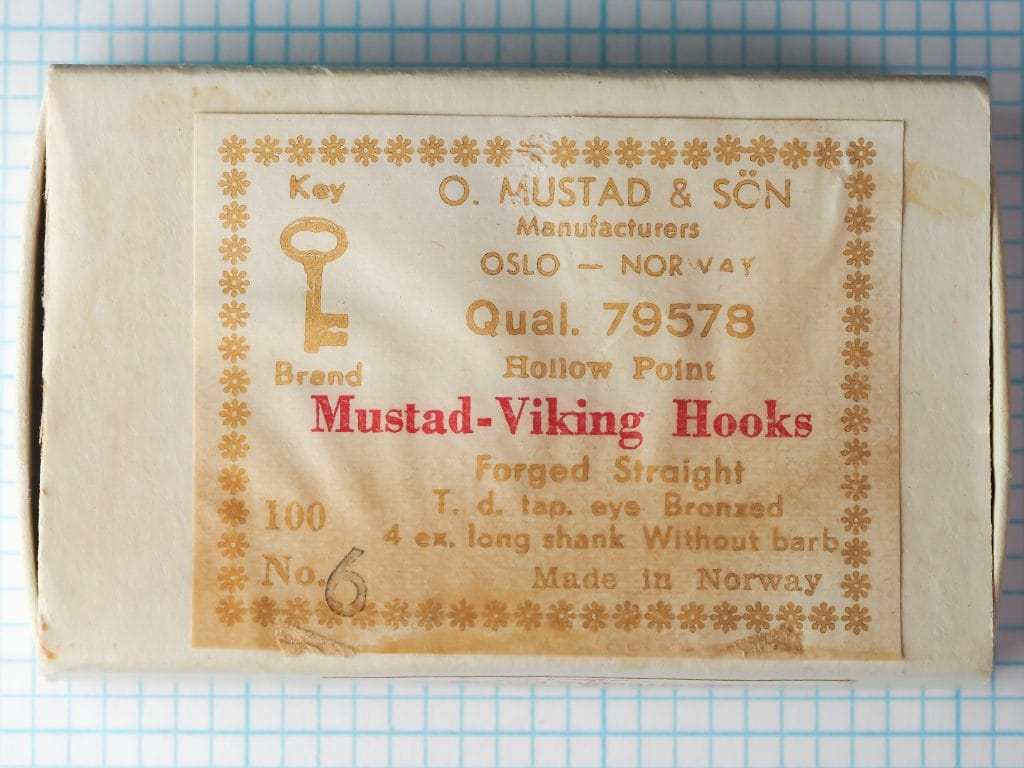
The packaging is a textbook example of vintage Mustad branding: a cream-colored paper card with the iconic Key Brand skeleton-key trademark and a formal eight-line label in gold ink with red accents. The presence of ‘OSLO – NORWAY’ and the specific typography date this card definitively to the mid-century era. Finding a complete, original-packaging box of barbless Mustad streamers from this period is uncommon, as most vintage stock was either consumed by anglers or discarded after use.
Original Mustad 79578 sales card from c. 1950s–1960s, showing the classic eight-line label format with gold ink and decorative snowflake border. The 'OSLO – NORWAY' address and 'Mustad-Viking Hooks' branding are key dating indicators.
Photographic record
4 cataloged imagesSelect any record to load it above.
4 images shown
Mustad 79578 Barbless Streamer Hook Box Label VintageOriginal Mustad 79578 sales card from c. 1950s–1960s, showing the classic eight-line label format with gold ink and decorative snowflake border. The 'OSLO – NORWAY' address and 'Mustad-Viking Hooks' branding are key dating indicators.Open originalMustad 79578 Hollow Point Detail Size 6Magnified side view of the hook point showing the concave, hollow-point geometry characteristic of Mustad's rapid-penetration design. The inner face curves inward from the tip toward the barb location, creating a knife-edge effect.Open originalMustad 79578 Hook Full Profile Size 6 Measurement GridFull side profile of the Mustad 79578 showing the 4X extra-long shank, Sproat-pattern round bend, and tapered straight eye. The forged wire profile is visible as a subtle flattening along the lateral edges.Open originalMustad 79578 Barbless Hooks Size 6 PairTwo specimen hooks from the Mustad 79578 box, displayed side by side on the measurement grid, demonstrating the consistency of mid-century Mustad manufacturing. Both show identical bend geometry, shank length, and point profile.Open original
Technical profile
Eye
Tapered Eye, Turned DownTapered, down eye (T.d. tap. eye as labeled). Wire tapers uniformly toward the eye loop, reducing weight at the front of the shank — a design feature critical for dry fly and streamer buoyancy. P
Wire
Heavy (1X Heavy), Forged
Shank
4X Long — Plain
Bend
Sproat, Standard gapRound, parabolic bend characteristic of the Sproat pattern. No offset. Clean, symmetrical curve from shank to barb area. P
Point
Hollow Point (concave inner face)Barbless construction — no barb cut into the wire. Wire terminates with a clean, straight taper to the point. P
Finish
Bronzed — Confirmed (stated on packaging)Warm, brownish-bronze lacquer coating, uniformly applied. Color tone is characteristic of mid-century baked-on lacquer finish. Specimen shows even tone across the shank with slight patina development consistent with age storage. P
The forging process—applying pressure to flatten the wire along its lateral axis—fundamentally strengthens the hook without adding weight or diameter. This is critical for streamer hooks, where larger fly bodies and aggressive fish species demand structural integrity. The forged profile maintains the round exterior appearance to the eye but creates a denser internal matrix that resists opening under load.
The hollow point, indicated by the concave inner face of the taper, was engineered to achieve rapid initial penetration with minimal applied force. This is essential for streamer work, where the angler often sets the hook with a subtle strip rather than a violent jab. The point penetrates quickly through the soft tissue of a fish’s mouth without requiring excessive force.
The tapered eye is a weight-reduction technique: by gradually reducing the wire diameter as it forms the loop, Mustad ensured that the terminal mass at the front of a large streamer or wet fly does not drag the nose underwater. This engineering permits the fly to float horizontally or swim at a neutral depth, which is crucial for classic downstream wet-fly fishing and streamer presentations where the fly must maintain a specific attitude in the water.
Label carries 'OSLO – NORWAY' designation, placing production after January 1, 1925 (when Christiania was renamed Oslo) and prior to widespread adoption of Gjøvik as the primary factory designation in later decades. The specific typography, paper stock quality, gold ink printing method (likely letterpress or early offset), and the presence of the classic Key Brand logo in its mid-century form all point to 1950s–1960s production. The font treatment of 'Mustad-Viking Hooks' and the decorative snowflake border are hallmarks of post-WWII Scandinavian packaging design. No barcode present (barcodes not standard until early 1970s), consistent with pre-1974 manufacture. The label is mounted on a traditional cream-colored card stock typical of retail packaging from this era.
The Barbless Anomaly: Catch-and-Release Before Its Time
In the mid-20th century, factory-barbless hooks were a rarity and a mark of premium manufacturing. Most anglers of the 1950s simply pinched down the barbs of standard hooks themselves or preferred the holding power of a full barb. The Mustad 79578's barbless design suggests it was marketed toward high-end fly shops and sophisticated anglers who valued delicate presentations on selective trout or who practiced early catch-and-release ethics—a conservation ethos that would not become mainstream until the 1980s. Finding an unopened box of Mustad barbless streamers from this era is like discovering a time capsule of angling philosophy.
Design lineage and influence
The 79578 is a direct descendant of the legendary Mustad 7957, which debuted in the early 20th century as the Norwegian manufacturer’s answer to the Scottish and English streamer traditions. The 7957 was itself inspired by regional fly patterns popular in Scandinavia and gradually adopted globally. The Mustad 7957B became the standard-bearer—the barbed version that dominated commercial fly-fishing markets through the mid-20th century.
The ‘8’ suffix (79578) denotes the factory-barbless variant, part of Mustad’s strategy to offer specialized versions of their core patterns. This design philosophy—offering multiple configurations of a single core bend—became the hallmark of Mustad’s market dominance. Later successors include the Heritage S82 (formerly 9672, a descended 4X long streamer hook, though typically with a turned-down eye) and modern Mustad C70S variants. The straight tapered eye influenced later Japanese designs, particularly the Tiemco 5263 and Daiichi 1720, which adopted similar eye geometries for streamer applications.
Best matchRelated by Attribute
Computed automatically from catalog data — updated as new hooks are added.
Matches: Gap, Eye, Eye Orient., Point, Finish +4 moreDiffers: Bend: Sproat vs Viking; Shank: 4X Long vs 3X Long; Wire: Heavy (1X Heavy) vs Standard +3 more
Matches: Shank, Gap, Point, Offset, Shank Feat.Differs: Bend: Sproat vs Carlisle; Wire: Heavy (1X Heavy) vs Standard; Eye: Tapered Eye vs Ball Eye +7 more
The Mustad 79578 is engineered as a premium streamer and wet fly hook, specifically designed for tying elongated baitfish imitations, woolly buggers, and classic nymphs. The 4X extra-long shank provides ample space for bulky fly bodies and allows the tier to create profiles that mimic the silhouette of live minnows. The straight tapered eye permits the fly to swim without the downward kick imparted by turned-down eyes, making it ideal for true-swimming streamers where lateral movement and neutral depth are critical. The forged wire adds structural integrity for larger patterns and aggressive fish species.
Japanese streamer hook with similar 4X long shank, round bend, and tapered straight eye geometry. Considered the modern standard equivalent. Available with or without barb.
Daiichi 1720
Excellent
Japanese 4X long streamer hook with tapered straight eye, comparable shank length and bend profile. Excellent alternative for tyers seeking the vintage aesthetic.
Mustad Heritage S82
Very Good
Direct Mustad descendant, 4X long shank, but typically features a turned-down eye. Still maintains the forged wire and hollow point of the vintage line.
Collector notes
Rated 4.5/10 — Uncommon overall, but the barbless variant is genuinely scarce. The model is widely recognized among vintage-tackle collectors and streamer tyers, but the specific 79578 barbless version represents only a fraction of surviving Mustad stock. Larger sizes (4, 6, 8) are more common than smaller or larger extremes.
Reference value
$8 – $15 USD estimate
Packaging condition
Good — moderate wear, legibleRecorded specimen
Packaging format
GW-M-06Catalog code
Positive Factors: The barbless construction is a significant collector draw, representing a niche market preference that predates modern conservation ethics. The Mustad-Viking branding and mid-century Oslo packaging are highly desirable to vintage Scandinavian tackle enthusiasts. The forged wire and tapered eye are premium features that appeal to serious fly tyers. Original packaging in good condition commands a real premium over loose hooks. Size 6 is a versatile, standard size that generates consistent demand.
Limiting Factors: The 79578 is not rare in the absolute sense—Mustad produced thousands of these hooks globally. The barbed 7957B vastly outnumbers the barbless 79578 in surviving stock, so only specialists actively seek this specific variant. Condition of original packaging is critical: damaged, faded, or incomplete cards reduce value significantly. Modern equivalent hooks (Tiemco 5263, Daiichi 1720) are readily available and perform identically, so utility value is low for working anglers.
Most Desirable Variants: Complete original packaging in excellent condition (minimal wear, full hook count). Smaller sizes (16, 14, 12) and larger sizes (1/0, 2/0) are scarcer than size 6 and command premiums. Sealed or near-sealed cards are rare and worth 50–75% more than opened stock. All-original labels with vibrant gold ink are more collectible than faded or stained examples.
Condition Factors: Card condition is paramount—a pristine card with all 100 hooks intact can justify the higher end of the valuation range. Missing hooks reduce value proportionally (estimate ~$0.10–0.15 per missing hook). Packaging damage (tears, water stains, fading) deducts 20–40% from the high-end estimate. Hook condition (bright, unbent, sharp point) adds modest premium but is secondary to packaging integrity.
Packaging
Vintage paper sales card with cream-colored stock and gold/tan printed label. Label bears the iconic Mustad Key Brand trademark (skeleton key graphic) in upper left. Eight-line label format in gold ink with red accent text for product line name. Text includes: O. MUSTAD & SÖN, Manufacturers, OSLO – NORWAY, Qual. 79578, Hollow Point, Mustad-Viking Hooks, Forged Straight, T.d. tap. eye, Bronzed, 4 ex. long shank, Without barb, Made in Norway. Decorative snowflake border design. Quantity marked as 100 No. 6 in lower left corner. Card shows age-appropriate toning and minor edge wear consistent with 1950s–1960s production and storage.
Market Value Notes
Low ($8): Good condition — opened card, 85–95 hooks present, card shows moderate toning/wear, hooks bright and sharp. High ($15): Excellent/Mint condition — sealed or near-sealed card, complete 100-hook count, minimal card wear, vibrant original printing.
Premium factors: Complete 100-hook count, sealed/near-sealed original card, vibrant label printing, all hooks unbent and sharp, original packaging intact with no tears or water damage.
Platforms: eBay (historical sales Apr 2023–Apr 2026), vintage tackle dealers, specialized fly-fishing auctions.
Confidence: V verified — Based on eBay sold data (Apr 13, 2023 – Apr 12, 2026), avg $11.58, range $5.00 – $24.95 for similar vintage Mustad streamer hook cards. The 79578 barbless variant typically sells at the higher end of the Mustad streamer range due to scarcity of the barbless designation.
Where to Find
eBay (UK and US sellers have periodic stock); vintage tackle dealers specializing in Mustad or Scandinavian hooks; fly-fishing estate sales and auctions; specialist online retailers focusing on pre-1980 fly-tying supplies. Expect 3–6 month intervals between listings. Sealed or mint cards are significantly rarer and may require proactive dealer inquiry.
Collector's Identification Tips
Confirm ‘Qual. 79578’ printed on the label — the quality code is the definitive identifier. The ‘8’ suffix is critical; the standard 7957B will lack this suffix. Verify the barbless construction by examining the shank near the bend — there should be no barb cut. Check for ‘OSLO – NORWAY’ on the label (pre-1925 Christiania examples are rarer but exist). The tapered eye can be confirmed by observing that the eye wire diameter visibly decreases as it forms the loop. Bronzed finish should show a warm, brownish tone distinct from japanned (pure black) or bright steel.
eBay market reference. Researcher-curated. Prices in USD.
Preservation
Storage and Preservation
Store the original box in a cool, dry environment away from direct sunlight and moisture. The bronzed lacquer finish is durable but can develop patina with high humidity; many collectors consider this desirable as it adds character to vintage packaging. If the card is original and intact, keep the hooks on the card rather than removing them — the packaging is part of the historical artifact.
Inspect periodically for signs of rust or corrosion, particularly if stored in humid conditions (basements, garages). The forged steel is high-carbon and can develop surface oxidation if humidity exceeds 60%. A silica gel packet placed near the card will help manage moisture without damaging the paper stock.
Avoid exposing the label to light — gold ink and red ink can fade over time. Store in a closed box or cabinet if possible. Do not attempt to clean or restore faded labels; collectors value original patina and evidence of age. If any hooks show rust spots, do not attempt to remove them by scrubbing; light surface corrosion is acceptable and will not significantly impact value for display purposes.
If you are building a working fly box of vintage hooks, select examples with visible wear and missing hooks — these are significantly less valuable and better suited to actual use. Reserve unopened or near-unopened cards for collection and display.
Primary Source
Label Text and Line-by-Line Decryption
Source: Mustad 79578 Original Box Label — c. 1950s–1960s
Graphic Identifier: The iconic Mustad ‘Key Brand’ logo (skeleton key graphic) appears in the upper left corner, surrounded by a decorative snowflake border. This trademark served as a universal visual identifier for dock workers and merchants handling global exports.
Line 1 – Manufacturer Title: ‘O. MUSTAD & SÖN’ (with the Norwegian ø character). The unabbreviated corporate name establishes ultimate brand authority and differentiates Mustad from regional distributors and repackagers who dominated the tackle market in the early 20th century.
Line 2 – Industrial Role: ‘Manufacturers’ — a critical distinction. By cementing their role as primary manufacturers (not import agents or jobbers), Mustad ensured brand loyalty directly from end-users regardless of which regional distributor handled the sale.
Line 3 – Geographic Origin: ‘OSLO – NORWAY’ — The use of ‘Oslo’ (not the older ‘Christiania’) places this label post-January 1, 1925. This designation also signals the mid-century expansion of Mustad’s global marketing, emphasizing Norwegian heritage and ‘Nor-Tempered’ steel quality.
Line 4 – Quality Code: ‘Qual. 79578’ — The numeric model designation fell into Mustad’s mid-tier product category (3000–3999 for quality models, 4000+ for premium). The ‘79578’ places this in the streamer/wet-fly premium bracket. The ‘8’ suffix denotes the barbless variant — a rarity indicating specialized manufacturing.
Line 5 – Point Identifier (Exclusive Rule): ‘Hollow Point’ — Per Mustad’s standardized labeling system, this line is reserved exclusively for point geometry. The hollow point (concave inner face taper) was engineered for rapid, low-force penetration — ideal for soft-mouthed trout and delicate presentations.
Line 6 – Pattern Name: ‘Mustad-Viking Hooks’ — The ‘Viking’ branding was used to emphasize Norwegian heritage and the strength of Nor-Tempered steel. This is a product-line identifier, not a specific bend family designation, though the underlying pattern is a Sproat.
Lines 7–8 – Anatomical Modifications & Finish: ‘Forged Straight’ (wire type and shank positioning), ‘T.d. tap. eye’ (tapered, straight eye), ‘Bronzed’ (finish), ‘4 ex. long shank’ (shank length category), ‘Without barb’ (no barb cut). These final modifiers synthesize the complete technical specification of the hook.
Bottom Line – Quantity and Size: ‘100 No. 6’ — Standard retail box quantity (100 hooks) at size No. 6 (0.240–0.260″ gap typical for this size in Mustad’s vintage scale). The complete label represents a dense, encrypted specification system that allowed Mustad to communicate sophisticated hook data across linguistic and geographical barriers.
Additional
The Mustad-Viking Legacy and the Norwegian Hook Industry
The ‘Viking’ branding on Mustad hooks reflects a deliberate marketing strategy during the post-WWII economic boom. As the Norwegian company established itself as the global hook-manufacturing hegemon (by the 1950s, Mustad controlled approximately 50% of worldwide hook production), they leveraged their Scandinavian heritage as a marker of quality and industrial prowess. The Viking imagery connected modern, mechanized manufacturing with the legacy of Norse craftsmanship and durability — a powerful psychological tool in markets still recovering from wartime disruption.
The 79578’s combination of premium features (forged wire, tapered eye, hollow point, barbless construction) positioned it as a product for discerning fly tyers and competitive anglers. In the 1950s, when most recreational fishing equipment was utilitarian and mass-market, a factory-barbless hook was a luxury item — evidence of rising standards in fly-fishing technique and an early harbinger of conservation consciousness that would explode into the catch-and-release movement of the 1980s and beyond.
Today, vintage Mustad-Viking cards serve as tangible artifacts of Cold War-era Scandinavian industrial confidence and the period when handcrafted fishing knowledge was beginning its transition into commercial standardization and global supply chains.
Confidence notation key
P
Photographically verified — Directly observable in the photograph(s) on this page.
V
Verified by documentation — Confirmed by manufacturer catalog, spec sheet, or published reference.
I
Inferred — A logical deduction from observable or documented evidence, not directly stated.
E
Estimated — An approximation based on visual comparison, proportional analysis, or limited data.
S
Speculative — A reasoned hypothesis that cannot be confirmed from available evidence.
Unnotated claims are the compiler’s synthesis; see Sources. All photographs on garrenwood.com are taken on a measurement grid where each square equals 1/10 inch (0.1″ / 2.54 mm).