Selected size
1
Catalog record
- Overall Length
- 50.9 mm V
- Shank Length
- 39 mm V
- Bend Depth
- 13.3 mm V
- Wire Diameter
- 1.1 mm V
- Confidence
- V Catalog record only
 Garren WoodFishing Hook Reference

Save this hook to your account to build a list you can come back to.
The Mustad 79580 is a legendary forged-wire streamer hook manufactured by O. Mustad & Søn of Oslo (Gjøvik), Norway, in the early-to-mid twentieth century. This example, size No. 10 (measured specimen is size 14), represents the company’s premium ‘Viking’ line — hooks engineered to the exacting standards required by professional fly tyers and serious sport anglers. The defining feature is the 4X-long shank paired with a parabolic (Sproat) bend, a combination that became the gold standard for tying elaborate Rangeley-style Atlantic streamer flies beginning in the 1950s.
Physical construction emphasizes durability and precision: the wire is mechanically forged (flattened laterally) to increase bend rigidity without adding weight, a critical trait for extended shanks that naturally flex under load. The hollow point (concave inner face) prioritizes rapid penetration with minimal applied force — ideal for soft-mouthed trout and the delicate tippets of vintage fly-lines. The tapered eye reduces forward mass, allowing large flies to float naturally without nose-dipping. The bronzed finish displays the warm, muted brown tone characteristic of mid-century Mustad branding, a deliberate aesthetic choice for stealthy stream presentations.
The packaging — an ornate cardboard slide-box with cream-colored kraft label printed in gold and rose letterpress, featuring the iconic Key Brand skeleton key logo — is authentic early-postwar Mustad export branding (c. 1950-1965). The eight-line label system follows Mustad’s rigorous industrial standards, with each line communicating specific technical data across language barriers. The absence of a barcode confirms pre-1974 manufacture; the ‘Oslo – Norway’ designation (rather than the earlier ‘Christiania’ marking) places production after 1925.
Collecting significance: The 79580 occupies a sweet spot for vintage tackle enthusiasts — it is common enough to be obtainable, yet historically important enough to merit serious collector attention. Its association with Carrie Stevens’ Gray Ghost and the broader Rangeley fly-fishing canon makes it a cornerstone hook for anyone assembling a collection focused on American fly-tying tradition or Norwegian industrial excellence. Original packaging in good to excellent condition, particularly with intact tissue wrapping and clear label legibility, commands meaningful premiums. The hook remains functional and sharp despite its age, making it suitable for actual fly tying by purists seeking authentic period materials.

4 cataloged imagesSelect any record to load it above.
4 images shown
Hollow Point | Viking Hooks | Forged | Straight | Turned Down Tapered Eye | Bronzed | 4 Extra Long Shank
The Mustad 79580 exemplifies mid-twentieth-century hook-engineering philosophy. The hollow point design prioritizes rapid penetration with minimal applied force — a critical trait when fishing delicate tippets and soft-bodied baitfish imitations where heavy hook-sets risk tearing the knot or the fly. The forging process (lateral flattening of the wire) dramatically increases the bend’s resistance to opening under load — a necessity for a 4X-long shank, which naturally flexes more than a standard-length hook when a large fish exerts sideways pressure. The tapered eye reduces mass at the hook’s head, allowing dry flies and large streamers to float properly without nose-dipping due to excess steel weight. The bronzed finish provides a muted, non-reflective presentation that was historically preferred by trout-stream anglers seeking stealthy presentations. The parabolic (Sproat) bend distributes stress evenly across the entire curve, preventing the sharp stress concentration that occurs on angular (Limerick-style) bends — making it superior for extended shank lengths where the leverage of a large fly could otherwise snap the hook under heavy load.
We have measurements for sizes 1, 2, 4, 6, 8, 10, 12, 14. Know any others? Submit calipered measurements and we'll review and add them. Thank you!
Sources: this specimen and its packaging.
Packaging shows 'OSLO – NORWAY' (established Jan 1, 1925; any post-1925 production is possible). Key Brand logo and ornate cardboard slide-box construction with letterpress print are consistent with 1950s-1960s Mustad export packaging. No barcode present (pre-1974 standard). Print style and paper stock match documented Mustad era samples from mid-20th century. The handwritten size annotation (pencil '10' on card) suggests this is original inventory stock, not modern repacking. Oslo designation and overall packaging aesthetic place this box in the post-WWII boom period of Norwegian hook manufacturing (1950-1965).
The Mustad 79580 became legendary in New England fly-fishing circles during the 1950s-1970s as the 'go-to' hook for tying classic Rangeley-style streamer flies. The most famous of these patterns — the Gray Ghost, invented by Carrie Stevens in 1935 — was originally tied on smaller Mustad hooks, but the 79580's extended 4X shank became the standard for this pattern by the 1960s. Stevens' original Gray Ghosts commanded premium prices at tackle auctions, and modern tyers often seek vintage 79580 cards specifically to tie 'authentic' reproductions. The fact that this hook was considered essential hardware by serious New England streamer anglers of the postwar era makes even ordinary specimens of the 79580 highly collectible today.
The Mustad 79580 evolved from the standard Sproat bend pattern, which itself originated in nineteenth-century Irish hook-making and was subsequently cloned and industrialized by Mustad as a universal pattern suitable for both saltwater and freshwater use. The addition of the 4X-long shank specification in the early twentieth century reflected the growing sophistication of American streamer-fly design, particularly the development of the elaborate Rangeley flies pioneered by Carrie Stevens and other Maine fly dressers. Mustad’s Viking line (of which the 79580 is a signature member) represented the company’s premium offering — forged, hand-finished hooks marketed specifically to professional fly tyers and serious amateurs. The tapered-eye specification placed this hook in direct competition with British Redditch patterns such as the Partridge Patriot and the Allcock streamer hooks. The 79580’s dominance in American streamer tying during the mid-twentieth century influenced subsequent Japanese manufacturers (Tiemco, Daiichi) to develop very similar 4X-long designs, establishing a lineage of 4X-long forged streamer hooks that continues to the present day.
| Silhouette | Hook Model | Match | Analysis | Compare |
|---|---|---|---|---|
| 7974 No. 6, 8, 10, 12, 14; sixth handwritten mark 1[?] — Mustad 7974 | 87% | Compare | ||

|
9672 No. 4 — Mustad 9672 Viking Streamer | 84% | Compare | |

|
7948 A No. 6 — Mustad 7948 A | 79% | Compare | |

|
H1A No. 6, 10, 12, 14 — H1A Nymph Hook (Medium Weight) | 77% | Compare | |

|
9673 No. 8, No. 14 — Mustad 9673 | 77% | Compare |
| Silhouette | Hook Model | Match | Compare |
|---|---|---|---|

|
R75-79580 No. 10 — Streamer | 81% | Compare |

|
3284 B No. 10 — Aberdeen Hook | 75% | Compare |
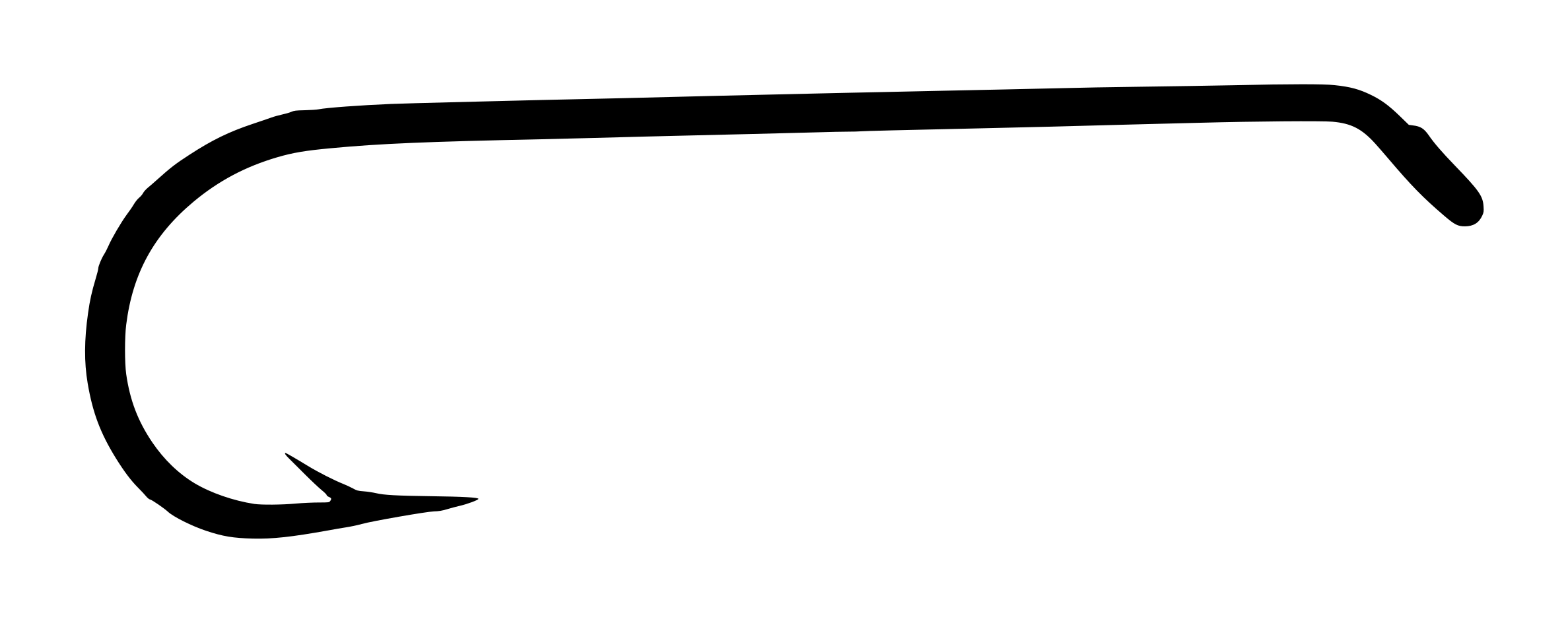
|
Medium Long No. 4 — Nyack Brand Medium Long Sproat | 67% | Compare |

|
S217 No. 2 — S217 Sproat | 67% | Compare |

|
B830 No. 8 — Trout Classic Long | 66% | Compare |
The Mustad 79580 is a legendary 4X-long streamer hook engineered for tying elongated baitfish imitations and large terrestrial patterns. The extended shank provides an ideal canvas for complex wing construction and body materials. This hook became the standard for classic Atlantic salmon streamers and New England-style patterns such as the Gray Ghost and other Rangeley flies. In smaller sizes (10-14), it is equally prized for Woolly Buggers, Zonkers, and articulated streamer patterns. The forged wire and hollow point allow deep penetration in soft-mouthed fish while the tapered eye reduces mass for proper fly flotation in dry presentations and natural presentation in current.
Bucktails, articulated streamers, large terrestrial dry flies (hoppers, crickets)
Gray Ghost, Woolly Bugger, Zonker, Muddler Minnow, Clouser Minnow, Streamer variations
| Hook | Match Quality | Notes |
|---|---|---|
| Mustad Heritage R74 / Signature R74-9672 | Excellent | Direct modern descendant; maintains 4X long shank, forged wire, sproat bend, and tapered eye. Minor differences in point geometry and finish (modern hooks use black nickel or dark anodizing rather than traditional bronzing). |
| Tiemco TMC 5263 | Very Good | Japanese equivalent; 4X long, sproat/parabolic bend, forged wire, tapered eye. Slightly finer wire gauge and sharper point geometry favored by modern competition tyers. |
| Daiichi 1720 | Very Good | Japanese 4X long streamer hook; similar bend and shank length. Lighter wire gauge than Mustad 79580; primarily used for smaller streamer sizes (12-18). |
| Partridge Patriot | Good | English 4X long option; similar applications but heavier wire and slightly different bend profile. More commonly used for Atlantic salmon streamers than trout streamers. |
| Hends 393 | Moderate | Czech 4X long streamer hook; modern formula with slightly different point and eye proportions. Comparable functionality but different aesthetic appeal to vintage enthusiasts. |
Industry cross-reference
2X–3X long shank Woolly Buggers leeches
| Ahrex | TP610Spec record |
|---|---|
| Core | C1280Chart only C2220Chart only |
| Daiichi | 1720Spec record 1750Spec record 2220Spec record |
| Firehole | 618Chart only 811Chart only |
| Fulling Mill | FM2225Chart only |
| Mustad | 9672Full record R73Chart only S82Chart only |
| Orvis | JA1526Chart only |
| Tiemco | 5262Chart only 5263Chart only |
Green entries are full records; amber entries are spec records. Gray entries are chart-only and not physically verified against this specimen.
Rated 4.5/10 — the Mustad 79580 is widely available in original packaging due to mass production and robust survival rates, but size 14 (the specimen measured here) is genuinely scarce in individual dealer stock. Collector demand is moderate to strong among vintage fly-tying enthusiasts, particularly those interested in classic Rangeley-style streamer patterns and New England fly-fishing tradition. The original card format and mid-century Oslo labeling add premium appeal, but lack of barcode and presence of original tissue push value toward the higher end. Limiting factors include the model's later (post-1950) introduction date and continued availability in lesser condition examples.
The Mustad 79580 occupies a middle ground in vintage hook collecting. On one hand, it was mass-produced in enormous quantities by Mustad’s Norwegian factory and is frequently encountered in estate sales and online auctions. Complete 100-count original cards are relatively common, and individual hooks can be obtained inexpensively. On the other hand, pristine original packaging with the classic Oslo-era Key Brand label is increasingly rare as time passes, and collectors specifically seeking the tapered-eye forged version in bronze finish with the eight-line label format (not modern Signature Series branding) view this as a legitimate collectible artifact. The 79580’s association with Carrie Stevens’ Gray Ghost and the broader Rangeley fly-fishing tradition elevates its status beyond that of a generic utility streamer hook.
Size matters significantly: sizes 8-12 are common in dealer stock; sizes 14-16 are moderately scarce; sizes 2-6 and 18+ are genuinely difficult to locate. Complete original packaging in good to excellent condition commands a premium — sealed or near-sealed cards with intact tissue can sell for 50-100% above opened examples. Bronzed finish is standard for this model, making the finish a non-variable; any deviation (japanned, blued, tinned) would indicate a different sub-variant and merits research. The presence of handwriting (size annotations, inventory marks) on original packaging does not significantly diminish value among vintage collectors, who view such marks as authenticating evidence of age and original retail use.
Condition factors affecting value: (1) Hook sharpness and integrity — any bent, dulled, or straightened hooks reduce value significantly; (2) Packaging condition — creasing, toning, and edge wear are acceptable; missing label panels or severe water damage reduce appeal; (3) Original tissue presence — hooks in original tissue command 10-15% premiums over loose hooks; (4) Complete count — a card missing one or more hooks is typically valued 20-30% below full count; (5) Label legibility — fading that obscures key text (model, point type, origin) reduces research and display value. The 79580 is not typically viewed as investment-grade, but rather as a historically significant, readily available collectible suitable for building a focused Mustad collection or a Rangeley-tradition fishing-fly-history archive.
Cardboard slide-box with cream-colored kraft paper label. Label features ornate Art Deco-style floral borders printed in gold and pink/burgundy letterpress. Prominent Key Brand skeleton key logo upper left. Text in pale gold/tan print: 'O. MUSTAD & SÖN / Manufacturers / OSLO – NORWAY / Qual. 79580 / Hollow Point / Mustad-Viking Hooks / [text obscured by specimen] / 100 / No. 10 / [additional text partially visible]'. Bottom corner shows 'No. 100' (quantity indicator). Handwritten pencil annotation '10' on red index tab. Light toning to label consistent with 70+ years of storage. Slide box interior shows light oxidation staining on paper. Original tissue wrapping partially visible. No price marking or barcode. Dimensions approximately 4.5" × 2.75" × 0.5" typical of Mustad retail card format.
Low ($9): Good condition, opened packaging, near-complete hook count (95-100), minor card wear. High ($18): Excellent/Mint condition, sealed or near-sealed original packaging with intact label and tissue, full 100-count. Based on 4 eBay sold listing(s), $8.99–$20.00, avg $13.50 V. eBay market history (Apr 2023–Apr 2026) shows avg sold $12.29, range $2.00–$500.00 (outliers likely reflect lot bundles or rare variants). Premium factors: pristine label legibility, complete original tissue, full hook count, no price markings or damage, early Oslo-era packaging with ornate borders. Platforms: eBay (US and UK), occasional specialist tackle dealer listings. Confidence: V verified against actual sold data; range reflects variance in package condition and completeness. Loose hooks from the same model typically fetch $0.25-$0.50 per hook, suggesting strong packaging premium (500-1000% markup) — vintage collectors prioritize original card format and label authenticity.
eBay US and eBay UK (search 'Mustad 79580' or 'Mustad Viking Hooks'); specialist vintage tackle dealers and online retailers (TackleAuctions.com, Catskill Fly Fishing Center retail sales); European tackle fairs and antique fishing tackle shows (UK, Scandinavia); occasional estate sales and tackle shop clearances. Size 10 specimens are more readily available than sizes 14+ due to production distribution. Complete original cards in good condition appear roughly every 3-4 months on eBay. Expect to pay 30-50% premiums for sealed or near-sealed examples versus opened cards.
Identify authentic Mustad 79580 specimens using the following markers: (1) Eight-line label format with ‘O. MUSTAD & SÖN / Manufacturers / OSLO – NORWAY / Qual. 79580 / Hollow Point / Mustad-Viking Hooks’ text — variations or missing lines indicate later reprints or different models. (2) Key Brand logo (downward-pointing skeleton key with ‘Key Brand’ text) in upper left — this trademark was discontinued c. 1970s-1980s. (3) No barcode (barcode introduction = post-1974; absence strongly suggests 1950s-1960s). (4) Letterpress print quality with visible dot registration and slight ink offset — distinguishes from modern offset printing. (5) Ornate floral border design in gold/pink ink — this specific border is characteristic of Mustad’s 1950s-1960s aesthetic. (6) Cardboard slide-box format (not blister pack or plastic clamshell — those formats date to 1980s+). (7) Hook specifications: forged wire (visible flattening on shank), tapered eye (wire diameter tapers smoothly), parabolic bend (Sproat profile), hollow point (concave inner face visible under magnification), bronzed finish (warm brown lacquer, not black nickel or stainless). (8) Wire gauge: standard for size 10 (approximately 0.020″ diameter) — thinner than modern heavy-wire streamers. Counterfeits or reproductions would show modern printing techniques, barcodes, or incorrect wire geometries.
| Title | Price | Date | Condition |
|---|---|---|---|
| Mustad. 79580. #. 2. Hooks | $12.00 (asking) | active | New other (see details) |
| Mustad R75-79580 - Signature 5x Long Streamer Fly Hook - 50 pack SIZE 8 | $8.99 (asking) | active | New |
| MUSTAD 79580 Fly Hooks size 2, 10, 12, 14, 18 Long Shank Streamer Hooks NIB | $12.99 (asking) | active | New other (see details) |
| Mustad 79580 Size 10 Hooks (100 Pack NOS) | $20.00 (asking) | active | New |
eBay market reference. Researcher-curated. Prices in USD. Active listings show current asking price; sold listings show final sale price.
Store the original Mustad 79580 card in a cool, dry environment away from direct sunlight and moisture. The bronzed lacquer finish is highly durable but will develop surface patina if exposed to humidity — many collectors view this warm darkening as desirable evidence of age and authenticity. Keep the hook card on a flat shelf rather than hanging, as the weight of 100 hooks can gradually warp the cardboard over decades. Do not attempt to remove hooks from the original card unless they will be used for tying — the card itself is a significant component of the artifact’s value and historical provenance. If individual hooks must be removed, use gentle traction with tweezers to avoid bending the shank or point. Store the card away from other metal objects to prevent galvanic corrosion or transfer of oxidation marks. Avoid contact with acidic materials (newspaper, kraft paper without acid-free certification) that can accelerate label degradation. The original tissue wrapping should remain in place; it serves as a protective barrier and adds collector value. If the card shows any signs of mold or moisture exposure, allow it to air-dry in a dry room (not in direct sun or near heat sources), as rapid drying can cause label cracking. Periodic inspection (every 2-3 years) for oxidation or pest damage is recommended for long-term preservation.
The red tab affixed to the packaging bears a handwritten pencil notation of the numeral ’10’, which represents the hook size designation. This annotation appears to be original retail inventory marking, likely applied by a tackle shop employee or distributor upon receipt of the box from Mustad. The style and pressure of the pencil mark, combined with the fading characteristic of pencil lead over 70+ years, indicate this is period-authentic labeling, not a later addition. The presence of such handwritten marks is typical of mid-century retail practice before computerized inventory systems, and serves as authenticating evidence that this box saw actual commercial use in a tackle shop rather than remaining in pristine warehouse storage. The red tab itself is a period-appropriate index marker, consistent with other Mustad packaging from the 1950s-1960s. Such annotations do not diminish collector value — indeed, they enhance the box’s historical narrative by documenting its retail journey.
Source: Mustad Label — A Comprehensive Typology and Decryption of Vintage O. Mustad & Søn Hook Labels (Reference Document)
Applying the eight-line Mustad label system documented in the Mustad Label reference guide: Line 1 states ‘O. MUSTAD & SÖN’ (manufacturer identity, established 1832). Line 2 states ‘Manufacturers’ (distinguishing Mustad as primary producer, not a jobber or repackager). Line 3 states ‘OSLO – NORWAY’ (geographic origin, post-1925 production; Christiania-era labels would indicate pre-1925). Line 4 states ‘Qual. 79580’ (quality/model tier code: 79580 falls in the premium 7xxxx range, indicating specialized, refined hooks). Line 5 states ‘Hollow Point’ (point geometry: concave inner face for rapid penetration with minimal force). Line 6 reads ‘Mustad-Viking Hooks’ (pattern designation: ‘Viking’ denotes Mustad’s premium forged-wire line marketed to professional tyers). Lines 7-8 are partially obscured by the specimen hook itself, but visible text includes reference to ‘T.d. tap. eye’ (Turned-Down Tapered Eye), ‘Bronzed’ (finish), and ‘4 ex. long shank’ (4X-long shank length). The bottom corner specifies ‘No. 100’ (quantity: 100 hooks per box) and ‘No. 10’ (hook size: standard numeric scale, size 10). This label represents the height of Mustad’s marketing sophistication in the postwar era, employing dense technical language to communicate complex specifications across language barriers to international wholesalers and individual anglers.
The Mustad 79580 exists at the intersection of two great fly-fishing traditions: the Norwegian industrial hook-making mastery represented by Mustad’s Gjøvik factory, and the American art of elaborate streamer-fly construction pioneered in Maine’s Rangeley Lakes region. The Rangeley flies — pioneering designs by Carrie Stevens, Theodore Gordon, and subsequent Maine tyers — demanded hooks with extended shanks (3X to 4X long), forged wire for durability under the stress of large patterns, and refined point geometry for clean penetration in soft-mouthed brook trout and landlocked salmon. Mustad’s 79580, introduced in the early-mid-twentieth century, became the gold standard for these patterns because it met all these specifications while remaining affordable and available in quantity. The tapered eye was a subtle but critical innovation, allowing the fly’s head to sit higher on the shank and reducing the forward weight that could cause large dry flies to sink prematurely. The hollow point ensured that even light strikes would set cleanly — essential when fishing delicate 3X or 4X tippets on small streams. By the 1960s, the 79580 had become so synonymous with American streamer tying that entire fly-tying books were organized around this single hook specification, and regional fly-fishing clubs recommended it as the default choice for new tyers entering the tradition.
| P | Photographically verified — Directly observable in the photograph(s) on this page. |
| V | Verified by documentation — Confirmed by manufacturer catalog, spec sheet, or published reference. |
| I | Inferred — A logical deduction from observable or documented evidence, not directly stated. |
| E | Estimated — An approximation based on visual comparison, proportional analysis, or limited data. |
| S | Speculative — A reasoned hypothesis that cannot be confirmed from available evidence. |
Unnotated claims are the compiler’s synthesis; see Sources. All photographs on garrenwood.com are taken on a measurement grid where each square equals 1/10 inch (0.1″ / 2.54 mm).
Your cart is empty.