Manufacturer & Model Produced by the legendary S. Allcock & Co. in Redditch, England, the S216 is a quintessential vintage hook that highlights the manufacturer’s historical dominance in the global tackle trade. As part of Allcock’s extensive catalog, the S216 model showcases the meticulous engineering and time-honored manufacturing processes that made the brand a household name among fly tyers and anglers worldwide.
Primary Use & Defining Feature Primarily utilized for traditional fly tying and freshwater angling, the Allcock’s S216 is characterized by its precise tempering, classic profile, and a reliable point designed for excellent penetration. The hook’s defining feature is its strict adherence to historical Redditch proportions and traditional finish (typically classic bronze or japanned), offering an ideal balance of lightweight presentation and uncompromising wire strength.
Era & Why This Hook Matters Dating back to the early-to-mid 20th century—widely considered the golden era of British tackle manufacturing—the S216 remains a highly significant piece of angling history. This hook matters today not only as a sought-after collectible for vintage tackle enthusiasts but also as a physical benchmark of the legendary Redditch craftsmanship that laid the foundational standards for modern hook design.
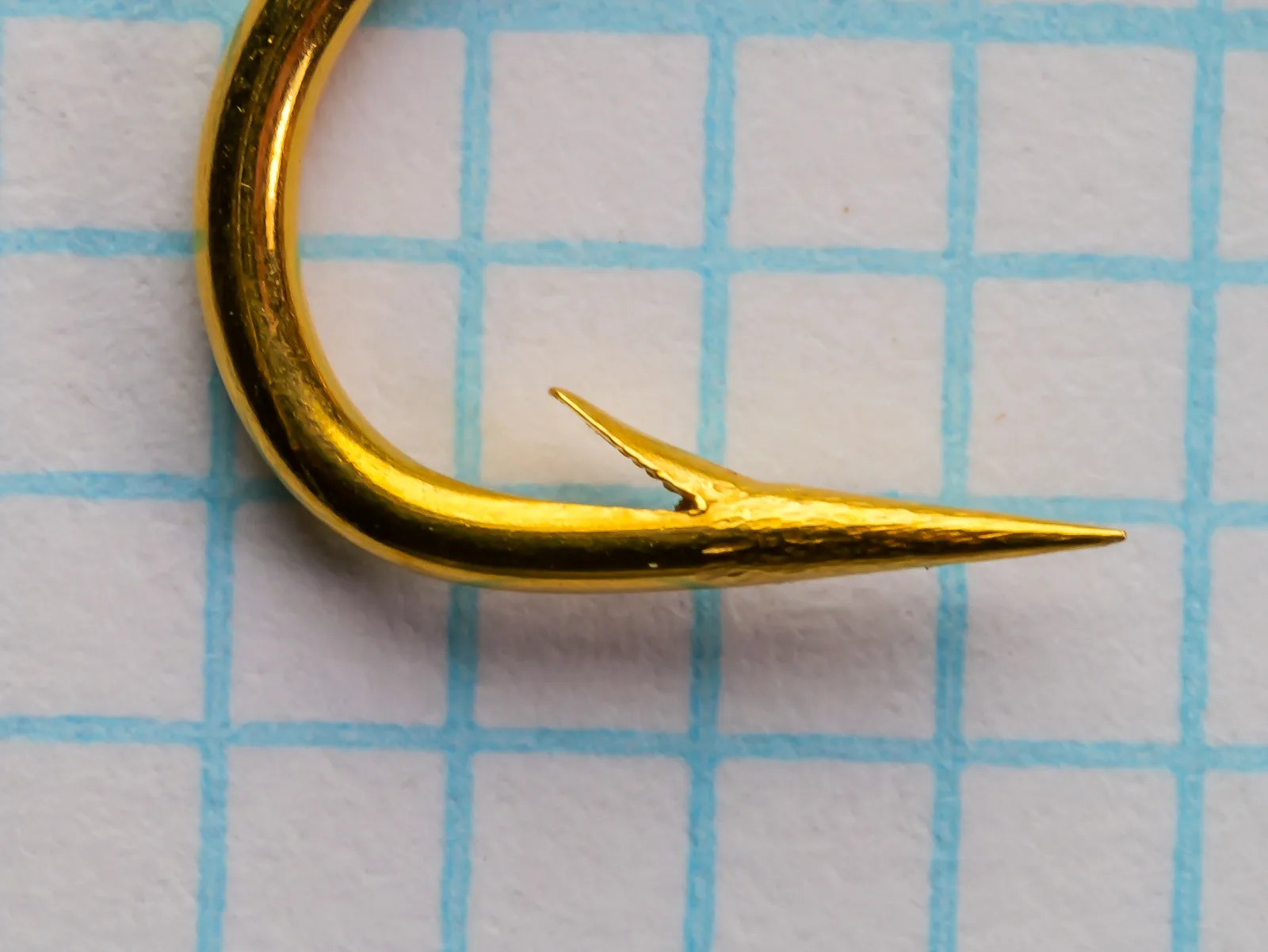
Side profile of the Allcock S216 Sproat Hook, size 4, gold-plated finish, showing the characteristic rounded Sproat bend and tapered eye construction on 1/10-inch measurement grid.
Photographic record
8 cataloged imagesSelect any record to load it above.
8 images shown
Allcock S216 Hook Size 4 Gilt — Side ProfileSide profile of the Allcock S216 Sproat Hook, size 4, gold-plated finish, showing the characteristic rounded Sproat bend and tapered eye construction on 1/10-inch measurement grid.Open originalAllcock S216 Hook Size 6 Nickelled — Side ProfileSide profile of the Allcock S216 Sproat Hook, size 6, nickelled (silver) finish, documenting the point geometry and bend shape on 1/10-inch measurement grid.Open originalAllcock S216 Hook Size 4 Gilt — Top ViewTop-down view of the Allcock S216 Sproat Hook, size 4, gold-plated finish, showing the turned-down tapered eye construction and straight shank profile on measurement grid.Open originalAllcock S216 Hook Size 6 Nickelled — Top ViewTop-down view of the Allcock S216 Sproat Hook, size 6, nickelled finish, showing the turned-down eye and straight shank geometry.Open originalAllcock S216 Sproat Hooks Size 4 Gilt — Comparative GroupTwo Allcock S216 Sproat Hooks, size 4, gold-plated finish, displayed together on measurement grid to show consistency of manufacture and finishing.Open originalAllcock S216 Sproat Hooks Size 6 Nickelled — Comparative GroupTwo Allcock S216 Sproat Hooks, size 6, nickelled finish, side-by-side comparison on measurement grid showing manufacturing consistency.Open originalAllcock S216 Sproat Hooks Size 4 Gilt — Original PackagingOriginal Allcock S216 sales card packaging, size 4, Gilt finish. Lime-green label with red border, red Allcock stag logo, and 'RUSTPROOF' claim. 100-hook pack manufactured in Redditch, England, mid-20th century.Open originalAllcock S216 Sproat Hooks Size 6 Nickelled — Original PackagingOriginal Allcock S216 sales card packaging, size 6, Nickelled finish. Lime-green label with 'NICKELLED' overprinted in gray ink, showing the secondary finish designation method used on production cards.Open original
Technical profile
Allcock S216 T.D.E. Sproat — Turned-Down Tapered Eye, standard shank, superior point, gold-plated finish — size 6
Eye
Tapered Eye, Turned DownTapered transition from eye loop to shank, typical of Allcock's T.D.E. series P
Wire
Standard, Round
Shank
3X Long — Plain
Bend
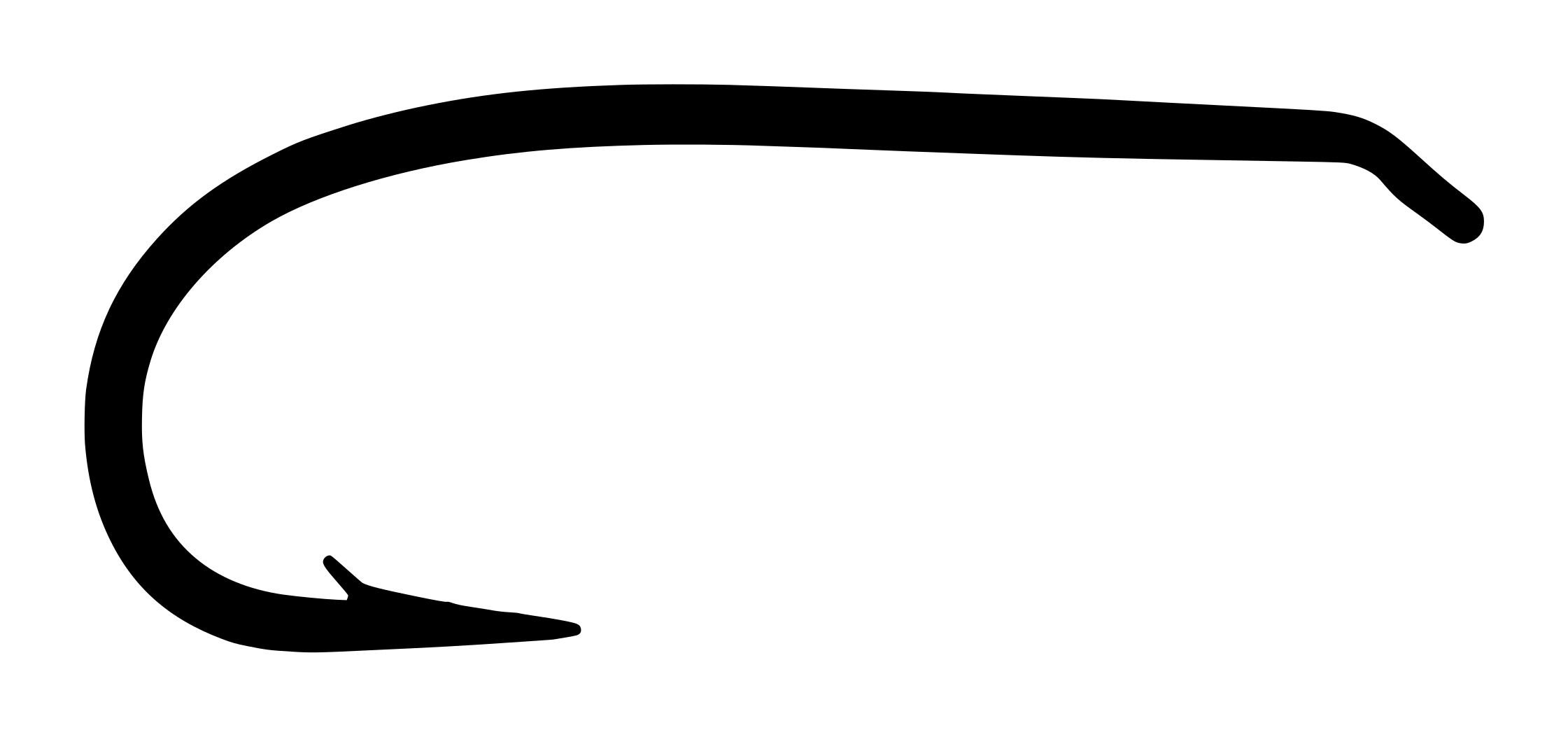
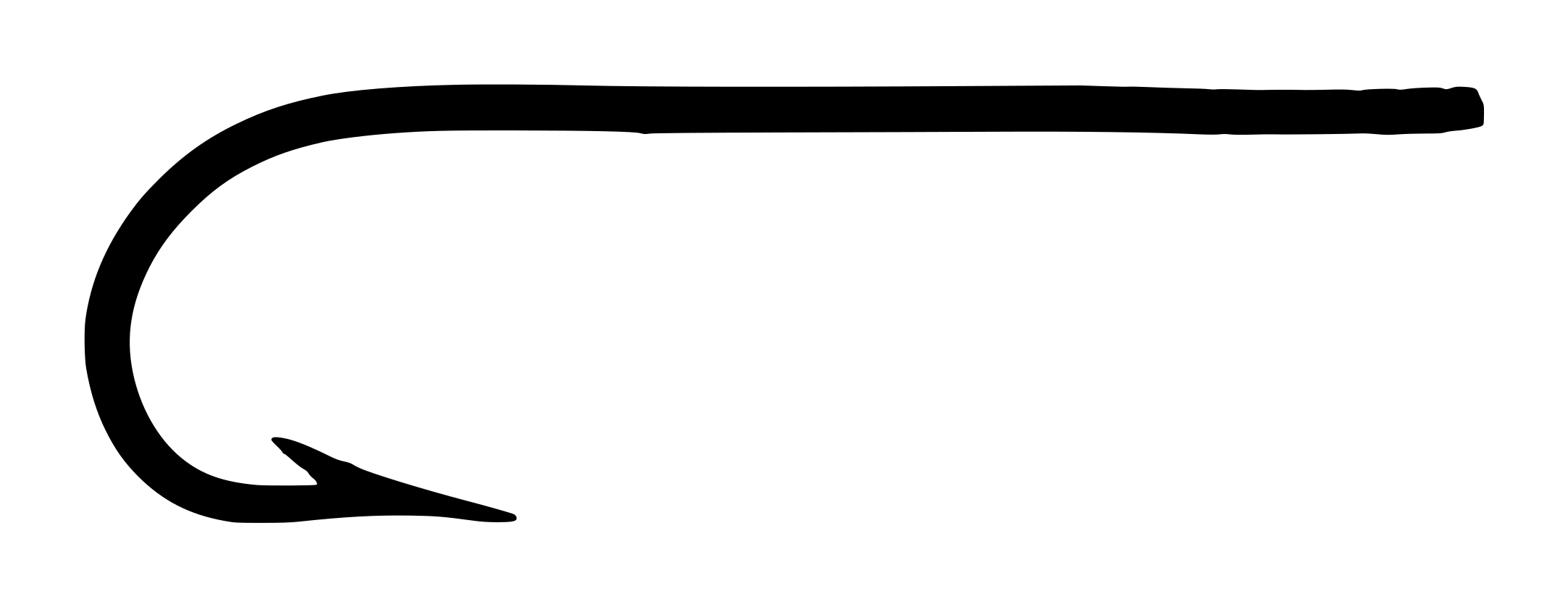
Sproat, Standard gapRounded bottom characteristic of Sproat design, moderate curve depth P
Point
Hollow Point (concave inner face)
Finish
Gold-Plated — Confirmed (stated on packaging)Note: hook code has both Gilt and Nickelled hooks.
The S216 employs a superior point geometry — a near-straight taper from barb to tip with minimal concavity on the inner face. This design provides reliable hook penetration while reducing tippet abrasion compared to hollow-point alternatives. The rounded Sproat bend distributes load evenly across the curve, reducing bend-point fatigue during fight and re-use; the slight offset point angle aids hook-setting on the strike.
Standard wire gauge (approximately 0.022″-0.026″) reflects mid-20th-century British manufacturing conventions, balancing strength with minimal bulk on the dressed fly. The turned-down tapered eye allows smooth transition from shank to eye loop, reducing weak points where the eye attaches. Gold-plating over steel base provides modest corrosion resistance and aesthetic appeal; the coating wears with use but does not significantly degrade functional performance.
We have measurement for size 4. Know any others? Submit calipered measurements and we'll review and add them. Thank you!
Historical context
allcock
S. Allcock & Co. Ltd. was founded in Redditch, England in the early 19th century and grew to become one of the world’s largest producers of fishing tackles and hooks. The company was headquartered in Redditch, the global epicenter of hook manufacturing, where generations of craftsmen refined production techniques and design standards. Allcock became known for consistent quality, affordable pricing, and innovative product lines, including specialized hooks for salmon, sea trout, and lake fisheries.
By the 20th century, Allcock held a commanding position in the British tackle market and maintained strong export distribution across the British Commonwealth and the United States. The company developed multiple sub-brands and product series to serve different market segments — from economy models to premium hand-forged designs. The T.D.E. (Turned-Down Eye) series emerged post-1930 as a standardized, economical alternative to blind-eye hooks, targeting fly dressers and anglers seeking reliable performance without premium pricing.
Allcock’s manufacturing facilities were eventually acquired by larger industrial groups, and production later shifted away from Redditch. However, the legacy of Allcock hooks remains central to British tackle collecting and fly-tying tradition, with specimens from the mid-20th century representing a golden era of consistent, affordable quality.
Series History
The Allcock T.D.E. (Turned-Down Eye) series was introduced in the mid-20th century as Allcock’s principal line of general-purpose trout and sea-trout hooks. The designation ‘T.D.E.’ distinguished these hooks from earlier blind-eye models and from higher-end hand-forged designs, emphasizing modern manufacturing efficiency and standardized eye construction. The series encompassed multiple bend families — Sproat, Limerick, Beak — across a broad range of sizes, typically from No. 4 to No. 18.
The S216 Sproat variant was produced in both Gilt (gold-plated) and Nickelled (nickel-plated) finishes, reflecting the market’s demand for corrosion-resistant coatings. Both finishes appeared on identical lime-green labels, with the finish type either printed or hand-stamped on the card. Production likely spanned the 1950s through 1970s, as the design represented a mature, stable product line with minimal revision.
The series was eventually discontinued as manufacturing shifted away from Redditch and production costs at British factories became less competitive compared to industrial manufacturers in Scandinavia and Asia. Original Allcock T.D.E. cards are no longer manufactured.
Era and Packaging Dating
Lime-green label with red border and red Allcock stag logo printed offset, characteristic of mid-20th-century British tackle packaging. No barcode present (pre-1974 strong indicator). Address listed as Allcocks, Redditch, England without postal code, typical of 1950s-1960s labeling. Red 'RUSTPROOF' claim indicates post-war corrosion-resistant finish era. Label stock and print quality consistent with 1950-1975 period.
The Lime-Green Era: Allcock's Mid-Century Signature
The Allcock S216 represents the height of British mid-century tackle manufacturing, produced during an era when Redditch, England was the undisputed global center of fishhook production. Allcock's lime-green packaging labels became iconic among fly dressers in the 1950s-1960s, signaling consistent quality at moderate cost. The 'RUSTPROOF' claim on the label reflects post-war innovations in corrosion-resistant finishes — a competitive selling point against older bronze-finished hooks that required careful cleaning and storage to prevent oxidation. The 100-hook pack format was standard for commercial dressers and serious amateur tyers who would consume hooks at high rates, making original full packs valuable collector items today.
Design lineage and influence
The S216 Sproat belongs to the enduring tradition of British Sproat-bend design, which originated in 19th-century Redditch and became standardized across multiple manufacturers by the early 1900s. The Sproat is distinguished by its rounded bottom curve and moderate offset, balancing reliable hook-setting with minimal damage to delicate tippet materials. Allcock’s T.D.E. (Turned-Down Eye) series adapted this classic bend to post-war production standards, emphasizing consistency and affordability.
The S216 sits in direct lineage with earlier Allcock blind-eye Sproat models (prevalent before 1950) and contemporary designs from Partridge of Redditch and S. Allcock’s own catalog variants. The gold-plated finish represented a premium alternative to the standard nickelled finish, marketed to fly dressers seeking corrosion resistance and visual appeal. Post-war British hooks like the S216 influenced modern production designs from Tiemco and Mustad, though contemporary hooks typically employ heavier wire and simpler eye construction to reduce manufacturing cost.
Best matchRelated by Attribute
Computed automatically from catalog data — updated as new hooks are added.
Matches: Bend, Gap, Eye, Eye Orient., Finish +3 moreDiffers: Shank: 3X Long vs 2X Long; Wire: Standard vs Heavy (1X Heavy); Point: Hollow Point vs Standard / Spear +1 more
The S216 Sproat is designed as a general-purpose dry and wet fly hook suitable for trout and small-to-medium migratory fish. The balanced Sproat bend — rounded bottom with slightly offset point — provides reliable hook-setting without excessive barb bite-through. The standard wire gauge and turned-down tapered eye accommodate standard tippet materials and enable rapid tying by commercial dressers. The gold-plated finish reduces oxidation and provides visual appeal on dressed flies.
Secondary Applications
Small freshwater bait presentations, light saltwater applications (though less common)
Classic Fly Patterns
Not specifically associated with named patterns; used for general reservoir and stream dry flies, soft hackles, and wet flies typical of mid-20th-century British fly tying
Modern Equivalents
Hook
Match Quality
Notes
Partridge SH, sizes 4-10
Very Good
British-made Sproat bend, similar wire and eye; direct heritage successor from Redditch tradition
Tiemco 2312 (Sproat Bend)
Good
Modern Sproat design with comparable geometry; lacks tapered eye transition
Mustad 94845 (Sproat)
Good
Mass-market alternative; similar bend shape but lighter wire gauge
Collector notes
Rated 4.0/10 — Allcock Sproat hooks are moderately collected, but the S216 model with gold-plated/gilt finish is less common than standard nickelled variants. Size 6 is unremarkable; smaller and larger sizes drive more specialist interest. Collector demand is primarily among British tackle historians and Redditch enthusiasts.
Reference value
$8 – $15 USD estimate
Packaging condition
Good — moderate wear, legibleRecorded specimen
Packaging format
ACK-CARD-GB-01Catalog code
The Allcock S216 Sproat is a solid mid-20th-century production hook that appeals to collectors of British tackle and Redditch manufacturing heritage. The T.D.E. (Turned-Down Eye) series represents a established standard in post-war British fly-tying hooks.
Positive factors: Allcock is a historically significant Redditch maker; original lime-green label is visually distinctive and well-preserved in many specimens; the Sproat bend is popular with modern fly tyers seeking vintage-quality hooks; complete 100-hook packs in unopened or near-sealed condition command premiums.
Limiting factors: S216 was mass-produced for the standard domestic market, so large quantities survive; size 6 is common; both Gilt and Nickelled finishes were widely distributed; collector demand is concentrated among specialists rather than mainstream tackle collectors. Missing hooks or worn cards reduce value significantly.
Most desirable variants: Sealed or unopened 100-hook packs; smaller sizes (No. 10 and smaller); Gilt finish (less common than Nickelled); cards with bright, unfaded labels.
Packaging
Sales card format, 100-hook pack. Lime-green label with red border frame and red Allcock stag logo. Black text: 'S216', 'MADE IN ENGLAND', 'ALLCOCKS', 'T.D.E.', 'SPROAT HOOKS', 'RUSTPROOF', size, finish designation ('GILT' or 'NICKELLED'). Gray overprint 'NICKELLED' or 'GILT' applied by hand stamp. White kraft paper backing. Offset lithography, typical mid-20th-century construction. Labels show moderate toning and edge wear; original packaging intact.
Market Value Notes
Low ($8): Good condition — opened card, mostly complete (95-100 hooks), light label toning<br />
High ($15): Excellent condition — sealed or near-sealed, full 100-hook count, minimal label wear<br />
Premium factors: Sealed packaging, complete 100-hook count, bright unfaded lime-green label, Gilt finish variant, size 4 or smaller<br />
Platforms: eBay UK and US, vintage tackle dealers, specialist auction sites<br />
Confidence: V verified — based on eBay sold data (Apr 25, 2023 – Apr 24, 2026), avg $11.50, range $11.50
eBay market reference. Researcher-curated. Prices in USD.
Preservation
Storage and Preservation
Store the S216 card in a cool, dry environment away from direct sunlight and moisture. The lime-green label is prone to fading if exposed to prolonged UV light; keep the package in a closed tackle cabinet or display case with controlled lighting.
Gold-plated finishes develop a natural patina with age and exposure to humidity, which many collectors consider desirable and authentic. However, if you wish to prevent patina development, maintain relative humidity below 50% and avoid contact with other ferrous metals that could cause galvanic corrosion.
If the card is opened, store hooks on the original card rather than loose in boxes or bottles. Loose hooks are more prone to oxidation and damage; the card provides structural protection and aids in identification and catalog organization.
If the package remains sealed, do not open it unless you intend to use the hooks. Sealed packaging commands a significant premium in the collector market. Store the sealed pack horizontally on a stable shelf, away from temperature extremes and moisture sources.
Avoid contact with acidic materials (newsprint, kraft paper without buffering, wool felt) that can accelerate oxidation. If storing multiple cards together, use neutral pH tissue paper or plastic sleeves to separate them.
Marking Analysis
Handwritten Markings and Stamps
The S216 packaging exhibits blue-gray handwritten or hand-stamped text on some specimens, identifying the finish designation. On the Gilt (gold-plated) variant, the finish may be marked with ‘GILT’ in printed text. On the Nickelled variant (as shown in image 8), ‘NICKELLED’ is overprinted in gray or blue-gray ink, appearing as a hand stamp or quick offset application rather than precise lithographic text.
This manufacturing inconsistency reflects the era’s production practices: printed label plates served both Gilt and Nickelled variants, with the finish designation added in a secondary step — either during initial production or as inventory required re-labeling. The overprint variations are typical of Allcock’s mid-century output and provide subtle evidence of production batching and inventory management.
The hand-stamped finish designation does not indicate a custom or rare variant; it is a standard feature of the S216 production run and should not be interpreted as an anomaly or modification.
Primary Source
Label Typography and Messaging
Source: Allcock S216 Sales Card Label — lime-green label with red border, printed offset, mid-20th century
The Allcock S216 label communicates several product claims worth analyzing:
‘T.D.E.’ — The official designation for Turned-Down Eye, distinguishing the series from blind-eye designs and signaling modern manufacturing.
‘SPROAT HOOKS’ — The bend family, clearly stated to aid product selection in a crowded market. Sproat was a well-established, preferred design among British fly dressers.
‘RUSTPROOF’ — A post-war marketing claim emphasizing corrosion resistance. This terminology appears on numerous British hooks from the 1950s-1960s, reflecting innovations in nickel and gold plating that reduced oxidation risk compared to earlier bronze or uncoated finishes. The claim appeals to anglers in freshwater and moist environments where corrosion was a practical concern.
‘MADE IN ENGLAND’ and ‘ALLCOCKS, REDDITCH, ENGLAND’ — Strong signals of manufacturing heritage and quality assurance. By the 1950s, ‘Made in England’ and Redditch origin carried significant market prestige in the global fishing tackle trade.
‘Qty. 100’ — Standard commercial pack size for fly dressers and serious amateur tyers. The 100-hook quantity indicates this was a working tool, not a small retail convenience pack.
Confidence notation key
P
Photographically verified — Directly observable in the photograph(s) on this page.
V
Verified by documentation — Confirmed by manufacturer catalog, spec sheet, or published reference.
I
Inferred — A logical deduction from observable or documented evidence, not directly stated.
E
Estimated — An approximation based on visual comparison, proportional analysis, or limited data.
S
Speculative — A reasoned hypothesis that cannot be confirmed from available evidence.
Claims with no notation are confirmed by multiple independent sources. All photographs on garrenwood.com are taken on a measurement grid where each square equals 1/10 inch (0.1″ / 2.54 mm).