The Allcocks S222 is a mid-20th-century Sproat pattern fly hook manufactured in Redditch, England, bearing the signature Turned-Down Tapered Eye (T.D.E.) construction that defined Allcocks’ premium line from approximately 1948 through the 1970s. This size 6 specimen is nickelled (confirmed on original packaging) with standard wire gauge suitable for dry flies, wet flies, and small nymphs — a general-purpose trout hook from the era when British hook makers dominated the market.
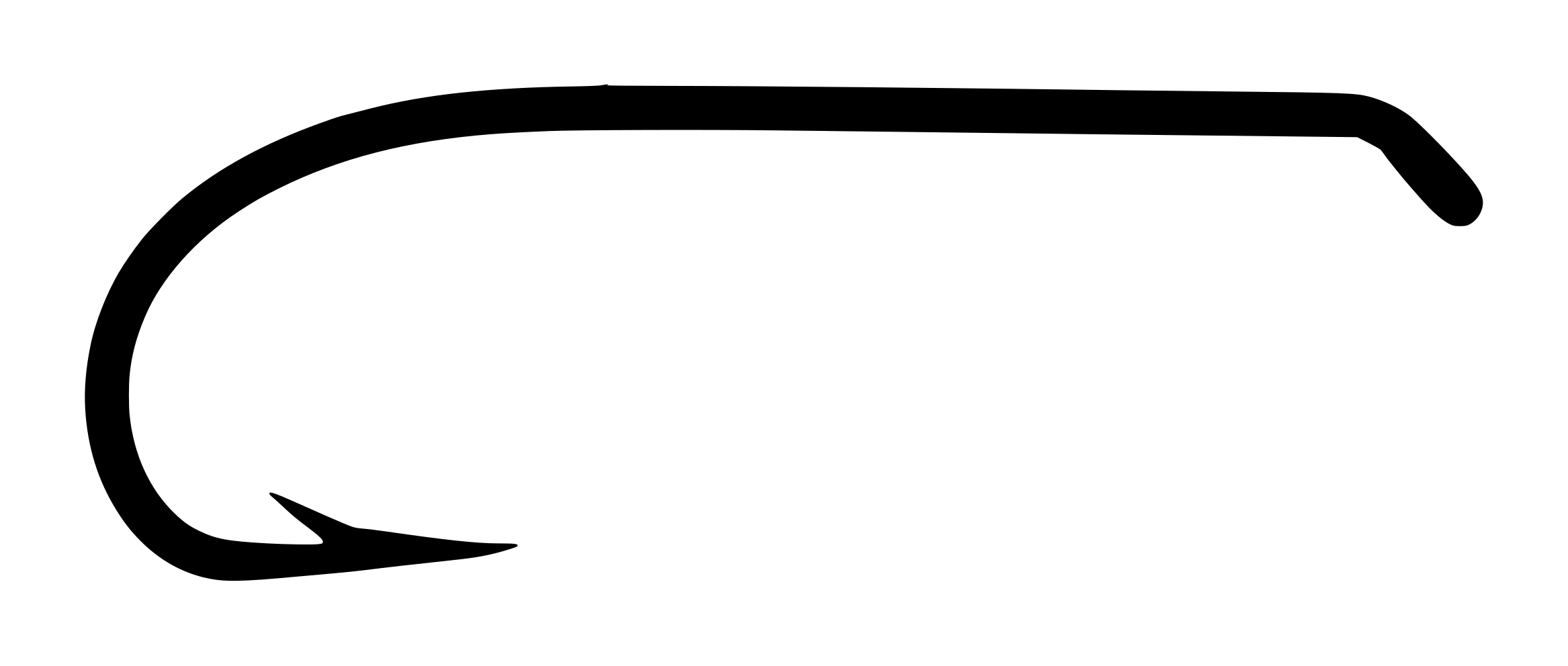
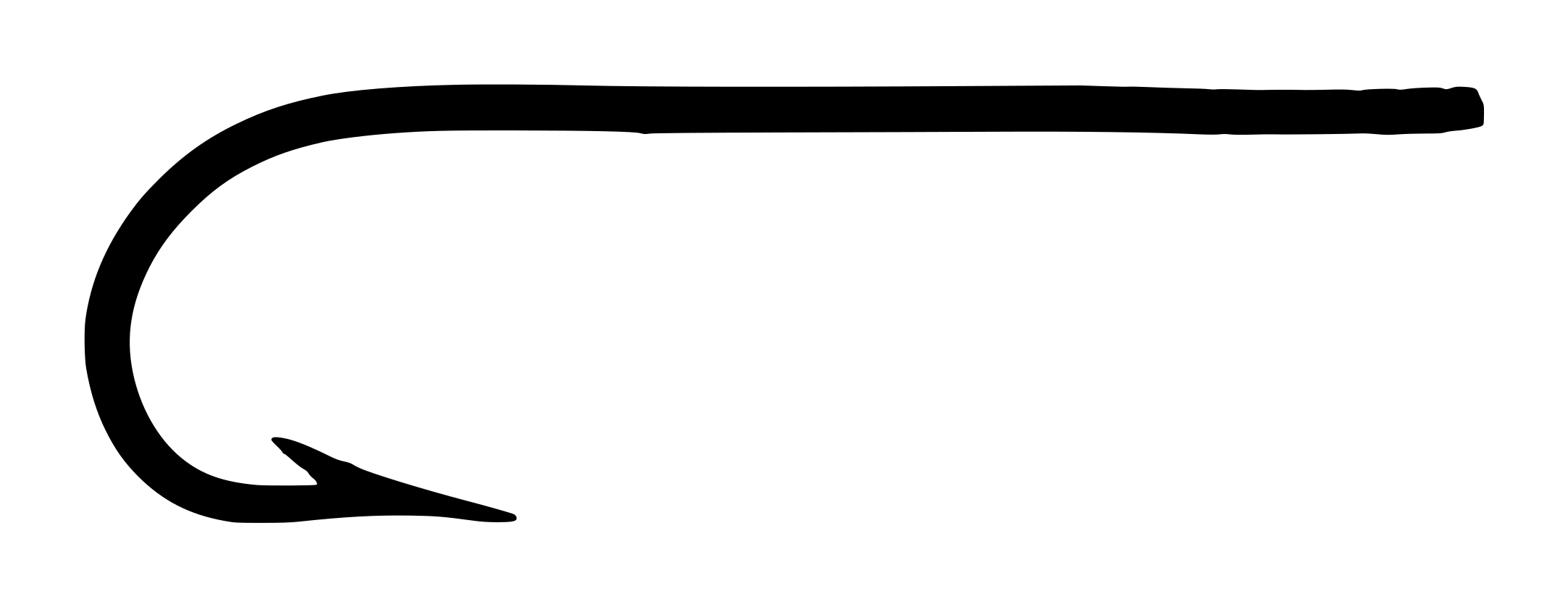
The defining feature is the smooth, tapered eye ring that transitions gradually from ring to shank, eliminating the bulk of earlier blind flatted (spade) eye designs. The Sproat bend provides a rounded bottom with good strength characteristics and balanced fly-holding — a popular profile that sits between the very open Aberdeen and the more angular Limerick.
Era dating is supported by multiple packaging indicators: bright lime-green card stock with offset printing typical of 1950s-1970s retail design, absence of barcode (pre-1974), Allcocks’ T.D.E. marketing terminology (primary c. 1948-1975), and hand-written size notation in period blue ink. The card shows characteristic age toning consistent with 50+ years of storage.
Collecting significance: Complete original packaging cards of Allcocks T.D.E. series hooks are moderately scarce, particularly in sizes 6-8 where fly-fishing demand was highest and survival in complete lots is less common. The S222 represents solid mid-century British craftsmanship and the last generation of hooks before Japanese manufacturers displaced independent Redditch makers.
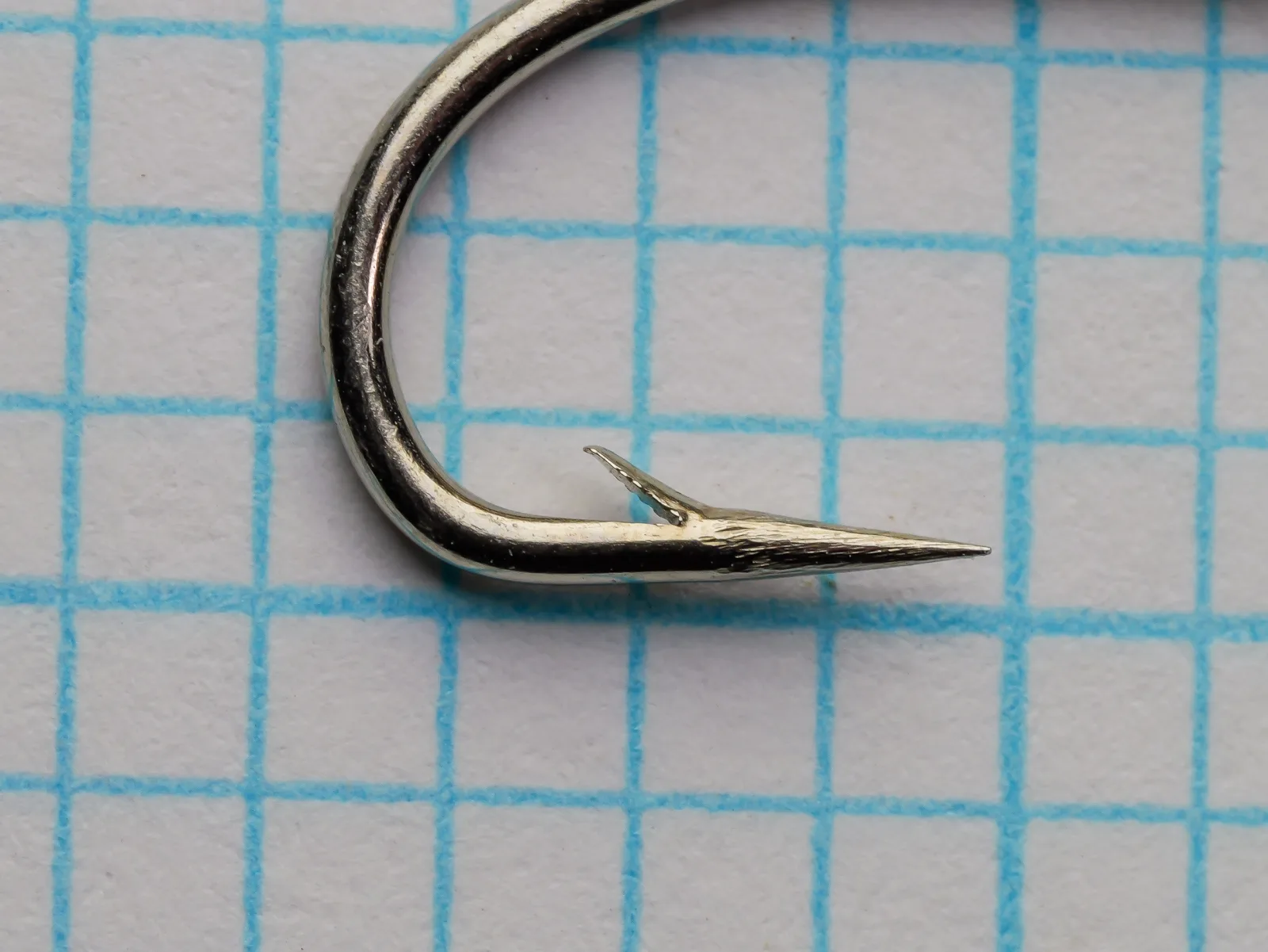
Side profile of the S222 showing the distinctive rounded Sproat bend with superior point taper. The turned-down tapered eye is visible at the hook ring. Nickelled finish displays characteristic cool silver-grey tone. Photographed on 1/10-inch measurement grid.
Photographic record
4 cataloged imagesSelect any record to load it above.
4 images shown
Allcocks S222 Size 6 Sproat — Side ProfileSide profile of the S222 showing the distinctive rounded Sproat bend with superior point taper. The turned-down tapered eye is visible at the hook ring. Nickelled finish displays characteristic cool silver-grey tone. Photographed on 1/10-inch measurement grid.Open originalAllcocks S222 Size 6 — Full Shank and EyeFull length view of the S222 showing the tapered eye ring smoothly transitioning from eye to shank, characteristic of the T.D.E. construction. The shank appears plain with no ridging or baitholder barbs. Nickelled finish is uniform throughout.Open originalAllcocks S222 Size 6 — Multiple SpecimensTwo S222 hooks shown together for size reference and consistency verification. Both specimens display identical Sproat geometry and uniform nickelled finish, demonstrating manufacturing consistency across the lot.Open originalAllcocks S222 Packaging Label — Size 6 Sproat HooksOriginal sales card label showing model code S222, manufacturer information 'Allcocks, Redditch, England,' and key specifications. The bright lime-green card with red/orange border is characteristic of 1950s-1960s British tackle retail packaging. Handwritten size marking '6' and inventory notation '24' are visible.Open original
Technical profile
Eye
Tapered Eye, Turned DownTapered turned-down eye with smooth taper from eye ring to shank, characteristic of Allcocks TDE construction P. No flatting or spade end visible.
Wire
Standard, Round
Shank
3X Long — Plain
Bend
Sproat, Standard gapRounded bottom bend typical of Sproat pattern. Symmetrical, well-formed, moderate depth relative to wire gauge P.
Point
Standard / SpearStandard close-cut barb placed slightly back from the point taper, angled inward P.
Finish
Nickelled / Nickel-Plated — Confirmed (stated on packaging)Cool silver-grey tone consistent with nickel plating. Mirror-like reflectivity visible throughout specimen. Finish uniform with no warm brown tones P.
Specimen hooks are bright with no corrosion or pitting. Eye and point retain sharp definition with minimal wear. Card shows characteristic age toning on wrapper and light foxing, but structure remains sound. Two hooks visible in detail photographs show uniform hook quality throughout lot.
The S222 employs a standard round-wire forging process typical of mid-century Redditch production. The Sproat bend is formed by upsetting and bending the hot wire, creating a rounded bottom with symmetrical radius. Unlike the Limerick, which concentrates stress at angular corners, the Sproat distributes bending stress more evenly across the bend arc, reducing the likelihood of fracture under load.
The superior point (near-straight inner taper) provides reliable penetration without the hollow-point’s concave geometry. The standard wire gauge (approximately 0.025″-0.028″ diameter) balances strength for general trout fishing with fine enough dimensions to minimize disturbance of small flies.
The turned-down tapered eye is a manufacturing refinement: the wire is drawn down smoothly from the eye ring to the shank, reducing bulk at the eye and allowing cleaner fly attachment. This contrasts with ball-eye construction, which adds volume to the eye ring itself. The tapered approach was Allcocks’ signature in this era.
Nickel plating provides corrosion resistance superior to blued or japanned finishes, making the S222 suitable for extended freshwater use without degradation. The plating process involves electrodeposition of nickel over a base steel forging, resulting in the characteristic cool silver-grey tone and reflectivity.
We have measurement for size 6. Know any others? Submit calipered measurements and we'll review and add them. Thank you!
Historical context
allcock
S. Allcock & Co. was founded in the early 19th century in Redditch, England, and grew to become one of the largest hook manufacturers in the British Isles. Like other Redditch makers, Allcocks benefited from the town’s concentration of expertise, water power, and established trade networks. The company manufactured not only hooks but also fishing tackle, reels, lines, and related equipment, making it a comprehensive supplier to the British and international angling trade.
Allcocks’ manufacturing process during the mid-20th century followed traditional Redditch methods: forging from wire stock, hand-finishing, and quality control through visual inspection and spot-checking. The company maintained strict standards for eye construction, point geometry, and finish application — standards evident in the precise T.D.E. tapers visible on surviving specimens.
The introduction of the T.D.E. (Turned-Down Eye) series circa 1948 represented Allcocks’ strategic move to modernize its product line and compete with rivals like Partridge of Redditch and H. Milward & Sons. The T.D.E. construction was marketed as a premium refinement, particularly for dry-fly fishing where precise eye geometry affects fly balance.
Allcocks operated its main works in Redditch throughout the 20th century. The company exported hooks worldwide, with particular strength in Commonwealth markets (Australia, New Zealand, India) and North American tackle shops. By the 1960s, however, Japanese manufacturers began capturing market share with lighter wires and specialized patterns, and Allcocks’ share of the global market gradually declined. The company continued operations into the 1990s before eventually ceasing hook production, a fate shared by virtually all independent British hook makers.
Series History
The Allcocks T.D.E. (Turned-Down Eye) series was introduced circa 1948 and gained prominence through the 1950s and 1960s as Allcocks’ response to changing preferences in dry-fly design. Earlier Allcocks hooks (1920s-1940s) relied heavily on blind flatted eyes (spade ends), which were the standard in British salmon and trout fishing of that era. The T.D.E. line represented a modernization: the tapered eye offered cleaner fly presentation, reduced wire at the eye ring, and a more streamlined profile suitable for small delicate patterns.
The S222 Sproat was one of several Sproat variants within the T.D.E. series, alongside the S220 (earlier designation) and S223 (possibly a variant with different wire weight or size range). The series also included variants in other bends: Aberdeen (S225), Limerick (S224), and specialty patterns. All shared the same Turned-Down Eye construction and nickelled or blued finishes.
Production of the T.D.E. series remained steady through the 1950s-1970s, with the bright lime-green packaging introduced circa 1950 replacing earlier kraft-paper cards. By the 1970s, however, the series began to decline as British hook makers faced competition from Japanese manufacturers and a shift toward lighter-wire, specialized designs. The S222 was eventually discontinued, though exact discontinuation date is not documented in surviving catalogs.
The series survives today primarily as collectible specimens. Complete original packaging cards are highly sought by British hook historians and vintage fly-tying enthusiasts, particularly cards with intact hook counts and minimal damage to the printed graphics.
Era and Packaging Dating
Packaging evidence: (1) Bright lime-green card stock with red/orange border and serif typography typical of 1950s-1970s British retail packaging, distinct from earlier Art Deco or later minimalist design. (2) Offset printing method with multi-color registration visible on card edges — established standard for mid-century mass production. (3) No barcode present — strong indicator of pre-1974 manufacture, as UPC barcodes became mandatory on UK packaging in 1974-1976. (4) Qty. 100 notation in bold — standard bulk-card format of the 1950s-1960s before individual packaging became common. (5) Allcocks, Redditch address printed without postal code — postal codes were introduced to UK in phases 1959-1974, and their absence suggests early-to-mid period. (6) T.D.E. branding (Turned-Down Eye) was Allcocks' primary marketing focus 1948-1970s. Conclusion: circa 1950-1975, most likely 1955-1970 based on card construction and printing method.
The Redditch Golden Age
The Allcocks S222 was manufactured during a golden age of Redditch hook making, when the English town was the undisputed center of global hook production. Allcocks shared Redditch with Partridge, H. Milward & Sons, Edgar Sealey, and John James — five major makers all within walking distance of one another, each with their own distinctive designs and loyal following. The T.D.E. line represented Allcocks' direct answer to the blind-eye hooks that dominated dry-fly fishing in the 1930s-1940s. By the 1960s, however, Japanese manufacturers like Tiemco were beginning to displace British makers with lighter wire and more specialized profiles. The S222, with its solid mid-century engineering, eventually became a relic of that pre-industrial era — yet collectors prize it today precisely because it represents the last flowering of the Redditch tradition before offshore manufacturing took hold.
Design lineage and influence
The Sproat bend traces its origins to the 19th-century Redditch tradition and gained particular favor in late Victorian and Edwardian fly-fishing. The rounded bottom of the Sproat offers a compromise between the very open Aberdeen bend and the more angular Limerick — it provides good fly-holding characteristics without the extreme sweep of the Aberdeen or the stress concentration of sharp corners in the Limerick.
Allcocks’ adoption of the T.D.E. (Turned-Down Eye) construction in the mid-20th century represented a refinement of earlier blind-eye patterns. The tapered eye replaced the flatted or spade eye of Edwardian-era hooks, offering better fly presentation and reduced material at the eye ring. The S222 sits within Allcocks’ broader T.D.E. Sproat family, which was sold as a premium alternative to their blind-eye offerings.
The S222 competed directly with Partridge of Redditch’s similar Sproat patterns and later with Japanese imports from Tiemco and Daiichi. The model remained in production through the 1960s-1970s before being displaced by lighter wire and more specialized profiles.
Best matchRelated by Attribute
Computed automatically from catalog data — updated as new hooks are added.
Matches: Bend, Gap, Eye, Eye Orient., Point +3 moreDiffers: Shank: 3X Long vs 2X Long; Wire: Standard vs Heavy (1X Heavy); Finish: Nickelled vs Gold-Plated +1 more
Matches: Bend, Gap, Eye, Eye Orient., Point +3 moreDiffers: Shank: 3X Long vs 2X Long; Wire: Standard vs Heavy (1X Heavy); Finish: Nickelled vs Bronzed +1 more
Matches: Bend, Wire, Gap, Point, Forging +2 moreDiffers: Shank: 3X Long vs 2X Long; Eye: Tapered Eye vs Ball Eye; Eye Orient.: Turned Down vs Straight / Inline +2 more
The S222 Sproat is a general-purpose trout fly hook suited to dry flies, wet flies, and small nymphs. The standard wire gauge and modest shank length make it ideal for patterns requiring a balanced profile without excessive hook weight. The turned-down eye and tapered construction are characteristic of the Allcocks T.D.E. (Turned-Down Eye) line, which gained prominence in British fly-fishing during the mid-20th century.
Classic Fly Patterns
Standard dry fly patterns (March Brown, Greenwell's Glory, Wickham's Fancy), small wet flies (Butcher, Teal series), and nymph imitations in sizes 8-14
Modern Equivalents
Hook
Match Quality
Notes
Tiemco TMC 100
Very Good
Standard dry fly hook, tapered eye, similar wire gauge and shank length profile to the S222
Daiichi 1180
Good
General-purpose dry fly hook with comparable geometry, though eye construction differs
Mustad C49S
Moderate
Sproat bend in modern production, but heavier wire and less tapered eye than vintage S222
Collector notes
Rated 4.5/10 — Moderately uncommon. Complete original packaging cards of Allcocks T.D.E. series are genuinely scarce, particularly with full hook counts intact. However, the hook itself is a common general-purpose trout pattern with moderate collector demand primarily from British hook historians and vintage Redditch specialists. The principal limiting factor is that many surviving cards have missing hooks or damaged packaging. Size 6 is more collectable than larger sizes, as smaller trout hooks were harder on equipment and less likely to survive complete in original packaging.
Reference value
$12 – $35 USD estimate
Packaging condition
Very Good — light wear, fully legibleRecorded specimen
Packaging format
AC-E-S222-100Catalog code
What Makes This Collectible: Allcocks was a major Redditch maker with high manufacturing standards and wide distribution. The T.D.E. series represents a documented innovation in eye construction and is well-documented in period catalogs. Original lime-green packaging from the 1950s-1960s is visually distinctive and photogenic — it appeals to both hook enthusiasts and general vintage tackle collectors. The S222 model code is clearly printed, aiding identification and verification. The nickname ‘Sproat’ is familiar to fly tyers, creating steady baseline demand.
What Limits the Rating: The S222 is a general-purpose hook with no unusual pattern-specific associations (unlike, for example, a Limerick salmon hook or a specialized saltwater pattern). Allcocks produced millions of hooks — even the T.D.E. series, while upscale, was mass production. Loose S222 hooks are common and worth $0.50-$2.00 each. The scarcity is almost entirely in original packaging with complete counts, not in the hook itself. British hooks are less globally collectible than Redditch craft-era pre-1920s hooks or famous Norwegian Mustad patterns. Condition of surviving cards is highly variable — many are faded, torn, or with missing hooks.
Size and Variant Desirability: Size 6 is moderately desirable — the most active range for general trout patterns. Sizes 8-14 are more common (higher original production); sizes 2-4 are less common (lower production demand). Nickelled finish is less sought than blued (which patinas attractively) or japanned (which is rarer). Cards with 100 intact hooks command strong premiums; partial cards or mixed lots are substantially discounted.
Condition Factors Affecting Value: A sealed original card with factory tissue wrapper and all 100 hooks intact represents the highest tier ($40-60+). An opened card with intact packaging graphics and 95+ hooks present is very good condition ($20-35). A card with visible wear, faded printing, or 10-20% missing hooks drops to good condition ($8-15). Severely damaged cards, missing hooks, or water damage can drop below $5. The printed graphics and card color are primary value drivers — a card with crisp lime-green printing and clear model/size identification commands premium prices from collectors who value visual impact.
Packaging
Sales card format, 100-hook count. Bright lime-green card stock (acid-free paper) with red/orange letterpress border frame. Header text in serif font: 'S222' (blue, large), 'Qty. 100' (red, right alignment). Central block: 'MADE IN' (red, left) | heraldic lion rampant (red) | 'ENGLAND' (red, right). Below: 'ALLCOCKS' (black, bold sans-serif, large). Below: 'T.D.E.' (red, serif) | 'SPROAT HOOKS' (red, serif) | 'RUSTPROOF' (red, smaller text). Footer: 'ALLCOCKS, REDDITCH, ENGLAND' (black serif text). Handwritten markings in blue ink: '6' (size) and '24' (possibly inventory code) visible on card face. Card wrapped in translucent waxed tissue paper showing foxing/age toning on outer wrapper. All 100 hooks appear to be present and secured in place. Card shows moderate creasing and light soiling consistent with 50+ years of storage.
Market Value Notes
Low ($12): Good condition — opened packaging, 80-95% hook count intact, visible wear on card and wrapper, printed text faded but readable<br />
High ($35): Very Good/Excellent condition — opened but intact packaging with clear graphics, 95-100% hook count, minimal wear, original wrapper present<br />
Premium factors: Complete 100-hook count, pristine lime-green printing, intact waxed tissue wrapper, size 6 (more desirable than 8 or larger), bright condition of individual hooks with no corrosion<br />
Platforms: eBay UK auctions, specialist vintage tackle dealers (UK and Australia), occasional tackle fairs, auction house general antiques sections<br />
Confidence: E Estimated — based on limited comparable sales data. Allcocks T.D.E. series cards have appeared on eBay UK ($8-40 range depending on condition and completeness), but the S222 specifically is less frequently cataloged than Aberdeen or Limerick variants. Values are extrapolated from closely comparable Allcocks contemporary packaging.
Where to Find
eBay UK (search: 'Allcocks S222' or 'Allcocks Sproat T.D.E.'), specialist vintage tackle dealers based in the UK (particularly Midlands region near Redditch), European fishing antique fairs and online auctions, occasional appearances on general antique auction sites. Australian and New Zealand dealers occasionally stock Allcocks imports due to Commonwealth distribution history. Loose hooks from this pattern turn up more frequently but lack packaging premium.
Collector's Identification Tips
Model Code: ‘S222′ printed on packaging — corresponds to Allcocks’ internal catalog designation for this Sproat pattern. The model code is a reliable identifier and appears consistently across all surviving cards from this series.
Finish Verification: Confirmed ‘Nickelled’ on the card label. The finish displays the characteristic cool silver-grey tone and mirror-like reflectivity of true nickel plating, distinct from tinned (warmer silver) or blued (blue-grey metallic) finishes.
Size Marking: Size ‘6’ is both printed (header area) and handwritten on the card face (blue ink), indicating this specific lot. British hook sizing convention places a size 6 in the medium trout range, equivalent to modern US size 6-8.
T.D.E. Construction: The turned-down tapered eye is the signature feature. Examine the eye ring — it will show a smooth, continuous taper downward from ring to shank rather than a sharp bend or flatted/spade construction. This is distinct from blind-eye or ball-eye variants.
Sproat Bend Recognition: The rounded bottom of the bend is the defining characteristic. Compare to Limerick (angular bottom) or Aberdeen (very wide, open curve). The Sproat maintains moderate depth and symmetry.
Rustproof Label: The word ‘Rustproof’ on the card indicates nickel plating, which was marketed as corrosion-resistant compared to blued or japanned finishes.
Preservation
Storage and Preservation
Store the original card in a cool, dry environment away from direct sunlight and moisture. The bright lime-green card stock is susceptible to fading if exposed to prolonged UV light — keep in a display case with UV-filtering glass, or store in a closed cabinet or archival box.
The nickelled finish is inherently corrosion-resistant and will not patina or darken with age in the way that blued or bronzed finishes do. However, the hooks should be stored away from damp environments to prevent any rust development at the wire edges. Avoid stacking the card with other items that might crush the fragile printed surface or bend the hooks.
Original waxed tissue wrapper should be retained if still present — it adds significant collectibility premium and helps protect the card from dust and light. Do not remove the hooks from the card unless absolutely necessary for examination; loose hooks lose all packaging context and value.
Acid-free storage: If transferring to archival storage (not recommended for valuable lots), use only acid-free tissue and archival-grade boxes. Avoid kraft paper or standard tissue, which contains acids that promote yellowing and paper degradation over decades.
Display considerations: If the card is to be displayed, mount it under UV-filtering acrylic or glass in a frame or sealed display case. Ensure adequate air circulation to prevent condensation. Avoid wall-mounting in kitchens or bathrooms where humidity and temperature fluctuation are high.
Marking Analysis
Handwritten Marks and Annotations
Two handwritten annotations appear on the card face in blue ballpoint or fountain pen ink. The marking ‘6’ (size designation) is written in the upper left area, and ’24’ appears below, possibly indicating an inventory or lot number.
The handwriting is consistent with mid-20th-century British commercial practices — informal, quick notation rather than formal cataloging script. The size marking confirms this card held size 6 hooks, though the ’24’ designation is ambiguous. It may represent an inventory lot within a larger wholesale purchase, a retailer’s internal stock code, or a personal collector’s notation.
The ballpoint ink shows no sign of fading or bleeding, suggesting application well after the card was printed — likely during storage or handling by a collector or retailer. The size marking was almost certainly applied at point of sale or during shop inventory control, a common practice before barcodes and computer tracking.
Primary Source
Packaging Text and Markings — Detailed Analysis
‘S222’ (Model Code): The model designation appears prominently in large blue serif numerals at the top left of the card. This is Allcocks’ internal catalog number for this specific Sproat configuration. Allcocks used sequential numbering (S220, S221, S222, S223, etc.) to designate different bend patterns and variants within their product line. The ‘S’ prefix likely stood for ‘Sproat’ or ‘Series,’ though precise convention is not documented in surviving Allcocks catalogs. The model code is a reliable identifier and appears consistently across all known surviving cards from this series.
‘Qty. 100’: Indicates the card was sold as a bulk pack containing 100 individual hooks. This was the standard bulk quantity for retail fishing tackle shops and fly tying suppliers in the 1950s-1960s. Cards with 50-hook counts exist but are less common. The Qty. 100 notation confirms this is a retailer/professional pack rather than a consumer retail size.
‘MADE IN ENGLAND’ (with heraldic lion): The red lion rampant is the Allcocks trademark and manufacturer’s mark. This heraldic symbol appears on all Allcocks packaging from the mid-20th century and serves as a clear maker’s signature. The ‘Made in England’ statement was standard on British manufacturing exports and had marketing value in the post-WWII era, when British craftsmanship commanded premium pricing.
‘T.D.E. SPROAT HOOKS’: T.D.E. stands for Turned-Down Eye, Allcocks’ designation for their tapered eye construction. ‘Sproat’ explicitly identifies the bend pattern. This text combination clearly communicates the hook’s primary characteristics to the buyer — a modern general-purpose trout hook with tapered eye construction and traditional Sproat geometry.
‘RUSTPROOF’: This claim refers to the nickelled finish, which resists oxidation better than blued or japanned finishes. The term ‘Rustproof’ was a marketing advantage in the mid-20th century, when tackle anglers were accustomed to corrosion issues with older hooks. Nickel plating became increasingly common in the 1950s-1960s as British makers sought to compete on durability. The claim was somewhat optimistic — the hooks are corrosion-resistant but not entirely immune to rust, particularly if stored in damp conditions.
‘ALLCOCKS, REDDITCH, ENGLAND’: The footer identifies the manufacturer and location. The absence of a postal code is characteristic of pre-1974 printing (UK postal codes were introduced in phases 1959-1974, with full adoption by 1976). Redditch’s status as a center of hook manufacturing is implicit in the location statement — Redditch, like Sheffield for cutlery, was synonymous with hooks for British anglers.
Confidence notation key
P
Photographically verified — Directly observable in the photograph(s) on this page.
V
Verified by documentation — Confirmed by manufacturer catalog, spec sheet, or published reference.
I
Inferred — A logical deduction from observable or documented evidence, not directly stated.
E
Estimated — An approximation based on visual comparison, proportional analysis, or limited data.
S
Speculative — A reasoned hypothesis that cannot be confirmed from available evidence.
Claims with no notation are confirmed by multiple independent sources. All photographs on garrenwood.com are taken on a measurement grid where each square equals 1/10 inch (0.1″ / 2.54 mm).