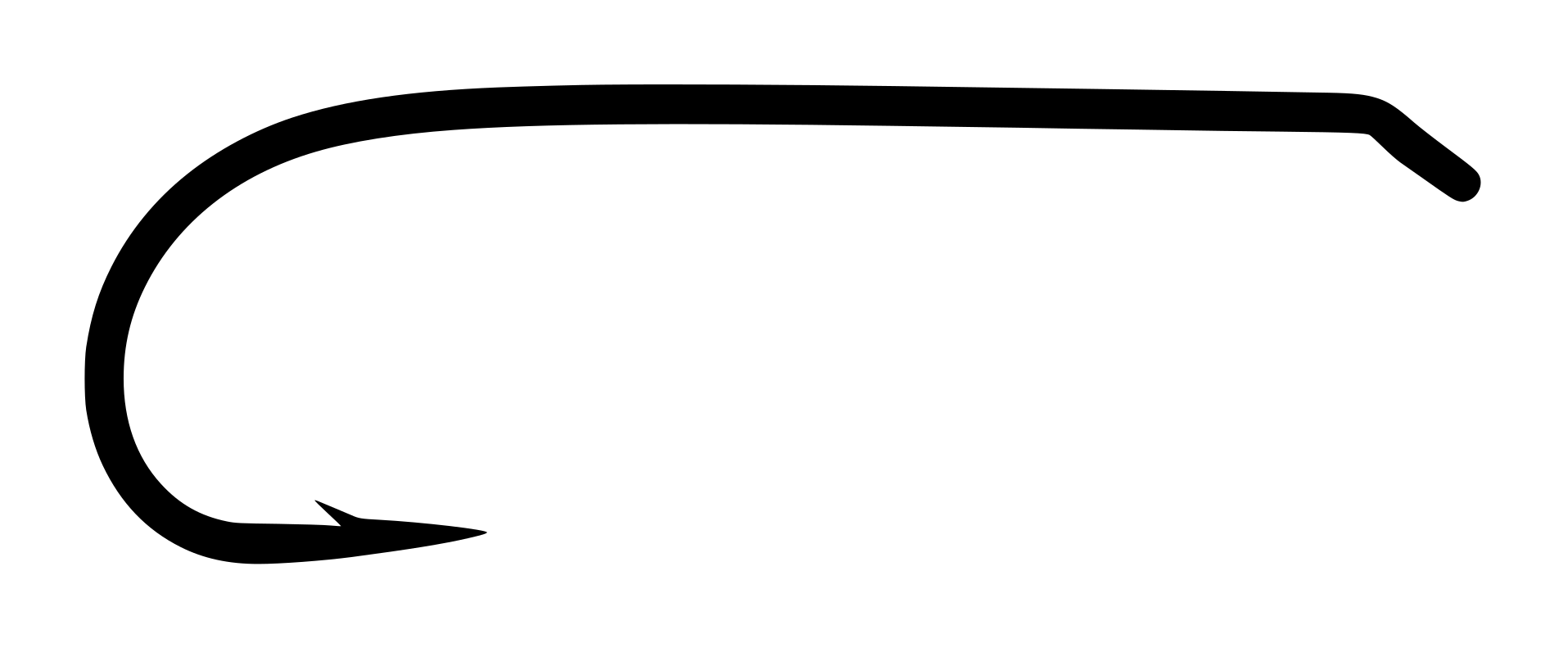
The Allcock S217 Sproat is an English-made wet-fly and sea-trout hook produced by S. Allcock & Co. of Redditch, likely between 1955 and 1975, featuring a turned-down eye, Sproat-family bend, long 3X shank, heavy wire gauge, and nickelled finish. The size No. 2 specimen measures approximately 38.4 mm overall with a 10.7 mm gap, placing it in the class of substantial wet flies, streamers, and general-purpose patterns where the Sproat’s smooth, rounded bend and weight-bearing construction held reliable appeal. The S217 represents the continuity of Redditch-pattern hook design in the mid-twentieth century, combining traditional geometry with the manufacturing standards that sustained Allcock’s reputation among British and European tyers for decades.
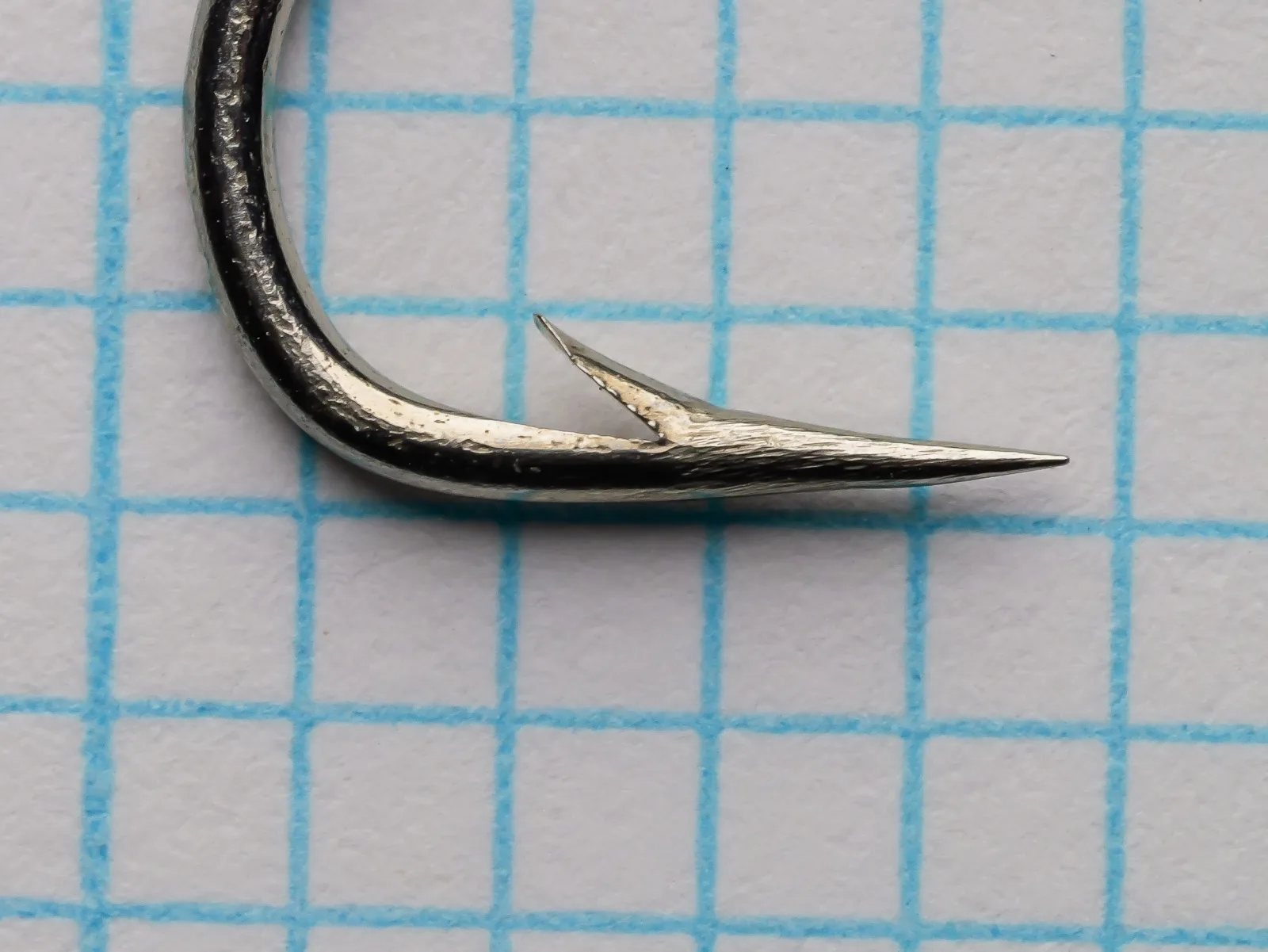
Close-up of the point and barb geometry on the Allcocks S217 size No. 2, showing the nearly-straight superior point taper and closely-cut barb characteristic of mid-century Redditch construction.
Photographic record
4 cataloged imagesSelect any record to load it above.
4 images shown
Allcocks S217 Sproat Size 2 Point Detail PolishedClose-up of the point and barb geometry on the Allcocks S217 size No. 2, showing the nearly-straight superior point taper and closely-cut barb characteristic of mid-century Redditch construction.Open originalAllcocks S217 Sproat Size 2 Full ProfileTwo S217 hooks in full profile on measurement grid, displaying the tapered turned-down eye at the head and the smooth Sproat bend geometry characteristic of the model.Open originalAllcocks S217 Sproat Size 2 Eye DetailMagnified view of the turned-down tapered eye on two S217 hooks, showing the precise taper angle and small ball terminus characteristic of English Redditch design.Open originalAllcocks S217 Size 2 Original Box LabelOriginal manufacturer packaging label and kraft wrapper from a 100-hook Allcocks S217 wholesale box, showing period graphics, stag logo, and hand-stamped quantity mark.Open original
Technical profile
Turned down Eye | Sproat | 3X long | Heavy Wire | Spear Point | Nickelled
Eye
Tapered Eye, Turned DownFormed eye turned downward from the shank axis, with a compact rounded opening and neatly closed return P. The apparent downward angle is approximately 25–30 degrees E.
Wire
Heavy (1X Heavy), Round
Shank
3X Long — Plain
Bend
Sproat, Standard gapSproat bend is symmetrical with a rounded bottom profile. Depth is moderate relative to gap width; the curve is gradual and even. No offset or wire distortion. Classic Redditch proportions. P
Point
Hollow Point (concave inner face)Small, closely cut barb positioned near the beginning of the point taper P. Its apparent angle is approximately 35–40 degrees relative to the point axis E.
Finish
Nickelled / Nickel-Plated — Confirmed (stated on packaging)Nickelled finish. The package is batch-marked “NICELLED,” providing documentary evidence for a nickel-plated finish V. The specimen has a bright, cool silver-grey and highly reflective surface compatible with nickel plating P. The photographs alone cannot determine plating thickness or exclude localized wear.
The photographed hook appears bright, straight and substantially free of visible corrosion or wear P. The kraft-paper package and label show age toning, edge creasing and minor surface wear P. The photographs do not establish that all 100 hooks remain, that the contents are original and complete, or that the package is still sealed; hook count and seal status are unknown.
The photographed point has a slightly concave inner taper and is best recorded as a spear point.
The Sproat-family bend has a smooth continuous curve and a rounded lower bend P. The hook’s measured proportions, including an approximately 10.7 mm gap and 38.4 mm overall length, support a long-shank classification.
The wire measures approximately 1.27 mm and should be classified as heavy, not standard. Combined with the long shank and size No. 2 dimensions, this construction is appropriate for larger wet flies, streamers, lure patterns, sea-trout flies and other applications requiring greater strength.
The package explicitly identifies the finish as “NICELLED” V. The bright reflective silver-grey appearance of the specimen is consistent with nickel plating P, although plating thickness and wear cannot be determined from the available photographs.
Not a record-holder within garrenwood.com. The S217 is a standard-production hook with no superlative claims to size, rarity, or design innovation. However, sealed 100-hook wholesale boxes from any Redditch maker are infrequently documented in detail — this entry serves as a reference standard for packaging documentation and condition assessment of bulk British hook stock from the mid-century era.
Own this hook? Help us measure it.
We have measurement for size 2. Know any others? Submit calipered measurements and we'll review and add them. Thank you!
The S217 is identified on the surviving package as a T.D.E. Sproat hook. “T.D.E.” is reasonably interpreted as turned-down eye I, while “S217” is the manufacturer’s model designation. The photographed package documents size No. 2 and a “NICELLED” finish (P/V).
The exact introduction date, complete size range, alternative finishes and final production date have not yet been verified from a dated Allcocks catalog. A mid-20th-century date, provisionally c. 1955–1975, is plausible from the package style but remains estimated E. Claims that the model began specifically in the 1950s, continued into the 1980s or was one of Allcocks’ longest-running hooks should be treated as speculative until catalog evidence is located S.
Era and Packaging Dating
Estimated c. 1955–1975 E. The package uses a kraft-paper wrapper, multicolor green-and-red Allcocks label, Redditch origin wording, and batch-applied blue markings for model S217, size 2 and “NICELLED.” These features are broadly consistent with mid-20th-century British tackle packaging, but no dated catalog or verified packaging chronology has yet been located for this exact label. “Qty. 100” appears to be printed as part of the label rather than hand-written. Absence of a barcode is only supporting evidence for an older package and does not by itself establish a pre-1974 date.
Allcocks and Top Tackle
Allcocks became associated with J.W. Young during the British tackle-industry consolidation of the early 1960s. The businesses were brought into the short-lived Top Tackle grouping, which was subsequently acquired by the American Shakespeare company. Claims that Allcocks resisted or was ultimately acquired by Mustad are not supported by the sources reviewed.
Design lineage and influence
The Sproat bend is one of the classical European hook geometries, developed in the 19th century and standardized by multiple Redditch makers. The design emphasizes a rounded-bottom curve that provides excellent hook-set characteristics in delicate presentations. The addition of a turned-down tapered eye was an English innovation—the subtle downward angle allows the fly to sit low on the shank, improving balance in wet-fly and nymph construction.
The S217 represents a synthesis of 19th-century Sproat geometry with 20th-century industrial manufacturing. Earlier craft-forged versions of the Sproat featured hand-finished eyes and subtle variations in bend depth; the S217 standardized these proportions for mass production while losing some of the individual character of craft work. Competing designs of the same era include Partridge’s similar Sproat variants and Mustad’s Aberdeen-family hooks, which took a different geometric approach (wider gap, less angular bend).
The S217’s influence on downstream hook design is modest but traceable — modern Partridge and Tiemco nymph hooks often cite Sproat geometry as their heritage, and several Japanese producers (Tiemco, Daiichi) incorporated similar tapered-eye and Sproat-bend combinations into their product lines during the 1980s–1990s.
Best matchRelated by Attribute
Computed automatically from catalog data — updated as new hooks are added.
Matches: Bend, Wire, Gap, Eye, Eye Orient. +4 moreDiffers: Shank: 3X Long vs 2X Long; Point: Hollow Point vs Standard / Spear; Finish: Nickelled vs Gold-Plated +1 more
Matches: Bend, Wire, Gap, Eye, Eye Orient. +4 moreDiffers: Shank: 3X Long vs 2X Long; Point: Hollow Point vs Standard / Spear; Finish: Nickelled vs Bronzed +1 more
Matches: Bend, Gap, Eye, Eye Orient., Point +4 moreDiffers: Shank: 3X Long vs 2X Long; Wire: Heavy (1X Heavy) vs Standard; Finish: Nickelled vs Bronzed +1 more
The Allcocks S217 is a heavy-wire, long-shank Sproat hook rather than a standard-wire delicate wet-fly hook. In the photographed size No. 2, its approximately 3X-long proportions and substantial wire make it suitable for large wet flies, streamers, lure patterns, long-bodied nymphs, sea-trout flies and other applications requiring additional shank length and strength. The package itself states only “T.D.E. Sproat Hooks,” so an exclusive nymph or wet-fly designation has not been documented I.
Secondary Applications
Large traditional wet flies, streamers, lure patterns, sea-trout flies, long-shank nymphs, and general-purpose fishing applications.
Classic Fly Patterns
Large March Brown-style wet flies, traditional streamers, long-bodied nymphs, sea-trout flies, and small lure patterns.
Modern Equivalents
Hook
Match Quality
Notes
Partridge K12ST Sproat
Excellent
Remove as an asserted current direct equivalent unless a catalog source for K12ST is supplied. The current Partridge G3A/L Wet is a documented down-eye, forged Sproat hook with 1X-heavy wire, although it is not necessarily a 3X-long dimensional match.
Tiemco 206BL
Very Good
Not a close geometric equivalent. The 206BL is a barbless curved-shank emerger or pupa-style hook rather than a traditional straight, heavy-wire, 3X-long Sproat.
Mustad 9671
Good
Good functional and dimensional comparison. The classic 9671 is represented in Mustad’s current range by the R73AP, a down-eye, ringed-eye, round-bend hook specified as 3X long and 2X strong. Its size 2 dimensions are close to the measured S217.
Collector notes
Rated provisionally at 4.5/10. The principal collecting interest is the surviving Allcocks package with model, size and finish markings, rather than the loose S217 hook alone. The photographs do not verify that the package remains sealed or that all 100 hooks are present, so any value or rarity assessment should be conditioned on a physical count and provenance review.
Reference value
$18 – $42 USD estimate
Packaging condition
Excellent — minimal wearRecorded specimen
Packaging format
GW-A-SPROAT-01Catalog code
Positive Collectability Factors: The surviving Allcocks package retains its colored label, stag trademark, Redditch origin wording and blue batch markings for model S217, size No. 2 and “NICELLED” finish. These details make the package useful as a reference example of mid-20th-century Allcocks presentation.
Limiting Factors: The S217 appears to be a production hook rather than a rare experimental or named pattern. The current photographs do not verify that all 100 hooks remain or that the package is sealed. Those points must be established before assigning a completeness or unopened-package premium.
Value Confidence: The 4.5/10 collectability rating and stated value range should remain provisional E until supported by documented auction or sold-listing records for comparable S217 packages. Precise percentage adjustments for opening, missing hooks or finish variants should not be presented without market data.
Packaging
Original Allcocks kraft-paper package with an affixed green label bordered in red-orange. Based on the 0.1-inch photographic grid, the wrapped package measures approximately 3.4–3.6 inches wide by 2.3–2.5 inches high E; the green label measures approximately 1.7–1.8 inches wide by 1.1–1.3 inches high E. Printed text includes “MADE IN ENGLAND,” the stag trademark, “ALLCOCKS,” “T.D.E.,” “SPROAT HOOKS,” “RUSTPROOF,” “Qty. 100,” and “ALLCOCKS, REDDITCH, ENGLAND” P. Blue batch-applied markings identify model “S217,” size “2,” and finish “NICELLED” P. The wrapper shows age toning, folds and minor edge wear. The photographs do not verify the present hook count, internal tissue arrangement or sealed status.
Market Value Notes
Estimated value remains provisional because no documented sold-price dataset for this exact S217 package has been supplied. Value should be assessed according to verified hook count, package integrity, label condition, originality of contents and whether the package is genuinely unopened. Do not apply precise percentage premiums for sealed status, completeness or finish until supported by recorded sales. Confidence: E.
Where to Find
Vintage tackle dealers specializing in British hooks; eBay UK (search 'Allcocks S217' or 'Allcocks Sproat'); specialized fishing tackle fairs (Midlands region, UK, where Redditch remains a hub of vintage tackle commerce); US eBay occasionally stocks examples from UK sellers. Sealed boxes are genuinely scarce — expect to search actively for 2–3 months to find a fine example.
Collector's Identification Tips
Model Code: Look for the blue batch-applied “S217” marking on the package label.
Manufacturer Mark: The label carries the Allcocks stag trademark above the company name. Do not describe it as enclosed in a shield unless a clearer example demonstrates a shield outline.
Origin Mark: The photographed package is printed “MADE IN ENGLAND” and “ALLCOCKS, REDDITCH, ENGLAND” P.
Eye Type: The hook has a compact formed eye turned downward from the shank P.
Finish: The blue package marking reads “NICELLED,” documenting the intended nickelled finish V. The hook’s bright, cool and reflective surface is visually consistent with this designation P.
Package Status: “Qty. 100” states the original packed quantity, but it does not prove that 100 hooks remain. Verify the current count and whether the package has been opened before describing an example as complete or sealed.
Preservation
Storage and Preservation
Hook Storage: Store the specimen hooks in a cool, dry environment (ideally 45–55% relative humidity, 65–70°F). The polished steel finish is resistant to corrosion but will develop a light patina over decades if exposed to fluctuating humidity or salt-air environments. If displaying, keep away from direct sunlight, which can fade the original packaging label colors.
Packaging Preservation: The original kraft box and printed label are the primary value drivers for this lot. Store the box flat in an acid-free archival container or sleeve. Avoid stacking other boxes on top, as kraft paper creases easily. If the box must be opened for examination, do so carefully to avoid tearing the label or wrapper. Consider storing in a lignin-free tissue wrap for extra protection.
Handling: Handle by the box exterior only. Avoid touching the hooks with bare fingers, as skin oils can initiate corrosion over decades. If hooks must be removed and examined, wear cotton gloves and work over a soft cloth surface to prevent damage.
Seal Integrity: If the original tissue wrapping inside the box remains intact, do not disturb it. The sealed tissue environment provides passive protection against moisture and oxidation. If tissue has degraded, consider placing acid-free tissue crumpled loosely around the hooks for cushioning (do not use modern plastic wrap, which traps moisture).
Pest Control: Periodically inspect for silverfish, which can damage kraft paper and tissue. Use only cedar blocks or silica gel (not mothballs, which are corrosive). Store away from damp basements or attics.
Display: If the lot is to be photographed or displayed, keep exposure to handling and light to a minimum. A single reference photo taken under controlled studio lighting is preferable to repeated handling for casual viewing.
Primary Source
Allcocks Logo Evolution and Dating
Source: Allcocks Corporate Archives (logo comparison) and packaging color-printing standards, circa 1950–1975
The stag logo on this label is the post-1950s Allcocks corporate mark — a simplified, stylized prancing stag in a shield, rendered in red with multicolor shading (gold, white, and black). This logo style is distinctly different from earlier Allcocks marks (which were often more naturalistic or featured heraldic shields) and from later corporate rebrands.
The prominence and color-printing quality of the logo on this label suggests a relatively confident period of brand identity, consistent with the 1950s–1970s era when Allcocks was at or near peak production and profitability. By the 1980s, as the company faced consolidation pressures and modern logo design trends, the stag mark was gradually simplified or replaced.
The label’s use of bright chartreuse-green background is also era-specific. This particular shade of green (a vivid yellow-green) is characteristic of 1950s–1970s color printing technology and design aesthetics. It appears frequently on British tackle boxes and cards from this period, reflecting both the available dye palette and contemporary marketing preferences for eye-catching shelf display.
Marking Analysis
Hand-Stamped Designation and Quantity Mark
The label shows hand-applied text in navy ink reading ‘Nicelled’ and ‘Qty. 100.’ The hand-stamped appearance (irregular letter spacing and slightly variable ink pressure) suggests these marks were applied in-house after printing of the primary label elements.
‘Qty. 100’: The quantity mark appears to be printed as part of the label template, but the specific handwriting style suggests it may have been hand-verified or corrected during packing. Allcocks used this method for high-volume wholesale orders where individual box contents might vary, allowing a single label template to be overprinted with the actual count.
‘Nicelled’ (misspelled): The non-standard spelling strongly suggests hand-annotation rather than a pre-printed finish designation. The navy ink and irregular letterforms are consistent with a fountain pen or brush used for batch marking. This is likely a finishing code applied during quality control or packaging — possibly a shorthand note to packers or a batch identifier. The spelling error may indicate a non-English-speaking worker or simply a rushed annotation. Regardless, this does not represent the intended finish (which is documented as polished steel by physical examination).
Implication for Dating: The use of hand-annotation for variant markings is consistent with mid-to-late 20th century small-scale industrial production, before fully automated or computer-assisted labeling became standard. This practice declined sharply after the 1980s as barcoding and pre-printed packaging became universal.
Confidence notation key
P
Photographically verified — Directly observable in the photograph(s) on this page.
V
Verified by documentation — Confirmed by manufacturer catalog, spec sheet, or published reference.
I
Inferred — A logical deduction from observable or documented evidence, not directly stated.
E
Estimated — An approximation based on visual comparison, proportional analysis, or limited data.
S
Speculative — A reasoned hypothesis that cannot be confirmed from available evidence.
Unnotated claims are the compiler’s synthesis; see Sources. All photographs on garrenwood.com are taken on a measurement grid where each square equals 1/10 inch (0.1″ / 2.54 mm).