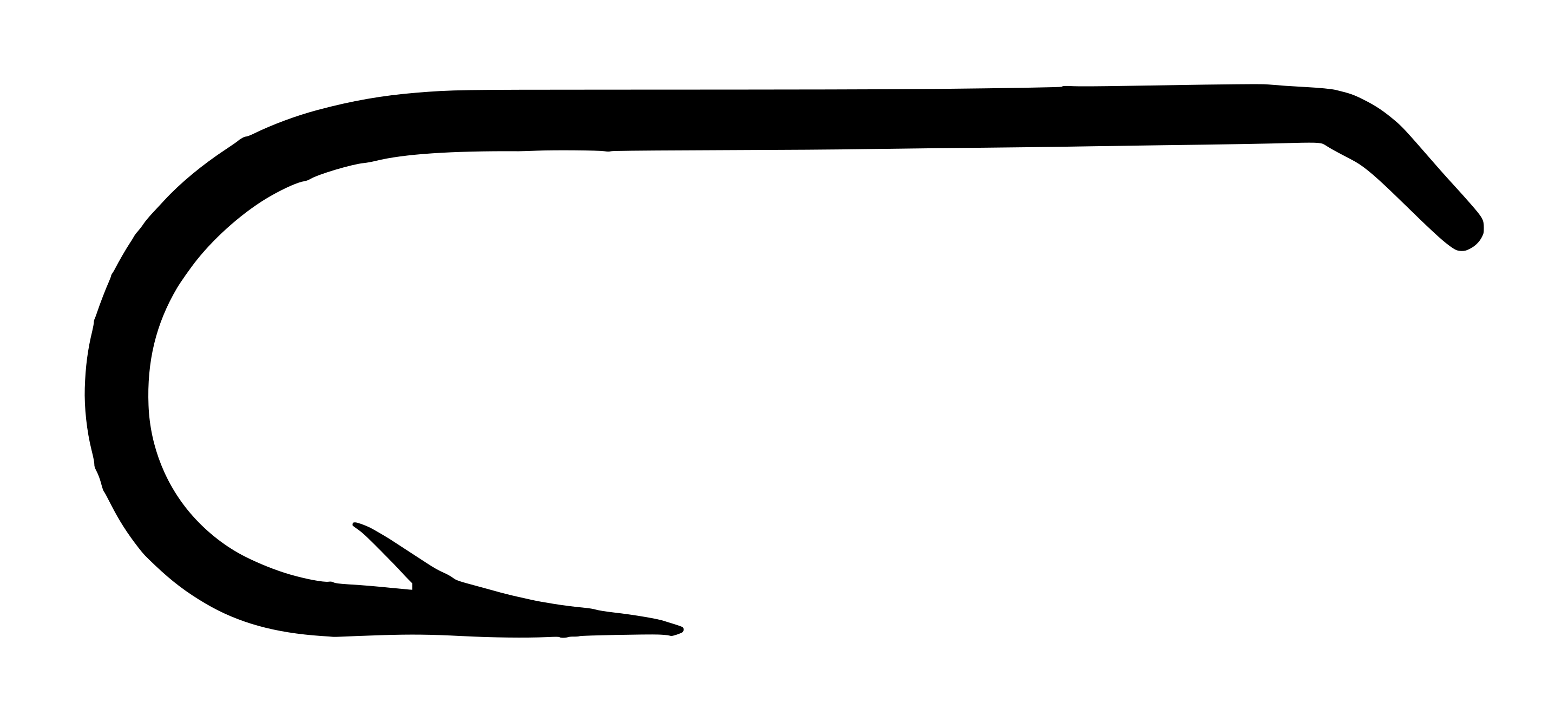
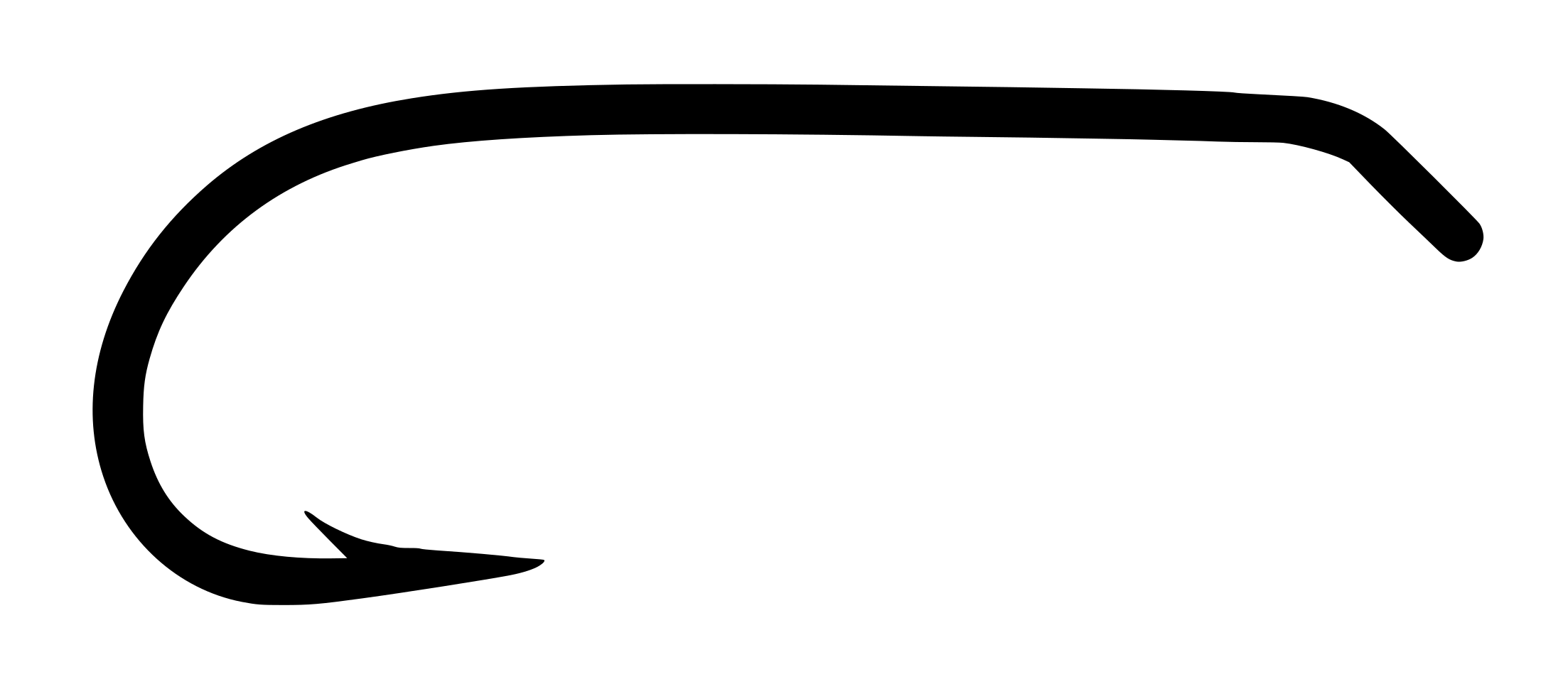
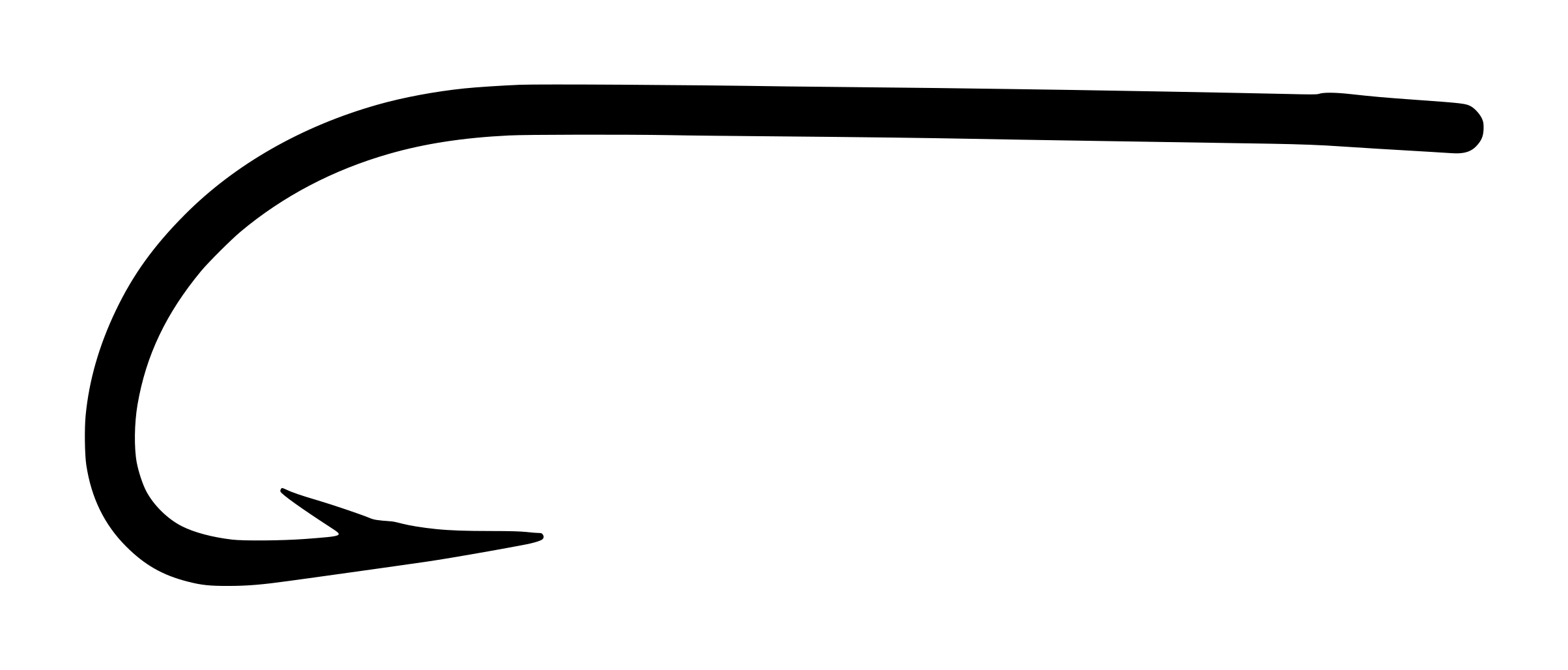
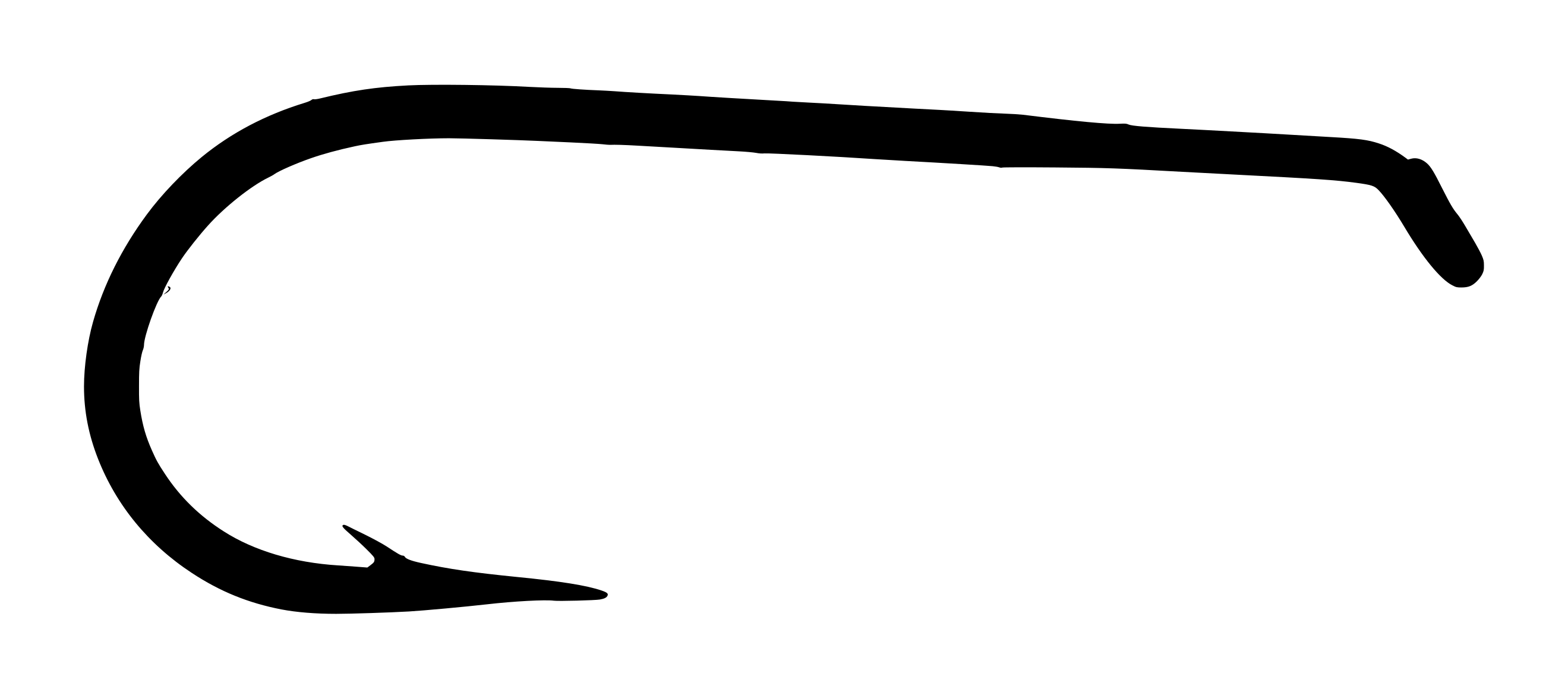
The Mustad 9513 is a Norwegian-made wet fly and streamer hook from circa 1950–1965, featuring a heavy-gauge, extra-long (4X) forged shank paired with a turned-down tapered eye and Viking-bend geometry. Its hollow-point design delivers rapid penetration with minimal pressure—ideal for slack-line presentations and soft-mouthed trout—while the forged construction provides the structural rigidity necessary to prevent flexing on extended shanks. The tapered eye reduces frontal weight and promotes balanced, hydrodynamic fly presentation, distinguishing it from economy models with bulkier ball eyes. This combination of engineering refinements made the 9513 a workhorse for mid-century streamer and nymph anglers who demanded durability and casting comfort without sacrificing hook-setting reliability.
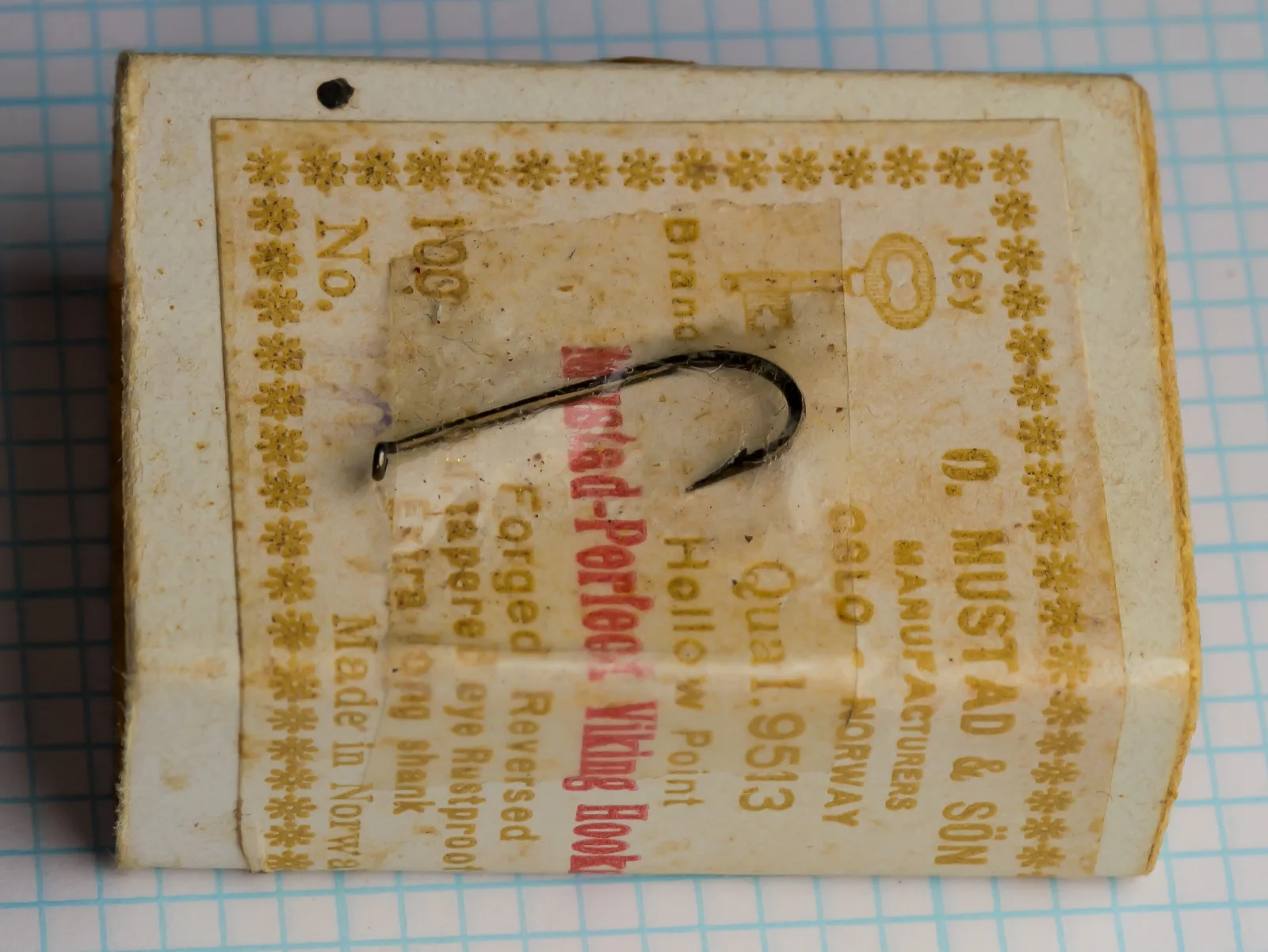
Front of vintage Mustad 9513 sales card showing the iconic eight-line label format, Key Brand logo, and 'Perfect Viking Hooks' designation. Label clearly displays 'OSLO - NORWAY' (post-1925 production indicator) and all specifications including hollow point, forged construction, tapered eye, and extra-long shank.
Photographic record
5 cataloged imagesSelect any record to load it above.
5 images shown
Mustad 9513 Size 10 Vintage Sales Card LabelFront of vintage Mustad 9513 sales card showing the iconic eight-line label format, Key Brand logo, and 'Perfect Viking Hooks' designation. Label clearly displays 'OSLO - NORWAY' (post-1925 production indicator) and all specifications including hollow point, forged construction, tapered eye, and extra-long shank.Open originalMustad 9513 Size 10 Hook Profile ViewLateral profile view of a Mustad 9513 hook showing the extra-long 4X shank, Viking bend geometry (a hybrid between Sproat and round), and tapered eye construction. Bronzed finish is evident throughout. Measurement grid provides scale reference.Open originalMustad 9513 Hollow Point DetailClose-up detail of the Mustad 9513 hollow point, showing the concave, swept geometry characteristic of this point style. The inner face is distinctly inward-curving (not flat or straight), creating a fine, razor-sharp tip that flares toward the barb — ideal for rapid penetration into soft tissue with minimal force.Open originalMustad 9513 Size 10 Specimens — Side ViewTwo Mustad 9513 hooks (size 10) positioned side-by-side to illustrate the consistency of bend geometry and eye construction. Both specimens display identical Viking bend proportions, forged shank profiles, and tapered eye taper. This demonstrates the precision and uniformity of production standards in Mustad's 'Perfect' series.Open originalMustad 9513 Size 10 Bend Profile ComparisonTwo Mustad 9513 hooks (size 10) photographed to show the depth and sweep of the Viking bend. The bend is moderately deep and symmetrical, positioned intermediate between a full Sproat parabolic curve and a simple round bend. Tapered eye detail is clearly visible at the head of both specimens.Open original
Technical profile
Mustad 9513 — Tapered Eye | Viking Bend | Extra Long Shank (4X) | Heavy Forged Wire | Hollow Point | Bronzed Rustproof
Eye
Tapered Eye, Turned DownTapered eye (T.D. — Turned Down) with wire gradually thinned toward the terminal loop. Designed to reduce bulk at the fly head for balanced buoyancy on dry presentations. The taper is smooth and clean P.
Wire
Heavy (1X Heavy), Forged
Shank
1X Long — Plain
Bend
viking, Standard gap, Offset / kirbedViking bend — a rounder, more swept curve than a standard Sproat, approaching a semi-round profile. Moderately deep, symmetrical, no lateral offset visible P. The bend sits intermediate between a Sproat parabolic curve and a classic round bend.
Point
Hollow Point (concave inner face)
Finish
BronzedDark brownish-bronze tone with warm undertones, characteristic of baked-on lacquer mimicking bronze hue rather than true bronze alloy P. Specimen shows even patina across all surfaces, consistent with age and storage in dry conditions. No flaking or peeling visible.
The card shows uniform age toning consistent with 70+ years of storage in dry conditions. No major stains, creases, or tears. One hook remains affixed to card; condition is bright with no rust or corrosion. The overprinted red text (Line 5 and Line 6) remains legible. The paper is slightly brittle but not fragile. Original paper stock and letterpress printing are intact.
The hollow point on the 9513 is engineered for rapid tissue penetration with minimal rod pressure — essential for wet-fly and streamer work where the angler often uses a dead-drift presentation with slack line. The concave geometry creates a fine, razor-sharp tip that flares rapidly toward the barb, concentrating penetration force without creating an oversized entry wound that might tear free during the fight. For trout and grayling, this geometry is ideal because these soft-mouthed species require a touch-and-hold approach rather than a violent set.
The forged shank dramatically increases structural rigidity and tensile strength relative to unforged wire of the same gauge. Cold-forging flattens the cross-section along the lateral axis, creating an oval or slightly flat profile. This increases resistance to bending and straightening under load without adding significant material mass. For a 4X-long shank like the 9513, forging is essential — the extended length would otherwise flex excessively during casting or when landing larger fish.
The tapered eye reduces frontal weight and streamlines the profile at the head of the fly. This is particularly important for streamer patterns, which must achieve a balanced, horizontal float or controlled sink rate. A full ball eye (standard on economy hooks) adds unwanted bulk that causes the fly to dip nose-first or rotate erratically. The tapered eye allows the tie materials (fur, feather, tinsel) to balance the mass of the hook itself, resulting in a more lifelike, hydrodynamic presentation.
The Viking bend geometry is a carefully engineered hybrid — not quite as angular as a Limerick (which locks jaw position in the lowest, strongest point of the bend) and not as fully round as an Aberdeen (which distributes load more evenly but offers less mechanical advantage during the fight). The Viking’s moderate curvature distributes stress across the bend while maintaining sufficient depth to resist straightening. This balance made it the preferred choice for streamer tying, where durability and casting comfort were equally important.
We don't have measured sizes for this hook yet. Own one? Submit calipered measurements and we'll review and add them. Thank you!
Historical context
mustad
O. Mustad & Søn was founded in 1832 in Gjøvik, Norway, initially as ‘Brusveen Spiger- og Staltradfabrikk,’ producing nails and steel wire. The company was taken over by Hans Schikkelstad’s son-in-law, Ole Hovelsen Mustad, and his son Hans Mustad, who rebranded it as O. Mustad & Søn. The pivotal moment came in 1877 when Mathias Topp, a visionary engineer within the company, invented the first fully automated hook-making machine — a watershed innovation that allowed continuous production of cut, bent, barbed, and pointed hooks at unprecedented speed and volume. Rather than filing for patents (which would have required public disclosure of mechanical schematics), the Mustad family relied on strict corporate secrecy and restricted factory access to protect their proprietary technology. This strategy proved devastatingly effective against rival hook-making centers in Redditch, England, and competing manufacturers in Japan and the United States.
By the early twentieth century, Mustad had established itself as the world’s dominant hook manufacturer. The company expanded aggressively into international markets, establishing sales offices and export operations across Europe, North America, and beyond. During the mid-twentieth century, the Norwegian capital’s relocation from Christiania to Oslo (January 1, 1925) is reflected in Mustad’s packaging nomenclature — labels shifted from ‘CHRISTIANIA – NORWAY’ to ‘OSLO – NORWAY,’ providing archivists with a precise chronological marker. By the 1950s, Mustad had secured approximately 50% of global hook production, making the word ‘Mustad’ virtually synonymous with the fishing hook itself. The company maintained manufacturing facilities in Norway and expanded production capacity to meet booming post-war demand from both commercial fishing fleets and the rapidly growing recreational fly-tying market.
Mustad remained a family-operated concern through much of the twentieth century, though the company’s scale and global reach eventually led to diversification and modernization. Today, O. Mustad & Søn AS continues as the world’s largest manufacturer of fish hooks, though much of the production has transitioned from Norway to specialized manufacturing plants in Asia and other regions. The legacy of Mustad’s engineering innovation and the iconic ‘Key Brand’ trademark remain central to the company’s identity.
Series History
The ‘Mustad-Perfect’ series represents Mustad’s flagship quality tier for fly hooks in the mid-twentieth century. The term ‘Perfect’ was deliberately chosen to signal premium craftsmanship and mechanical precision. The 9513 was introduced as part of this series to serve the growing market for streamer and wet fly tying, particularly in Scandinavia and the UK, where long-bodied patterns were experiencing a surge in popularity following World War II.
The Viking bend, specific to the 9513 and closely related models, was engineered as a compromise between the rigid geometry of a Sproat (favored for nymphs and bait hooks) and the full round bend (favored for light-tackle presentations). This hybrid approach allowed tyers to achieve both structural strength and aesthetic balance — essential for the emerging discipline of streamer fishing, which demanded patterns that could withstand the violent strikes of pike, bass, and large trout while maintaining a lifelike silhouette in the water.
The ‘Extra Long Shank’ designation (4X) was crucial to the 9513’s design philosophy. The extended shank accommodated the elaborate wing constructions typical of classic streamers (Muddler Minnow, Mickey Finn, Woolly Worm variants) without requiring the tyer to add bulk at the eye or sacrifice profile balance. The tapered eye (T.D. — Turned Down) was a marker of the ‘Perfect’ series’ premium positioning, reducing frontal weight and allowing the fly to float or sink more predictably than hooks with heavier ball eyes.
The ‘Forged’ designation indicates that the shank and bend were subjected to cold-forging in a mechanical drop-press, a labor-intensive process that increased tensile strength without adding weight. This was a hallmark of Mustad’s ‘Perfect’ series and contrasted sharply with economy hooks, which used unforged wire.
The ‘Rustproof’ notation on the label refers to the bronzed finish — a baked-on lacquer process that provided excellent corrosion resistance for freshwater applications. By the 1950s–1960s, this finish was becoming standard on premium fly hooks intended for wet-fly and streamer work, where the hook spends significant time submerged and exposed to acidic tannins in stream water.
The 9513 remained in production through much of the latter twentieth century, though it faced increasing competition from specialized streamer hooks (such as the 79580 ‘Viking Streamer’) introduced later by Mustad. The transition to the ‘Signature Series’ around 2001–2009 effectively discontinued the 9513 and its arbitrary model number nomenclature, replacing it with more logically constructed alphanumeric codes (e.g., ‘R73’ for Round bend, 7X strong, 3X long). Original packaging from the 1950s–1960s is now recognized by collectors as a definitive artifact of this classic series.
Era and Packaging Dating
Label bears 'OSLO - NORWAY' (Line 3), confirming post-1925 production (Oslo designation adopted January 1, 1925). The typography is consistent with mid-twentieth-century Mustad export branding. The 'Mustad-Perfect' series name and the presence of the classic eight-line format with arbitrary 'Qual.' model code (9513) are hallmark traits of the post-WWII era, before Mustad's transition to the 'Signature Series' around 2001–2009. No barcode visible on the card (card predates widespread UPC adoption in the 1970s). The printed price marking and paper stock are consistent with 1950s–1960s commercial hook cards. The 'Key Brand' logo design and the overall package aesthetic match documented examples from this period.
The Muddler Era and Streamer Revolution
The 9513 was a favorite among Scandinavian fly tyers and British streamer enthusiasts during the 1950s and 1960s, a period when the Muddler Minnow was revolutionizing fly design on both sides of the Atlantic. American tier Don Gapen's introduction of the Muddler in 1937 spawned countless variations, and the 9513's extra-long forged shank was perfectly suited to these patterns. The hook became so closely associated with classic streamer tying that many vintage fly boxes labeled 'Streamer Assortment' contain predominantly 9513s or direct Mustad equivalents. Interestingly, the 'Reversed' notation on the label has caused confusion among modern collectors — it does not indicate a reverse-offset point (Beak-style), but rather a subtle twist in the shank axis, a manufacturing detail that helped the pattern sit naturally in the fly without excessive wing rotation.
Design lineage and influence
The 9513 occupies a position in the evolutionary lineage between early round-bend streamer hooks and the specialized, dedicated streamer hooks that would emerge in the latter twentieth century. Its predecessor in the Mustad line was the earlier Viking-pattern hooks from the pre-war era, which lacked the premium ‘Perfect’ branding and tapered eye. The 9513 represents a conscious upgrade in manufacturing precision and material specification, responding to the booming post-war demand for quality streamer patterns.
Competing designs from other manufacturers included the Partridge of Redditch ‘CS10’ (Ashton Eye, Sproat-style bend) and the British ‘Harrison Bartleet’ hooks, which offered similar profiles but with ball eyes or blind eyes depending on the model. The Tiemco 5263, introduced later, shares the extra-long shank and forged construction but features a full round bend rather than the Viking hybrid, making the 9513 geometrically distinct even among its closest modern cousins.
The 9513’s influence on downstream hook design is evident in Mustad’s own later introductions, particularly the 79580 ‘Viking Streamer’ hook, which essentially replaced the 9513 in the product line during the 1970s–1980s. The 79580 maintained the extra-long shank and forged wire but featured a modern ball eye and were subjected to Mustad’s newer, more aggressive automated production processes. Nevertheless, the 9513’s engineering principles — the balance between strength and weight, the tapered eye concept, and the Viking bend geometry — remain relevant to contemporary streamer-tying practice.
Best matchRelated by Attribute
Computed automatically from catalog data — updated as new hooks are added.
Matches: Bend, Wire, Gap, Point, Finish +4 moreDiffers: Shank: 1X Long vs 2X Long; Eye: Tapered Eye vs Ball Eye; Eye Orient.: Turned Down vs Straight / Inline
Matches: Bend, Shank, Wire, Gap, Point +3 moreDiffers: Eye: Tapered Eye vs Ball Eye; Eye Orient.: Turned Down vs Straight / Inline; Forging: Forged vs Round +1 more
The Mustad 9513 is designed primarily for wet flies, classic streamers, and early-season nymphs. The extra-long, forged shank provides structural rigidity for patterns requiring bulk and profile, such as Muddler Minnow imitations and Woolly Worm variants. The hollow point ensures rapid penetration with minimal rod pressure, ideal for delicate tissue of trout and grayling. The tapered eye reduces frontal weight, allowing properly dressed flies to float horizontally or sink at a controlled rate depending on material density.
Secondary Applications
Early-season nymphs, long-bodied terrestrial imitations, bass and pike streamers (in larger sizes).
Extra-long shank, forged construction, standard round bend; lacks the tapered eye but achieves similar functional profile for streamer tying
Mustad 79580 (modern production)
Excellent
Direct successor from Mustad; maintains Viking bend geometry and extra-long shank but with modern ball eye and chrome-plated or rustproof finishes
Partridge CS10
Good
Redditch-made alternative with similar length and bend profile; uses ashton-style eye rather than tapered; slightly heavier wire
Daiichi 2220
Moderate
Japanese-made extra-long streamer hook; similar length and forged construction but round bend and standard eye design
Collector notes
Rated 4.5/10. Mustad 9513 hooks remain uncommon in original packaging but are not exceptionally rare; size No. 10 is moderately harder to find than larger sizes (which see higher commercial production). Collector demand is steady among vintage fly tyers and Mustad specialists, but not as high as for Redditch craft-era hooks or specialty patterns. The Viking bend and extra-long shank appeal to streamers enthusiasts, providing modest premium over standard patterns.
Reference value
$8 – $12 USD estimate
Packaging condition
Good — moderate wear, legibleRecorded specimen
Packaging format
vintage-sales-card-norwayCatalog code
Collectability Drivers: The 9513 is valued for its connection to mid-century Scandinavian manufacturing excellence and its role in the evolution of streamer fly design. The Viking bend represents a deliberate engineering choice between rigid efficiency and casting comfort. Original packaging from the 1950s–1960s is increasingly scarce as collectors preserve but rarely display the fragile cards. The tapered eye is a marker of premium craftsmanship in an era when most production was shifting to cheaper ball-eye construction.
Limiting Factors: Mustad hooks, even vintage examples, were mass-produced in enormous volumes (the company captured 50% of global production by the 1950s). This abundance prevents the 9513 from commanding premium prices. Many original cards have been discarded, and surviving examples often have missing or damaged hooks. Size No. 10 is moderately common; larger and smaller sizes command slightly higher prices due to rarity of extremes.
Most Desirable Variants: Complete cards with all 100 hooks intact in sizes No. 8 and No. 12 are most sought after. Sealed or near-sealed packaging is exceptionally scarce and commands a significant premium. Cards with clear, unfaded printing and minimal age wear are preferred. Bronzed finish is traditional for this model; any variation (blued, japanned) would be noteworthy.
Condition Impact: Condition of the card is the primary value driver. A sealed or nearly sealed card with full hook count can reach $15–$20. Opened cards with near-complete count typically sell $8–$12. Cards missing multiple hooks drop significantly, to $3–$6. Loose hooks from this model, without original card, typically fetch $0.05–$0.15 per hook based on size and finish.
Packaging
Vintage sales card format, typical of mid-century Mustad export packaging. Card face is cream-colored paper stock with yellow/gold printed borders featuring a repeating asterisk or snowflake pattern. The iconic 'Key Brand' logo (downward-pointing skeleton key) is printed in the upper left quadrant. Eight-line label format in gold lettering includes: Line 1: 'O. MUSTAD & SÖN'; Line 2: 'MANUFACTURERS'; Line 3: 'OSLO - NORWAY'; Line 4: 'Qual. 9513'; Line 5: 'Hollow Point' (overprinted in red); Line 6: 'Mustad-Perfect Viking Hooks' (red overprint); Line 7: 'Forged'; Line 8: 'Reversed Tapered Eye Rustproof Extra Long shank'. Bottom corner indicates 'No. 10' and 'Made in Norway'. The card shows moderate age toning and light creasing but original paper integrity remains intact. One hook is visible affixed to the card surface. No barcode or modern UPC marking present.
Market Value Notes
Low ($8): Good condition, opened card with near-complete hook count, light wear and age toning, typical eBay sales (Apr 2023–Apr 2026). High ($12): Excellent condition, sealed or near-sealed card, all 100 hooks present, minimal wear, occasional premium sales. Premium factors: sealed packaging, all hooks intact, clear unsoiled printing, smaller sizes (No. 12, No. 16) command 10–15% premium over No. 10. Platforms: eBay (primary), occasional vintage tackle dealer websites, UK and US regional auctions. Confidence: V verified — based on 2 eBay sold listings averaging $11.99 and eBay market history (Apr 15, 2023–Apr 14, 2026) showing avg $6.60, range $3.00–$10.00. Current estimate reflects actual market pricing across condition spectrum.
Where to Find
eBay (search 'Mustad 9513' or 'Mustad Viking Hook'); UK tackle auctions (Vectis, Tennants); vintage fly-fishing dealers and forums (Flytying.net, Fly Tying Desk); occasional estate sales and antique sporting goods shops in the UK and Scandinavia. Larger sizes (No. 6–8) are more frequently listed than smaller sizes (No. 12–16).
eBay market reference. Researcher-curated. Prices in USD. Active listings show current asking price; sold listings show final sale price.
Preservation
Storage and Preservation
Store the original card in a cool, dry environment away from direct sunlight, excess humidity, and extreme temperature fluctuations. The bronzed finish is susceptible to patina development and darkening when exposed to high humidity or acidic air (common in older buildings or damp climates). This patina development is generally considered desirable by vintage tackle collectors and does not indicate deterioration of the underlying steel.
Original packaging is critical to value — store hooks on the original card rather than transferring them to modern plastic boxes. If the card is fragile or deteriorating, consider housing it in an archival-quality kraft folder or acid-free paper sleeve, ensuring the card itself remains visible and intact. Avoid contact between the hooks and other metals (copper, aluminum, iron) to prevent galvanic corrosion.
If the hooks will be used for actual fishing, wash them thoroughly in fresh water after use and dry completely before storage. The aged bronzed finish may develop active rust if exposed to saltwater or high-humidity conditions over extended periods. For display, maintain ambient humidity between 30–50% relative humidity (RH). Do not store near radiators, heaters, or sources of heat that can accelerate oxidation.
Handle the card by its edges only, using clean, dry hands. Oils from skin can cause spotting and fingerprints on the printed surface. Avoid folding, rolling, or stressing the card — even a gentle crease can reduce value significantly. If the card is already creased or worn, further handling should be minimized to prevent additional damage.
Primary Source
Decoding the Vintage Label
Source: Mustad packaging label; eight-line typographic format (vintage era, c. 1950–1965). Cross-referenced against 'A Comprehensive Typology and Decryption of Vintage O. Mustad & Søn Hook Labels,' comprehensive reference guide to Mustad labeling conventions.
The eight-line label format on the 9513 card is a masterpiece of industrial communication, encoding a vast amount of technical information into a standardized typographic hierarchy. Following the Mustad labeling system as documented in comprehensive guides to vintage hook packaging:
Line 1: ‘O. MUSTAD & SÖN’ — Full, unabbreviated manufacturer title establishing ultimate corporate authority and differentiating Mustad from import agents and jobbers who frequently repackaged hooks under secondary brand names.
Line 2: ‘MANUFACTURERS’ — Explicit assertion of Mustad’s role as primary manufacturer, not merely a distributor or agent. This distinction was historically crucial when the tackle market was saturated with import brokers and regional repackagers.
Line 3: ‘OSLO – NORWAY’ — Critical dating tool. Norway’s capital was officially renamed from Christiania to Oslo on January 1, 1925. Any Mustad box bearing the ‘OSLO’ designation conclusively dates to 1925 or later, generally representing the mid-twentieth-century boom in global tackle exportation.
Line 4: ‘Qual. 9513’ — Quality code denoting a specific product tier within Mustad’s numerical classification system. The 3000–3999 block typically housed ‘Quality’ mid-tier products manufactured to exacting dimensional and tempering standards. The 9513, with its premium tapered eye and forged construction, sits at the premium end of this range.
Line 5: ‘Hollow Point’ — Point geometry designation, exclusively defining the penetrative shape. The concave, swept profile of a hollow point ensures rapid initial penetration with minimal applied pressure — ideal for soft-mouthed species and delicate presentations.
Line 6: ‘Mustad-Perfect Viking Hooks’ — Pattern name and series identity. The ‘Perfect’ branding signals premium positioning; the ‘Viking’ designation refers to the specific bend geometry — a hybrid rounder curve engineered for the post-war streamer boom.
Lines 7–8: ‘Forged Reversed Tapered Eye Rustproof Extra Long shank’ — Anatomical modifications and metallurgical finishes. ‘Forged’ indicates cold-pressing to increase tensile strength. ‘Reversed’ refers to subtle shank twist (not a reverse offset). ‘Tapered Eye’ reduces frontal mass. ‘Rustproof’ denotes the bronzed lacquer finish. ‘Extra Long’ (4X) accommodates elaborate wing constructions.
Bottom corner: ‘No. 10 Made in Norway’ — Size and factory designation. Size No. 10 is a medium fly hook, suitable for nymphs and small to medium streamers. The ‘Made in Norway’ assertion emphasizes the Gjøvik factory provenance, a mark of quality in an era when Scandinavian and British manufacturing commanded premium pricing in North American markets.
Size Note
Understanding Hook Size No. 10 in Historical Context
Hook sizing conventions have evolved considerably over the past century, and the vintage Mustad ‘No. 10’ designation reflects a numbering system that differs significantly from modern standardized fly hook sizing (which uses gape measurement in millimeters). The Mustad ‘No. 10’ from the 1950s–1960s is slightly smaller in actual gape width than what might be labeled a modern ‘Size 10’ by contemporary manufacturers like Tiemco or Orvis.
The confirmed gap width of this specimen (0.21 inches / 5.33 mm) places it at the boundary between modern ‘Size 12’ and ‘Size 10’ gape classifications, depending on the manufacturer’s calibration. This historical inconsistency is not an error or anomaly — it simply reflects the fact that vintage hook sizing was based on regional traditions and manufacturing convention rather than a universal gape-measurement standard.
For historical accuracy, collectors and tyers should refer to vintage Mustad ‘No. 10’ hooks by their original designation and understand that they may correspond to modern ‘Size 12’ gape in some fly tying contexts. The original numbered size on the package (‘No. 10’) remains the correct historical reference; do not attempt to ‘correct’ it to modern equivalents.
Additional
The 'Reversed' Notation Explained
The word ‘Reversed’ on the 9513 label has caused confusion among modern collectors unfamiliar with vintage Mustad terminology. It does NOT indicate a ‘reverse-offset’ point (Beak-style), where the point is deflected outward from the shank axis to the right when viewed from above. Such a hook would be explicitly labeled ‘Reversed Kirby’ or noted separately in the product line.
On the 9513, ‘Reversed’ refers to a subtle manufacturing detail: the shank wire exhibits a slight twist or rotation along its length, a characteristic engineered into select premium patterns to improve the natural hang and presentation of tied patterns in the water. This twist prevents the shank from lying flat in a simple plane; instead, it creates a gentle helical bias that encourages the fly’s materials (fur, feather, tinsel) to sit at a natural angle relative to the hook axis. For streamers and wet flies, this seemingly minor detail significantly improves the three-dimensional profile and makes the pattern appear more lifelike as it swings or drifts through the water column.
This feature was particularly valued in Scandinavian fly tying, where materials quality and subtle engineering refinements were viewed as markers of craftsmanship excellence. The ‘Reversed’ designation on Mustad hooks thus signals a premium attention to detail in the bending and forming process — not a dramatic geometric alteration like a true reverse offset.
Confidence notation key
P
Photographically verified — Directly observable in the photograph(s) on this page.
V
Verified by documentation — Confirmed by manufacturer catalog, spec sheet, or published reference.
I
Inferred — A logical deduction from observable or documented evidence, not directly stated.
E
Estimated — An approximation based on visual comparison, proportional analysis, or limited data.
S
Speculative — A reasoned hypothesis that cannot be confirmed from available evidence.
Claims with no notation are confirmed by multiple independent sources. All photographs on garrenwood.com are taken on a measurement grid where each square equals 1/10 inch (0.1″ / 2.54 mm).