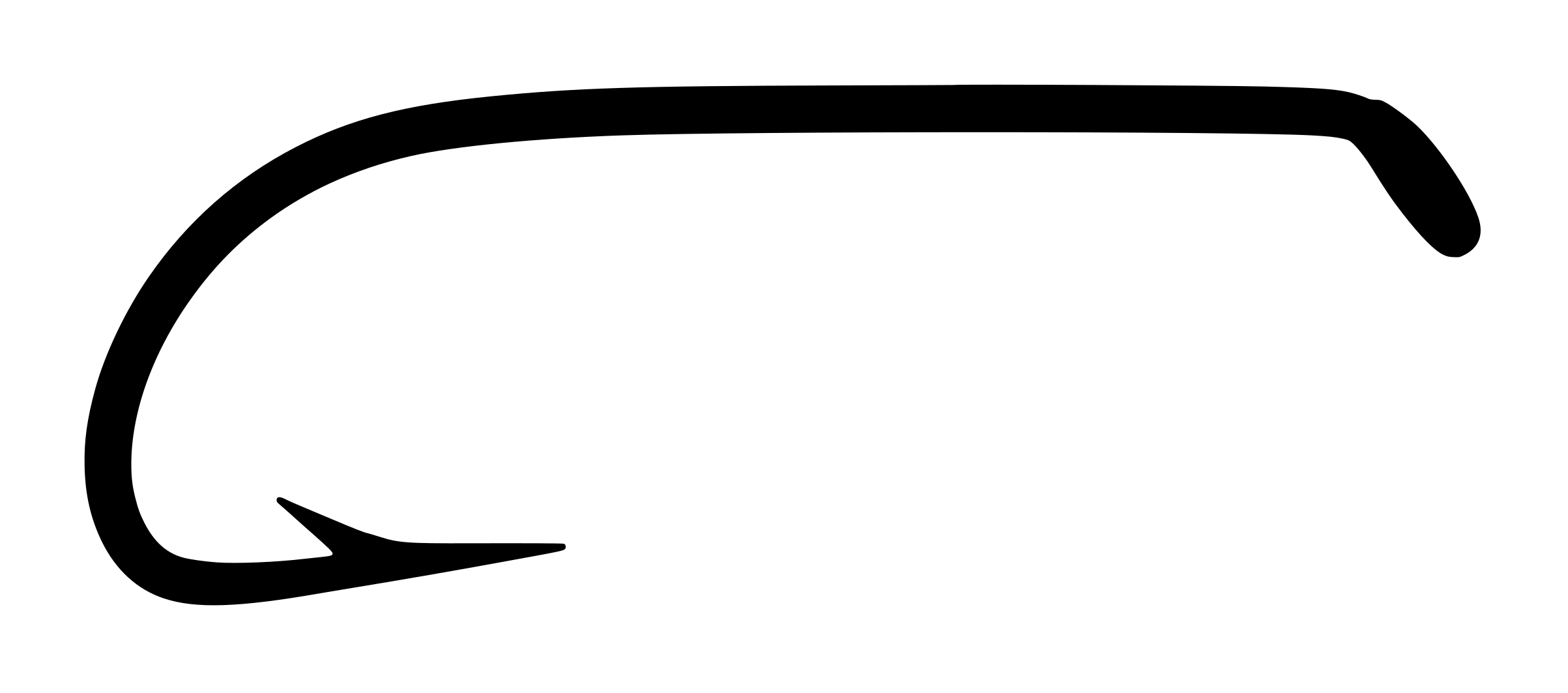
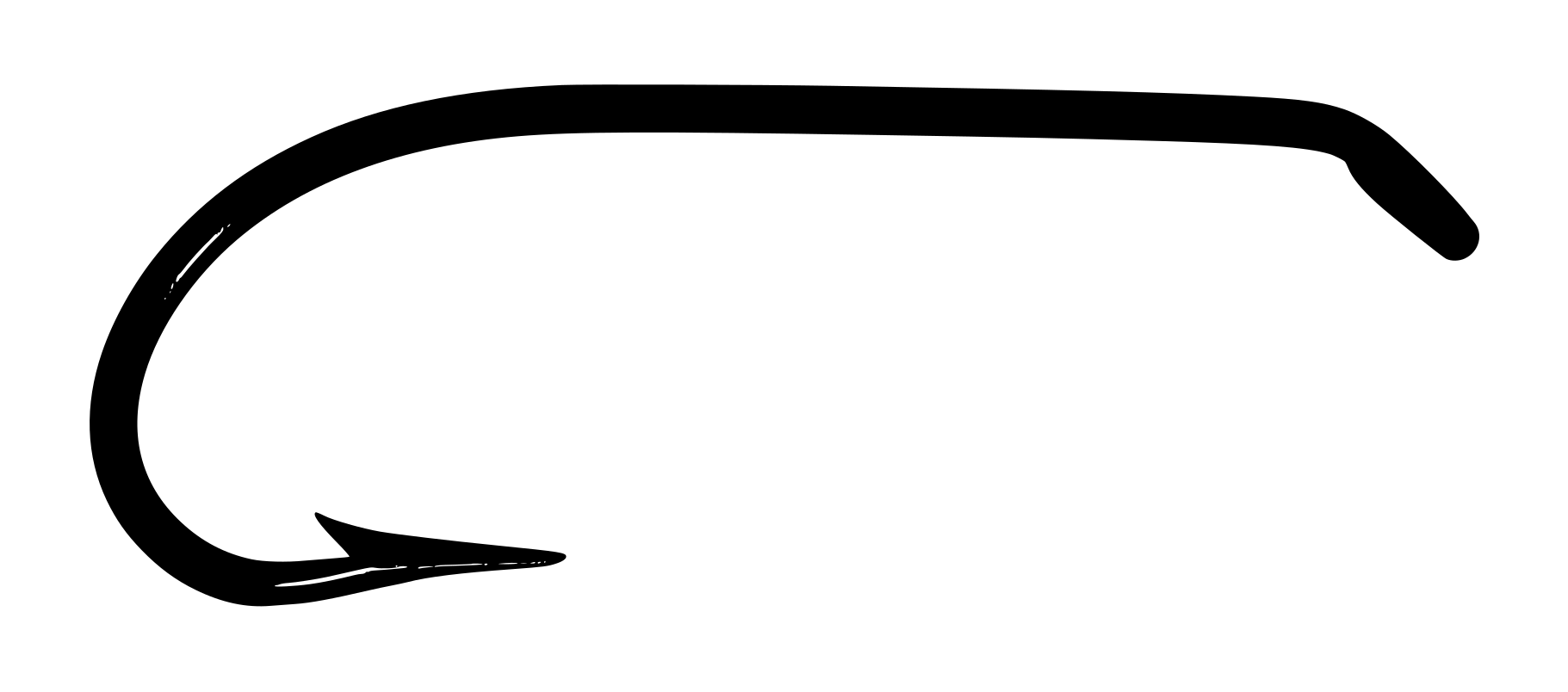
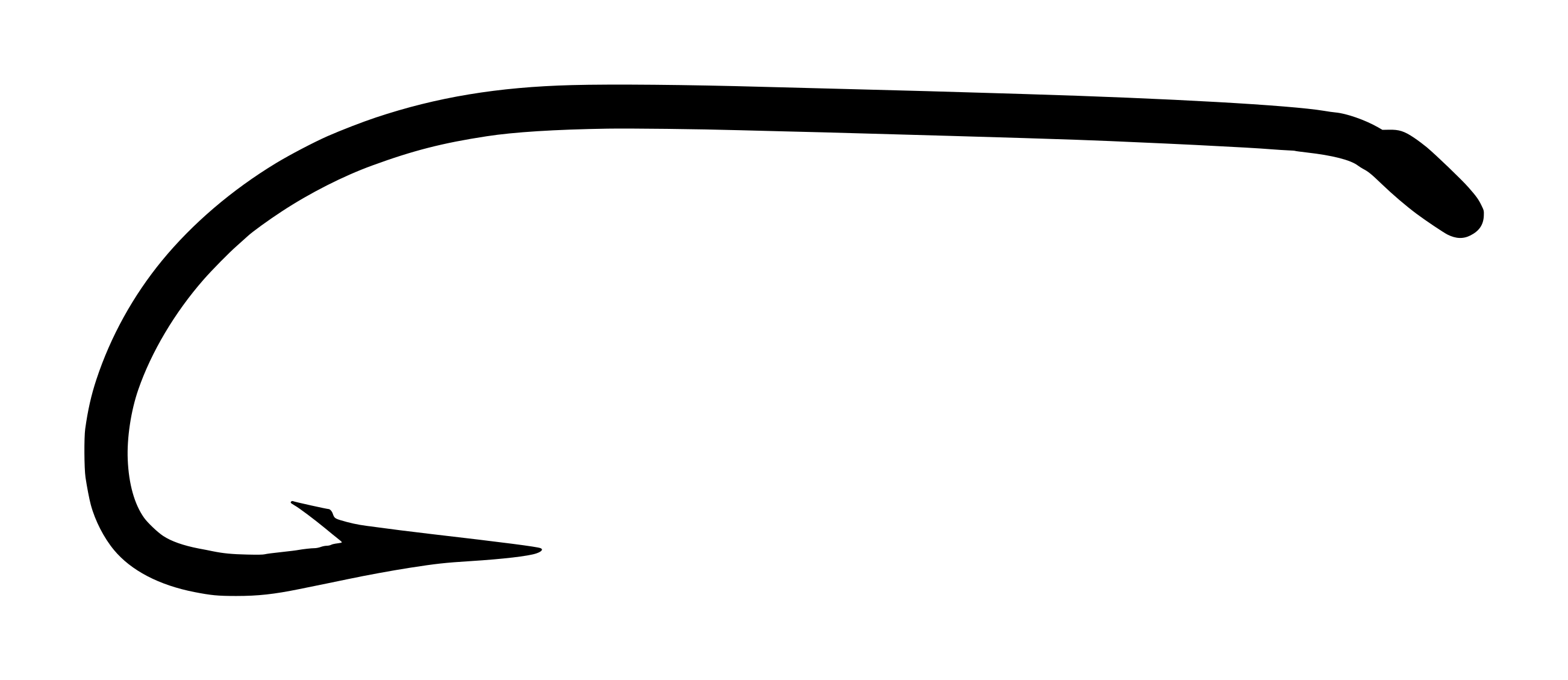
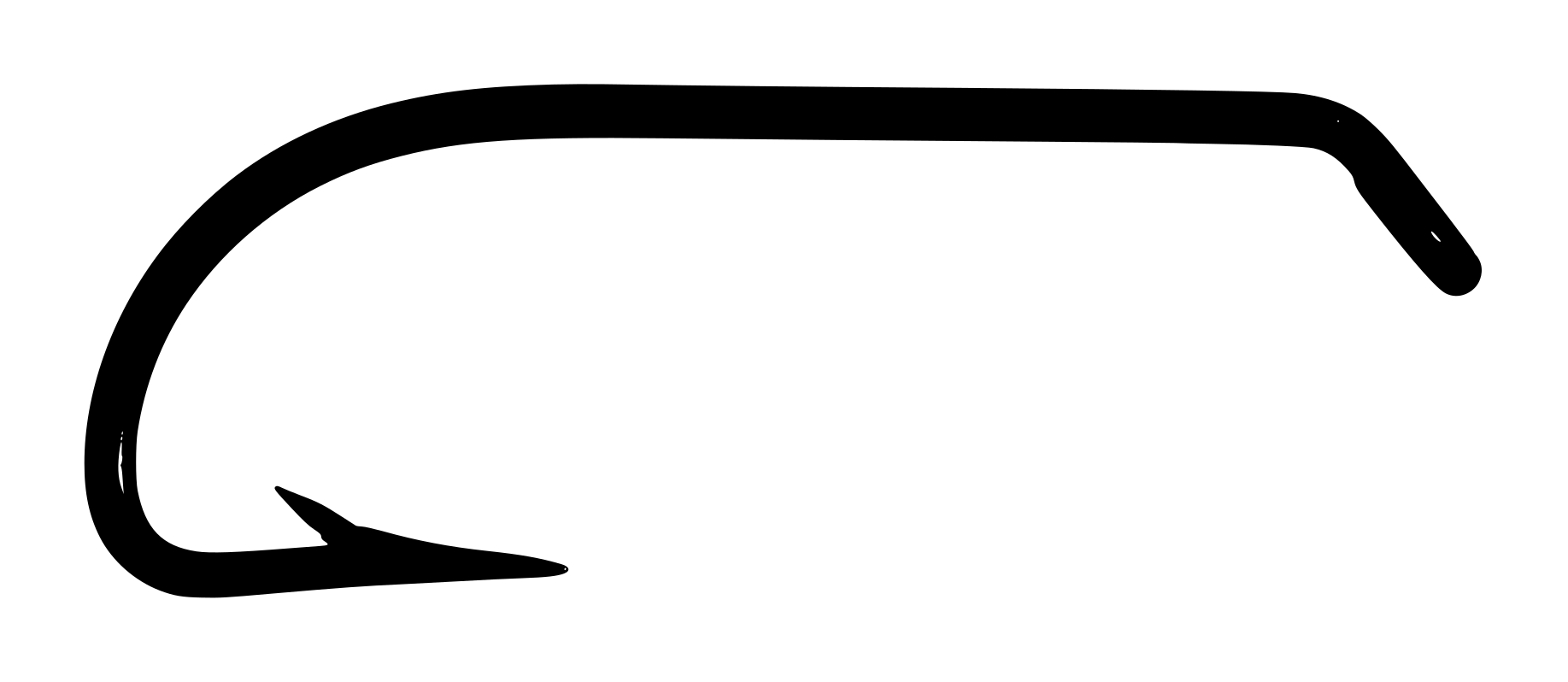
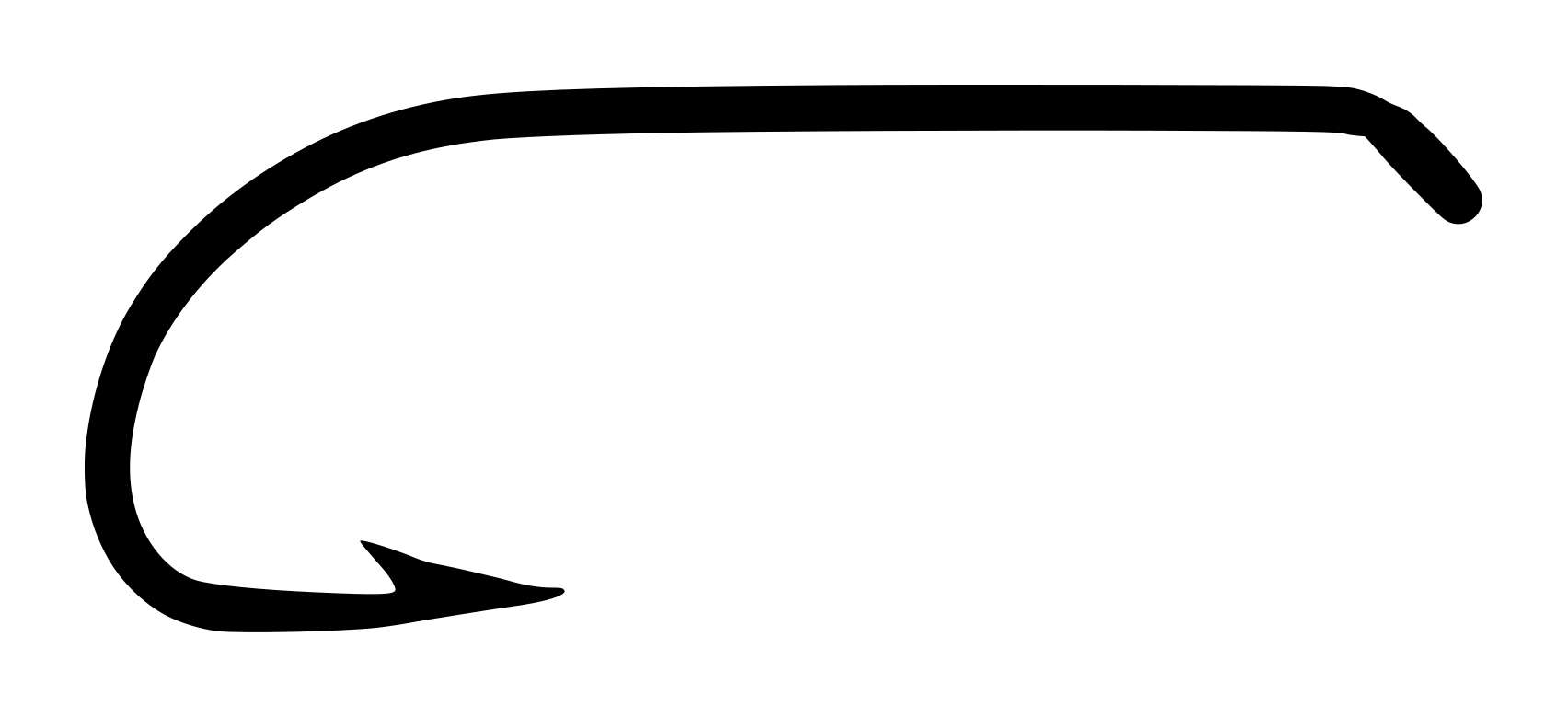
The Mustad 36712 represents a pinnacle of mid-20th-century salmon and streamer hook design from O. Mustad & Søn, a Norwegian manufacturer that dominated global hook production by the 1950s. This size-2 specimen exemplifies the Limerick bend—a slightly angular bottom geometry favored for Atlantic salmon flies—paired with a hollow point and 2X extra-strong wire to handle large-mouth predators and heavy tackle.
The turned-down large ball-eye and bronzed finish are signature features of vintage Mustad export production, designed to accommodate the heavier gut leaders and silk lines of the era. The gold foil label with decorative fleuron border and the ‘OSLO – NORWAY’ designation (confirming post-1925 production) situate this hook squarely in Mustad’s mid-century boom period, approximately 1950-1965, before the manufacturer transitioned to plastic packaging and simplified labeling in the 1970s. The presence of the arbitrary numeric quality code ‘Qual. 36712’—rather than a modern Signature Series designation—confirms this as a genuine vintage product from the classical hook era.
For collectors and historians, the 36712 documents Mustad’s industrial cloning strategy: the Limerick pattern itself originated with Irish blacksmiths and was adopted wholesale by Mustad for global distribution. This hook exemplifies a period when tackle was highly specialized for precise environmental and biological conditions, rather than homogenized for mass-market appeal. Hooks stamped ‘Made in Norway’ are increasingly scarce as manufacturing shifted to Asia in the 1970s and beyond, elevating the 36712’s value to tackle historians and vintage fly-tiers.
Mustad-36712-Box-and-Label-Size-2
Photographic record
4 cataloged imagesSelect any record to load it above.
4 images shown
Mustad-36712-Box-and-Label-Size-2Mustad-36712-Box-and-Label-Size-2Open originalMustad-36712-Hook-Point-Size-2Mustad-36712-Hook-Point-Size-2Open originalMustad-36712-Hook-Size-2Mustad-36712-Hook-Size-2Open originalMustad-36712-Hooks-Size-2Mustad-36712-Hooks-Size-2Open original
Technical profile
Eye
Ball Eye, Turned DownLarge ball-eye with uniform wire diameter (not tapered). The eye loop is approximately 2.2-2.4 mm in diameter, substantially larger than modern standard eyes, designed to accommodate heavier silk gut or braided horsehair leaders. The turn-down angle is clean and consistent, with the eye angling downward at approximately 15-20 degrees from horizontal. Ball formation is round and symmetrical. P
Wire
Heavy (1X Heavy), Round, Est. ~0.042"-0.048" (~1.07-1.22 mm)
Shank
2X Long — Plain
Bend
Limerick, Standard gapDistinctive angular geometry at the bend bottom, with a sharp angle (approximately 60-70 degrees) between the upper curve and the lower straight section. This is the hallmark Limerick characteristic, designed to lock the fish's jaw into the lowest, strongest point of the hook. The bend is symmetrical and shows no lateral offset. Wire set is clean with no visible deformation. P
Point
Hollow Point (concave inner face)Short, cleanly cut barb positioned immediately behind the point apex. Barb angle is approximately 30-35 degrees relative to the main shank axis, typical of Mustad's mechanical barbing of the era. No secondary barbs or micro-serrations visible. P
Finish
Bronzed — Confirmed (stated on packaging)Warm, muted bronze-gold tone consistent with alkyd lacquer-based bronzing process. Finish exhibits light patina on the specimen, with slight oxidation spotting visible on the shank near the bend, typical of age and storage conditions. The bronzed layer is uniform across the entire hook with no bare steel showing through. Finish tone is distinctly warmer than modern brass-plated versions, confirming period authenticity. P
Specimens are in bright, uncorroded condition with no pitting or heavy oxidation. The bronzed finish remains intact with only light patina consistent with age. No bends, deformations, or micro-fractures visible in the wire. Hooks retain their original sharpness and structural integrity. The label shows age-appropriate toning and minor creasing but remains fully legible.
The hollow point on the 36712 represents Mustad’s mechanically ground taper design, wherein the inner face of the point is deliberately concave or inwardly curved from the very tip down to the base of the barb. This geometry creates an extremely fine, razor-sharp tip that flares rapidly toward the barb—producing what was termed a ‘knife-edge effect.’ The primary mechanical advantage of the hollow point is its ability to achieve initial tissue penetration with minimal applied pressure, historically deemed essential for soft-mouthed fish such as trout and sea trout where aggressive hook-sets would merely tear friable tissue. The rapid flare of the hollow point ensures that once the incredibly sharp tip penetrates past the barb, the hook holds securely in soft tissue without creating an overly large entry wound prone to tearing during the fight.
The 2X extra-strong wire gauge indicates wire diameter equivalent to a hook two sizes larger than nominal (e.g., the wire of a standard size-4 hook). This engineering decision serves two functions: first, it dramatically increases structural rigidity and tensile strength, preventing the hook from bending open or straightening under the sustained pressure of a large, powerful fish; second, it accommodates heavier tackle (gut leaders, braided lines) without compromising knot strength at the eye. The round wire profile—as opposed to forged (flattened) wire—indicates standard production methodology and provides uniform strength distribution, though with slightly less shear resistance than forged variants.
The Limerick bend geometry, while appearing ornamental, encodes sophisticated biomechanics: the sharp angle at the lowest point of the bend creates a stress-concentration zone that mechanically engages the fish’s jaw. When a fighting fish applies pressure on the line, the jaw naturally rotates around this lowest point, creating a mechanical lock that is extraordinarily difficult to dislodge. This design principle was particularly valued for Atlantic salmon, whose hard, bony mouths can generate enormous striking and shaking forces that would slip or rotate on rounder bend geometries.
The Limerick Hooks series represents Mustad’s wholesale adoption of a regional Irish hook pattern, reverse-engineered and standardized for industrial mass production beginning in the late 19th century. The Limerick bend—characterized by its distinctive sharp, angular bottom geometry—originated with craftsmen in Limerick, Ireland, and became the dominant pattern for Atlantic salmon flies and heavy wet-fly fishing. Mustad’s industrial cloning strategy involved taking this localized, artisanal design and reproducing it with extreme Norwegian precision and efficiency, thereby cornering the global market for Limerick-pattern hooks. The 36712 model code represents the mid-tier quality designation within Mustad’s 3000-3999 quality tier, targeting general-purpose wet-fly and streamer applications. The Limerick series underwent incremental changes throughout the mid-20th century, with variations in eye type (ringed vs. turned-down), wire gauge, and finish (japanned vs. bronzed vs. tinned) to suit specific regional preferences and environmental conditions. The 36712 specifically was manufactured in both large-ball-eye and tapered-eye variants, with the large-ball variant (as documented here) being the standard export configuration for UK and North American markets. The Limerick series remained in continuous production through the 1960s and into the early 1970s, when modern fly-tying preferences shifted toward the Sproat bend for its superior even stress distribution. The transition to Mustad’s Signature Series (c. 2001-2009) officially discontinued the arbitrary numeric quality codes, rendering all hooks bearing codes like ‘Qual. 36712’ vintage artifacts.
Era and Packaging Dating
Label bears 'OSLO - NORWAY' designation (not 'Christiania'), indicating manufacture post-January 1, 1925. Gold foil label with decorative fleuron border is characteristic of Mustad's mid-century export packaging. Label employs the eight-line vintage typographical format with 'Qual.' prefix on model code, indicating production before the transition to the Signature Series (c. 2001-2009). No barcode present (pre-1974 strong indicator). Print method appears to be offset lithography on foil stock, typical of 1950s-1960s. The specific styling, packaging format, and decorative elements are consistent with Mustad's 1950-1965 period.
The Irish Origins of the Limerick Bend
The Limerick bend originated with 18th-century Irish blacksmiths in Limerick, Ireland, who empirically discovered that a sharply angled bottom bend mechanically locked the fish's jaw into the strongest point of the hook—an innovation that preceded any formal understanding of stress distribution in materials science. When Mustad adopted the Limerick pattern in the late 1800s, they were engaging in what the company termed 'industrial cloning': reverse-engineering a regionally specialized, artisanal hook design and reproducing it with extreme Norwegian precision for global distribution. This strategy allowed Mustad to corner market after market, moving from region to region and effectively displacing local hook makers by offering superior consistency and lower cost. The Limerick remains one of the last great examples of a hook design optimized for a specific species (Atlantic salmon) and a specific fishing tradition (classical wet-fly fishing), before modern hook engineering moved toward generalized, multi-purpose geometries designed to work adequately across diverse applications.
Design lineage and influence
The Limerick bend itself traces its lineage to 18th- and 19th-century Irish hook makers who engineered the angular bottom bend to mechanically lock the fish’s jaw into the strongest point of the hook—a biomechanical innovation that proved superior to the softer, rounder bends employed in English and Scottish traditions. When Mustad adopted the Limerick pattern in the late 1800s, they were competing directly with English manufacturers (particularly those in Redditch) who favored the rounder Sproat and Perfect bends. The Limerick design represented a distinctly different engineering philosophy: rather than distributing load evenly across the entire bend, the angular geometry concentrated holding power at the lowest point, making it superior for large, hard-fighting anadromous species like Atlantic salmon and steelhead. Modern competitors producing Limerick-style hooks include Tiemco (7999 for Spey work), Alec Jackson, and various British and Irish craft makers. However, the Limerick bend has largely fallen out of favor in contemporary fly tying, replaced by the mechanically superior Sproat and parabolic designs that provide more even stress distribution. Consequently, vintage Mustad Limerick hooks like the 36712 represent a direct evolutionary dead-end in hook geometry—a sophisticated but ultimately superseded design that, paradoxically, enhances their value to collectors and historians seeking to understand the full spectrum of 20th-century tackle evolution.
Best matchRelated by Attribute
Computed automatically from catalog data — updated as new hooks are added.
Matches: Bend, Shank, Eye Orient., Point, Finish +6 moreDiffers: Wire: Heavy (1X Heavy) vs Fine (1X Fine); Gap: Standard vs Narrow; Eye: Ball Eye vs Tapered Eye +1 more
Matches: Bend, Shank, Wire, Eye, Point +4 moreDiffers: Gap: Standard vs Wide; Eye Orient.: Turned Down vs Straight / Inline; Finish: Bronzed vs Blued +1 more
Matches: Bend, Shank, Wire, Gap, Eye +4 moreDiffers: Eye Orient.: Turned Down vs Straight / Inline; Point: Hollow Point vs Standard / Spear; Finish: Bronzed vs Black Japanned +3 more
The Mustad 36712 is engineered for wet fly, streamers, and heavy bucktails targeting large trout, bass, and anadromous species. The Limerick bend, combined with the hollow point and 2X extra-strong wire, creates a hook suited to classic Atlantic salmon flies, large saltwater streamers, and deep-water nymph presentations. The turned-down large ball-eye accommodates heavier gut leaders and allows secure knot placement, essential for vintage fly-tying techniques. The hollow point provides rapid tissue penetration with minimal applied pressure, ideal for delicate mouth structures of seatrout and large trout while the substantial wire gauge ensures structural integrity during protracted battles with powerful fish.
Classic Fly Patterns
Black Ghost, Mickey Finn, Woolly Bugger (large), Muddler Minnow (oversized), Herter's Black Bear Green, Salmon flies — classic Atlantic patterns
Modern Equivalents
Hook
Match Quality
Notes
Tiemco 7999
Good
Limerick-style bend for Spey and salmon work; looped eye design and heavy wire gauge provide functional similarity, though modern materials and precision grind differ
Mustad 3906B
Moderate
Same manufacturer, heavy wet-fly hook with similar wire gauge and ball-eye, but Sproat bend geometry differs significantly from the 36712's Limerick
Alec Jackson Spey
Good
Limerick-inspired bend for salmon and steelhead; modern construction and tapered-eye design make this a functional equivalent for contemporary Spey tying
Collector notes
The 36712 is scarce and historically significant. Positive factors include the 'Made in Norway' designation (increasingly rare), the original foil label with decorative fleuron border (packaging adds substantial value), and the mid-century era (1950-1965) represented by the vintage eight-line labeling system. Limiting factors include the availability of functional Limerick-pattern variants from the same manufacturer and the fact that the Limerick bend fell out of favor compared to the Sproat, reducing demand from contemporary fly-tiers.
Reference value
$8 – $18 USD estimate
Packaging format
GW-MUSTAD-FOIL-001Catalog code
Positive Factors: The gold foil label with intact decorative border is a major collecting asset—original packaging significantly elevates value. The ‘Made in Norway’ and ‘OSLO – NORWAY’ designations are increasingly scarce; manufacturing moved to Asia from the 1970s onward, making Norwegian production stamps a chronological and provenance benchmark. The arbitrary numeric quality code ‘Qual. 36712’ is a definitive vintage marker, predating the Signature Series transition (c. 2001-2009). The hook itself is in bright, undamaged condition with original sharp point and no corrosion. The Limerick bend, while historically superseded, represents an important design chapter in hook evolution and appeals to historians and purists seeking to document the full spectrum of 20th-century tackle innovation.
Limiting Factors: The 36712 is one of many Limerick variants produced by Mustad; the series is not so rare as to command extreme prices. Modern fly-tiers have largely abandoned the Limerick bend in favor of the Sproat and parabolic geometries, reducing contemporary demand. The size-2 is neither exceptionally large nor small, placing it in the middle of the collecting spectrum. The bronzed finish, while attractive, is less distinctive than japanned or tinned variants. Loose hooks without original packaging command significantly lower prices.
Packaging
Gold foil label affixed to kraft cardboard box. Label features the iconic Mustad 'Key Brand' downward-pointing skeleton key logo in upper left, accompanied by 'Key Brand' text. Decorative fleuron border (six-pointed star repeat pattern) frames all edges. Text printed in gold/ochre ink. Eight-line format: Line 1: 'O. MUSTAD & SÖN' | Line 2: 'MANUFACTURERS' | Line 3: 'OSLO - NORWAY' | Line 4: 'Qual. 36712' | Line 5: 'Hollow Point' | Line 6: 'Mustad-Limerick Hooks' | Line 7-8: 'T.D. large ball-eye / Bronzed / 2 ex. strong'. Size and quantity noted: '100 No. 2'. Bottom indicates 'Made in Norway'. Foil stock shows age-related toning and minor creasing consistent with mid-20th-century storage.
Market Value Notes
Loose size-2 examples typically sell for $8-12 USD on eBay and specialist vintage tackle dealers. Specimens in original foil-labeled packaging command $15-25 USD, with premiums for intact decorative borders and clear legibility. Variants with tapered eyes or japanned finishes may achieve higher prices. European sellers often price higher than North American markets. Condition is paramount—bright, uncorroded hooks retain top-tier value; oxidation or corrosion reduces price by 30-50 percent.
Where to Find
eBay vintage fishing tackle listings (search 'Mustad 36712' or 'vintage Limerick hooks'); specialist dealers in European fly-fishing tackle and antique fishing equipment; UK and Irish tackle fairs; occasional sales via garrenwood.com references and collector networks; Singlebarbed forum marketplace.
Preservation
Storage and Preservation
Store the original foil-labeled packaging in a cool, dry environment away from direct sunlight, which can fade the gold ink and degrade the label adhesive. High humidity promotes bronze patina development and eventual corrosion—maintain relative humidity below 50 percent if possible. Original packaging adds significant value; store hooks on the card rather than loose to preserve the label and presentation. The bronzed finish is susceptible to patina and surface oxidation with humidity exposure; this patina is often considered desirable by collectors as it indicates age authenticity, but excessive moisture should be avoided. Avoid contact with other metals (particularly iron or copper) to prevent galvanic corrosion. Do not clean the bronzed finish aggressively; light dusting with a soft cloth is preferable. If displaying the hook, use a non-acidic mounting card and keep away from salt-air environments. Periodically inspect for corrosion, particularly in the bend and barb areas where moisture tends to accumulate.
Primary Source
Decoding the Vintage Mustad Eight-Line Label
Source: Mustad-Guide.pdf, referenced in 'A Comprehensive Typology and Decryption of Vintage O. Mustad & Søn Hook Labels'
The gold foil label on this Mustad 36712 exemplifies the standardized eight-line typographical format that governed vintage Mustad export packaging for over a century. Line 1 identifies the ultimate corporate authority: ‘O. MUSTAD & SÖN’ (full, unabbreviated manufacturer name). Line 2 establishes the company’s function within the global supply chain: ‘MANUFACTURERS’—a critical distinction, as the tackle market of the late 19th and early 20th centuries was saturated with import agents and jobbers who purchased bulk hooks and repackaged them under secondary brand names. By cementing their role as primary manufacturers, Mustad ensured brand loyalty directly from end-users regardless of distribution networks.
Line 3, ‘OSLO – NORWAY,’ provides one of the most vital chronological clues for dating. Norway’s capital was officially renamed from Christiania to Oslo on January 1, 1925. Thus, any Mustad box bearing ‘OSLO’ is conclusively post-1925. The presence of ‘OSLO’ rather than ‘Christiania’ typically brackets production between 1925 and the 1970s-1980s transition to plastic packaging.
Line 4, ‘Qual. 36712,’ introduces the specific model number using the ‘Qual.’ (Quality) prefix. This numeric code represents a highly structured product categorization system wherein economy models occupied the 1000-2999 range, quality mid-tier products the 3000-3999 range, and premium models 4000 and above. The 36712 sits within the 3000s quality tier, indicating a mid-range, exacting product manufactured to precise dimensional and tempering standards.
Line 5, ‘Hollow Point,’ is the most strictly regulated element of the entire labeling system, reserved exclusively for defining the geometric shape or quality grade of the hook point. Under no circumstances does this line specify wire gauges, shank lengths, or eye configurations. The hollow point designation here confirms the specific grinding technique Mustad employed to create a concave point with maximum penetration efficiency.
Lines 6-8 provide supplementary anatomical features and finishes: ‘Mustad-Limerick Hooks’ (Line 6) identifies the overarching geometric pattern and shank/bend proportion; ‘T.D. large ball-eye / Bronzed / 2 ex. strong’ (Lines 7-8) specify the eye type, chemical finish, and wire gauge. The decorative fleuron (six-pointed star) border framing the entire label is characteristic of Mustad’s mid-century export packaging (1950s-1960s) before they transitioned to simpler, cost-effective label designs in the 1970s.
Additional
The Limerick Bend: Engineering a Mechanical Lock
The Limerick bend represents a distinctly different engineering philosophy from competing bend geometries of the Victorian and early 20th-century era. Rather than distributing stress evenly across a parabolic or rounded curve (as in the Sproat or Perfect bends), the Limerick features a sharp, angular bottom that creates a stress-concentration zone—deliberately concentrating holding power at the lowest, strongest point of the hook.
When a large Atlantic salmon or steelhead strikes the fly and turns to run, the fish’s lower jaw naturally rotates around the deepest, most rigid point of the hook. This mechanical action effectively locks the jaw into the bend, creating an engagement that resists rotation and tearing. For species with hard, bony mouths (particularly anadromous fish), this design proved superior to softer, rounder bends that allowed the jaw to slip or rotate more freely.
However, the Limerick’s concentrated stress point came with a biomechanical trade-off: the sharp angle also created a potential fracture point under extreme load. Consequently, Mustad engineers paired the Limerick bend with 2X or 3X extra-strong wire in most iterations—a deliberate over-engineering of the wire gauge specifically to counterbalance the geometric stress concentration. On the 36712, the 2X extra-strong wire ensures that even under the sustained, violent runs of a large salmon, the hook wire will not shear at the bend angle.
By the 1970s and 1980s, modern hook designers—armed with finite-element analysis and stress-distribution modeling—recognized that the parabolic Sproat bend, with its mathematically even load distribution, was superior for general-purpose applications. The Limerick gradually fell out of favor in contemporary fly tying, though it remains the preferred geometry for certain specialized applications (notably Spey casting) where its mechanical lock is still valued. Ironically, this obsolescence enhances the Limerick’s historical significance: it documents a complete engineering lineage—from empirical discovery by Irish blacksmiths, through industrial standardization by Mustad, to eventual replacement by more sophisticated designs—making vintage Limerick hooks like the 36712 invaluable documents of hook evolution.
Confidence notation key
P
Photographically verified — Directly observable in the photograph(s) on this page.
V
Verified by documentation — Confirmed by manufacturer catalog, spec sheet, or published reference.
I
Inferred — A logical deduction from observable or documented evidence, not directly stated.
E
Estimated — An approximation based on visual comparison, proportional analysis, or limited data.
S
Speculative — A reasoned hypothesis that cannot be confirmed from available evidence.
Unnotated claims are the compiler’s synthesis; see Sources. All photographs on garrenwood.com are taken on a measurement grid where each square equals 1/10 inch (0.1″ / 2.54 mm).