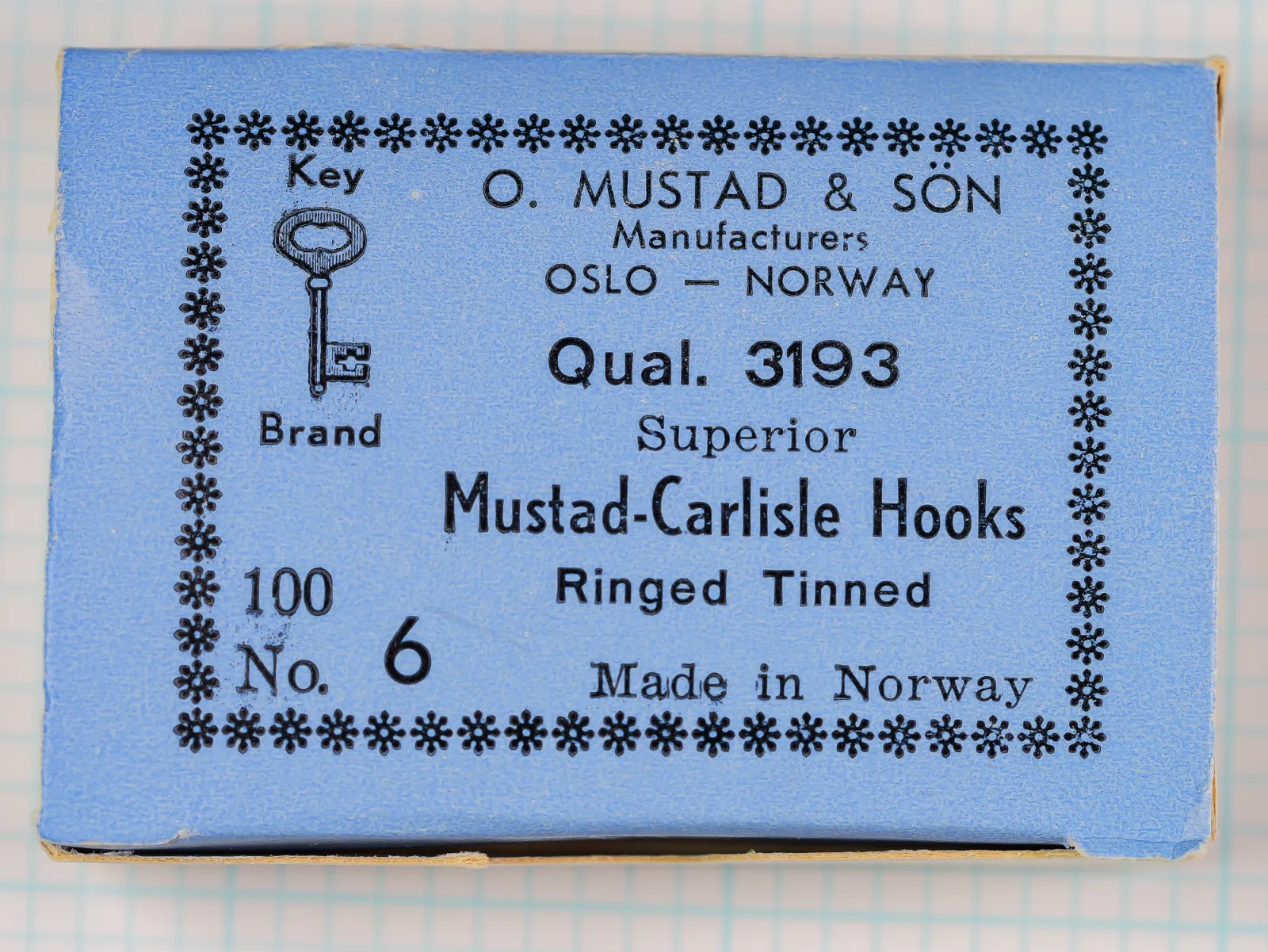
O. Mustad & Son, Quality 3193 Carlisle Hooks, tinned finish, size 6 specimen shown. This box contains 100 hooks, packaged in a bright powder-blue rigid box with black letterpress labeling and characteristic Mustad Nordic aesthetics. The Carlisle bend is a gentle rounded pattern with moderate depth and kirbed offset, historically favored for streamer and bait fishing in both freshwater and light saltwater applications.
The hooks measure 1.4 inches overall length (35.56 mm) with a narrow 0.274-inch gap (6.96 mm) and standard wire gauge. Extra-extra-long shank is characteristic of the pattern, accommodating larger bait presentations or extended streamers. The superior point features a near-straight inner taper with excellent penetration properties and a working barb positioned below the point.
Packaging evidence — no barcode, letterpress print, powder-blue Nordic design, “Made in Norway” statement — indicates production in the 1950s–1960s mid-century era. The specimen box shows light wear consistent with period storage but retains all 100 hooks in bright condition. The straight-eye configuration is relatively uncommon on streamer patterns of this era, and the narrower gap makes this variant distinct from more standard Carlisle offerings.
Carlisle hooks occupied a middle ground between light-duty Sproat patterns and heavier OShaughnessy designs, making them a practical all-purpose choice for tyers who needed a hook that could handle both fly materials and live or cut bait without excessive wire weight.
Original powder-blue rigid box with black letterpress labeling and ornamental star border, containing 100 tinned Carlisle hooks, size 6. Box shows light shelf wear with intact lid and clear printing throughout.
Photographic record
3 cataloged imagesSelect any record to load it above.
3 images shown
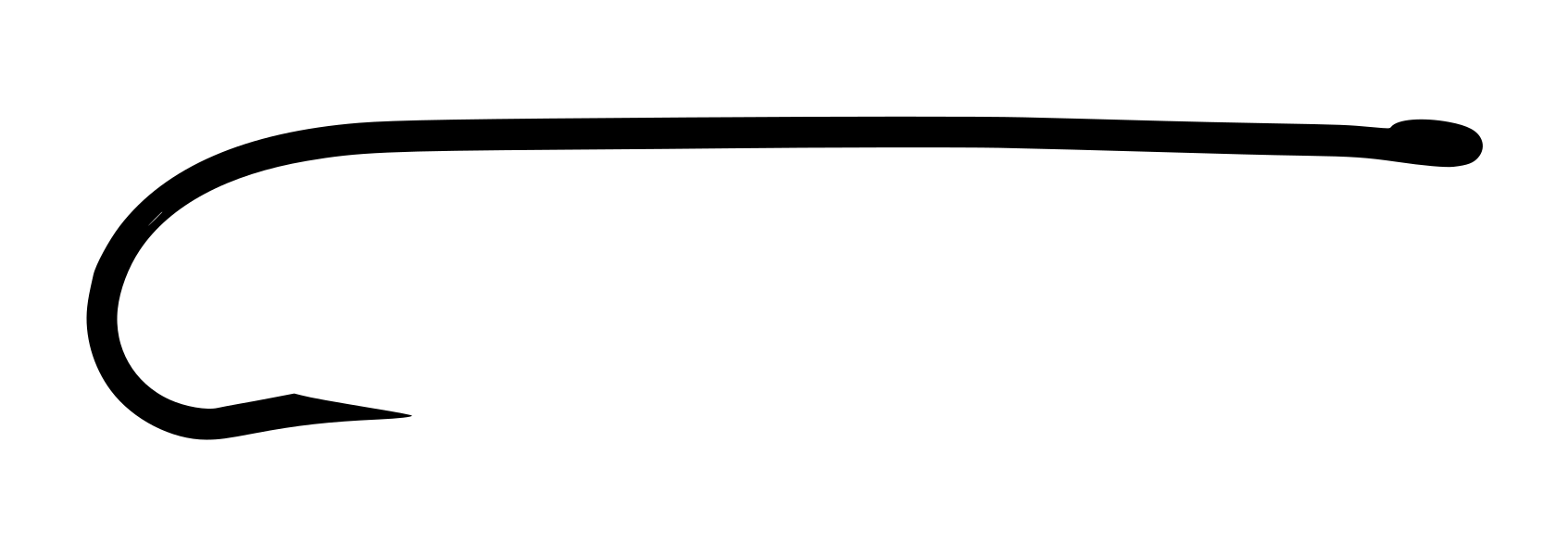
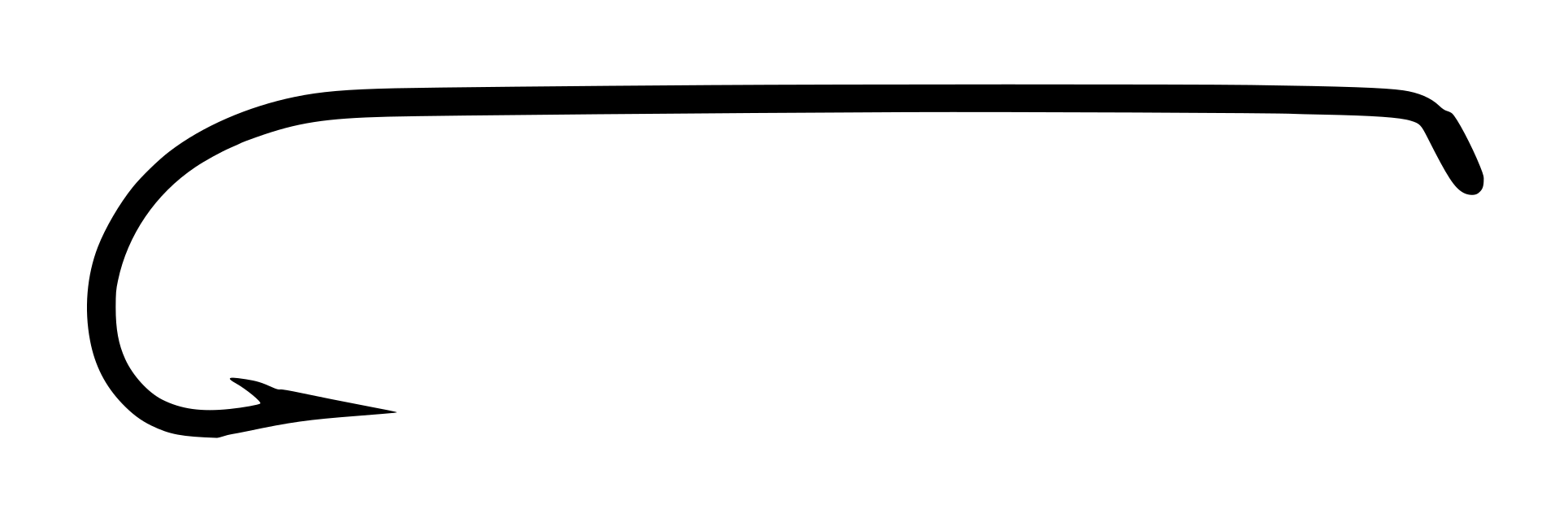
Mustad Quality 3193 Carlisle Hooks Size 6 — Box ExteriorOriginal powder-blue rigid box with black letterpress labeling and ornamental star border, containing 100 tinned Carlisle hooks, size 6. Box shows light shelf wear with intact lid and clear printing throughout.Open originalMustad Quality 3193 Size 6 — Hook Profile and BendSide profile view of a size 6 Carlisle hook showing the gentle inward curve of the bend, kirbed offset, and superior point geometry. Hook photographed on 0.1-inch grid for precise measurement and scale reference.Open originalMustad Quality 3193 Size 6 — Full Hook Dorsal ViewFull dorsal (top-down) view of the size 6 Carlisle hook showing straight-eye orientation, balanced kirbed offset throughout the bend, and overall proportions on measurement grid. Extra-extra-long shank is evident relative to the gap width.Open original
Technical profile
Straight / Inline Ball Eye | Carlisle | Extra-Extra Long | Superior Point | Tinned
Eye
Ball Eye, Straight / InlineBall eye is uniform in diameter, cleanly formed with proportional size relative to standard shank wire gauge. Eye is inline (straight orientation) rather than turned; this construction is somewhat less common than turned-down eyes on streamer and bait hooks of the period. Wire ends are butted cleanly to shank closure P.
Wire
Standard, Round
Shank
Extra-Extra Long (XXL) — Plain
Bend
carlisle, Narrow gap, Offset / kirbedCarlisle bend displays the characteristic gentle inward curve of the family — a rounded hook with moderate depth and light offset. The bend is smooth and symmetrical, with even wire distribution throughout the curve. The depth-to-width ratio is standard for the Carlisle pattern. Kirbed offset is subtle but present throughout the bend P.
Point
Superior (near-straight inner taper)Standard cut barb positioned just below the point. Barb is short and close-cut, angled moderately inward at approximately 45 degrees. Single barb construction. Barb size and placement consistent with Mustad standard production specifications for this period P.
Finish
Tinned — Confirmed (stated on packaging)Tinned finish is bright silver, evenly applied throughout the wire. Tone is slightly warmer and duller than pure nickel — characteristic of tinned steel. The finish is uniform with no streaking, oxidation, or patina visible on the specimen. Wire texture remains visible beneath the finish, indicating a thin application P.
Box exterior shows light edge wear and minor scuffing on corners consistent with shelf storage. Lid remains properly hinged and closes securely. Blue finish uniform without fading; letterpress print sharp and legible throughout. Interior box and lid show minor dust accumulation but no moisture damage or corrosion. All 100 hooks present, bright tinned finish with no visible oxidation or surface corrosion. Hooks stored loose without original tissue; no hookmarks or tangle damage evident.
The superior point represents a classical taper geometry optimized for clean penetration. Unlike the hollow point’s concave inner face (which creates a knife-edge but sacrifices inner-surface strength), the superior point maintains a near-straight inner profile from barb to tip. This trade-off — sacrificing extreme sharpness for marginally greater durability in the inner taper — made the superior point historically popular for bait hooks and robust fly patterns where repetitive casting or friction against hard surfaces was expected.
The Carlisle bend’s moderate depth and inward curve distribute stress evenly across the bend, reducing the tendency to develop weak points or fracture lines under heavy pressure. The gentle radius is less severe than the angular Limerick or the extreme O’Shaughnessy, making it suitable for lighter tippet material and smaller baits.
The extra-extra-long shank lengthens the hook’s working length by approximately 35–40% relative to standard models, shifting the hook’s center of mass and balance point forward. This property made XL shank variants preferred for tandem rigs, articulated streamers, and bait presentations where the extended leverage improved hook-setting performance and reduced line-twist in spinning applications.
Tinning with a bright silver finish increases corrosion resistance and reduces tarnish development compared to bare steel or bronzed finishes, making it a practical choice for freshwater use where moisture and organic acids (from decaying plant matter and sediment) can accelerate oxidation. The tinned surface also provides minimal light reflection, reducing spooking risk in clear water.
This pattern was made in sizes 2-16 (V). We have measurement for size 6. Know the others? Submit calipered measurements and we'll review and add them. Thank you!
The Carlisle bend, as a hook family, derives from 19th-century English wet-fly tradition. The pattern originated as a refined alternative to heavier Sproat designs and lighter Round-Bend models, offering a compromise in depth and wire weight suitable for medium-sized freshwater flies and baits. The Carlisle design was adopted across multiple manufacturers — Allcock, Edgar Sealey, and eventually Mustad — ensuring it became a standard reference pattern by the early 1900s.
Mustad’s Quality 3193 designation indicates a specific production variant established within Mustad’s internal model-numbering system, likely in the inter-war or immediate post-war period. The “3193” code bundled specific combinations: Carlisle bend + tinned finish + normal wire gauge + ball eye. Variants of the same conceptual pattern existed under slightly different quality numbers (e.g., 3191, 3192, 3195) with minor specification changes.
The tinned “Ringed” designation printed on the box refers to a surface treating method — light scoring or dimpling of the wire surface intended to provide tactile grip for binding materials during fly-tying. This specification was standard across Mustad’s mid-century production and distinguished the hooks from smooth-finish variants. The practice fell out of common use by the 1980s as synthetic binding materials and modern vise technology reduced the perceived benefit.
The straight-eye configuration of this specimen, while confirmed on this box, was less common than turned-down equivalents. Straight eyes on streamer patterns were typically favored in saltwater contexts or for larger bait presentations where hook orientation needed to be neutral rather than naturally angled downward.
Era and Packaging Dating
No barcode present — strong indicator of pre-1974 manufacture. Letterpress print method (not offset lithography) consistent with 1950s-1960s production. Powder-blue box stock and four-point star border design are characteristic of mid-century Mustad Nordic packaging. "Oslo — Norway" address format and key logo style consistent with post-WWII Mustad standard branding. "Made in Norway" nationalist statement typical of 1950s-1960s Norwegian industrial marketing. Absence of metric conversions (e.g., "mm" alongside inches) suggests pre-metrication era, supporting 1950s-early 1960s. Ringed Tinned designation was standard Mustad descriptive term from 1940s onward but remained in use through 1970s. No modern barcode, lot code, or regulatory text. Conservative estimate: c. 1950-1970, with central production likely 1955-1965.
The Ringed Finish and the Tying Vise Tradition
The "Ringed Tinned" designation printed on this box refers to a surface treatment that modern tyers rarely encounter: light circumferential scoring or micro-dimpling of the wire shank to improve grip during hand-binding with thread. In the era before lever-actuated rotary vises and thread-tension bobbins became universal, fly tyers relied on mechanical friction and the hook shank's surface finish to keep materials from slipping during wrap-around work. The ringed surface — achieved by light knurling or intentional surface-oxidation patterns during tinning — gave the binding thread a slight mechanical purchase, reducing the need to over-tighten and risk breaking fine materials or damaging delicate fur and feather. This became less necessary as vise technology evolved and synthetic thread materials (polyester, GSP) offered better grip characteristics than traditional silk. The "ringed" specification has largely disappeared from modern catalogs, making vintage examples like this box a relic of a specific tooling tradition that predates modern fly-tying ergonomics.
Design lineage and influence
The Carlisle bend traces to 19th-century English wet-fly design, emerging as a refinement of the Round-Bend model. Unlike the sharper Limerick or the bulky O’Shaughnessy, the Carlisle offered moderate depth with inward curve, positioning it between extremes. The pattern was documented by Allcock and other English makers by the 1890s and became a reference standard across European and North American manufacturers by the 1920s.
Mustad’s adoption of the Carlisle pattern signaled the firm’s commitment to traditional English patterns alongside its own Norwegian-developed designs (such as the Viking and the Egg Hook). This dual-catalog approach reflected the industrial reality that Mustad’s market was global and regionally diverse — Norwegian anglers had different preferences than British, American, or Scandinavian fly fishers.
Contemporary competitors offering Carlisle-pattern hooks included Partridge of Redditch, H. Milward & Sons, and Allcock, which maintained their own Carlisle variants. Mustad’s industrial production volume and pricing allowed it to undercut craft makers on commodity items like the Carlisle, concentrating design innovation on proprietary patterns and specialty variants.
Downstream influence of the Carlisle has been modest. The pattern remains available from some modern makers (e.g., Partridge retains a Carlisle offering) but has been largely supplanted by the more angular O’Shaughnessy for heavy work and the more delicate Sproat for lighter applications. The Carlisle now occupies a transitional niche rather than a primary position in modern hook design.
Best matchRelated by Attribute
Computed automatically from catalog data — updated as new hooks are added.
Matches: Bend, Wire, Eye, Eye Orient., Point +4 moreDiffers: Shank: Extra-Extra Long vs 4X Long; Gap: Narrow vs Standard; Finish: Tinned vs Gold-Plated +1 more
The Carlisle Hooks, Quality 3193, are documented as suitable for both streamer and bait fishing. In streamer contexts, the extra-extra-long shank accommodates larger bucktail, marabou, and hair-wing flies tied for trout, pike, and early saltwater applications. The narrow gap and straight eye are less typical for classic streamer dressing but suitable for sparsely tied patterns or presentations emphasizing lateral profile over bulk.
As a bait hook, the extra-long shank and superior point are designed for live or cut bait presentations in freshwater systems — small fish baits, shiners, and cut-herring applications for pike, large trout, and warm-water species. The straight eye provides a neutral presentation angle, avoiding the downward cant that some anglers found unnatural for bait rigs.
Historical documentation is sparse for this specific variant, but the tinned finish and packaging designation (“Ringed Tinned”) suggest production for mid-century tackle catalogs targeting amateur anglers who needed a single hook pattern capable of dual-purpose work — fly and bait interchangeably.
Secondary Applications
Light saltwater streamer work (pre-1970s coastal fly fishing was less specialized). Small livebait presentations for freshwater pike and pike-perch. Tandem-rig mid-body hook on larger streamers. Experimental nymph dressing in larger sizes (10–12) where extra shank length was preferred over traditional short-shank nymph patterns.
Classic Fly Patterns
Not typically associated with specific named fly patterns. The hook's extra-long shank and straight eye made it a general-purpose component rather than the standardized substrate for a signature pattern. Amateur tyers of the 1950s-1960s era likely improvised freely across multiple dressing styles without formal pattern documentation.
Collector notes
Rated 4.0/10. Uncommon overall, but size 6 is representative and readily available in archive collections. The straight-eye variant and original powder-blue box are more desirable than later cardboard packaging. Collector demand is moderate among Mustad specialists and mid-century tackle historians. Complete, unopened box commands a modest premium; individual loose hooks have negligible collector value. Condition and packaging completeness are the primary value drivers.
Reference value
$4 – $12 USD estimate
Packaging condition
Very Good — light wear, fully legibleRecorded specimen
Packaging format
GW-Mustad-01Catalog code
Positive Factors: Original rigid manufacturer box with vibrant finish, complete 100-hook count, all hooks present and in bright condition. No barcode or modern markings make this clearly mid-century Mustad production. Powder-blue Nordic box design is visually distinctive and appeals to packaging collectors. Straight-eye configuration on a Carlisle pattern is less common than turned-down variants, adding mild variant interest. The Carlisle pattern itself is historically significant as a traditional English design adopted by industrial manufacturers.
Limiting Factors: Mustad hooks were produced in enormous quantities and remain abundant in used and new condition. Size 6 is neither exceptionally scarce nor notably large. The Superior brand line, while attractive, was a standard commercial offering rather than a limited or experimental production. Straight-eye configuration, while interesting, does not substantially increase demand since most collectors and tyers prefer turned-down eyes for practical reasons. No famous associated fly patterns or designer attribution. The tinned finish is less valued by collectors than bronzed or blued equivalents, which show more character and patina development.
Desirable Variants: Smaller sizes (14, 16, 18) are scarcer in this line and command modest premium. Original sealed box with intact tissue wrapping (if ever used) would be worth 50% more than opened and loose. Turned-down eye variant would be more broadly collectible. Complete original set of Quality 3193 in all sizes 2–16 in original packaging would constitute a significant lot.
Condition Factors Affecting Value: The box condition is the dominant value component — a box in mint condition (sealed, no shelf wear) can fetch 50% premium. This specimen’s very good condition (light wear, all hooks intact) represents the standard expectation. Missing hooks reduce value approximately 2–3% per hook for small losses (<5 hooks); larger gaps (10+ missing) reduce value by 20–30%. Corrosion or tarnish on the hooks themselves dramatically reduces value — bright tinned finish is the expectation. Water damage or mold on the box is a dealbreaker, cutting value by 50% or more.
Packaging
Rigid manufacturer box with separate hinged lid. Exterior: bright powder-blue finish with black letterpress print. Ornamental border of small four-pointed stars on all four sides. Interior lid and bottom box unprinted. Dimensions approximately 5.5" × 3.5" × 1.5" (140mm × 89mm × 38mm). Contents: 100 loose tinned hooks, stored without tissue or dividers. Printed text: Key logo, O. Mustad & Son / Manufacturers / Oslo — Norway / Qual. 3193 / Super / Mustad-Carlisle Hooks / Ringed Tinned / Made in Norway / No. 6 / 100. All text black letterpress on blue stock. No barcode. No date. No price marking visible.
Market Value Notes
Low ($4): Good condition, box worn, 90–95 hooks present, minor shelf marks. High ($12): Very good to excellent condition, box minimal wear, all 100 hooks bright and complete, lid secure. Premium factors: Original rigid box (2–4× loose hook value), complete 100-count (vs partial), bright tinned finish, larger sizes 2–8 more valuable than smaller sizes 12–16, straight-eye variant interest. Platforms: eBay (international), occasional Etsy vintage tackle lots, regional tackle shows and swap meets. Confidence: E estimated — limited comparable sales data specific to Quality 3193 in original box; estimate based on general Mustad Superior line performance and mid-century box packaging premiums. Larger lots and sealed examples can exceed high estimate.
Where to Find
eBay UK and eBay US (vintage fishing tackle category). Etsy vintage tackle shops, particularly those specializing in mid-century Norwegian or Scandinavian products. Regional tackle swaps and antique shows in Europe and North America. Specialized vintage-tackle dealers in Scandinavia and the UK. Auction houses with estate tackle lots. Rarely listed at major online retailers — primarily collector-to-collector transactions.
Collector's Identification Tips
Mustad Quality 3193 can be identified by the bright powder-blue box with black letterpress border and star ornament. The “Qual. 3193” designation is printed clearly below the company name. The package states “100” and specifies “No. 6” prominently. The straight-eye configuration is unusual for Carlisle hooks and can be confirmed by visual inspection of the hooks themselves — they do not angle downward as turned-down eyes would. The tinned finish has a bright silver tone (warm compared to pure nickel). Absence of barcode, metric conversions, and modern safety labeling confirms mid-century origin. Size range 2–16 is documented on the box. The overall box dimensions and letterpress print quality are diagnostic for 1950s-1960s Mustad Nordic production.
Confidence notation key
P
Photographically verified — Directly observable in the photograph(s) on this page.
V
Verified by documentation — Confirmed by manufacturer catalog, spec sheet, or published reference.
I
Inferred — A logical deduction from observable or documented evidence, not directly stated.
E
Estimated — An approximation based on visual comparison, proportional analysis, or limited data.
S
Speculative — A reasoned hypothesis that cannot be confirmed from available evidence.
Unnotated claims are the compiler’s synthesis; see Sources. All photographs on garrenwood.com are taken on a measurement grid where each square equals 1/10 inch (0.1″ / 2.54 mm).