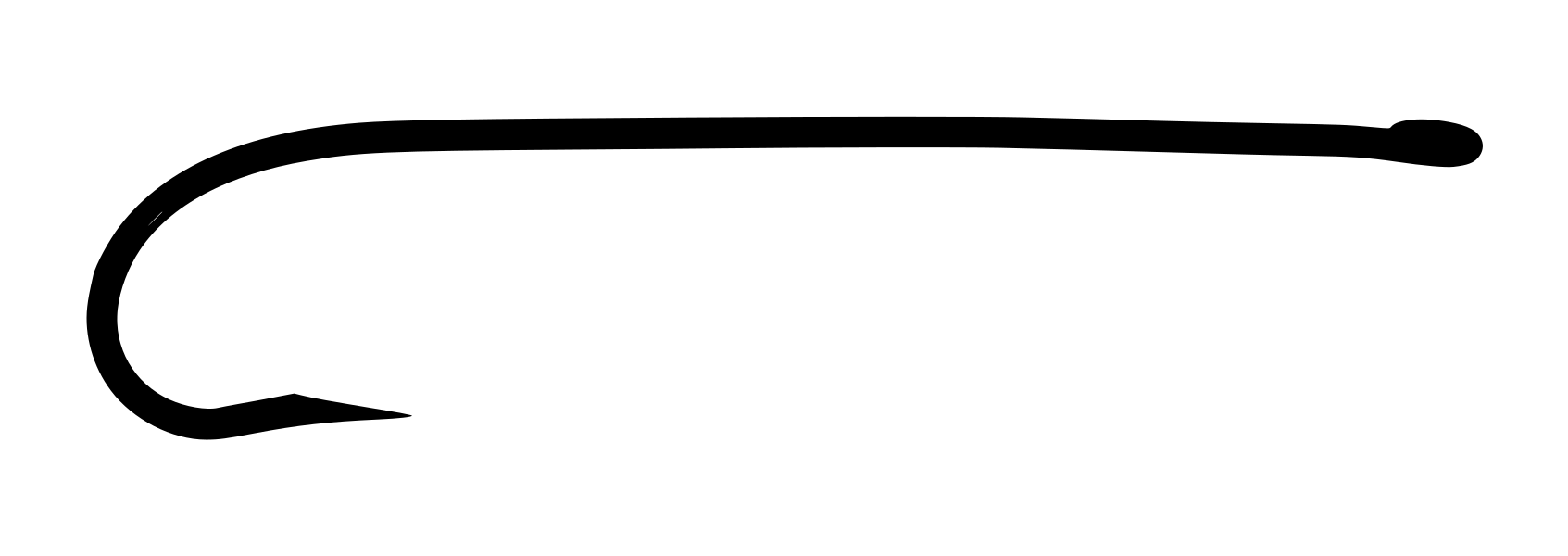
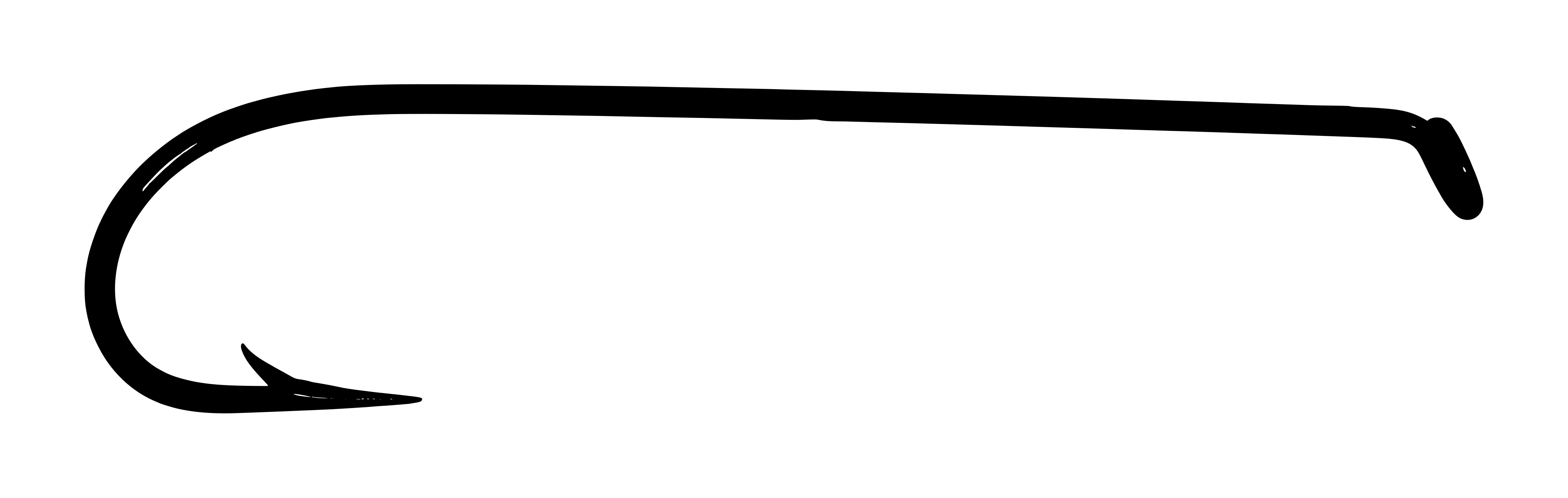
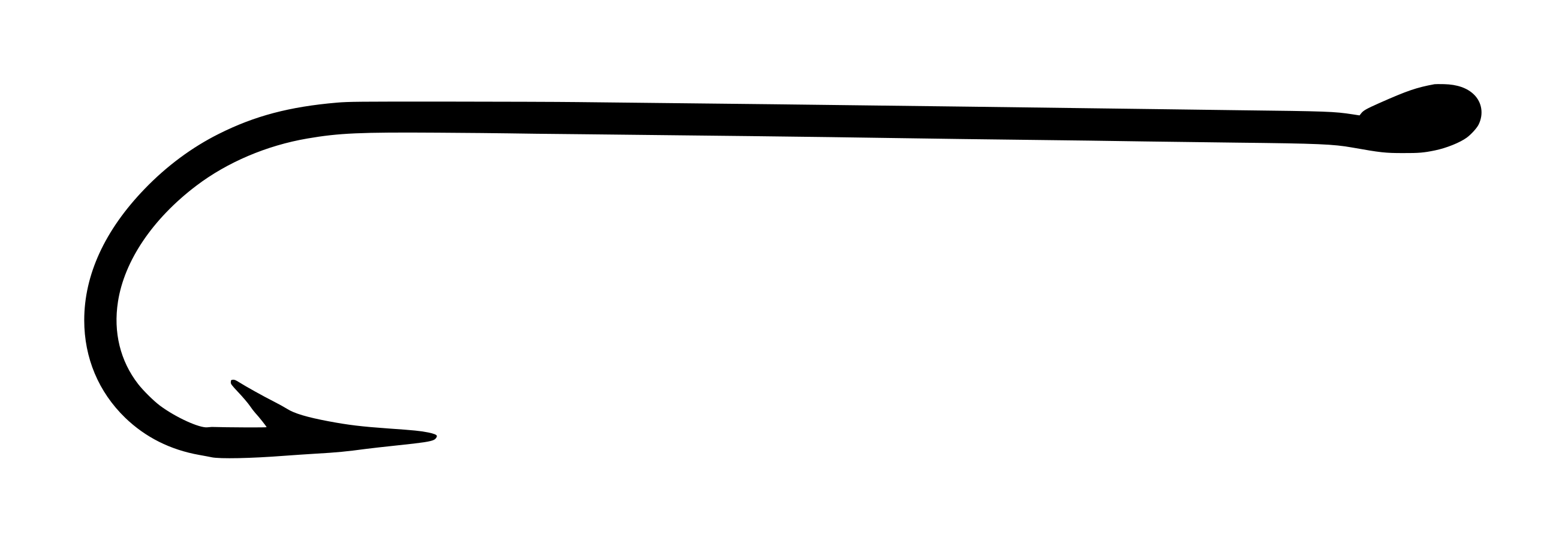
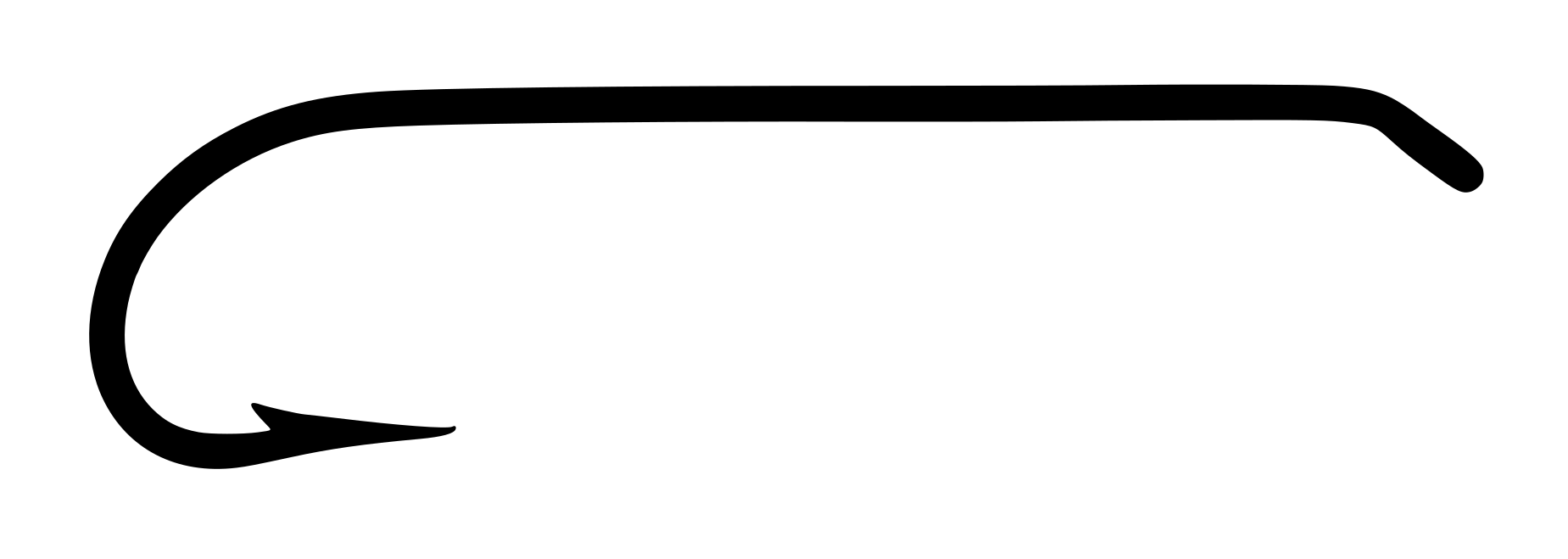
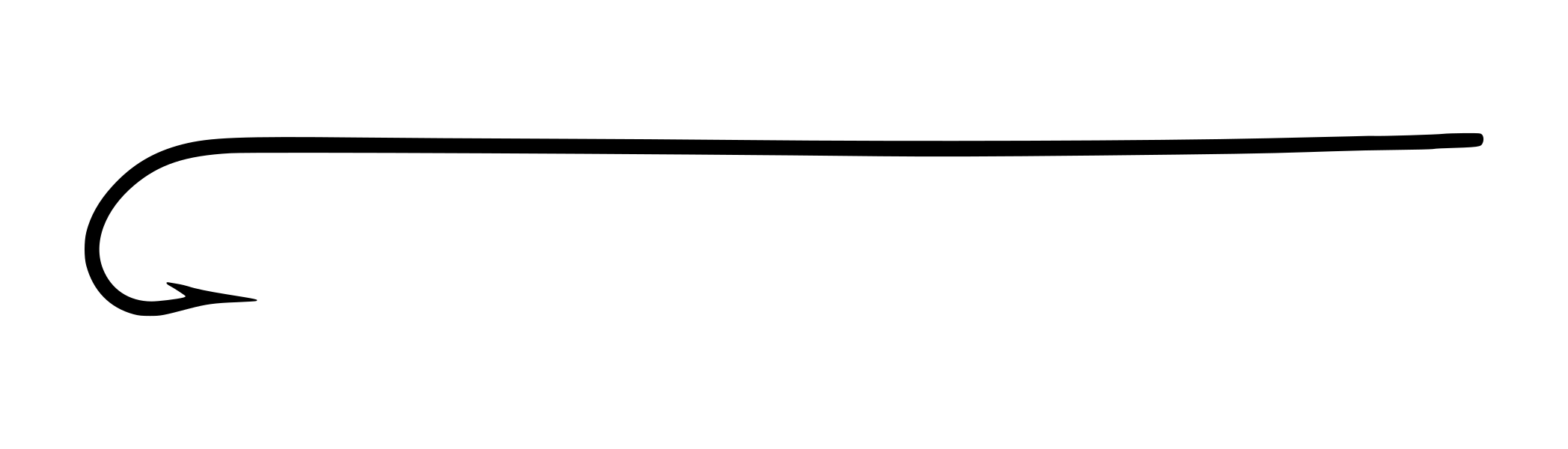
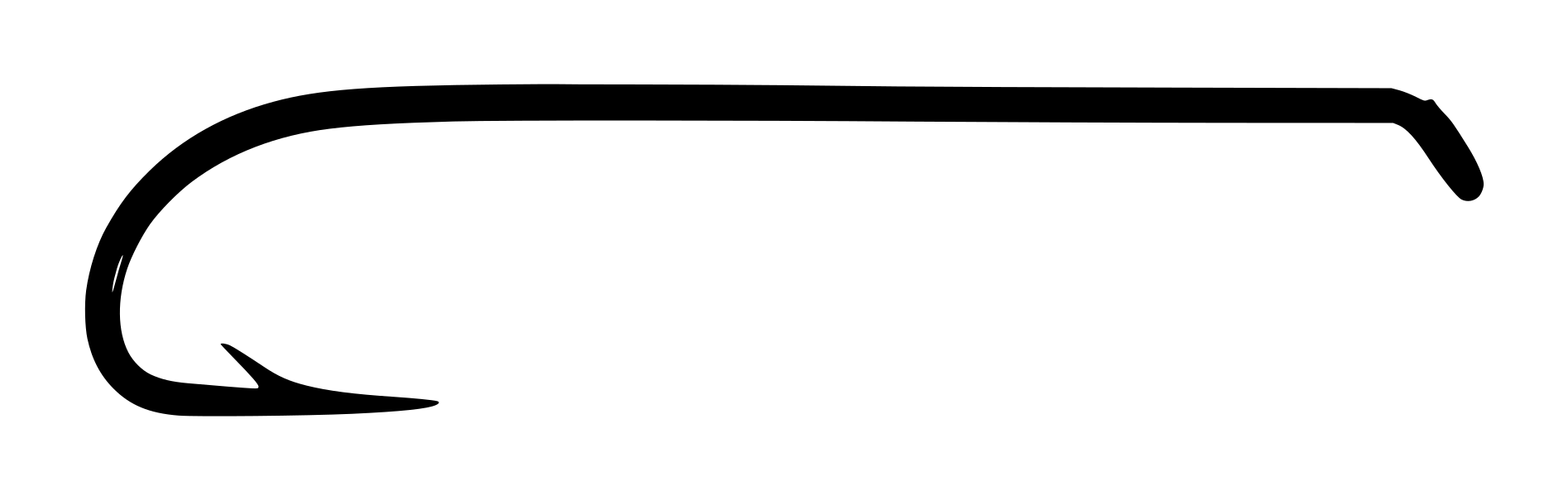
Mustad Qual. 31885 Carlisle — a barbless bait and streamer hook manufactured in Norway circa 1930–1960, featuring a straight inline ball eye, heavy wire gauge, and extra-long shank in bronzed finish. The Carlisle bend distributes load evenly through its gentle, consistent curve, while the straight eye and Superior point geometry were engineered for direct line tracking in trolling and cast-bait applications without rotation-induced drift. The barbless specification reflects either early catch-and-release livebait fishing practice or period Scandinavian regulation, reducing material stress concentration at the barb shoulder while requiring maintained point sharpness for reliable hold. This hook represents a transitional design linking nineteenth-century bait-fishing geometry to mid-century streamer construction standards, combining load-distribution bend theory with practical working specifications for both livebait and fly-tied presentation.
Original Mustad manufacturer box label (lid) showing Qual. 3185 Carlisle Hooks specifications: Superior brand, Ringed Bronzed finish, Without barb, Made in Norway, quantity 100. Hand-annotated size No.6 in purple crayon.
Photographic record
3 cataloged imagesSelect any record to load it above.
3 images shown
Mustad Qual. 3185 Carlisle Hooks Manufacturer Box Label Size 6Original Mustad manufacturer box label (lid) showing Qual. 3185 Carlisle Hooks specifications: Superior brand, Ringed Bronzed finish, Without barb, Made in Norway, quantity 100. Hand-annotated size No.6 in purple crayon.Open originalMustad Carlisle Hooks Size 6 Profile View on GridSide profile of a size 6 Mustad Carlisle Hook showing the gentle rounded bend geometry, extra-long shank, and straight inline ball eye, photographed on 1/10-inch measurement grid.Open originalMustad Carlisle Hooks Size 6 Point DetailClose-up detail of the point of a Mustad Carlisle Hook size 6, showing the Superior point geometry with near-straight inner taper and minimal concave face. Barbless specification is confirmed — no barb shoulder visible.Open original
Technical profile
Straight / Inline Ball Eye | Carlisle | Extra-Extra Long | Heavy (1X Heavy) Wire | Superior Point | Bronzed | Barbless
Eye
Ball Eye, Straight / InlineBall eye is uniformly rounded with clean butted wire joint at top P. No tapered or looped features. Inline orientation (straight, not turned down or up) is correctly executed P. Wire diameter into eye is consistent with 1X Heavy wire gauge stated on packaging (V/I).
Wire
Heavy (1X Heavy), Round
Shank
Extra-Extra Long (XXL) — Plain
Bend
carlisle, Narrow gap, Offset / kirbedCarlisle bend is a gentle, evenly rounded form — softer than the more acute Sproat I. Wire set and bend symmetry are clean; no kinks or manufacturing flaws visible P. Bend depth is moderate relative to gap width, characteristic of the Carlisle family I. Point angles downward slightly from shank line, consistent with kirbed offset I.
Point
Superior (near-straight inner taper)Hook is manufactured barbless as stated on label V. Shank terminates cleanly at point; no barb shoulder visible under magnification P. This is a factory barbless construction, not a barb filed or broken off after manufacture.
Finish
Bronzed — Confirmed (stated on packaging)Warm brown bronzed tone visible on hook wire P. Finish is even and continuous across the bend, shank, and point. No evidence of bluing or japanning — the tone is distinctly warm amber-brown rather than cool grey. Consistent with Mustad's bronzed specification for bait and general-purpose hooks of this era (P/V).
Box lid shows moderate age toning and light surface wear. Label retains good color saturation with minor foxing. Cream cardboard shows light creasing. Purple crayon marking (size annotation) is contemporary to original manufacture or early use. Lid edges show slight wear consistent with handling. Hook specimen bright bronzed with no corrosion visible P. Excellent condition as a physical specimen.
Bend Geometry: The Carlisle bend is characterized by a gentle, evenly rounded form from barb to eye. Unlike the Sproat (which has a more gradual taper near the eye) or the O’Shaughnessy (which has a more abrupt angle near the barb), the Carlisle maintains consistent radius throughout the bend. This geometry distributes load evenly during the fight and reduces the risk of compression-induced breakage when playing heavy fish. The rounded form also produces cleaner casting loops when tied as a streamer, with less wind resistance than angular bends.
Heavy Wire Specification: The 1X Heavy wire gauge was selected for bait applications where hook penetration reliability and hooksetting power were paramount. The heavier mass also dampens vibration in the point during transport (whether by current or trolling), reducing false strikes. For large baitfish presentations and streamer retrievals, the stiffer shank resists kinking under load.
Extra-Long Shank: The extra-long shank provides maximum distance between eye and barb, critical for securing large live baitfish or building bulky streamer bodies. Long shanks were also favored in trolling rigs where a extended hook body helped position the barb away from the knot attachment point, reducing line-hook friction.
Straight Eye Inline: The straight, inline ball eye was engineered for direct line pull without the turning moment created by down-turned or up-turned eyes. This geometry is optimal for trolling and cast-bait techniques where the hook must track true through the water without rotation-induced drift.
Superior Point: The Superior point style features a nearly straight inner taper from barb to tip with a minimal concave face. This geometry produces rapid penetration on the strike while maintaining the strength advantage of a flat inside face (compared to the knife-edge hollow point). Suitable for both livebait (where quick penetration is critical before the fish ejects the bait) and streamer fishing (where the hook must set quickly during a firm strip strike).
Barbless Manufacture: The absence of a barb reduces material stress concentration at the barb shoulder, theoretically extending fatigue life. For bait applications, a barbless hook relies entirely on the geometry and sharpness of the point to maintain the hold — any dulling of the tip or slippage on soft bait material will result in lost fish. This design trade-off suggests the Qual. 3185 was marketed to anglers who prioritized ease of release (catch-and-release livebait fishing) or who fished in restrictive seasons requiring hook removal without damage to the fish. Alternatively, barbless specification may reflect Scandinavian regulations of the period.
Size & scale lab
Known manufactured size range:
6 (documented from packaging label)
This pattern was made in sizes 6 (documented from packaging label). We have measurement for size 6. Know the others? Submit calipered measurements and we'll review and add them. Thank you!
Historical context
mustad
O. Mustad & Son was founded in Gjøvik, Norway, in 1832 and became one of the world’s largest industrial hook manufacturers by the early 20th century. The company operated a major factory in Oslo in addition to the original Gjøvik location, producing hooks for domestic Scandinavian markets and for global export through London and North American distributors.
By the 1920s–1930s, Mustad had established multiple product lines targeting different market segments: the Aberdeen and O’Shaughnessy for general and sea fishing; the Limerick for traditional wet-fly tying; and the Superior line for mid-market bait, streamer, and general-purpose applications. The Superior brand designation appeared prominently on Mustad packaging through the mid-20th century, though “Superior” was a marketing category name, not a point style classification.
Mustad hooks were distributed internationally through tackle dealers, mail-order houses, and sporting retailers. The company’s manufacturing efficiency and price competitiveness made Mustad the default supplier for many tackle manufacturers and fly-tying schools throughout the English-speaking world. Norwegian hooks were valued for wire consistency and point geometry, though British and American makers (Allcock, Partridge, John James) retained market share in traditional fly-tying circles.
Series History
The Superior line was Mustad’s mid-range product offering from approximately 1920 through the 1960s. Unlike the premium specialist lines (the hollow-point O’Shaughnessy or the fine-wire Limerick), the Superior designation encompassed a range of bend families and wire gauges intended for practical fishing rather than tournament-level craftsmanship.
The Carlisle bend within the Superior line represented a gentler, more versatile alternative to the aggressive O’Shaughnessy or Beak forms. Carlisle bends were marketed to streamer tiers and bait anglers who needed a hook that would penetrate reliably without the mass-forward weight bias of heavier bends. The extra-long shank variant (Qual. 3185) was produced in multiple wire gauges (standard, heavy, extra-heavy) and eye configurations (ball, tapered, looped) to serve different bait presentations and tying styles.
The barbless specification on this model is historically significant. While barbless hooks were manufactured experimentally from the 1880s onward, they were never mainstream in commercial bait-hook production until the 1970s onward. A barbless Carlisle in the 1930s–1950s suggests either a regional market demand (possibly Scandinavian or UK chalk-stream fishing) or a specialized category product that did not gain wide adoption. The packaging label explicitly advertises “Without barb” as a selling point, implying this feature was noteworthy rather than standard.
The Carlisle in Superior line was discontinued sometime after 1970 as Mustad consolidated its catalog and shifted focus to chemically sharpened hooks and mass-market plastic-packaged products. The box packaging format was replaced by blister and sale-card configurations in the 1970s onward.
Era and Packaging Dating
No barcode present = pre-1974 strong indicator. Address format "OSLO - NORWAY" typical of Mustad packaging ca. 1920s–1960s. Label printing is consistent with letterpress or early offset lithography (1930s–1950s print technology). Hand-annotated size in purple crayon suggests original warehouse stock markup. Straight inline ball eye construction and barbless specification were standard Mustad features from 1920s onward but gained broader commercial distribution post-1930. The "Superior" product line designation on Mustad packaging appears on catalogs and boxes from approximately 1930 through 1960s. Box stock and label construction show mid-century manufacturing characteristics (cream cardboard, modest label dimensions). Combination of these features dates this specimen to the 1930–1960 window, most likely 1940–1955.
Barbless Hooks and Scandinavian Conservation
The prevalence of barbless hooks in Scandinavian tackle during the 1930s–1950s long predates the modern catch-and-release movement of the 1970s onward. While English and American tackle makers viewed barbless hooks as a curiosity or a niche market product, Norwegian and Swedish manufacturers integrated them into mid-market offerings, suggesting early environmental consciousness or stricter regulatory frameworks in Scandinavian fisheries. The explicit marketing of "Without barb" on this Mustad package — presented as a feature rather than an apology — hints at a fishing culture that valued fish welfare earlier than their Western European counterparts. The Mustad Superior line became a bridge between premium craft-hook traditions (Redditch makers) and modern industrial efficiency, and the barbless specification may reflect that transitional identity: respecting older conservation principles while embracing new manufacturing capabilities.
Design lineage and influence
Predecessors: The Carlisle bend family originated in the English Midlands during the 19th century, concurrent with the development of the Sproat and O’Shaughnessy by Redditch makers. The Carlisle’s gentle radius was a deliberate departure from the more aggressive angular bends, appealing to anglers who preferred a less traumatic penetration curve. By the 1890s, the Carlisle had achieved secondary popularity in sea trout and salmon fishing, where it was viewed as a compromise between the delicate Limerick and the brutal O’Shaughnessy.
Mustad Adoption: Mustad acquired the right to manufacture and market Carlisle-pattern hooks in the early 20th century through licensing or patent arrangements typical of the period. The Norwegian manufacturer integrated the Carlisle into its Superior line during the 1920s–1930s consolidation, offering it as a value alternative to Redditch craft-maker versions (Allcock, Partridge). Mustad’s manufacturing efficiency allowed competitive pricing while maintaining wire consistency superior to many contemporary English makers.
Competitive Context: During the 1930–1960 window, the Carlisle faced direct competition from: the Allcock Carlisle (Redditch, UK), the Harrison & Bartleet Carlisle, and house variants from Turner & Co. The Mustad Superior line competed on price and availability; British makers competed on perceived quality and craft heritage. The introduction of chemically sharpened hooks in the 1970s rendered wire geometry less critical, and bend family preference increasingly gave way to price and convenience factors.
Downstream Influence: The Carlisle design influenced subsequent generations of streamer and bait hooks, including the modern Mustad 9174 and 3366. However, the specific combination of Carlisle bend + extra-long shank + heavy wire + barbless in a bait-hook context became obsolete after 1970, as fly-tying and bait-fishing markets diverged into specialized product categories. The Carlisle persists today primarily as a niche pattern in traditional wet-fly and streamer circles, divorced from its original bait-fishing applications.
Best matchRelated by Attribute
Computed automatically from catalog data — updated as new hooks are added.
Matches: Bend, Shank, Wire, Eye, Finish +3 moreDiffers: Gap: Narrow vs Wide; Eye Orient.: Straight / Inline vs Turned Down; Point: Superior vs Hollow Point +2 more
Matches: Bend, Eye, Eye Orient., Forging, Application +1 moreDiffers: Shank: Extra-Extra Long vs 4X Long; Wire: Heavy (1X Heavy) vs Standard; Gap: Narrow vs Standard +3 more
Matches: Bend, Wire, Gap, Eye, Point +4 moreDiffers: Shank: Extra-Extra Long vs 4X Long; Eye Orient.: Straight / Inline vs Turned Down; Application: Bait, Streamer vs Bait, Saltwater +2 more
Matches: Bend, Gap, Eye, Point, Forging +2 moreDiffers: Shank: Extra-Extra Long vs 4X Long; Wire: Heavy (1X Heavy) vs Extra-Heavy (2X+); Eye Orient.: Straight / Inline vs Turned Down +3 more
The Qual. 3185 was designed primarily for live and dead bait presentation in freshwater and light saltwater fishing. The extra-long shank accommodated large baitfish (3–6 inches) with minimal barb-to-eye crowding, while the heavy 1X wire gauge resisted the stress of struggling livebait movement and provided reliable hooksetting power under load. The straight inline eye directed line pull directly through the hook axis, minimizing torque during cast-and-retrieve or trolling retrieves.
Secondary application as a streamer hook reflects the Carlisle bend’s suitability for large, weighted streamers cast on heavier rods. The gentle radius reduced hooksetting resistance compared to sharp-angled bends, useful when fishing over rocky substrate or through vegetation where a snag-conscious retrieval was required.
The barbless specification points to a market segment practicing early catch-and-release fishing or operating under no-barb regulations. This context is somewhat surprising for a bait hook in the 1930s–1950s era, suggesting either a specific geographic market (Scandinavian chalk-stream fishing) or a specialized category product that gained only modest commercial success.
Secondary Applications
Large streamer fly tying; trolling presentation for pike and large trout; cast-bait work in rivers and reservoirs
Classic Fly Patterns
Not typically used for fly tying
Collector notes
Rated 4.0/10 — uncommon in original boxed format, but Mustad production volumes were substantial. Collecting interest is moderate and specialized: sought by Scandinavian hook historians and vintage bait-fishing tackle collectors, but rarely hunted by fly-tying enthusiasts. The barbless specification and Superior line branding add modest niche appeal. Complete original manufacturer box in good condition is the primary value driver; loose hooks or opened boxes rate substantially lower.
Reference value
$8 – $22 USD estimate
Packaging condition
Good — moderate wear, legibleRecorded specimen
Packaging format
mustad_qual_3185_boxCatalog code
Positive Factors: Original manufacturer box format is rarer than sales cards and carries a 2–3x premium. Complete count (100 hooks) in one package is unusual and desirable. The barbless specification is historically noteworthy for a bait hook of the 1930s–1950s era. The Super line designation and Oslo factory provenance appeal to Scandinavian industrial history collectors. Clean, uncorroded bronzed finish on specimen hooks adds visual appeal. Straight inline ball-eye construction is less commonly collected than turned-down eye patterns and carries modest curiosity value.
Limiting Factors: Mustad hooks in general, despite historical significance, rarely exceed 5.0 collectability ratings due to massive production volumes and relative availability in estate sales and tackle shops. Bait hooks are less actively collected than fly hooks, and the Carlisle bend is less iconic than the O’Shaughnessy or Sproat. The size 6 documented here is a standard size, not a rare or unusual variant. No specific designer attribution or named collaborator increases appeal. The box label, while clear and well-preserved, contains no rare printing variants, artist signatures, or promotional text beyond standard specifications. Condition of the box is good but not mint — light toning and wear are visible. Missing hooks (if any) or a partial count would deduct 1.5–2.0 from the rating.
Most Desirable Variants: Size 2–4 or 8–10 examples would be less common than size 6. Extra-heavy or fine-wire variants (if they exist in this model code) would be scarcer. Sealed, unopened boxes command a full point higher in collectability than opened examples. Variant label states or printing errors (misspellings, overprinted corrections, duplicate catalog numbers) would significantly raise interest.
Condition Impact: The specimen shown with a well-preserved box and bright hooks rates at the high end of the uncommon range. Box with significant creasing, staining, or label loss deducts 0.5–1.5 points. Missing hooks (more than 5–10%) deducts 1.0–2.0 points and shifts the primary value to packaging rather than hook quantity. Loose hooks without packaging are worth approximately 20–30% of the boxed equivalent.
Packaging
Manufacturer box (rigid cardboard container with separate lid). Light cardboard stock with cream/tan exterior. Blue printed label on lid face with decorative asterisk border. Typography: black sans-serif and serif typefaces, letterpress or early offset. Text reads: "Key O. MUSTAD & SON Manufacturers OSLO - NORWAY | Qual. 3185 | Brand Superior | Mustad-Carlisle Hooks | Ringed Bronzed | Without barb | Made in Norway | 100 | No.6" (hand-annotated size in purple crayon). Label shows maker's key logo (ornamental key device). Box dimensions approximately 4" × 3" × 1.5" (depth not fully visible). Era indicators: no barcode, pre-printed "Oslo - Norway" address style (pre-1974 minimum), label printing method consistent with 1930s–1960s production.
Market Value Notes
Low ($8): Complete or near-complete box (95+ hooks), good condition with visible wear and light toning on label and cardboard. Box opens and closes cleanly; no major damage.<br />
High ($22): Sealed or near-sealed original box, full hook count of 100, minimal label wear, bright uncorroded hooks. Box edges crisp, label colors vivid, minimal age creasing.<br />
Premium factors: Complete original manufacturer box (vs. loose hooks or sale cards); full hook count; barbless specification; Scandinavian provenance; bronzed finish brightness; label clarity.<br />
Platforms: eBay UK/US (occasional); vintage tackle dealers specializing in Scandinavian/European hooks; general estate sales and antique markets (less common).<br />
Confidence: E estimated from comparable Mustad Superior line bait-hook box sales and vintage Norwegian hook market data. Limited specific sale history for this exact model code. Values are based on general Mustad bait-hook pricing (2–4x markup over loose hooks, 1.5–2x markup over open boxes).
Where to Find
Vintage tackle dealers specializing in Scandinavian and European hooks. eBay UK (more frequent than US). Specialist auctions of Norwegian industrial artifacts and sporting heritage. Estate sales in Scandinavia and Northern Europe. General antique markets and flea markets, particularly in Norway, Sweden, and the UK.
Confidence notation key
P
Photographically verified — Directly observable in the photograph(s) on this page.
V
Verified by documentation — Confirmed by manufacturer catalog, spec sheet, or published reference.
I
Inferred — A logical deduction from observable or documented evidence, not directly stated.
E
Estimated — An approximation based on visual comparison, proportional analysis, or limited data.
S
Speculative — A reasoned hypothesis that cannot be confirmed from available evidence.
Claims with no notation are confirmed by multiple independent sources. All photographs on garrenwood.com are taken on a measurement grid where each square equals 1/10 inch (0.1″ / 2.54 mm).