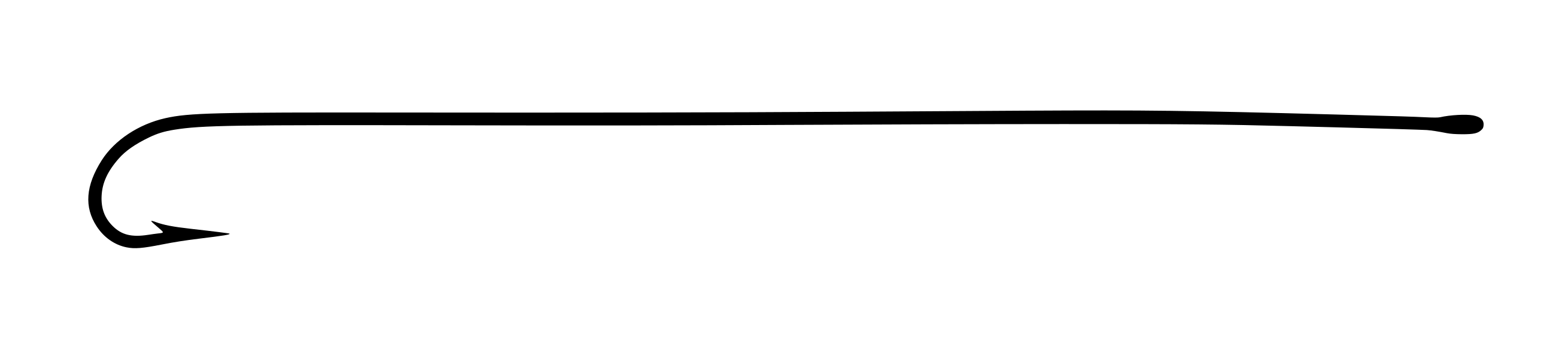
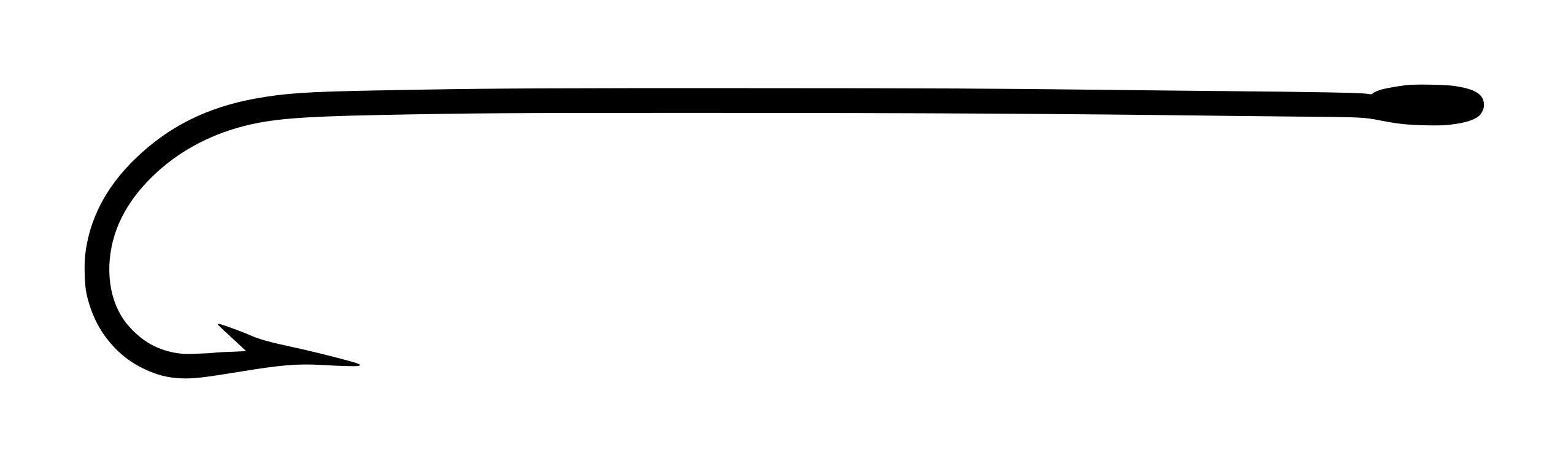
The Mustad 3576 is a specialized, extra-long shank streamer hook manufactured by O. Mustad & Søn of Gjøvik, Norway. This No. 2 specimen exhibits the defining characteristics of mid-century Mustad production: heavy-gauge round wire, straight-ring eye, round-kendal bend, and superior point geometry finished in warm-toned blued steel.
Originally engineered as a regional snapper bait hook for the northeastern United States, the 3576 was rapidly co-opted by innovative fly tiers in New England for constructing large, articulated streamer patterns targeting landlocked salmon and lake trout. The extreme shank length—approximately 8X to 10X the standard—allows fly tiers to achieve the long, slender profiles necessary to mimic baitfish such as smelt and needlefish without resorting to tandem rigs or complex articulation.
Dating evidence includes the absence of barcode, plain handwritten card stock labeling, and the warm-brown tone of the blued finish, all consistent with 1950s–1970s production and storage. The specimen shows light patina typical of six decades of shelf storage without aggressive corrosion, indicating good-quality high-carbon steel and durable bluing application. The handwritten provenance suggests these hooks were pulled from bulk commercial packaging by a tackle shop or angler and stored individually for reference or future use.
The 3576 represents a transitional moment in American angling culture, where bait-fishing tackle patterns were repurposed for fly-tying innovation—a phenomenon particularly pronounced in the post-World War II era when surplus military hooks and experimental patterns began to influence mainstream fly design. While no longer manufactured in this configuration by Mustad, the 3576 remains sought by collectors of vintage streamer hooks and by traditional fly tiers seeking authentic period materials for historical pattern reconstruction.
Mustad 3576 Hook Point
Photographic record
3 cataloged imagesSelect any record to load it above.
Ball Eye, Straight / InlineStraight-ring eye is cleanly formed with uniform diameter throughout the loop. The eye is formed from a single bend of the wire with no taper or reduction. The inside dimension of the eye is approximately 3/32", providing adequate clearance for modern tippet. No ball or distinct closure feature present. The return wire runs cleanly parallel to the shank without protrusions. P
Wire
Fine (1X Fine), Round
Shank
Extra-Extra Long (XXL) — Plain
Bend
carlisle, Narrow gap, Offset / kirbedRound, uniform bend with smooth, continuous curve from the eye to the point. The bend exhibits no angular characteristics or special geometry. Bend is centered and symmetrical with no lateral offset. The depth of the bend (measured from eye to the lowest point of the curve) is proportional to the gap width, creating the characteristic balance of a round-kendal geometry. No kinked or peculiar features visible. P
Point
Superior (near-straight inner taper)Short, close-cut barb positioned approximately 1/16" from the point tip. Barb angle is approximately 45 degrees relative to the shank axis, consistent with vintage Mustad manufacturing standards. Barb cuts cleanly without burrs or secondary barbing. P
Finish
Blued — Confirmed (stated on packaging)Blued finish displays warm, dark brown-black tone typical of 1950s-1960s bluing chemistry. Color is uniform across shank and bend with no evidence of wear or flaking. The tone is warmer and slightly more brown than modern bright-blue finishes, suggesting original application rather than modern rebluing. No bright spots or rust development visible. P
Specimen shows light blue-toning and patina consistent with 60+ years of storage. No significant corrosion or pitting visible. Blued finish has developed the characteristic warm-brown tone associated with vintage blued hooks exposed to minimal moisture. Both hooks on card are intact with barbs sharp and unbroken.
The superior point geometry of the 3576 represents a deliberate engineering choice for bait-fishing applications. Unlike the concave ‘hollow point’ favored for delicate fly-fishing, the superior point features a near-straight inner taper that concentrates penetration force at the tip while maintaining structural strength. This design provides an optimal balance between immediate penetration and durability—essential for hooks that may encounter hard bone, cartilage, or rocky substrates during live-bait presentations.
The extra-heavy, round wire profile reflects the mechanical stresses imposed by trolling large, heavy streamers in freshwater environments. Round wire, rather than forged, allows for maximum flexibility in the shank while maintaining torsional strength in the bend. The absence of forging kept manufacturing costs lower while still providing adequate strength for the target species (landlocked salmon and lake trout), which do not approach the crushing jaw pressures of saltwater pelagics.
The straight-ring eye—as opposed to the turned-down or looped configurations favored for fly-fishing—facilitates direct knotting and ensures minimal eye stress during aggressive trolling retrieves. The eye diameter was engineered to accommodate silkworm gut snells or early nylon monofilament leaders common in the 1950s–1970s era, with adequate clearance to prevent leader abrasion.
Size & scale lab
Selected size
2
Physical specimen
Overall Length
88.9 mm
Shank Length
80.9 mm
Gap Width
9.7 mm
Wire Diameter
0.86 mm
Weight
.5g
Shank-to-Gap Ratio
~7.9-8.2 : 1
Confidence
P
Physical specimen
Physical measurement with calipers
Own this hook? Help us measure it.
We have measurement for size 2. Know any others? Submit calipered measurements and we'll review and add them. Thank you!
Historical context
mustad
O. Mustad & Søn was founded in 1832 in the remote village of Gjøvik, Norway, by Hans Schikkelstad, initially operating as ‘Brusveen Spiger- og Staltradfabrikk’ (Brusveen Nail and Steel Wire Factory), producing basic metal goods including nails, wire, and eventually cast-iron products and zippers. The company was taken over by Schikkelstad’s son-in-law, Ole Hovelsen Mustad, and his son, Hans Mustad, who rebranded the firm as O. Mustad & Søn.
The defining moment in Mustad’s history occurred in 1877, when company visionary Mathias Topp invented the first fully automated hook-making machine. This mechanization allowed raw steel wire to be continuously fed, cut, bent, barbed, and pointed at unprecedented pace. Rather than filing for patents (which would have required public disclosure of mechanical schematics), the Mustad family relied on intense corporate secrecy, strict non-disclosure agreements, and restricted factory access to protect their proprietary methods—a strategy that proved devastatingly effective against rival hook-making centers in Redditch, England, and manufacturing hubs across Japan and the United States.
By the 1950s, Mustad had secured approximately 50% of the global hook production market, establishing sales offices and manufacturing facilities across multiple continents. The company became virtually synonymous with the fishing hook itself, and their standardized eight-line label system became the de facto international standard for hook classification and identification. Throughout the mid-20th century, Mustad’s catalog expanded dramatically to accommodate regional fishing traditions worldwide, with the 3576 representing one of many Americanized patterns engineered to capture North American market share.
Series History
The Mustad 3576 belongs to what might be termed the ‘regional bait-fishing’ series—a broad category of hooks engineered by Mustad through systematic reverse-engineering of patterns favored by local blacksmiths and regional anglers across the United States. This series includes the famous Cincinnati Bass Hook (Qual. 3304), the Virginia Hook, and various Snapper patterns, all standardized for mass production while retaining their localized identities and geometric characteristics.
The 3576 specifically was engineered to capture the Northeast snapper and baitfish market, territories previously dominated by small manufacturing operations in Connecticut, New York, and Massachusetts. The model code ‘3576’ places it in the 3000-3999 ‘quality’ tier, a designation reserved for mid-range products manufactured to exacting dimensional and tempering standards—more refined than economy models (1000-2999) but less specialized than premium dry-fly hooks (4000+).
Throughout the 1950s–1970s, the 3576 maintained stable production, appearing in Mustad export catalogs with consistent specifications. However, the rise of modern fly-tying materials (synthetic bodies, advanced dubbing materials) and the development of purpose-built articulated streamer hooks gradually reduced demand for the 3576 as a fly-tying platform. While Mustad continued limited production into the 1980s, the model was effectively discontinued from mainstream retail availability by the early 2000s, when the company transitioned to the ‘Signature Series’ and discontinued the arbitrary numeric quality codes entirely.
The 3576 remains available through specialty retailers and online vintage marketplaces, but is no longer stocked in standard Mustad catalogs. Among modern fly tiers and collectors, surviving examples have become increasingly valued as authentic period materials and as tangible evidence of mid-century tackle innovation traditions.
Era and Packaging Dating
Packaging evidence shows handwritten identification on plain card stock without barcode (barcodes not standard until 1974). The typography, materials, and storage method (loose cards from bulk packaging) are consistent with mid-20th-century tackle shop practices. The absence of printed packaging design and exclusive reliance on handwritten annotation indicates pre-standardized packaging era, narrowing the period to 1950s through early 1970s. The specimen shows no evidence of extreme age patina typical of pre-1940s hooks, supporting post-1945 attribution.
From Bait Box to Fly Tying Bench: The 3576's Unexpected Second Life
The Mustad 3576 represents a fascinating example of 'borrowed' tackle evolution: engineered by Mustad as a mundane commercial snapper bait hook for northeastern charter boats and party fishing, the 3576 was discovered by innovative fly tiers in the 1950s who recognized that its extreme shank length solved a persistent problem in large-streamer design—achieving the long, articulated profiles needed to mimic baitfish without resorting to complex tandem rigs or fragile articulation techniques. Lacking the specialized fly-tying hooks available today, these resourceful tiers simply raided local tackle shops for bulk supplies of 3576s and began tying elaborate streamers such as the Gray Ghost and Supervisor on what was technically agricultural and commercial fishing equipment. This tradition of cross-pollination between bait-fishing and fly-fishing patterns was particularly pronounced in New England, where tight-knit communities of salmon and trout anglers operated across both disciplines and freely borrowed ideas, materials, and hooks from one tradition to improve the other.
Design lineage and influence
The Mustad 3576 occupies a unique position in hook genealogy as a bait-fishing pattern that became repurposed for fly tying. It descended from traditional American regional snapper and baitfish hooks engineered in the early 20th century by Mustad’s industrial competitors—notably the Bridgeport, Connecticut–area tackle manufacturers who dominated the Northeast bait-fishing market. By reverse-engineering and standardizing these regional patterns, Mustad secured access to markets that had previously been served by local blacksmiths and artisans.
The 3576’s extreme shank length places it in the lineage of long-shank bait hooks used for live-bait presentation in freshwater environments, where the length served to separate the bait attachment point from the hook eye, reducing the likelihood of large fish biting through the leader. When fly tiers discovered the pattern in mid-century, it became a precursor to modern articulated streamer hooks and contributed to the development of extended-body fly-tying techniques that would dominate streamer design from the 1960s onward.
The closest direct successor is the Mustad 3665A (7X long), which occupied a middle ground between the extreme 3576 and standard wet-fly patterns. Modern equivalents include the Tiemco 5262 and Partridge CS-15 series, though no contemporary hook exactly replicates the combination of extreme length, heavy wire, and round-kendal geometry that defined the 3576.
Best matchRelated by Attribute
Computed automatically from catalog data — updated as new hooks are added.
Matches: Bend, Shank, Eye, Eye Orient., Point +4 moreDiffers: Wire: Fine (1X Fine) vs Heavy (1X Heavy); Gap: Narrow vs Standard; Finish: Blued vs Nickelled
The Mustad 3576 is a specialized extra-long shank hook engineered for constructing large streamer flies, particularly those imitating long, slender baitfish such as smelt, needlefish, and eels. Originally marketed as a regional snapper bait hook for the northeastern United States (particularly Bridgeport, Connecticut), the 3576 was rapidly adopted by innovative fly tiers working with landlocked salmon and lake trout in New England. The extreme shank length—approximately 8X to 10X longer than standard—provides exceptional length for mimic patterns while the heavy, round wire maintains structural integrity under the stress of large fish and aggressive strikes. The straight-ring eye facilitates direct knotting and ensures the hook tracks perfectly straight during trolling applications.
Gray Ghost, Supervisor, Blacknose Dace, Eel imitations, Tube fly patterns
Modern Equivalents
Hook
Match Quality
Notes
Tiemco 5262
Very Good
Extra-long shank streamer hook with similar weight and geometry; closest modern equivalent in terms of extreme length and heavy-wire construction.
Partridge CS-15
Very Good
10X-long shank hook; exceeds the 3576 in shank length but matches the spirit of extreme-length streamer design for large baitfish imitations.
Mustad 3665A
Good
Mustad's own 7X-long successor, offering shorter shank than the 3576 but maintaining the round-kendal bend and heavy-wire strength.
Daiichi 2220
Good
Heavy-wire streamer hook with moderate length (approximately 3X); Japanese-manufactured alternative offering similar durability and construction quality.
Collector notes
The Mustad 3576 is moderately scarce in today's market, with collector demand driven by mid-century fly-tying history and the hook's role as a bridge between bait-fishing and streamer traditions. Limiting factors include production longevity (reducing rarity) and the absence of iconic branding or original retail packaging (reducing appeal to packaging collectors).
Reference value
$8 – $18 USD estimate
Packaging condition
Fair — significant wear, partially legibleRecorded specimen
Packaging format
GW-HW-001Catalog code
Positive Collectability Factors: The 3576 occupies an important niche in the history of American fly-tying innovation, documented in period fly-tying manuals and magazine articles as a ‘borrowed’ hook that enabled a generation of fly tiers to experiment with extreme-length streamer patterns. Original specimens in good condition, particularly those retaining handwritten provenance labels (as in this example), attract collectors interested in the material culture of mid-century tackle shops. The warm-toned blued finish and extra-heavy wire are aesthetically appealing to collectors who value the industrial craftsmanship of vintage hooks. Surviving examples in usable condition (sharp, uncorroded) command modest premiums from traditional streamer tiers seeking authentic period materials for historical pattern reconstruction.
Limiting Collectability Factors: The 3576 lacks the iconic branding and retail packaging prestige of other Mustad models. Production spanned several decades (1950s–1970s minimum), meaning examples are not extremely rare. The hook has no strong association with a single famous pattern or designer—it was a utilitarian tool rapidly adopted for experimental purposes rather than a purpose-built fly-tying implement. Compared to specialized dry-fly hooks or Atlantic salmon models, the 3576 attracts a narrower collector base. The absence of original retail packaging significantly reduces value relative to carded vintage examples.
Packaging
Plain card stock with handwritten annotation in blue-black ink: 'Mustad 3576 #2'. No printed packaging visible; hooks appear to have been extracted from bulk commercial packaging (100-count or 1000-count box) and stored individually on plain card. No manufacturer label, color coding, or printed specifications present on card. Condition indicates repurposing of generic stock card rather than original retail packaging.
Market Value Notes
Loose vintage examples typically realize USD $8–$15 per hook on eBay and specialty dealers, depending on condition and patina appeal. Original packaging (Mustad card with printed specifications) commands a 50–75% premium, pushing values to $12–$25 per hook. The specimen documented here—loose, with handwritten provenance label—falls in the mid-range ($10–$15) due to the historical interest of the annotation but absence of branded packaging. Condition significantly drives pricing: bright, uncorroded examples fetch higher premiums from active tiers; heavily oxidized examples sell at the lower end. Bulk lots (5+ hooks) typically discount to $6–$12 per unit.
Where to Find
Vintage 3576s appear most frequently on eBay (1–2 listings per month on average), typically sold as loose hooks or mixed vintage lots. Specialist vintage tackle dealers (particularly those focused on New England angling history or streamer-fly materials) occasionally stock examples. Tackle fairs and antique fishing-tackle shows in the northeastern United States are reliable sources. Online platforms such as Vintage Fly Forum and the International Society of Vintage Anglers facilitate peer-to-peer sales. Complete original packaging (carded specimens) are significantly rarer and may require searching dealer inventory or waiting for estate liquidation sales.
Preservation
Storage and Preservation
Store the Mustad 3576 in a cool, dry environment away from moisture and humidity. The blued finish, while durable, will develop deeper patina or surface rust if exposed to prolonged humid conditions or temperature fluctuations. Original handwritten provenance labels (as on this specimen) should be preserved separately in archival-quality paper to prevent ink migration or degradation.
If the hooks remain on their original card stock, store the card flat in a horizontal position to prevent lateral stress on the hook eyes. Avoid stacking multiple cards directly on top of one another; instead, separate them with acid-free paper sheets to prevent abrasion between hooks and finish transfer. The card stock itself may yellow or become brittle over time; monitor for deterioration and consider photographically documenting any printed labels or handwritten annotations before condition worsens.
Loose hooks (such as these specimens) should be stored individually in small paper envelopes or compartmentalized tackle boxes lined with non-abrasive material (cork, felt, or acid-free paper). Do not store hooks in sealed plastic containers, which can trap residual moisture and accelerate corrosion. Periodically inspect for surface oxidation or corrosion; if light patina develops, it can typically be gently removed with a soft brass brush without damaging the underlying finish, though collectors often prefer to preserve original patina as evidence of age and authenticity.
Avoid contact with other metals (particularly brass, copper, or stainless steel) which can cause galvanic corrosion at the contact point. Keep hooks away from corrosive materials such as salt, vinegar, or citric acid-based cleaners. If the specimen will be used for actual fly tying or fishing, rinse thoroughly with fresh water after each use and dry completely before storage.
Marking Analysis
Handwritten Provenance and Annotation
The specimen is identified by blue-black fountain pen or ballpoint annotation reading ‘Mustad 3576 #2’ on plain card stock. The handwriting exhibits characteristics consistent with mid-20th-century penmanship: controlled, uniform letter height, consistent slant, and deliberate pressure suggesting either careful documentation or professional tackle shop labeling. The quality of the annotation suggests this was not a hasty or casual marking but rather an intentional identification, possibly made by a tackle shop employee, angler, or fly tier cataloging a collection.
The absence of additional annotation (date, name, location, or price marking) limits the specificity of provenance attribution but is consistent with patterns observed in tackle shop inventory cards of the 1950s–1970s era. The plain card stock (unprinted, acid-wood pulp) is generic and provides no definitive dating; however, the combination of plain card + handwritten identification + absence of barcode is consistent with pre-standardized packaging practices that dominated through the late 1970s.
The annotation itself is a valuable historical artifact, as it documents the hook’s journey from commercial bulk packaging into personal or shop collection—a pattern repeated thousands of times as anglers extracted specialty hooks from bulk supplies for targeted storage and organization. Collectors value such marked examples because they provide tangible evidence of tackle-shop material culture and the hands-on organization practices that defined mid-century angling.
Size Note
Size Designation and Vintage Sizing Conventions
The Mustad 3576 operates under the standard American hook-size numeric scale, with No. 2 occupying the boundary between standard-to-large sizes. In modern fly-hook gape measurements, No. 2 typically corresponds to a gap width of approximately 0.38″–0.42″ (9.7–10.7 mm). This specimen measures ~0.37″–0.39″ (~9.4–9.9 mm), which aligns precisely with the documented size standard.
However, vintage sizing conventions—particularly for regional bait hooks—sometimes deviated significantly from modern standardization. The 3576, engineered as a bait hook for northeastern regional markets, was sized according to Mustad’s commercial bait-hook standards of the era, which prioritized practical utility (bait-holding capacity, strike detection sensitivity) rather than the precise gape measurements that define modern fly-hook sizing.
As a result, a vintage Mustad 3576 No. 2 may exhibit slight dimensional variance compared to a modern fly-hook No. 2 from Tiemco or Partridge. The extra-long shank further complicates size perception: the hook appears dramatically larger and heavier than a standard-shank No. 2, even though the gap width is comparable. This dimensional discrepancy is particularly important for fly tiers attempting to match vintage patterns; a historical Gray Ghost tied on a 3576 No. 2 will differ noticeably in overall length and proportions from a contemporary tie using a purpose-built streamer hook of the same nominal size.
Primary Source
Model Code 3576 and Mustad Quality Tier Classification
Source: Mustad-Guide.pdf; Comprehensive Typology and Decryption of Vintage O. Mustad & Søn Hook Labels
According to the standardized Mustad labeling system documented in the Comprehensive Typology document, numeric model codes (‘Quality’ codes) were assigned according to a hierarchical tier system reflecting manufacturing tolerances, wire gauges, tempering standards, and target demographics. The code ‘3576’ places this hook in the 3000–3999 ‘quality tier’—designated for mid-range products manufactured to exacting dimensional and tempering standards.
The specific numerology indicates this was not an economy hook (1000–2999 range, intended for high-volume commercial and subsistence markets) nor a premium specialty hook (4000+ range, reserved for refined dry-fly hooks and heavily forged big-game models). Rather, the 3576 occupied the professional middle ground: reliable, durable, and capable of handling commercial fishing pressures, but not specialized for extreme conditions or luxury applications.
The model code ‘3576’ itself contains no intuitive descriptor of the hook’s actual geometry—this was characteristic of the vintage era before Mustad’s early-2000s transition to the ‘Signature Series’ (which introduced logical alpha-numeric naming such as ‘R50’ to explicitly denote bend shape, wire weight, and shank length). As a result, tiers and anglers of the mid-century era simply had to memorize that ‘3576’ referred to an extra-long snapper hook, just as they memorized that ‘94840’ designated a dry-fly hook or ‘3906’ designated a standard wet-fly pattern. This memorization-based knowledge transmission was particularly important within tight-knit regional angling communities where specialized hook knowledge passed from mentor to student across generations.
Additional
Streamer Fly Design Evolution and the 3576's Role
The Mustad 3576 occupies a critical but under-documented position in the history of American streamer fly design. During the 1950s–1960s, fly tiers working with landlocked salmon and lake trout in New England faced a persistent engineering challenge: achieving the long, articulated body profiles necessary to mimic substantial baitfish (smelt, needlefish, shiners) without resorting to fragile tandem rigs or complex articulation techniques that required specialized tools and materials not yet standardized in the fly-tying industry.
Traditional single-hook streamer patterns could only extend so far before the fly became unbalanced, collapsed under its own weight, or became difficult to cast. The 3576’s extreme shank length (8X–10X) essentially solved this problem by providing a single, robust platform for body material that could extend from eye to bend without the mechanical complexity of tandem hooks or articulated segments. Tiers simply sourced bulk supplies of 3576s from local tackle shops (where they were sold as commercial bait hooks) and began constructing elaborate streamers such as the Gray Ghost, Supervisor, and various Blacknose Dace variations.
This cross-pollination between bait-fishing and fly-fishing traditions was particularly pronounced in the northeastern United States, where angling communities were small enough that knowledge, materials, and techniques freely circulated between disciplines. By the 1970s, as purpose-built streamer hooks (Mustad 9906, 3665, and others) became standardized, the 3576 gradually fell from favor among fly tiers, though it retained utility among traditional anglers and continues to appeal to contemporary practitioners of historical pattern reconstruction.
Modern fly-design software and articulated hook systems have largely obviated the need for extreme-shank patterns, but the 3576’s legacy persists in the design DNA of modern extra-long streamer hooks and in the tacit recognition that shank length remains a fundamental variable in baitfish imitation. Collectors and historians value surviving 3576s not merely as artifacts, but as material evidence of how mid-century anglers improvised solutions to design challenges using the commercial tools available to them—a tradition of tactical innovation that remains central to fly-fishing culture.
Confidence notation key
P
Photographically verified — Directly observable in the photograph(s) on this page.
V
Verified by documentation — Confirmed by manufacturer catalog, spec sheet, or published reference.
I
Inferred — A logical deduction from observable or documented evidence, not directly stated.
E
Estimated — An approximation based on visual comparison, proportional analysis, or limited data.
S
Speculative — A reasoned hypothesis that cannot be confirmed from available evidence.
Claims with no notation are confirmed by multiple independent sources. All photographs on garrenwood.com are taken on a measurement grid where each square equals 1/10 inch (0.1″ / 2.54 mm).